
Life, 1915-10-07 · page 31 of 52
Life — October 7, 1915 — page 31: what you’re looking at
What you’re looking at
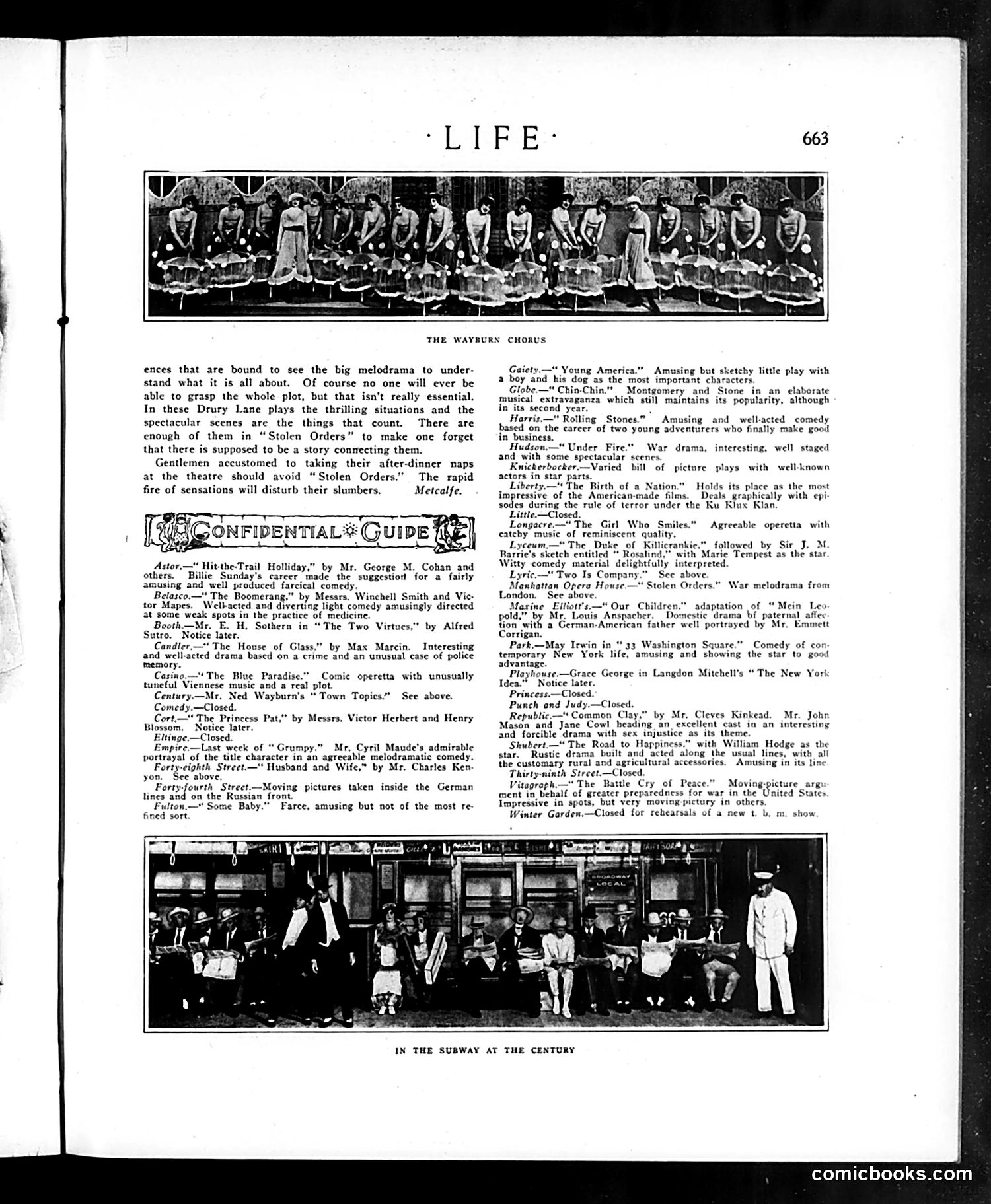
This page presents theater reviews from early 20th-century Broadway, accompanied by two photographs. The top image shows "The Wayburn Chorus"—a line of chorus girls in theatrical costume, representing Ned Wayburn's "Town Topics" production at the Century Theatre. The reviews discuss various theatrical productions with brief critical assessments. Notable entries include D.W. Griffith's "The Birth of a Nation," described as "the most impressive of the Americans-made films," dealing with "the rule of terror under the Ku Klux Klan"—presented here without apparent critical judgment of the film's racist content. The bottom photograph, captioned "In the Subway at the Century," shows a crowded subway scene, likely illustrating urban life or theater-going culture. The page reflects early 1910s Broadway culture and entertainment criticism, with no apparent political satire—it functions primarily as an entertainment guide with accompanying theatrical photography.
📄 Transcribed text from this page (OCR, searchable)
Machine-transcribed from the original scan — historical spelling and the odd misread are preserved.
THE WAYBURN CHORUS ences that are bound to sce the big melodrama to under- stand what it is all about. Of course no one will ever be able to grasp the whole plot, but that isn't really essential. In these Drury Lane plays the thrilling situations and the spectacular scenes are the things that count. There are enough of them in “Stolen Orders” to make one forget that there is supposed to be a story connecting them. Gentlemen accustomed to taking their after-dinner naps at the theatre should avoid “Stolen Orders.” The rapid fire of sensations will disturb their slumbers. Metcalfe. Hit-the-Trail Holliday,” by Mr. George M. Cohan and others. " Billie Sunday's career made the suggestiot for a fairly amusing and well produced farcical comedy. Belasco.—" The Boomerang,” by Messrs. Winchell Smith and Vic- tor Mapes. Welkacted and diverting light comedy amusingly directed at some weak spots in the practice of medicine. Booth—Mr. E. H, Sothern in “The Two Virtues," by Alfred Sutro, Notice later. Candler.—" The House of Glass,” by Max Marcin. Interesting and well-acted drama based on a crime and an unusual case of police memor Casino.—* The Blue Paradise."” Comic operetta with unusually tuneful Viennese music and a real plot. Century.—Mr, Ned Wayburn's “Town Topics.” Comedy.—Closed. Cor Blossom, Eltinge.- . Empire—Last week of “Grumpy.” Mr, Cyril Maude's admirable portrayal of the title character in an agreeable melodramatic comedy. Forty-eighth Street.—* Husband and Wife,” by Mr. Charles Ken- yon. See above. Forty-fourth Street.—Moving pictures taken inside the German lines and on the Russian front. Fulton,—" Some Baby.” Farce, amusing but not of the most re- fined sort. See above. Gaiety.— Young America." Amusing but sketchy a boy and his dog as the most important characters Globe—" Chin-Chin.” Montgomery and Stone in an elaborate musical extravaganza which still maintains popularity, although in its second year. z Harris.—"* Rolling Stones.” Amusing and well-acted comedy based on the career of two young adventurers who finally make good in business, Hudson.—" Under Fire.” War drama, and with some spectacular scenes. Knickerbocker.—Varied bill of actors in star parts. Liberty.—" The Birth of a Nation.” Holds its place as the most impressive of the Americansmade films. “Deals. graphically with epi sodes during the rule of terror under the Ku Klux Klan. Little.—Closed. Longacre.—" The Girl Who Smiles.” catchy music of reminiscent quality. Lyceum.—" The Duke of Killicrankie" followed by Sir J. M Rarrie’s sketch entitled “ Rosalind,” with Marie Tempest as the star Witty comedy material delightfully interpreted. Lyric.—" Two Is Company.” See above. Manhattan Opera House-—" Stolen Orders.” London. See above. e Elliott's Our Children.” adaptation of “Mein Leo: by Mr, Louis Anspacher, Domestic drama bf paternal affec th a German-American father well portrayed by Mr. Emmett Park.—May Irwin in “33 Washington Square.” Comedy of cor temporary New York life, amusing and showing the star to good advantage. Playhouse.—Grace George in Langdon Mitchell's “The New York Idea.” Notice later. Princess.—Closed Punch and Judy.—Closed. Republic —* Common Clay,” by Mr, Cleves Kinkead. Mr. John Mason and Jane Cow! heading an excellent cast in an interesting and forcible drama with sex injustice as its theme. Shubert —" The Road to Happiness.” with William Hodge as the star. Rustic drama built and acted along the usual lines, with all the customary rural and agricultural accessories, Amusing in its line Thirty-ninth Street.—Closed. Vitagraph.—" The Battle Cry of Peace.” Moving-picture_arg ment in bebalf of greater preparedness for war in the United States Impressive in spots, but very moving-pictury in others. Winter Garden.—Closed for rebearsals of a new t. b, m. show ttle play with interesting, well staged picture plays with well-known Agreeable operetta with War melodrama from (a nl Na ee, ta k | IN THE SUBWAY AT THE CENTURY comicbooks.com