
Life, 1915-10-07 · page 29 of 52
Life — October 7, 1915 — page 29: what you’re looking at
What you’re looking at
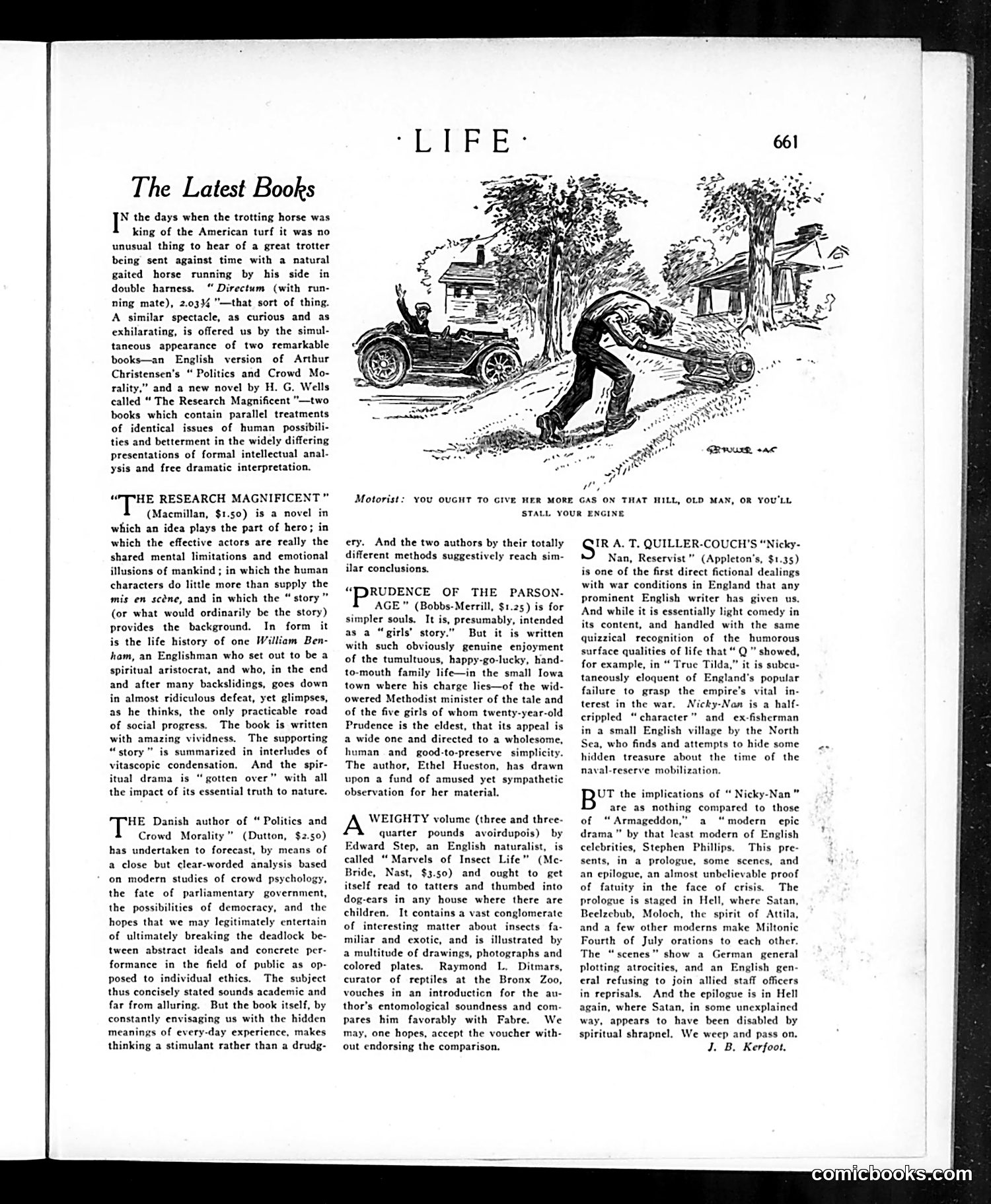
This is a book review section from Life magazine discussing four contemporary publications. The prominent cartoon depicts a motorist on a hill giving driving advice to an older man: "You ought to give her more gas on that hill, old man, or you'll stall your engine." The joke uses automotive/mechanical language as a metaphor—likely satirizing intellectual discourse of the era. The reviews themselves compare two parallel works examining human society and progress: H.G. Wells's novel "The Research Magnificent" and Arthur Christensen's analytical work "Politics and Crowd Morality." Life presents these as competing approaches to identical themes, comparing them humorously to horses racing in tandem harness. The reviews also cover lighter fare like "Prudence of the Parsonage" (small-town family life) and a naturalist's encyclopedia about insects. The page reflects Life's function as both satirical commentary and serious cultural criticism for educated American readers.
📄 Transcribed text from this page (OCR, searchable)
Machine-transcribed from the original scan — historical spelling and the odd misread are preserved.
The Latest Books N the days when the trotting horse was king of the American turf it was no unusual thing to hear of a great trotter being sent against time with a natural gaited horse running by his side in double harness. “ Directum (with run- ning mate), 2.0334 "—that sort of thing. A similar spectacle, as curious and as exhilarating, is offered us by the simul- taneous appearance of two remarkable books—an English version of Arthur Christensen’s “ Politics and Crowd Mo- rality,” and a new novel by H. G. Wells called “ The Research Magnificent "—two books which contain parallel treatments of identical issues of human possibili- ties and betterment in the widely differing presentations of formal intellectual anal- ysis and free dramatic interpretation. “THE RESEARCH MAGNIFICENT” (Macmillan, $1.50) is a novel in which an idea plays the part of hero; in which the effective actors are really the shared mental limitations and emotional illusions of mankind ; in which the human characters do little more than supply the mis en scéne, and in which the “ story” (or what would ordinarily be the story) provides the background. In form it is the life history of one William Ben- ham, an Englishman who set out to be a spiritual aristocrat, and who, in the end and after many backslidings, goes down in almost ridiculous defeat, yet glimpses, as he thinks, the only practicable road of social progress. The book is written with amazing vividness. The supporting “story” is summarized in interludes of vitascopic condensation, And the spir- itual drama is “ gotten over” with all the impact of its essential truth to nature. HE Danish author of “ Politics and Crowd Morality” (Dutton, $2.50) has undertaken to forecast, by means of a close but clear-worded analysis based on modern studies of crowd psychology, the fate of parliamentary government, the possibilities of democracy, and the hopes that we may legitimately entertain of ultimately breaking the deadlock be- tween abstract ideals and concrete per- formance in the field of public as op- posed to individual ethics. The subject thus concisely stated sounds academic and far from alluring. But the book itself, by constantly envisaging us with the hidden meanings of every-day experience, makes thinking a stimulant rather than a drudg- Motorist: e. at" 7 ey YOU OUGHT TO GIVE HER MORE GAS ON THAT HILL, OLD MAN, OR YOU'LL STALL YOUR ENGINE ery. And the two authors by their totally different methods suggestively reach sim- ilar conclusions. “PRUDENCE OF THE PARSON- AGE" (Bobbs-Merrill, $1.25) is for simpler souls, It is, presumably, intended as a “girls story.” But it is written with such obviously genuine enjoyment of the tumultuous, happy-go-lucky, hand- to-mouth family life—in the small Iowa town where his charge lies—of the wid- owered Methodist minister of the tale and of the five girls of whom twenty-year-old Prudence is the eldest, that its appeal is a wide one and directed to a wholesome, human and good-to-preserve simplicity. The author, Ethel Hueston, has drawn upon a fund of amused yet sympathetic observation for her material. WEIGHTY volume (three and three- quarter pounds avoirdupois) by Edward Step, an English naturalist, is called Marvels of Insect Life” (Me- Bride, Nast, $3.50) and ought to get itself read to tatters and thumbed into dog-ears in any house where there are children. It contains a vast conglomerate of interesting matter about insects fa- miliar and exotic, and is illustrated by a multitude of drawings, photographs and colored plates. Raymond L. Ditmars, curator of reptiles at the Bronx Zoo, vouches in an introducticn for the au- thor’s entomological soundness and com- pares him favorably with Fabre. We may, one hopes, accept the voucher with- out endorsing the comparison. IR A. T, QUILLER-COUCH'’S “Nicky- Nan, Reservist” (Appleton’s, $1.35) is one of the first direct fictional dealings with war conditions in gland that any prominent English writer has given us, And while it is essentially light comedy in its content, and handled with the same quizzical recognition of the humorous surface qualities of life that “Q” showed, for example, in “ True Tilda,” it is subcu- taneously eloquent of England's popular failure to grasp the empire’s vital in- terest in the war. Nicky-Nan is a half- crippled “character” and ex-fisherman in a small English village by the North Sea, who finds and attempts to hide some hidden treasure about the time of the naval-reserve mobilization. UT the implications of “ Nicky-Nan” are as nothing compared to those Armageddon,” a “modern epic drama” by that least modern of English celebrities, Stephen Phillips. This pre- sents, in a prologue, some scenes, and an epilogue, an almost unbelievable proof of fatuity in the face of crisis. The prologue is staged in Hell, where Satan, Beelzebub, Moloch, the spirit of Attila, and a few other moderns make Miltonic Fourth of July orations to each other. The “scenes” show a German general plotting atrocities, and an English gen- eral refusing to join allied staff officers in reprisals. And the epilogue is in Hell again, where Satan, in some unexplained way, appears to have been disabled by spiritual shrapnel. We weep and pass on. J. B. Kerfoot.