
Life, 1915-10-07 · page 16 of 52
Life — October 7, 1915 — page 16: what you’re looking at
What you’re looking at
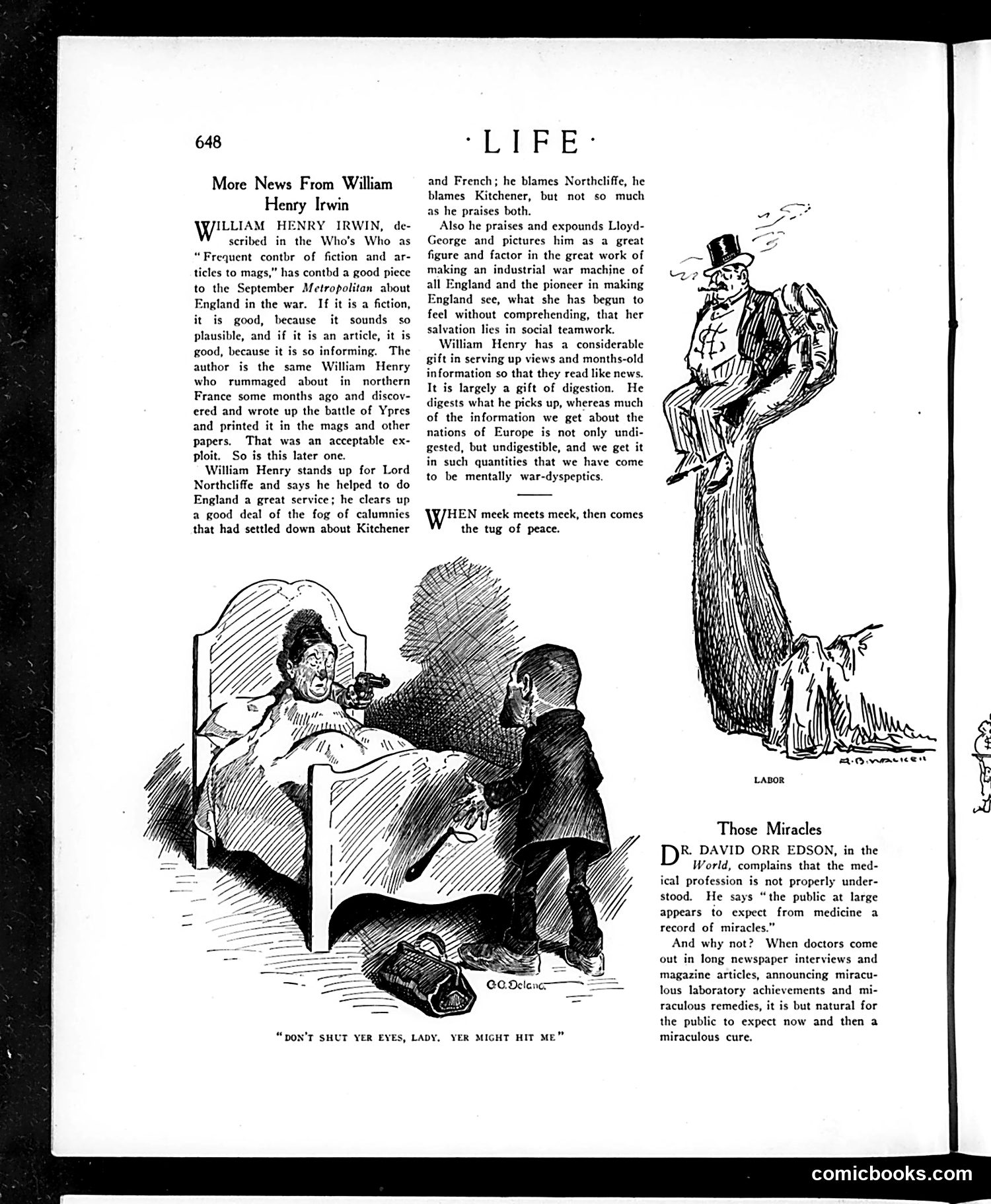
**Top Section - "More News From William Henry Irwin":** This column praises journalist William Henry Irwin's reporting on WWI England, particularly his articles about military leaders (Kitchener, French, Lloyd-George) and Lord Northcliffe. The critique is gently ironic: Irwin has a "gift" for making old information sound fresh and newsworthy through skillful "digestion"—implying he repackages existing views rather than breaking new ground. The phrase "mentally war-dyspeptics" mocks the public's indigestion from oversaturated European war coverage. **Bottom Cartoon:** A doctor examines a bedridden woman with the caption "DON'T SHUT YER EYES, LADY, YER MIGHT HIT ME." This darkly satirizes incompetent or dangerous medical practice. **"Those Miracles" Section:** Edson critiques doctors' inflated public claims about miraculous cures via newspaper and magazine interviews. Life's satire: doctors shouldn't be surprised when the public expects miracles if doctors keep *announcing* miraculous achievements. It's reasonable public expectation based on professional hype.
📄 Transcribed text from this page (OCR, searchable)
Machine-transcribed from the original scan — historical spelling and the odd misread are preserved.
648 More News From William Henry Irwin ILLIAM HENRY IRWIN, de- scribed in the Who's Who as “Frequent contbr of fiction and ar- ticles to mags,” has conthd a good piece to the September Metropolitan about England in the war. If it is a fiction, it is good, because it sounds so plausible, and if it is an article, it is good, because it is so informing. The author is the same William Henry who rummaged about in northern France some months ago and discov- ered and wrote up the battle of Ypres and printed it in the mags and other papers. That was an acceptable ex- ploit. So is this later one. William Henry stands up for Lord Northcliffe and says he helped to do England a great service; he clears up a good deal of the fog of calumnies that had settled down about Kitchener “LIPE-~ and French; he blames Northcliffe, he blames Kitchener, but not so much as he praises both. Also he praises and expounds Lloyd- George and pictures him as a great figure and factor in the great work of making an industrial war machine of all England and the pioneer in making England see, what she has begun to feel without comprehending, that her salvation lies in social teamwork. William Henry has a considerable gift in serving up views and months-old information so that they read like news. It is largely a gift of digestion. He digests what he picks up, whereas much of the information we get about the nations of Europe is not only undi- gested, but undigestible, and we get it in such quantities that we have come to be mentally war-dyspeptics. HEN meek meets meck, then comes the tug of peace. “DON'T SHUT YER EYES, LADY, YER MIGHT HIT ME” EO wrnetcest Those Miracles R. DAVID ORR EDSON, in the World, complains that the med- ical profession is not properly under- stood. He says “the public at large appears to expect from medicine a record of miracles.” And why not? When doctors come out in long newspaper interviews and magazine articles, announcing miracu- lous laboratory achievements and mi- raculous remedies, it is but natural for the public to expect now and then a miraculous cure. comicbooks.com