
Life, 1915-10-07 · page 30 of 52
Life — October 7, 1915 — page 30: what you’re looking at
What you’re looking at
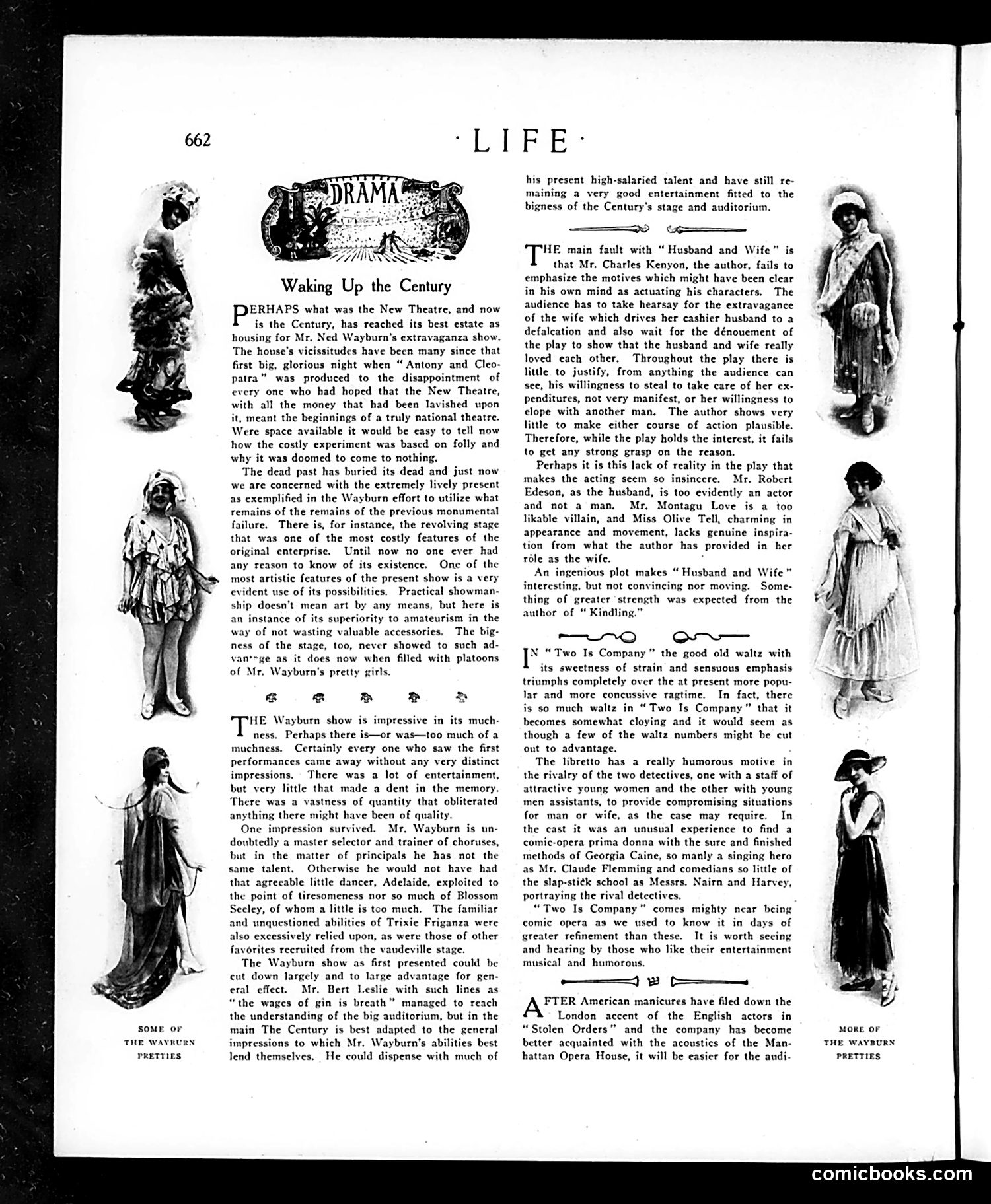
This page contains three theater reviews from Life magazine's drama section, illustrated with photographs of performers in costume. **"Waking Up the Century"** reviews Ned Wayburn's extravaganza at the Century Theatre (formerly the struggling "New Theatre"). The critic praises Wayburn's skill organizing chorus girls and using the theater's previously-hidden revolving stage effectively. However, the review criticizes the show's excessive scale—too many acts and performers create quantity over quality, leaving no lasting impression. The critic suggests cutting high-salaried performers like Adelaide, Blossom Seeley, and Trixie Friganza. **"Two Is Company"** receives brief praise for its waltzes charming audiences. **"Husband and Wife"** by Charles Kenyon is criticized for failing to justify characters' motivations. The critic complains audiences don't understand why the wife's extravagance drives her husband to embezzlement or why she'd leave him. The sidebar images show "Wayburn Pretties"—chorus performers in costume, reflecting the era's emphasis on female dancers as theatrical attractions.
📄 Transcribed text from this page (OCR, searchable)
Machine-transcribed from the original scan — historical spelling and the odd misread are preserved.
SOME OF THE WAYRURN PRETTIES ‘LIFE: Waking Up the Century ERHAPS what was the New Theatre, and now is the Century, has reached its best estate as housing for Mr. Ned Wayburn’s extravaganza show. The house's vicissitudes have been many since that first big, glorious night when “Antony and Cleo- patra” was produced to the disappointment of every one who had hoped that the New Theatre, with all the money that had been lavished upon it, meant the beginnings of a truly national theatre. Were space available it would be easy to tell now how the costly experiment was based on folly and why it was doomed to come to nothing. The dead past has buried its dead and just now we are concerned with the extremely lively present as exemplified in the Wayburn effort to utilize what remains of the remains of the previous monumental failure. There is, for instance, the revolving stage that was one of the most costly features of the original enterprise. Until now no one ever had any reason to know of its existence. One of the most artistic features of the present show is a very evident use of its possibilities. Practical showman- ship doesn’t mean art by any means, but here is an instance of its superiority to amateurism in the way of not wasting valuable accessories. The big- ness of the stage, too, never showed to such ad- van‘-ge as it does now when filled with platoons of Mr. Wayburn’s pretty girls. g & ® HE Wayburn show is impressive in its much- ness, Perhaps there is—or was—too much of a muchness. Certainly every one who saw the first performances came away without any very distinct impressions, There was a lot of entertainment, but very little that made a dent in the memory. There was a vastness of quantity that obliterated anything there might have been of quality. One impression survived. Mr, Wayburn is un- doubtedly a master selector and trainer of choruses, but in the matter of principals he has not the same talent. Otherwise he would not have had that agrecable little dancer, Adelaide, exploited to the point of tiresomeness nor so much of Blossom Seeley, of whom a little is too much. The familiar and unquestioned abilities of Trixie Friganza were also excessively relied upon, as were those of other favorites recruited from the vaudeville stage. The Wayburn show as first presented could be cut down largely and to large advantage for gen- eral effect. Mr. Bert Leslie with such lines as “the wages of gin is breath” managed to reach the understanding of the big auditorium, but in the main The Century is best adapted to the general impressions to which Mr. Wayburn’s abilities best lend themselves. He could dispense with much of his present high-salaried talent and have still re- maining a very good entertainment fitted to the bigness of the Century's stage and auditorium. SSW _- HE main fault with “Husband and Wife” is that Mr. Charles Kenyon, the author, fails to emphasize the motives which might have been clear in his own mind as actuating his characters. The audience has to take hearsay for the extravagance of the wife which drives her cashier husband to a defalcation and also wait for the dénouement of the play to show that the husband and wife really loved each other. Throughout the play there is little to justify, from anything the audience can see, his willingness to steal to take care of her ex- penditures, not very manifest, or her willingness to elope with another man. The author shows very little to make either course of action plausible. Therefore, while the play holds the interest, it fails to get any strong grasp on the reason. Perhaps it is this lack of reality in the play that makes the acting seem so insincere. Mr. Robert Edeson, as the husband, is too evidently an actor and not a man. Mr. Montagu Love is a too likable villain, and Miss Olive Tell, charming in appearance and movement, lacks genuine inspira- tion from what the author has provided in her réle as the wife. . An ingenious plot makes “ Husband and Wife” interesting, but not convincing nor moving. Some- thing of greater ‘strength was expected from the author of “ Kindling.” TO on Two Is Company” the good old waltz with its sweetness of strain and sensuous emphasis triumphs completely over the at present more popu- lar and more concussive ragtime. In fact, there is so much waltz in “Two Is Company” that it becomes somewhat cloying and it would seem as though a few of the waltz numbers might be cut out to advantage. The libretto has a really humorous motive in the rivalry of the two detectives, one with a staff of attractive young women and the other with young men assistants, to provide compromising situations for man or wife, as the case may require. In the cast it was an unusual experience to find a comic-opera prima donna with the sure and finished methods of Georgia Caine, so manly a singing hero as Mr, Claude Flemming and comedians so little of the slap-sti¢k school as Messrs. Nairn and Harvey, portraying the rival detectives. “Two Is Company” comes mighty near being comic opera as we used to know it in days of greater refinement than these. It is worth secing and hearing by those who like their entertainment musical and humorous. —_—S »v =. FTER American manicures have filed down the London accent of the English actors in “Stolen Orders” and the company has become better acquainted with the acoustics of the Man- hattan Opera House, it will be easier for the audi MORE oF THE WAYBURN PRETTIES comicbooks.com