
Life, 1915-10-07 · page 34 of 52
Life — October 7, 1915 — page 34: what you’re looking at
What you’re looking at
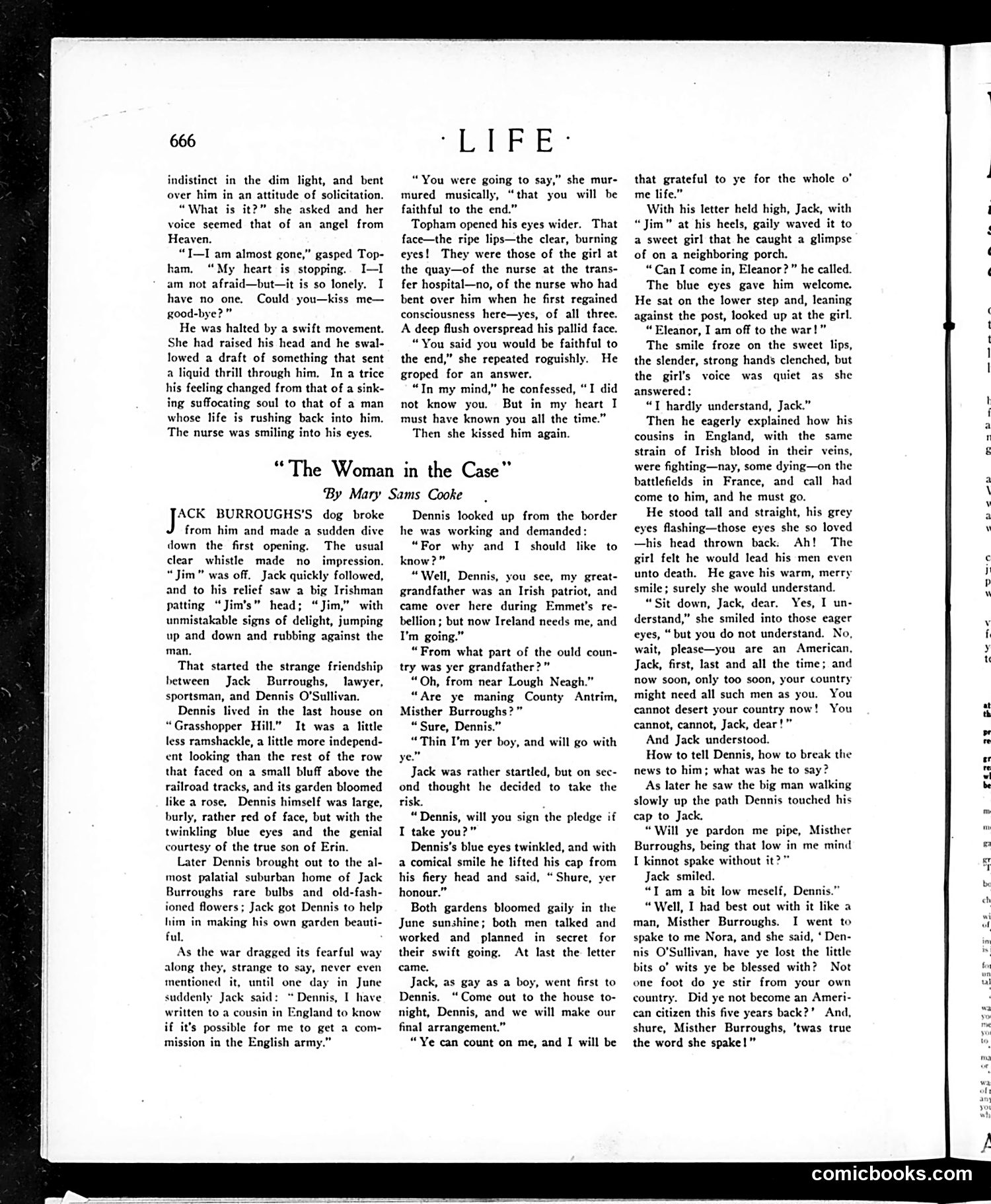
This page contains two distinct pieces of fiction rather than political cartoons. **Top section** appears to be the conclusion of a serialized story involving a character named Topham and a mysterious nurse who has appeared to him in multiple guises—at a quay, a transfer hospital, and his current location. The narrative suggests romantic/supernatural elements as she nurses him back from near-death. **Main story**: "The Woman in the Case" by Mary Sams Cooke depicts an upper-class American lawyer (Jack Burroughs) and his working-class Irish gardener neighbor (Dennis O'Sullivan) during World War I. Jack reveals he's obtained a commission in the English army due to Irish ancestry. Dennis enthusiastically volunteers to join him. The story explores themes of patriotism, class friendship, and Irish-American identity during wartime. The dialogue captures period attitudes toward military service and Irish participation in the Great War. Both pieces are sentimental fiction typical of *Life*'s literary content during this era—not satirical commentary.
📄 Transcribed text from this page (OCR, searchable)
Machine-transcribed from the original scan — historical spelling and the odd misread are preserved.
666 indistinct in the dim light, and bent over him in an attitude of solicitation. “What is it?” she asked and her voice seemed that of an angel from Heaven. “I—I am almost gone,” gasped Top- ham. “My heart is stopping. I—I am not afraid—but—it is so lonely, I have no one. Could you—kiss me— good-bye?” He was halted by a swift movement. She had raised his head and he swal- lowed a draft of something that sent a liquid thrill through him, In a trice his feeling changed from that of a sink- ing suffocating soul to that of a man whose life is rushing back into him. The nurse was smiling into his eyes. gOS ei oi “You were going to say,” she mur- mured musically, “that you will be faithful to the end.” Topham opened his eyes wider. That face—the ripe lips—the clear, burning eyes! They were those of the girl at the quay—of the nurse at the trans- fer hospital—no, of the nurse who had bent over him when he first regained consciousness here—yes, of all three. A deep flush overspread his pallid face. “You said you would be faithful to the end,” she repeated roguishly. He groped for an answer. “In my mind,” he confessed, “I did not know you. But in my heart I must have known you all the time.” Then she kissed him again. “The Woman in the Case” By Mary Sams Cooke ACK BURROUGHS'S dog broke from him and made a sudden dive down the first opening. The usual clear whistle made no impression. “Jim” was off. Jack quickly followed, and to his relief saw a big Irishman patting “Jim's” head; “Jim,” with unmistakable signs of delight, jumping up and down and rubbing against the man. That started the strange friendship between Jack Burroughs, lawyer, sportsman, and Dennis O'Sullivan. Dennis lived in the last house on “Grasshopper Hill.” It was a little less ramshackle, a little more independ- ent looking than the rest of the row that faced on a small bluff above the railroad tracks, and its garden bloomed like a rose, Dennis himself was large, burly, rather red of face, but with the twinkling blue eyes and the genial courtesy of the true son of Erin. Later Dennis brought out to the al- most palatial suburban home of Jack Burroughs rare bulbs and old-fash- ioned flowers; Jack got Dennis to help him in making his own garden beauti- ful. As the war dragged its fearful way along they, strange to say, never even mentioned it, until one day in June suddenly Jack said: “Dennis, I have written to a cousin in England to know if it’s possible for me to get a com- mission in the English army.” Dennis looked up from the border he was working and demanded: “For why and I should like to know?” “Well, Dennis, you see, my great- grandfather was an Irish patriot, and came over here during Emmet’s re- bellion ; but now Ireland needs me, and I'm going.” “From what part of the ould coun- try was yer grandfather?” “Oh, from near Lough Neagh.” “Are ye maning County Antrim, Misther Burroughs?” “Sure, Dennis.” “Thin I’m yer boy, and will go with ye.” Jack was rather startled, but on sec- ond thought he decided to take the risk. “Dennis, will you sign the pledge if I take you? Dennis's blue eyes twinkled, and with a comical smile he lifted his cap from his fiery head and said, “Shure, yer honour.” Both gardens bloomed gaily in the June sunshine; both men talked and worked and planned in secret for their swift going. At last the letter came. Jack, as gay as a boy, went first to Dennis. “Come out to the house to- night, Dennis, and we will make our final arrangement.” “Ye can count on me, and I will be that grateful to ye for the whole o° me life.” With his letter held high, Jack, with “Jim” at his heels, gaily waved it to a sweet girl that he caught a glimpse of on a neighboring porch. “Can I come in, Eleanor?” he called. The blue eyes gave him welcome. He sat on the lower step and, leaning against the post, looked up at the girl. “Eleanor, I am off to the war!” The smile froze on the sweet lips, the slender, strong hands clenched, but the girl’s voice was quiet as she answered: “TI hardly understand, Jack.” Then he eagerly explained how his cousins in England, with the same strain of Irish blood in their veins, were fighting—nay, some dying—on the battlefields in France, and call had come to him, and he must go. He stood tall and straight, his grey eyes flashing—those eyes she so loved —his head thrown back. Ah! The girl felt he would lead his men even unto death. He gave his warm, merry smile; surely she would understand. “Sit down, Jack, dear. Yes, I un- derstand,” she smiled into those eager eyes, “but you do not understand. No, wait, please—you are an American, Jack, first, last and all the time; and now soon, only too soon, your country might need all such men as you. You cannot desert your country now! You cannot, cannot, Jack, dear!” And Jack understood. How to tell Dennis, how to break the news to him; what was he to say? As later he saw the big man walking slowly up the path Dennis touched his cap to Jack, “Will ye pardon me pipe, Misther Burroughs, being that low in me mind I kinnot spake without it?” Jack smiled. “Iam a bit low meself, Denni: “Well, I had best out with it like a man, Misther Burroughs. I went to spake to me Nora, and she said, ‘ Den- nis O'Sullivan, have ye lost the little bits o’ wits ye be blessed with? Not one foot do ye stir from your own country. Did ye not become an Ameri- can citizen this five years back?’ And, shure, Misther Burroughs, ’twas true the word she spake!” comicbooks.com ci t t 1 |