
Life, 1915-10-07 · page 33 of 52
Life — October 7, 1915 — page 33: what you’re looking at
What you’re looking at
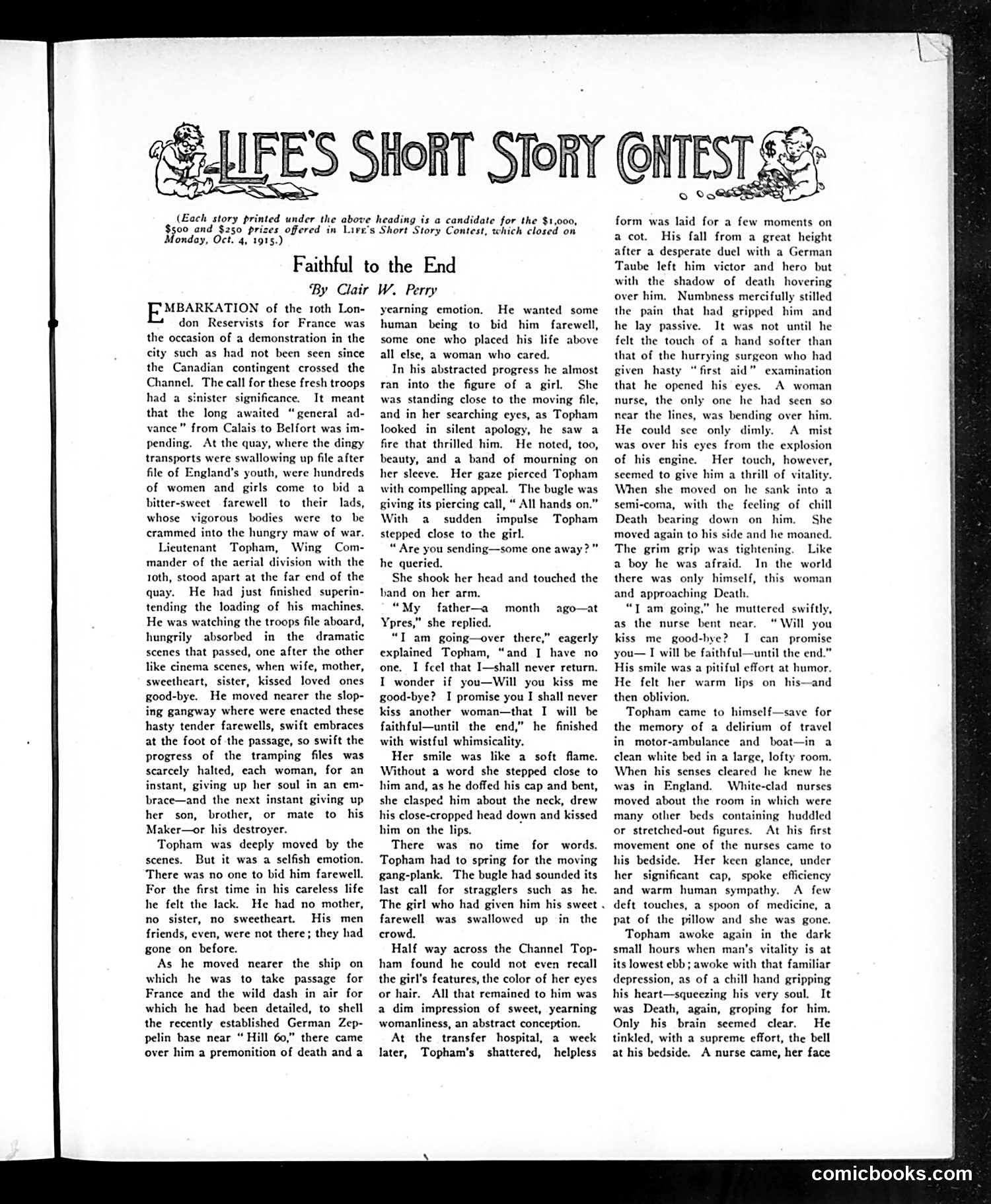
This page presents a romantic wartime short story, not political satire. The narrative concerns Lieutenant Topham, a British aerial commander departing for France during World War I (specifically to attack German Zeppelin bases near "Hill 60"). Emotionally isolated—lacking family or sweetheart to bid him farewell—Topham impulsively asks a young woman at the docks to kiss him goodbye, promising he'll remain faithful "until the end." She agrees, they kiss, and he departs. The story reflects WWI's emotional tenor: soldiers' mortality anxiety, the poignancy of hasty farewells, and romantic idealization amid mechanized warfare. This was published October 4, 1915, when Britain had been at war for over a year. The piece is a *Life* magazine fiction contest entry, not satirical commentary—it's sentimental melodrama typical of wartime popular literature.
📄 Transcribed text from this page (OCR, searchable)
Machine-transcribed from the original scan — historical spelling and the odd misread are preserved.
© JIFES SHORT STORY GNTESTS (Each story printed under the above heading is a candidate for the $1,000, $500 and $250. pri offered in Li Monday, Oct. 4, 1915.) s Short Story Contest, which closed on Faithful to the End By Clair MBARKATION of the roth Lon- don Reservists for France was the occasion of a demonstration in the city such as had not been seen since the Canadian contingent crossed the Channel. The call for these fresh troops had a sinister significance. It meant that the long awaited “general ad- vance” from Calais to Belfort was im- pending. At the quay, where the dingy transports were swallowing up file after file of England’s youth, were hundreds of women and girls come to bid a bitter-sweet farewell to their lads, whose vigorous bodies were to be crammed into the hungry maw of war. Lieutenant Topham, Wing Com- mander of the aerial division with the 1oth, stood apart at the far end of the quay. He had just finished superin- tending the loading of his machines. He was watching the troops file aboard, hungrily absorbed in the dramatic scenes that passed, one after the other like cinema scenes, when wife, mother, sweetheart, sister, kissed loved ones good-bye. He moved nearer the slop- ing gangway where were enacted these hasty tender farewells, swift embraces at the foot of the passage, so swift the progress of the tramping files was scarcely halted, each woman, for an instant, giving up her soul in an em- brace—and the next instant giving up her son, brother, or mate to his Maker—or his destroyer. Topham was deeply moved by the scenes. But it was a selfish emotion. ‘There was no one to bid him farewell. For the first time in his careless life he felt the lack. He had no mother, no sister, no sweetheart. His men friends, even, were not there; they had gone on before. As he moved nearer the ship on which he was to take passage for France and the wild dash in air for which he had been detailed, to shell the recently established German Zep- pelin base near “ Hill 60,” there came over him a premonition of death and a W. Perry yearning emotion. He wanted some human being to bid him farewell, some one who placed his life above all else, a woman who cared. In his abstracted progress he almost ran into the figure of a girl. She was standing close to the moving file, and in her searching eyes, as Topham looked in silent apology, he saw a fire that thrilled him. He noted, too, beauty, and a band of mourning on her sleeve. Her gaze pierced Topham with compelling appeal. The bugle was giving its piercing call, “ All hands ot V a sudden impulse Topham stepped close to the girl. “ Are you sending—some one away?” he queried. She shook her head and touched the hand on her arm. “My — father—a Ypres,” she replied. “T am going—over there,” eagerly explained Topham, “and I] have no one. I feel that I—shall never return. I wonder if you—Will you kiss me good-bye? I promise you I shall never kiss another woman—that I will be faithful—until the end,” he finished with wistful whimsicality. Her smile was like a soft flame. Without a word she stepped close to him and, as he doffed his cap and bent, she clasped him about the neck, drew his close-cropped head down and kissed him on the lips. There was no time for words. Topham had to spring for the moving gang-plank. The bugle had sounded its last call for stragglers such as he. month ago—at The girl who had given him his sweet . farewell was swallowed up in the crowd, Half way across the Channel Top- ham found he could not even recall the girl's features, the color of her eyes or hair. All that remained to him was a dim impression of sweet, yearning womanliness, an abstract conception. At the transfer hospital, a week later, Topham’s shattered, helpless © Sof form was laid for a few moments on a cot. His fall from a great height after a desperate duel with a German Taube left him victor and hero but with the shadow of death hovering over him. Numbness mercifully stilled the pain that had gripped him and he lay passive. It was not until he felt the touch of a hand softer than that of the hurrying surgeon who had given hasty “first aid” examination that he opened his eyes. A woman nurse, the only one he had seen so near the lines, was bending over him. He could sce only dimly. A mist was over his eyes from the explosion of his engine. Her touch, however, seemed to give him a thrill of vitality. When she moved on he sank into a semi-coma, with the feeling of chill Death bearing down on him. She moved again to his side and he moaned. The grim grip was tightening. Like a boy he was afraid. In the world there was only himself, this woman and approaching Death. “T am going,” he muttered swiftly, as the nurse bent near. “Will you kiss me good-hye? I can promise you— I will be faithful—until the end.” His smile was a pitiful effort at humor. He felt her warm lips on his—and then oblivion. Topham came to himself—save for the memory of a delirium of travel in motor-ambulance and boat—in a clean white bed in a large, lofty room. When his senses cleared he knew he was in England. White-clad nurses moved about the room in which were many other beds containing huddled or stretched-out figures. At his first movement one of the nurses came to his bedside. Her keen glance, under her significant cap, spoke efficiency and warm human sympathy. A few deft touches, a spoon of medicine, a pat of the pillow and she was gone. Topham awoke again in the dark small hours when man's vitality is at its lowest ebb; awoke with that familiar depression, as of a chill hand gripping his heart—squeezing his very soul. It was Death, again, groping for him. Only his brain seemed clear. He tinkled, with a supreme effort, the bell at his bedside. A nurse came, her face comicbooks.com