
Life, 1915-10-07 · page 5 of 52
Life — October 7, 1915 — page 5: what you’re looking at
What you’re looking at
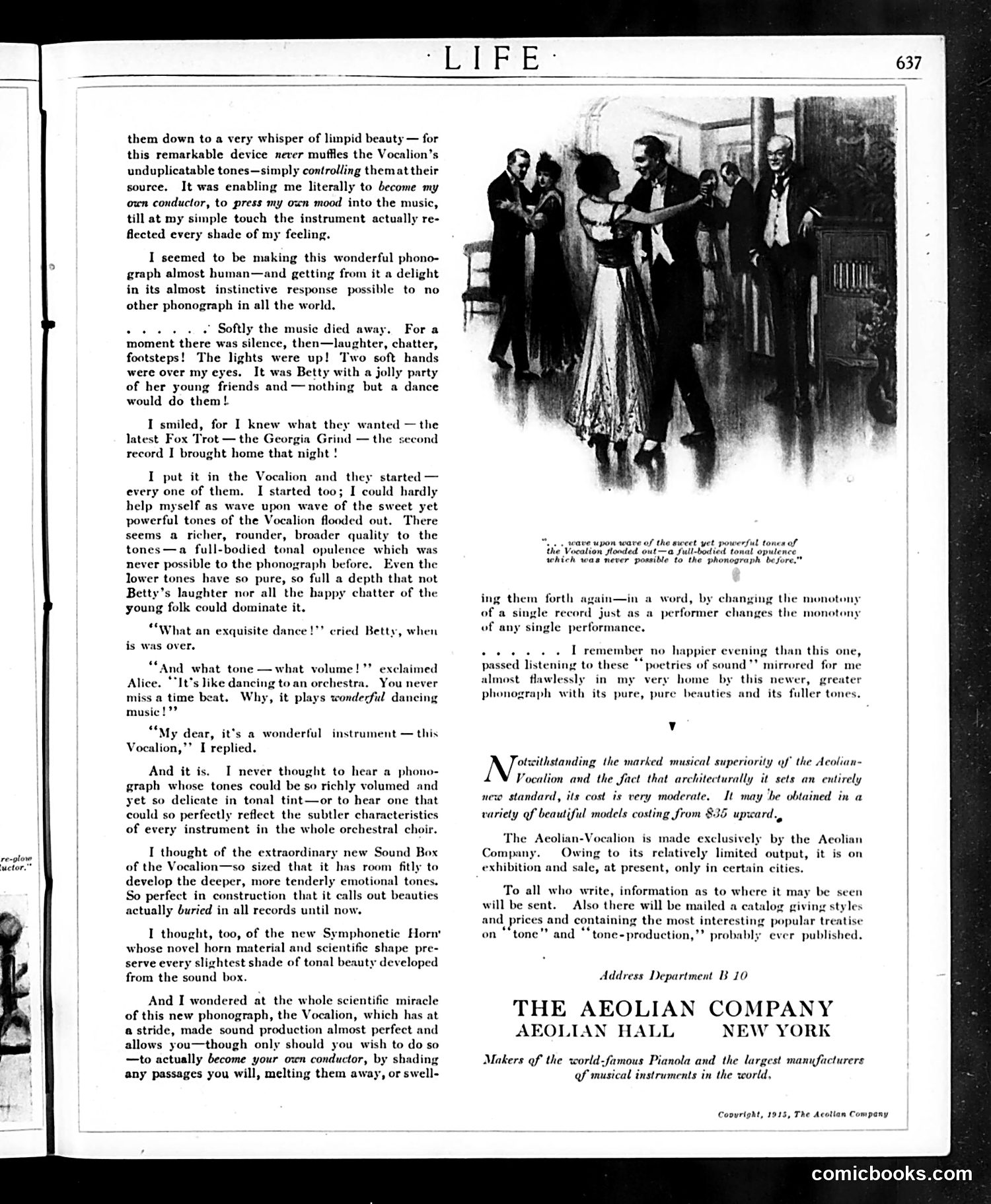
This page is primarily **advertising content**, not satire or political commentary. The text and illustration describe the **Aeolian Vocalion phonograph**, a new sound reproduction device. The image shows a social gathering where the phonograph is playing music for dancing—specifically, it mentions playing "the Georgia Grind" and a "Fox Trot." The narrative emphasizes the Vocalion's superior sound quality compared to earlier phonographs, praising its ability to reproduce orchestral music with "richer, rounder, broader quality." The speaker claims it's so realistic that listeners feel like they're hearing a live performance. This represents **early-twentieth-century consumer marketing** highlighting technological advancement in home entertainment. The social scene illustrates the phonograph's role in modern domestic leisure and social gatherings.
📄 Transcribed text from this page (OCR, searchable)
Machine-transcribed from the original scan — historical spelling and the odd misread are preserved.
them down to a very whisper of limpid beauty — for this remarkable device never muffles the Vocalion’s unduplicatable tones—simply controlling themat their source. It was enabling me literally to become my own conductor, to press my own mood into the music, till at my simple touch the instrument actually re- flected every shade of my feeling. I seemed to be making this wonderful phono- graph almost human—and getting from it a delight in its almost instinctive response possible to no other phonograph in all the world. + + + + « « Softly the music died away, For a moment there was silence, then—laughter, chatter, footsteps! The lights were up! Two soft hands were over my eyes. It was Betty with a jolly party of her young friends and—nothing but a dance would do them! I smiled, for I knew what they wanted — the latest Fox Trot — the Georgia Grind — the second record I brought home that night ! I put it in the Vocalion and they started — every one of them. I started too; I could hardly help myself as wave upon wave of the sweet yet powerful tones of the Vocalion flooded out. There seems a richer, rounder, broader quality to the tones—a full-bodied tonal opulence which was never possible to the phonograph before. Even the lower tones have so pure, so full a depth that not Betty’s laughter nor all the happy chatter of the young folk could dominate it. “What an exquisite dance !"? cried Betty, when is was over. “‘And what tone —what volume! ’? exclaimed Alice. “It’s like dancing to an orchestra. You never miss a time beat. Why, it plays wonderful dancing music !”? My dear, it's a wonderful instrument — this Vocalion,’” I replied. And it is. I never thought to hear a phono- graph whose tones could be so richly volumed and yet so delicate in tonal tint—or to hear one that could so perfectly reflect the subtler characteristics of every instrument in the whole orchestral choir. I thought of the extraordinary new Sound Box of the Vocalion—so sized that it has room fitly to develop the deeper, more tenderly emotional tones. So perfect in construction that it calls out beauties actually buried in all records until now. I thought, too, of the new Symphonetic Horn’ whose novel horn material and scientific shape pre- serve every slightest shade of tonal beauty developed from the sound box. And I wondered at the whole scientific miracle of this new phonograph, the Vocalion, which has at a stride, made sound production almost perfect and allows you—though only should you wish to do so —to actually become your own conductor, by shading any passages you will, melting them away, or swell- wave upon ware of the sweet yet powerful ton the’ Vocation slooded out—a full-bodied tonal opute: which was never possible to the phonograph before, ing them forth again—in a word, by changing the monotony of a single record just as a performer changes the monotony of any single performance. © ee eee LT remember no happier evening than this one, passed listening to these “*poetries of sound*’ mirrored for me almost flawlessly in my very home by this n er, greater phonograph with its pure, pure beauties and its fuller tones. v otwithstanding the marked musical superiority of’ the Acolian- Vocalion and the fact that architecturally it sets an entirely new standard, its cost is very moderate. It may ‘be obtained in a variety of beautiful models costing from $35 upward. The Acolian-Vocalion is made exclusively by the Acolian Company. Owing to its relatively limited output, it is on exhibition and sale, at present, only in certain cities. To all who write, information as to where it may be seen will be sent. Also there will be mailed a catalog giving styles and prices and containing the most interesting popular treatise on “tone” and ‘‘tone-production,” probably ever published. Address Department B10 THE AEOLIAN COMPANY AEOLIAN HALL EW YORK Makers of the world-famous Pianola and the largest manufacturers of musical instruments in the world, Covuright, 1915, The Acotian Company comicbooks.com