
A complete issue · 48 pages · 1915
Life — September 23, 1915
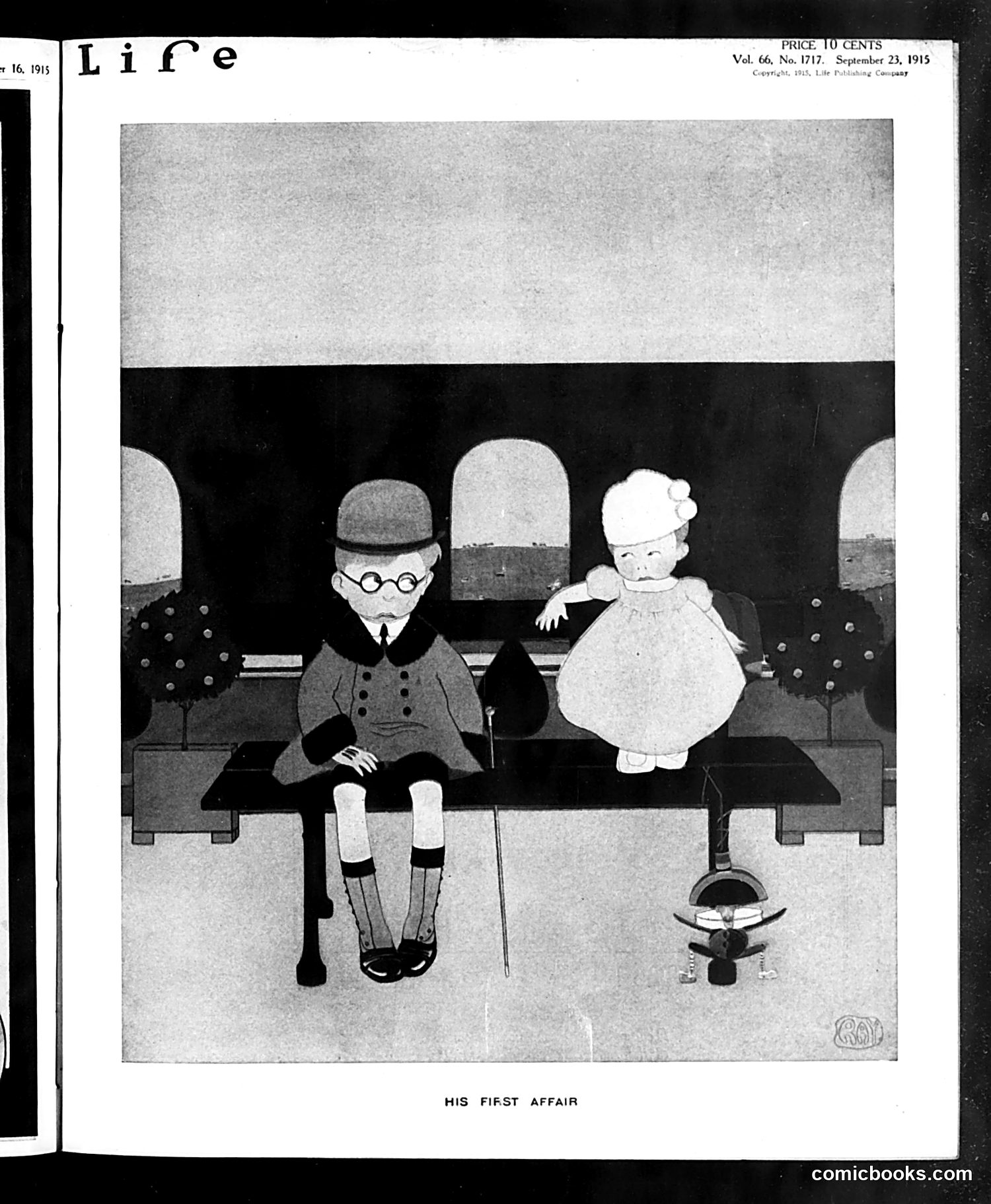
This cartoon depicts a young boy in formal attire (bowler hat, glasses, suit) seated next to a plump woman in a large white dress and bonnet on a park bench. The title "His First Affair" is a humorous reference to a romantic encounter. The satire likely mocks either: 1. An age-inappropriate romantic pairing, or 2. The absurdity of childhood "courtship" mimicking adult behavior The boy's formal, serious demeanor contrasts with the comical oversized proportions of his companion, suggesting the humor derives from an awkward or ridiculous mismatch. Without additional context, the specific individuals being caricatured remain unclear, though this appears to reference a notable public figure or contemporary social situation from 1915.
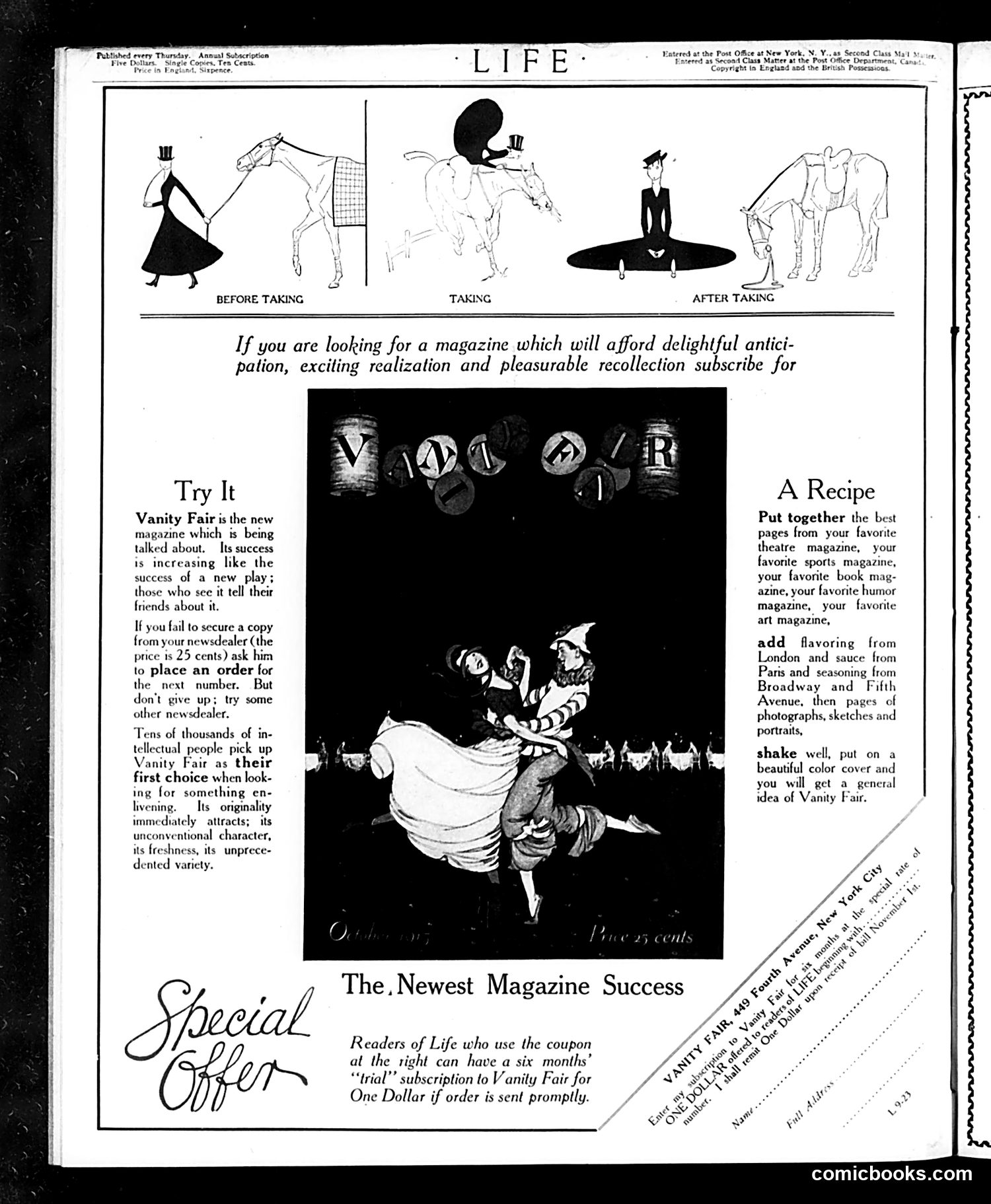
This page is primarily an **advertisement for Vanity Fair magazine**, not political satire. The top cartoon uses visual humor to show the transformative effect of reading the magazine: a woman appears exhausted "before taking," weighed down by burdens; while "taking" (reading) it, she's energized; and "after taking," she's so elevated she floats above her camel. The central illustration shows a whimsical figure in costume, reinforcing Vanity Fair's association with entertainment, fashion, and cultural sophistication. The text emphasizes the magazine's "originality," "unconventional character," and "unprecedented variety"—appealing to intellectually adventurous readers seeking sophisticated entertainment beyond standard publications. The "special offer" provides a six-month trial subscription for one dollar, targeting Life magazine's readers specifically.
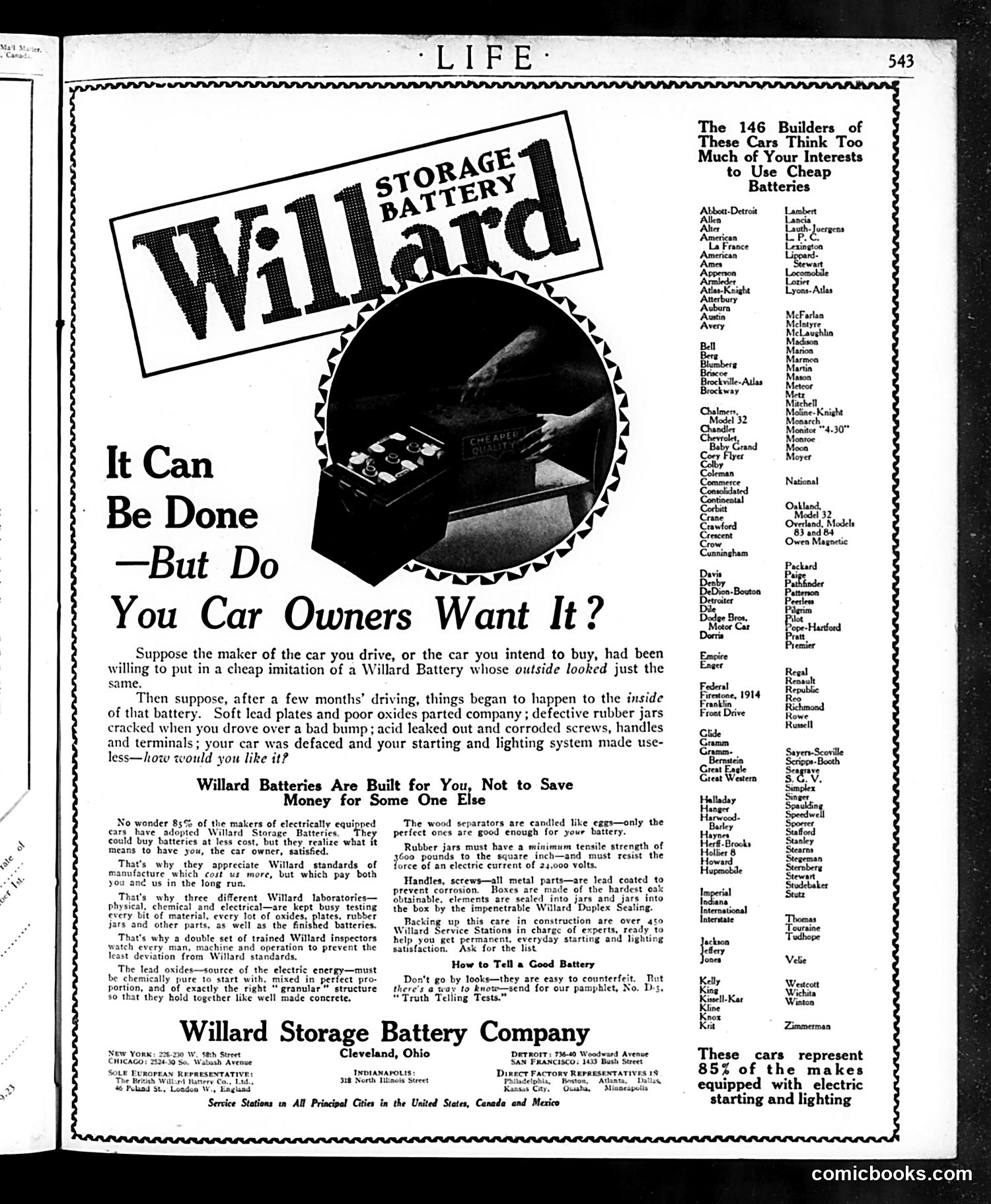
This page is primarily an **advertisement for Willard Storage Batteries**, not a political cartoon. The ad uses a rhetorical argument rather than satirical imagery. The pitch targets car owners by posing a hypothetical: imagine if your car manufacturer used cheap imitation batteries to save money. The ad describes potential failures—soft plates, defective rubber, acid leaks, corroded screws, failed ignition—creating anxiety about inferior products. The list on the right shows 146 car manufacturers (representing 85% of cars with electric starting/lighting) that apparently trust Willard batteries, functioning as a social-proof endorsement. This reflects early automotive-era concerns about battery reliability and quality standards, when battery failure was a common, serious problem for vehicle owners. The ad essentially argues: premium batteries aren't luxury—they're necessary.
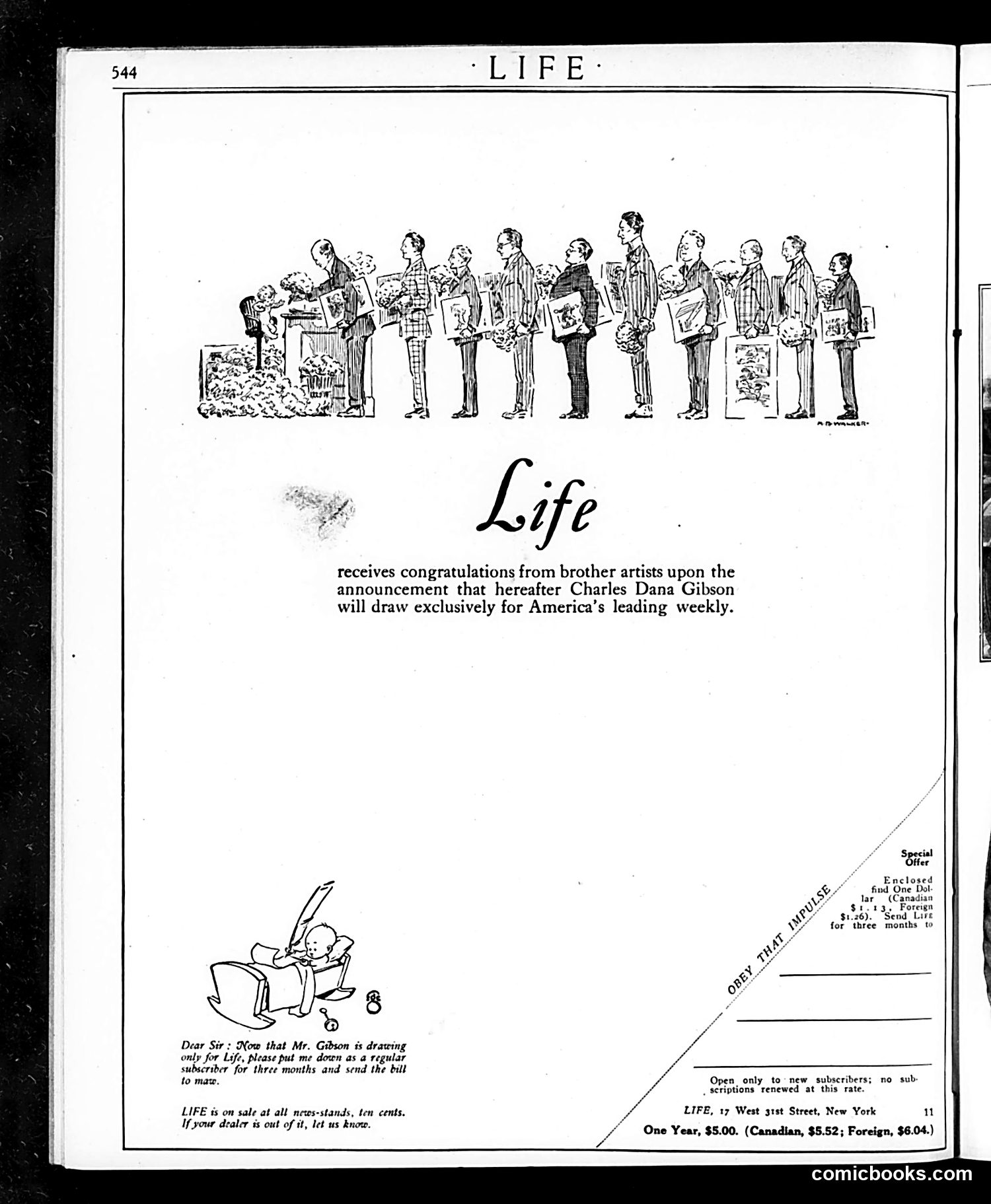
This page announces that Charles Dana Gibson will draw exclusively for Life magazine. The top illustration depicts a line of men in business attire holding papers, apparently representing "brother artists" offering congratulations to Life. The bottom cartoon shows a man in a chair with rabbit ears, apparently a joke about the announcement itself—possibly mocking the competitive jealousy among illustrators or satirizing the fuss over Gibson's exclusive contract. The text confirms Gibson's new arrangement with "America's leading weekly." A subscription offer appears on the right side. **Context:** Charles Dana Gibson was famous for the "Gibson Girl" illustrations. This appears to be a promotional/congratulatory notice, with self-aware humor about the announcement's significance to the illustration profession.
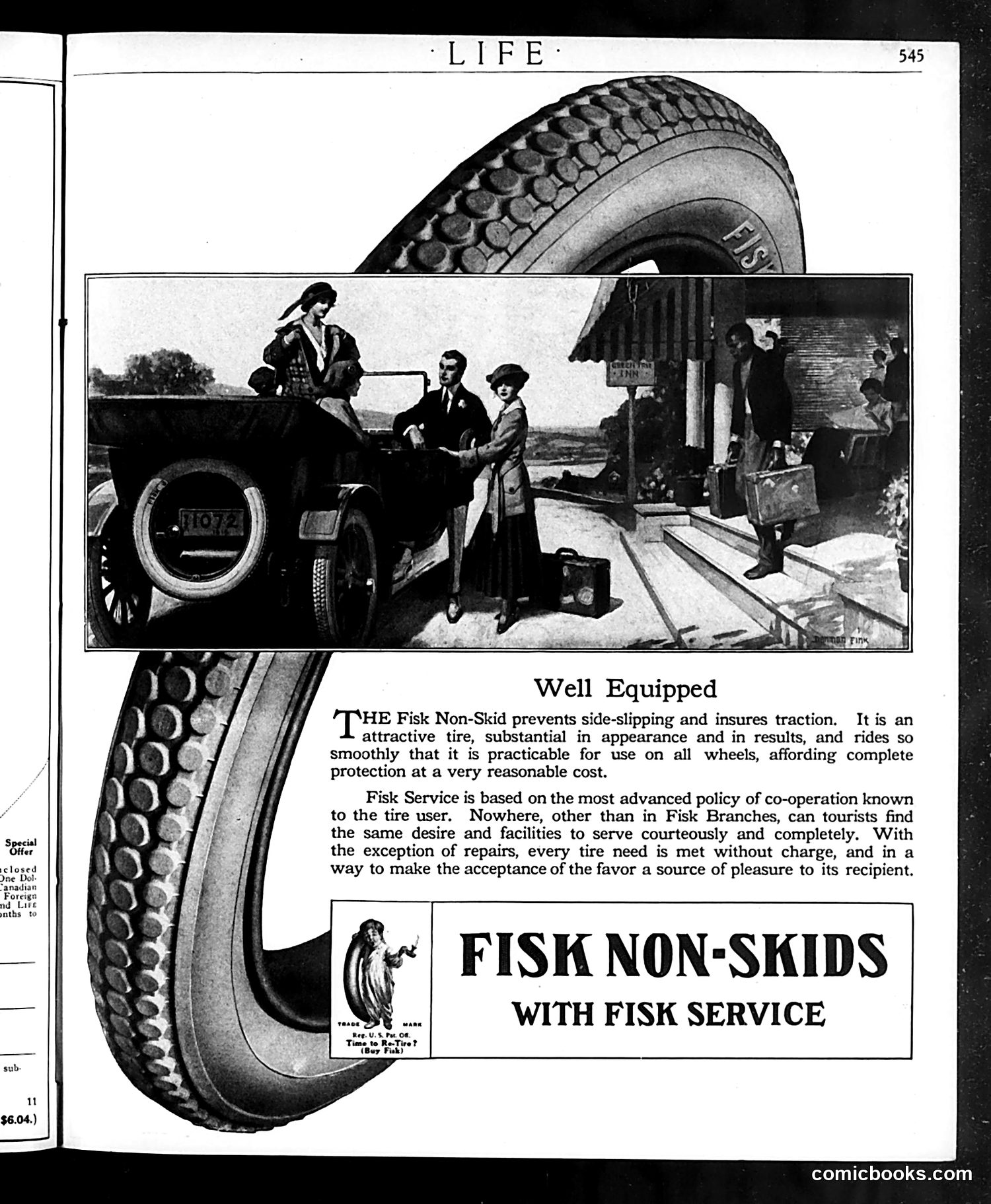
This is a **commercial advertisement**, not political satire. The page promotes Fisk Non-Skid tires, a real early-20th-century tire brand known for their mascot (visible in the lower left corner). The ad emphasizes the tire's practical benefits: preventing side-slipping and ensuring traction. The photograph shows well-dressed people examining a vehicle, suggesting the product appeals to respectable middle-class motorists. The "Fisk Service" component highlights the company's customer-service approach—free tire maintenance through authorized branches. This was a novel selling point when automobile ownership was becoming widespread but still somewhat luxury-oriented. The prominent tire image dominates the layout, and the overall design is typical of early automotive advertising emphasizing both product quality and dealer support.
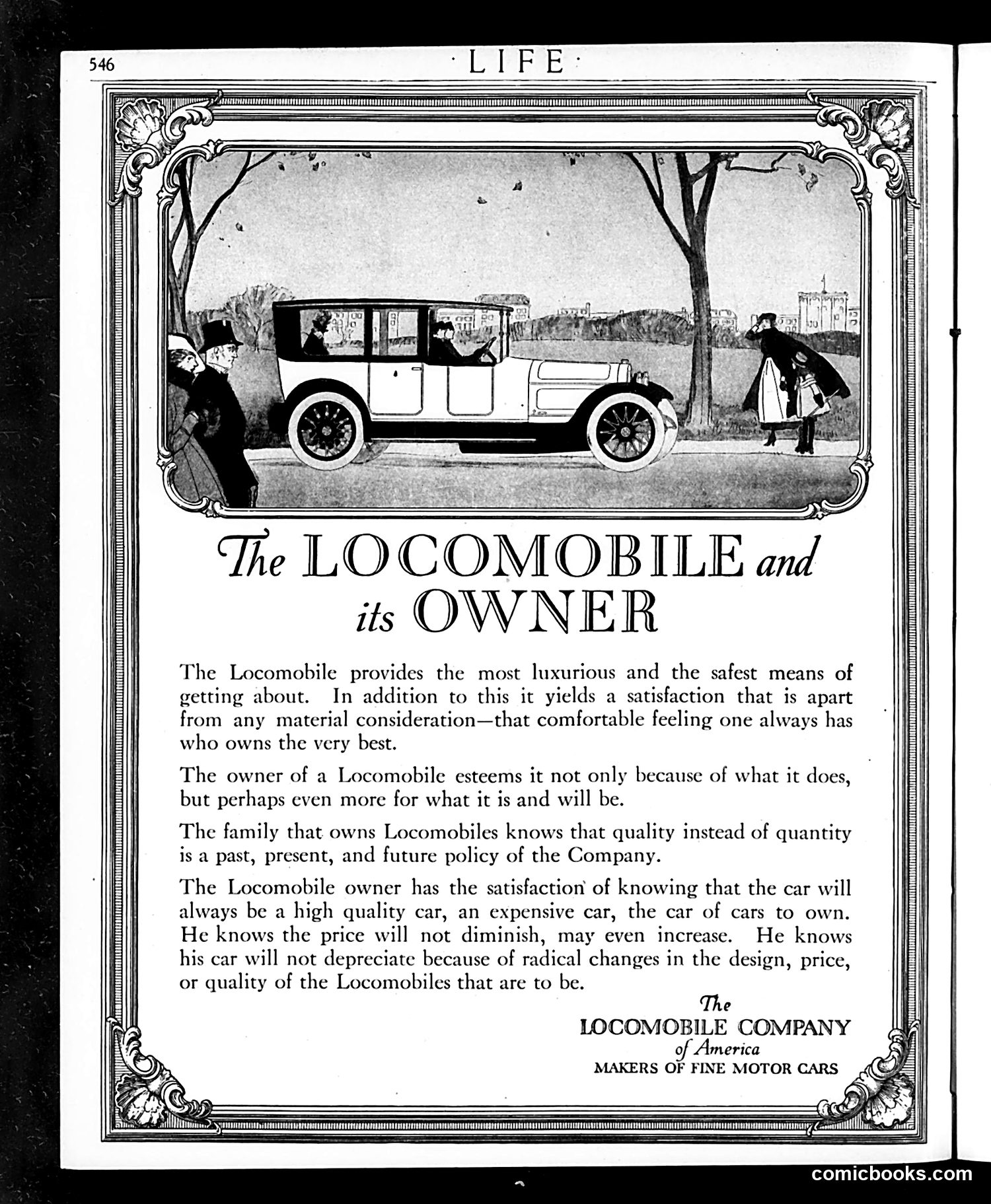
This is **not a satirical cartoon but a luxury automobile advertisement** from Life magazine (page 546). The Locomobile Company of America advertised their high-end vehicles by emphasizing exclusivity and value retention. The illustrated scene shows a well-dressed couple with their Locomobile automobile, accompanied by pedestrians in formal attire. The advertisement's message targets wealthy buyers by stressing that owning a Locomobile signifies refined taste and social status. Key claims made: the car provides luxury, safety, and satisfaction; ownership reflects quality over quantity; the vehicle will maintain or increase in value; and design won't become obsolete. This appeals to affluent buyers concerned with prestige and financial prudence—positioning the Locomobile as a wise investment for the upper class.
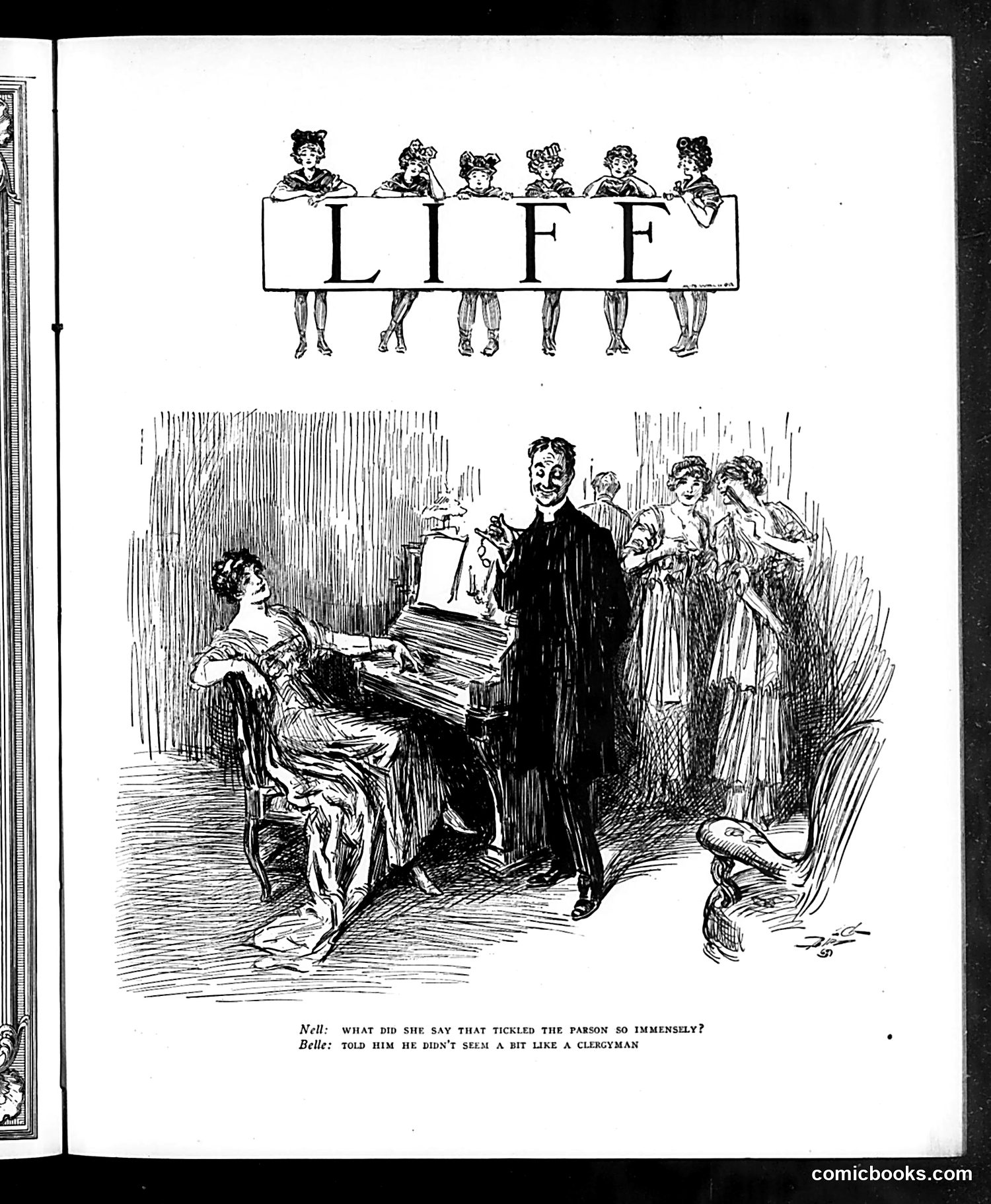
This page features two illustrations under the heading "LIFE": **Top illustration**: Six women in period dress hold a banner displaying the word "LIFE," functioning as a decorative title treatment. **Bottom illustration**: A social scene depicts a man at a piano with a woman seated beside it, while several other women observe. The accompanying dialogue reads: *Nell: "What did she say that tickled the parson so immensely?"* *Belle: "Told him he didn't seem a bit like a clergyman"* The joke satirizes social hypocrisy and appearance. A clergyman is being complimented for not appearing to be what he actually is—suggesting clergy have a recognizable (perhaps unsavory) reputation or stereotype. The humor derives from the irony of praising someone by saying they don't resemble their own profession, implying negative associations with that profession.
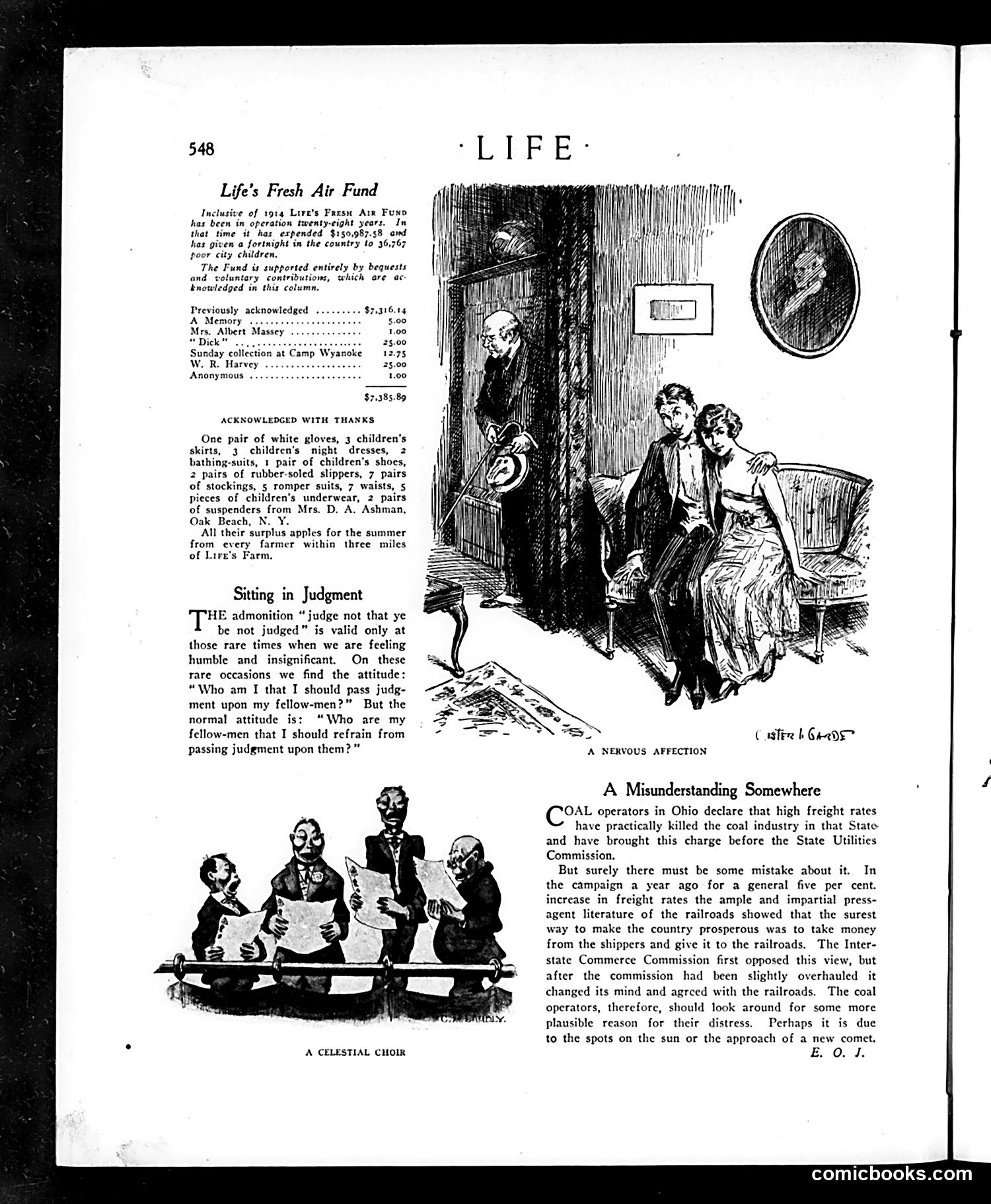
This page contains three distinct pieces: **"Life's Fresh Air Fund"** - A charitable donation list acknowledging contributions to help poor city children. **"Sitting in Judgment"** - A philosophical essay about the danger of judging others, using Biblical reference ("judge not that ye be not judged") to argue we should restrain from passing judgment on our fellow citizens. **"A Nervous Affection"** (sketch) - Shows a well-dressed man entering a room where two women sit; the title suggests awkward social anxiety. **"A Misunderstanding Somewhere"** - An editorial piece criticizing Ohio coal operators who blame high freight rates for industry distress. The author suggests they're misdirecting blame and should look elsewhere for the real cause—humorously suggesting "spots on the sun or the approach of a new comet." **"A Celestial Choir"** (bottom cartoon) - Depicts four figures in formal dress, likely satirizing some contemporary group or institution, though the specific target is unclear.
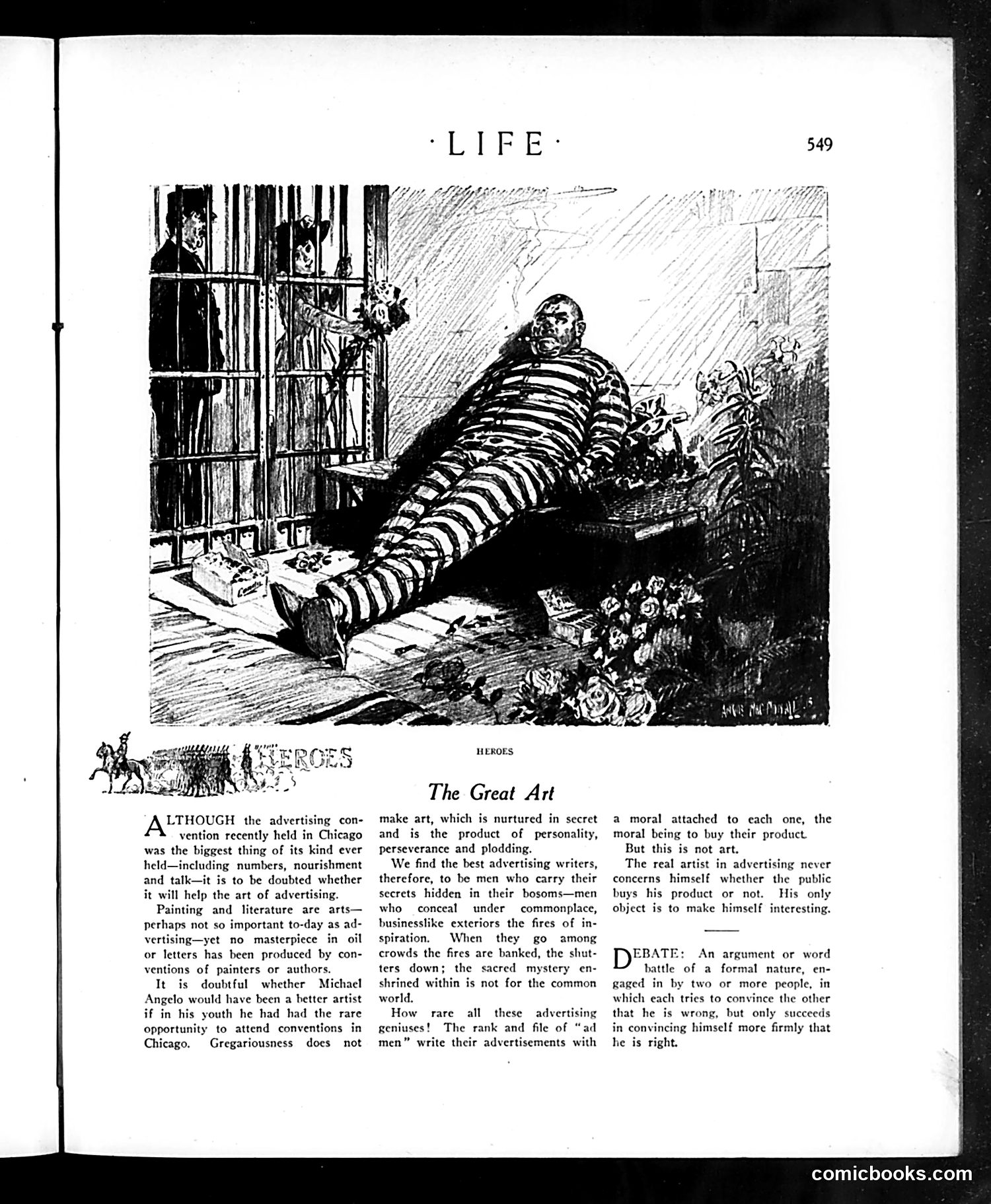
This page satirizes advertising's pretensions to artistry. The cartoon depicts a corpulent man in striped clothing reclining luxuriously among flowers—a parody of classical artistic poses. The accompanying text argues that while painters and writers guard their "secrets" and claim noble artistic pursuits, advertising copywriters are the true "geniuses" of their era, yet they conceal their work behind commercialism rather than claiming artistic credit. The satire's point: advertisers possess genuine creative talent but refuse to acknowledge it as "art" because advertising is purely commercial. The reclining figure mocks both the pretension of "fine artists" and the hypocrisy of ad-men who deny their own artistry while producing sophisticated persuasive work. The text concludes that real artistic integrity means acknowledging one's own product's merit regardless of public opinion.
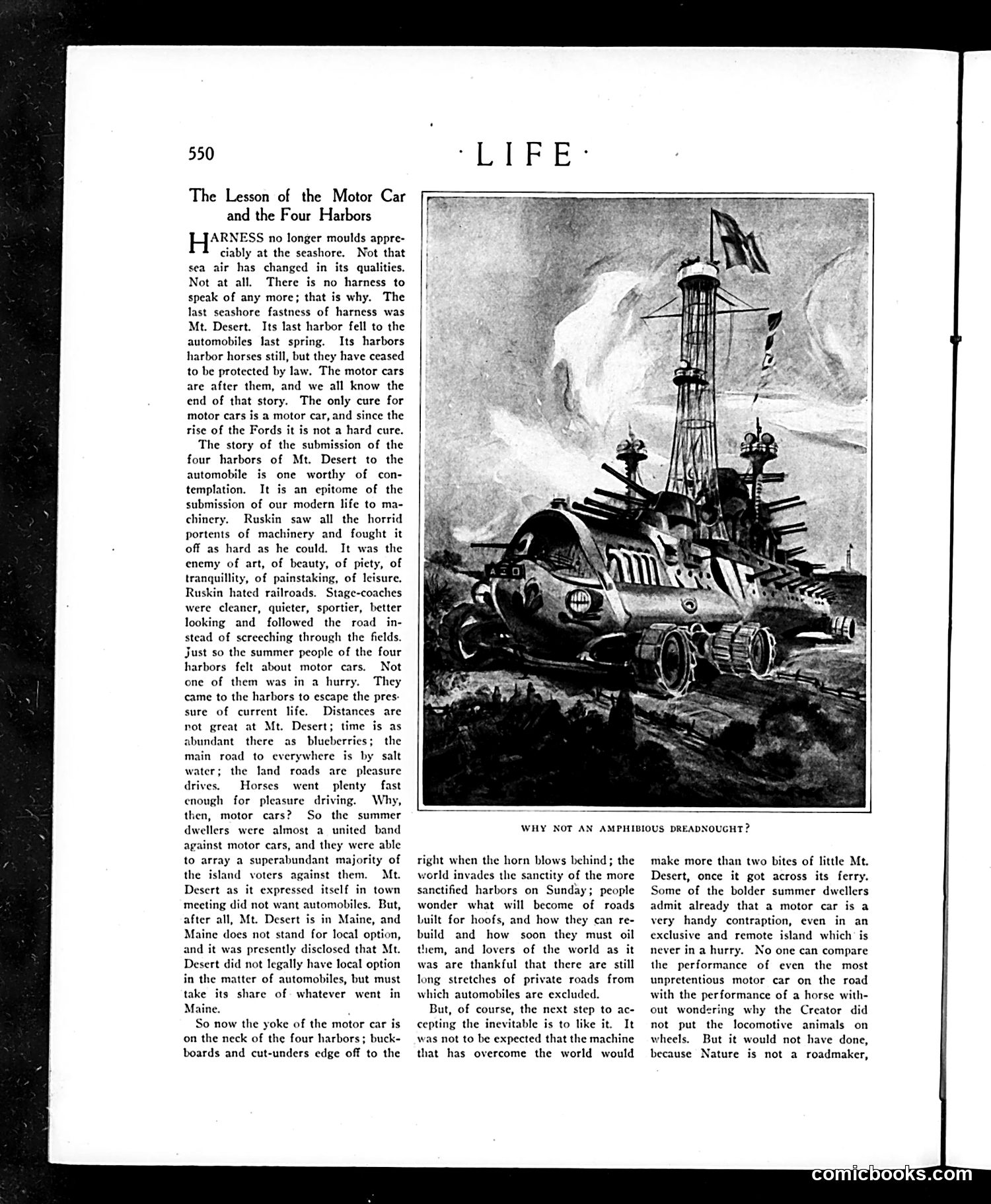
This is editorial commentary, not a political cartoon. The piece satirizes resistance to automobiles in Mount Desert, Maine, where locals—particularly artist John Ruskin's admirers who valued aesthetic and pastoral ideals—initially opposed motor cars as incompatible with the island's beauty and tranquility. The image shows an absurdist vision: a massive industrial locomotive-ship hybrid violating the serenity Mount Desert sought to preserve. The author argues this juxtaposition is ironic: locals who romanticized horses and rejected cars as machinery's intrusion must accept that progress is inevitable. The "four harbors" reference suggests development pressures were mounting despite efforts to maintain the island's exclusive, undisturbed character.
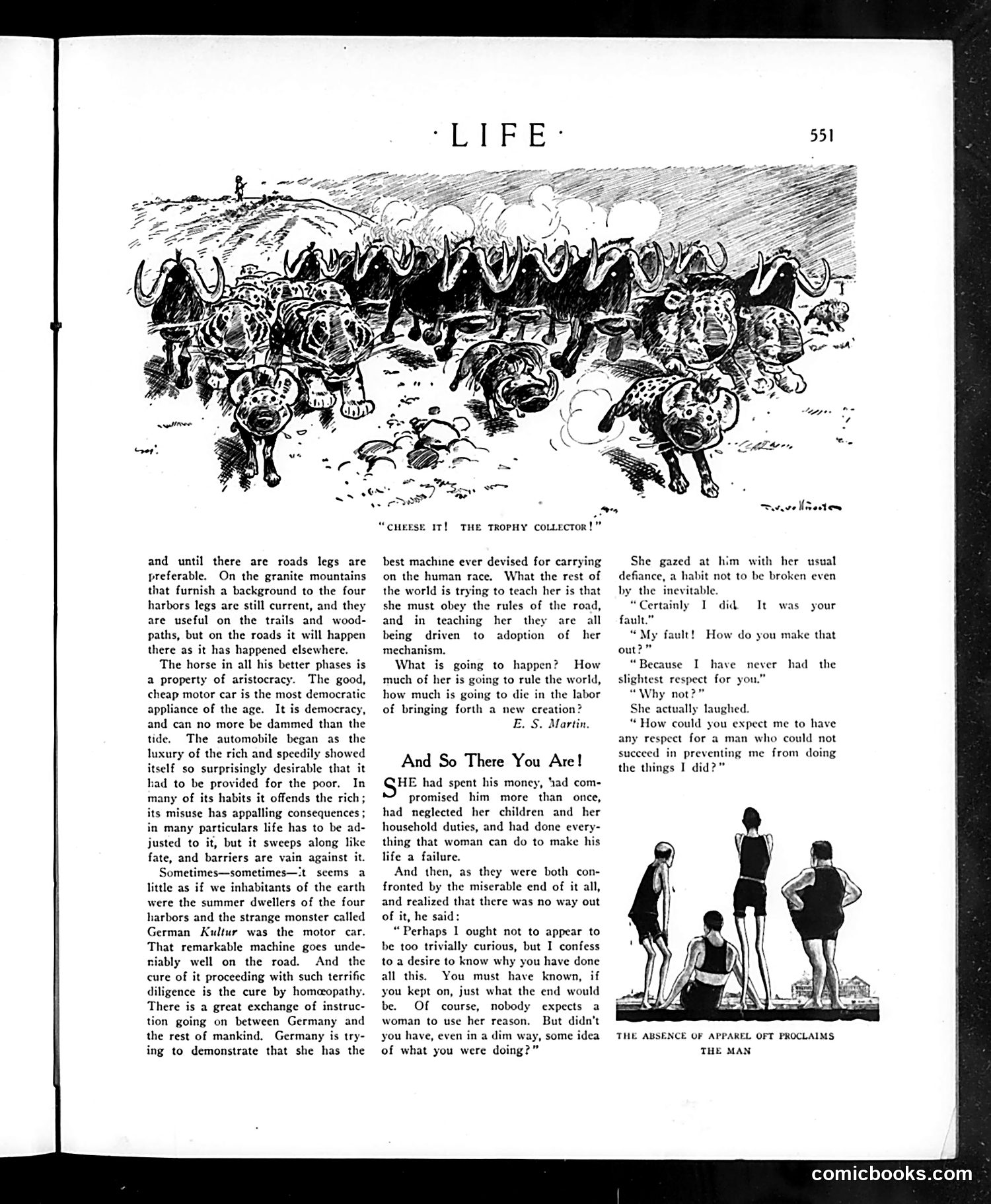
The top cartoon, captioned "Cheese It! The Trophy Collector!," depicts a large group of animals (appearing to be various beasts and creatures) gathered around what looks like trophies or hunted remains. This appears to be satirizing trophy hunting or collection practices, likely commenting on wealthy individuals who hunted exotic animals for sport and displayed their kills as status symbols—a common upper-class pastime of the early 20th century. The lower illustration, "The Absence of Apparel Off Proclaims the Man," shows several figures in minimal clothing on a beach. This likely satirizes changing social norms regarding swimwear and public decorum, possibly critiquing modern attitudes toward modesty or the emerging "modern woman" of the era who challenged traditional dress codes. Both pieces use visual humor to mock contemporary social pretensions and shifting cultural values.
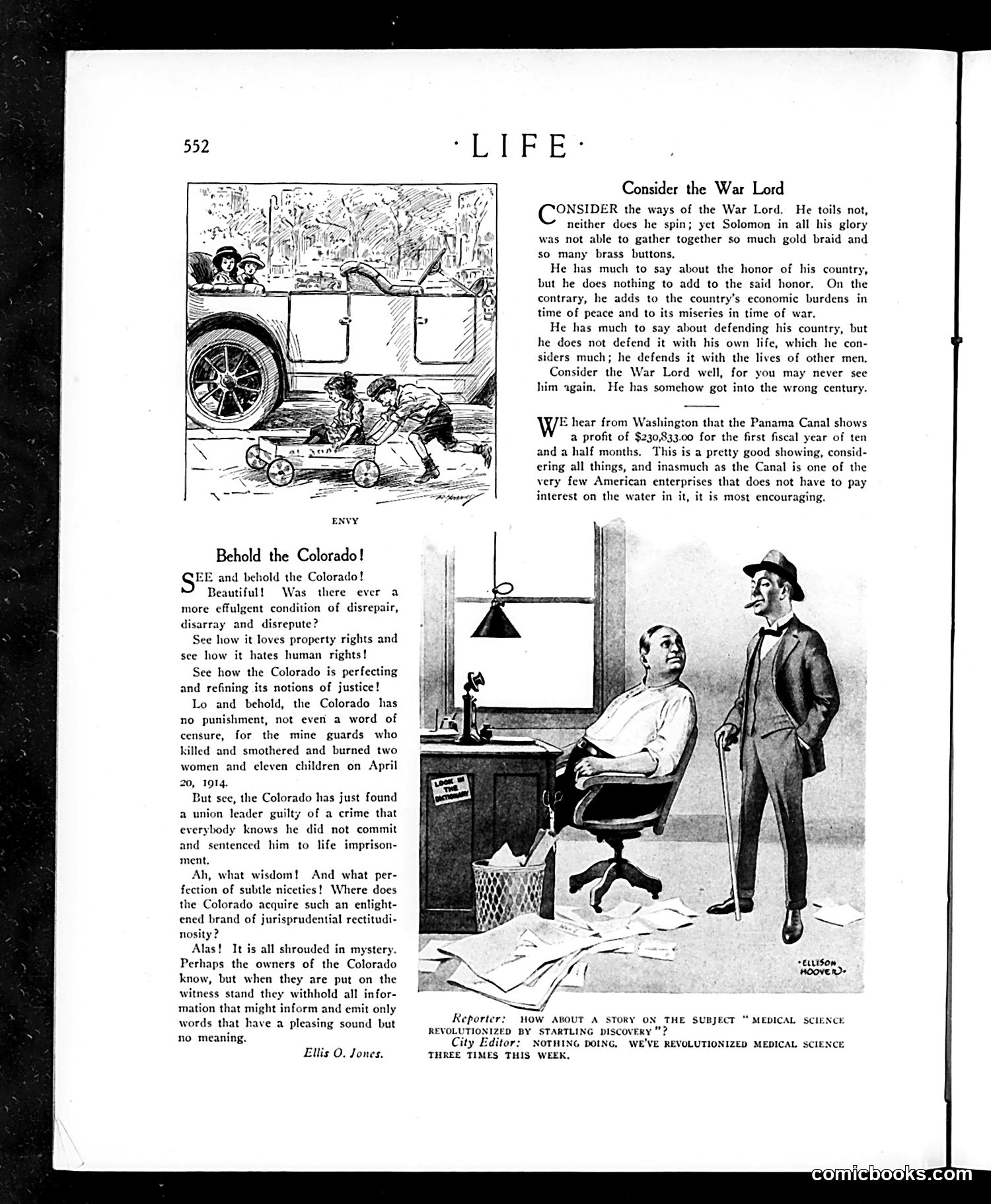
This page contains two satirical pieces from Life magazine (a date is not visible). **"Envy" cartoon**: Shows figures in a car looking down at poor children with toy wagons. The accompanying text by Ellis O. Jones sarcastically praises the Colorado (likely referring to Colorado Fuel & Iron Company) for its "enlightened" labor practices, while condemning it for a real incident where mine guards "killed and smothered and burned two women and eleven children on April 20, 1914." Jones condemns the company's silence and calls their acquittal an outrage. **Bottom cartoon**: A "Reporter" and "City Editor" dialogue mocks newspapers' claim to have "revolutionized medical science" through sensational discovery stories, when actually they're "doing nothing." Both pieces critique institutional hypocrisy and irresponsible journalism.
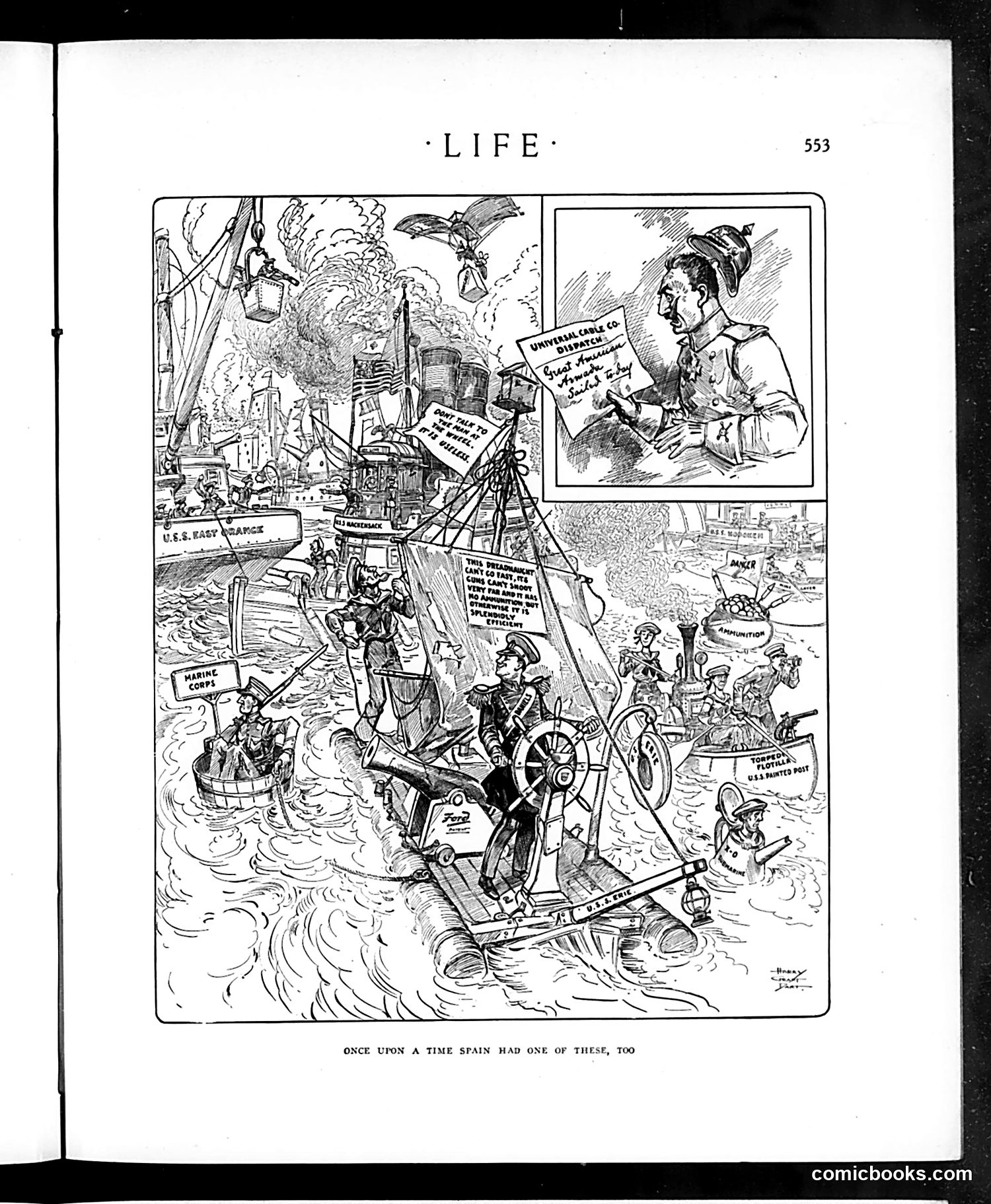
This is a satirical cartoon from *Life* magazine titled "Once Upon a Time Spain Had One of These, Too." It depicts the U.S. Navy's expansion and military buildup, shown as an elaborate, chaotic maritime operation with various labeled military departments and equipment (visible labels include "Marine Corps," "Ammunition," "Supplies," and references to different naval units). The inset portrait shows a caricatured figure (likely a European political leader, suggested by the traditional hat) holding documents labeled "Universities and Libraries," appearing to contrast past Spanish cultural and institutional prominence with current American military might. The satire suggests that just as Spain once possessed a great naval empire but lost it, the U.S. should be cautious about overconfidence in military power, particularly regarding the maintenance of civilian institutions and learning.
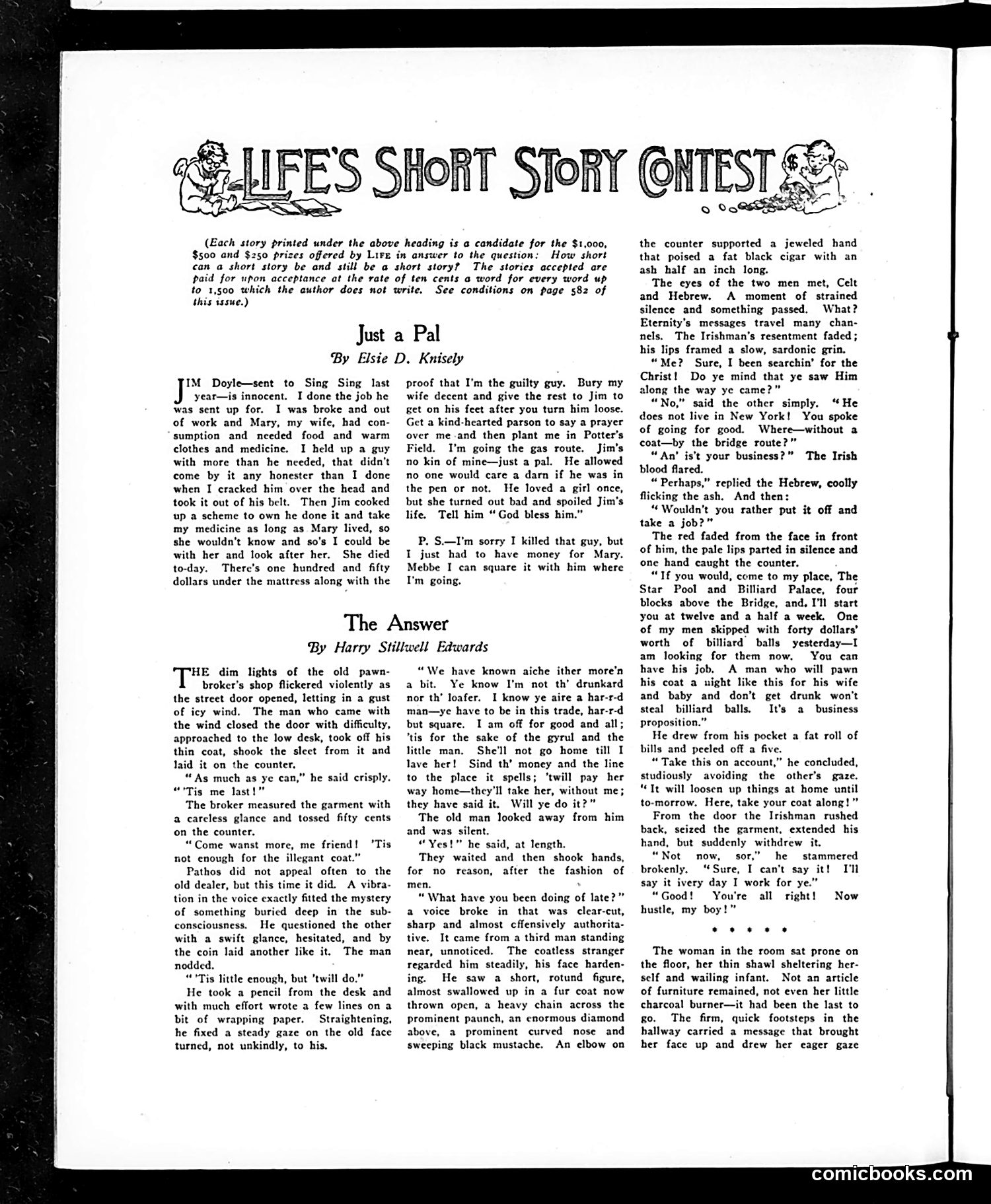
This page presents two short stories competing in Life magazine's fiction contest (prizes of $1,000, $500, and $250). **"Just a Pal"** by Edna J. Knisley depicts a man named Jim Doyle who admits to killing someone and asks a friend to help him escape—burying his wife, giving Jim money to flee. The narrator promises to plant him in Potter's Field and forge a note claiming he left for good. **"The Answer"** by Harry Stillwell Edwards shows a pawnbroker confronted by a desperate man seeking money. A well-dressed stranger appears, offers to pay the man's debt in exchange for stealing billiard balls—framing it as a "business proposition." Both stories explore moral compromise and desperation during what appears to be the early 20th century, with themes of loyalty, survival, and ethical corruption.
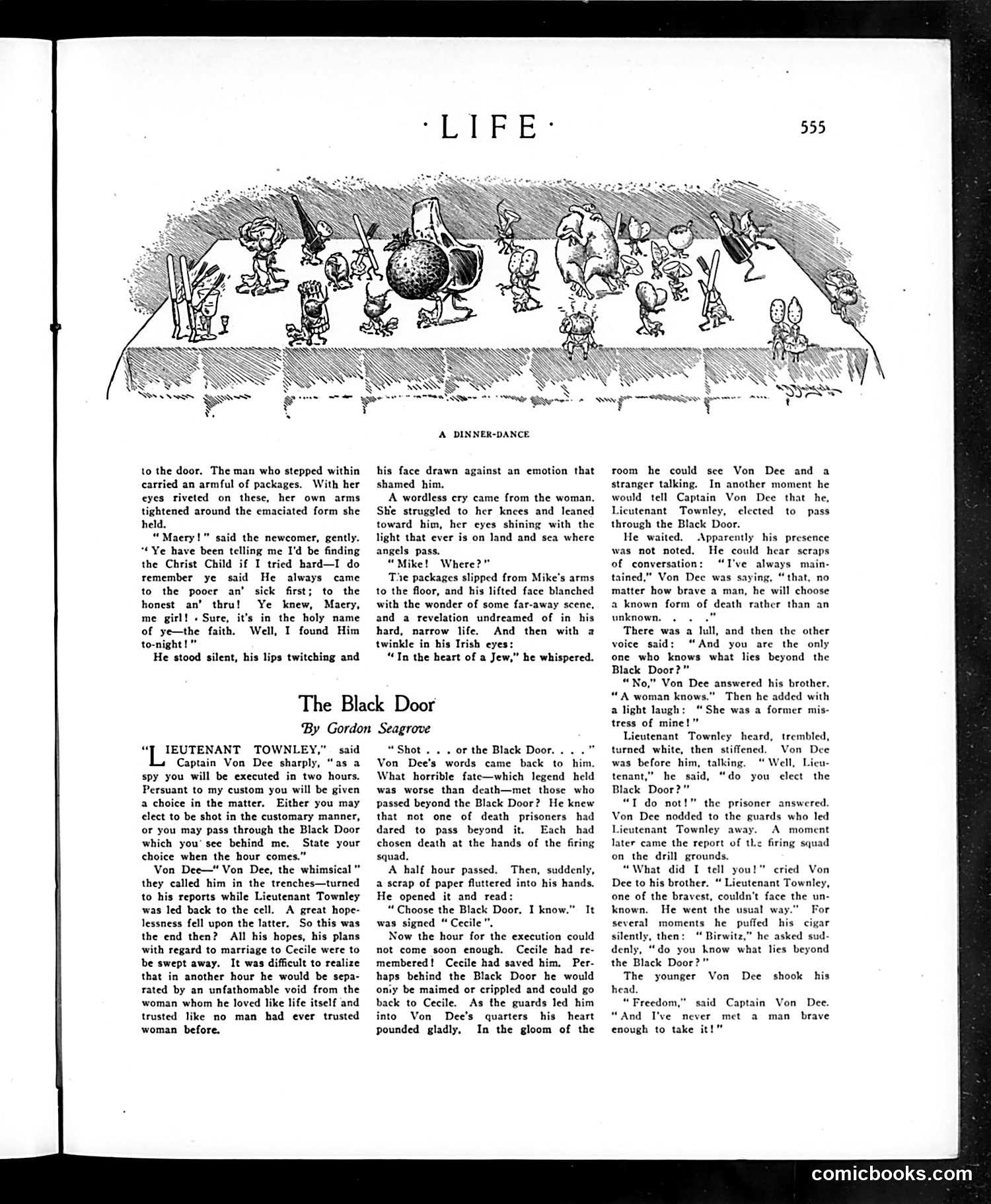
The cartoon at the top of the page depicts a whimsical scene of tiny figures engaged in dining and dancing atop what appears to be a large table or platter. The figures are rendered in a playful, diminutive style—consistent with early 20th-century Life magazine's satirical humor. Below this is "The Black Door," a short story by Gordon Seagrove featuring Lieutenant Townley and Captain Von Dee. The narrative concerns military prisoners facing execution and themes of honor, sacrifice, and forbidden love. The story appears to be dramatic fiction rather than satire. The cartoon's precise satirical target is unclear from the image alone, but its small-scale figures engaged in civilized dining suggest possible commentary on society's absurdities or human pretension.
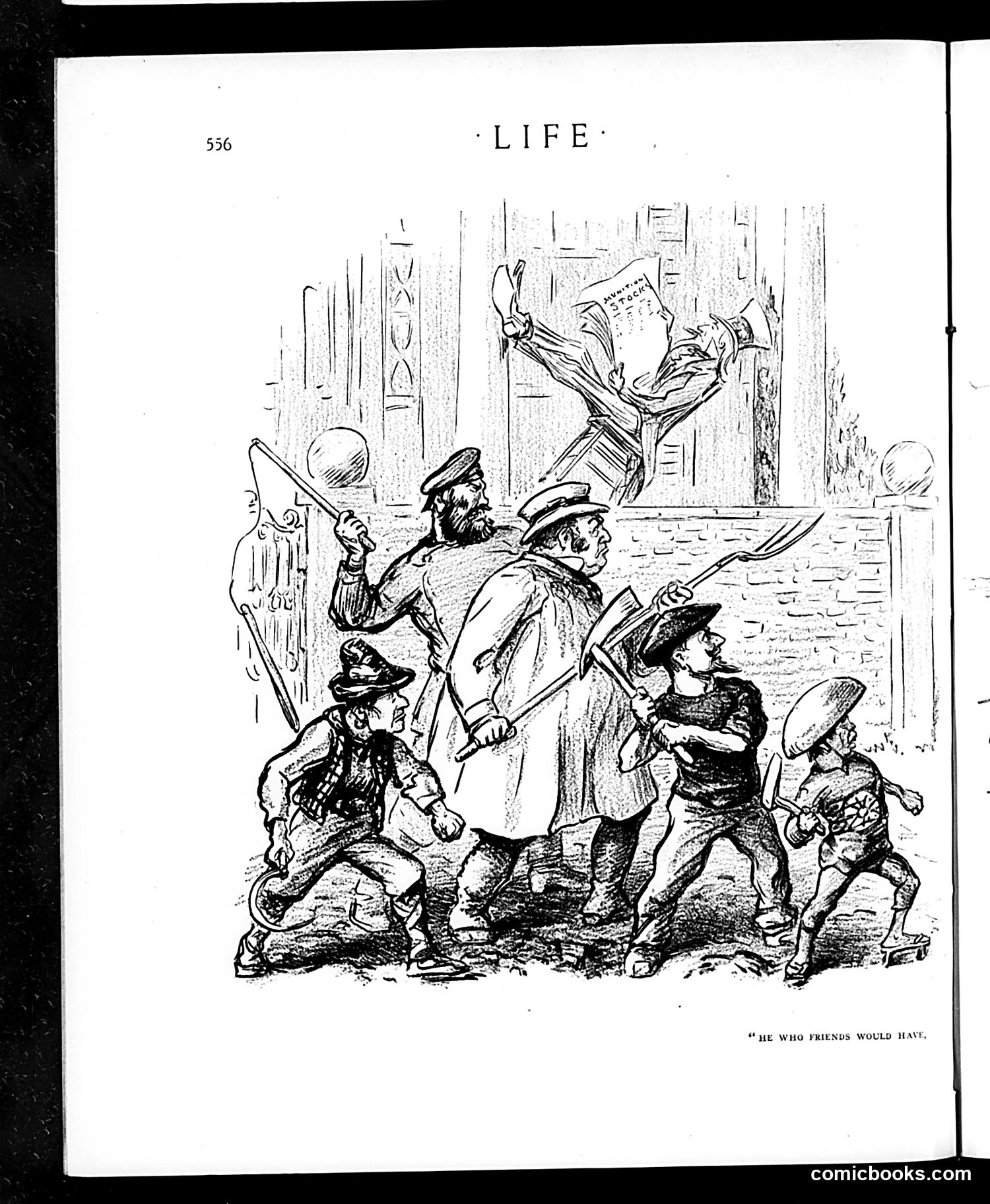
This is a satirical cartoon from *Life* magazine depicting what appears to be a political or social commentary. The image shows three young boys and two adult men in period dress (likely late 19th century, based on the style). The caption reads "HE WHO FRIENDS WOULD HAVE," suggesting a theme about friendship or social association. The cartoon likely satirizes how children are influenced by or associate with adults of questionable character. The exaggerated, caricatured features of the adults and the positioning of the boys suggest mockery of either poor parenting, class mixing, or the corrupting influence of disreputable company on youth. Without additional context about the specific issue date or surrounding articles, the precise political or social target remains unclear, though the satire criticizes adult influence on children's social development.
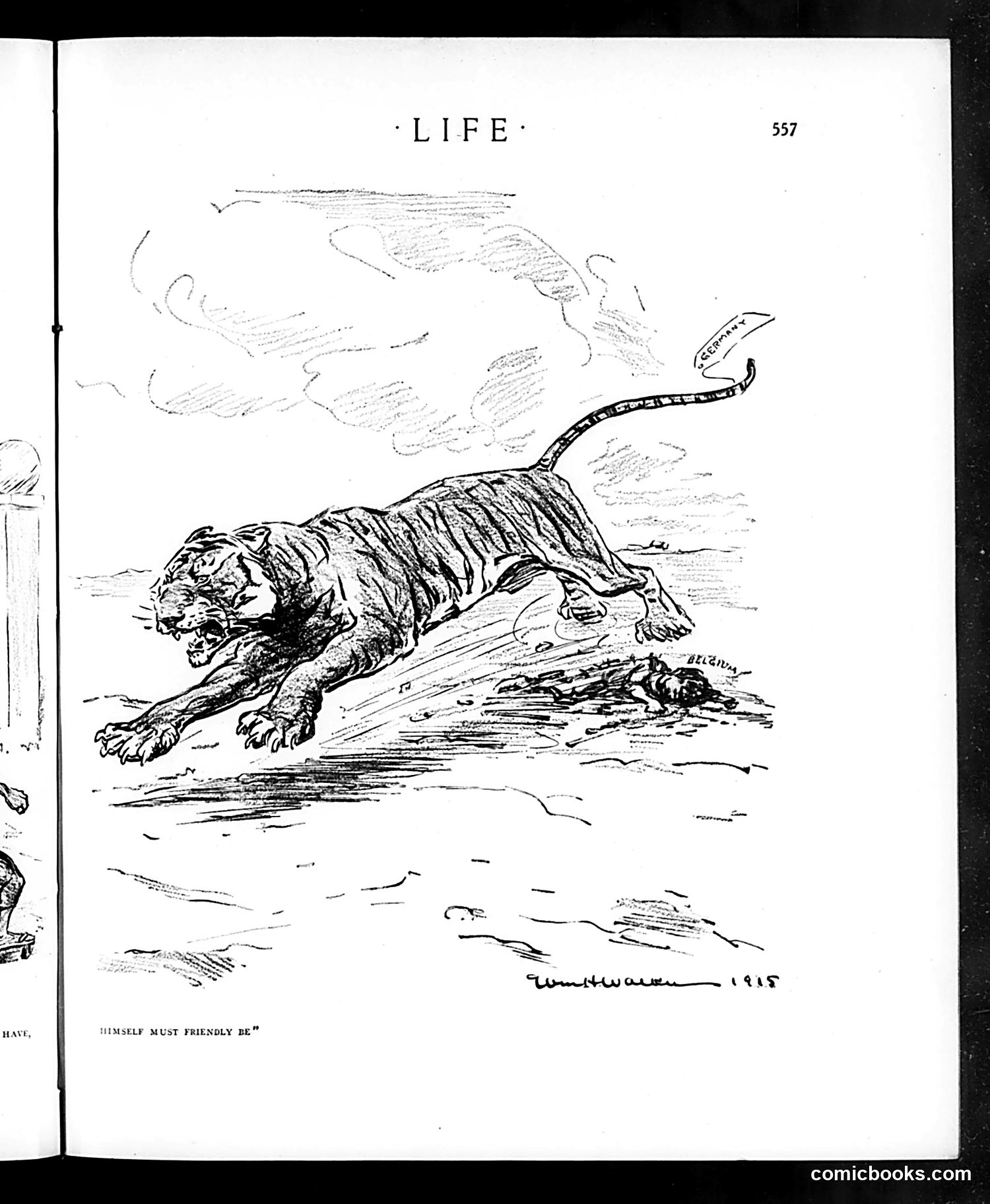
This 1915 cartoon depicts a tiger in an aggressive crouch with its tail raised menacingly. The caption reads "HIMSELF MUST FRIENDLY BE," which appears to be incomplete or partial text. The imagery likely references international relations during World War I, when "the Tiger" was a common personification for Germany or German aggression. The contrasting caption suggesting friendliness creates ironic commentary—the visual shows an obviously threatening posture while the text demands peaceable behavior. Without the full context or caption, the exact satirical target remains unclear, but this appears to criticize either German military aggression or hypocrisy regarding diplomatic claims of peaceful intent. The 1915 date places this during early American neutrality debates.
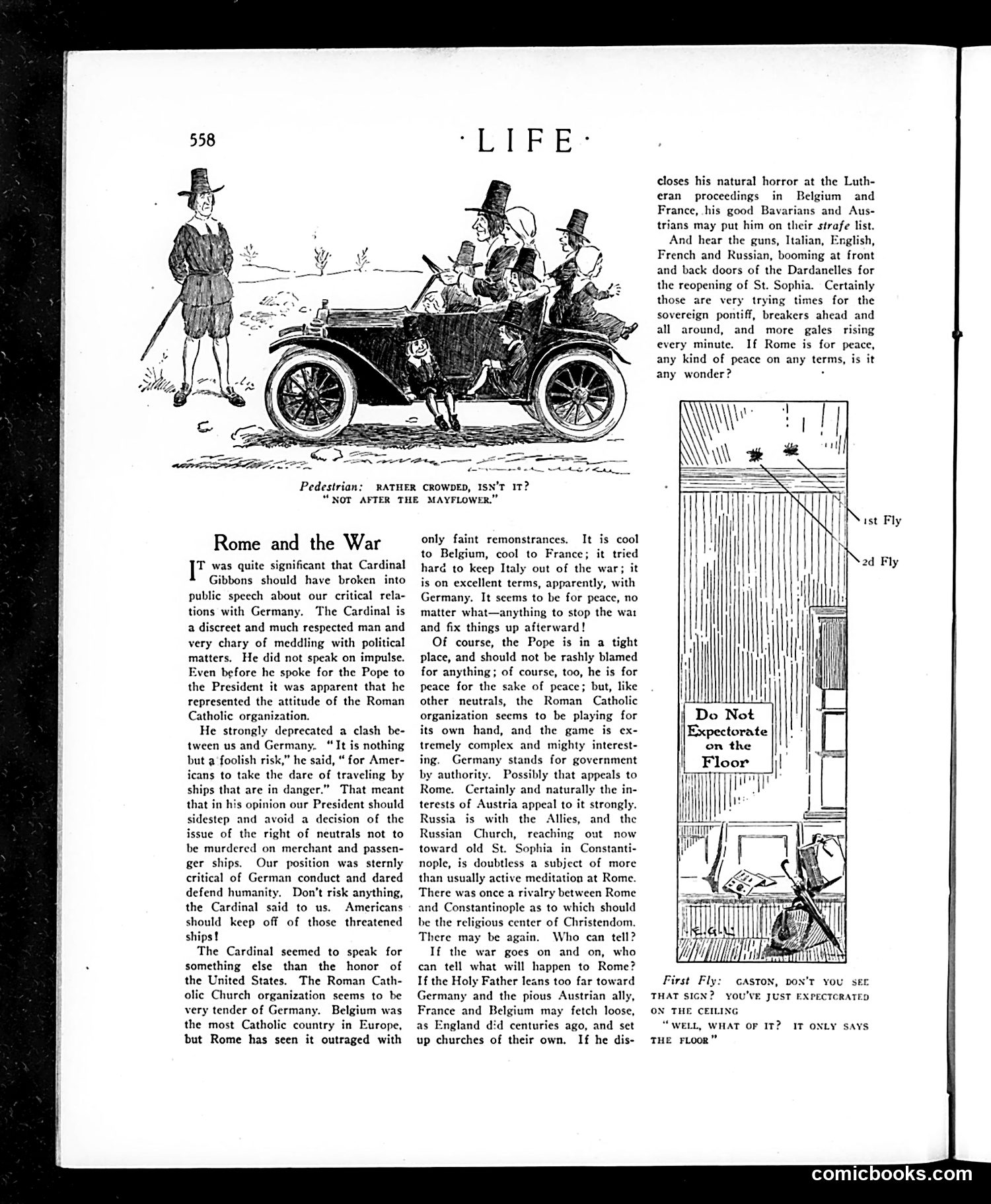
**Main Article Context:** This is WWI-era commentary (pre-U.S. entry, likely 1915-1916) criticizing Cardinal Gibbons and the Roman Catholic Church for allegedly favoring Germany over the Allies. **The Argument:** The author accuses the Church of: - Discouraging American travel on ships (implicitly siding with German U-boat threats) - Showing "only faint remonstrances" over Belgium's devastation despite it being Catholic - Maintaining friendly relations with Germany and Austria - Possibly preferring authoritarian "government by authority" (Germany/Austria) - Playing geopolitical games regarding Constantinople/Orthodox Christianity **Top Cartoon:** The pedestrian's remark "Not after the Mayflower" is a bitter joke—referencing the Pilgrim ship, it suggests Catholic immigrants are too numerous, echoing anti-Catholic nativism common in early 20th-century America. **Bottom Comic:** An absurdist joke about a sign saying "Do Not Expectorate on the Floor"—one fly notes another has spit on the *ceiling*, violating only the letter, not spirit, of the rule. **Overall Point:** Satire questioning Catholic institutional loyalty to America versus European Catholic powers during wartime.
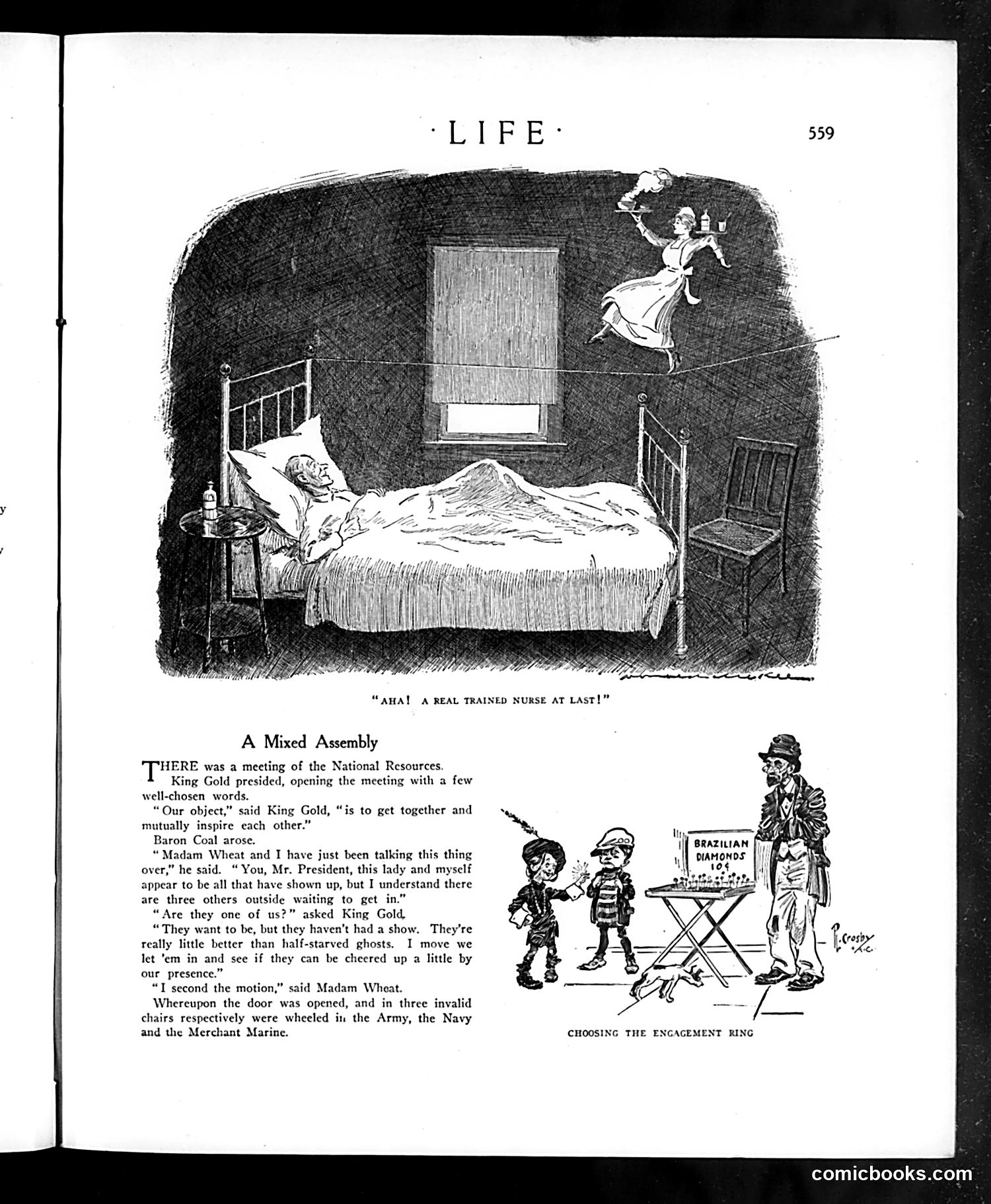
This page contains two separate satirical pieces from Life magazine: **Top cartoon**: "Aha! A Real Trained Nurse at Last!" shows a bedridden patient dreaming of a nurse—likely a humorous commentary on wartime nursing shortages or the desire for professional female caregivers. **Bottom story and cartoon**: "A Mixed Assembly" is an allegory where personified economic forces (King Gold, Baron Coal, Madam Wheat) represent industrial/agricultural power. They meet and decide to "let in" three figures arriving in invalid chairs: the Army, Navy, and Merchant Marine—depicted as weakened, dependent entities needing care from the wealthy industries. The satire critiques how American military and commercial interests are sustained by (and subordinate to) industrial and agricultural monopolies. The accompanying cartoon "Choosing the Engagement Ring" shows these same interests as vendors hawking Brazilian diamonds, reinforcing the theme of commercial/military entanglement. The overall point appears to be skepticism about whether these institutions genuinely serve national interests or merely profit from military and trade arrangements.
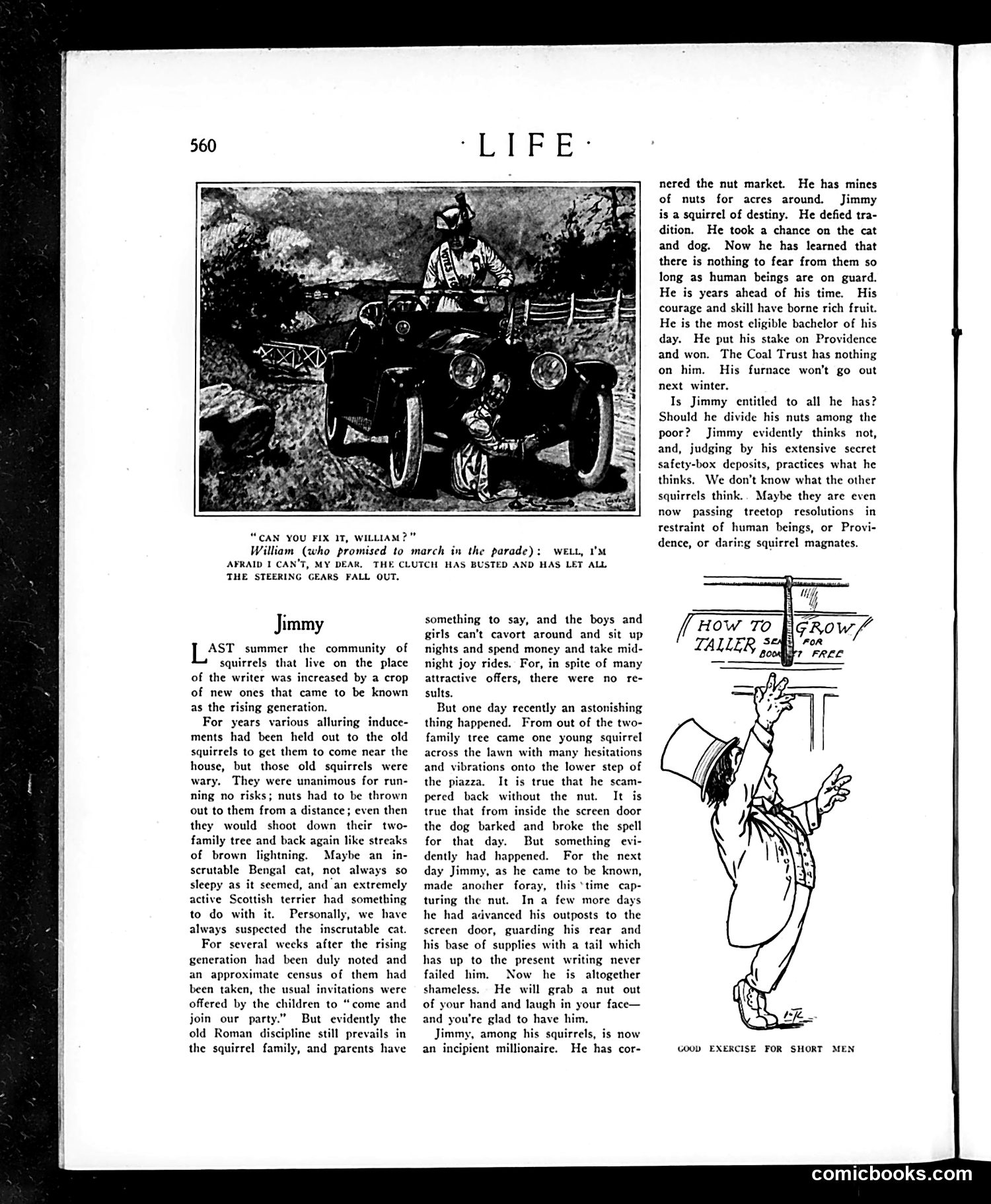
**Top Image/Caption:** Shows William in a broken-down car, apologizing that he can't march in a parade because "the clutch has busted." This is straightforward physical comedy—a humorous excuse for not keeping a promise. **"Jimmy" Story:** This is satirical social commentary dressed as a charming animal tale. Jimmy is a young squirrel who breaks tradition by befriending humans and monopolizing the nut supply, becoming wealthy while older squirrels remain cautious. The satire targets **American capitalism and class anxiety of the 1920s-30s era**: Jimmy represents the ambitious businessman who ignores convention, takes risks, and accumulates wealth without sharing it. The text sarcastically questions whether he should distribute his wealth to "the poor" and jokes about other squirrels forming unions ("treetop resolutions") against such inequality. The story presents this ruthless accumulation as admirable ("courage and skill") while simultaneously mocking it—the irony being that a *squirrel* has become a robber baron. **Side Cartoon:** "Good Exercise for Short Men" shows a figure reaching upward. This is simple physical humor about height.
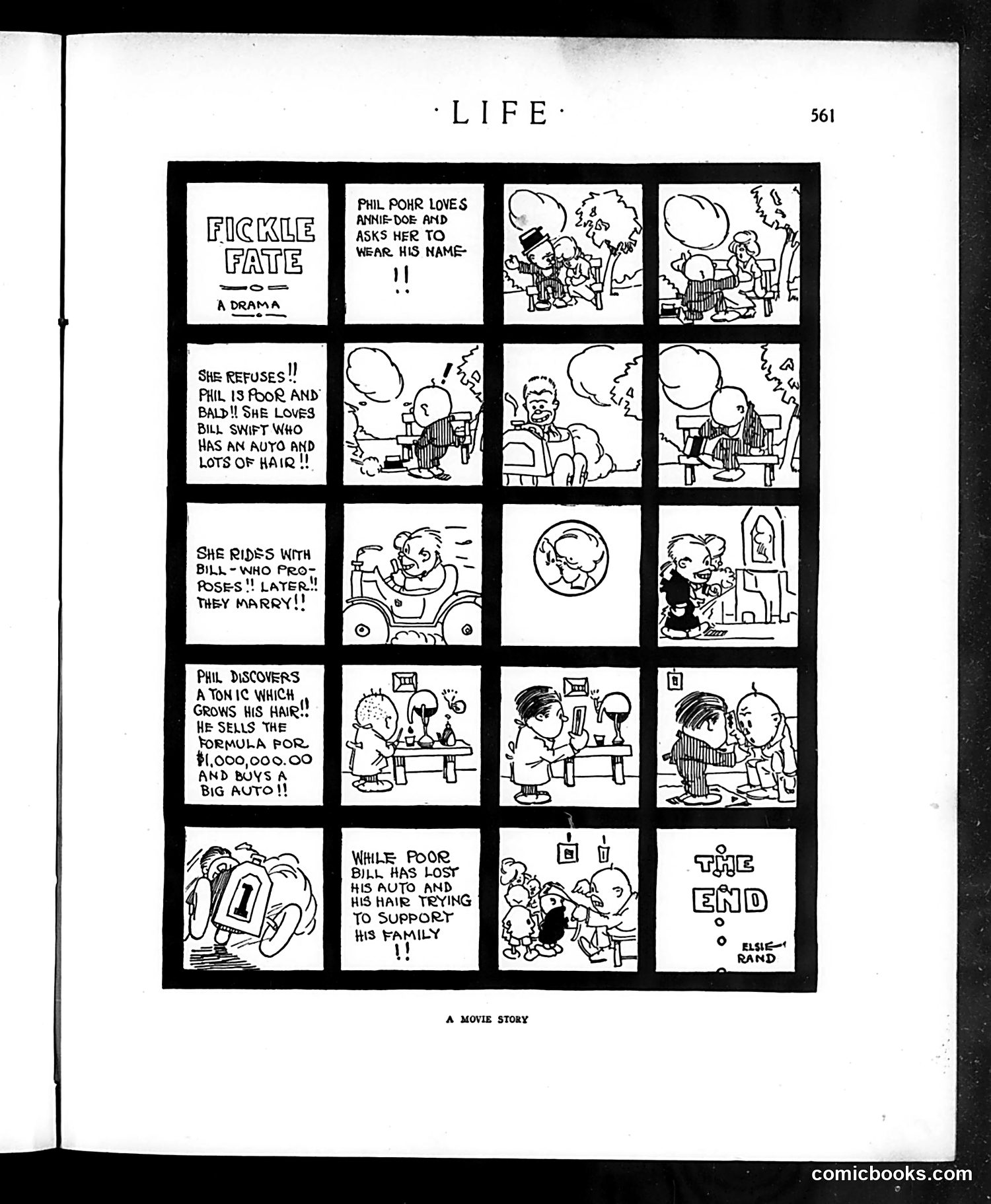
This comic strip parodies the shallow romantic values depicted in 1920s silent films. The narrative follows "Faye," a woman who rejects poor, bald Phil for wealthy Bill Swift—valuing his automobile and hair over character. After marrying Bill, she abandons him when Phil discovers a hair-growth tonic, becomes rich, and buys a fancy car. Now she wants to wear *Phil's* name instead. The satire targets female fickleness and materialism: women portrayed as mercenary, caring only for wealth and appearance. It also mocks the "rags to riches" plot common in silent movies. The ironic twist—that Phil's fortune reverses their situations, causing Faye to switch suitors—exposes how absurd such values are. The credited artist, Elsie Rand, uses this domestic drama to critique both popular entertainment and contemporary attitudes toward women, wealth, and marriage.
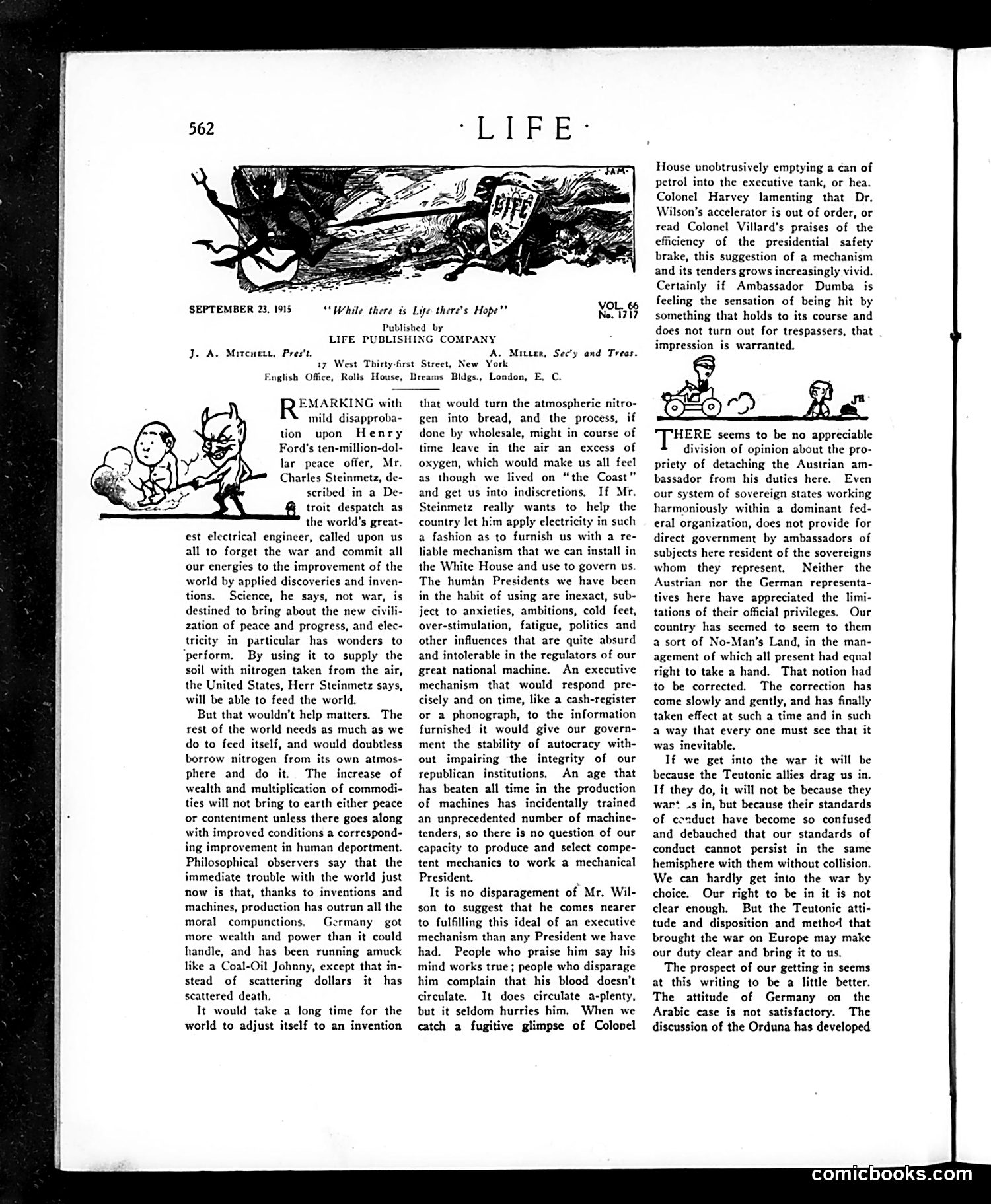
This page satirizes inventor Charles Steinmetz's proposal that applied electricity and science—specifically synthetic nitrogen production—could solve world problems and replace war as a path to progress. The cartoon depicts Steinmetz as a devil-like figure, mocking his technological utopianism. The editorial argues that inventions cannot cure humanity's moral failings, citing Germany's misuse of industrial power in World War I as evidence. The piece then pivots to satirizing President Woodrow Wilson, describing him as a mechanical automaton. References to "Colonel House," "Colonel Harvey," and "Colonel Villard" suggest advisors managing Wilson like a machine—filling his "executive tank" with petrol, adjusting his "accelerator" and "safety brake." This portrays Wilson as a remote, emotionally detached leader lacking spontaneity or human responsiveness, controlled by handlers rather than acting independently. The satire critiques both naive technological optimism and Wilson's perceived mechanical, bloodless approach to governance during America's pre-war period.
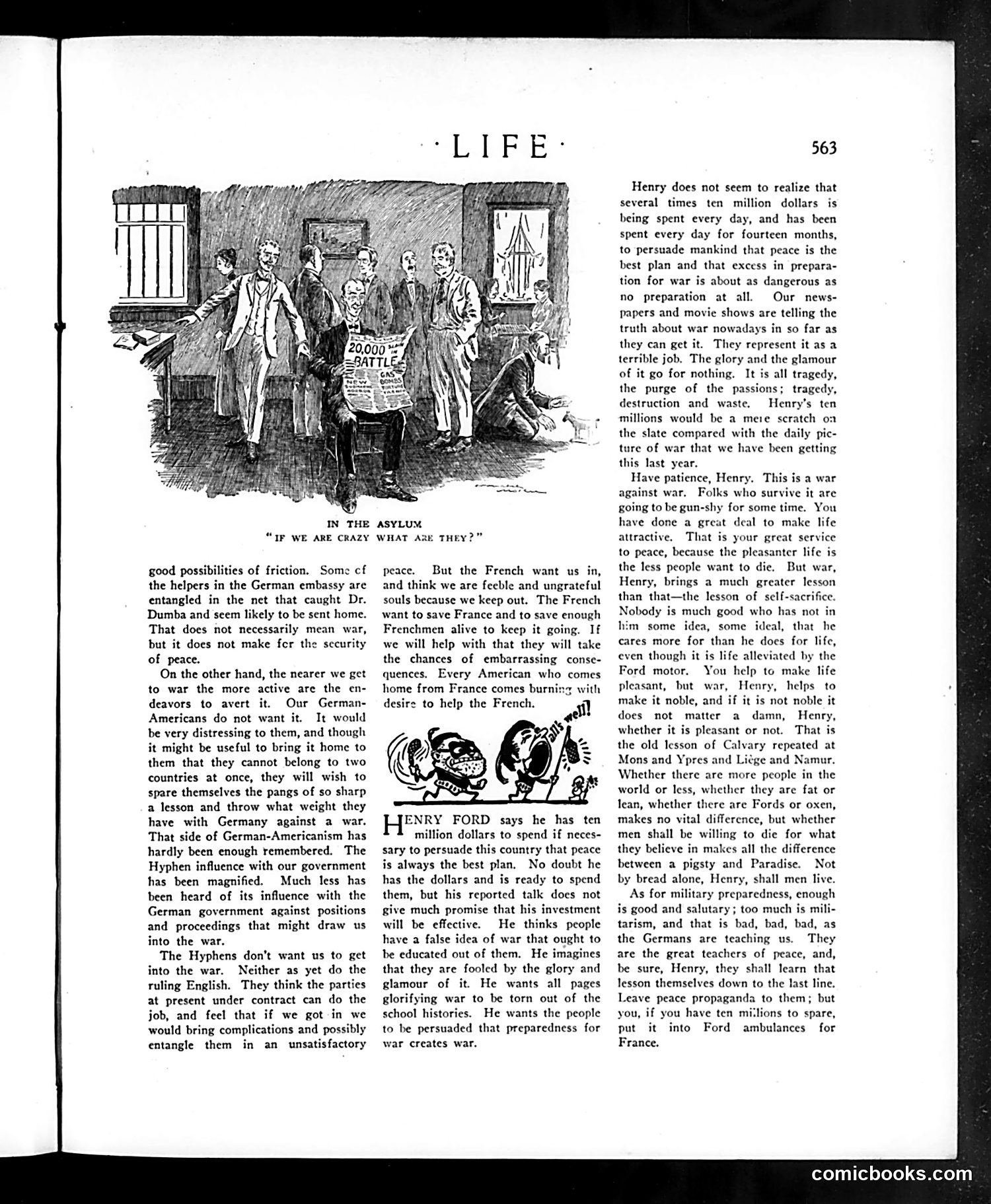
The cartoon "In the Asylum" depicts World War I-era American political debate. The sketch shows men in an asylum discussing whether they are "crazy," satirizing the divided American public over whether the U.S. should enter the war (America entered in 1917). The accompanying text discusses Henry Ford's peace advocacy—his plan to spend millions promoting pacifism and removing war glorification from schoolbooks. The author argues Ford's efforts are futile against the daily reality of war reporting in newspapers and films. The piece also references German-American ("Hyphen") political influence, French pressure for American intervention, and the tension between peace advocates and those viewing military sacrifice as noble and necessary. The satire suggests that debating peace while war rages abroad is itself a form of madness—a critique of American isolationism amid global conflict.
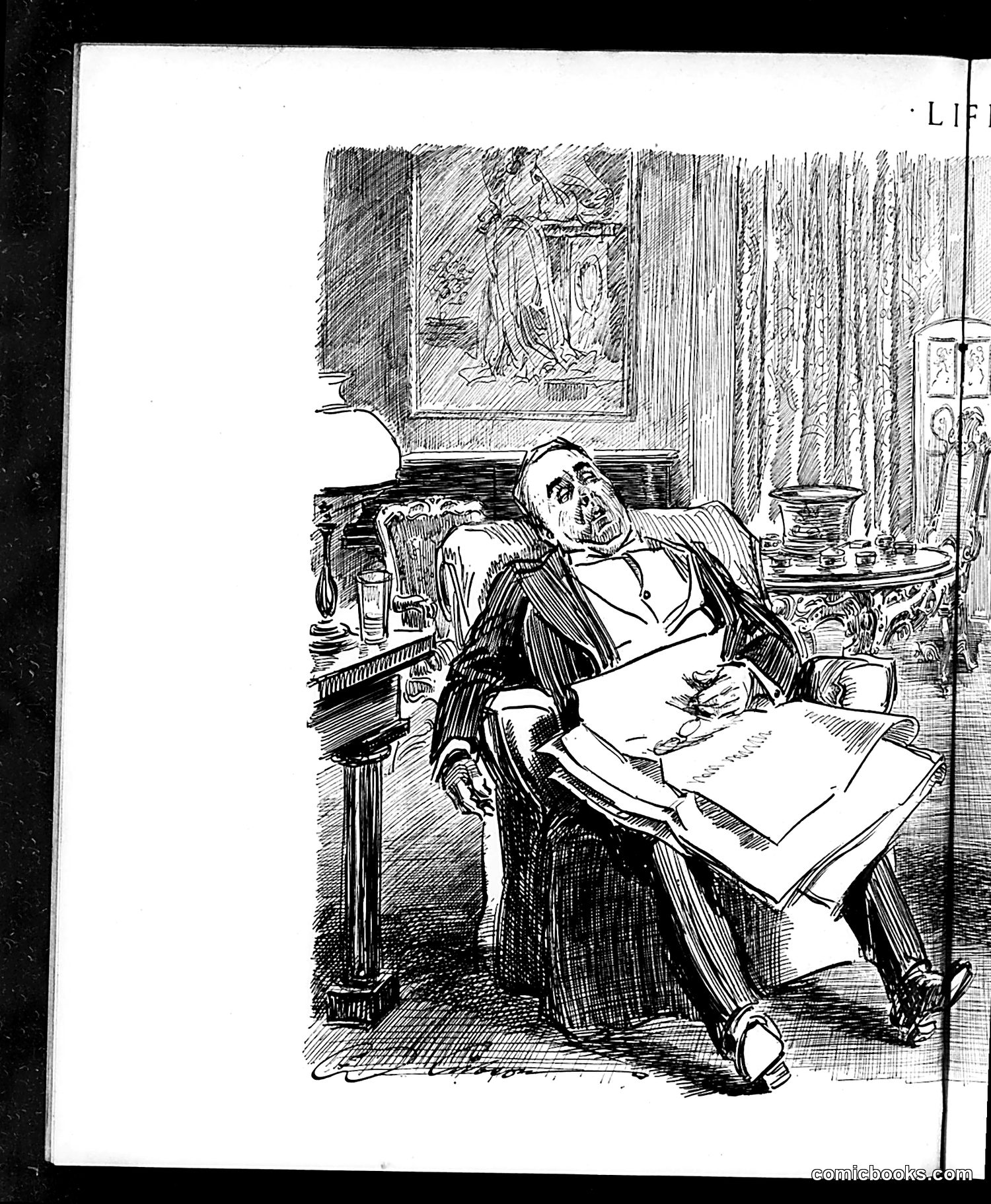
This page shows a single ink illustration of a well-dressed man in a suit, reclined in a chair at what appears to be an ornate desk or study. He holds papers and looks relaxed or satisfied. The setting suggests a person of wealth or authority in a private study, with detailed furnishings visible in the background. However, **the OCR text is largely illegible** and provides no caption or explanation. Without visible text identifying the figure or the cartoon's subject, I cannot determine: - Who this person represents - What political or social situation is being satirized - What the specific joke or critique is meant to convey The artistic style and setting suggest this is likely political satire from Life magazine's satirical period, but I cannot accurately identify the specific reference or meaning without clearer caption text.
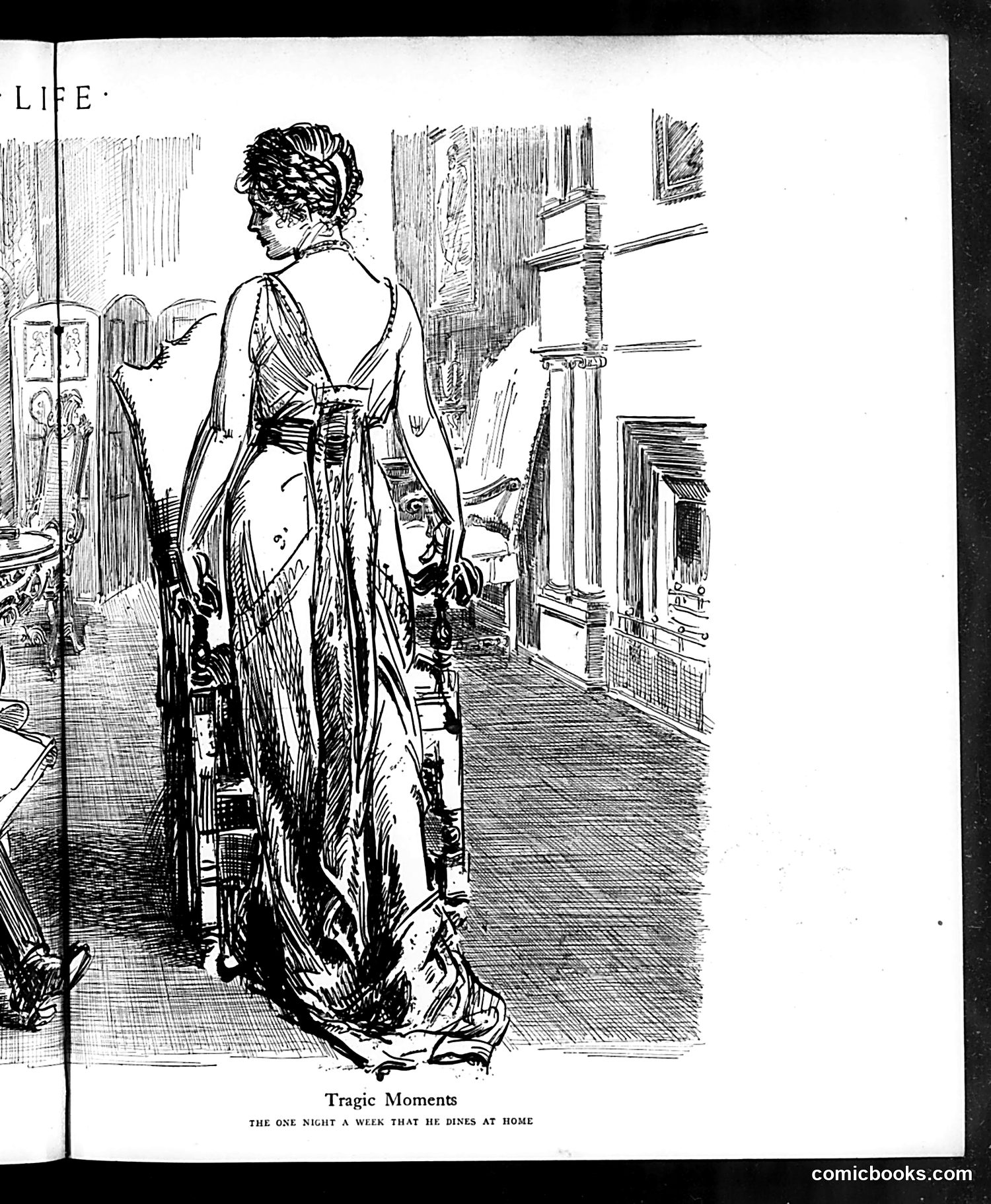
This is a satirical illustration titled "Tragic Moments" with the subtitle "The One Night a Week That He Dines at Home." The image shows a woman in an elegant evening gown standing in what appears to be a dining room or hallway, viewed from behind. The satire targets domestic life and marriage—specifically the supposedly romantic occasion when a husband dines at home, which the caption suggests happens only once weekly. The woman's elaborate formal dress contrasts with the mundane reality of home dining, suggesting either disappointment with domestic life or ironic commentary on the gap between romantic expectation and actual marriage experience. The joke relies on the implication that husbands routinely dine elsewhere (likely at clubs or restaurants), making home dinners rare "tragic moments" worthy of elaborate dress.
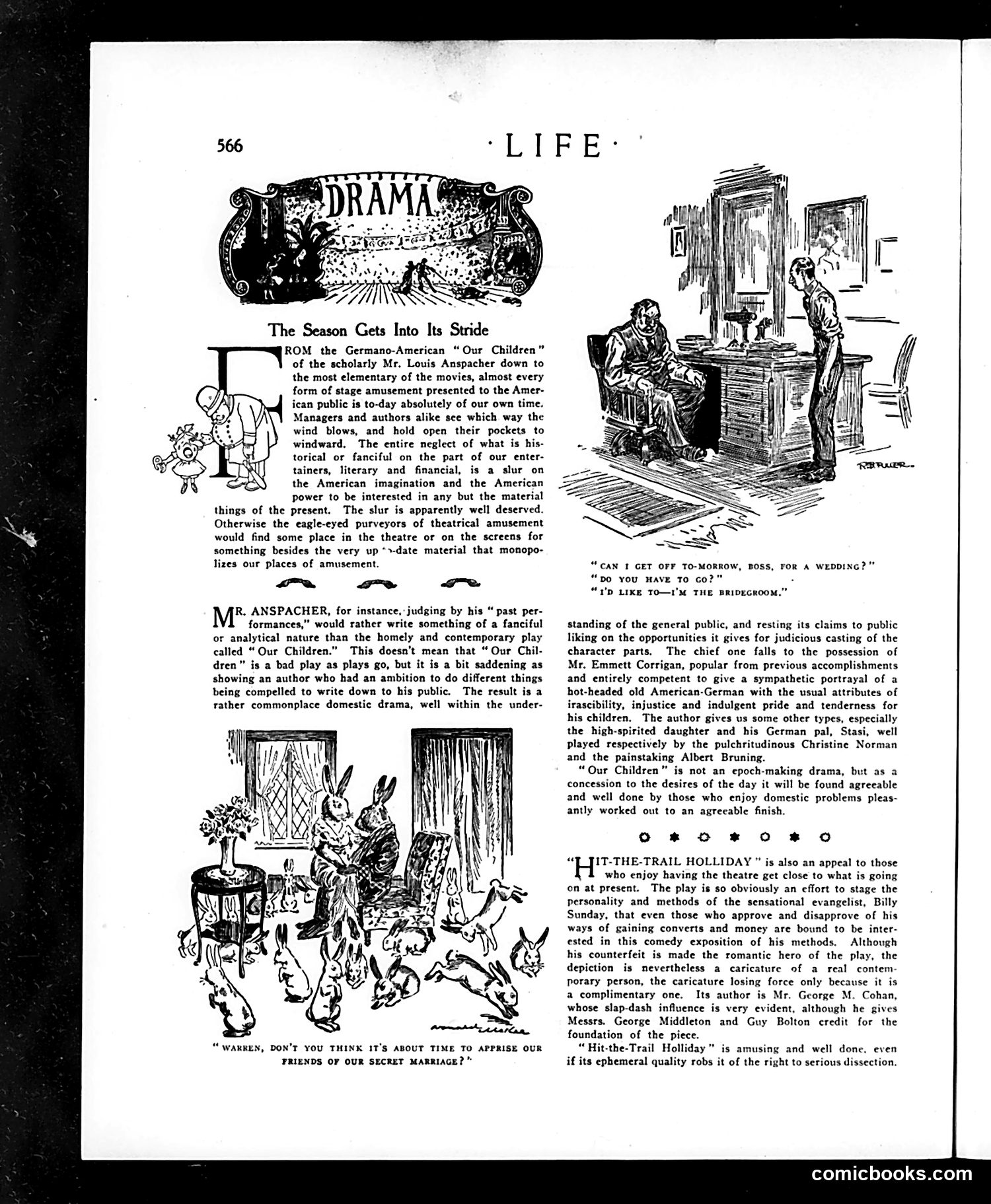
This page reviews contemporary theatrical productions, critiquing American entertainment's obsession with topical, present-day material over imaginative storytelling. **Main reviews discussed:** 1. **"Our Children"** by Louis Anspacher—a domestic drama featuring Emmett Corrigan as a hot-headed German-American father. The critic views it as competently executed but artistically compromised; Anspacher allegedly abandoned higher artistic ambitions to write "down to his public." 2. **"Hit-the-Trail Holliday"** by George M. Cohan—a comedy satirizing evangelist Billy Sunday's sensational conversion methods and fundraising. The critic notes it's entertaining but superficial satire, losing impact precisely because it flatters its subject rather than truly critiquing him. **The satirical point:** Managers and playwrights pander to audience demand for contemporary material, neglecting imaginative or historical drama. The cartoons and jokes mock this materialism—depicting workplace concerns (a boss refusing an employee time off for his own wedding) as the mundane reality theaters now prioritize over fanciful entertainment.
This page critiques two early films: **"Trilby"** (adapted from a popular novel) and **"The Battle Cry of Peace"** (a patriotic defense film). The cartoons at top show a figure being struck—likely satirizing how cinema relies on crude physical comedy ("mugging") rather than psychological depth. **The satire's point:** Both films exemplify cinema's shallow approach. "Trilby" wastes the camera's artistic potential by prioritizing mechanical spectacle over the source material's subtlety. "The Battle Cry of Peace," despite tackling serious national preparedness themes, undermines itself through cheap sentimentality and exaggerated acting—appealing to "gum-chewing audiences" rather than intelligent viewers. The critic argues patriotic appeals lose force when wrapped in theatrical excess. He notes the film shows only New York under attack, not Western cities, limiting its persuasive power for actual defense readiness. **Core complaint:** Early cinema prioritizes entertaining "the cheap public" over artistic integrity or practical messaging.
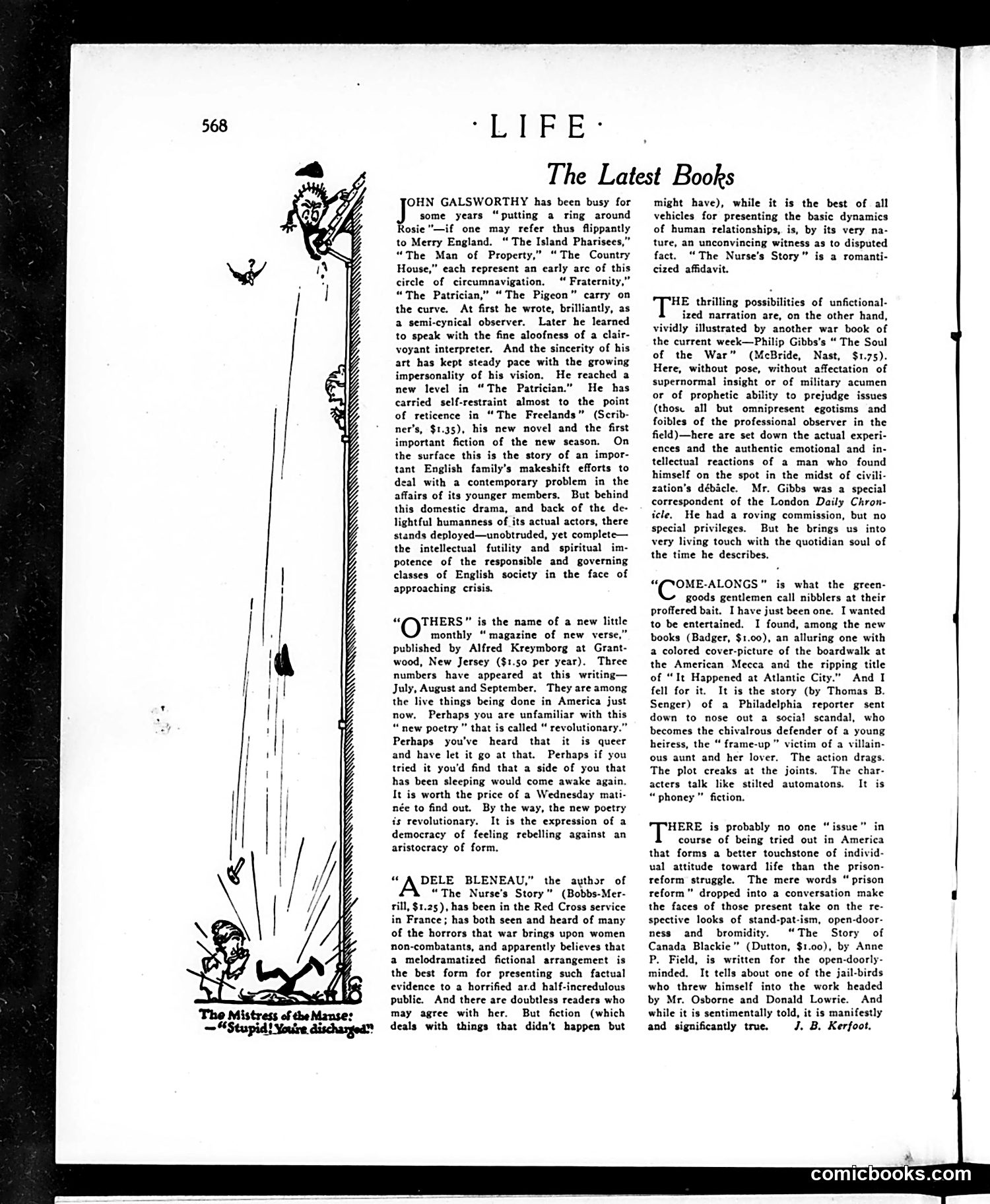
The cartoon depicts a domestic scene where a woman (the "mistress of the manse," or lady of the house) scolds a male servant or employee, calling him "Stupid! You're discharged." The satire targets the arbitrary authority and harsh treatment servants received from their employers in Edwardian England. The title references the woman's position as head of household. Her imperious dismissal—apparently for some minor infraction—exemplifies the callous power dynamics between social classes of the era. This cuts against the contemporary literary works reviewed on the page, particularly John Galsworthy's novels about English society's "intellectual futility and spiritual impotence" in facing crisis. The cartoon suggests that even in the home, England's governing classes display moral shortcomings and cruelty, reinforcing the page's broader critique of English society's failures.
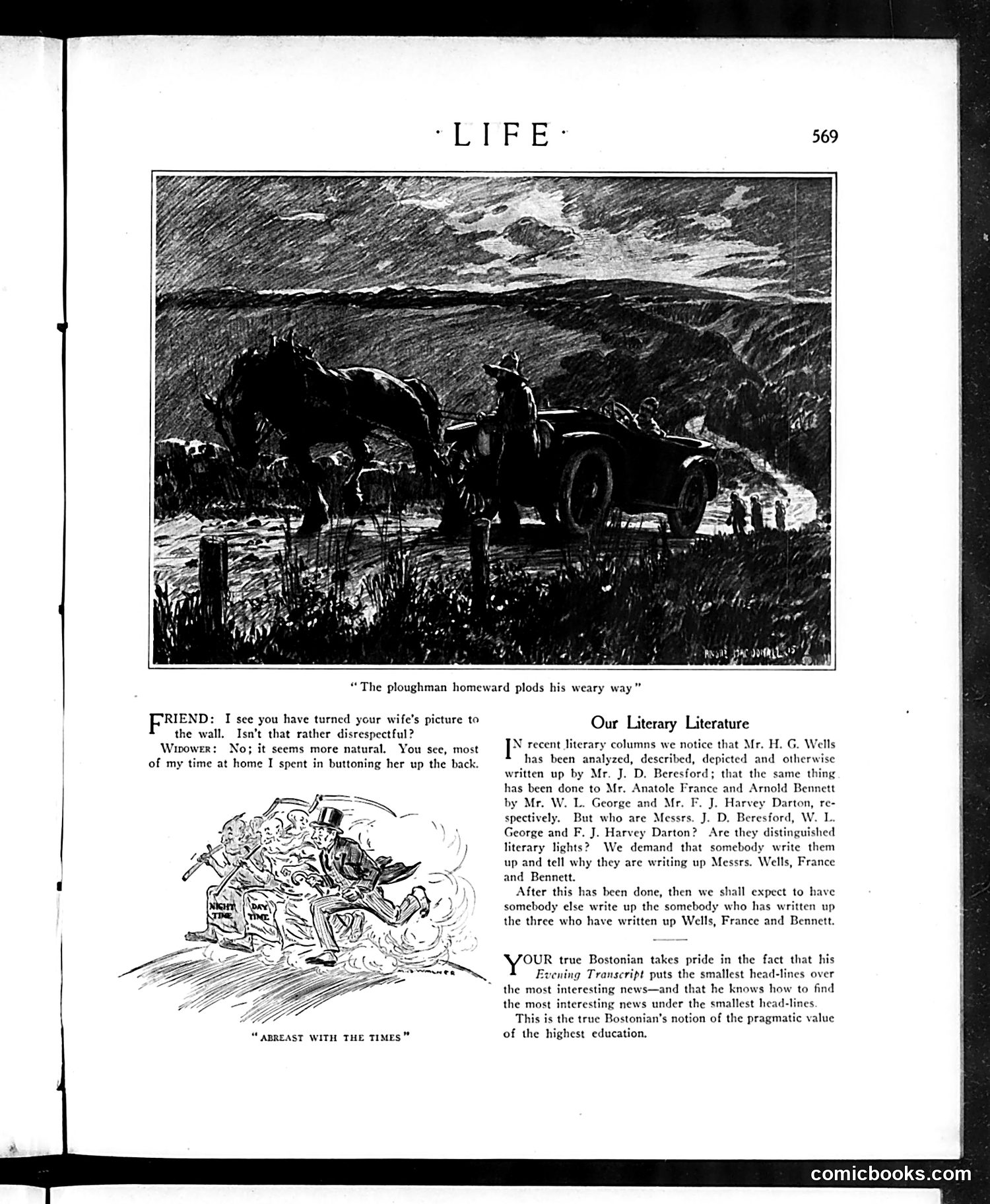
**Top Cartoon:** "The Ploughman Homeward Plods His Weary Way" depicts a rural scene with a horse-drawn plow, illustrating honest agricultural labor. **Middle Joke:** A widower explains turning his wife's portrait to the wall isn't disrespectful—he spent most home time buttoning up her dress, so facing the wall seems natural. This is a mildly risqué joke about marital duties, typical of early 20th-century humor. **"Abreast with the Times":** A cluttered illustration of tangled, overstuffed newspapers—satirizing how newspapers present excessive information. **"Our Literary Literature":** Satire of self-referential literary criticism. The piece mocks a chain of literary critics writing about other critics writing about famous authors (Wells, France, Bennett). It questions who these secondary critics are and proposes an infinite regress where each critic gets written about by another—poking fun at literary establishment navel-gazing. **Boston Section:** Satirizes the *Boston Evening Transcript's* practice of printing tiny headlines over important news, suggesting Bostonians pride themselves on intellectual sophistication in extracting meaning from minimal information.
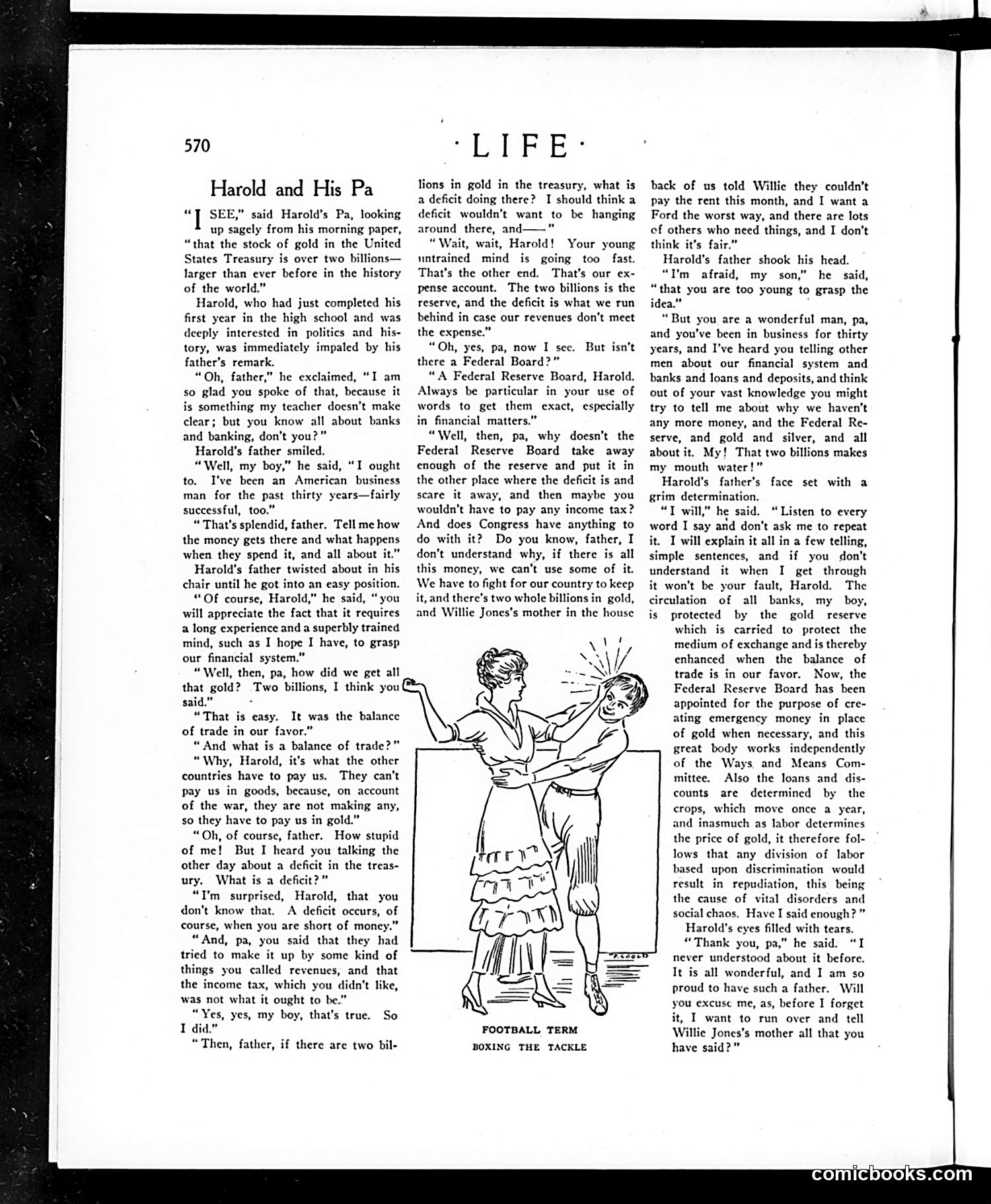
This is a satirical dialogue about post-WWI American financial policy. Harold, a high school student, questions his father—a successful businessman—about apparent contradictions in U.S. Treasury management. The satire targets the gap between expert confidence and logical inconsistency: the father boasts of understanding complex finance yet cannot explain why the nation simultaneously holds $2 billion in gold reserves *and* runs a deficit, nor why those reserves cannot address the deficit or help citizens like "Willie Jones's mother" pay rent. The cartoon (showing two figures grasping/pulling at something) likely illustrates the tension between competing financial claims. The joke is that Harold's innocent, logical questions expose the absurdity of the financial system itself—suggesting that even a trained businessman's explanations collapse under scrutiny. It's a Depression-era critique of government fiscal management and the apparent paradox of national wealth coexisting with citizen poverty.
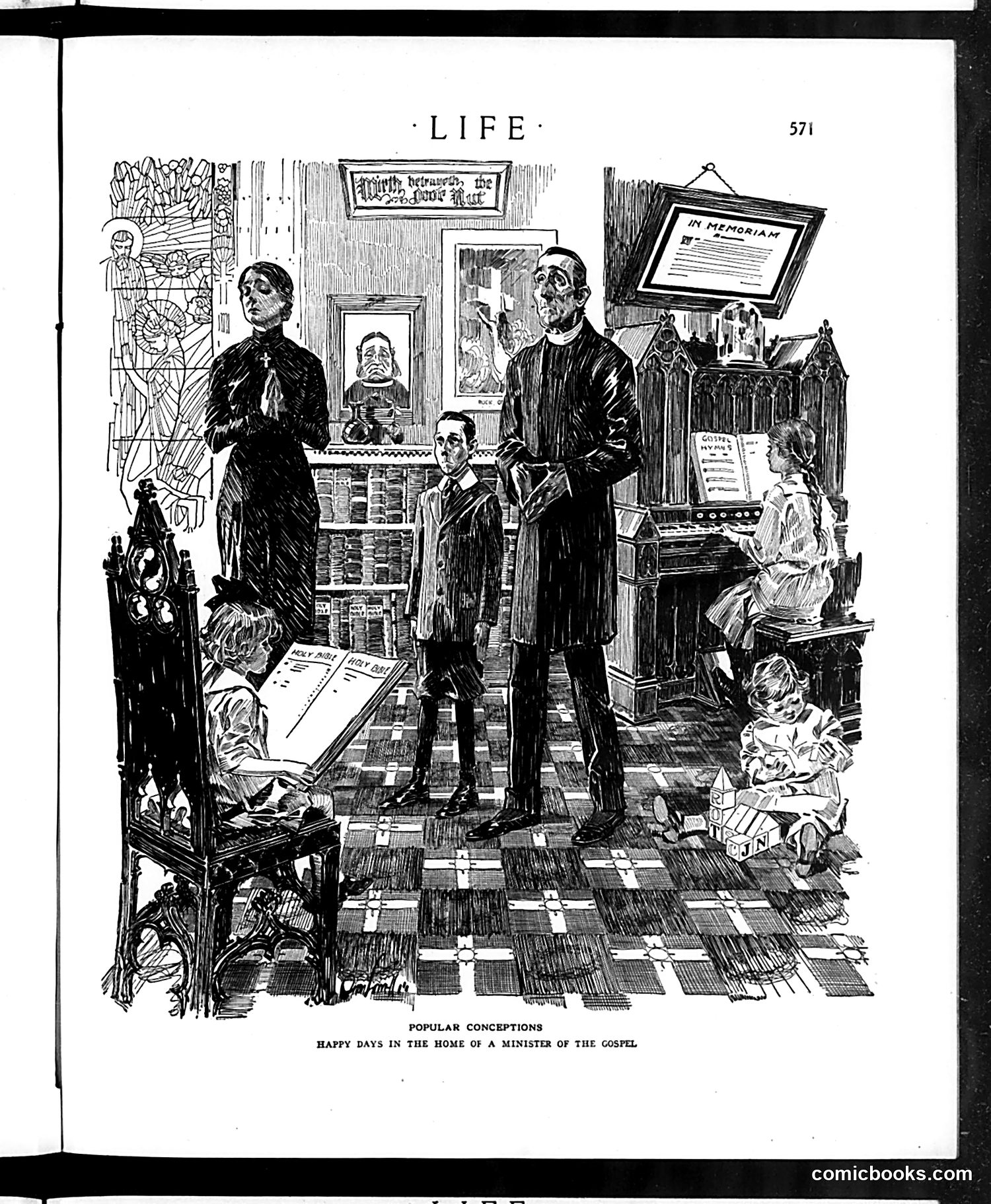
This cartoon satirizes idealized notions of a Protestant minister's home life. The caption "Happy Days in the Home of a Minister of the Gospel" is ironic—the scene shows chaos rather than contentment. The interior depicts multiple disruptions: children play underfoot, a woman sits at an organ (suggesting tedious piety), men conduct serious business in the parlor, and various religious items (crucifixes, memorial plaques, stained glass imagery) clutter the space. The clergy figure stands amid this disorder, apparently undisturbed or oblivious. The satire mocks the gap between public perception of ministerial homes as havens of virtue and discipline versus the messy reality of crowded, chaotic domestic life. It critiques both sentimental romanticizing of religious households and, implicitly, the impracticality of maintaining such idealized standards.
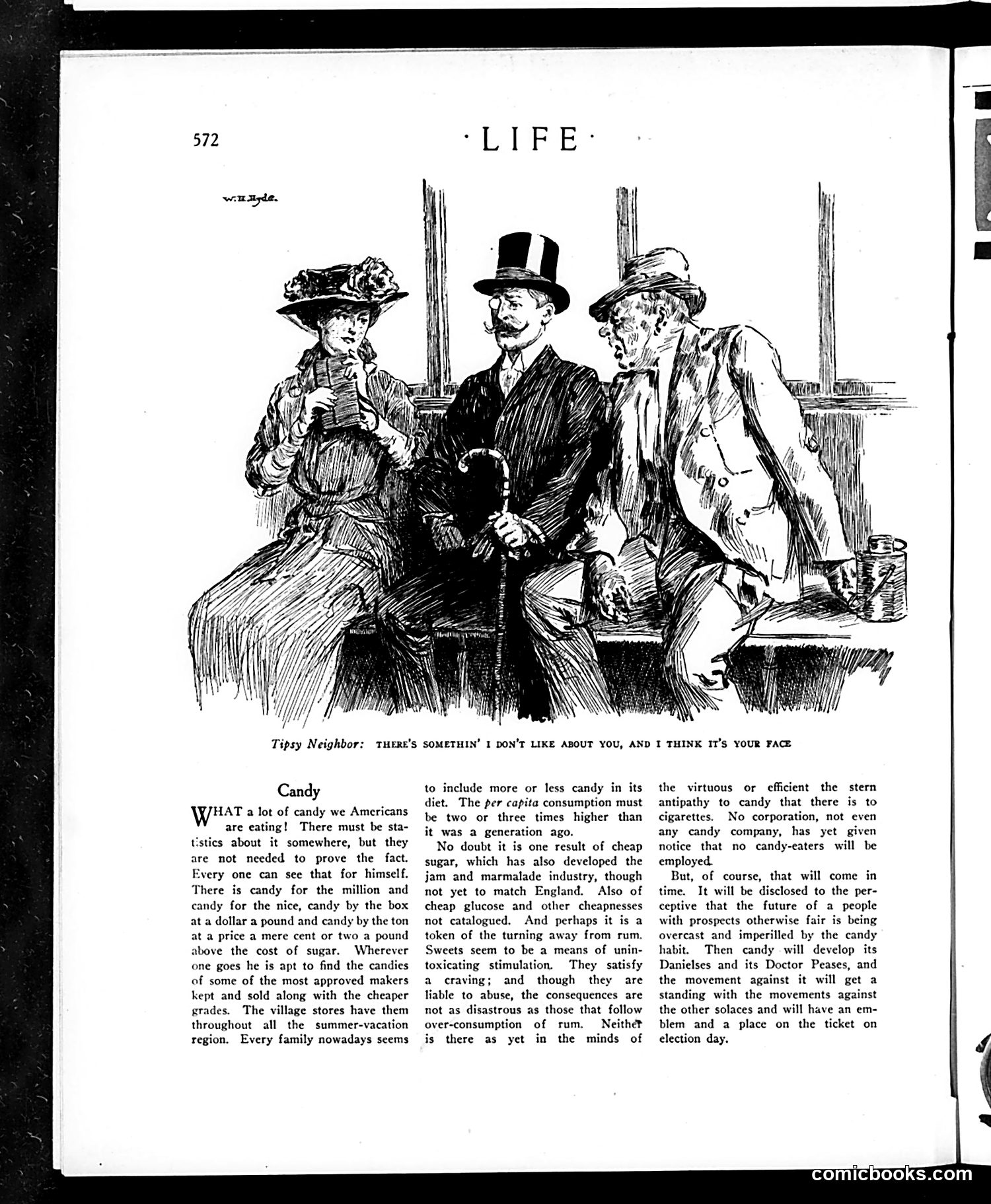
This *Life* magazine page contains two distinct pieces: **The Cartoon (top):** A drunk man confronts three well-dressed people, saying he dislikes their faces. It's a simple gag about alcohol-fueled rudeness, with no apparent political meaning. **The "Candy" Essay (bottom):** Social satire about Americans' growing candy consumption. The writer observes that candy eating has become ubiquitous and notes it's replacing alcohol as a stimulant. The satire's point: he predicts that eventually, progressive reformers will demonize candy the way they currently oppose cigarettes and alcohol, creating anti-candy crusades and politicians who pledge to ban candy-eaters from employment. This reflects early 20th-century anxieties about public morality movements and corporate reform campaigns. The author gently mocks both unchecked consumption *and* the tendency of reformers to identify new social "evils" to campaign against—treating candy prohibition as inevitable despite currently seeming absurd.
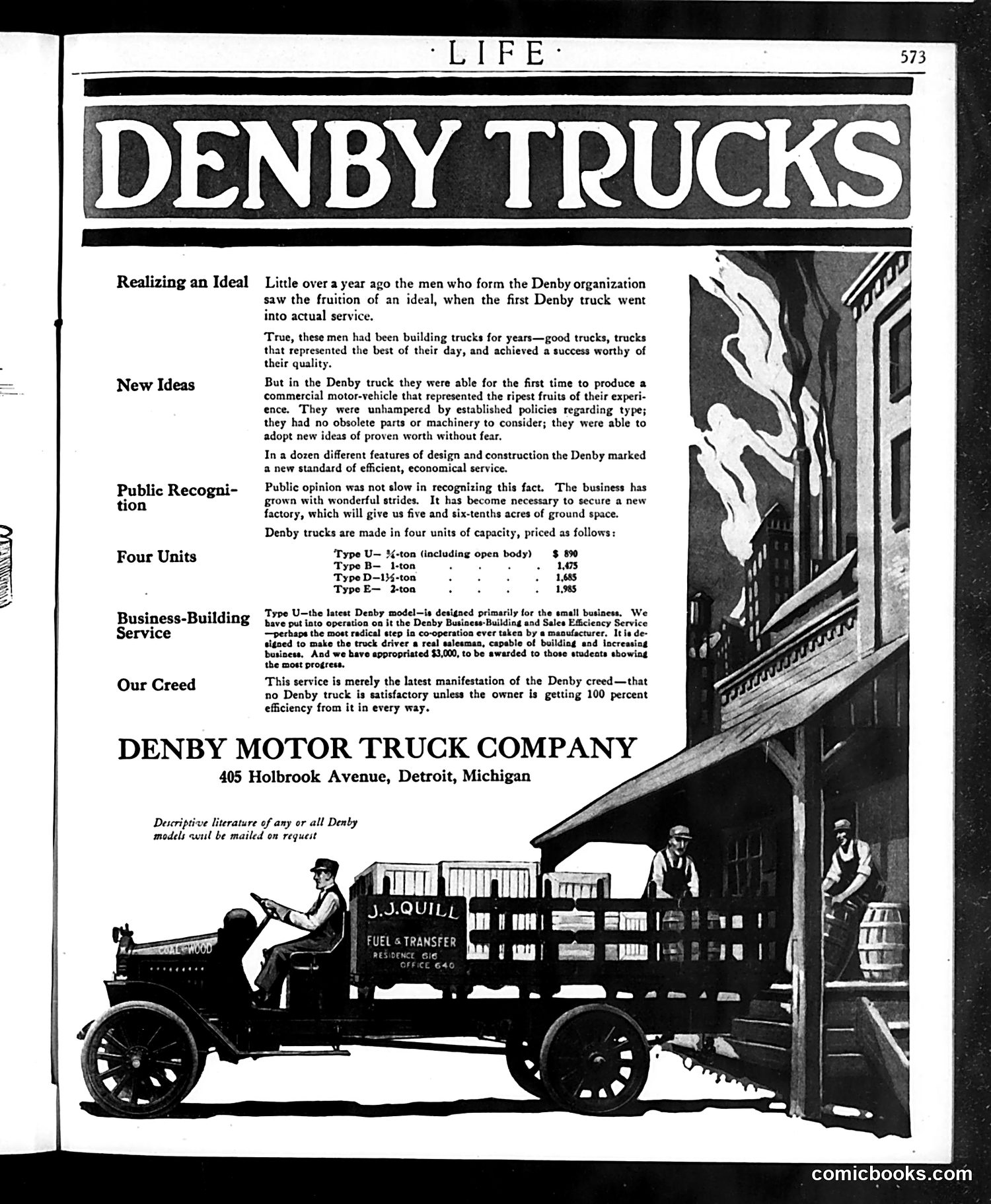
This is **not a cartoon or satire**, but a straightforward **advertisement** for the Denby Motor Truck Company of Detroit. The page promotes Denby's new truck line by emphasizing innovation: unlike established manufacturers burdened by outdated parts and policies, Denby could adopt "new ideas of proven worth without fear." The company highlights four truck models ranging from ¾-ton to 2-ton capacity, priced $890–$1,985. The illustration shows a Denby truck delivering fuel for "J.J. Quill Fuel & Transfer," demonstrating practical commercial use. A notable feature is the "Business-Building and Sales Efficiency Service"—a $3,000 training program for truck drivers, positioning them as salesmen to increase customer business. This reflects early automotive industry efforts to create customer loyalty through driver education. The tone is aspirational, positioning Denby as a modern, progressive manufacturer unburdened by industrial tradition.
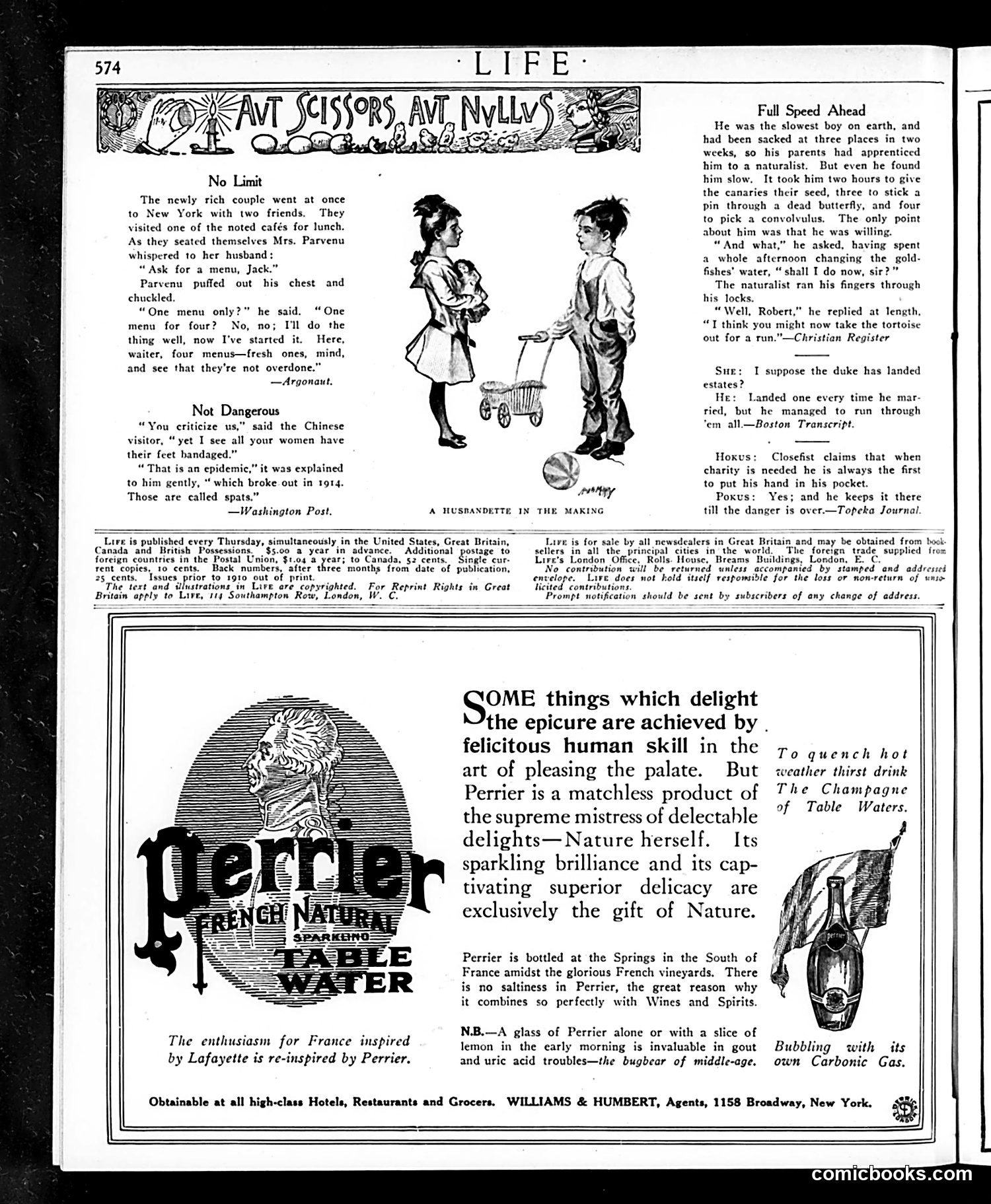
This page contains several brief satirical anecdotes typical of early 20th-century American humor magazines: **"No Limit"** mocks newly wealthy "parvenus" (social climbers) who ostentatiously order four fresh menus at a café to display their newfound riches—a comedic exaggeration of nouveau riche excess. **"Full Speed Ahead"** humorously describes an impossibly slow apprentice naturalist, playing on the irony that despite his glacial pace at mundane tasks, his only virtue is willingness. **"Not Dangerous"** features a Chinese visitor criticizing women's "bandaged feet," only to learn the "epidemic" refers to spats (ankle coverings)—a joke exploiting 1910s-era awareness of Chinese foot-binding practices while poking fun at contemporary American fashion. The page is primarily filler material—brief jokes and anecdotes—alongside a substantial **Perrier water advertisement** promoting the French sparkling water as a natural luxury product and digestive aid. The humor reflects genteel, class-conscious American satire of the era, gently mocking both social pretension and fashion follies.
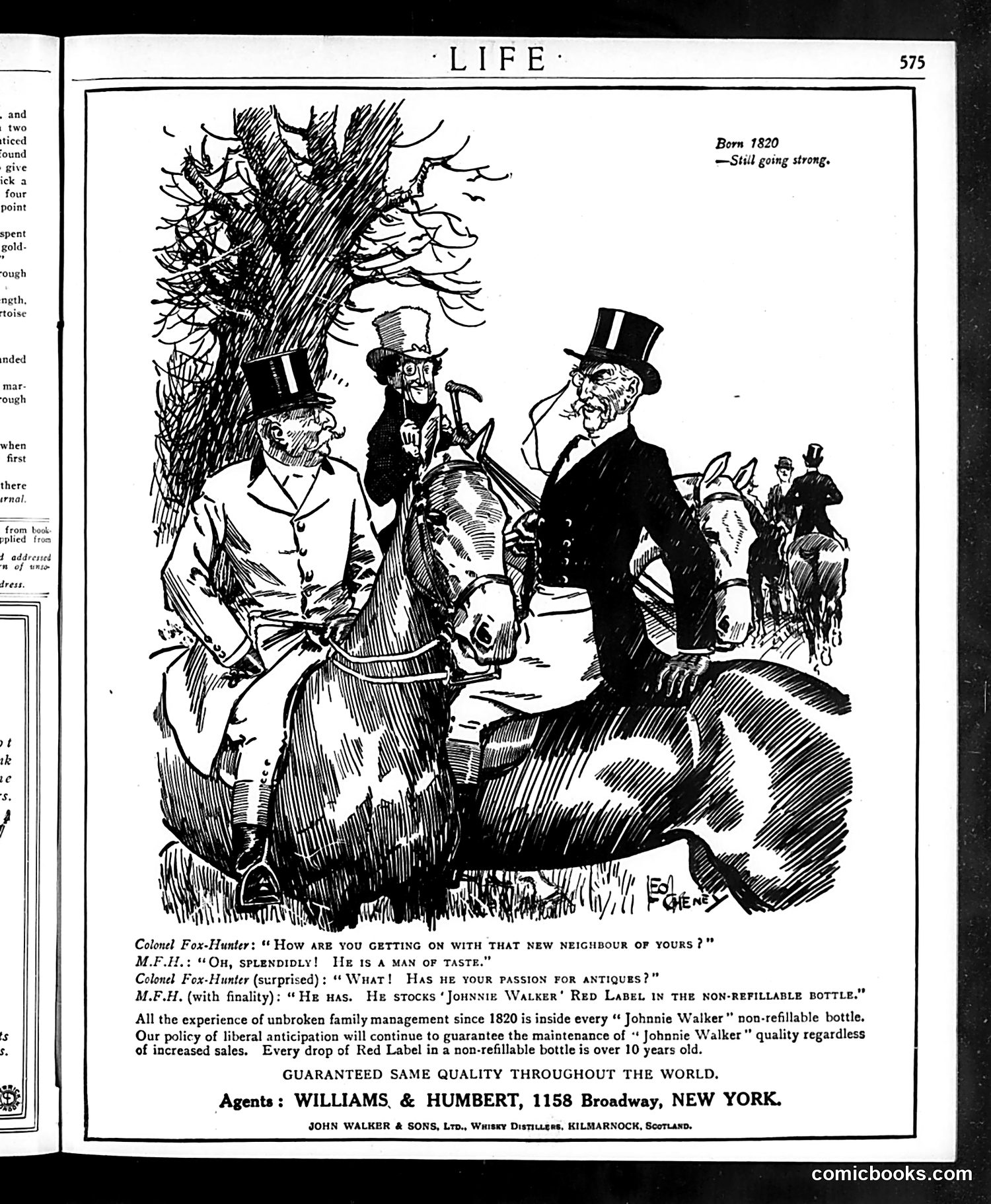
This is primarily a **whisky advertisement** disguised as satirical humor. Two fox-hunting gentlemen on horseback discuss a new neighbor. One praises him as "a man of taste," and when asked if he shares a passion for antiques, the punchline reveals the neighbor's refined taste is actually his preference for Johnnie Walker Red Label whisky in non-refillable bottles. The joke equates drinking quality scotch with collecting antiques—positioning whisky consumption as a mark of sophistication and "taste." The ad emphasizes the product's century-old heritage ("Born 1820—Still going strong") and guarantees consistent quality. The fox-hunting setting and upper-class dialogue reinforce the whisky's positioning as an elite product for gentlemen of means. This appears typical of early 20th-century advertising strategy: wrapping commercial messaging in seemingly clever social commentary to appeal to aspirational consumers.
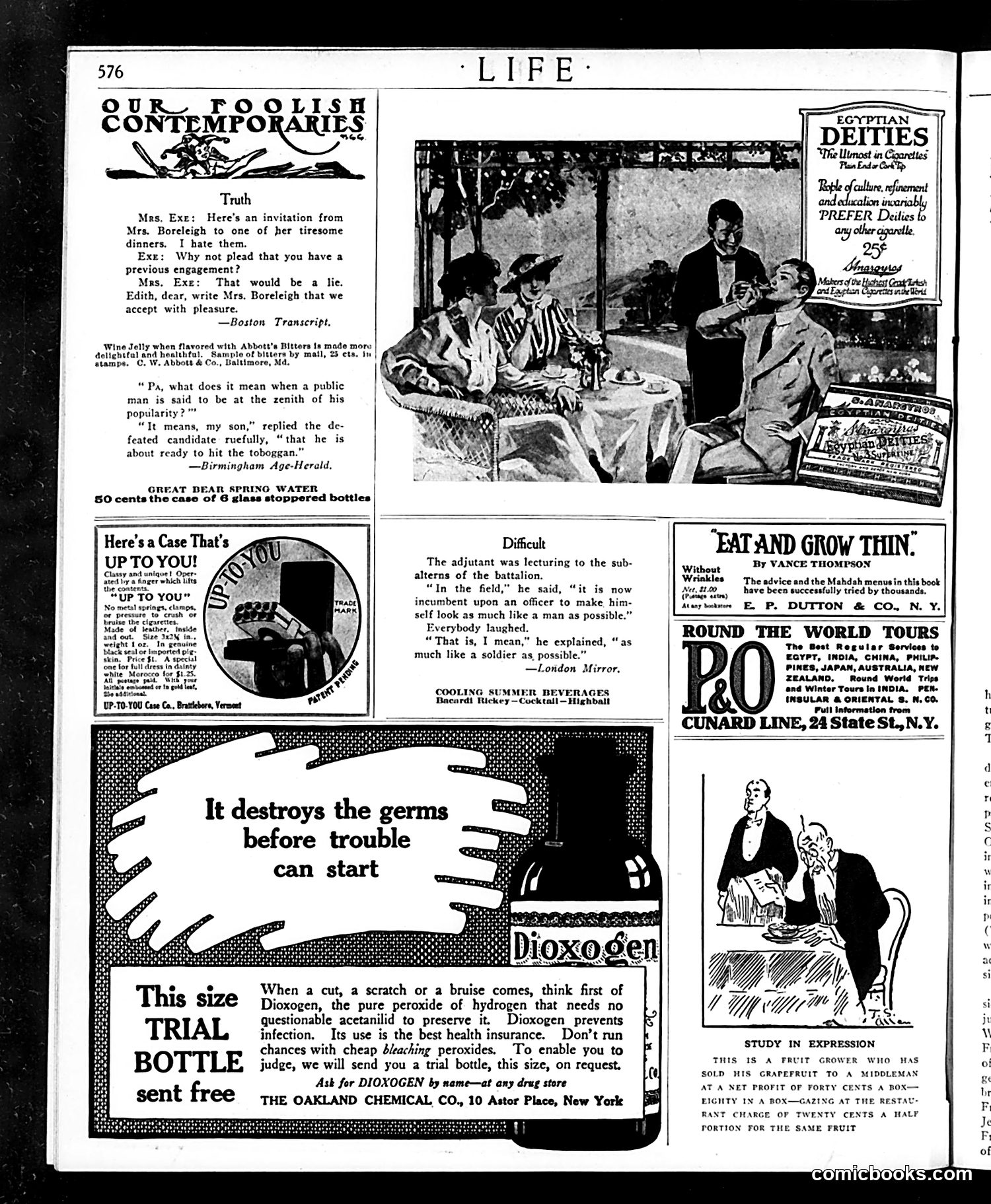
This page mixes satirical humor with period advertising. The top cartoon satirizes social obligation: Mrs. Exe must accept a tedious dinner invitation from Mrs. Boreleigh despite hating such events, because pleading a prior engagement would be dishonest—suggesting the rigid social conventions constrained people into uncomfortable situations. A second joke mocks political decline: a defeated candidate explains that a public man "at the zenith of popularity" means he's "about ready to hit the toboggan"—i.e., about to lose power and fall from favor. A military cartoon jokes about officer appearance standards becoming absurdly focused on looking "like a man" rather than competent soldiering. The remainder consists of period advertisements: patent medicines (Dioxogen disinfectant, Abbott's Bitters), diet books ("Eat and Grow Thin"), and travel services. The bottom cartoon shows a cheapskate restaurant patron upset at costs—a common humor subject of the era. The page reflects early 20th-century concerns: social conformity, political instability, and consumer health anxieties.
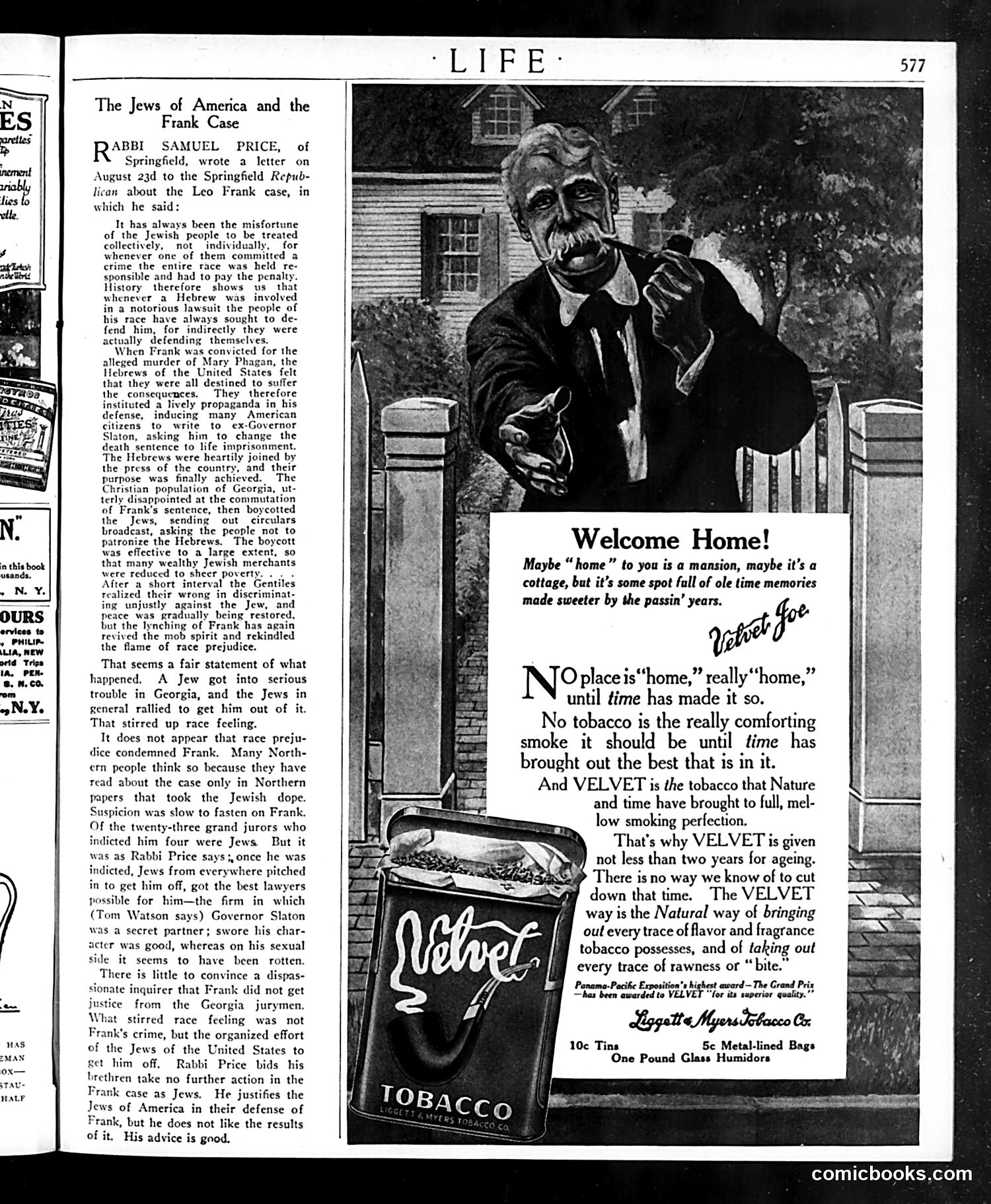
This page juxtaposes serious political commentary with commercial advertising. The left column discusses the Leo Frank case—a real 1913 Georgia murder conviction of a Jewish man. Rabbi Samuel Price's letter explains how Frank's case inflamed anti-Jewish sentiment: when Frank was convicted, Georgia's Christian population boycotted Jewish merchants in retaliation; when Governor Slaton commuted his death sentence, Frank was later lynched by a mob. The right side features a Velvet tobacco advertisement depicting an elderly man at a homestead with the slogan "Welcome Home!" The ad emphasizes how tobacco "improves" with age, mirroring time's refinement. The jarring contrast appears intentional—Life's satirical editors likely positioned a sentimental, nostalgic advertisement beside coverage of racial violence and religious prejudice, creating ironic commentary on American "home" and belonging during a period of intense anti-Semitism.
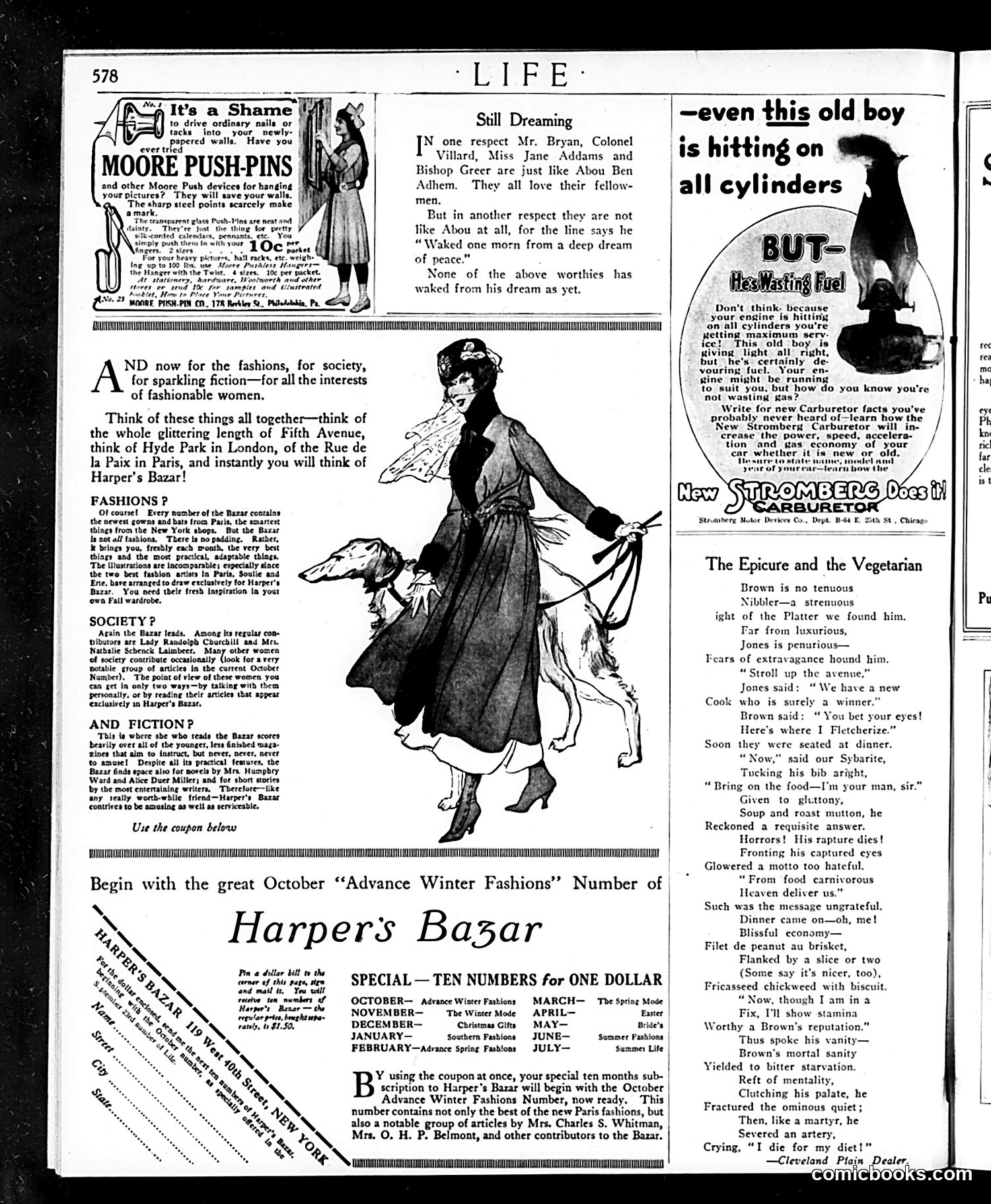
This Life magazine page features **advertising and light social commentary** rather than political cartoons in the modern sense. **Main elements:** 1. **Moore Push-Pins ad** (top left): A hardware product advertisement with practical copy. 2. **Fashion illustration** (center): A woman in stylish coat walking a greyhound, accompanying text praising Harper's Bazaar magazine for covering fashions from Fifth Avenue, Hyde Park London, and Paris—establishing aspirational sophistication for wealthy female readers. 3. **Stromberg Carburetor ad** (right): Claims even "this old boy is hitting on all cylinders"—a humorous automobile advertisement using the metaphor of engine performance. 4. **"The Epicure and the Vegetarian"** (lower right): A poem contrasting two dinner guests—one gluttonous ("Sybarite"), one ascetic ("vegetarian")—poking gentle fun at both dietary extremes. The vegetarian's moral superiority becomes pompous when confronted with actual food. **The satire targets** fashionable materialism, consumer culture, and self-righteous dietary philosophies—all through humor rather than sharp political critique. This reflects Life's role as sophisticated entertainment for urban, wealthy audiences.
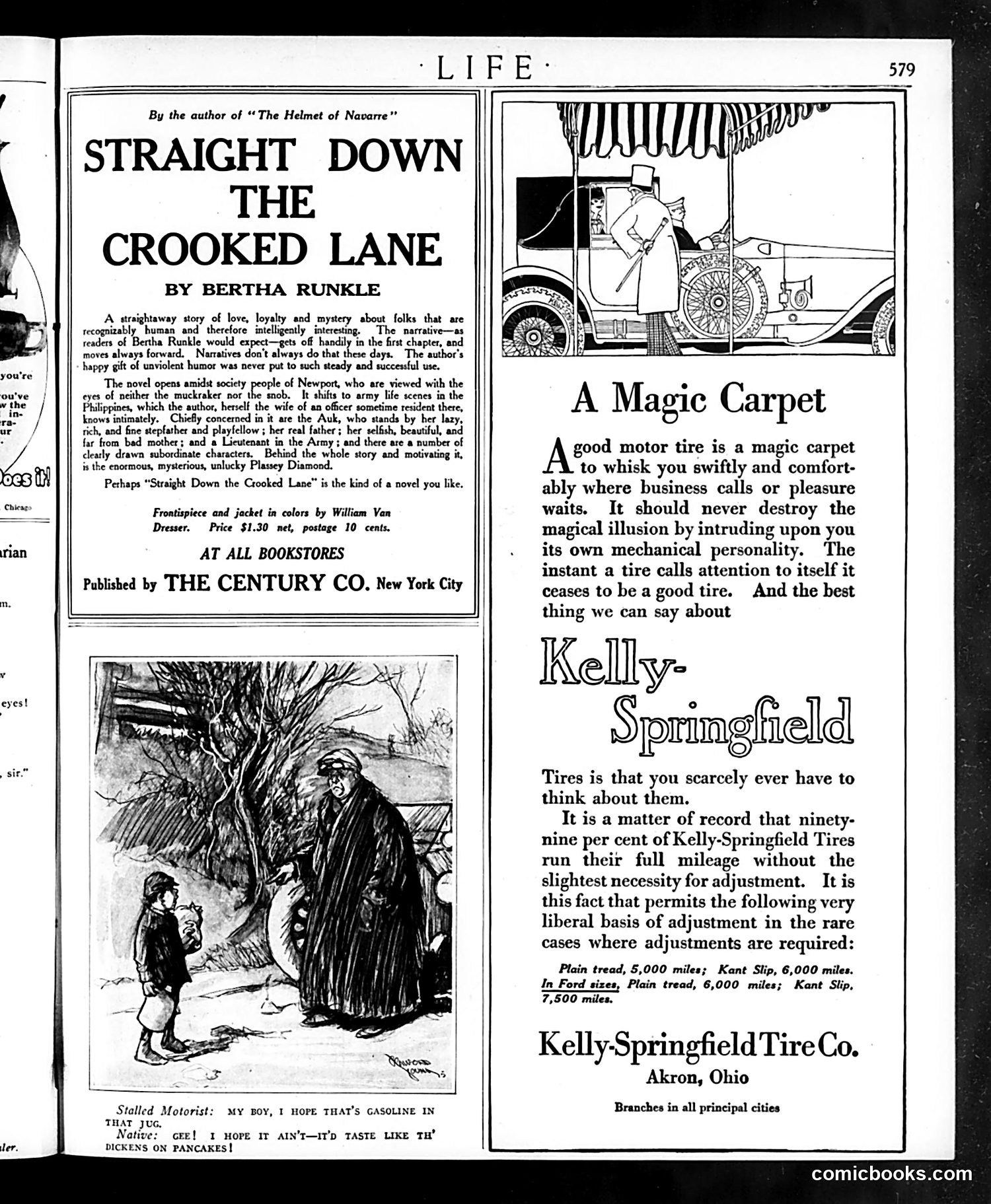
This page contains a book advertisement and a cartoon satirizing early automobile culture. **The Cartoon:** A "stalled motorist" (broken-down car driver) asks a native person if a jug contains gasoline. The native's reply—hoping it *isn't* gasoline because it would taste bad on pancakes—is the joke. This references a common early-1900s stereotype about Native Americans or rural people as unsophisticated, implying they might consume gasoline or wouldn't know the difference between fuel and food. The humor relies on this demeaning racial/cultural caricature. **The Advertisement:** Kelly-Springfield Tires uses the metaphor of a "magic carpet" for reliable tires, claiming 99% run full mileage without adjustment. The pitch: good tires should be invisible—you shouldn't notice them working. **Context:** This reflects when automobiles were still novel, tire failures common, and casual ethnic mockery was standard magazine humor.
This page satirizes the fractious peace advocacy movement of the pre-WWI era. The main advertisement promotes an upcoming October issue of *Everybody's Magazine* featuring an article by William Hard that will expose the hypocrisy and internal contradictions among peace advocates. The satire targets prominent figures including **Jane Addams** (social reformer), **William Jennings Bryan** (populist politician), and **John Hays Hammond** (mining magnate)—all known peace advocates who disagreed fundamentally about what "peace" meant. The joke is that these self-proclaimed pacifists "almost quarrel about their different Peace views," undermining their moral authority. The right-side "Free War Editorial" is itself satirical: it offers newspaper editors a cynical boilerplate war editorial that simultaneously acknowledges the war's horror while defending it as beneficial for "business interests." This mocks how media outlets rationalize supporting war. The overall message: peace advocates lack credibility, and wartime discourse is compromised by commercial interests—a cynical commentary on Progressive-era political rhetoric circa 1914-1915.
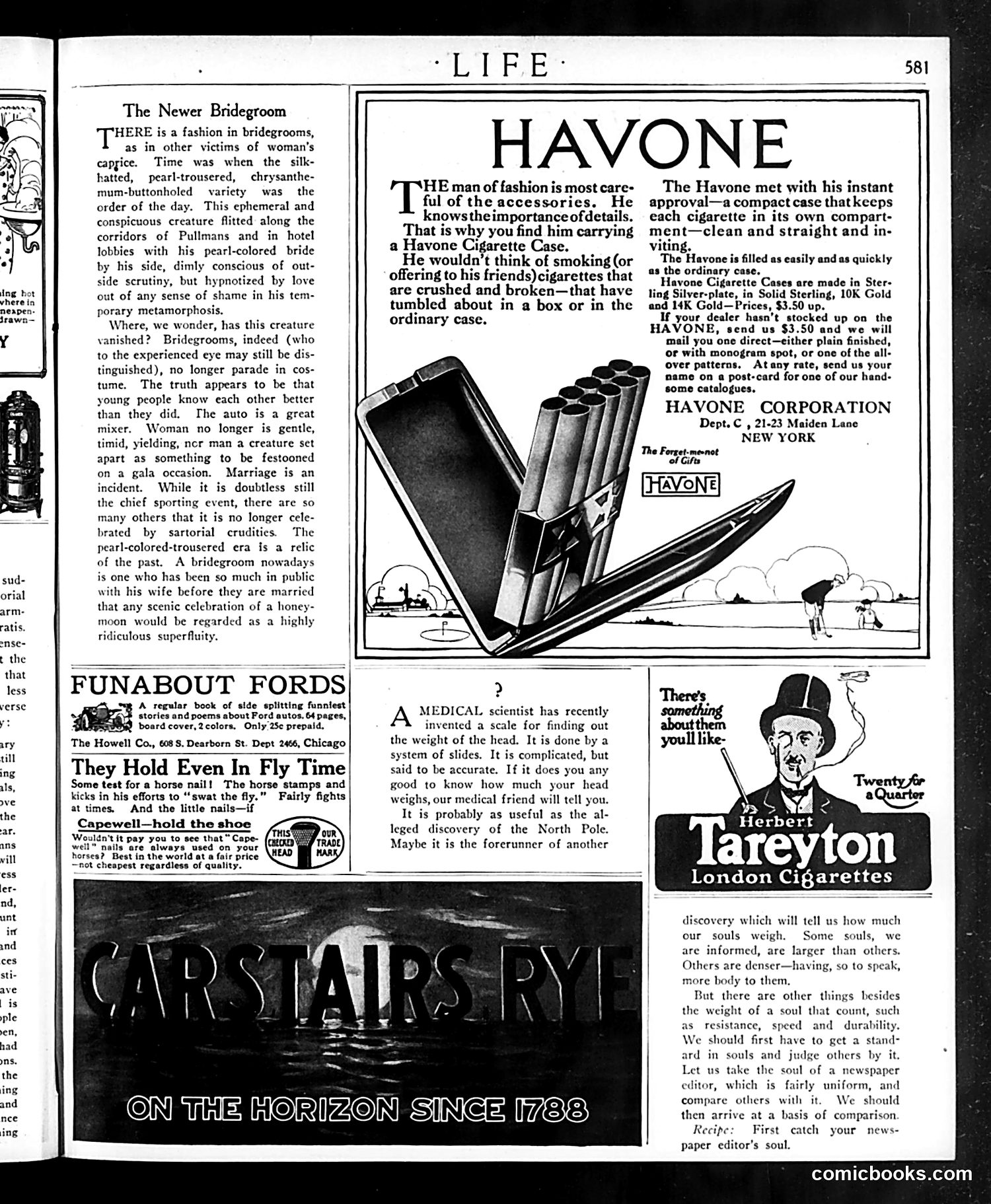
This page primarily consists of **advertisements** rather than editorial cartoons. The main content includes: **Havone Cigarette Cases** (center): A product advertisement presenting an elegant cigarette case as essential for the fashionable man who won't tolerate crushed cigarettes. The accompanying illustration shows the case and a golf scene. **"The Newer Bridegroom"** (left column): A satirical essay arguing that modern bridegrooms no longer wear ostentatious formal dress (silk hats, pearl-colored trousers) because young people socialize openly before marriage. The traditional elaborate wedding ceremony has become "ridiculous" when couples have already been publicly together. **Other advertisements** include Funabout Fords, Capewell shoe nails, Carr's Fair Rye, and Herbert Tareyton cigarettes. The page reflects **1920s social commentary**: changing courtship customs, automobiles enabling dating, women's increased independence, and the decline of rigid Victorian formality. Rather than traditional satirical cartoons, Life here uses product pitches and essay-commentary to discuss contemporary social shifts.
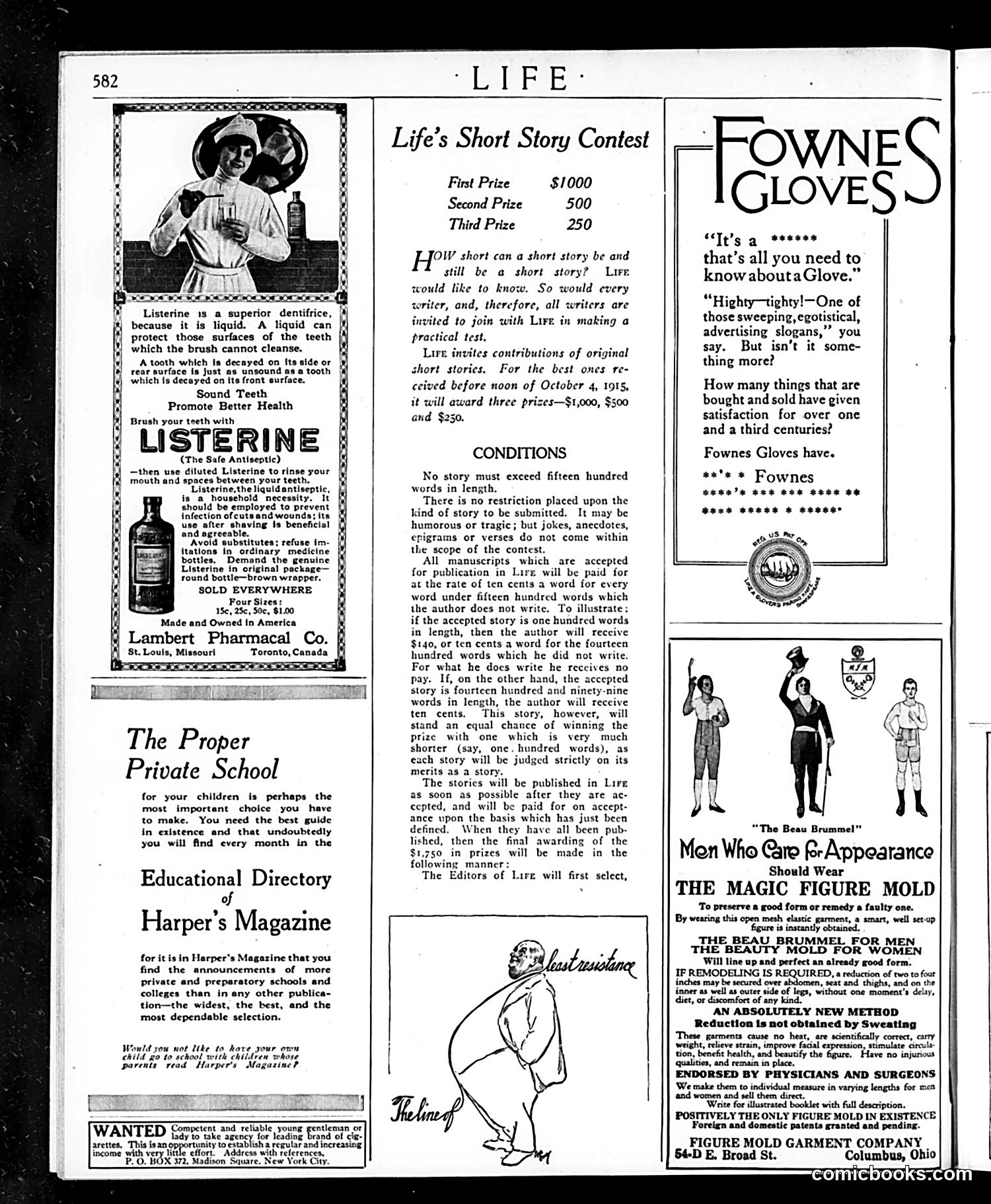
This page is primarily **advertising and contest announcements** rather than satirical content. The main feature is **Life's Short Story Contest**, offering $1,000, $500, and $250 prizes for stories under 1,500 words (with an unusual payment structure: authors earn 10 cents per word *not* written). The contest invites writers to test the practical limits of short-story brevity. The page also contains period product advertisements: **Listerine** mouthwash (marketed as both dental care and general antiseptic), **Harper's Magazine** (promoting its educational directory for private schools—with class implications about which children attend "proper" schools), and **Fownes Gloves** ("The Beau Brummel" brand). A **Figure Mold Garment** advertisement promotes a corset-like undergarment for men to maintain posture and appearance, endorsed by physicians. There is **no political cartoon or satirical content** visible on this page. It represents typical early-20th-century magazine advertising and editorial contests.
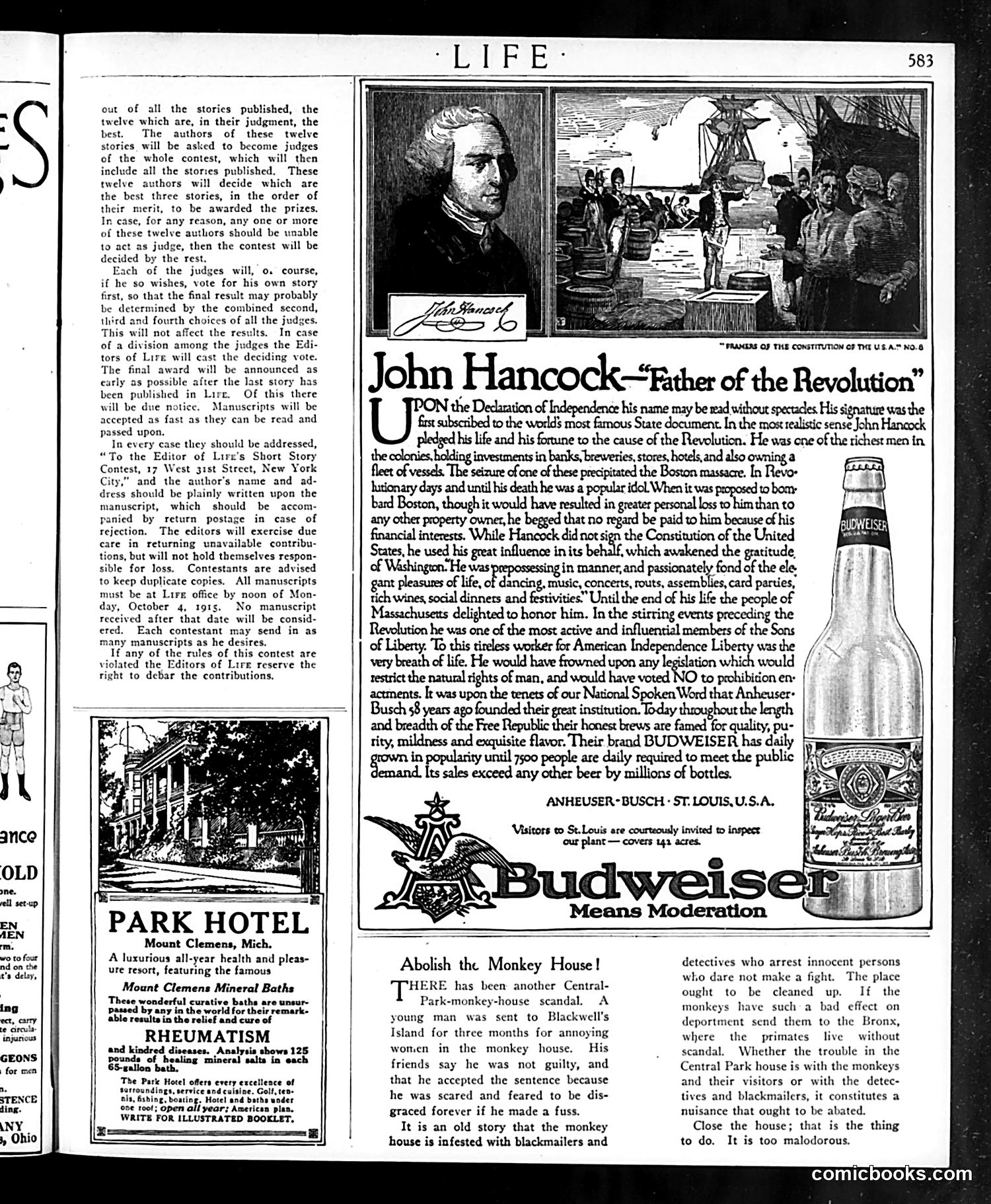
This page features a biographical article on John Hancock with accompanying portrait and historical engravings. The text emphasizes Hancock's role as a Revolutionary leader and wealthy merchant who sacrificed personal fortune for independence—notably his large, famous signature on the Declaration and his willingness to risk bombardment of Boston despite his substantial financial interests there. The page also contains advertisements (Park Hotel health resort, Budweiser beer) typical of early 20th-century magazines, plus information about Life's short-story contest with detailed submission rules. The "Framers of the Constitution" series (this is No. 8) appears designed to educate readers about American founding figures. There are no obvious satirical cartoons visible—this is primarily historical/biographical content mixed with period advertising, representing how Life balanced editorial material with commercial sponsorship during this era.
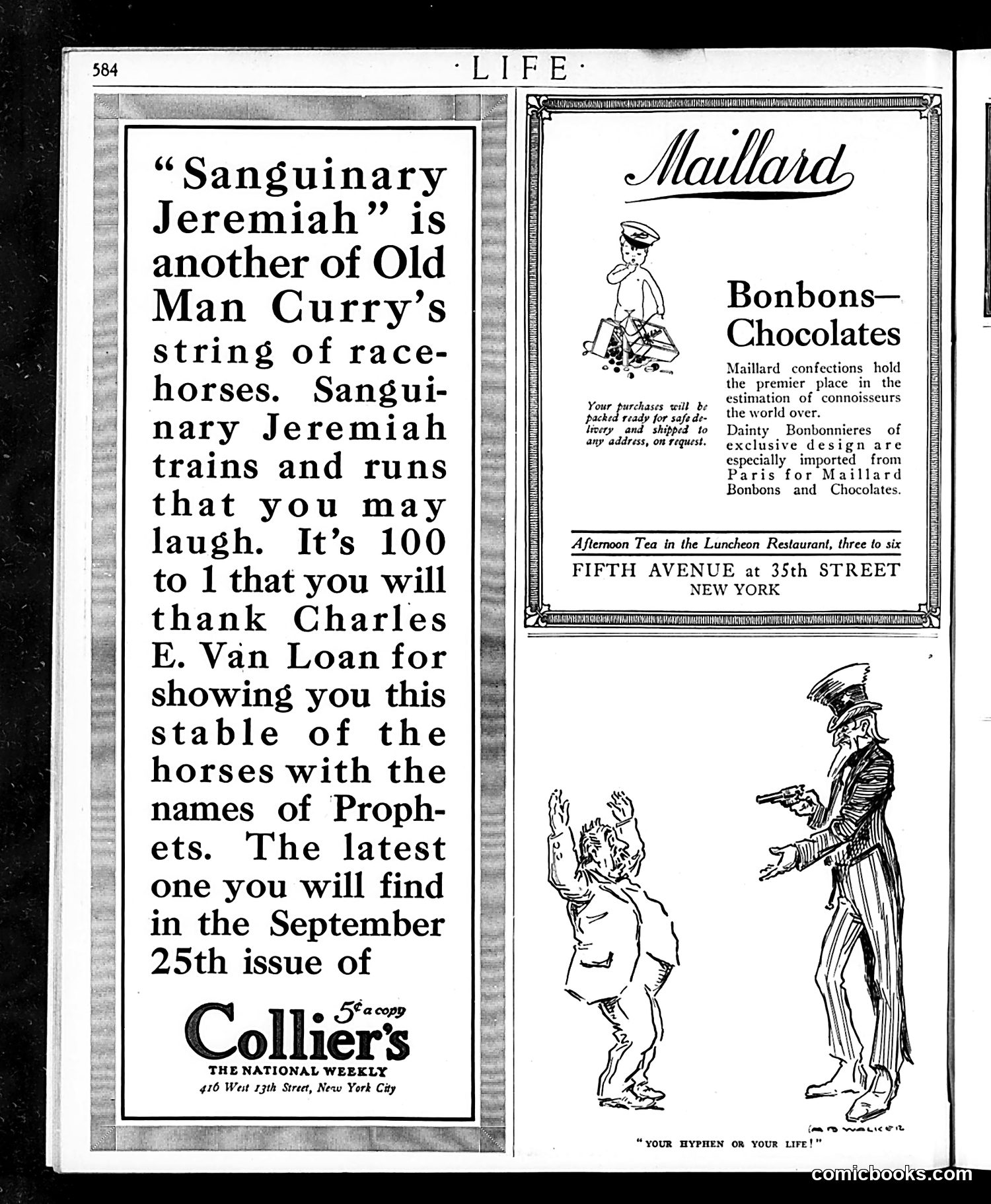
This page consists primarily of advertisements (Collier's magazine and Maillard chocolates) rather than satirical cartoons. The left side promotes a Collier's article by Charles E. Van Loan about a racehorse named "Sanguinary Jeremiah" owned by someone called "Old Man Curry." The joke appears to be that Van Loan has humorously named Curry's stable of racehorses after biblical prophets. The text suggests this is entertaining enough to warrant recommendation. The right side advertises Maillard bonbons/chocolates at a Fifth Avenue location, with a small illustration of what appears to be an old-fashioned figure and a dancing figure—likely just decorative advertisement imagery rather than political satire. The cartoon at the bottom right ("Your hyphen or your life!") remains unclear without additional context.
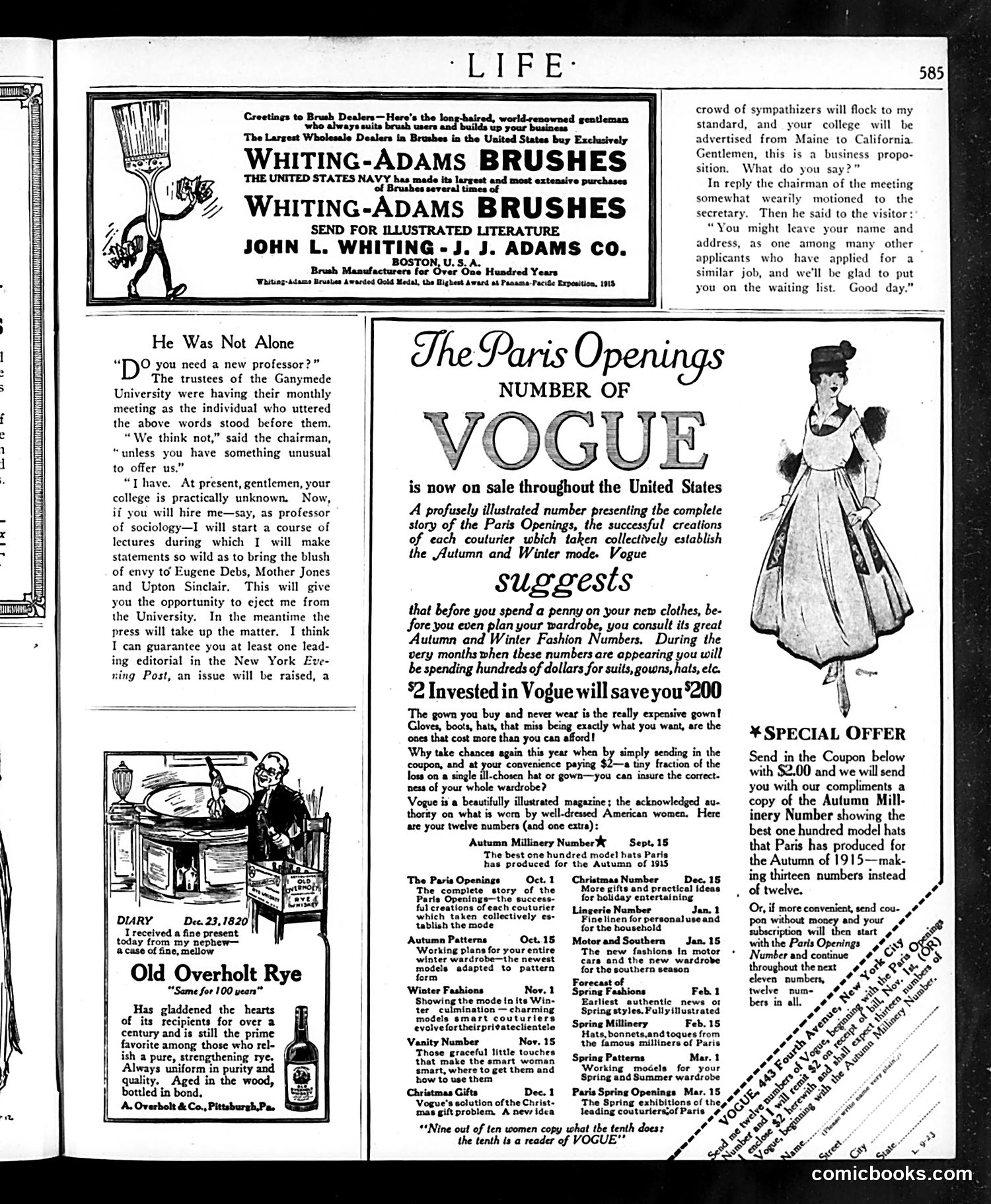
This short story satirizes universities' desperation for public attention and prestige. A job applicant proposes hiring himself as a sociology professor on the condition that he will make such "wild" statements that the university will be forced to eject him—generating sensational newspaper coverage, including editorials in prestigious outlets like the *New York Evening Post*. The joke targets two things: universities' willingness to tolerate controversy for publicity, and the implicit assumption that even negative attention ("we had to fire this radical") enhances institutional reputation. The satire mocks academic institutions that have become "practically unknown" and suggests their hunger for notoriety overrides sound educational judgment. The reference to Eugene Debs, Mother Jones, and Upton Sinclair—known labor radicals and socialists—indicates the applicant plans inflammatory rhetoric about class struggle.
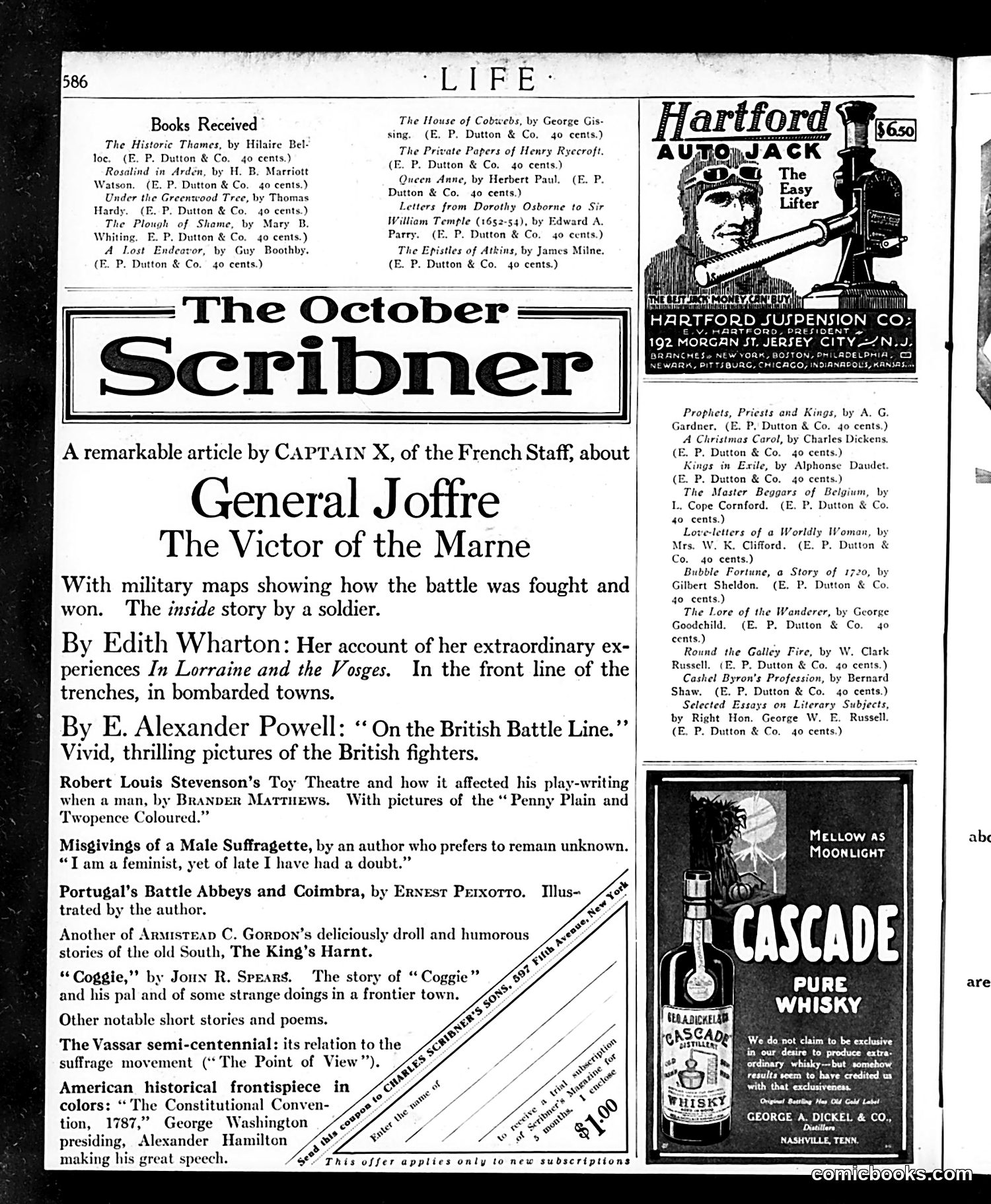
This is primarily a **table of contents and advertisements page** from *The October Scribner* magazine issue, not a satirical cartoon page. The main editorial content advertises Scribner's upcoming articles about **World War I**: General Joffre (French military commander at the Battle of the Marne), accounts by Edith Wharton from the front lines in France, and British battle reporting. These represent contemporary coverage of the ongoing European conflict. The only notable satirical reference is "**Misgivings of a Male Suffragette**"—a humorous piece by an anonymous author questioning feminism ("I am a feminist, yet of late I have had a doubt"), which appears to mock men sympathetic to women's suffrage during this period of active suffragette activism. The rest consists of book listings and advertisements for products like the Hartford Auto Jack and Cascade Whiskey. This is essentially a magazine contents page with period advertising.
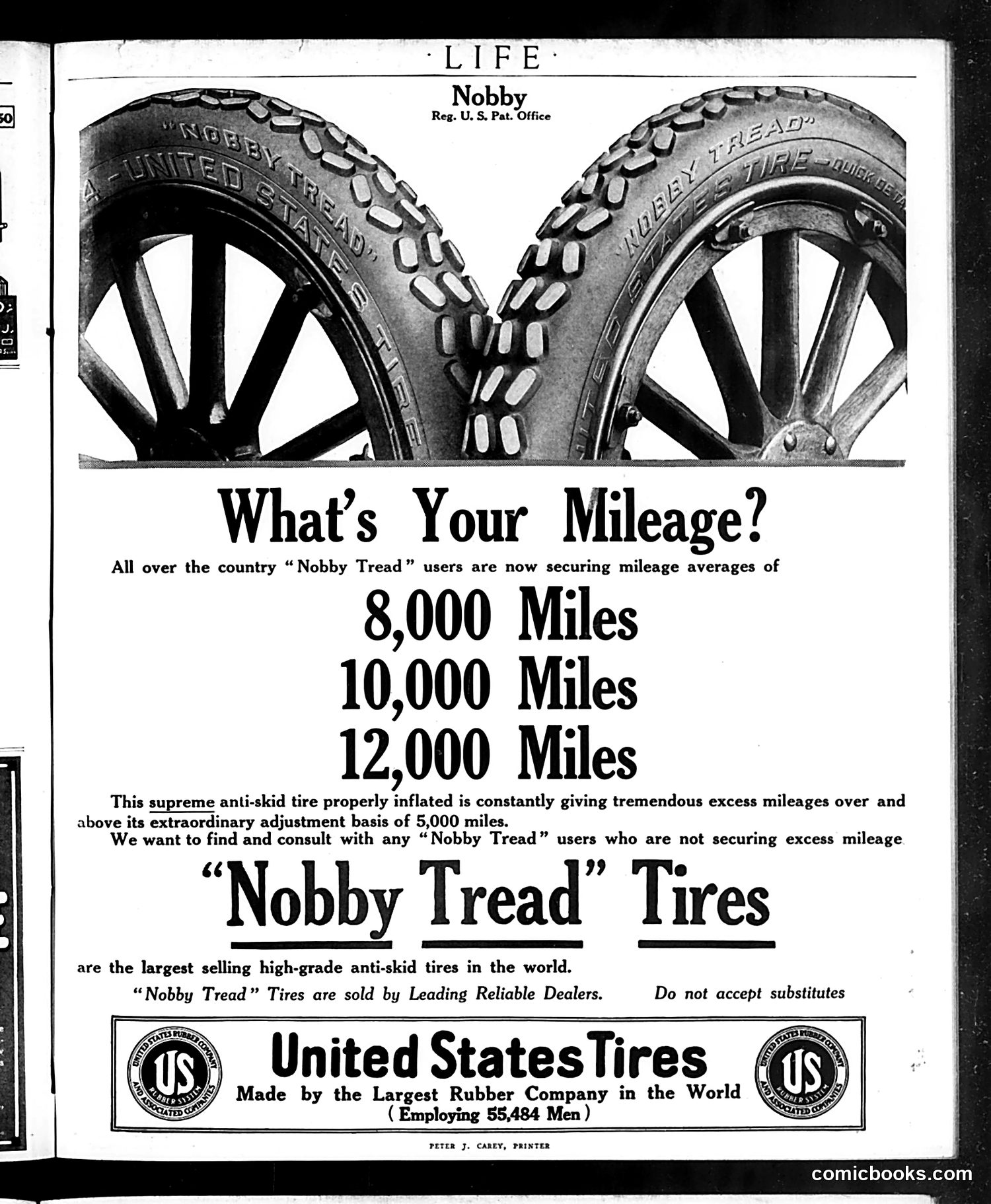
This is primarily **advertising copy**, not satire or political commentary. United States Tires is marketing their "Nobby Tread" brand anti-skid tires by claiming superior mileage performance. The advertisement states that users are achieving 8,000-12,000 miles per tire, when the baseline expectation was only 5,000 miles—representing exceptional longevity. The images show two tire cross-sections mounted on wheels, visually demonstrating the tire's tread design. The copy emphasizes the product's market dominance ("largest selling high-grade anti-skid tires in the world") and urges dealers not to substitute competing brands. The only quasi-humorous element is the rhetorical question "What's Your Mileage?"—a sales hook inviting consumers to boast about their tire performance. The company also claims to employ 55,484 workers, likely meant to convey economic significance during an era when manufacturing scale indicated quality. This reflects early-to-mid 20th century automotive advertising practices.
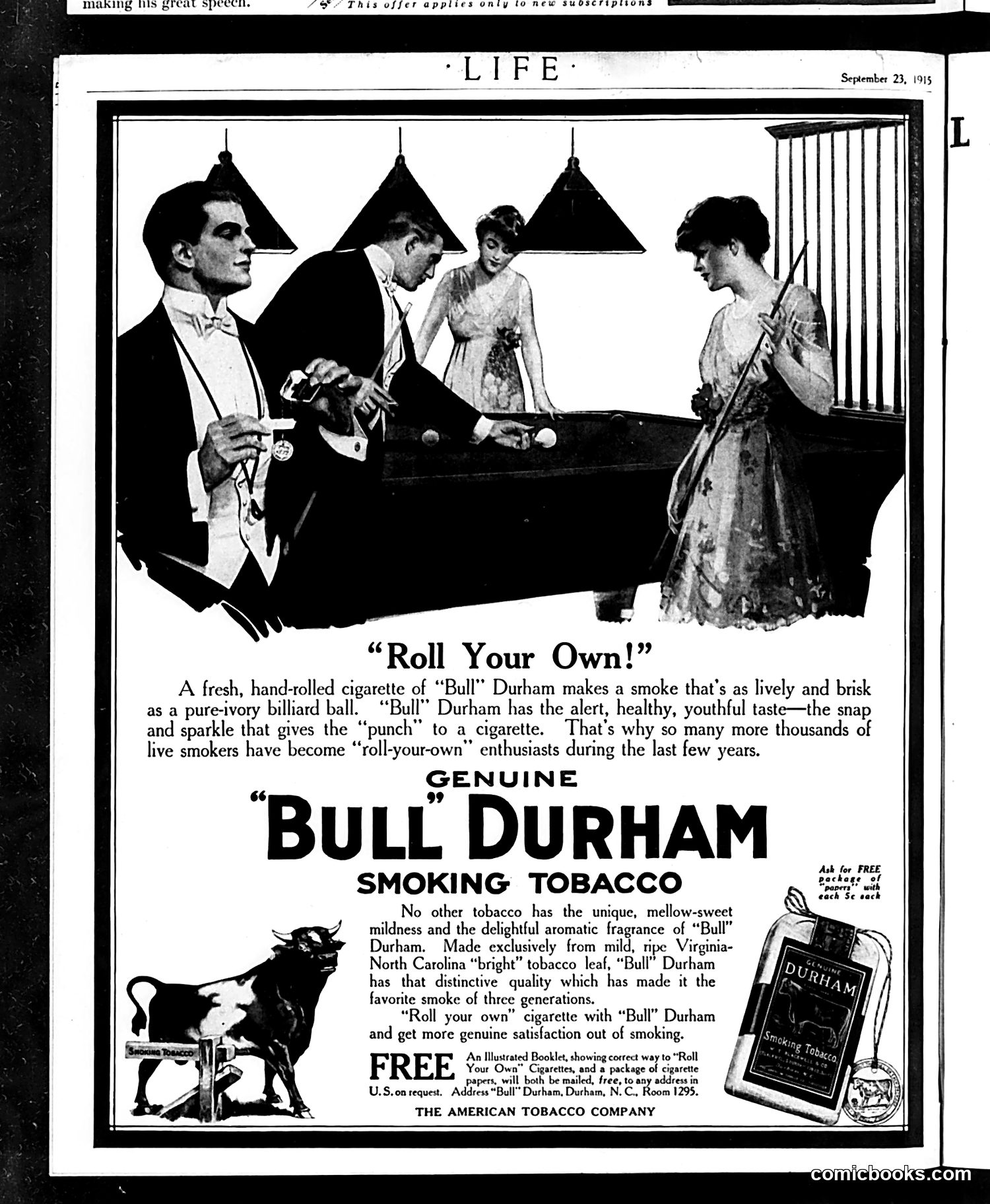
This is primarily a **cigarette advertisement**, not political satire. It promotes Bull Durham rolling tobacco, marketed as an affordable, quality product for hand-rolling cigarettes. The illustration depicts a fashionable social scene—well-dressed men and women in an elegant interior—to associate the product with sophistication and leisure. The phrase "Roll Your Own!" emphasizes that Bull Durham was sold as loose tobacco and papers, allowing smokers to hand-roll cigarettes cheaply rather than buying pre-made ones. Key marketing claims include that Bull Durham has a distinctive "mellow-sweet" taste from Virginia-North Carolina tobacco, appeals to "live smokers," and provides "genuine satisfaction." The advertisement offers a **free instructional booklet** on rolling technique and cigarette papers to encourage new customers. The bull logo (visible at bottom left) was the brand's identifying mascot. This reflects early 20th-century tobacco marketing before modern health warnings—promoting smoking as normal, pleasant, and economical for all social classes.