
Life, 1915-09-23 · page 22 of 48
Life — September 23, 1915 — page 22: what you’re looking at
What you’re looking at
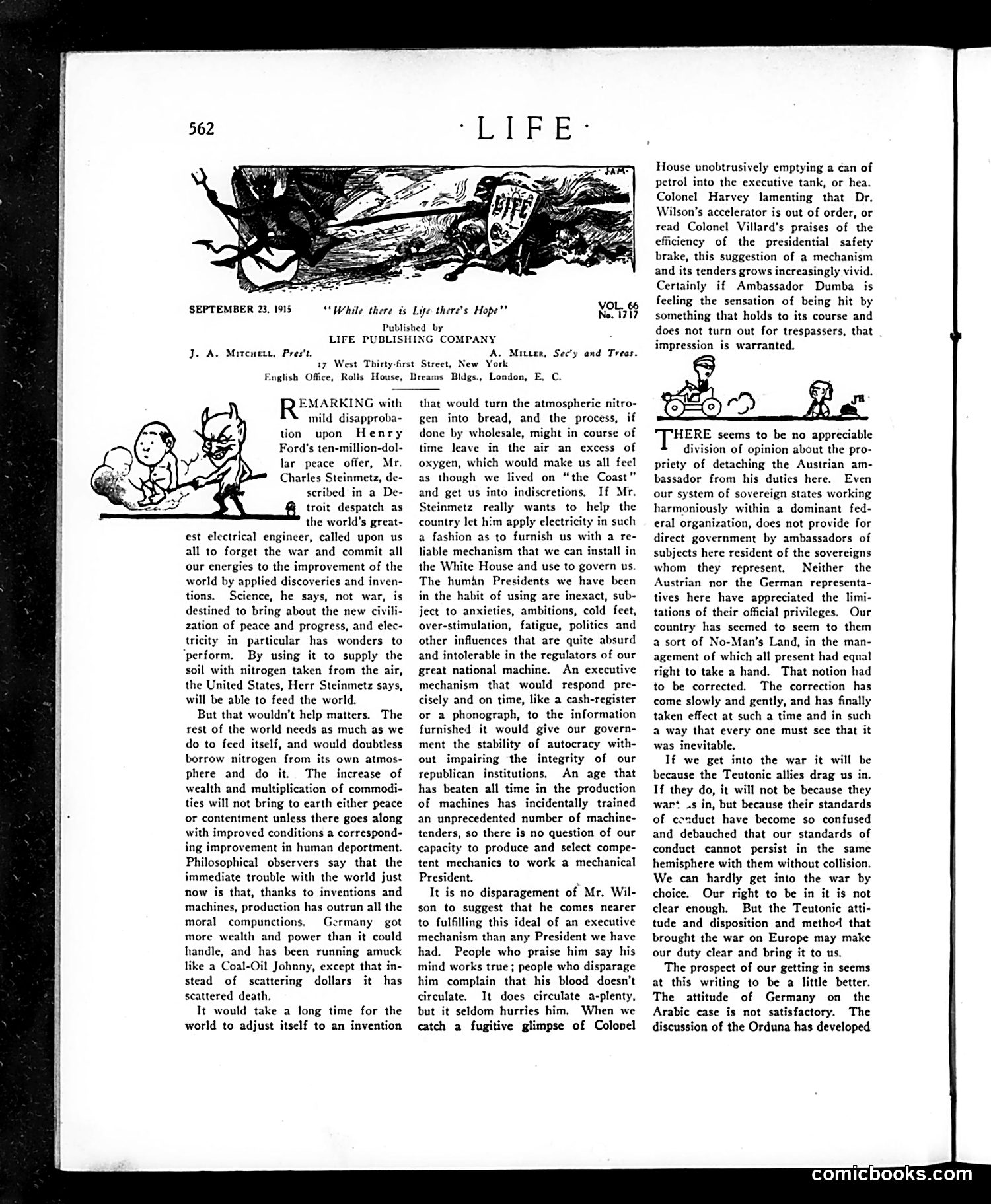
This page satirizes inventor Charles Steinmetz's proposal that applied electricity and science—specifically synthetic nitrogen production—could solve world problems and replace war as a path to progress. The cartoon depicts Steinmetz as a devil-like figure, mocking his technological utopianism. The editorial argues that inventions cannot cure humanity's moral failings, citing Germany's misuse of industrial power in World War I as evidence. The piece then pivots to satirizing President Woodrow Wilson, describing him as a mechanical automaton. References to "Colonel House," "Colonel Harvey," and "Colonel Villard" suggest advisors managing Wilson like a machine—filling his "executive tank" with petrol, adjusting his "accelerator" and "safety brake." This portrays Wilson as a remote, emotionally detached leader lacking spontaneity or human responsiveness, controlled by handlers rather than acting independently. The satire critiques both naive technological optimism and Wilson's perceived mechanical, bloodless approach to governance during America's pre-war period.
📄 Transcribed text from this page (OCR, searchable)
Machine-transcribed from the original scan — historical spelling and the odd misread are preserved.
SEPTEMBER 23. 1915 “While there ts Lige there's Hope” VOL. 66 No. 1717 Published by LIFE PUBLISHING COMPANY A. Mitten, Sec’y and Treas. 17 West Thirty-first Street, New York English Office, Rolls House, Breas Bldgs. London, E. C. J. A. Mitcwett, Pres't. MARKING with mild disapproba- tion upon Henry Ford’s ten-million-dol- lar peace offer, Mr. Charles Steinmetz, de- scribed in a De- troit despatch as the world’s great- est electrical engineer, called upon us all to forget the war and commit all our energies to the improvement of the world by applied discoveries and inven- tions, Science, he says, not war, is destined to bring about the new civili- zation of peace and progress, and elec- tricity in particular has wonders to ‘perform. By using it to supply the soil with nitrogen taken from the air, the United States, Herr Steinmetz says, will be able to feed the world. But that wouldn't help matters. The rest of the world needs as much as we do to feed itself, and would doubtless borrow nitrogen from its own atmos- phere and do it. The increase of wealth and multiplication of commodi- ties will not bring to earth either peace or contentment unless there goes along with improved conditions a correspond- ing improvement in human deportment. Philosophical observers say that the immediate trouble with the world just now is that, thanks to inventions and machines, production has outrun all the moral compunctions. Germany got more wealth and power than it could handle, and has been running amuck like a Coal-Oil Johnny, except that in- stead of scattering dollars it has scattered death. It would take a long time for the world to adjust itself to an invention that would turn the atmospheric nitro- gen into bread, and the process, if done by wholesale, might in course of time leave in the air an excess of oxygen, which would make us all feel as though we lived on “the Coast” and get us into indiscretions. If Mr. Steinmetz really wants to help the country let him apply electricity in such a fashion as to furnish us with a re- liable mechanism that we can install in the White House and use to govern us. The humin Presidents we have been in the habit of using are inexact, sub- ject to anxieties, ambitions, cold feet, over-stimulation, fatigue, politics and other influences that are quite absurd and intolerable in the regulators of our great national machine. An executive mechanism that would respond pre- cisely and on time, like a cash-register or a phonograph, to the information furnished it would give our govern- ment the stability of autocracy with- out impairing the integrity of our republican institutions. An age that has beaten all time in the production of machines has incidentally trained an unprecedented number of machine- tenders, so there is no question of our capacity to produce and select compe- tent mechanics to work a mechanical President. ; It is no disparagement of Mr. Wil- son to suggest that he comes nearer to fulfilling this ideal of an executive mechanism than any President we have had. People who praise him say his mind works true; people who disparage him complain that his blood doesn’t circulate. It does circulate a-plenty, but it seldom hurries him. When we catch a fugitive glimpse of Colonel House unobtrusively emptying a can of petrol into the executive tank, or hea. Colonel Harvey lamenting that Dr. Wilson's accelerator is out of order, or read Colonel Villard’s praises of the efficiency of the presidential safety brake, this suggestion of a mechanism and its tenders grows increasingly vivid. Certainly if Ambassador Dumba is feeling the sensation of being hit by something that holds to its course and does not turn out for trespassers, that impression is warranted. HERE seems to be no appreciable division of opinion about the pro- priety of detaching the Austrian am- bassador from his duties here. Even our system of sovereign states working harmoniously within a dominant fed- eral organization, does not provide for direct government by ambassadors of subjects here resident of the sovereigns whom they represent. Neither the Austrian nor the German representa- tives here have appreciated the limi- tations of their official privileges. Our country has seemed to seem to them a sort of No-Man’s Land, in the man- agement of which all present had equal right to take a hand. That notion had to be corrected. The correction has come slowly and gently, and has finally taken effect at such a time and in such a way that every one must see that it was inevitable. If we get into the war it will be because the Teutonic allies drag us in. If they do, it will not be because they wart us in, but because their standards of conduct have become so confused and debauched that our standards of conduct cannot persist in the same hemisphere with them without collision. We can hardly get into the war by choice. Our right to be in it is not clear enough. But the Teutonic atti- tude and disposition and method that brought the war on Europe may make our duty clear and bring it to us. The prospect of our getting in seems at this writing to be a little better. The attitude of Germany on the Arabic case is not satisfactory. The discussion of the Orduna has developed comicbooks.com