
Life, 1915-09-23 · page 18 of 48
Life — September 23, 1915 — page 18: what you’re looking at
What you’re looking at
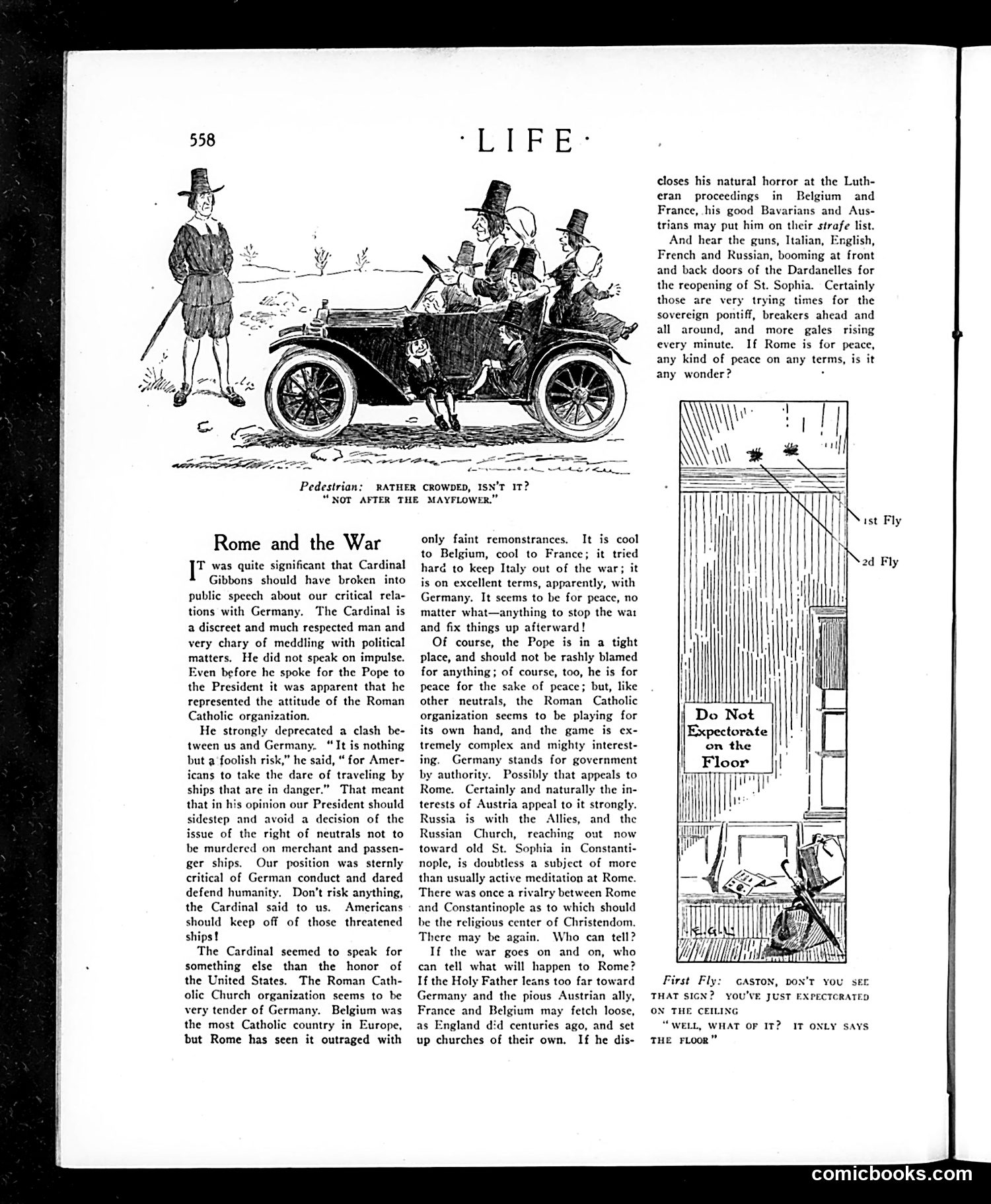
**Main Article Context:** This is WWI-era commentary (pre-U.S. entry, likely 1915-1916) criticizing Cardinal Gibbons and the Roman Catholic Church for allegedly favoring Germany over the Allies. **The Argument:** The author accuses the Church of: - Discouraging American travel on ships (implicitly siding with German U-boat threats) - Showing "only faint remonstrances" over Belgium's devastation despite it being Catholic - Maintaining friendly relations with Germany and Austria - Possibly preferring authoritarian "government by authority" (Germany/Austria) - Playing geopolitical games regarding Constantinople/Orthodox Christianity **Top Cartoon:** The pedestrian's remark "Not after the Mayflower" is a bitter joke—referencing the Pilgrim ship, it suggests Catholic immigrants are too numerous, echoing anti-Catholic nativism common in early 20th-century America. **Bottom Comic:** An absurdist joke about a sign saying "Do Not Expectorate on the Floor"—one fly notes another has spit on the *ceiling*, violating only the letter, not spirit, of the rule. **Overall Point:** Satire questioning Catholic institutional loyalty to America versus European Catholic powers during wartime.
📄 Transcribed text from this page (OCR, searchable)
Machine-transcribed from the original scan — historical spelling and the odd misread are preserved.
Pedestrian: RATHER CROWDED, ISN'T 1T? “NOT AFTER THE MAYFLOWER.” Rome and the War I" was quite significant that Cardinal Gibbons should have broken into public speech about our critical rela- tions with Germany. The Cardinal is a discreet and much respected man and very chary of meddling with political matters, He did not speak on impulse. Even before he spoke for the Pope to the President it was apparent that he represented the attitude of the Roman Catholic organization. He strongly deprecated a clash be- tween us and Germany. “It is nothing but a foolish risk,” he said, “ for Amer- icans to take the dare of traveling by ships that are in danger.” That meant that in his opinion our President should sidestep and avoid a decision of the issue of the right of neutrals not to be murdered on merchant and passen- ger ships. Our position was sternly critical of German conduct and dared defend humanity, Don’t risk anything, the Cardinal said to us. Americans should keep off of those threatened ships! The Cardinal seemed to speak for something else than the honor of the United States. The Roman Cath- olic Church organization seems to be very tender of Germany. Belgium was the most Catholic country in Europe, but Rome has seen it outraged with only faint remonstrances. It is cool to Belgium, cool to France; it tried hard to keep Italy out of the war; is on excellent terms, apparently, with Germany. It scems to be for peace, no matter what—anything to stop the wat and fix things up afterward! Of course, the Pope is in a tight place, and should not be rashly blamed for anything; of course, too, he is for peace for the sake of peace; but, like other neutrals, the Roman Catholic organization seems to be playing for its own hand, and the game is ex- tremely complex and mighty interest- ing. Germany stands for government by authority. Possibly that appeals to Rome. Certainly and naturally the in- terests of Austria appeal to it strongly. Russia is with the Allies, and the Russian Church, reaching out now toward old St. Sophia in Constanti- nople, is doubtless a subject of more than usually active meditation at Rome. There was once a rivalry between Rome and Constantinople as to which should be the religious center of Christendom. There may be aga Who can tell? If the war goes on and on, who can tell what will happen to Rome? If the Holy Father leans too far toward Germany and the pious Austrian ally, France and Belgium may fetch loose, as England did centuries ago, and set up churches of their own, If he dis- closes his natural horror at the Luth- eran proceedings in Belgium and France, his good Bavarians and Aus- trians may put him on their strafe list. And hear the guns, Italian, English, French and Russian, booming at front and back doors of the Dardanelles for the reopening of St. Sophia. Certainly those are very trying times for the sovereign pontiff, breakers ahead and all around, and more gales rising every minute. If Rome is for peace, any kind of peace on any terms, is it any wonder? ull | Mn Do Not || Expectorate on the Floor MONT Te] f iit First Fly: THAT SIGN? ot ON THE CEI “WELL, WHAT OF IT? THE FLOOR” GASTON, DON'T YOU SEE JUST EXPECTCRATED IT ONLY SAYS comicbooks.com