
Life, 1915-09-23 · page 23 of 48
Life — September 23, 1915 — page 23: what you’re looking at
What you’re looking at
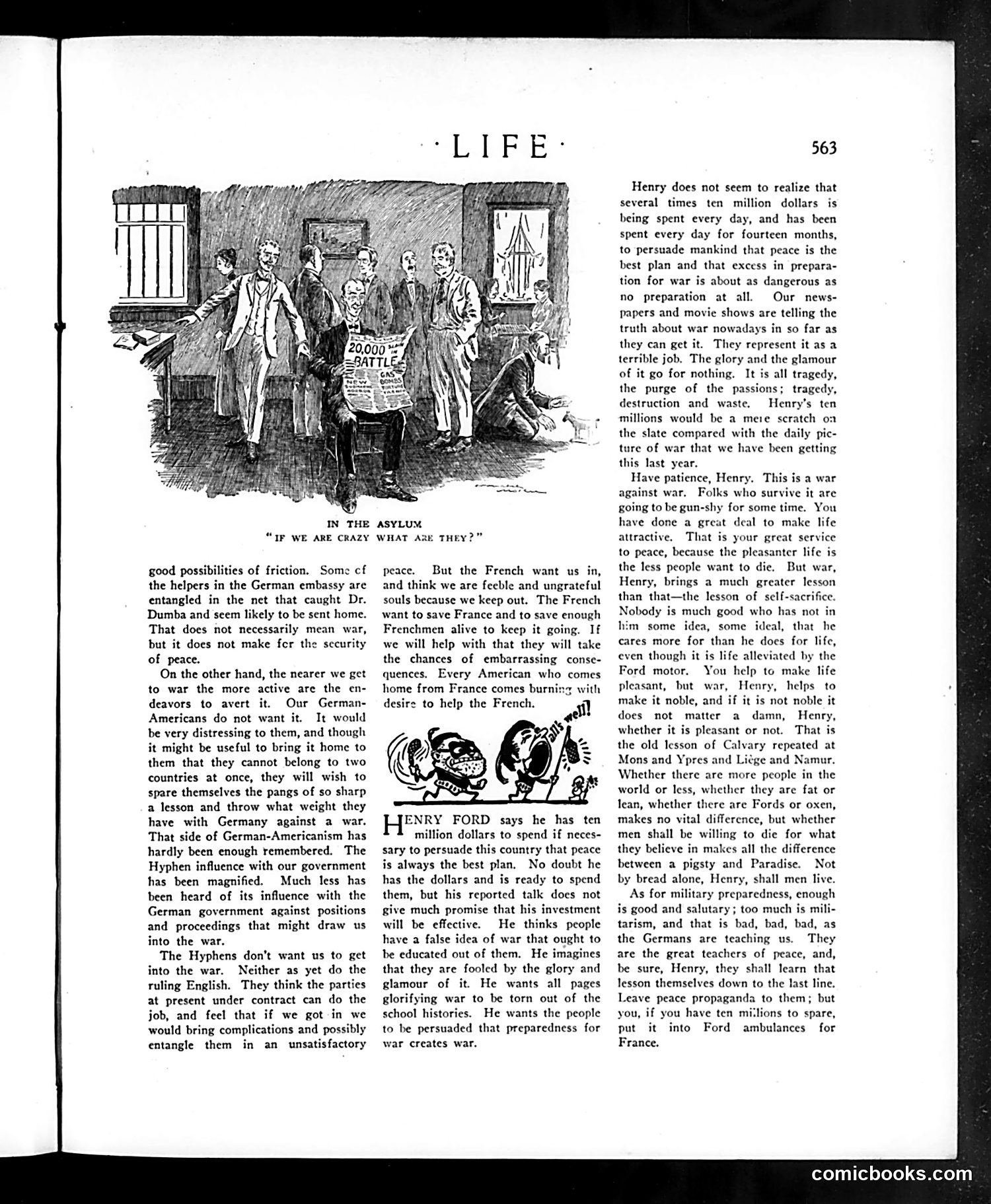
The cartoon "In the Asylum" depicts World War I-era American political debate. The sketch shows men in an asylum discussing whether they are "crazy," satirizing the divided American public over whether the U.S. should enter the war (America entered in 1917). The accompanying text discusses Henry Ford's peace advocacy—his plan to spend millions promoting pacifism and removing war glorification from schoolbooks. The author argues Ford's efforts are futile against the daily reality of war reporting in newspapers and films. The piece also references German-American ("Hyphen") political influence, French pressure for American intervention, and the tension between peace advocates and those viewing military sacrifice as noble and necessary. The satire suggests that debating peace while war rages abroad is itself a form of madness—a critique of American isolationism amid global conflict.
📄 Transcribed text from this page (OCR, searchable)
Machine-transcribed from the original scan — historical spelling and the odd misread are preserved.
a Y IN THE “IF WE ARE CRAZY good possibilities of friction. Some cf the helpers in the German embassy are entangled in the net that caught Dr. Dumba and seem likely to be sent home. That does not necessarily mean war, but it does not make fer the security of peace. On the other hand, the nearer we get to war the more active are the en- deavors to avert it. Our German- Americans do not want it. It would be very distressing to them, and though it might be useful to bring it home to them that they cannot belong to two countries at once, they will wish to spare themselves the pangs of so sharp a lesson and throw what weight they have with Germany against a war. That side of German-Americanism has hardly been enough remembered. The Hyphen influence with our government has been magnified. Much less has been heard of its influence with the German government against positions and proceedings that might draw us into the war. The Hyphens don’t want us to get into the war. Neither as yet do the ruling English. They think the parties at present under contract can do the job, and feel that if we got in we would bring complications and possibly entangle them in an unsatisfactory ASYLUM WHAT ARE THEY?” peace. But the French want us in, and think we are feeble and ungrateful souls because we keep out. The French want to save France and to save enough Frenchmen alive to keep it going. If we will help with that they will take the chances of embarrassing conse- quences. Every American who comes home from France comes burning with desire to help the French, ENRY FORD says he has ten million dollars to spend if neces- sary to persuade this country that peace is always the best plan. No doubt he has the dollars and is ready to spend them, but his reported talk does not give much promise that his investment will be effective. He thinks people have a false idea of war that ought to be educated out of them. He imagines that they are fooled by the glory and glamour of it. He wants all pages glorifying war to be torn out of the school histories. He wants the people to be persuaded that preparedness for war creates war. 563 Henry does not seem to realize that several times ten million dollars is being spent every day, and has been spent every day for fourteen months, to persuade mankind that peace is the best plan and that excess in prepara- tion for war is about as dangerous as no preparation at all. Our news- papers and movie shows are telling the truth about war nowadays in so far as they can get it. They represent it as a terrible job. The glory and the glamour of it go for nothing. It is all tragedy, the purge of the passions; tragedy, destruction and waste. Henry’s ten millions would be a mete scratch o2 the slate compared with the daily pic- ture of war that we have been getting this last year. Have patience, Henry. This is a war against war. Folks who survive it are going to be gun-shy for some time. You have done a great deal to make life attractive, That is your great service to peace, because the pleasanter life is the less people want to die, But war, Henry, brings a much greater lesson than that—the lesson of self-sacrifice. Nobody is much good who has not in him some idea, some ideal, that he cares more for than he does for life, even though it is life alleviated by the Ford motor. You help to make life pleasant, but war, Henry, helps to make it noble, and if it is not noble it does not matter a damn, Henry, whether it is pleasant or not. That is the old lesson of Calvary repeated at Mons and Ypres and Liége and Namur. Whether there are more people in the world or less, whether they are fat or lean, whether there are Fords or oxen, makes no vital difference, but whether men shall be willing to die for what they believe in makes all the difference between a pigsty and Paradise. Not by bread alone, Henry, shall men live. As for military preparedness, enough is good and salutary; too much is mili- tarism, and that is bad, bad, bad, as the Germans are teaching us. They are the great teachers of peace, and, be sure, Henry, they shall learn that lesson themselves down to the last line. Leave peace propaganda to them; but you, if you have ten mitlions to spare, put it into Ford ambulances for France. comicbooks.com