
Life, 1915-09-23 · page 27 of 48
Life — September 23, 1915 — page 27: what you’re looking at
What you’re looking at
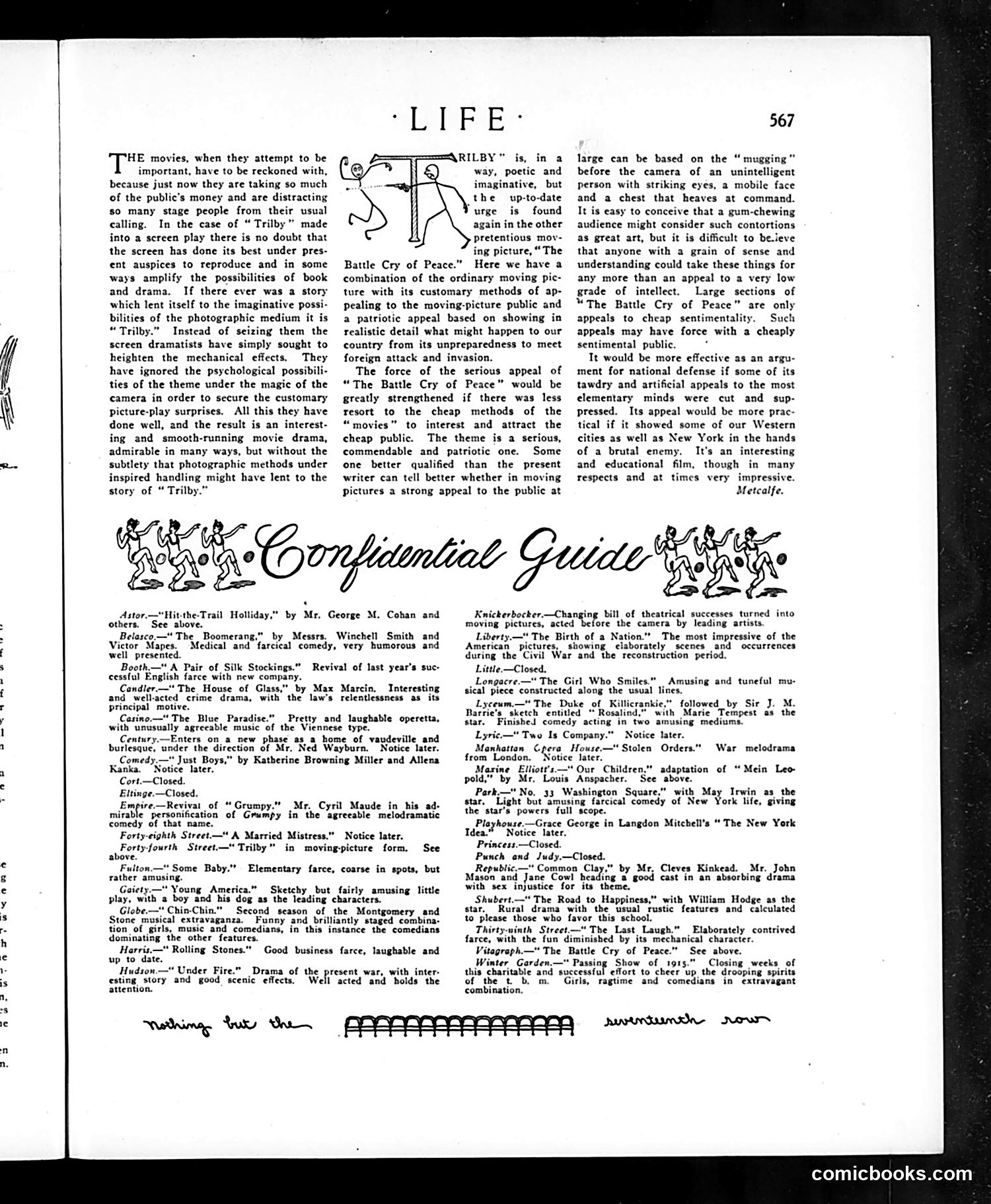
This page critiques two early films: **"Trilby"** (adapted from a popular novel) and **"The Battle Cry of Peace"** (a patriotic defense film). The cartoons at top show a figure being struck—likely satirizing how cinema relies on crude physical comedy ("mugging") rather than psychological depth. **The satire's point:** Both films exemplify cinema's shallow approach. "Trilby" wastes the camera's artistic potential by prioritizing mechanical spectacle over the source material's subtlety. "The Battle Cry of Peace," despite tackling serious national preparedness themes, undermines itself through cheap sentimentality and exaggerated acting—appealing to "gum-chewing audiences" rather than intelligent viewers. The critic argues patriotic appeals lose force when wrapped in theatrical excess. He notes the film shows only New York under attack, not Western cities, limiting its persuasive power for actual defense readiness. **Core complaint:** Early cinema prioritizes entertaining "the cheap public" over artistic integrity or practical messaging.
📄 Transcribed text from this page (OCR, searchable)
Machine-transcribed from the original scan — historical spelling and the odd misread are preserved.
f $ } 3 r y 1 1 ee es ana HE movies, when they attempt to be important, have to be reckoned with, because just now they are taking so much of the public’s money and are distracting so many stage people from their usual calling. In the case of “ Trilby” made into a screen play there is no doubt that the screen has done its best under pres- ent auspices to reproduce and in some ways amplify the possibilities of book and drama. If there ever was a story which lent itself to the imaginative possi- bilities of the photographic medium it is “Trilby.” Instead of seizing them the screen dramatists have simply sought to heighten the mechanical effects, They have ignored the psychological possibili- ties of the theme under the magic of the camera in order to secure the customary picture-play surprises. All this they have done well, and the result is an interest- ing and smooth-running movie drama, admirable in many ways, but without the subtlety that photographic methods under inspired handling might have lent to the story of “ Trilby.” Astor.—"“Hit-the-Trail Holliday, others. See above. Belasco.—" The Boomerang,” by Messrs. Winchell Smith and Victor Mapes. Medical and farcical comedy, very humorous and well presented. Booth.—" A Pair of Silk Stockings.” Revival of last year’s suc- cessful English farce with new company. Candler. principal motive. by Mr, George M. Cohan and The House of Glass," by Max Marcin, Interesting and well-acted crime drama, with’ the law's relentlessness as its LEE RILBY” is, in a way, poetic and imaginative, but the up-to-date Purge is found again in the other pretentious mov- ing picture, “The Battle Cry of Peace.” Here we have a combination of the ordinary moving pic- ture with its customary methods of ap- pealing to the moving-picture public and a patriotic appeal based on showing in realistic detail what might happen to our country from its unpreparedness to meet foreign attack and invasion. The force of the serious appeal of “The Battle Cry of Peace” would be greatly strengthened if there was less resort to the cheap methods of the “movies” to interest and attract the cheap public. The theme is a serious, commendable and patriotic one. Some one better qualified than the present writer can tell better whether in moving Pictures a strong appeal to the public at al Liberty. American pictures, 567 large can be based on the “ mugging” before the camera of an unintelligent person with striking eyes, a mobile face and a chest that heaves at command. Tt is easy to conceive that a gum-chewing audience might consider such contortions as great art, but it is difficult to beieve that anyone with a grain of sense and understanding could take these things for any more than an appeal to a very low grade of intellect. Large sections of “The Battle Cry of Peace” are only appeals to cheap sentimentality. Such appeals may have force with a cheaply sentimental public. It would be more effective as an argu- ment for national defense if some of its tawdry and artificial appeals to the most elementary minds were cut and sup- pressed. Its appeal would be more prac- tical if it showed some of our Western cities as well as New York in the hands of a brutal enemy. It’s an interesting and educational film, though in many respects and at times very impressive. Metcalfe. Knickerbocker—Changing bill of theatrical successes turned into moving pictures, acted befo The Birth of a Nation.” The most impressive of the showing elaborately scenes and occurrences, re the camera by leading artists. during the Civil War and the reconstruction period. Little —Closed. Barrie's with unusually agreeable music of the Viennese type. Century. burlesque, under the direction of Mi Comedy. Kanka. ‘Notice later. Cort.—Closed. Eltinge.—Closed. Empire.—Revival of “Grumpy.” Mr. Cyril Maude in his ad. Sta%- mirable personification of Grumpy in the agreeable melodramatic comedy of that name. Forty-eighth Street.—" A Married Mistress. Forty-fourth Street." Trilby above. Fulton.—" Some Baby." Elementary farce, coarse in spots, but rather amusing. Goiety.—" Young America.” Sketchy but fairly amusing little dog as the leading characters. play, with a boy and hi Globe-—" Chin-Chin. Stone musical extravaganza. Funny and brilliantly staged combina tion of girls, music and comedians, in this instance the comedians dominating the other features. Harris.—" Rolling Stones." Good business farce, laughable and up to date. Hudson.—“ Under Fire.” Drama of the Ri i esting story and good scenic effects, Wel attention. Enters on a new phase as a home of vaudeville and d Wayburn. Notice later. Just Boys,” by Katherine Browning Miller and Allena in moving-picture form. See resent war, with inter- acted and holds the Maxine Elliott's. pold,” by Mr. Loui Park.—" No. 33 Washington Square, ight but amusing farcical comedy of New York life, giving the star's powers full scope. Playhouse.—Grace George in Langdon Mitchell's “The New York Idea." Notice later. Notice later. : Princess.—Closed. Lyric—" Two Is Compan; Manhattan Cpera Hou: from London. Notice lat Longacre.—" The Girl Who Smiles." Amusing and tuneful mu- sical piece constructed along the usual lines. Lyceum.—" The Duke of Killicran! Carino—" The Blue Paradise." Pretty and laughable operetta, — arFie's, sketch entitied Rosalind.” followed by Sir J. M. rie Tempest as the Notice later. Stolen Orders." War melodrama Our Children." adaptation of “Mein Leo Anspacher. See above. with May Irwin as the Punch and Judy.—Closed. Republic" Common Clay.” by Mr, Cleves Kinkead. Mr. John Mason and Jane Cowl headt with sex injustice for its theme. Shubert.—"The Road to, Happiness,” with, William Hodge a8 the Si star. Rural drama with the usual rustic features and. calculate: eee Chutes Montegmery tnd ol please thote who favor this school, Thirty-ninth Stree ing a good cast in an absorbing drama The Last Laugh.” Elaborately contrived farce, with the fun diminished by its mechanical character. Vitagroph.—* The Battle Cry of Peace.” See above. inter Garden.— Passing Show of 1915." Closing weeks of of the tb, m. combination. this charitable and successful effort to cheer up the drooping spirits Girls, ragtime and comedians in extravagant comicbooks.com