
Life, 1915-09-23 · page 32 of 48
Life — September 23, 1915 — page 32: what you’re looking at
What you’re looking at
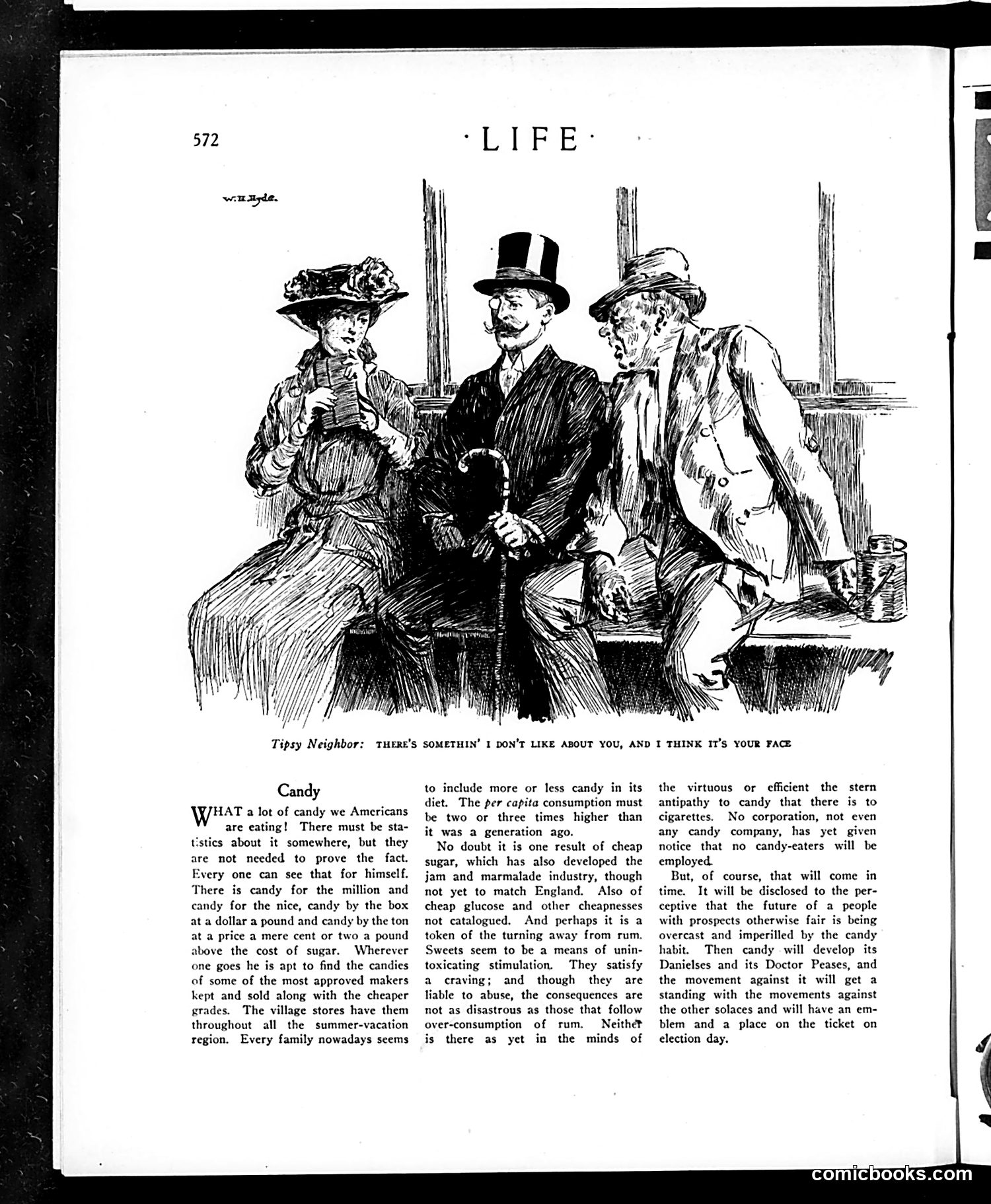
This *Life* magazine page contains two distinct pieces: **The Cartoon (top):** A drunk man confronts three well-dressed people, saying he dislikes their faces. It's a simple gag about alcohol-fueled rudeness, with no apparent political meaning. **The "Candy" Essay (bottom):** Social satire about Americans' growing candy consumption. The writer observes that candy eating has become ubiquitous and notes it's replacing alcohol as a stimulant. The satire's point: he predicts that eventually, progressive reformers will demonize candy the way they currently oppose cigarettes and alcohol, creating anti-candy crusades and politicians who pledge to ban candy-eaters from employment. This reflects early 20th-century anxieties about public morality movements and corporate reform campaigns. The author gently mocks both unchecked consumption *and* the tendency of reformers to identify new social "evils" to campaign against—treating candy prohibition as inevitable despite currently seeming absurd.
📄 Transcribed text from this page (OCR, searchable)
Machine-transcribed from the original scan — historical spelling and the odd misread are preserved.
Tipsy Neighbor: THERE'S SOMETHIN’ I DON'T LIKE ABOUT YOU, AND I THINK IT’S YOUR FACE Candy WHAT a lot of candy we Americans are eating! There must be sta- tistics about it somewhere, but they are not needed to prove the fact. Every one can see that for himself. There is candy for the million and candy for the nice, candy by the box ata dollar a pound and candy by the ton at a price a mere cent or two a pound above the cost of sugar. Wherever one goes he is apt to find the candies of some of the most approved makers kept and sold along with the cheaper grades. The village stores have them throughout all the summer-vacation region. Every family nowadays seems to include more or less candy in its diet. The per capita consumption must be two or three times higher than it was a generation ago. No doubt it is one result of cheap sugar, which has also developed the jam and marmalade industry, though not yet to match England. Also of cheap glucose and other cheapnesses not catalogued. And perhaps it is a token of the turning away from rum. Sweets seem to be a means of unin- toxicating stimulation. They satisfy a craving; and though they are liable to abuse, the consequences are not as disastrous as those that follow over-consumption of rum. Neithe? is there as yet in the minds of the virtuous or efficient the stern antipathy to candy that there is to cigarettes. No corporation, not even any candy company, has yet given notice that no candy-eaters will be employed. But, of course, that will come in time. It will be disclosed to the per- ceptive that the future of a people with prospects otherwise fair is being overcast and imperilled by the candy habit. Then candy will develop its Danielses and its Doctor Peases, and the movement against it will get a standing with the movements against the other solaces and will have an em- blem and a place on the ticket on election day, Ccomicbooks.com