
Life, 1915-09-23 · page 28 of 48
Life — September 23, 1915 — page 28: what you’re looking at
What you’re looking at
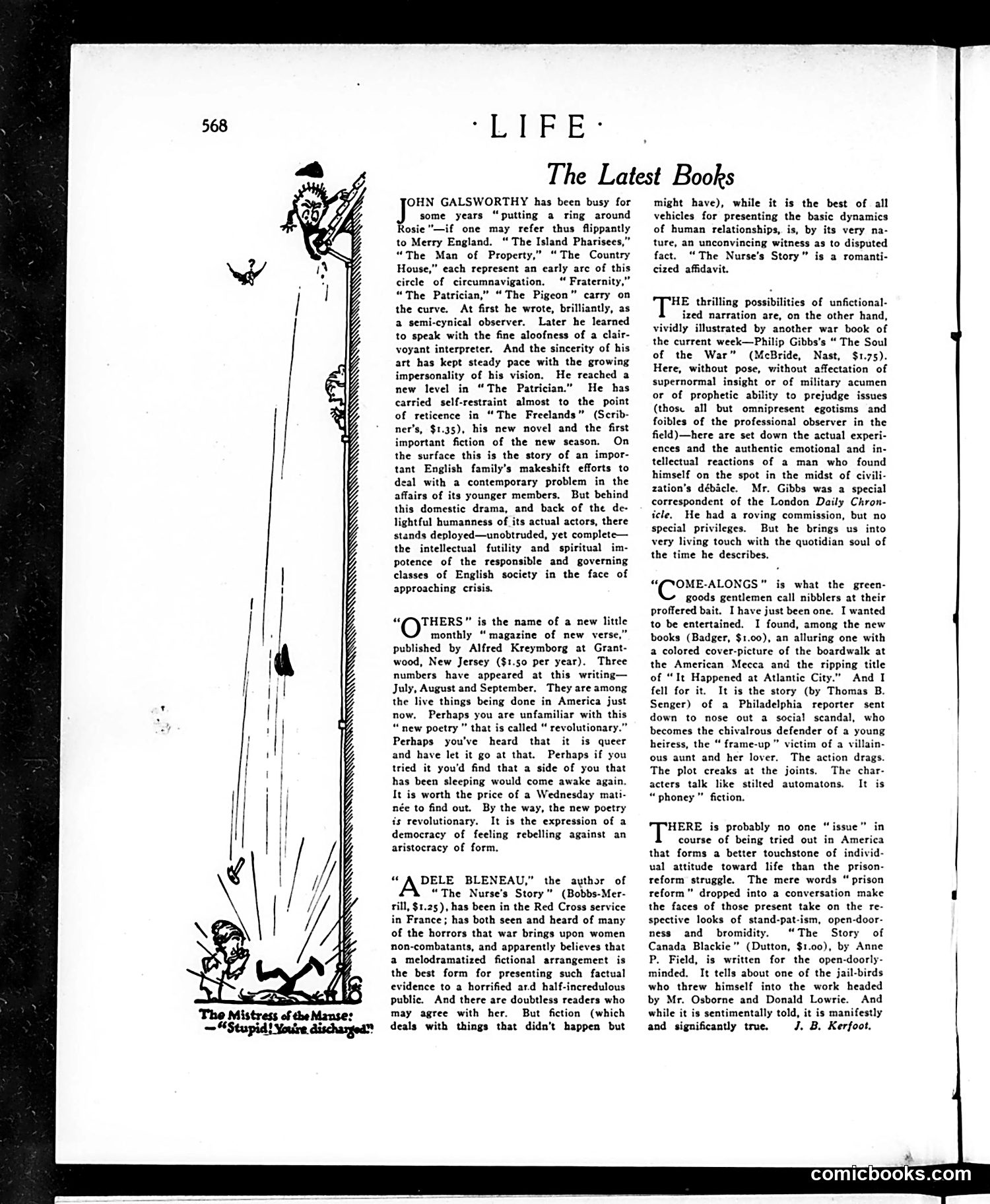
The cartoon depicts a domestic scene where a woman (the "mistress of the manse," or lady of the house) scolds a male servant or employee, calling him "Stupid! You're discharged." The satire targets the arbitrary authority and harsh treatment servants received from their employers in Edwardian England. The title references the woman's position as head of household. Her imperious dismissal—apparently for some minor infraction—exemplifies the callous power dynamics between social classes of the era. This cuts against the contemporary literary works reviewed on the page, particularly John Galsworthy's novels about English society's "intellectual futility and spiritual impotence" in facing crisis. The cartoon suggests that even in the home, England's governing classes display moral shortcomings and cruelty, reinforcing the page's broader critique of English society's failures.
📄 Transcribed text from this page (OCR, searchable)
Machine-transcribed from the original scan — historical spelling and the odd misread are preserved.
The Mistress of the Manse: — “Stupid! Youre discharges” ab) The Latest Books '(OHN GALSWORTHY has been busy for some years “putting a ring around Rosie"—if one may refer thus flippantly to Merry England. “The Island Pharisees,” “The Man of Property,” “The Country House,” each represent an early arc of thi circle of circumnavigation. “‘ Fraternity,’ “The Patrician,” “The Pigeon” carry on the curve. At first he wrote, brilliantly, as a semi-cynical observer. Later he learned to speak with the fine aloofness of a clair- voyant interpreter, And the sincerity of his art has kept steady pace with the growing impersonality of his vision. He reached a new level in “The Patrician.” He has carried self-restraint almost to the point of reticence in “The Freelands” (Scrib- ner’s, $1.35), his new novel and the first important fiction of the new season, On the surface this is the story of an impor- tant English family’s makeshift efforts to deal with a contemporary problem in the affairs of its younger members, But behind this domestic drama, and back of the de- lightful humanness of its actual actors, there stands deployed—unobtruded, yet complete— the intellectual futility and spiritual im- potence of the responsible and governing classes of English society in the face of approaching crisis. “CY)THERS” is the name of a new little monthly “magazine of new vers: published by Alfred Kreymborg at Grant- wood, New Jersey ($1.50 per year). Three numbers have appeared at this writing— July, August and September, They are among the live things being done in America just now. Perhaps you are unfamiliar with this “ new poetry ” that is called “ revolutionary.” Perhaps you've heard that it is queer and have let it go at that. Perhaps if you tried it you'd find that a side of you that has been sleeping would come awake again. It is worth the price of a Wednesday mati- née to find out. By the way, the new poetry is revolutionary. It is the expression of a democracy of feeling rebelling against an aristocracy of form. DELE BLENEAU,” the aythor of “The Nurse’s Story” (Bobbs-Mer- rill, $1.25), has been in the Red Cross service in France; has both seen and heard of many of the horrors that war brings upon women non-combatants, and apparently believes that a melodramatized fictional arrangemert is the best form for presenting such factual evidence to a horrified ard half-incredulous public. And there are doubtless readers who may agree with her. But fiction (which deals with things that didn’t happen but might have), while it is the best of all vehicles for presenting the basic dynamics of human relationships, is, by its very na- ture, an unconvincing witness as to disputed fact. “The Nurse's Story” is a romanti- cized affidavit. 'HE thrilling possibilities of unfictional- ized narration are, on the other hand, vividly illustrated by another war book of the current week—Philip Gibbs's “ The Soul of the War” (McBride, Nast, $1.75). Here, without pose, without affectation of supernormal insight or of military acumen or of prophetic ability to prejudge issues (those all but omnipresent egotisms and foibles of the professional observer in the field)—here are set down the actual experi- ences and the authentic emotional and in- tellectual reactions of a man who found himself on the spot in the midst of zation’s débicle. Mr. Gibbs was a special correspondent of the London Daily Chron- ticle, He had a roving commission, but no special privileges. But he brings us into very living touch with the quotidian soul of the time he describes, “(7 OME-ALONGS” is what the green- goods gentlemen call nibblers at their proffered bait. I have just been one. I wanted to be entertained. I found, among the new books (Badger, $1.00), an alluring one with a colored cover-picture of the boardwalk at the American Mecca and the ripping title of “It Happened at Atlantic City.” And I fell for it. It is the story (by Thomas B. Senger) of a Philadelphia reporter sent down to nose out a social scandal, who becomes the chivalrous defender of a young heiress, the “ frame-up” victim of a villain- ous aunt and her lover. The action drags. The plot creaks at the joints. The char- acters talk like stilted automatons. It is “ phoney” fiction. HERE is probably no one “issue” in course of being tried out in America that forms a better touchstone of individ- ual attitude toward life than the prison- reform struggle. The mere words “ prison reform" dropped into a conversation make the faces of those present take on the re- spective looks of stand-pat-ism, open-door- ness and bromidity. “The Story of Canada Blackie” (Dutton, $1.00), by Anne P. Field, is written for the open-doorly- minded. It tells about one of the jail-birds who threw himself into the work headed by Mr. Osborne and Donald Lowrie. And while it is sentimentally told, it is manifestly and significantly true. J. B. Kerfoot. comicbooks.com