
Life, 1915-09-23 · page 26 of 48
Life — September 23, 1915 — page 26: what you’re looking at
What you’re looking at
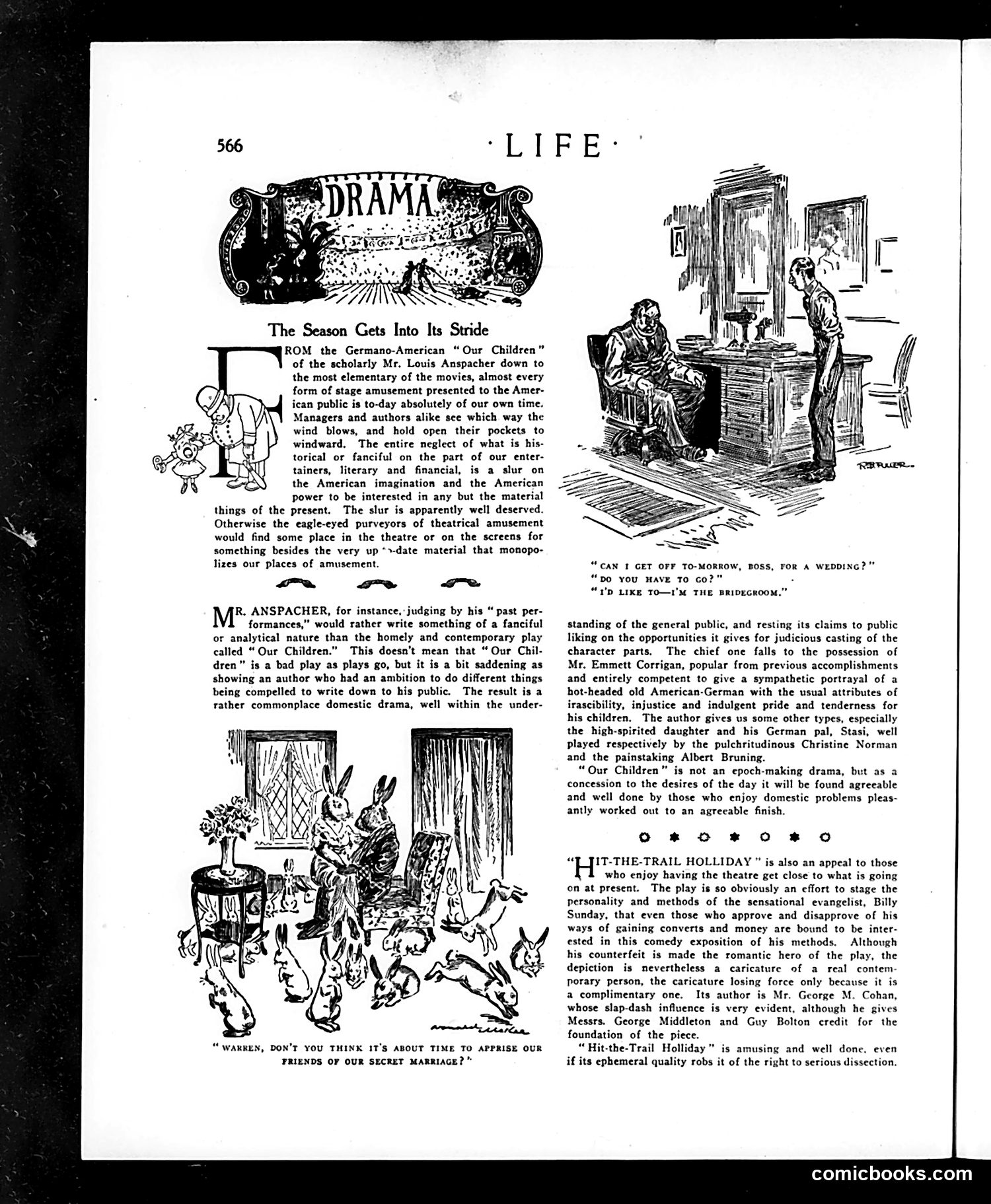
This page reviews contemporary theatrical productions, critiquing American entertainment's obsession with topical, present-day material over imaginative storytelling. **Main reviews discussed:** 1. **"Our Children"** by Louis Anspacher—a domestic drama featuring Emmett Corrigan as a hot-headed German-American father. The critic views it as competently executed but artistically compromised; Anspacher allegedly abandoned higher artistic ambitions to write "down to his public." 2. **"Hit-the-Trail Holliday"** by George M. Cohan—a comedy satirizing evangelist Billy Sunday's sensational conversion methods and fundraising. The critic notes it's entertaining but superficial satire, losing impact precisely because it flatters its subject rather than truly critiquing him. **The satirical point:** Managers and playwrights pander to audience demand for contemporary material, neglecting imaginative or historical drama. The cartoons and jokes mock this materialism—depicting workplace concerns (a boss refusing an employee time off for his own wedding) as the mundane reality theaters now prioritize over fanciful entertainment.
📄 Transcribed text from this page (OCR, searchable)
Machine-transcribed from the original scan — historical spelling and the odd misread are preserved.
The Season Gets Into Its Stride ROM the Germano-American “Our Children” of the scholarly Mr. Louis Anspacher down to the most elementary of the movies, almost every form of stage amusement presented to the Amer- ican public is to-day absolutely of our own time. Managers and authors alike see which way the wind blows, and hold open their pockets to windward, The entire neglect of what is his- torical or fanciful on the part of our enter- tainers, literary and financial, is a slur on the American imagination and the American power to be interested in any but the material things of the present. The slur is apparently well deserved. Otherwise the eagle-eyed purveyors of theatrical amusement would find some place in the theatre or on the screens for something besides the very up *>-date material that monopo- lizes our places of amusement. ~~ Fo M* ANSPACHER, for instance,: judging by his “ past per- formances,” would rather write something of a fanciful or analytical nature than the homely and contemporary play called “Our Children.” This doesn't mean that “ Our Chil- dren” is a bad play as plays go, but it is a bit saddening as showing an author who had an ambition to do different things being compelled to write down to his public. The result is a rather commonplace domestic drama, well within the under- “WARREN, DON’T YOU THINK IT'S ABOUT TIME TO APPRISE OUR FRIENDS OF OUR SECRET MARRIAGE?” “CAN I GET OFF TO-MORROW, BOSS, FOR A WEDDING?” “Do YoU MAVE To co?" . “I'D LIKE TO—I'M THE BRIDEGROOM.” standing of the general public, and resting its claims to public liking on the opportunities it gives for judicious casting of the character parts, The chief one falls to the possession of Mr. Emmett Corrigan, popular from previous accomplishments and entirely competent to give a sympathetic portrayal of a hot-headed old American-German with the usual attributes of irascibility, injustice and indulgent pride and tenderness for his children, The author gives us some other types, especially the high-spirited daughter and his German pal, Stasi, well played respectively by the pulchritudinous Christine Norman and the painstaking Albert Bruning. “Our Children” is not an epoch-making drama, but as a concession to the desires of the day it will be found agreeable and well done by those who enjoy domestic problems pleas- antly worked out to an agreeable finish. oe De 0 8 9 * IT-THE-TRAIL HOLLIDAY " is also an appeal to those who enjoy having the theatre get close to what is going on at present. The play is so obviously an effort to stage the personality and methods of the sensational evangelist, Billy Sunday, that even those who approve and disapprove of his ways of gaining converts and money are bound to be inter- ested in this comedy exposition of his methods. Although his counterfeit is made the romantic hero of the play, the depiction is nevertheless a caricature of a real contem- porary person, the caricature losing force only because it is a complimentary one. Its author is Mr. George M. Cohan, whose slap-dash influence is very evident, although he gives Messrs. George Middleton and Guy Bolton credit for the foundation of the piece. “ Hit-the-Trail Holliday" is amusing and well done, even if its ephemeral quality robs it of the right to serious dissection. comicbooks.com