
A complete issue · 48 pages · 1915
Life — September 2, 1915
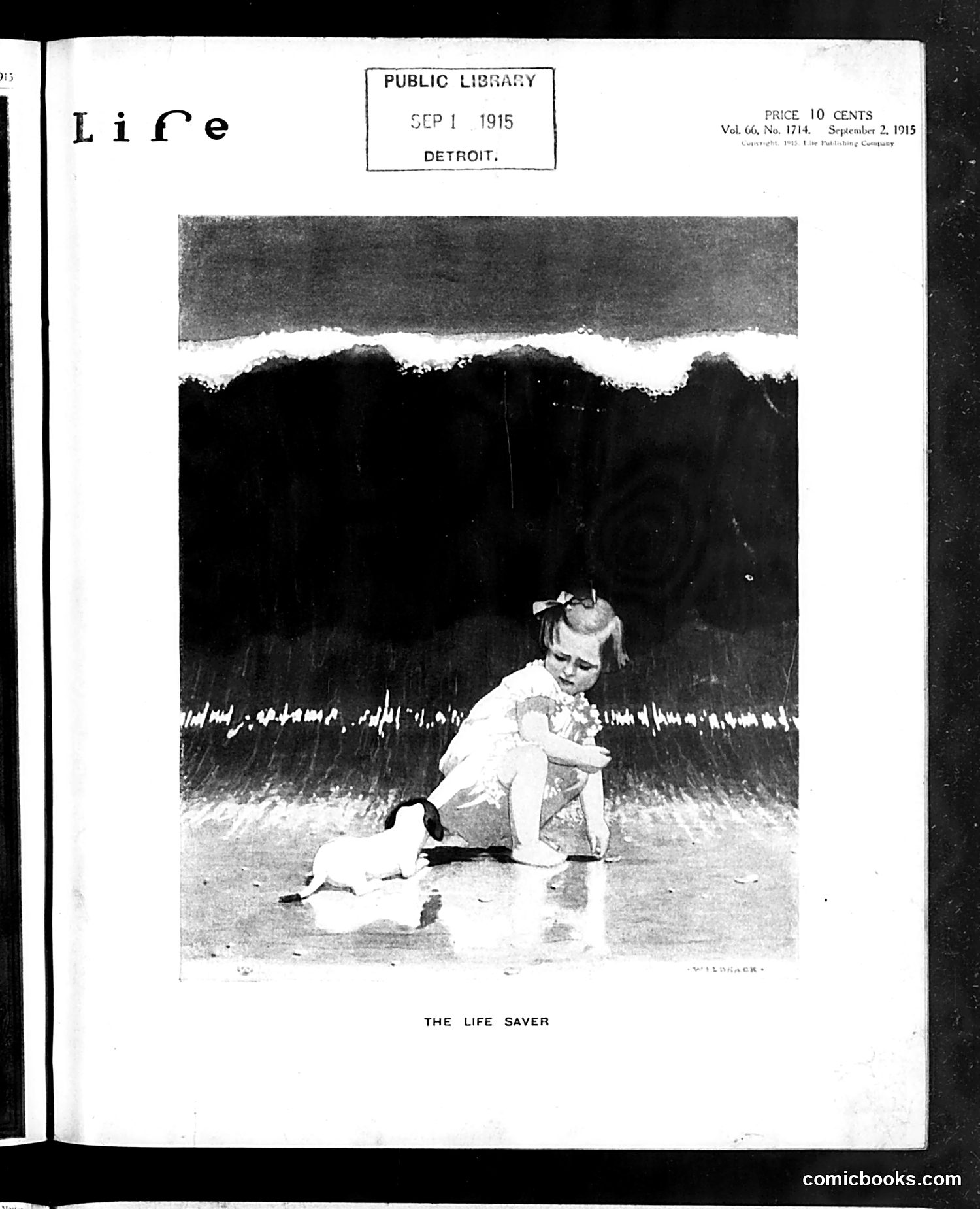
This photograph shows a young child crouching beside a small dog on wet sand or shallow water at a beach. The caption "The Life Saver" appears to be satirical wordplay. The humor likely works on multiple levels: the child appears to be rescuing or helping the small dog (literally "saving a life"), while the photographic composition and caption may reference contemporary lifeguard imagery or safety concerns. In 1915, beach safety and swimming dangers were topical issues in American culture. The satire seems to mock either the solemnity of lifeguard heroics or perhaps comment on domestic pet care versus human safety priorities—though the exact social commentary intended remains somewhat unclear from this image alone.
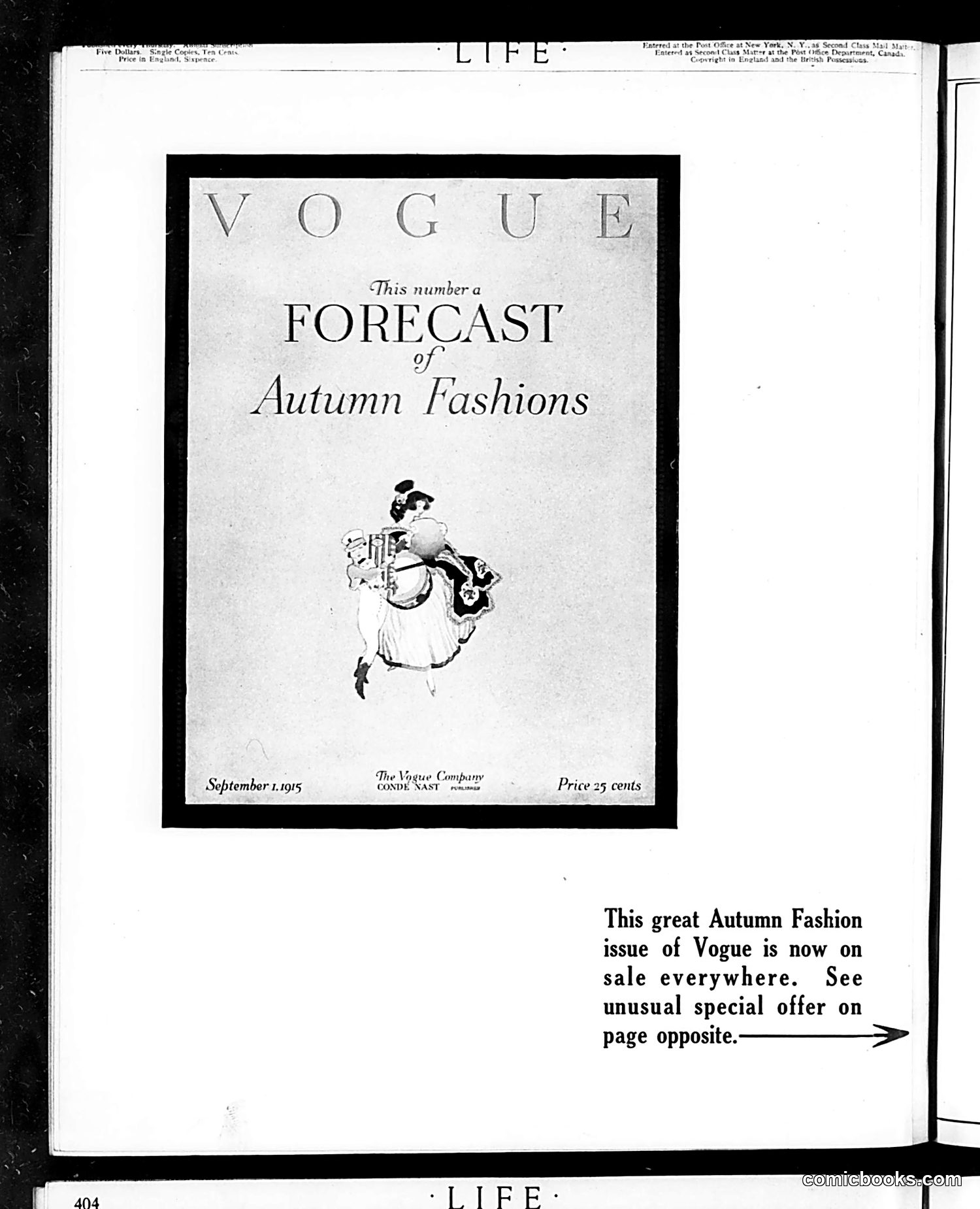
This page is primarily **advertising content**, not political satire. It features a **Vogue magazine cover advertisement** from September 1, 1915, promoting Vogue's "Forecast of Autumn Fashions" issue. The image shows an illustrated woman in early 20th-century dress, carrying what appears to be fashion accessories or garments. The advertisement is placed in Life magazine to promote the Vogue publication to Life's readers. Below the cover image, text encourages readers that "This great Autumn Fashion issue of Vogue is now on sale everywhere," directing them to "page opposite" for a "special offer." The price listed (25 cents) and publisher ("The Vogue Company, CONDE NAST") are historical details typical of 1915 publishing. This is straightforward commercial promotion rather than editorial commentary or satire.
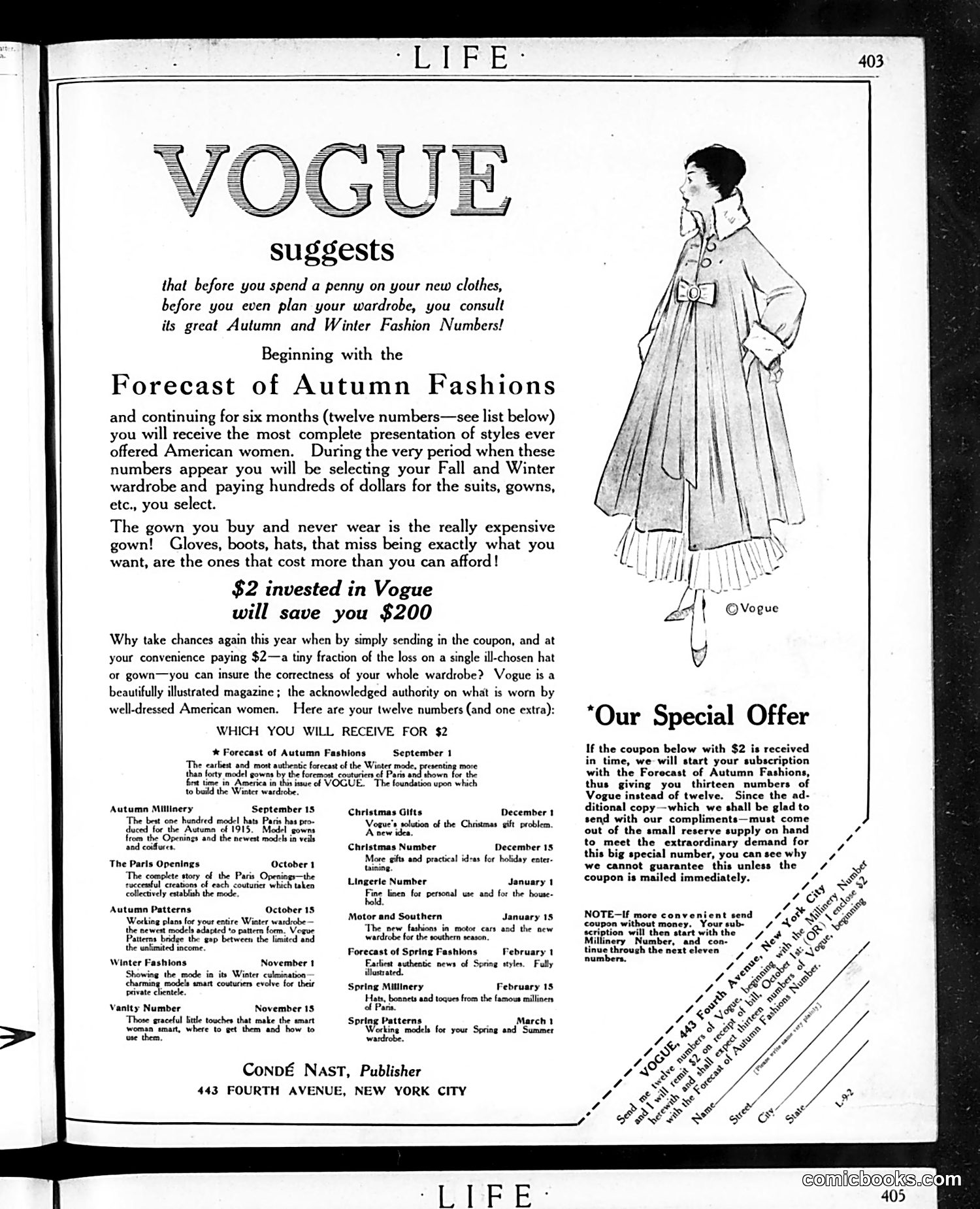
This page is **primarily an advertisement**, not satire or political commentary. It's a Vogue subscription promotion appearing in Life magazine (page 403). The advertisement promotes Vogue's "Forecast of Autumn Fashions" — a six-month series of fashion forecasts. The illustration shows a fashionably dressed woman in fall attire, representing the style guidance Vogue promises. The pitch claims that a $2 Vogue subscription will "save you $200" by helping readers make smart wardrobe choices and avoid costly fashion mistakes. The ad lists twelve upcoming issues featuring seasonal fashion guidance (autumn, winter, spring fashions, etc.). There is **no political satire here** — it's straightforward period advertising targeting American women interested in fashion, published by Condé Nast.
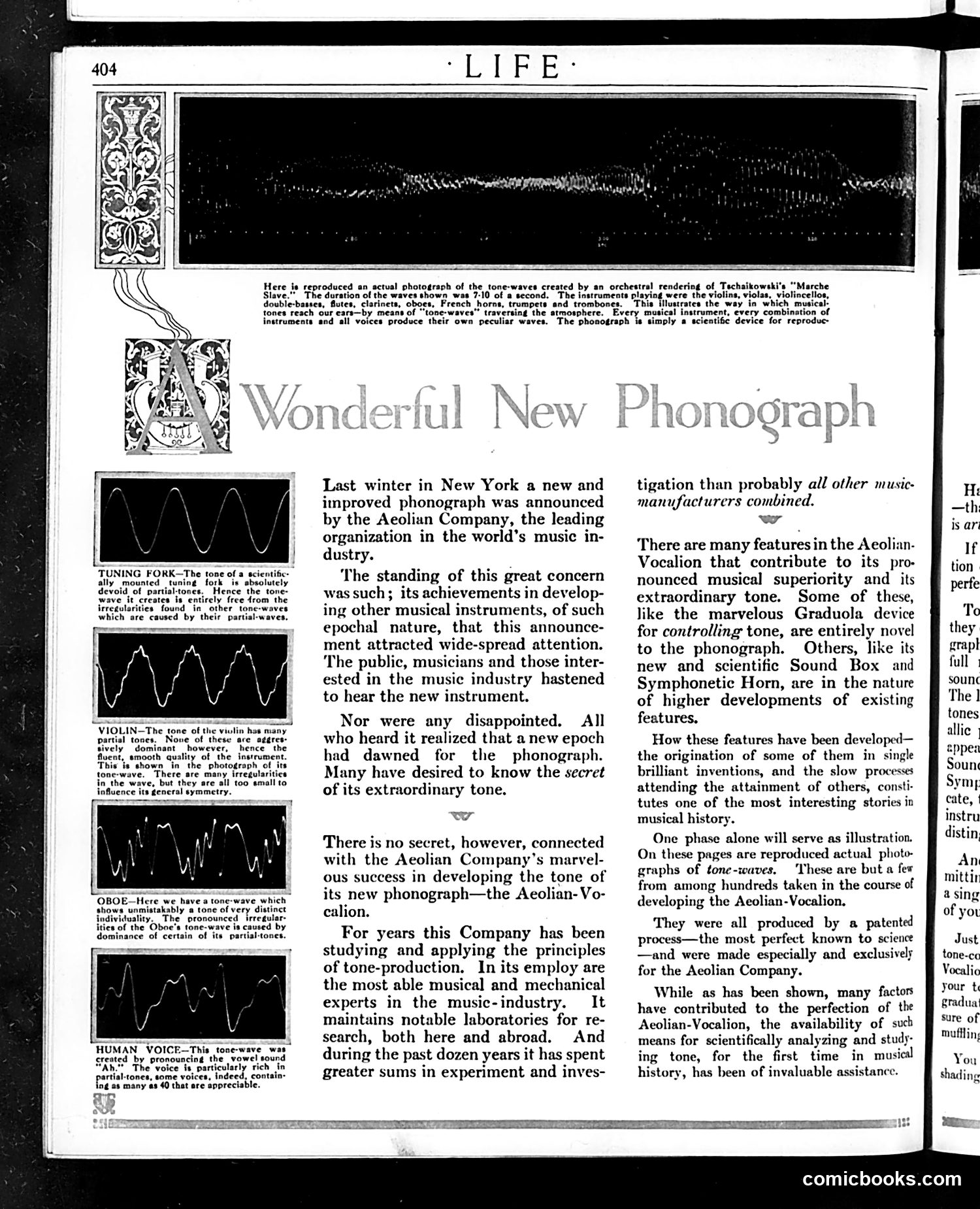
This is not political satire but rather a genuine technology article celebrating the **Aeolian Company's improved phonograph**. The page features actual sound-wave photographs—visual representations of musical tones captured from various instruments. The article describes how the Aeolian-Vocalization phonograph achieved superior sound quality through scientific tone-wave analysis. The wave diagrams shown (tuning fork, violin, oboe, human voice) demonstrate the magazine presenting cutting-edge audio technology to readers as genuinely marvelous innovation. This reflects early 20th-century enthusiasm for mechanical reproduction of sound and scientific visualization of music—treating phonograph development as a major industrial and cultural achievement worthy of detailed technical explanation.
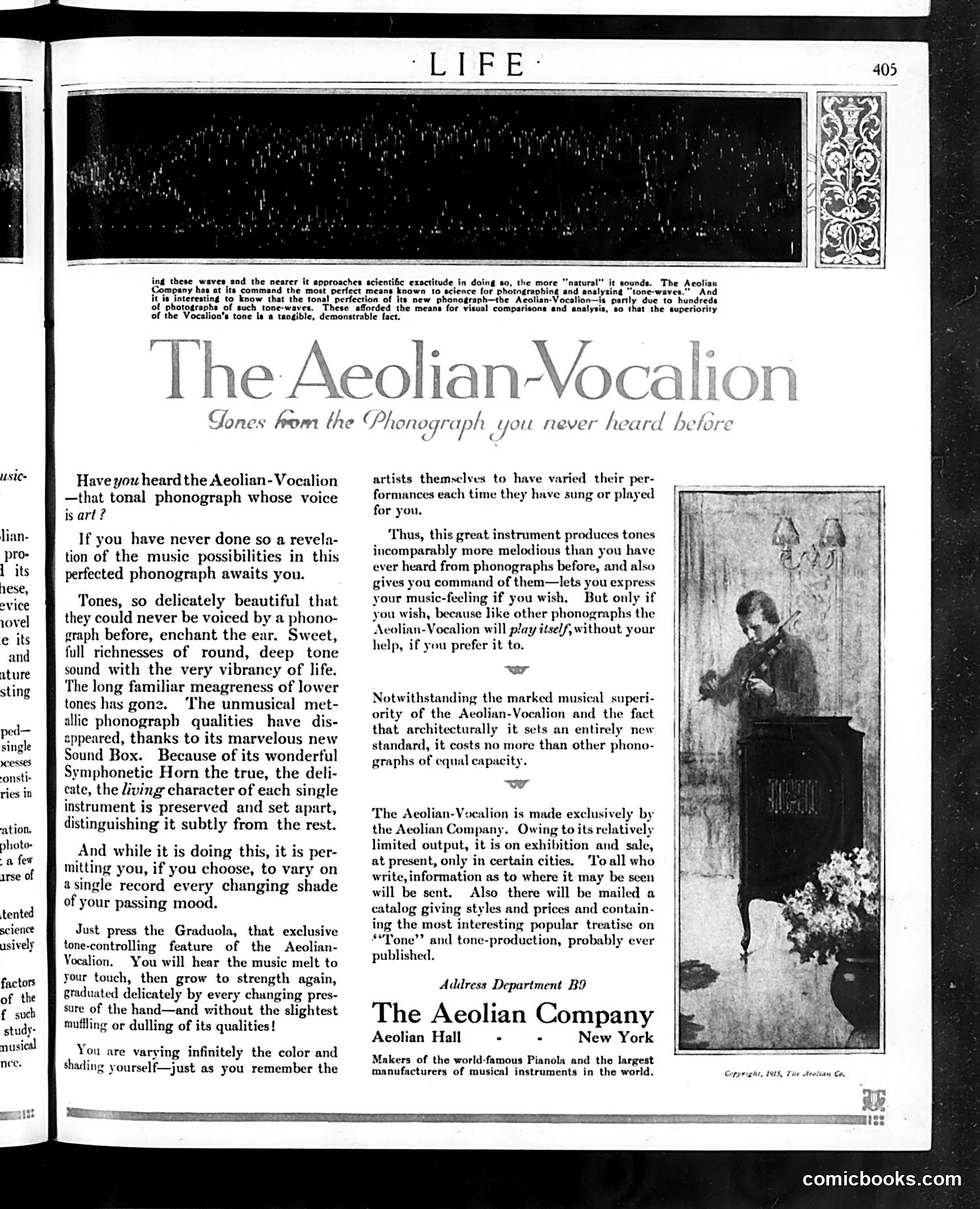
This page is primarily **advertising, not satire or political commentary**. It features a full-page advertisement for the Aeolian-Vocalion phonograph, positioned as a luxury music device. The ad emphasizes the phonograph's superior sound quality, claiming it produces "tones so delicately beautiful" that previous phonographs couldn't capture. It highlights an exclusive "Graduola" feature allowing listeners to control volume and tone. The accompanying photograph shows a woman at the device in an elegant interior setting, suggesting this is a high-end consumer product for affluent households. There is no political cartoon or satirical content on this page. The small illustration at the top appears to be a sound wave visualization, supporting the product's technical claims.
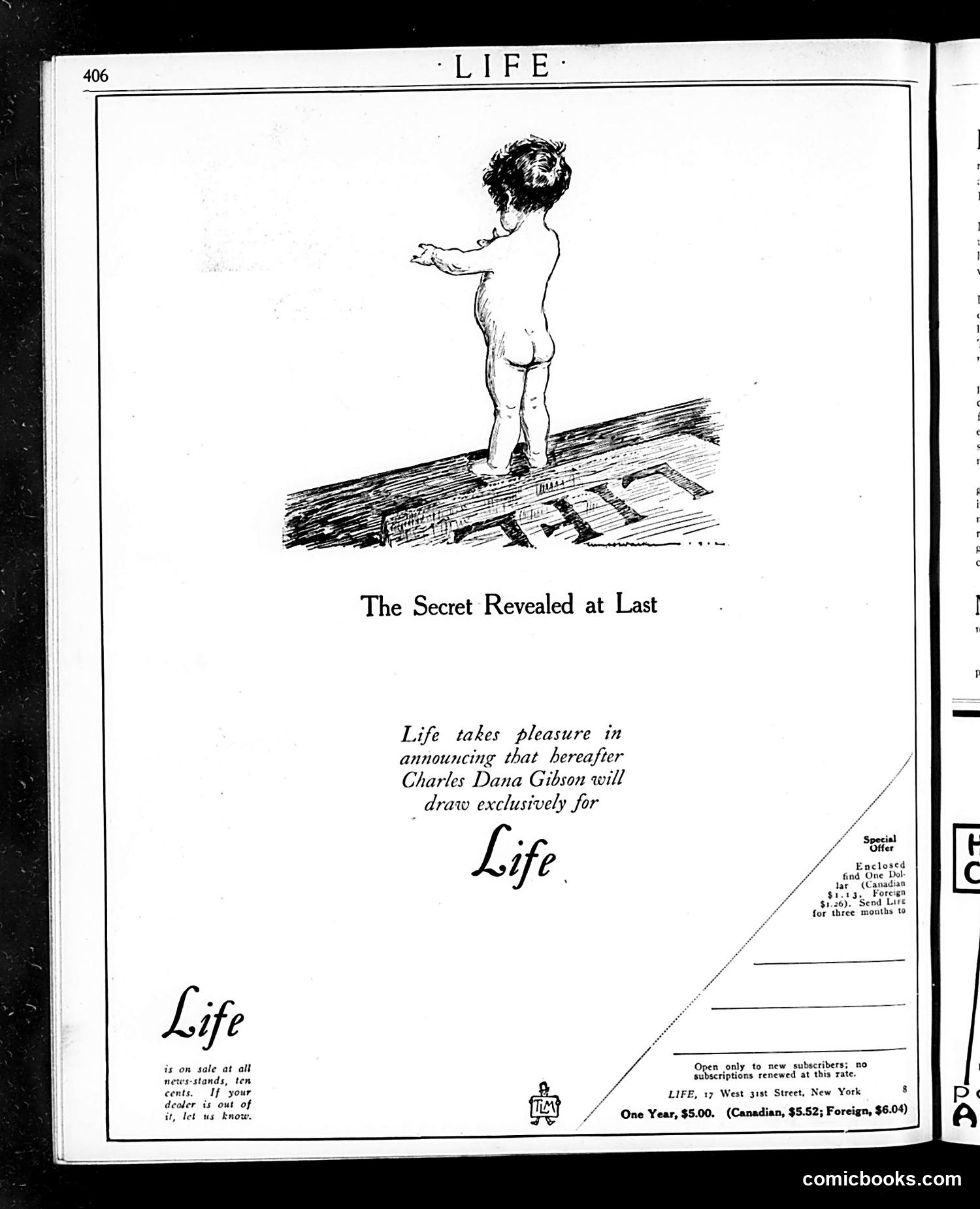
This page is primarily **advertising rather than political satire**. It announces that illustrator Charles Dana Gibson will draw exclusively for *Life* magazine going forward—a major publishing coup, as Gibson was famous for his "Gibson Girl" illustrations that defined early 20th-century beauty standards. The cartoon depicts a nude cherub or putto standing on railroad tracks, arms outstretched. This appears to be *Life* magazine's mascot or logo, presented playfully as "The Secret Revealed at Last"—the revelation being Gibson's exclusive contract. The bottom section contains subscription information and pricing ($5.00 yearly for U.S. subscribers). The overall presentation treats Gibson's signing as major entertainment news worthy of fanfare.
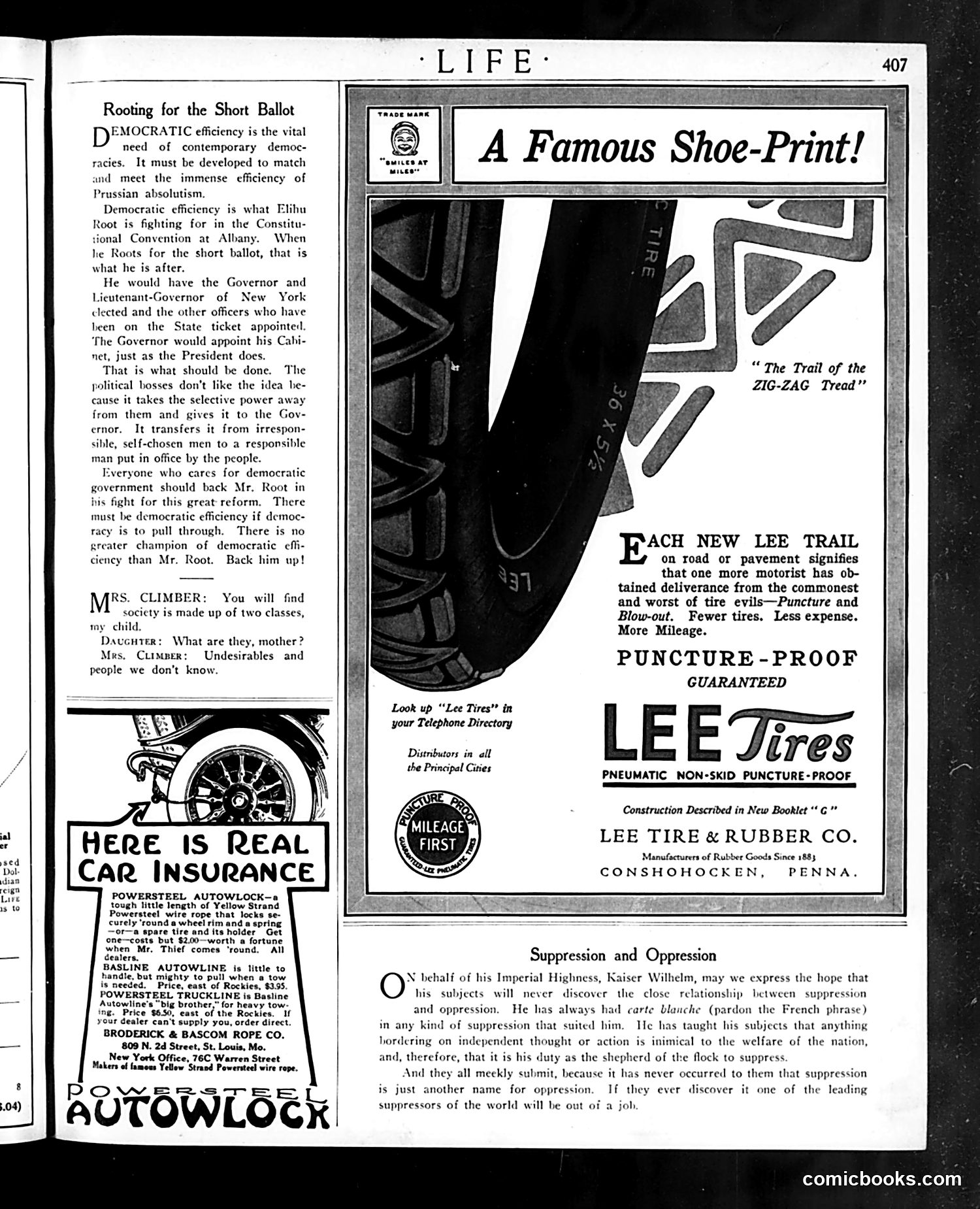
The left column contains a political editorial titled "Rooting for the Short Ballot" advocating for Elihu Root's Constitutional Convention efforts in Albany. Root sought to make New York's Governor and Lieutenant-Governor elected positions rather than appointed, arguing this would increase democratic efficiency and reduce the power of political machines. The piece criticizes how "political bosses" use appointed positions to maintain control, calling Root "the greatest champion of democratic efficiency." Below this is a dialogue satirizing class divisions—Mrs. Climber describes society as made of "Desirables" and "Undesirables," suggesting arbitrary social stratification. The rest of the page is advertising (car insurance, tires), not political commentary.
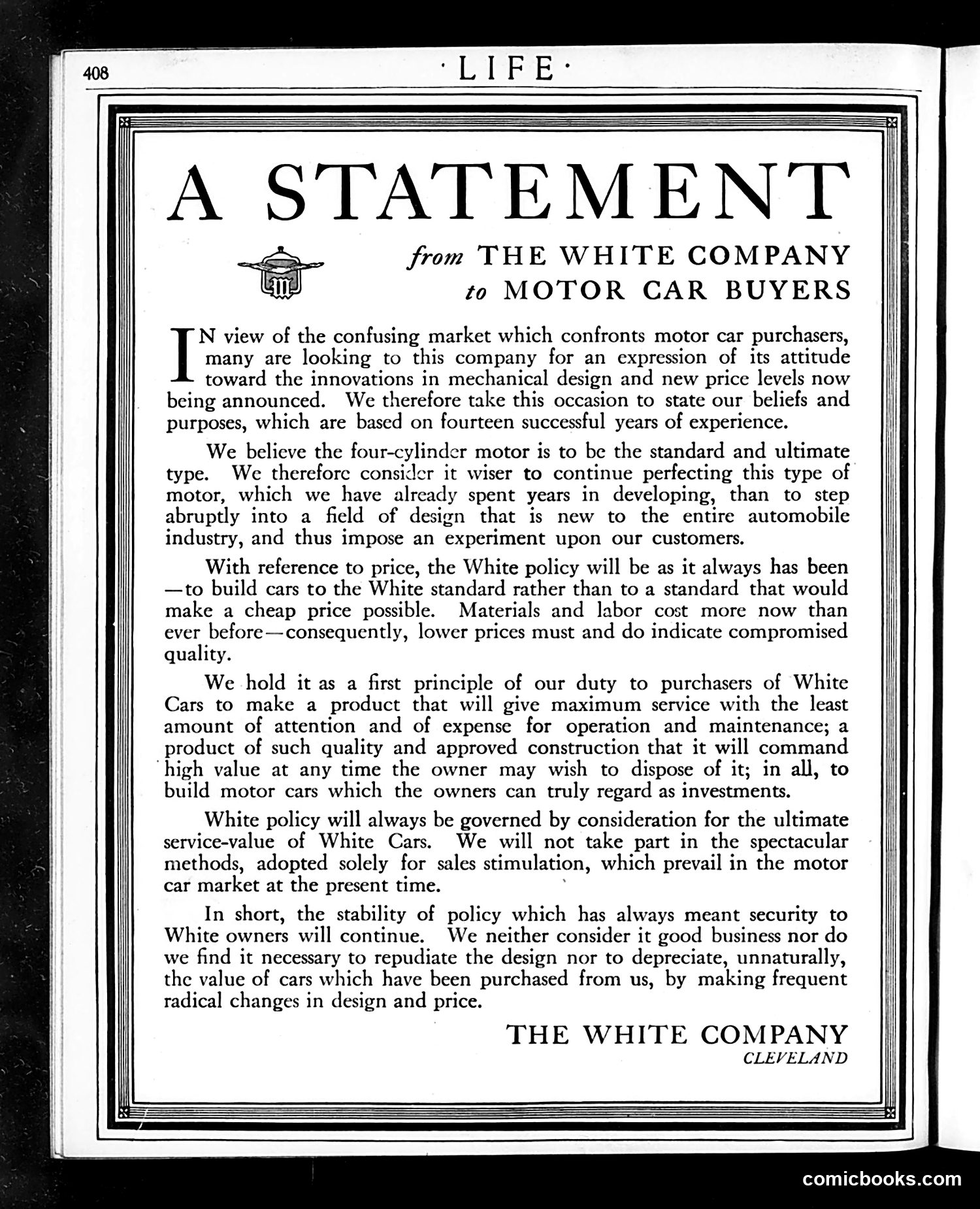
This is a **corporate advertisement**, not a political cartoon. The White Company (an automobile manufacturer based in Cleveland) addresses motor car buyers directly. The "statement" defends the company's design philosophy against competitors introducing radical innovations. White argues for continuing their proven **four-cylinder engine design** rather than experimental new types flooding the market. They position themselves as conservative and reliability-focused—building cars as "investments" with lasting value, avoiding the "spectacular methods" of competitors pursuing sales gimmicks. The implicit critique: other manufacturers are chasing trendy designs and price wars that compromise quality. This reflects early automotive industry competition (likely 1910s-1920s) when technological standards were unsettled and marketing claims were aggressive.
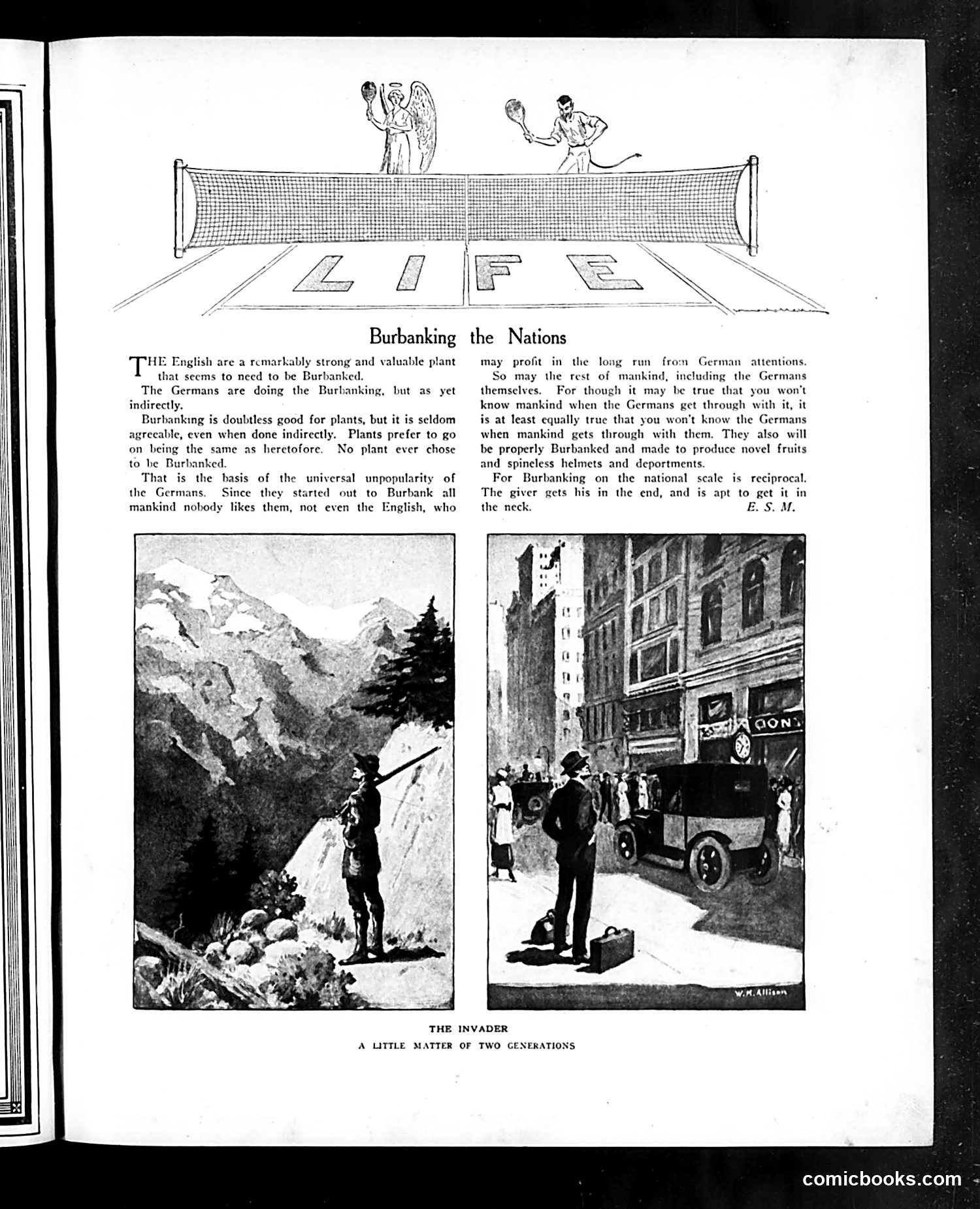
This satirical piece compares German military aggression to "burbanking"—a horticultural technique where plants are grafted onto different rootstock to produce new varieties. The article argues that just as plants resist being "burbanked" and prefer remaining unchanged, nations dislike German interference. The joke: Germans are attempting to forcibly "graft" their influence onto other nations, producing unwanted hybrid results (novel fruits, spineless helmets, deportments). The two photographs below labeled "The Invader: A Little Matter of Two Generations" show a soldier in a mountain pass (presumably a German soldier invading neutral territory) contrasted with a modern vehicle on a city street, illustrating how invasion methods have evolved across generations. The satire criticizes German expansionism as fundamentally unwanted foreign interference.
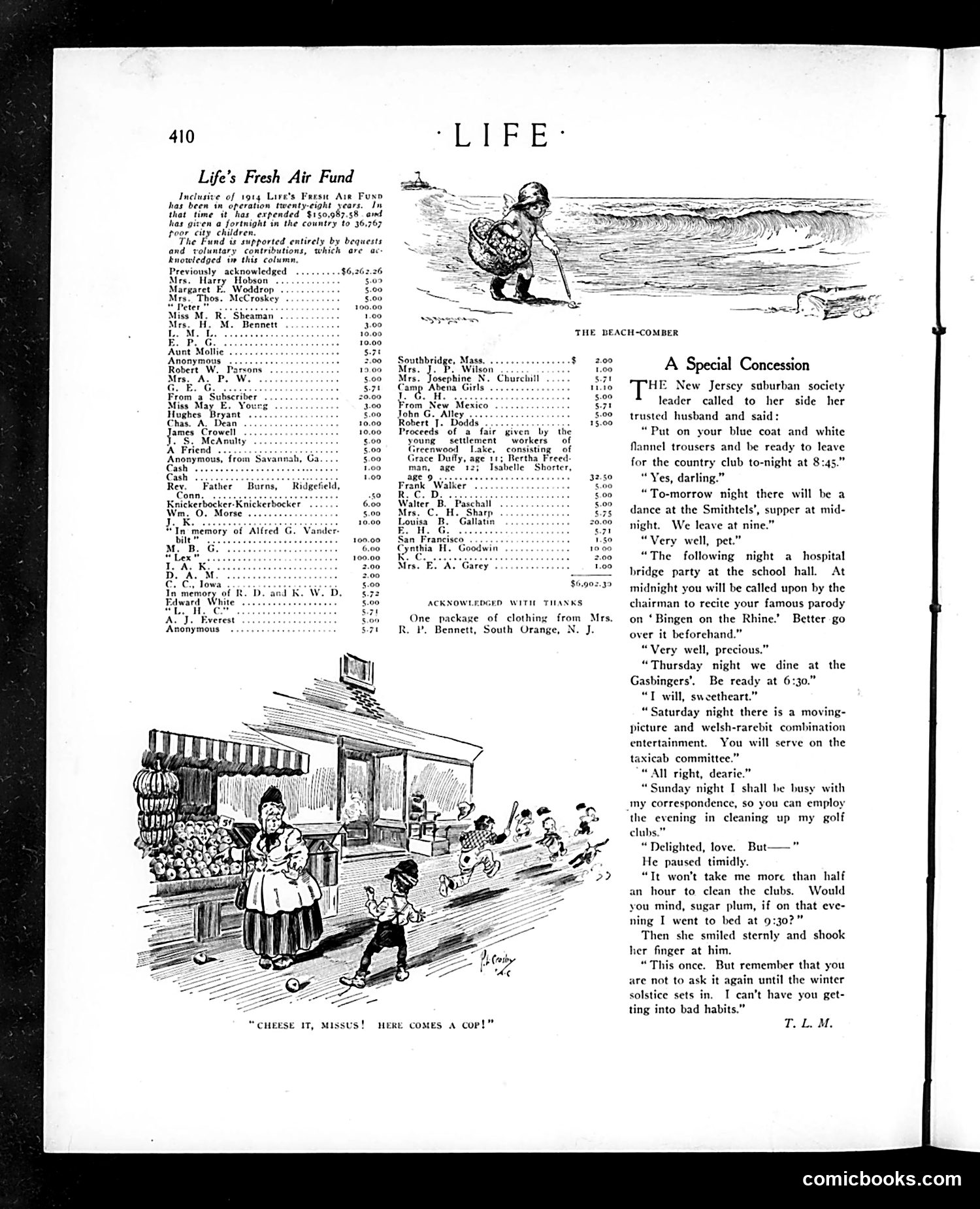
This page contains two distinct elements: **Upper section:** A charity fund listing for "Life's Fresh Air Fund," documenting donations to send children to the country for health benefits. The donations range from small amounts ($1) to larger gifts ($25.26), suggesting a community fundraising effort for working-class children's welfare. **Lower cartoon:** Titled "Cheese It, Misses! Here Comes a Cop!" depicts children playing street games (appears to be marbles or similar) while a policeman approaches. The humor relies on the period's common scene of street children scattering when authorities appeared—reflecting anxieties about urban youth, public space usage, and law enforcement attitudes toward poor children's play. The juxtaposition suggests Life magazine's interest in both charitable concerns and social commentary regarding urban childhood and poverty.
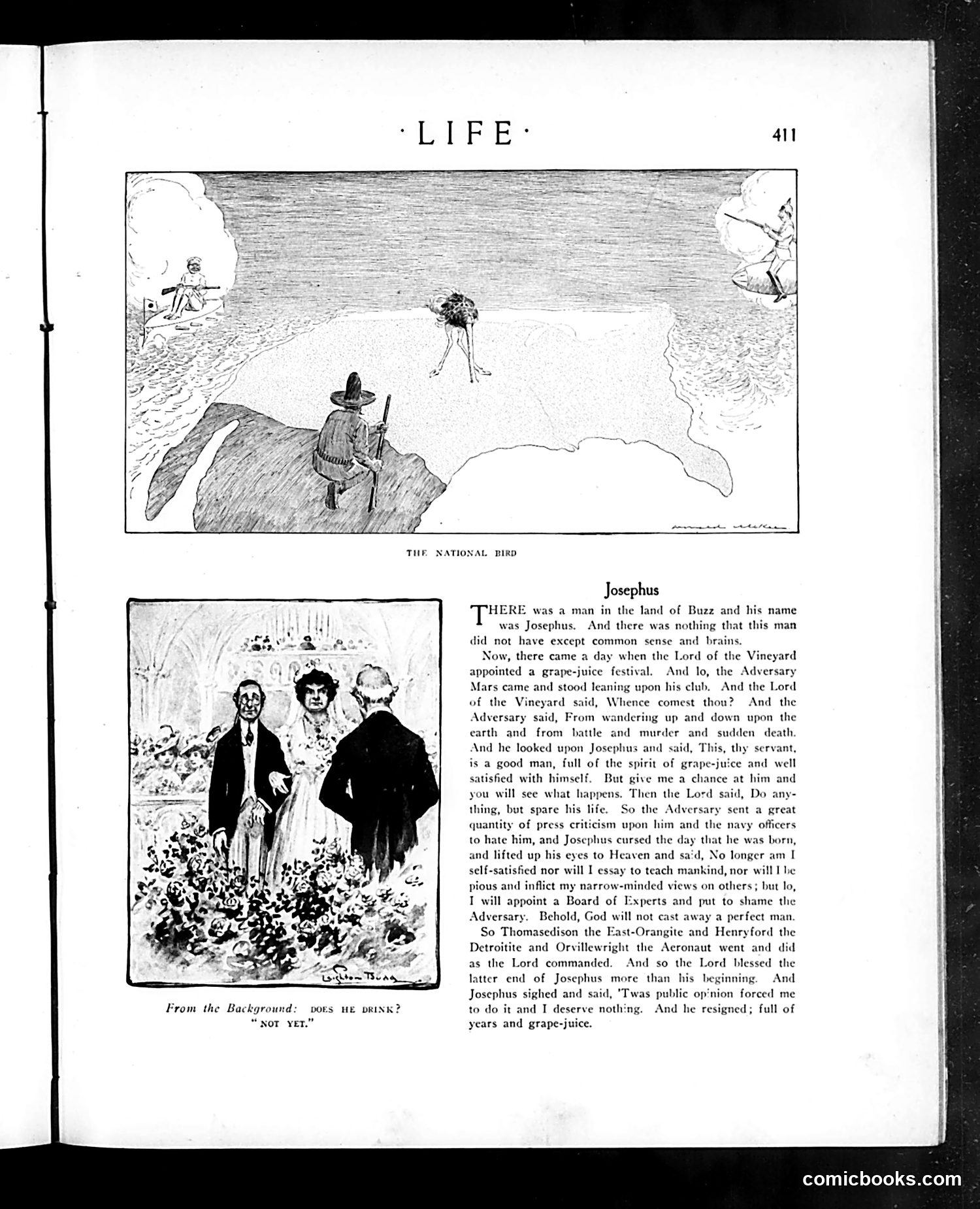
This page presents a satirical story illustrated with two cartoons. "The National Bird" (top) depicts a cowboy confronting a long-legged bird—likely representing American expansionism or imperialism meeting resistance. The main text tells an allegory: Josephus, a satisfied man content with grape-juice, is tested by the Lord through an Adversary (representing critics/press). Despite pressure to change, Josephus refuses self-improvement and instead appoints a "Board of Experts" to shame his critics rather than reform himself. The Lord, disappointed, allows his decline. The bottom cartoon ("Does He Drink? Not Yet") shows three men in a vineyard, illustrating the story's moral about stubborn resistance to legitimate criticism. The satire likely targets American complacency, stubbornness regarding social reform, or specific contemporary political figures unwilling to address public concerns.
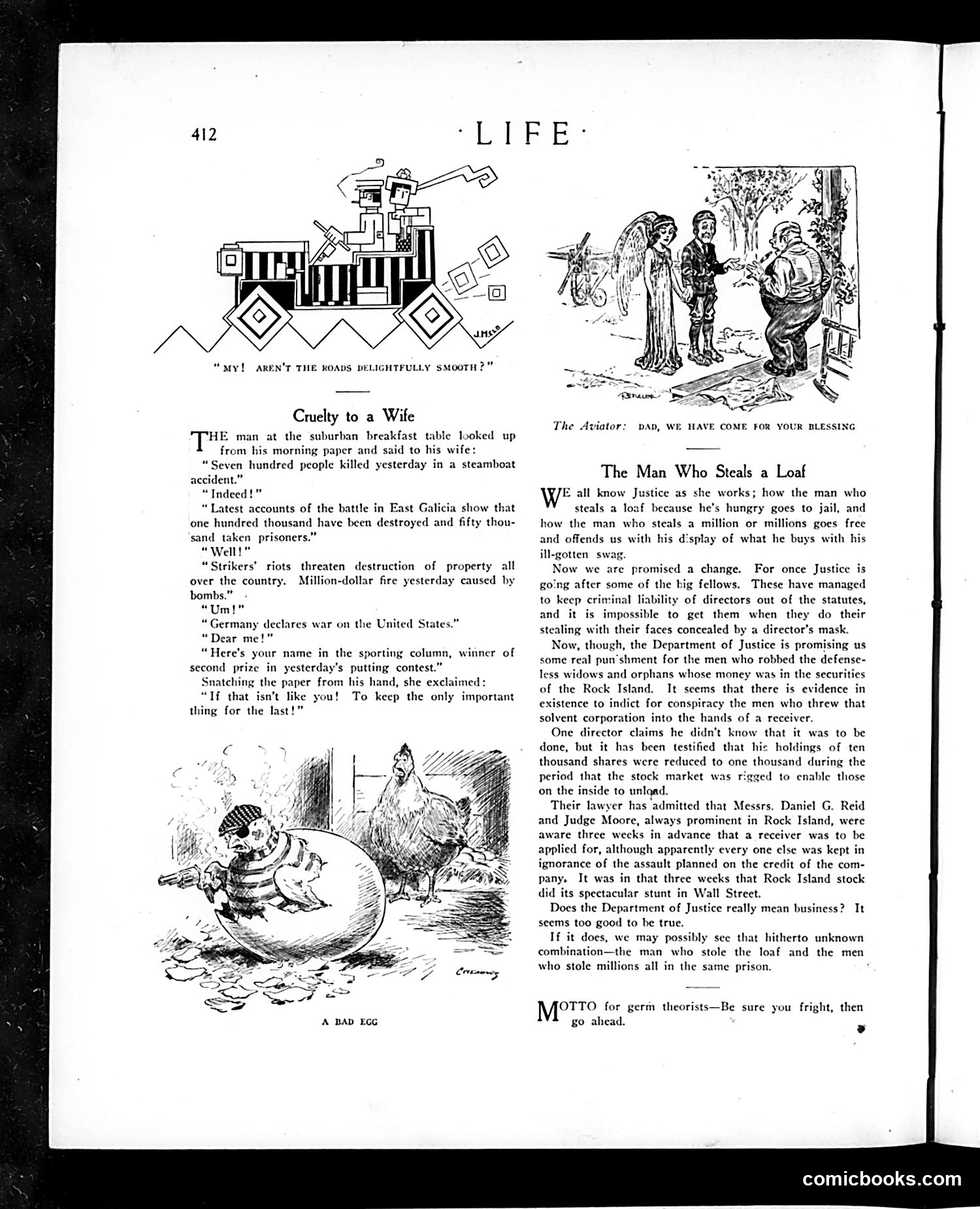
This page contains two separate pieces of social commentary: **"Cruelty to a Wife"** (left) shows a husband reading aloud from his newspaper—reciting increasingly catastrophic war and disaster headlines to his wife at breakfast. The joke satirizes insensitive husbands who inflict depressing news upon their spouses during intimate family moments, treating her as a captive audience for his reading practice rather than considering her feelings. **"The Man Who Steals a Loaf"** (right) is a serious editorial critique of corporate crime versus petty crime. It argues that while poor people go to jail for stealing bread out of hunger, wealthy directors and stock manipulators—who steal millions—escape justice through legal loopholes. The piece specifically references the Rock Island railroad scandal, demanding equal justice application.
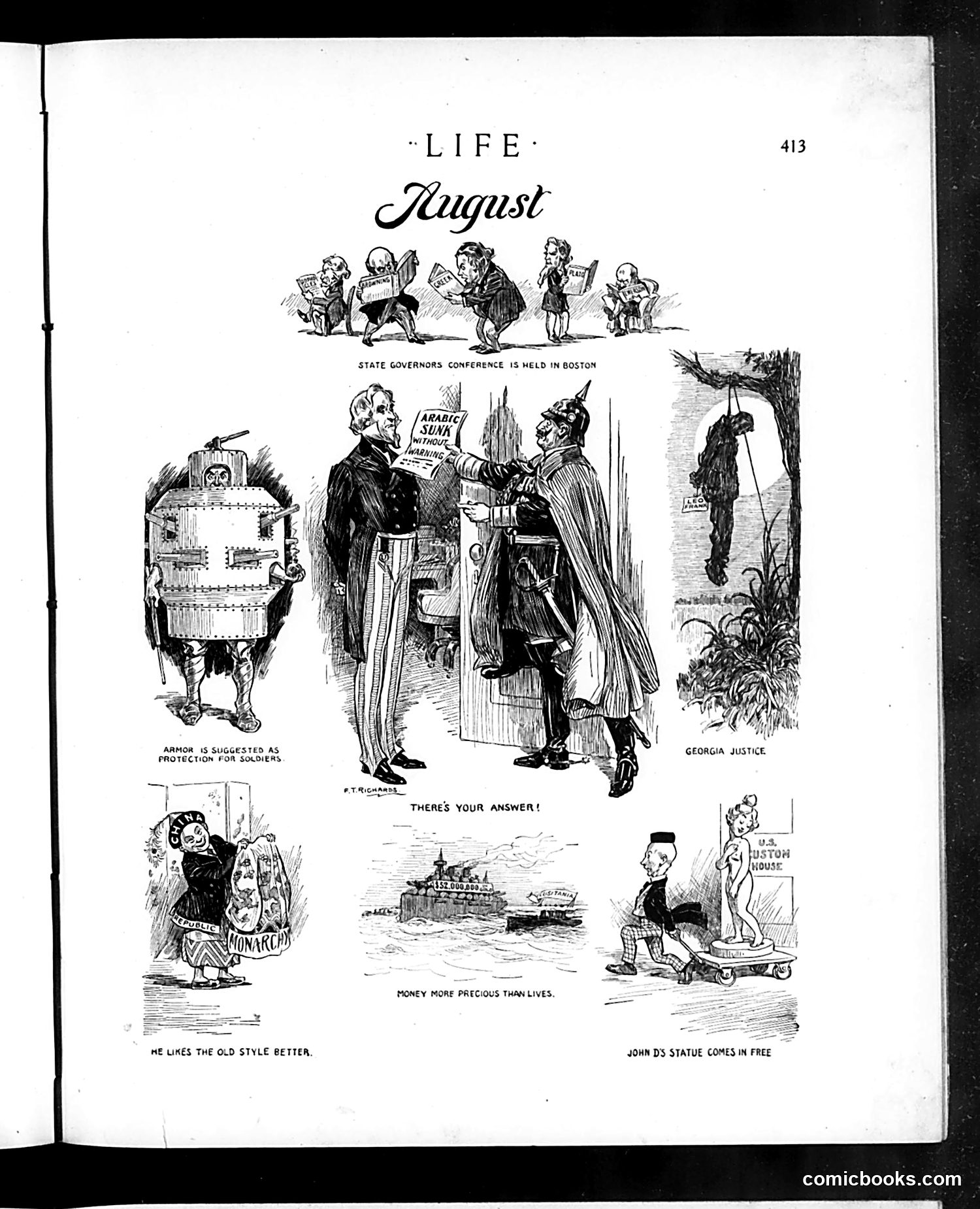
This page contains six satirical drawings critiquing early 20th-century American politics and social issues: **Top section** references a State Governors Conference in Boston, showing political figures reading newspapers. **Central cartoon** ("There's Your Answer!") depicts two military or political figures discussing what appears to be a newspaper about "Anarchist Sundays," likely commenting on labor unrest or radical politics of the era. **Other cartoons** address: soldier protection ("Armor is Suggested as Protection for Soldiers"), Georgia justice issues, monarchy preferences, maritime commerce ("Money More Precious Than Lives"), and a statue controversy ("John D's Statue Comes in Free"). The overall theme criticizes governmental priorities, suggesting officials valued property and commerce over human welfare and justice. The style is typical of Life's sharp political satire from this period.
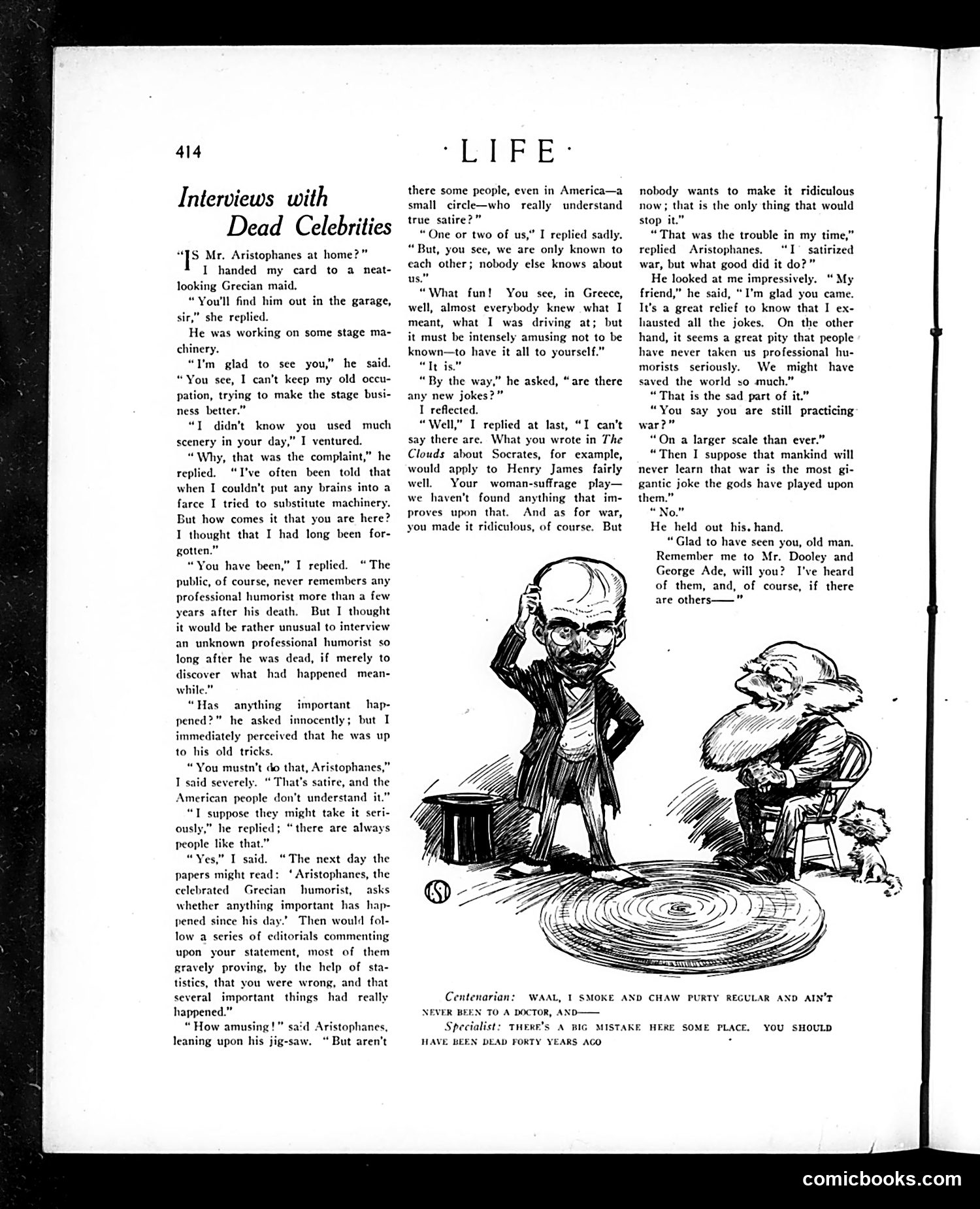
This satirical piece interviews the ancient Greek playwright **Aristophanes**, presented as a ghost. The humor relies on several layers: 1. **The Central Joke**: A modern interviewer visits Aristophanes' home to discuss whether anything important has happened since his death—implying centuries of human activity might bore an ancient comic genius. 2. **Social Commentary**: The text critiques modern American life, particularly women's suffrage and warfare. Aristophanes observes that current events (war, social change) are so absurd they'd be rejected as too ridiculous for his own comedic plays. 3. **The Caricature**: The illustration shows Aristophanes as a wizened, bald figure—standard period caricature style—listening to a modern specialist explain contemporary concerns. The satire suggests modern society has become too chaotic for even satirical treatment.
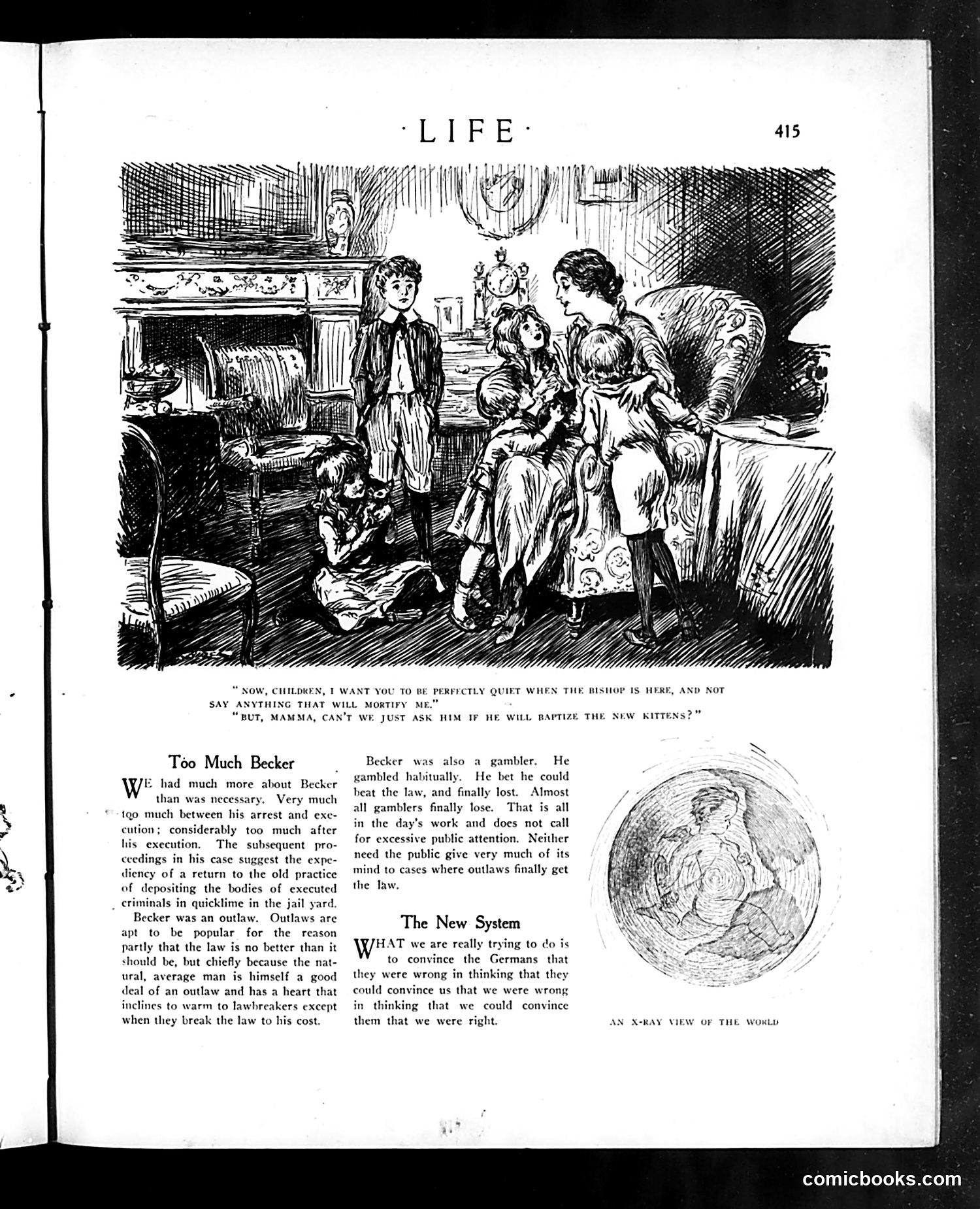
The top illustration depicts a domestic scene where a mother instructs children to be quiet during a bishop's visit, asking if they can "just ask him if he will baptize the new kittens." This is gentle satire mocking religious formality and children's innocent irreverence toward ecclesiastical authority. Below, the article "Too Much Becker" discusses a criminal case involving someone named Becker, criticizing excessive public attention to outlaws and suggesting the legal system should return to quietly executing criminals rather than making spectacles of them. "The New System" section appears to reference post-WWI diplomacy, specifically attempting to convince Germans of Allied rightness—likely commentary on Treaty of Versailles negotiations or peace treaty justifications. The x-ray diagram on the right's caption is unclear without full context.
This page presents two short stories submitted to **Life's Short Story Contest**, offering $1,000, $500, and $250 prizes for stories answering the question: "How short can a short story be and still be a short story?" **"Which?" by Joseph Hall** depicts a romantic dilemma through two old love letters—one man (Will) and another (John) each renouncing their claims to a woman, deferring to the other. The story's irony lies in its brevity: the entire emotional drama is conveyed through the letters themselves. **"Ben T. Allen, Atty., vs. Himself" by William H. Hamby** follows a small-town lawyer in Clayton Center who loses both a legal case and romantic competition to the same woman (Betty Lane, a court stenographer) through his own incompetence and alcoholism. The story ends with Allen drunkenly falling off a sidewalk, humorously subverting the "drunken men don't get hurt" maxim. Both stories explore compressed narrative—how much emotional and dramatic content can fit into minimal space while remaining coherent stories.
This story satirizes **judicial corruption and the mistreatment of poor defendants** in early 20th-century American courts. Young lawyer John Preston is appointed to defend Farral, a homeless man accused of killing a brakeman. The District Attorney and judge conspire to set Preston up as a fool—assigning him a "murder case" as a humiliating rite of passage, expecting him to accept the prisoner's coerced confession and secure a guilty plea. The satire targets: - **Forced confessions** ("third degree" interrogation) - **Class prejudice** (a hobo's life treated as worthless) - **Judicial mockery** of inexperienced lawyers defending poor clients - **Systemic injustice** where the outcome is predetermined Preston's integrity—refusing the patronizing advice to accept guilt quickly—suggests he'll actually mount a real defense, defying the court's expectations. The "joke" is the establishment's casual assumption that justice doesn't apply to society's poorest members.
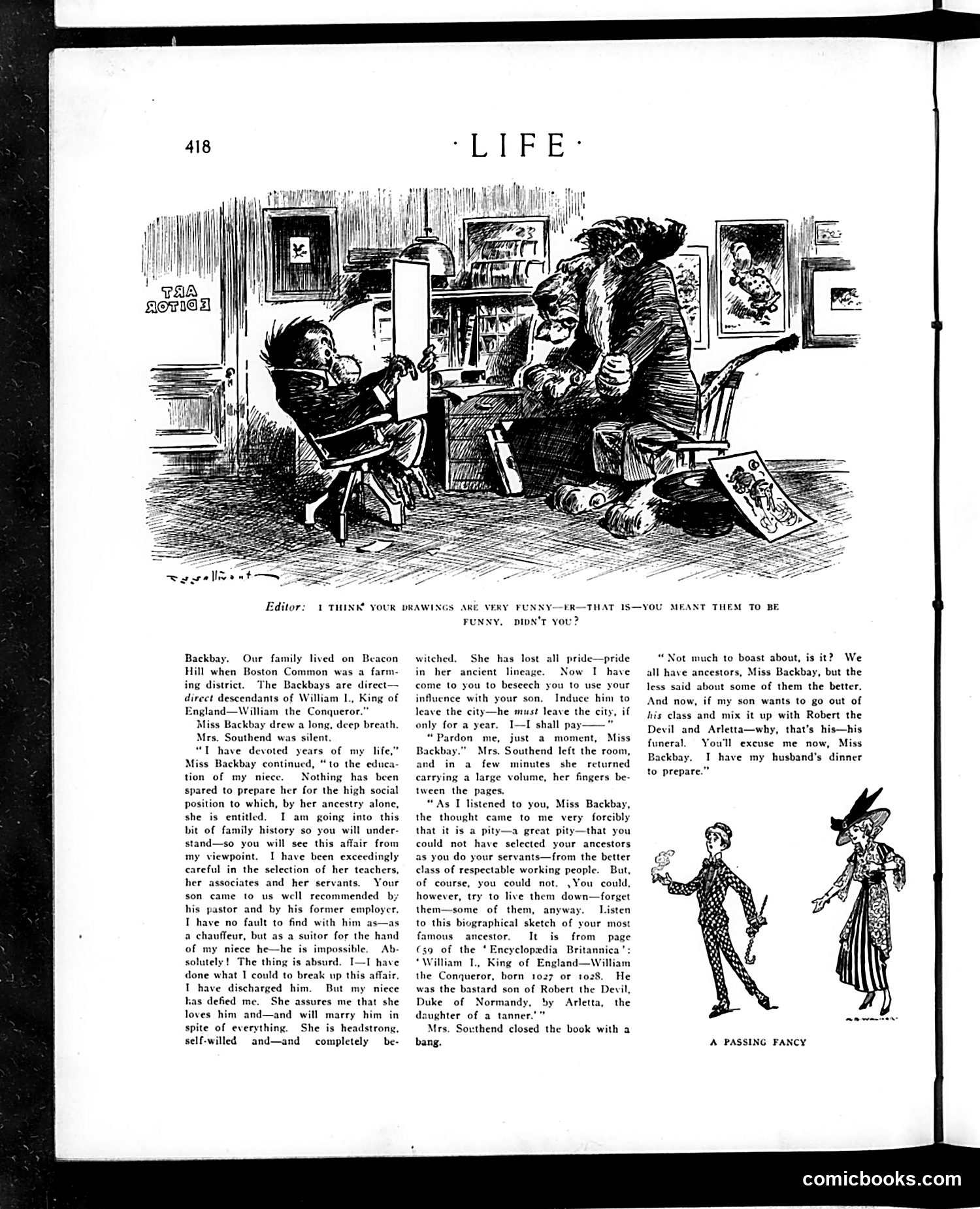
The main cartoon depicts an editor critiquing an artist's drawings, saying "I think your drawings are very funny—er—that is—you meant them to be funny, didn't you?" This is a **visual joke about artistic intent and perception**. The editor appears uncertain whether the crude, exaggerated sketches are intentionally humorous or simply poorly executed. The satire targets both amateur artists who produce awkward work and editors who must diplomatically assess such submissions. The accompanying text, "Backbay," discusses a woman's snobbish family lineage and her efforts to educate her son about his ancestors. It illustrates **class anxiety and social pretension** common to the era—mocking aristocratic obsession with ancestry while suggesting such pride is baseless. Both pieces satirize American social pretensions of the period.
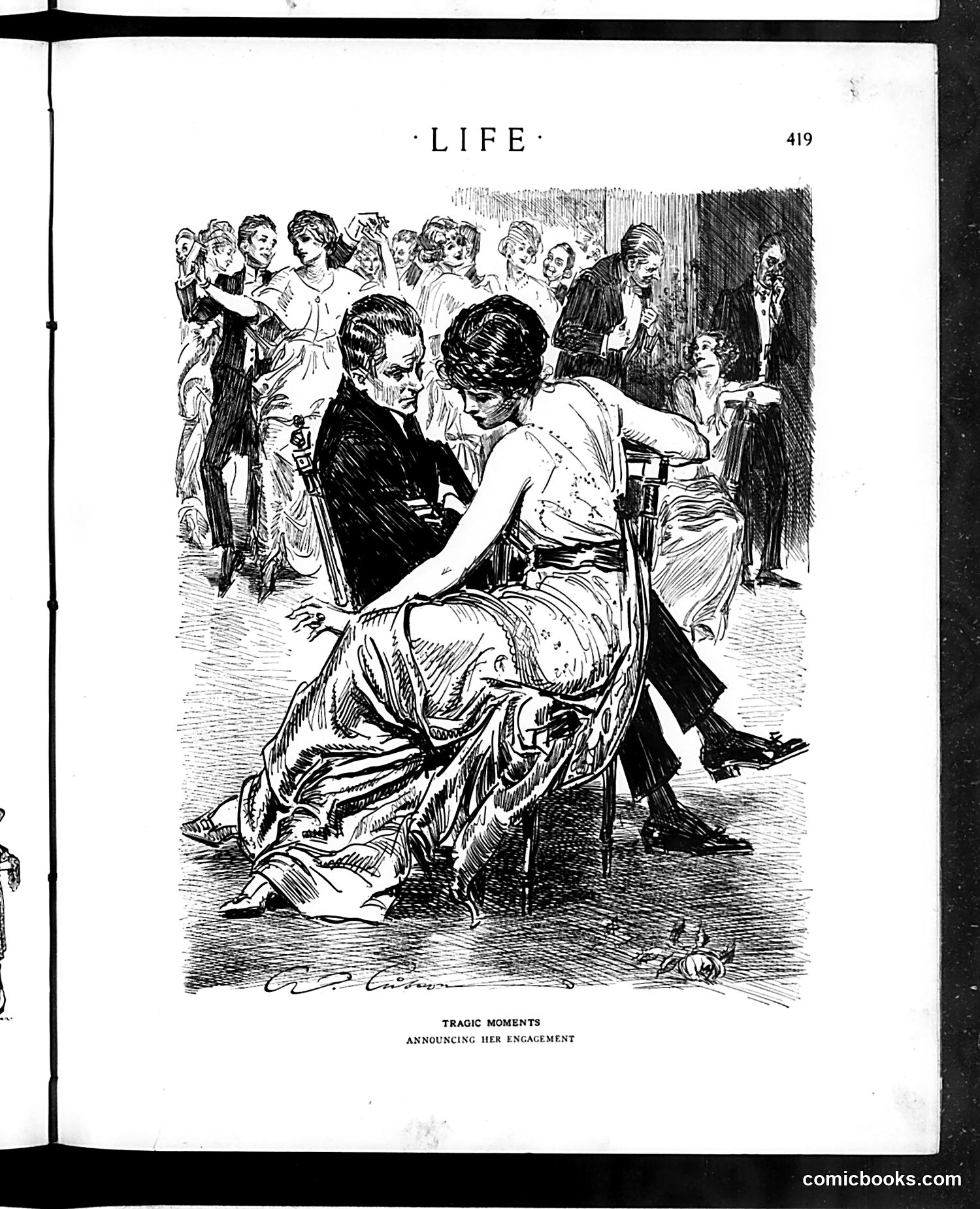
This is a satirical illustration captioned "Tragic Moments: Announcing Her Engagement." The sketch depicts a woman seated, appearing distressed or upset, while a man in formal attire stands beside her. A crowd of onlookers gathers in the background, suggesting this is a public social occasion—likely a party or gathering where an engagement announcement is taking place. The satire appears to target the social awkwardness or emotional difficulty of announcing an engagement, portraying it as a "tragic moment" rather than a joyous one. The woman's posture and expression suggest reluctance, sadness, or resignation about the engagement, while the gathered crowd observes. This likely satirizes either marital anxiety, forced engagements, or the gap between social expectations and personal feelings about marriage—common themes in early 20th-century satirical commentary on courtship and matrimony.
This editorial page addresses two major German-American controversies of WWI: **The Arabic Sinking**: The main text argues that Germany's policy of sinking merchant and passenger vessels without warning violates international humanitarian law. Life characterizes Germany as an "international outlaw" whose claim that "German necessity knows no law" is unacceptable. The U.S. government demands Germany cease these attacks or face consequences. **German Propaganda in America**: The article references revelations published in the *World* newspaper about German spy and propaganda activities in the U.S., specifically naming **George Sylvester Viereck** as a German agent posing as an American. Life dismisses German-American protests about these exposures, noting they don't change public estimation of such operatives. The cartoons (illustrations of children playing) appear to accompany discussions of hope and innocence amid wartime tensions. **Context**: This reflects 1915 America's growing frustration with Germany's submarine warfare and covert operations, before U.S. entry into WWI in 1917.
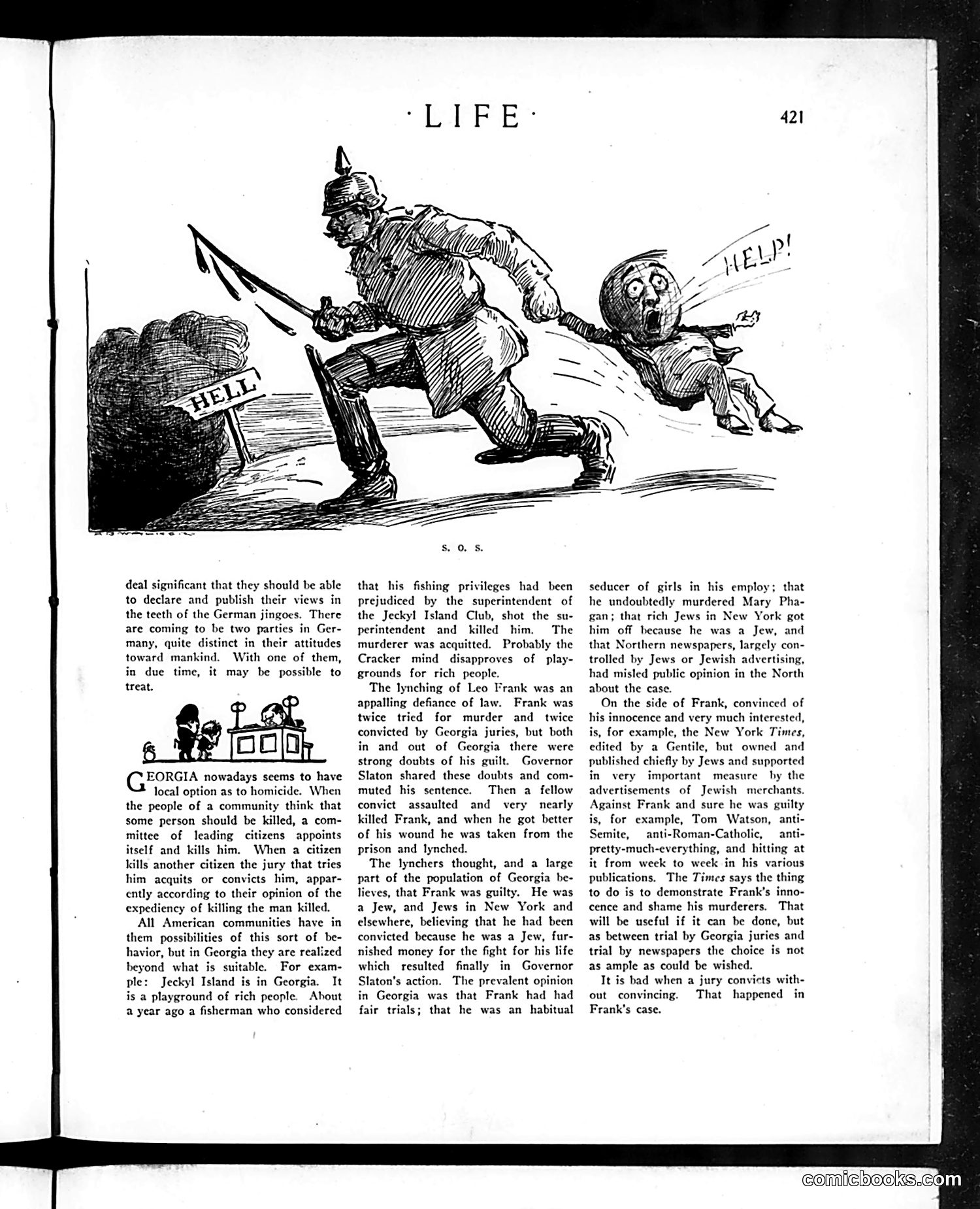
This page critiques Georgia's extrajudicial violence and the Leo Frank case. The cartoon shows a German military officer (representing autocratic "Prussian" values) gleefully watching an American lynch mob—equating Georgia's mob justice with militaristic tyranny. The article discusses how Georgia's wealthy and poor operate under different legal standards: a fisherman who killed a wealthy club superintendent was acquitted, while Leo Frank—a Jewish factory manager convicted (twice) of murdering a young worker, Mary Phagan—was lynched after Governor Slaton commuted his sentence based on reasonable doubt. The text presents both perspectives: Georgia believed Frank was guilty and guilty Jews manipulated Northern newspapers to free him; Frank's supporters (like the *New York Times*) saw religious prejudice behind his conviction and execution. **The satire's point**: Georgia's justice system isn't impartial law but mob rule reflecting class and religious bias—a shocking hypocrisy for a democracy claiming superiority to German authoritarianism.
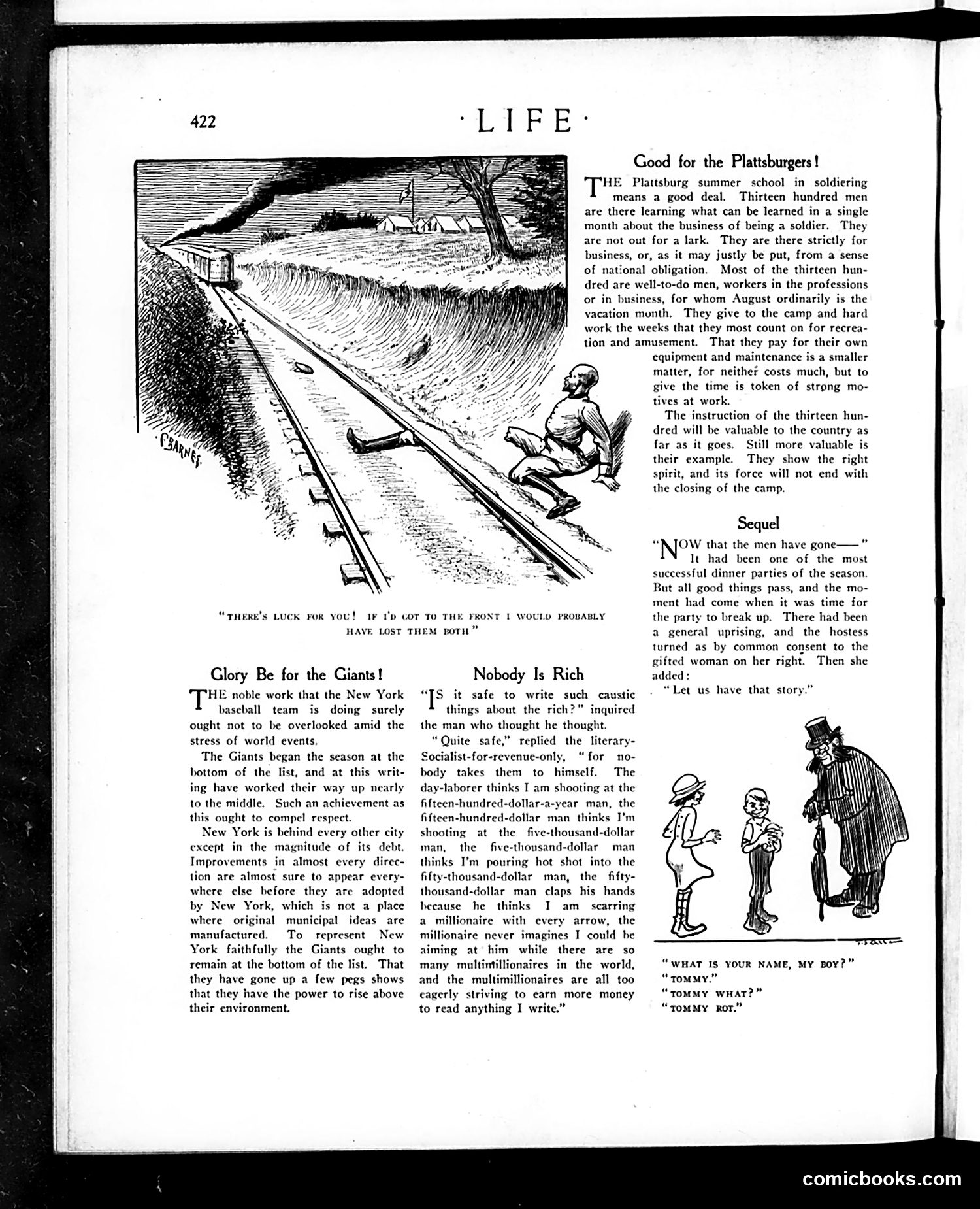
This page celebrates the **Plattsburg Training Camp**, a real 1915-1916 military preparedness program where affluent American civilians volunteered for summer military instruction. The first article praises these 1,300 well-to-do businessmen and professionals who sacrificed their vacation month for national defense—framing it as patriotic obligation rather than recreation. The sketch satirizes a fishing mishap: a man warns his companion that going to the front would cost him "both" (likely his catch and something else), playing on war's unpredictability. "Glory Be for the Giants!" uses the New York Giants baseball team's mid-season improvement as metaphor for New York's general sluggishness in civic progress compared to other cities. "Nobody Is Rich" is a witty social satire: a literary Socialist explains why rich-mocking writing is "safe"—because each income bracket believes criticism targets *someone richer*, creating a cascade where no one feels personally attacked. The final cartoon shows a man asking a boy's name, with "Tommy" misconstrued as "Tommy rot" (British slang: nonsense).
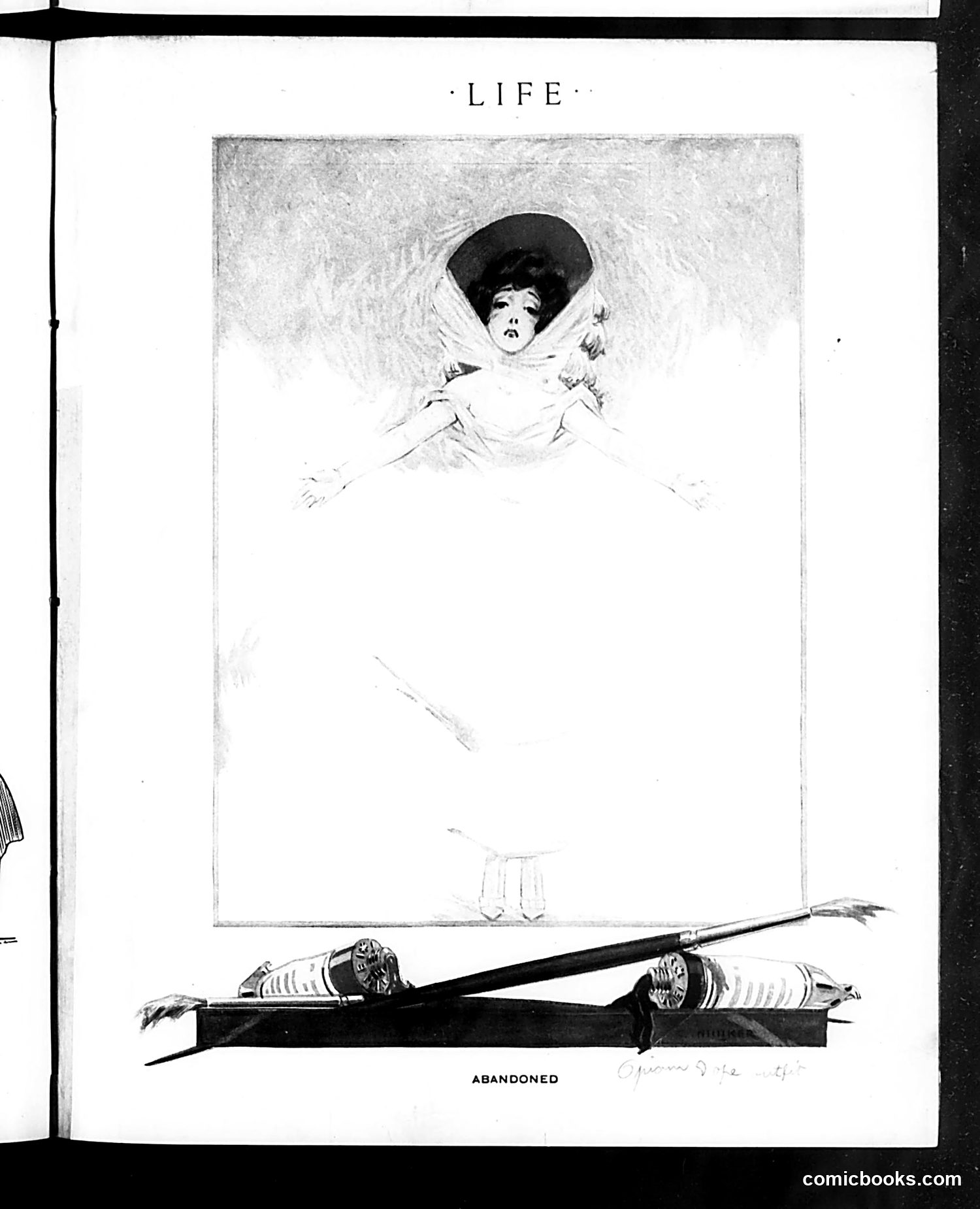
This is a satirical illustration from *Life* magazine titled "Abandoned." The image depicts a woman swaddled in white cloth or blankets, with dark hair visible, gazing downward with a sorrowful expression. Below her lie two discarded items that appear to be musical instruments or similar objects, rendered in black. The composition suggests commentary on abandonment—likely social commentary on women left destitute or forsaken. The stark contrast between the vulnerable figure above and the cast-off items below emphasizes themes of neglect or rejection. Without additional context or visible publication date, the specific historical reference remains unclear, though the style suggests early-to-mid 20th century. The piece critiques social indifference toward vulnerable populations through visual juxtaposition.
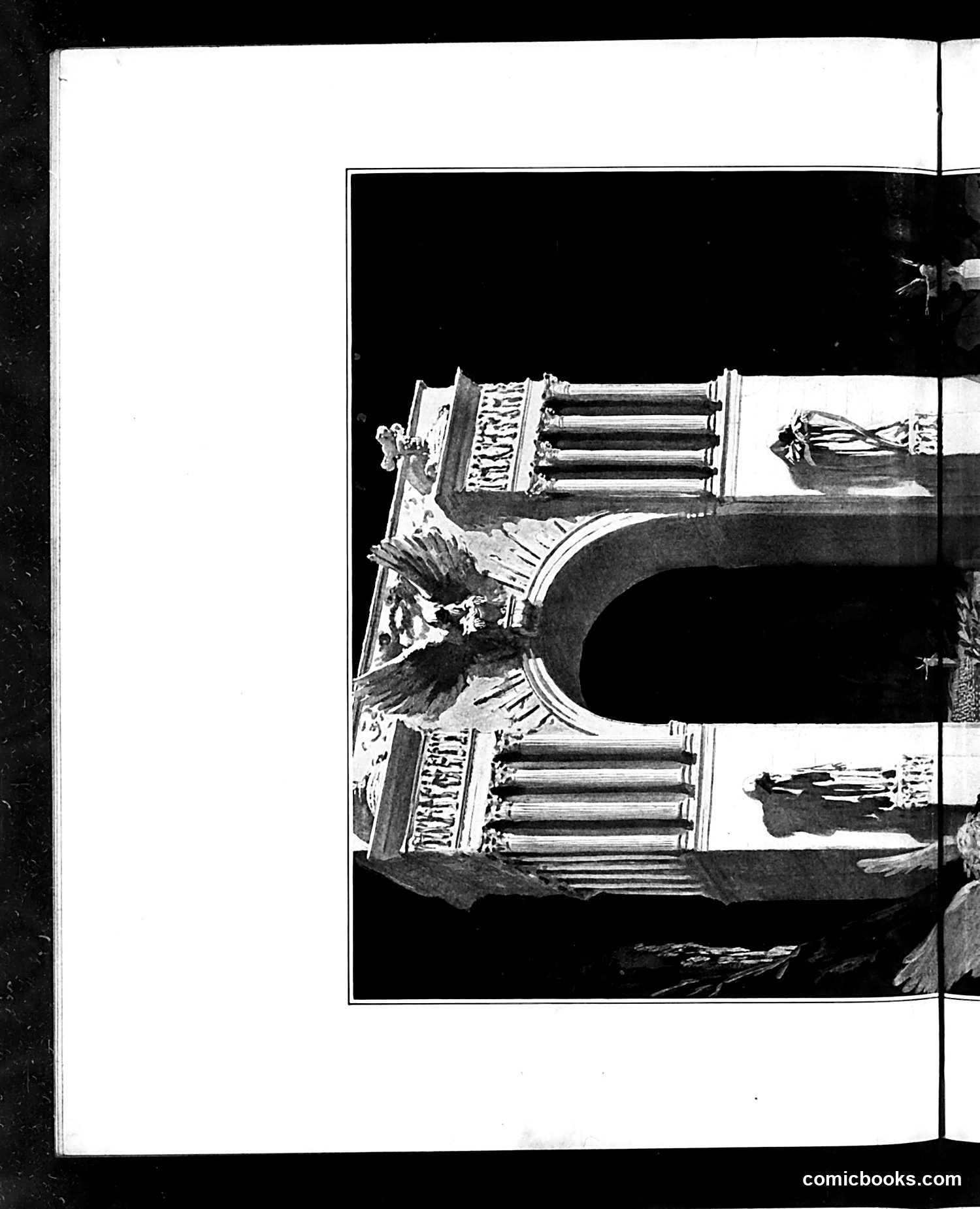
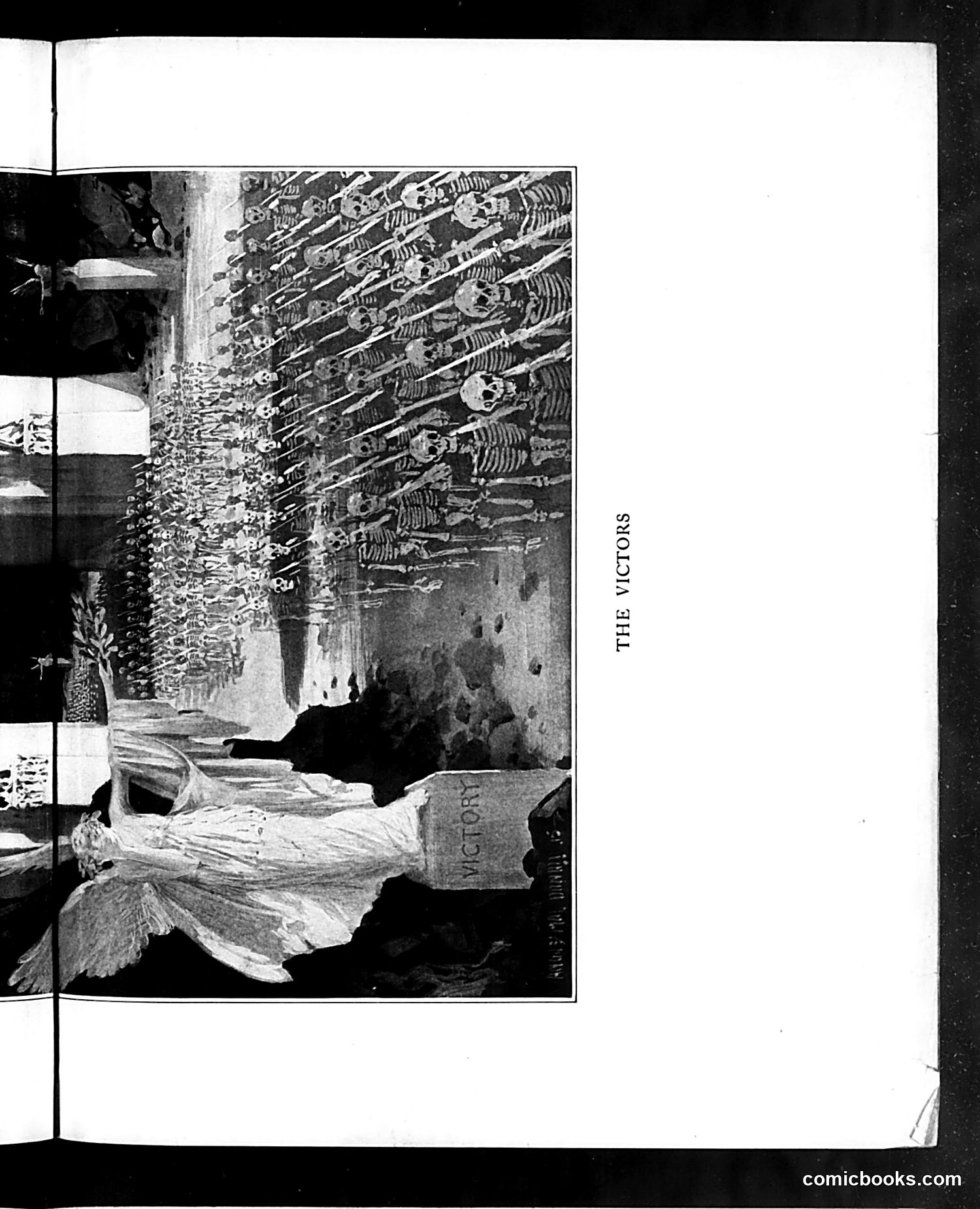
I can see this is a black and white photograph showing an ornate interior architectural space with classical columns, decorative moldings, and what appears to be two figures in period dress positioned at different levels. However, the image quality and orientation make it difficult to read specific details clearly. The OCR text only provides a website attribution ("comicbooks.com") without any accompanying article text, captions, or context that would explain the satirical content or identify the figures shown. Without legible accompanying text or captions, I cannot reliably identify who these figures represent, what political or social commentary is intended, or what specific historical event or topic this page addresses. To provide accurate analysis as requested, I would need either clearer image resolution or the actual article text that accompanied this photograph.
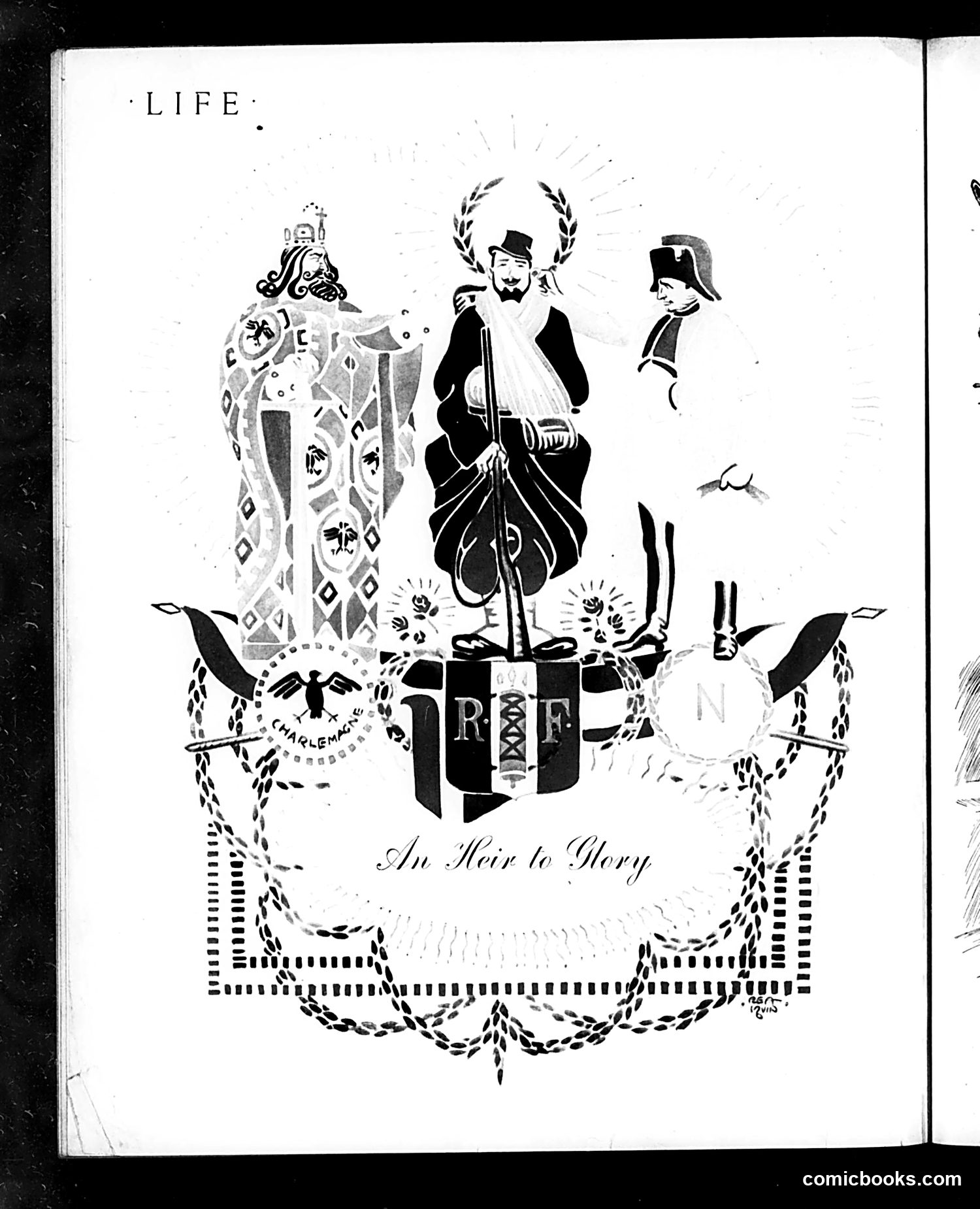
This is a satirical illustration from *Life* magazine showing a figure (center) wearing a laurel wreath and formal attire, positioned prominently above a ornate pedestal or throne. Two attendant figures flank the central character—one on the left in elaborate patterned clothing, one on the right in formal dress. The title "An Heir to Glory" suggests mockery of someone claiming or being positioned as inheriting greatness or power. The decorative elements, laurels, and theatrical staging parody grandiose pretension. The ornate costume and formal presentation emphasize the satirical elevation of this figure. Without clearer context or visible dates, I cannot identify the specific political figure or event being mocked, though the composition clearly ridicules someone's claim to inherited status or greatness.
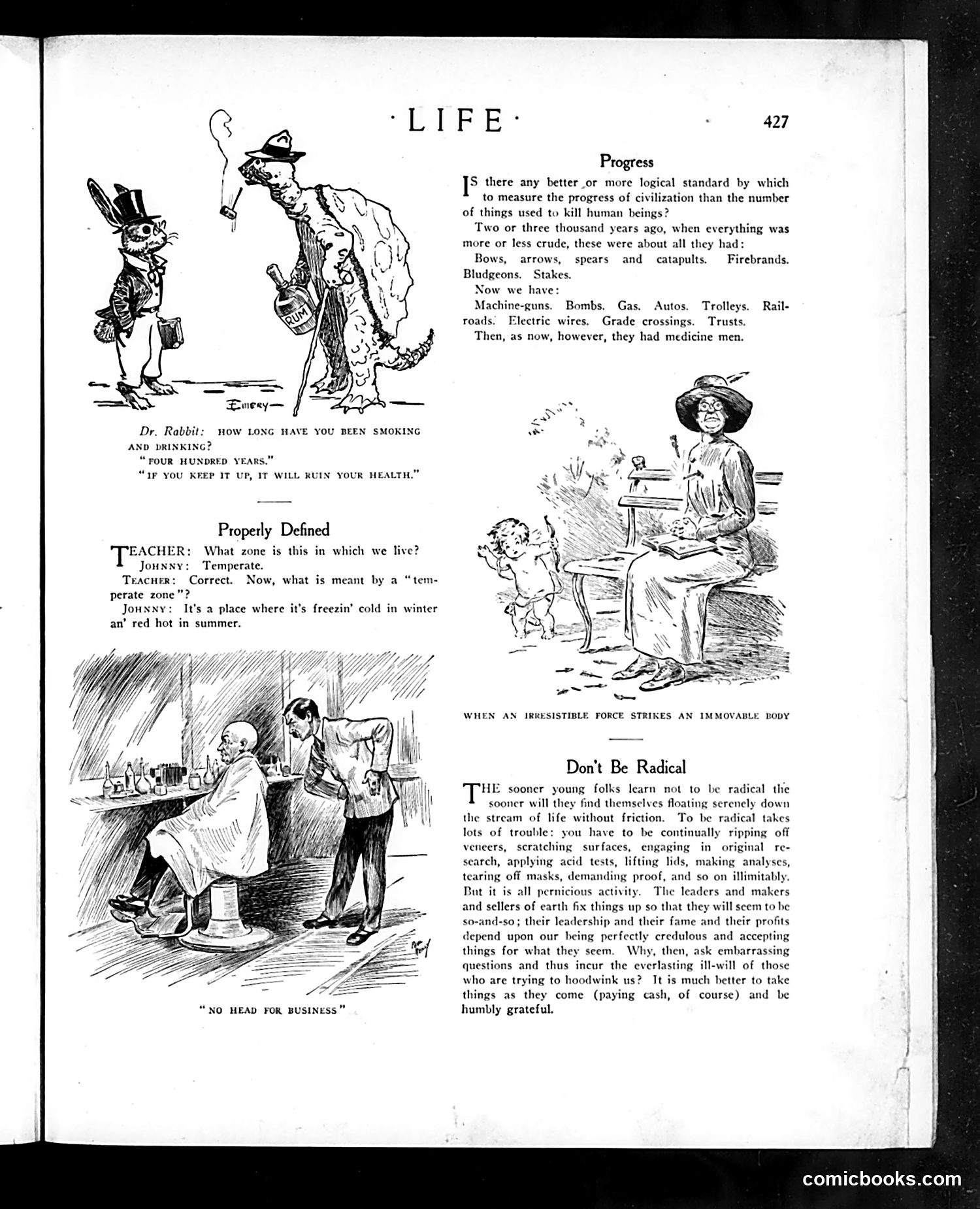
This page contains several satirical pieces critiquing early 20th-century society: **"Progress"**: Ironically lists humanity's "advancement" by cataloging weapons—from ancient bows and arrows to modern machine-guns, bombs, and gas. The final line notes that despite millennia of "progress," society still relies on "medicine men" (quacks/fraudulent practitioners), suggesting civilization hasn't actually improved morally or intellectually. **"Properly Defined"**: A brief joke where a student's literal definition of "temperate zone" (freezing cold and extremely hot) contradicts the scientific definition, mocking educational gaps. **"Don't Be Radical"**: Direct social commentary warning young people against questioning authority or demanding proof. It sarcastically argues that challenging established systems ("radical" behavior) causes trouble, while those in power prefer citizens remain "credulous" and accepting. This defends the status quo against progressive reform movements. The cartoons use humor to critique complacency, unexamined "progress," and societal resistance to critical thinking.
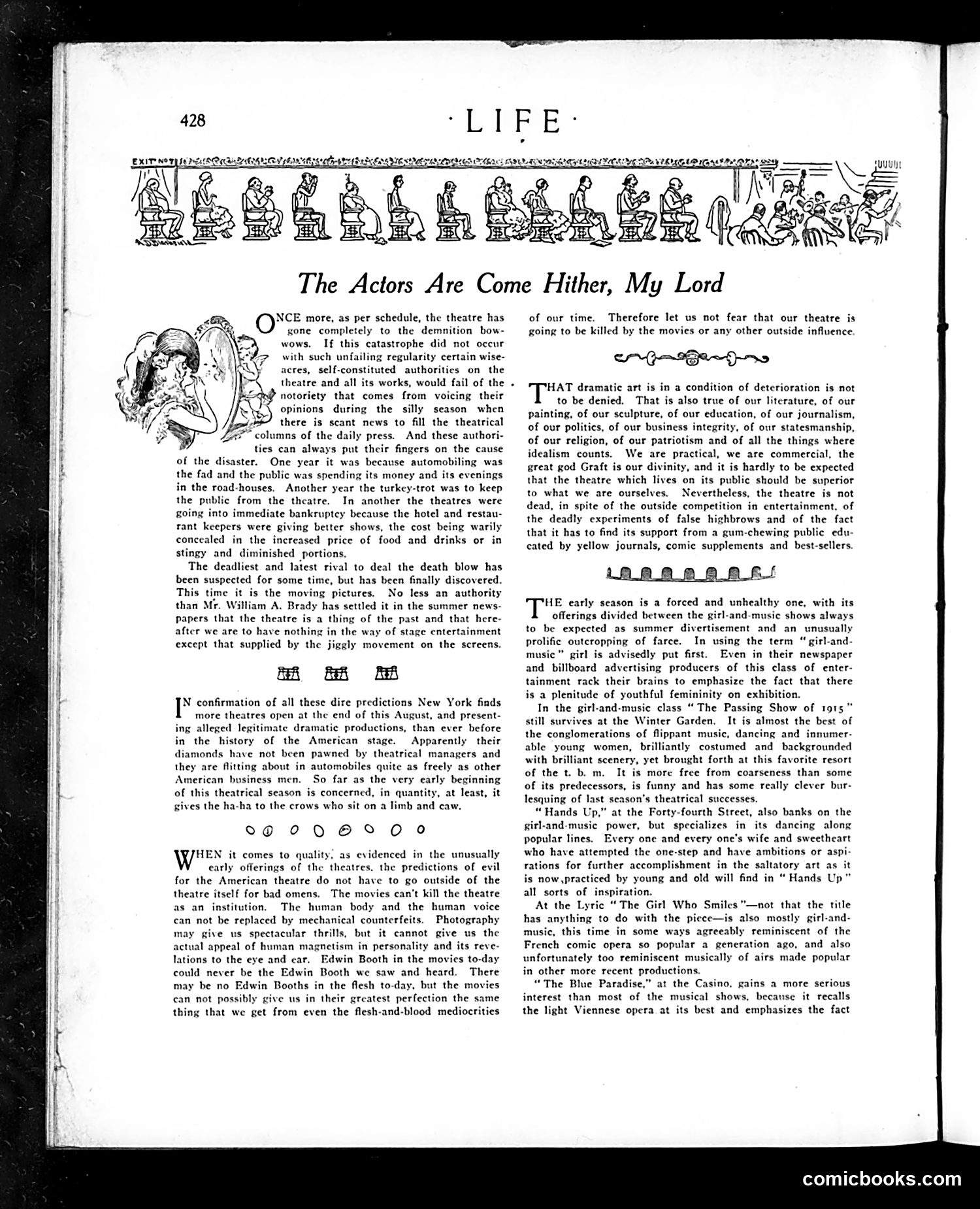
This article satirizes theatrical industry doomsayers who repeatedly predict the stage's imminent collapse. The cartoon header shows a procession of actors, illustrating the ironic abundance of theatre despite doom-mongering. The piece mocks so-called "authorities" who annually blame different scapegoats for theatre's supposed demise: automobiles, the turkey-trot dance craze, fancy restaurants. The latest culprit: moving pictures. Critic William A. Brady allegedly declared theatre "a thing of the past." The satire's punch: Life reports New York actually has *more* legitimate theatres open than ever before—undermining these predictions entirely. The author argues theatre cannot be killed by film because human magnetism and personality cannot be mechanically replicated. Even mediocre live actors surpass screen performances. The essay concludes that theatre's actual problem isn't external competition but internal decline reflecting broader American moral decay—corruption, commercialism, and lost idealism permeating society, not just entertainment.
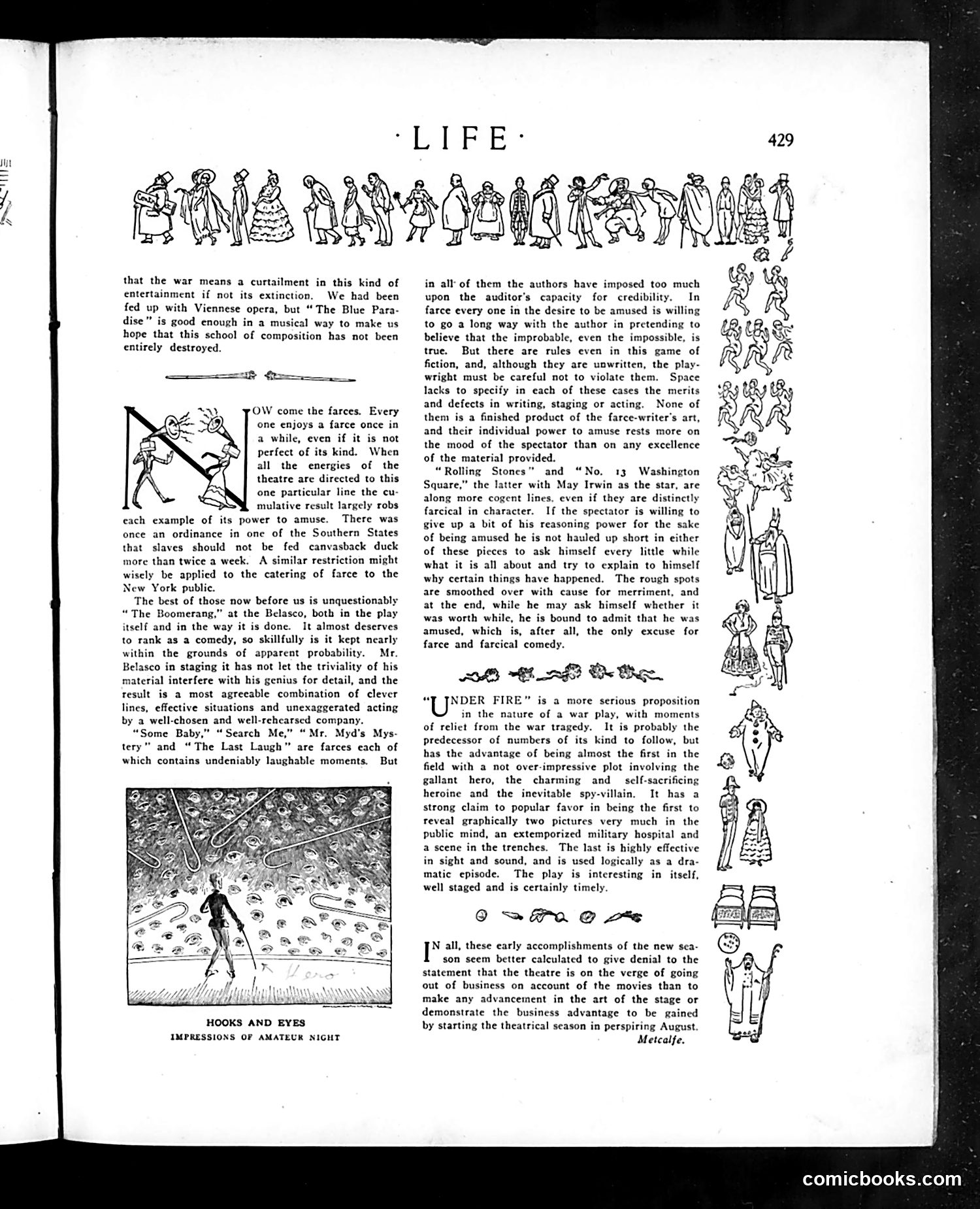
This page reviews recent Broadway theatrical productions during World War I. The main cartoon, "Hooks and Eyes: Impressions of Amateur Night," depicts a figure on stage surrounded by audience members—a satirical commentary on amateur theatrical performances. The text critiques contemporary farces, noting that New York audiences are oversaturated with them. The reviewer praises "The Boomerang" at the Belasco Theatre for skillfully maintaining probability, while dismissing other farces ("Some Baby," "Search Me," "Mr. Myd's Mystery," "The Last Laugh") as violating basic dramatic rules by asking audiences to suspend too much disbelief. The review also discusses "Under Fire," a war play capitalizing on public interest in trench warfare and military hospitals—timely subject matter given America's recent WWI involvement. The author (signed "Metcalfe") argues these theatrical efforts demonstrate the stage can still compete with cinema, despite wartime disruptions to entertainment.
This appears to be a satirical engraving showing multiple figures in a chaotic scene, likely depicting a social or political commentary typical of *Life* magazine's style. The image is oriented sideways on the page, showing what appears to be figures in period dress engaged in some form of conflict or disorder. However, **I cannot confidently identify the specific figures, historical event, or political reference** from the image alone. The OCR text provided only contains a watermark ("comicbooks.com") rather than the cartoon's caption or title, which would be essential for understanding the satire's target and meaning. To properly explain this cartoon's significance, I would need the original caption or publication date visible on the page.
This page presents book reviews from Life magazine's literary section. The critic discusses several contemporary novels with characteristic satirical wit: **"Michael O'Halloran"** by Gene Stratton Porter is dismissed as artificially sentimental—the newsboy hero is a romanticized "disguise" rather than realistic, so unrealistic that "in England he would probably be arrested for a German spy." The red flag reference suggests warning readers away. **"The Rim of the Desert"** is critiqued as "expository romance"—fiction designed to dramatize contemporary issues (Alaskan coal disputes) rather than tell authentic stories. **"Sundown Slim"** receives mixed treatment, praised for its Western setting but criticized for inconsistent tone and quality. The war book section reviews contemporary histories of WWI's 1914 campaigns, noting their varying clarity and reliability. The osteopathy book review complains of poor organization and accessibility—information exists but requires excessive effort to extract. Throughout, the tone is witty, somewhat condescending toward popular taste and poorly-executed instructional fiction.
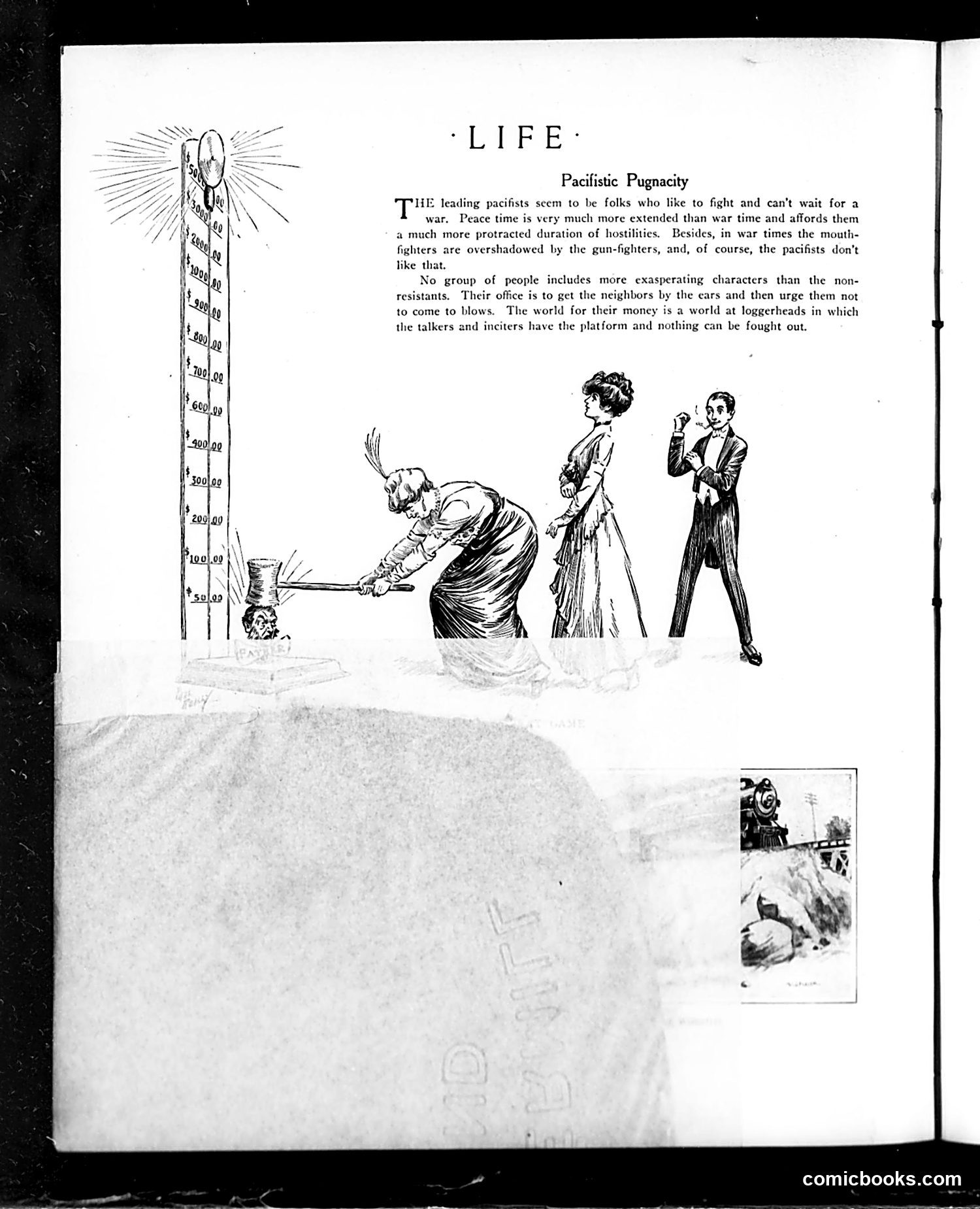
This satirical article attacks pacifists as hypocrites who claim to oppose violence while actually *enjoying* conflict and argument. The cartoon illustrates this contradiction: a figure labeled with a peace symbol swings an axe at a tall pole (marked with ascending numbers, suggesting measurement or progress), while two well-dressed onlookers observe—presumably representing pacifist "talkers and inciters." The satire's point: pacifists aren't truly peaceful; they're argumentative agitators who love debate and conflict but hide behind anti-war rhetoric. They prefer extended "hostilities" through talking rather than actual physical combat, where they'd be overshadowed by "gun-fighters." The author mocks their sanctimonious interference in others' affairs while failing to embody genuine non-resistance. This reflects early 20th-century American skepticism toward pacifist movements and their moral authority.
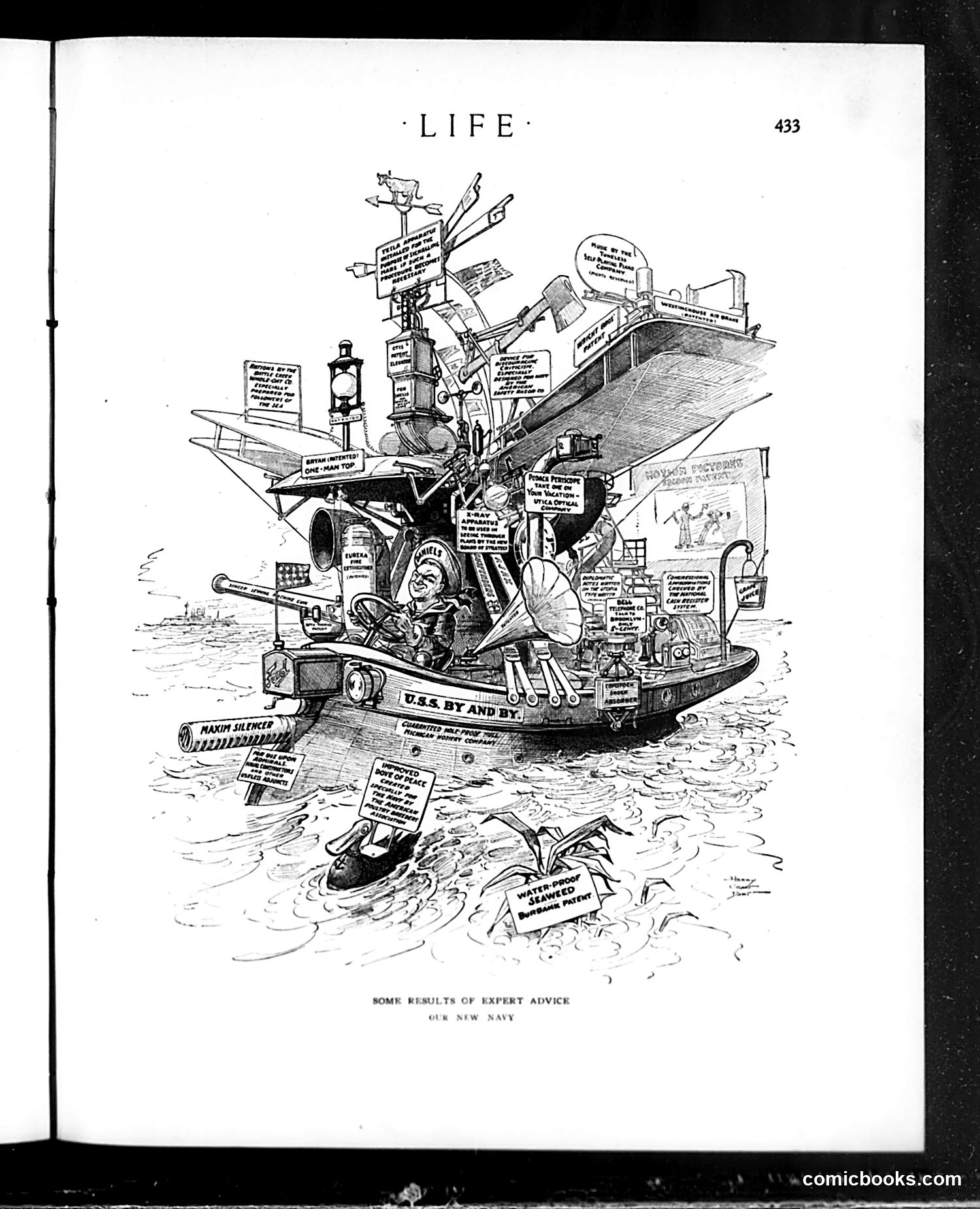
This satirical cartoon depicts a chaotic naval vessel labeled "U.S.S. BY AND BY," crowded with contradictory elements and labeled advice. The cartoon critiques conflicting expert opinions about naval construction and modernization. The vessel is an absurd amalgamation of parts—masts, smokestacks, cannons, and other equipment haphazardly assembled—suggesting that following too many competing "expert" recommendations produces an impractical, unseaworthy result. Various signs throughout carry text (too small to read clearly) presumably representing different experts' conflicting directives. The satire targets American naval policy debates, likely from the early 20th century, when maritime modernization was controversial. By showing the navy as a ridiculous, barely-functional contraption, the cartoon mocks how excessive deference to competing specialist opinions undermines coherent decision-making.
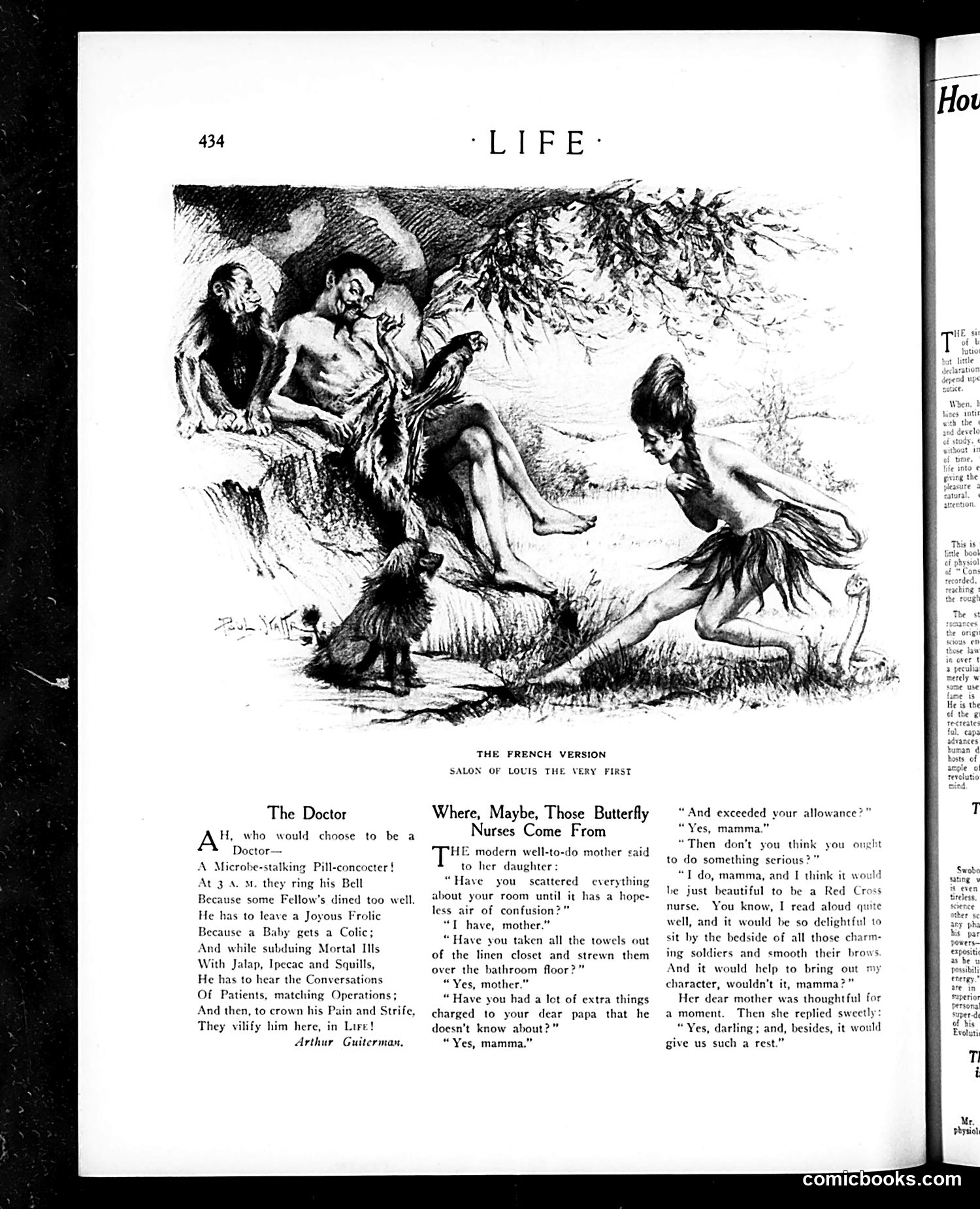
This page contains two satirical pieces mocking contemporary society circa early 1900s. **"The Doctor"** (poem by Arthur Guiterman) complains that physicians are underappreciated and overworked—called out at 3 AM for indigestion, interrupted during leisure, dealing with demanding patients who complain about their treatments, yet still face public criticism ("vilify him here, in Life"). **"Where, Maybe, Those Butterfly Nurses Come From"** satirizes wealthy young women's superficial motivations for becoming Red Cross nurses during wartime. A mother encourages her spoiled daughter to become a nurse not from genuine patriotic duty, but because she's exhausted the family budget through excessive spending and household chaos. The "serious" act of nursing is presented as an escape from consequences—a way to remove herself while giving parents "such a rest." The satire suggests these women viewed nursing as fashionable service rather than genuine sacrifice. Both pieces mock self-interest hiding behind socially respectable roles.
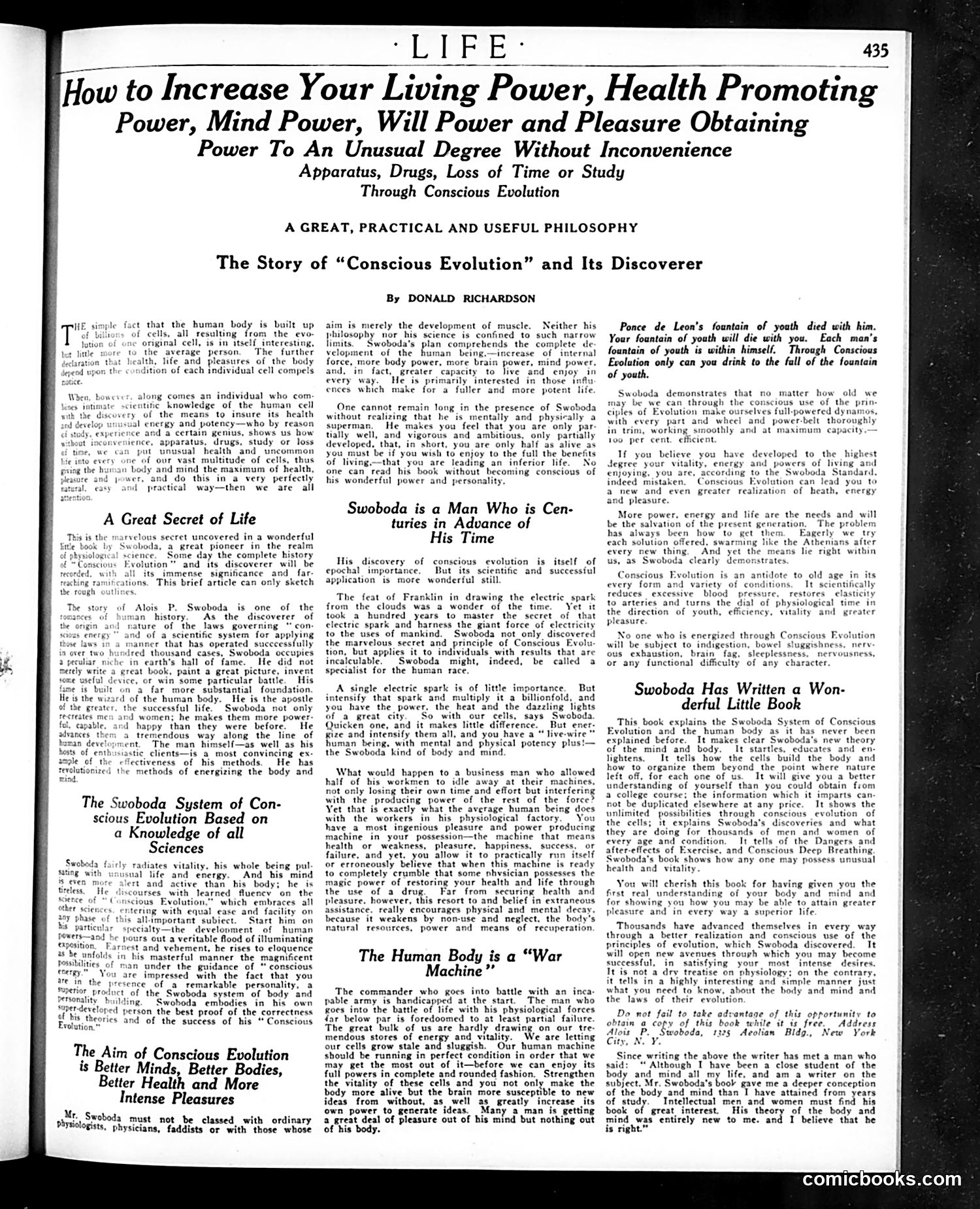
This page is not a political cartoon but rather **promotional editorial content** for a self-help philosophy called "Conscious Evolution" and its proponent, **Alois P. Swoboda**. The text presents Swoboda as a scientific innovator who has discovered methods to increase human vitality, mental power, and physical health through understanding the body's cellular function—without requiring drugs, apparatus, or extensive study. Key claims made: - Swoboda has successfully treated "over two hundred thousand cases" - His system is based on scientific knowledge of all disciplines - He embodies his own philosophy through remarkable personal vitality and eloquence - The approach promises enhanced pleasure, health, and mental capacity **For modern readers**: This exemplifies early 20th-century wellness marketing—pseudoscientific self-improvement promising dramatic results through a discoverer's secret system. The breathless promotional tone, unverified statistics, and appeal to both scientific authority and personal testimony are characteristic of period health fads.
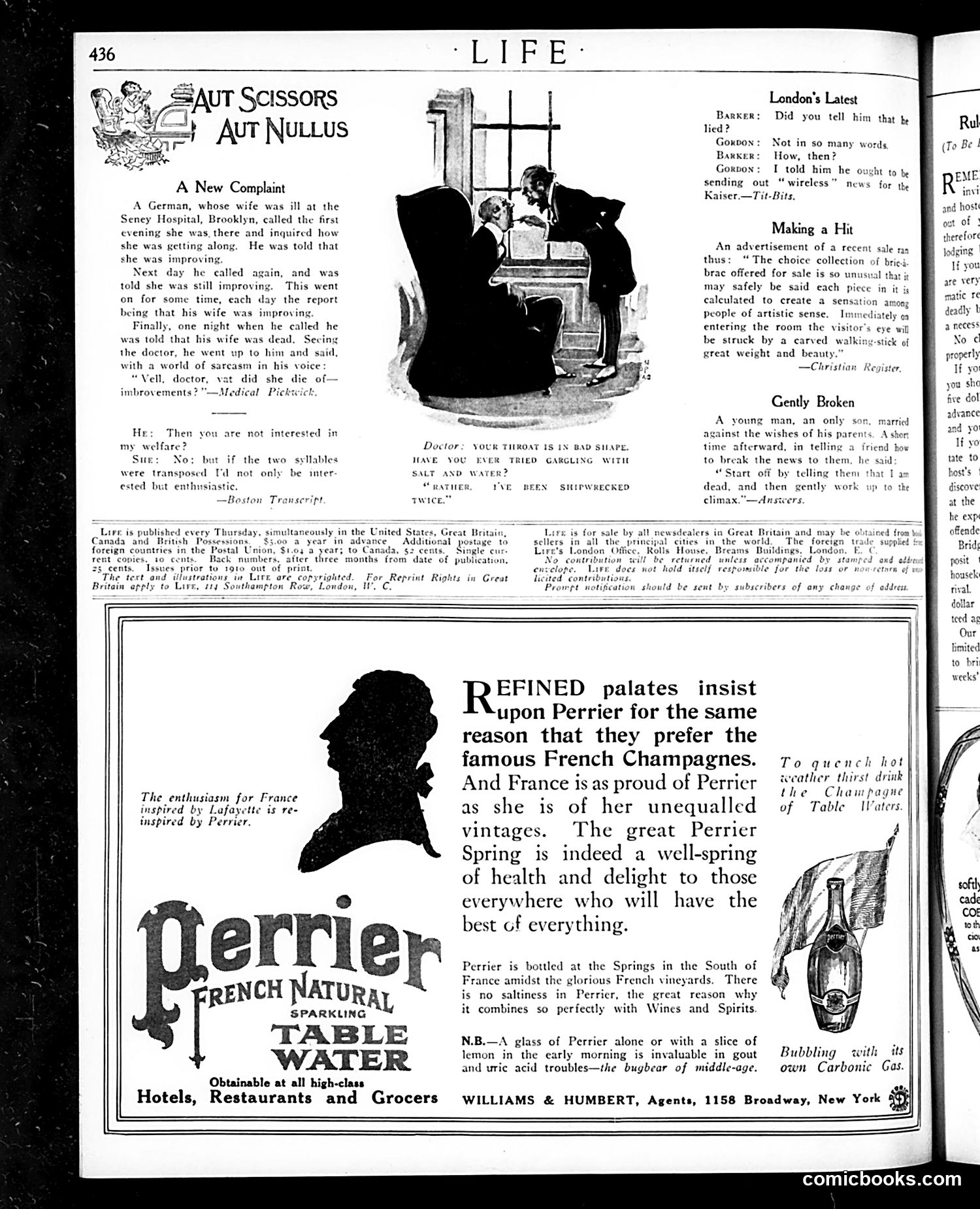
This page mixes satirical humor with period advertising, typical of Life magazine's format. **The Cartoons:** Several brief jokes mock contemporary figures and situations. One references the Kaiser (German emperor) via a wireless news joke, appealing to WWI-era British readers. Another depicts a German-American's heavily accented English ("vell, doctor, vat did she die of—imbrovements?"), using dialect humor—a common though now offensive comedic device. A third jokes about gargling for a sore throat. **The Advertisement:** The large Perrier water ad uses patriotic appeals to French superiority ("Lafayette") to market sparkling water, claiming refined taste prefers it like champagne. The health note about gout reflects period medical beliefs. **Context:** These jokes rely on ethnic caricature and accent humor now considered inappropriate, but typical of early 20th-century American comedy. The Kaiser reference and French patriotism suggest wartime publication.
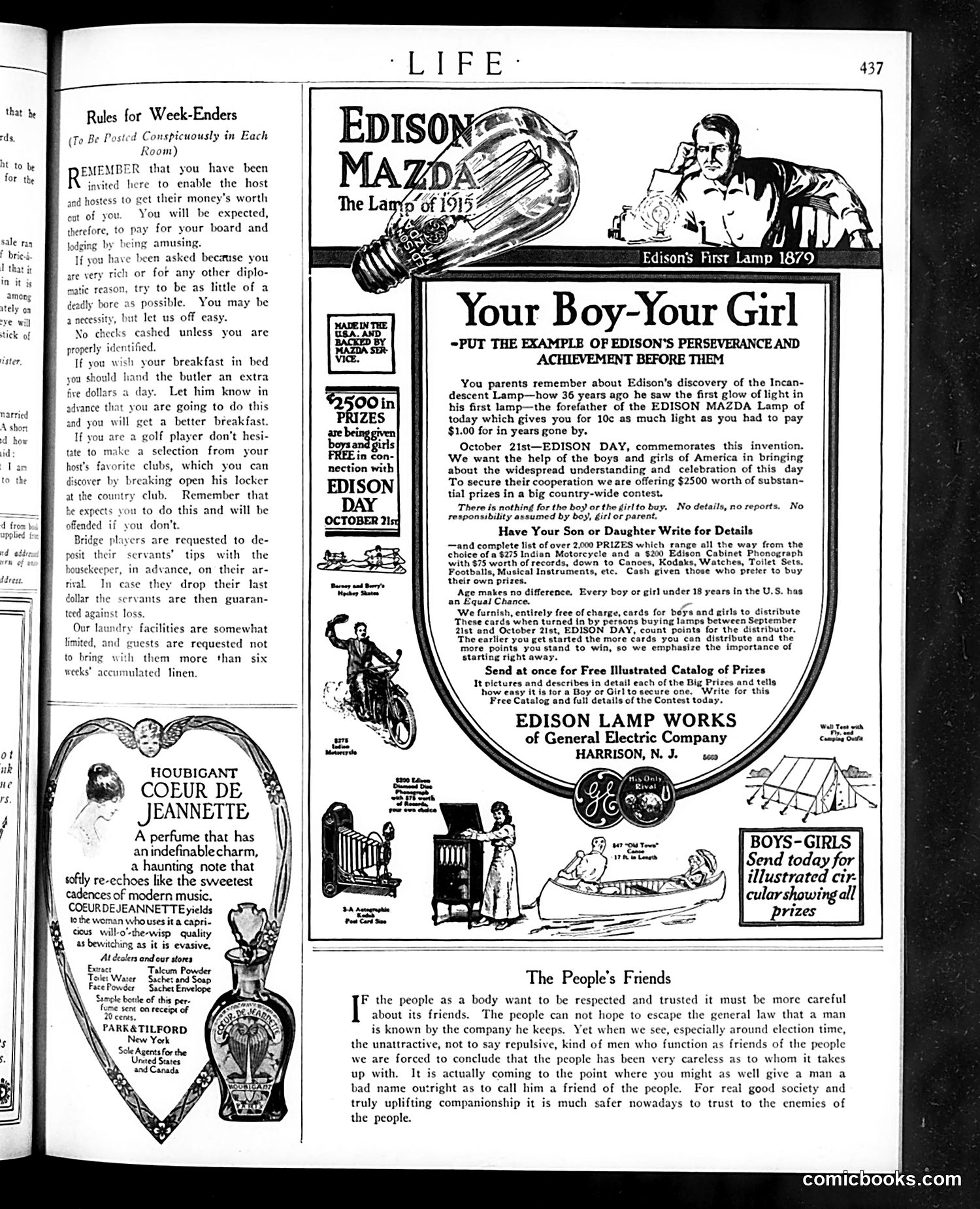
This page contains a satirical "Rules for Week-Enders" (left column) mocking the behavior expected of houseguests—advising them to be amusing, tip servants generously, avoid laundry burdens, and pay extra for breakfast in bed. The satire suggests guests are essentially obligated to entertain their hosts or provide financial compensation for their visit. The right side is primarily an Edison Mazda Lamp advertisement celebrating "Edison Day" (October 21st), promoting a nationwide contest for American children to distribute promotional cards for the company. It references Edison's 1879 lightbulb invention as an example of perseverance for youth to emulate. The page itself is largely commercial rather than satirical—while the "Rules" section offers gentle mockery of wealthy weekend guest conventions, the dominant content is straightforward product advertising and promotion.
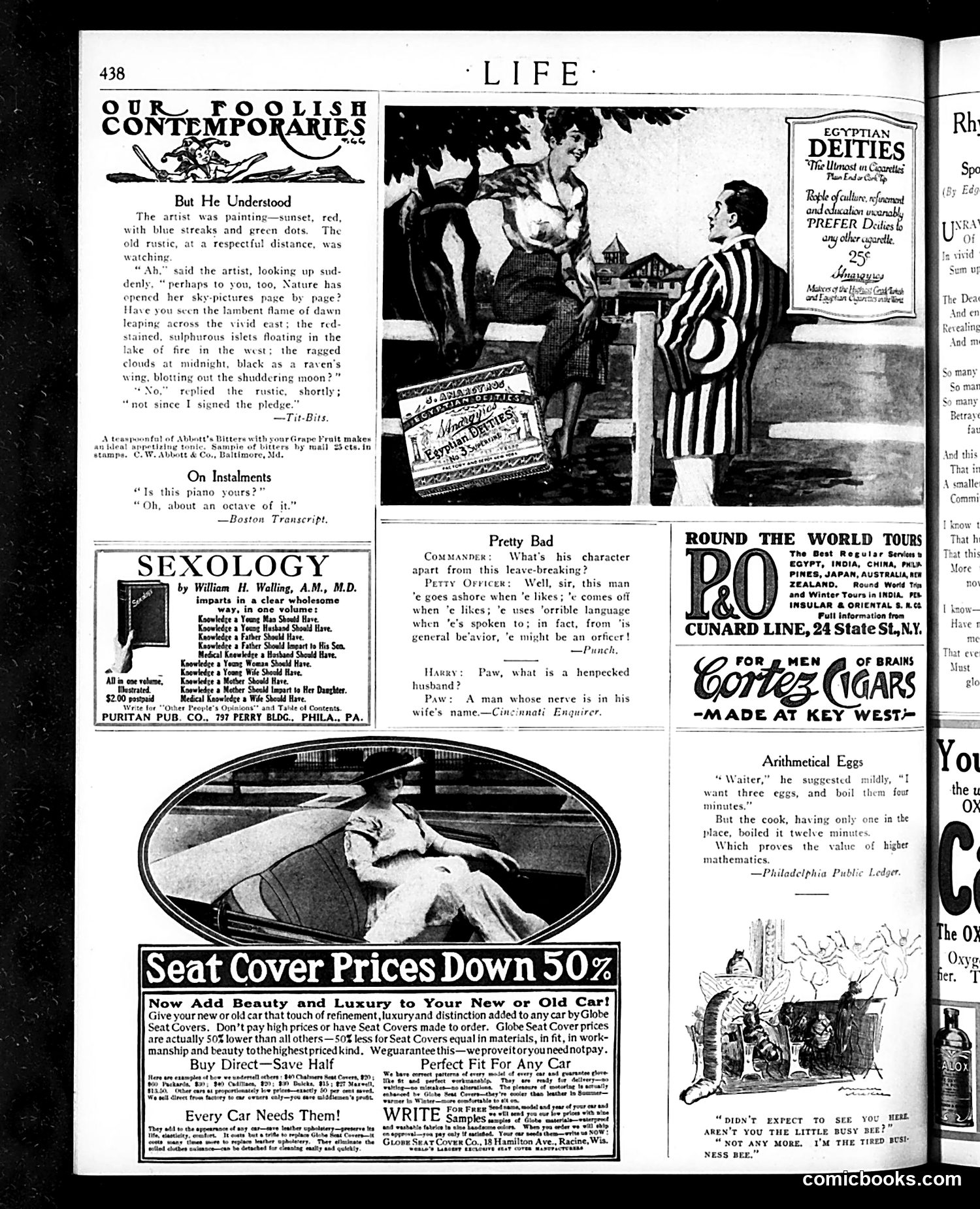
This page mixes short humorous pieces with advertisements. The notable cartoon appears under "Pretty Bad": a conversation between a **Customer and Officer** about a man's character. The Officer describes someone undisciplined—who "goes ashore when 'e likes," uses terrible language, and might be an officer based on his general behavior. This is British naval humor (*Punch* attribution), satirizing the stereotype that naval officers are unruly or poorly behaved despite their rank. The joke suggests that bad manners and lack of discipline are associated with (or expected of) officers. The page also contains period humor snippets: a temperance joke about a rustic who hasn't seen beautiful sunsets "since I signed the pledge" (anti-drinking pledge); a quip about a henpecked husband; and a math joke about boiling eggs. The bulk consists of advertisements for books (sexology), seat covers, world tours, cigars, and Egyptian deities.

This page is primarily **advertising**, not political satire. The dominant content features Western Electric Company ads for household appliances—an inter-phone ($15) and vacuum cleaner ($32.50)—positioned as modern conveniences that "make housekeeping easy and economical." The page includes a book review of Edgar Lee Masters's *Spoon River Anthology* (left column), a humorous verse commentary by Arthur Guiterman questioning why Masters's fictional small town contains so much tragedy, and two brief jokes at the bottom. The only satirical element is Guiterman's gentle mockery of Masters's dark worldview—suggesting perhaps the author has liver troubles rather than genuine observations about human nature. The final anecdote mocks European nobility's obsession with genealogy. The **Calox tooth powder ad** uses a whitening effect visual to promote oxygen-based dental care. This reflects 1910s-era Life magazine's blend of literary criticism, advertising, and light humor directed at educated, middle-class readers.
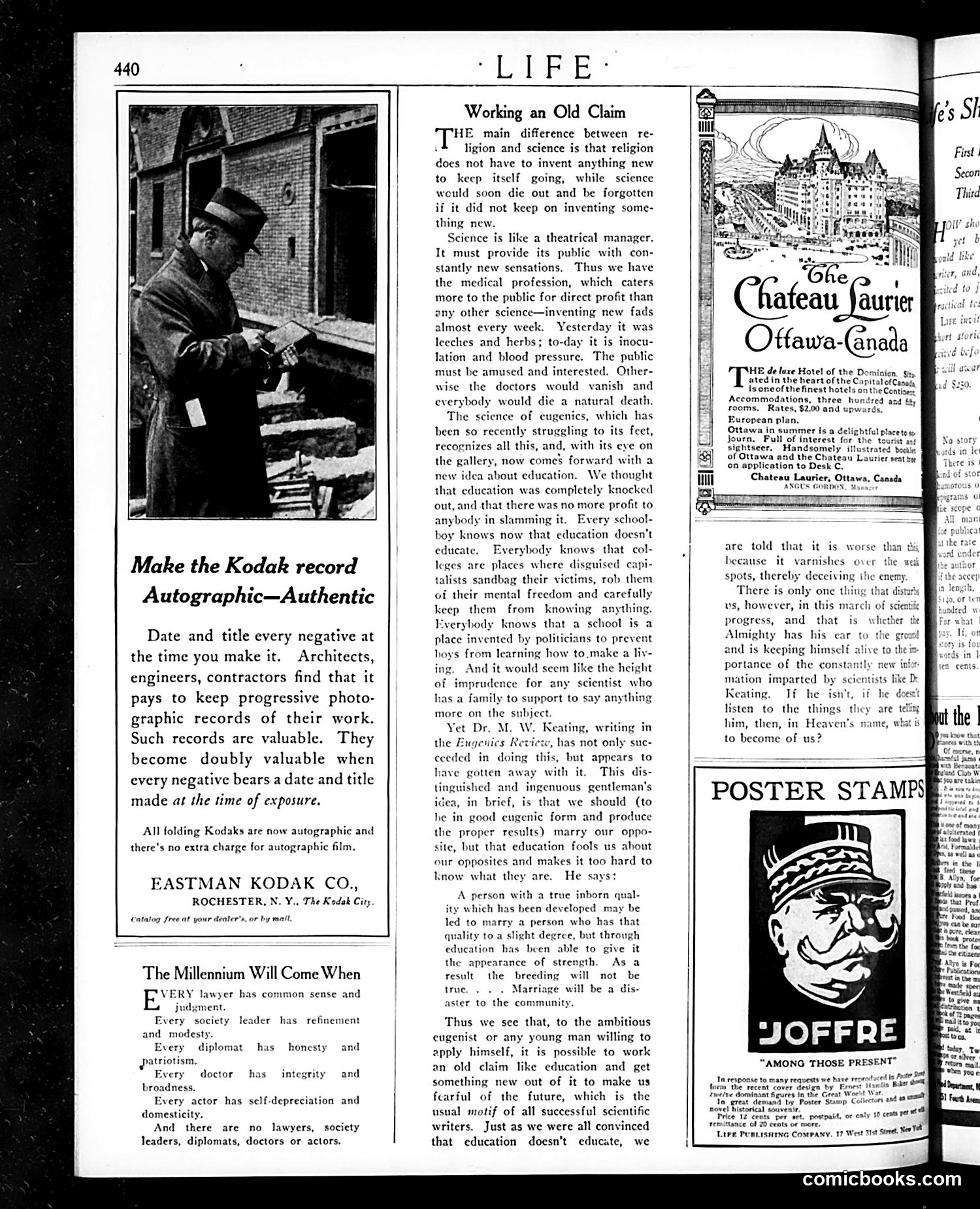
This Life magazine page (page 440) is primarily **advertising and satirical commentary**, not political cartoons in the traditional sense. The main satirical article, "Working an Old Claim," mocks the medical and scientific professions for constantly inventing new "fads" to maintain public interest and justify their existence. The author argues that science, unlike religion, must constantly innovate to survive—comparing scientists to theatrical managers seeking novelty. The piece specifically targets **eugenics** (a pseudo-scientific movement promoting selective breeding). It ridicules Dr. M. W. Keating's eugenic argument that education deceives us about potential marriage partners' true qualities, making "proper breeding" impossible. The satire suggests scientists exploit public fear about the future to promote dubious theories. The page also includes a humorous section, "The Millennium Will Come When," sarcastically listing impossible conditions (lawyers with common sense, diplomats with honesty)—implying these professions lack these virtues. The Kodak and hotel advertisements are standard period marketing.
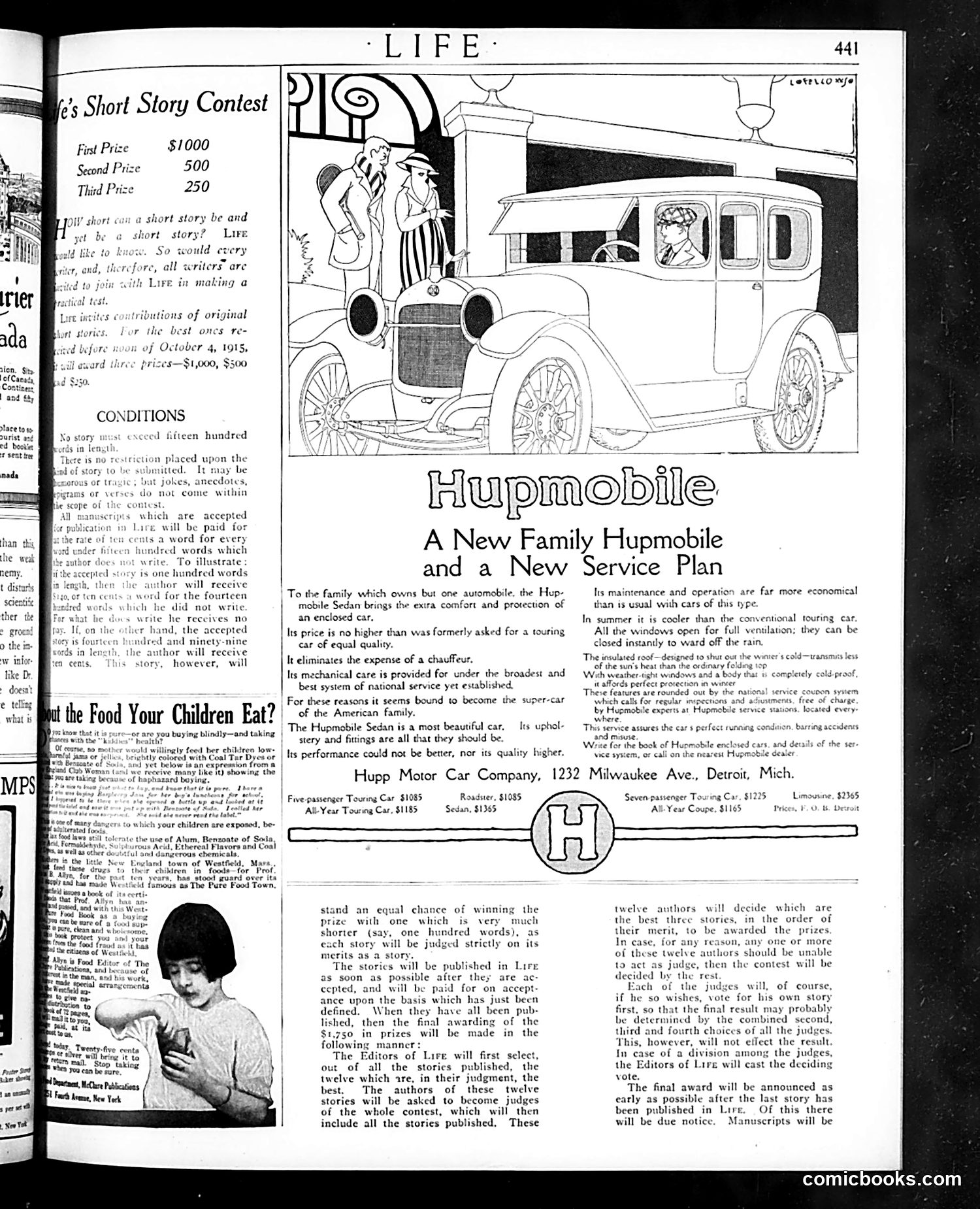
This page combines a **short story writing contest announcement** with a **Hupmobile automobile advertisement**. ## The Contest Life magazine is soliciting original short stories with substantial prizes ($1,000 first place). The detailed conditions specify stories must be 1,500 words maximum, judged on merit alone, with twelve prominent authors serving as judges. The announcement emphasizes competitive fairness—all stories treated equally regardless of length. ## The Advertisement The Hupmobile ad promotes a new enclosed sedan, positioning it as practical for middle-class American families. Key selling points include: superior comfort compared to open touring cars, weather protection, lower operating costs than hiring a chauffeur, and comprehensive national service support. The accompanying illustration shows a stylish 1910s automobile with well-dressed occupants, representing the aspirational lifestyle the advertisement targets. ## Historical Context This 1915 page reflects Life's dual purpose: satirical commentary through fiction contests AND revenue through luxury goods advertising—targeting educated, affluent readers interested in both literature and automobiles.
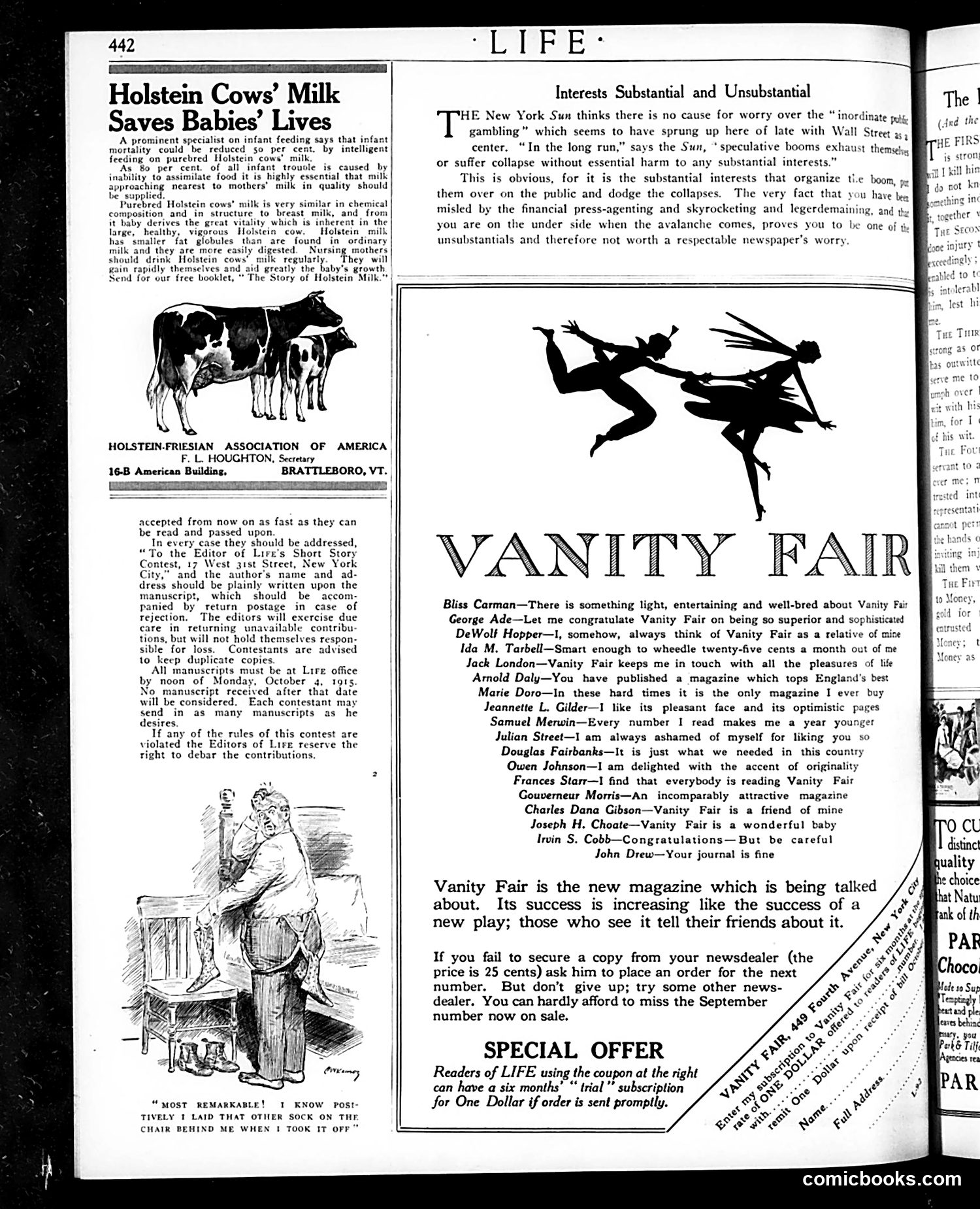
This page contains two distinct sections: **advertising** and **magazine promotion**. The **Holstein Cows' Milk advertisement** claims that feeding infants purebred Holstein milk reduces mortality by 80 percent because its chemical composition mirrors breast milk. This reflects early 20th-century faith in scientific nutrition and selective breeding to solve public health problems. The **cartoon** (bottom left) depicts a domestic scene of a woman accused by her husband of losing a sock—he insists he placed it on the chair behind him. This appears to be simple domestic humor, likely satirizing marital misunderstandings or memory lapses in everyday life. The **Vanity Fair promotion** showcases testimonials from celebrities (Bliss Carman, Jack London, Douglas Fairbanks, Frances Starr, et al.) praising the new magazine as sophisticated and entertaining. This represents typical early advertising strategy: celebrity endorsements to establish prestige for a competing publication. The page is primarily **commercial content** rather than satirical commentary.
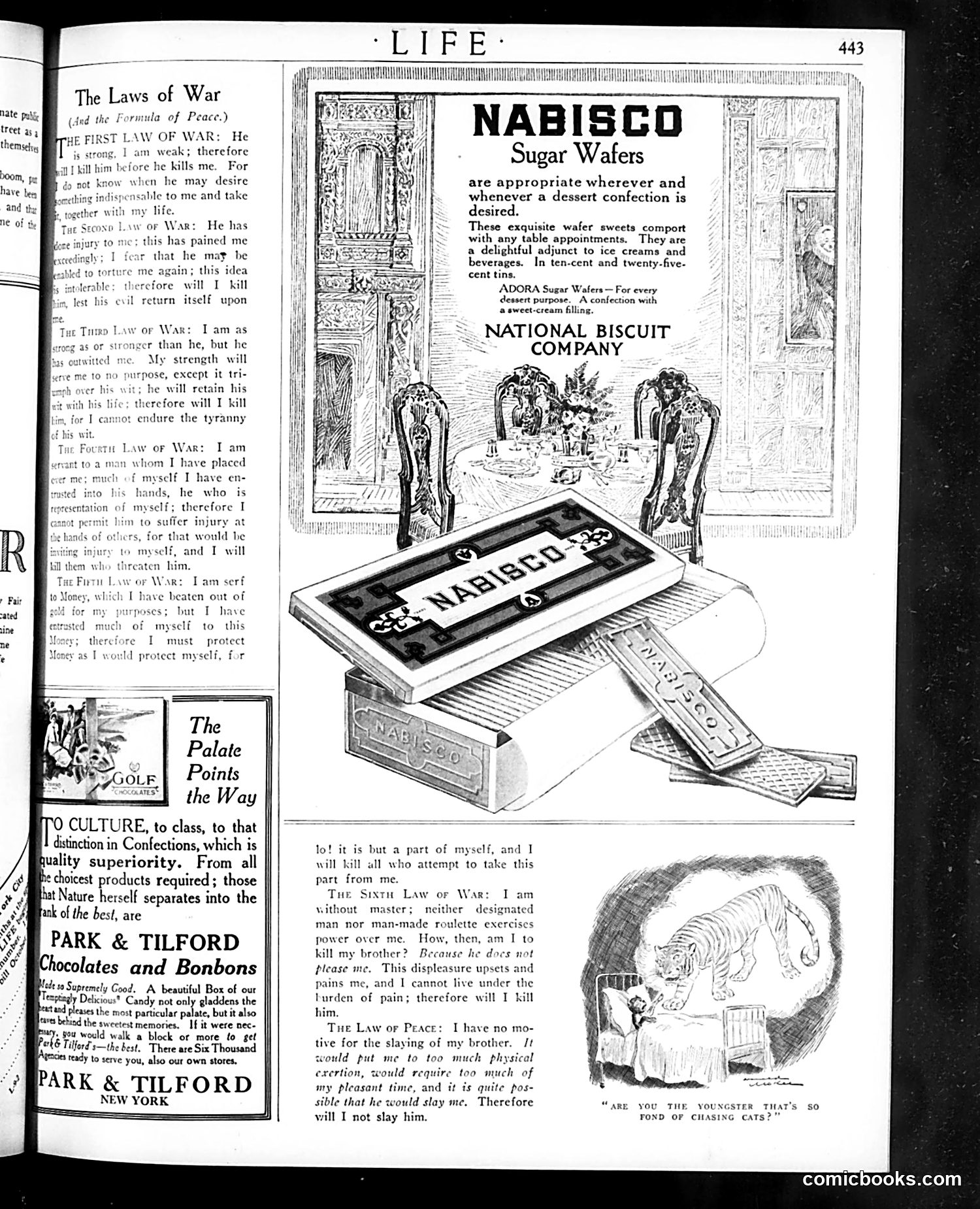
This satirical piece presents six cynical "laws" justifying violence, each grounded in self-interest: kill the strong before they kill you; kill those who've tortured you; kill the stronger if they won't serve your purposes; protect those you've invested in; protect money you've earned; kill those whose existence displeases you. The final "Law of Peace" undercuts the entire logic: the speaker won't kill his brother because it requires too much effort and he might lose—purely practical cowardice masquerading as morality. The satire targets how nations rationalize warfare through pseudo-logical justifications that reduce to naked self-preservation and convenience. The darkly comic point: there is no principled difference between the "laws of war" and the "formula of peace"—both are selfish calculation. The accompanying cartoon (bottom right) of a tiger chasing a cat appears thematically related to predatory behavior.
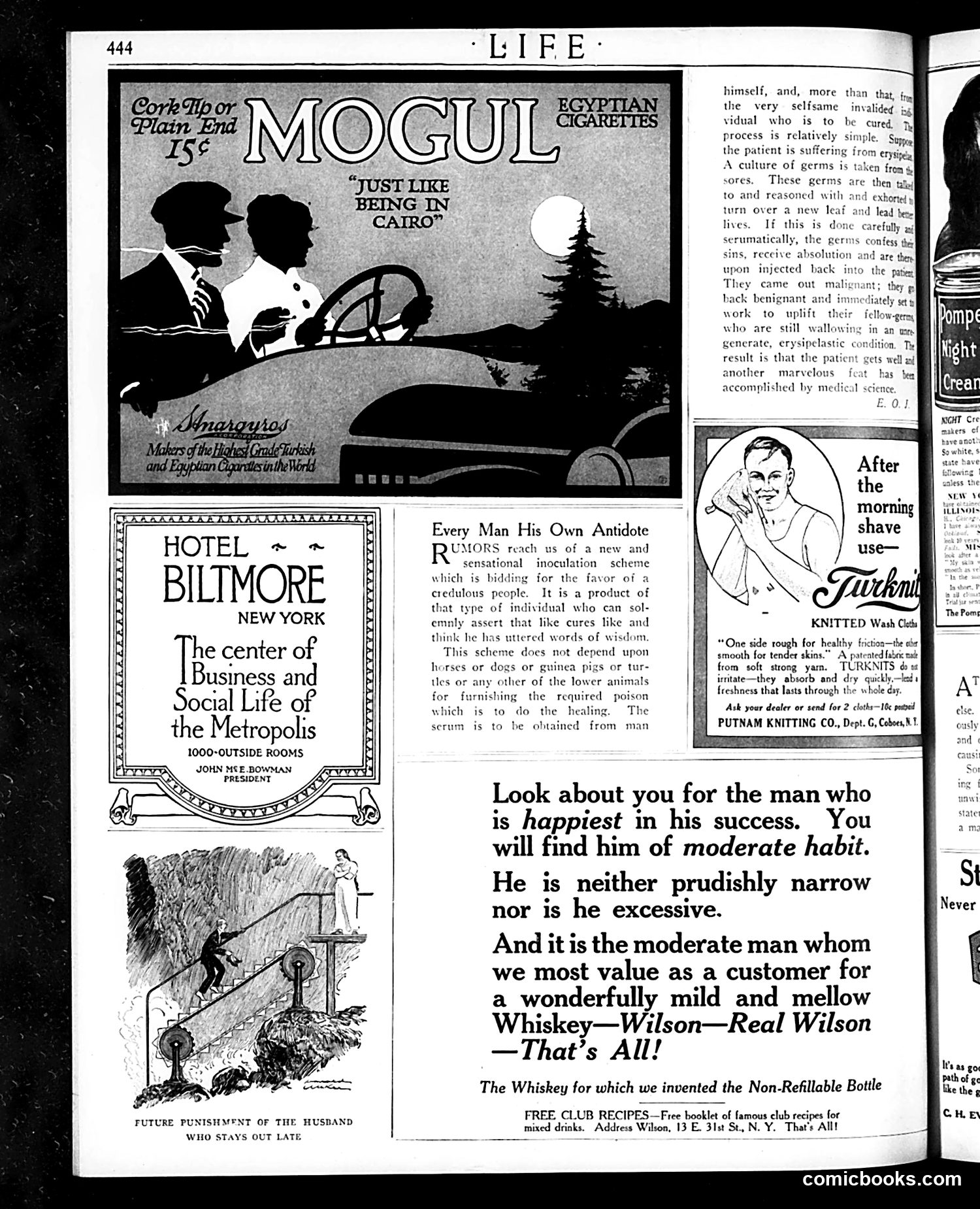
This page contains primarily **advertisements and medical satire**, not political cartoons. The main satirical content is "Every Man His Own Antidote," which mocks a dubious medical trend: a charlatan claiming to cure diseases through "sensational inoculation" using serum from sick patients themselves. The satire ridicules this "like cures like" philosophy as pseudoscientific nonsense peddled by gullible con artists. The visual cartoons include: - **Top**: A Mogul cigarette ad with silhouetted figures in an automobile (standard advertising imagery) - **Bottom**: A humorous sketch of a husband sneaking home late, captioned "Future Punishment of the Husband Who Stays Out Late" — domestic humor about marital consequences The page is dominated by **period advertisements** for Hotel Biltmore, Wilson Whiskey, and Turkman shaving products, which were the magazine's revenue source. The whiskey ad ironically promotes "moderation" while selling alcohol—typical of early 20th-century marketing.
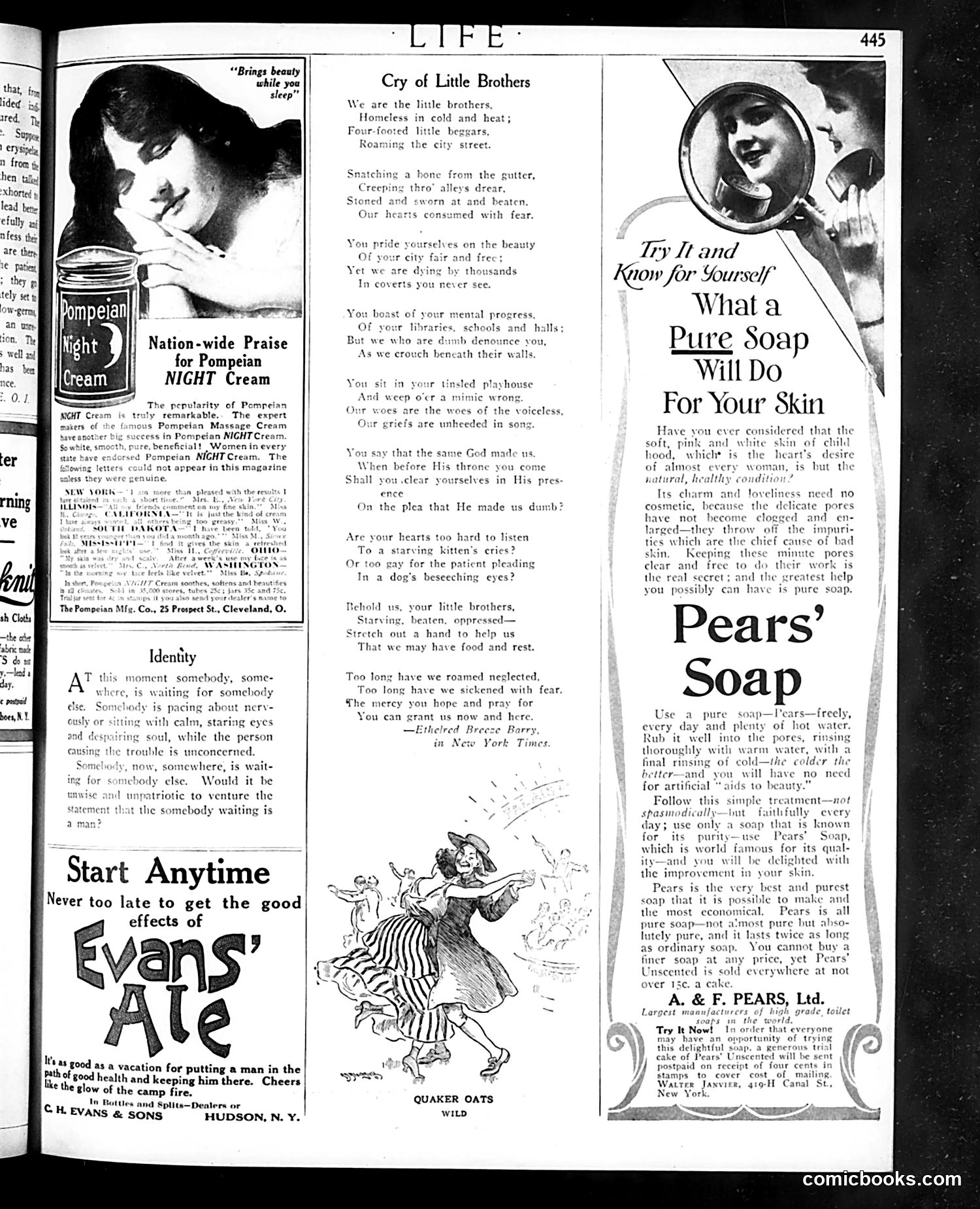
This page mixes advertisements with social commentary. The dominant feature is the poem "Cry of Little Brothers," attributed to Ethelred Breeze Barry of the New York Times. The poem is a sentimental appeal on behalf of homeless children and neglected animals—"little brothers" starving and beaten on city streets while the wealthy enjoy "tinsel playhouses" and take pride in their cities' progress. The satire lies in **juxtaposition**: this earnest plea for the destitute appears surrounded by luxury product advertisements (Pompeian Night Cream, Pears' Soap, Evans' Ale) aimed at affluent readers concerned with beauty and leisure. The contrast suggests hypocrisy—readers were urged to consider suffering children while being sold expensive cosmetics. The poem likely reflects Progressive Era concerns about urban poverty and child welfare, popular themes in early 20th-century American magazines. The "Identity" essay fragment discusses someone waiting for help, reinforcing themes of social concern.
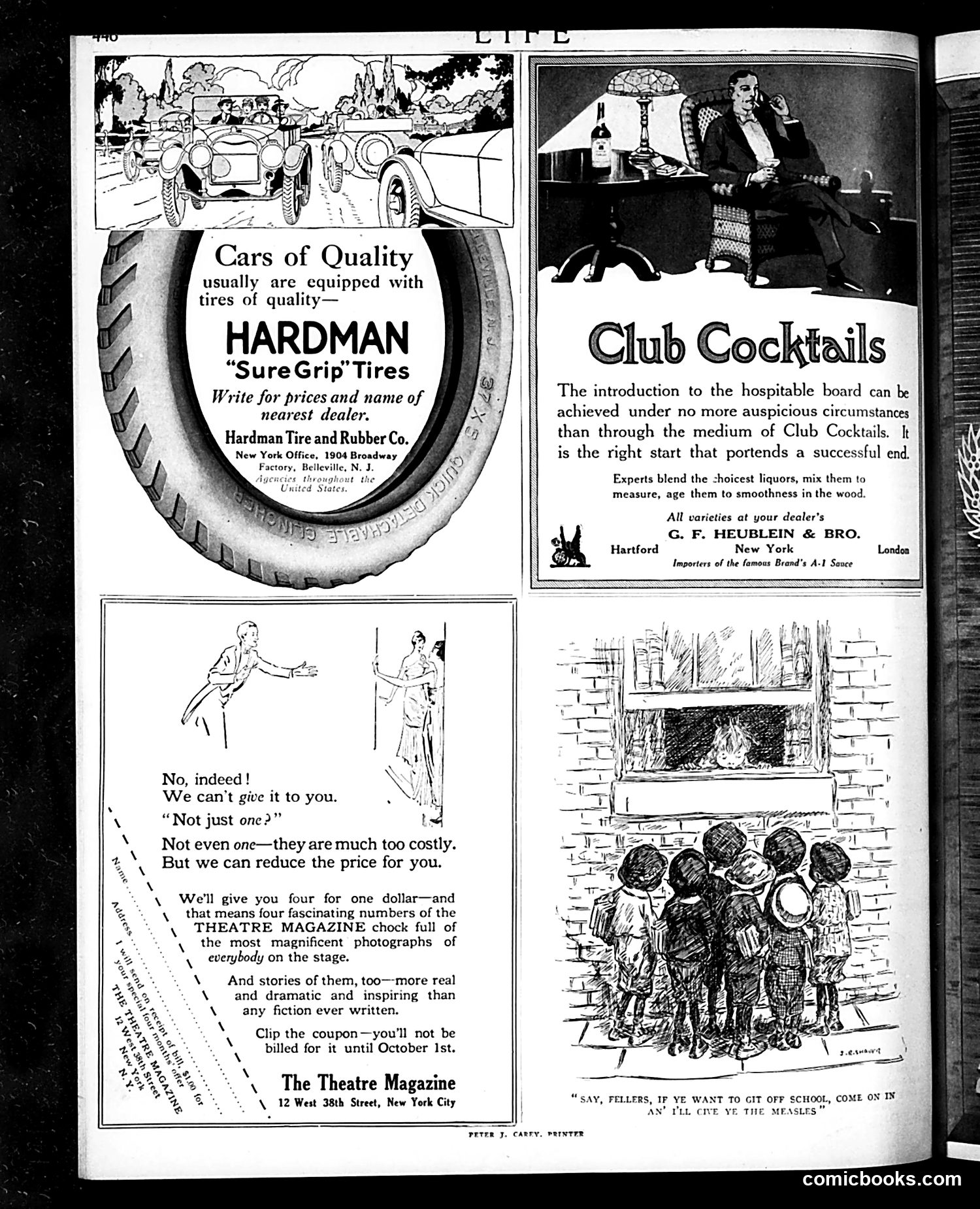
This page is primarily **advertising**, not political satire. It contains four distinct ads: 1. **Hardman Tires**: Standard product advertisement emphasizing quality ("Sure Grip" tires for quality automobiles). 2. **Club Cocktails**: Promotes pre-mixed cocktails by G.F. Heublein & Bro., positioning them as a sophisticated social lubricant for entertaining. 3. **Theatre Magazine**: A humor-based ad using a comedic "refusal" pitch—claiming they can't give away just one magazine issue because it's too costly, but offering four for one dollar instead. 4. **School Measles Cartoon** (bottom right): A sketch showing children gathered at a window, with one saying "If ye want to git off school, come on in an' I'll give ye the measles." This reflects period anxieties about contagious disease and childhood illness as a (somewhat darkly comic) way to escape school obligations. The page reflects 1910s-era consumer culture and social attitudes, with no discernible political commentary.
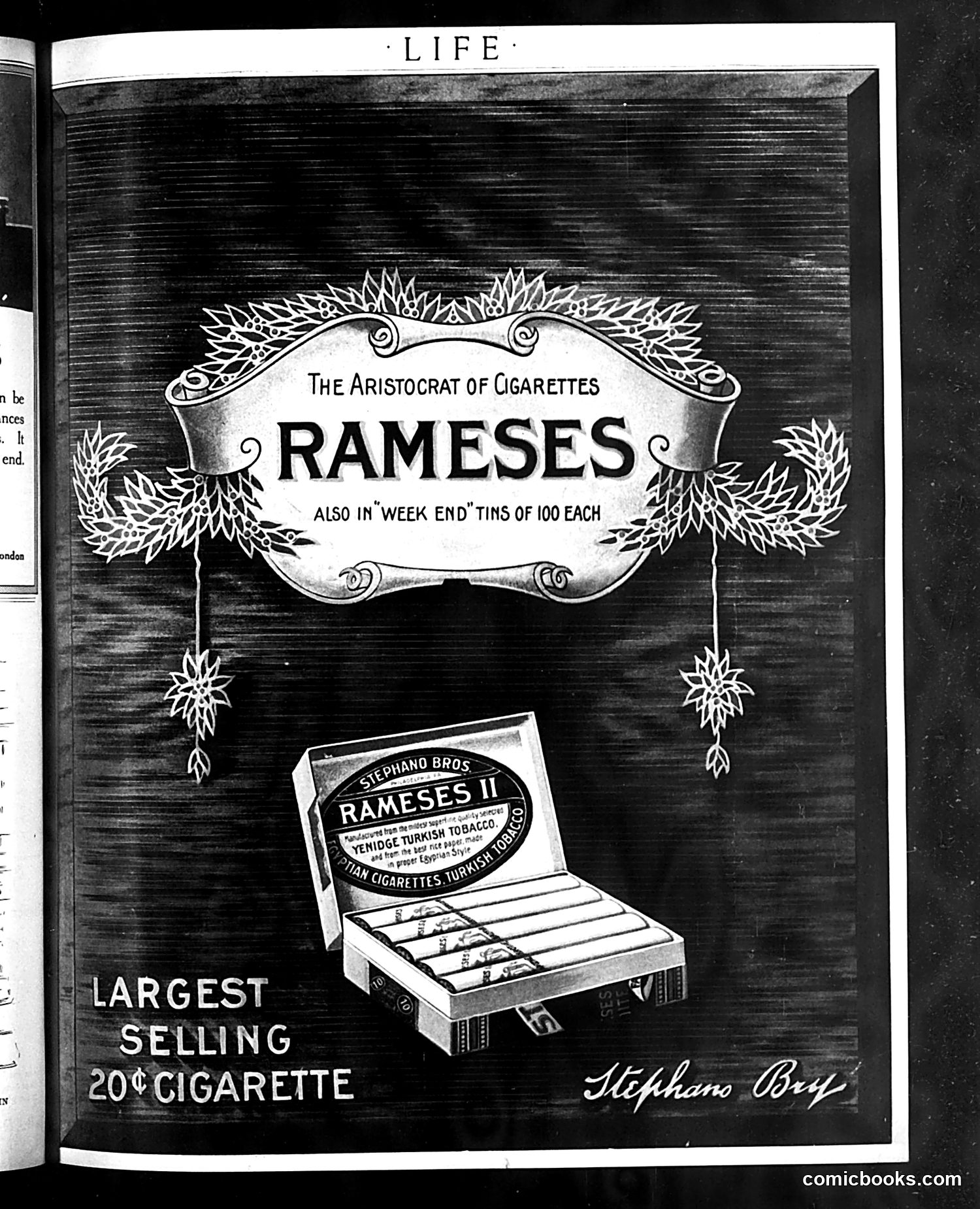
This is a **cigarette advertisement**, not satire or political commentary. It promotes Rameses cigarettes by Stephano Bros, described as "The Aristocrat of Cigarettes." The ad emphasizes they're the "Largest Selling 20¢ Cigarette" and notes they're available in "Week End" tins of 100. The decorative border features ornate scrollwork and stylized foliage. An open cigarette package is displayed prominently. The text and design employ period advertising conventions meant to convey luxury and status. For modern readers: This reflects early 20th-century marketing when cigarette advertising appeared regularly in mainstream publications without health warnings, and when premium cigarettes were marketed as status symbols to consumers.

This is a full-page advertisement for Columbia Records and gramophones, not political satire. The image shows what appears to be an opera or theatrical scene with well-dressed figures, likely depicting a performance scenario. The ad promotes Columbia Records' superiority by naming prestigious early 20th-century musicians: Fremstad (a famous opera singer) performing Isolde's Love Song, and Ysaye (a renowned violinist) playing Brahms' Hungarian Dance. The sales pitch emphasizes that Columbia records play on any standard phonograph, not just Columbia machines—a competitive advantage. The $200 Grafonola model shown was luxury merchandise. This targets affluent readers seeking culture and refinement through recorded music in their homes. The advertisement positions phonograph ownership as access to world-class musical performance.