
Life, 1915-09-02 · page 31 of 48
Life — September 2, 1915 — page 31: what you’re looking at
What you’re looking at
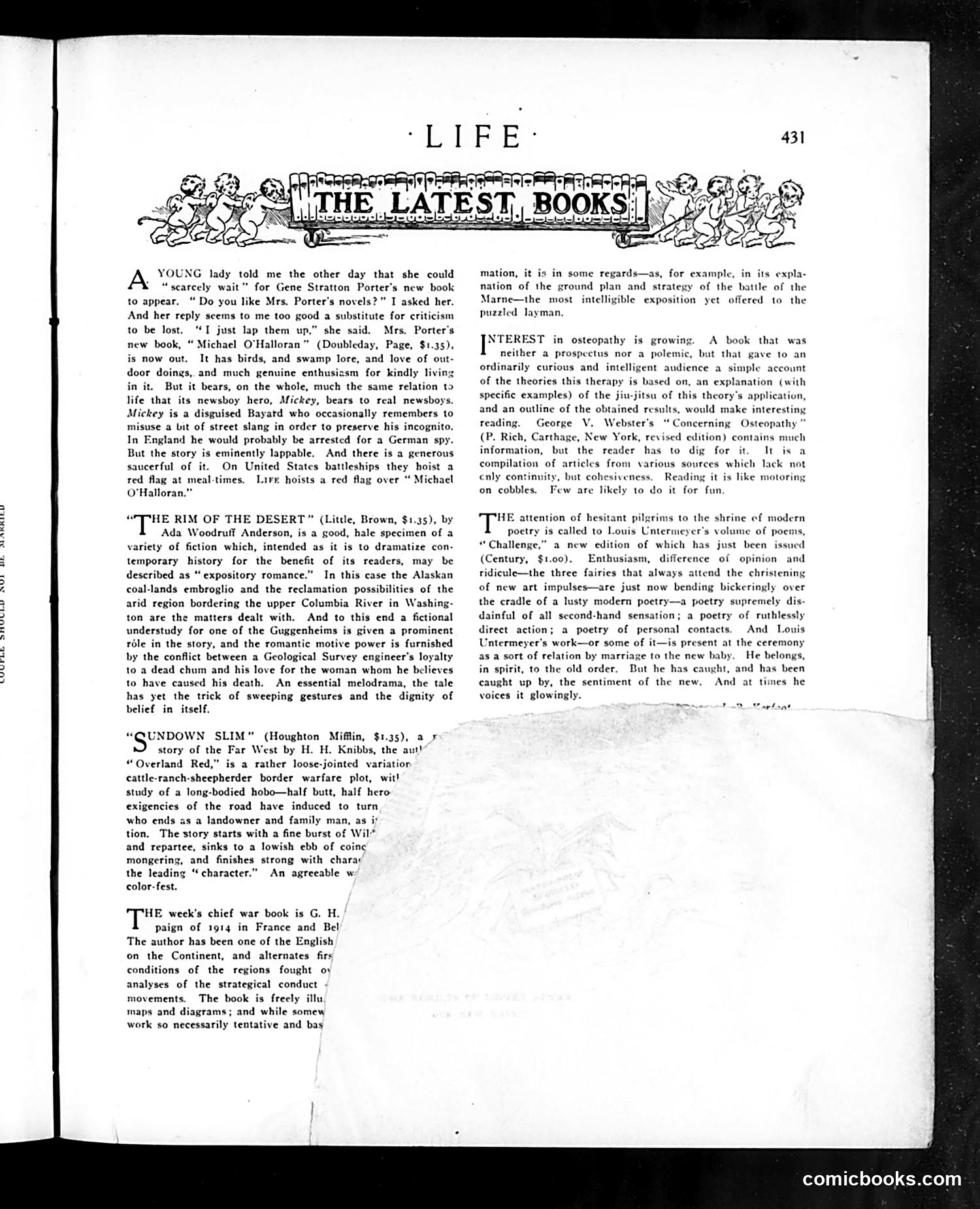
This page presents book reviews from Life magazine's literary section. The critic discusses several contemporary novels with characteristic satirical wit: **"Michael O'Halloran"** by Gene Stratton Porter is dismissed as artificially sentimental—the newsboy hero is a romanticized "disguise" rather than realistic, so unrealistic that "in England he would probably be arrested for a German spy." The red flag reference suggests warning readers away. **"The Rim of the Desert"** is critiqued as "expository romance"—fiction designed to dramatize contemporary issues (Alaskan coal disputes) rather than tell authentic stories. **"Sundown Slim"** receives mixed treatment, praised for its Western setting but criticized for inconsistent tone and quality. The war book section reviews contemporary histories of WWI's 1914 campaigns, noting their varying clarity and reliability. The osteopathy book review complains of poor organization and accessibility—information exists but requires excessive effort to extract. Throughout, the tone is witty, somewhat condescending toward popular taste and poorly-executed instructional fiction.
📄 Transcribed text from this page (OCR, searchable)
Machine-transcribed from the original scan — historical spelling and the odd misread are preserved.
5 Z > ; : > > YOUNG lady told me the other day that she could “scarcely wait” for Gene Stratton Porter's new book to appear. “ Do you like Mrs. Porter's novels?” I asked her. And her reply seems to me too good a substitute for criticism to be lost. ‘(I just lap them up,” she said. Mrs, Porter's new book, “ Michael O'Halloran” (Doubleday, Page, $1.35). is now out. It has birds, and swamp lore, and love of out- door doings, and much genuine enthusigsm for kindly livin: in it. But it bears, on the whole, much the same relation to life that its newsboy hero, Mickey, bears to real newsboys. Mickey is a disguised Bayatd who occasionally remembers to misuse a Lit of street slang in order to preserve his incognito. In England he would probably be arrested for a German spy. But the story is eminently lappable. And there is a generous saucerful of it. On United States battleships they hoist a red flag at meal-times. Lire hoists a red flag over “ Michael O'Halloran, “HE RIM OF THE DESERT” (Little, Brown, $1.35), by Ada Woodruff Anderson, is a good, hale specimen of a variety of fiction which, intended as it is to dramatize con- temporary history for the benefit of its readers, may be described as “expository romance.” In this case the Alaskan coal-lands embroglio and the reclamation possibilities of the arid region bordering the upper Columbia River in Washing- ton are the matters dealt with, And to this end a fictional understudy for one of the Guggenheims is given a prominent réle in the story, and the romantic motive power is furnished by the conflict between a Geological Survey engineer's loyalty to a dead chum and his love for the woman whom he believes to have caused his death. An essential melodrama, the tale has yet the trick of sweeping gestures and the dignity of belief in itself. NDOWN SLIM” (Houghton Mifflin, $1.35), ar story of the Far West by H. H. Knibbs, the aut! “Overland Red,” is a rather loose-jointed variation cattle-ranch-sheepherder border warfare plot, wit! study of a long-bodied hobo—half butt, half hero exigencies of the road have induced to turn who ends as a landowner and family man, as ir tion, The story starts with a fine burst of Wil* and repartee, sinks to a lowish ebb of coing mongering, and finishes strong with chara‘ the leading “character.” An agreeable w. color-fest. HE week's chief war book is G. H. paign of 1914 in France and Bel The author has been one of the English on the Continent, and alternates firs conditions of the regions fought oy analyses of the strategical conduct - movements. The book is freely illu. maps and diagrams; and while somew work so necessarily tentative and bas mation, it is in some regards—as, for example, in its expla- nation of the ground plan and strategy of the battle of the Marne—the most intelligible exposition yet offered to the puzzled layman. NTEREST in osteopathy is growing. A book that was neither a prospectus nor a polemic, but that gave to an ordinarily curious and intelligent audience a simple account of the theories this therapy is based on, an explanation (with specific examples) of the jiu-jitsu of this theory's applicatio! and an outline of the obtained results, would make interesting reading. George V. Webster's “Concerning Osteopathy” (P. Rich, Carthage, New York, revised edition) contains much information, but the reader has to dig for it. It is a compilation of articles from various sources which lack not cnly continuity, but cohesiveness. Reading it is like moto: on cobbles. Few are likely to do it for fun T’ attention of hesitant pilgrims to the shrine ef modern poetry is called to Louis Untermeyer’s volume of poems, “Challenge,” a new edition of which has just been issued (Century, $1.00). Enthusiasm, difference of opinion and ridicule—the three fairies that always attend the christening of new art impulses—are just now bending bickeringly over the cradle of a lusty modern poetry—a poetry supremely dis- dainful of all second-hand sensation; a poetry of ruthlessly direct action; a poetry of personal contacts. And Louis Untermeyer's work—or some of it—is present at the ceremony as a sort of relation by marriage to the new baby, He belongs, in spirit, to the old order. But he has caught, and has been caught up by, the sentiment of the new. And at times he voices it glowingly. comicbooks.com