
Life, 1915-09-02 · page 21 of 48
Life — September 2, 1915 — page 21: what you’re looking at
What you’re looking at
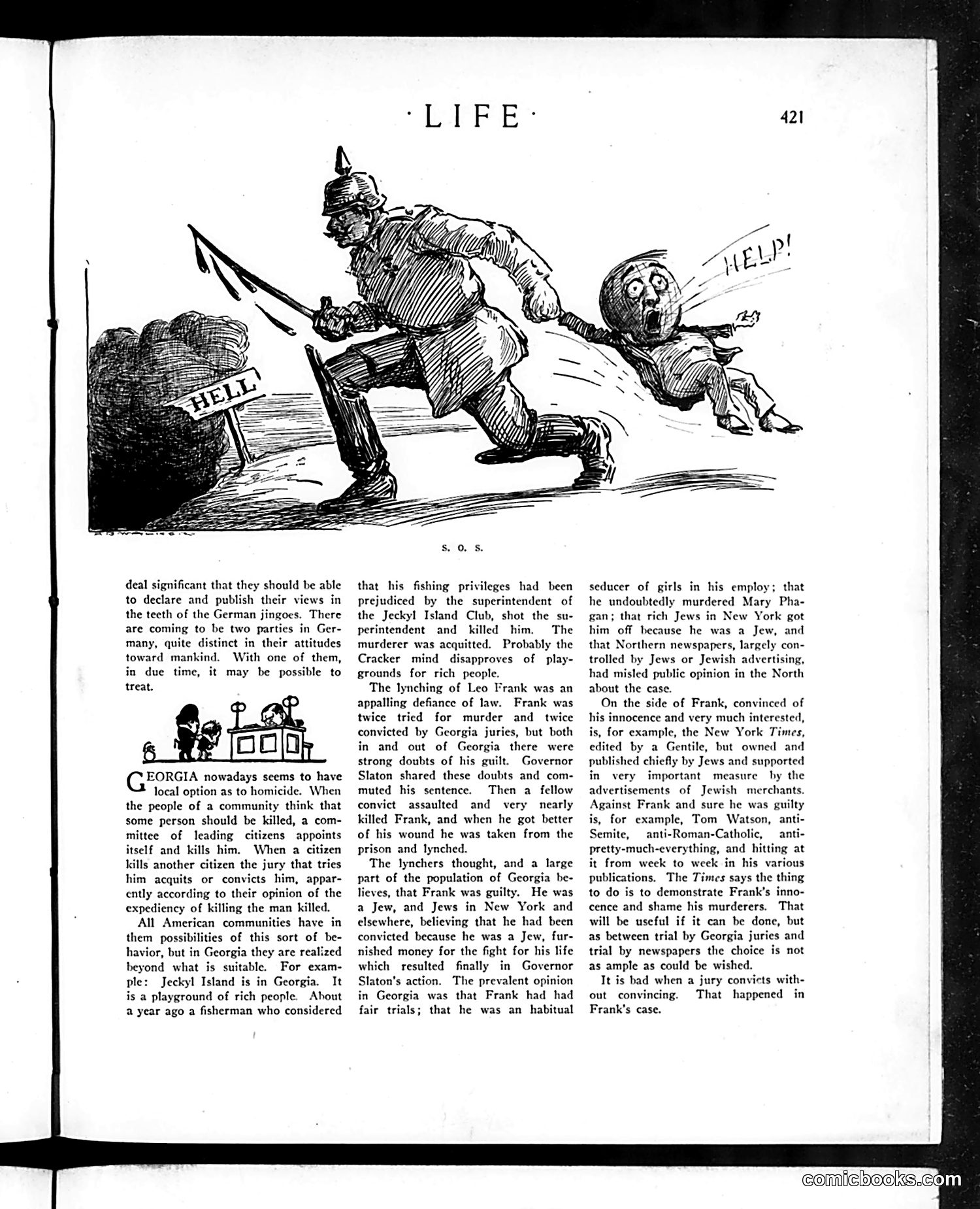
This page critiques Georgia's extrajudicial violence and the Leo Frank case. The cartoon shows a German military officer (representing autocratic "Prussian" values) gleefully watching an American lynch mob—equating Georgia's mob justice with militaristic tyranny. The article discusses how Georgia's wealthy and poor operate under different legal standards: a fisherman who killed a wealthy club superintendent was acquitted, while Leo Frank—a Jewish factory manager convicted (twice) of murdering a young worker, Mary Phagan—was lynched after Governor Slaton commuted his sentence based on reasonable doubt. The text presents both perspectives: Georgia believed Frank was guilty and guilty Jews manipulated Northern newspapers to free him; Frank's supporters (like the *New York Times*) saw religious prejudice behind his conviction and execution. **The satire's point**: Georgia's justice system isn't impartial law but mob rule reflecting class and religious bias—a shocking hypocrisy for a democracy claiming superiority to German authoritarianism.
📄 Transcribed text from this page (OCR, searchable)
Machine-transcribed from the original scan — historical spelling and the odd misread are preserved.
deal significant that they should be able to declare and publish their views in the teeth of the German jingoes. There are coming to be two parties in Ger- many, quite distinct in their attitudes toward mankind. With one of them, in due time, it may be possible to treat. GEORGIA nowadays seems to have local option as to homicide. When the people of a community think that some person should be killed, a com- mittee of leading citizens appoints itself and kills him. When a citizen kills another citizen the jury that tries him acquits or convicts him, appar- ently according to their opinion of the expediency of killing the man killed. All American communities have in them possibilities of this sort of be- havior, but in Georgia they are realized beyond what is suitable. For exam- ple: Jeckyl Island is in Georgia. It is a playground of rich people. About a year ago a fisherman who considered that his fishing privileges had been prejudiced by the superintendent of the Jeckyl Island Club, shot the su- perintendent and killed him. The murderer was acquitted. Probably the Cracker mind disapproves of play- grounds for rich people. The lynching of Leo Frank was an appalling defiance of law. Frank was twice tried for murder and twice convicted by Georgia juries, but both in and out of Georgia there were strong doubts of his guilt. Governor Slaton shared these doubts and com- muted his sentence. Then a fellow convict assaulted and very nearly killed Frank, and when he got better of his wound he was taken from the prison and lynched. The lynchers thought, and a large part of the population of Georgia be- lieves, that Frank was guilty. He was a Jew, and Jews in New York and elsewhere, believing that he had been convicted because he was a Jew, fur- nished money for the fight for his life which resulted finally in Governor Slaton’s action. The prevalent opinion in Georgia was that Frank had had fair trials; that he was an habitual seducer of girls in his employ; that he undoubtedly murdered Mary Pha- gan; that rich Jews in New York got him off because he was a Jew, and that Northern newspapers, largely trolled by Jews or Jewish advertising, had misled public opinion in the North about the case. On the side of Frank, convinced of his innocence and very much interested, is, for example, the New York Times, edited by a Gentile, but owned and published chiefly by Jews and supported in very important measure by the advertisements of Jewish merchants. Against Frank and sure he was guilty is, for example, Tom Watson, anti- Semite, anti-Roman-Catholic, —_ anti- pretty-much-everything, and hitting at it from week to week in his various publications. The Times says the thing to do is to demonstrate Frank’s inno- cence and shame his murderers. That will be useful if it can be done, but as between trial by Georgia juries and trial by newspapers the choice is not as ample as could be wished. It is bad when a jury convicts with- out convincing. That happened in Frank's case. ‘on- comichooks.