
Life, 1915-09-02 · page 16 of 48
Life — September 2, 1915 — page 16: what you’re looking at
What you’re looking at
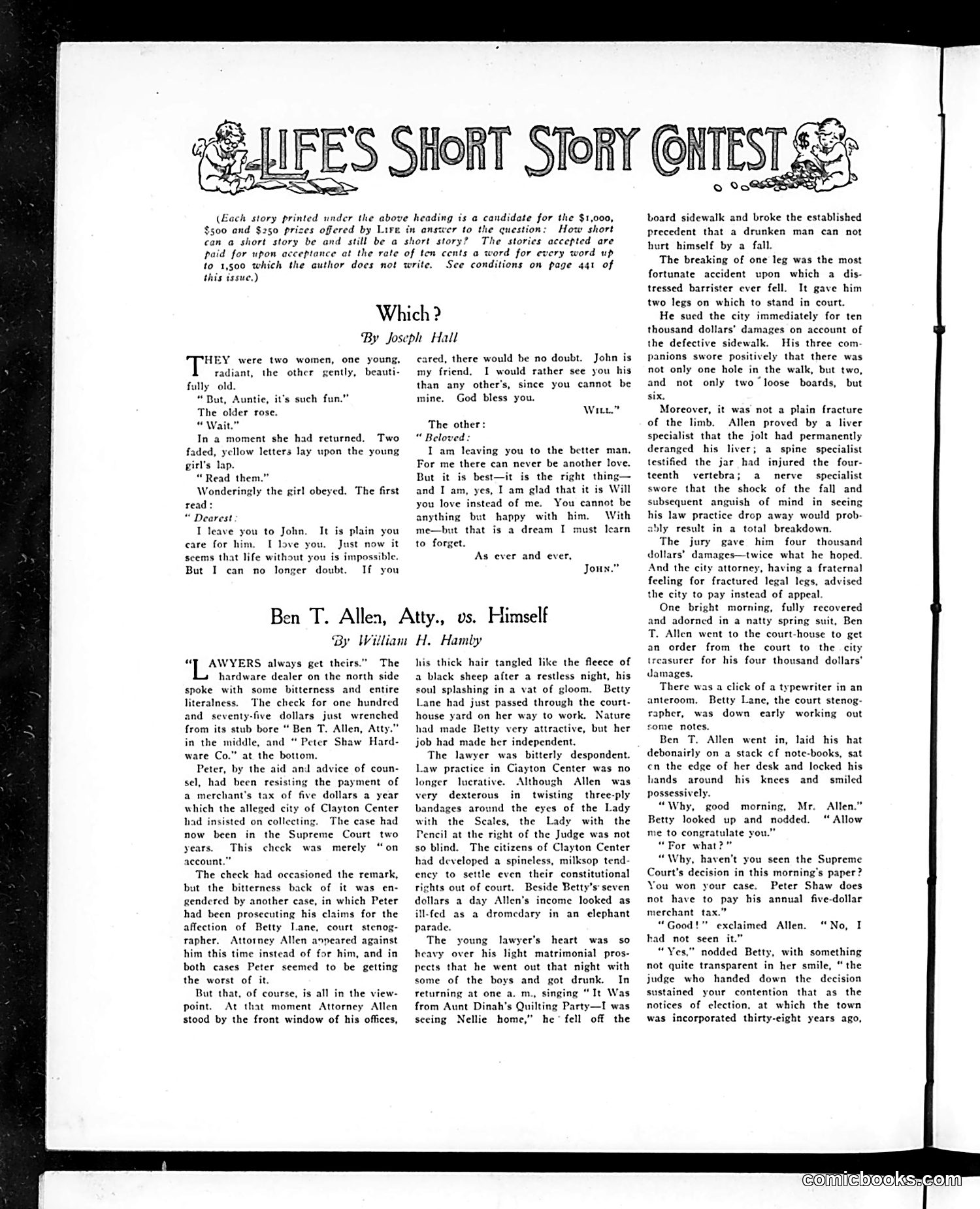
This page presents two short stories submitted to **Life's Short Story Contest**, offering $1,000, $500, and $250 prizes for stories answering the question: "How short can a short story be and still be a short story?" **"Which?" by Joseph Hall** depicts a romantic dilemma through two old love letters—one man (Will) and another (John) each renouncing their claims to a woman, deferring to the other. The story's irony lies in its brevity: the entire emotional drama is conveyed through the letters themselves. **"Ben T. Allen, Atty., vs. Himself" by William H. Hamby** follows a small-town lawyer in Clayton Center who loses both a legal case and romantic competition to the same woman (Betty Lane, a court stenographer) through his own incompetence and alcoholism. The story ends with Allen drunkenly falling off a sidewalk, humorously subverting the "drunken men don't get hurt" maxim. Both stories explore compressed narrative—how much emotional and dramatic content can fit into minimal space while remaining coherent stories.
📄 Transcribed text from this page (OCR, searchable)
Machine-transcribed from the original scan — historical spelling and the odd misread are preserved.
(Each story printed under the ab $500 and $250 prizes offered by Lire in answer to the question: can a short story be and still be @ short story? paid for upon acceptance at the rate of ten cents a to 1,500 which the author docs not write, this issue.) heading is @ candidate for the $1,000, How short The stories accepted are ‘ord for every word up See conditions on page 441 of Which ? By Joseph Hall HEY were two women, one young. radiant, the other gently, beaut fully old. “But, Auntie, it's such fun.” The older rose. “Wait.” In a moment she had returned. Two faded, yellow letters lay upon the young girl's lap. “Read them.” Wonderingly the girl obeyed. The first read: “ Dearest I leave you to John. It is plain you care for him. I love you. Just now it scems that life without you is impossible. But I can no longer doubt. If you cared, there would be no doubt. John is my friend, I would rather see you his than any other's, since you cannot be mine. God bless you. Wi.” The other: “ Beloved: I am leaving you to the better man, For me there can never be another love. But it is best—it is the right thing— and I am, yes, I am glad that it is Will you love instead of me. You cannot be anything but happy with him. With me—but that is a dream I must learn to forget. As ever and ever, Joun.” Ben T. Allea, Atty., vs. Himself By William H. Hamby “7 AWYERS always get theirs.” The hardware dealer on the north side spoke with some bitterness and entire literalness. The check for one hundred and seventy-five dollars just wrenched from its stub bore “ Ben T. Allen, Atty, in the middle, and “ Peter Shaw Hard- ware Co.” at the bottom. Peter, by the aid and advice of coun- sel, had been resisting the payment of a merchant's tax of five dollars a year which the alleged city of Clayton Center had insisted on collecting. The case had now been in the Supreme Court two years. This check was merely “on account.” The check had occasioned the remark, but the bitterness back of it was en- gendered by another case, in which Peter had been prosecuting his claims for the affection of Betty Lane, court stenog- rapher. Attorney Allen anpeared against him this time instead of for him, and in both cases Peter seemed to be getting the worst of it. But that, of course, is all in the view- point. At that moment Attorney Allen stood by the front window of his offices, his thick hair tangled like the fleece of a black sheep after a restless night, his soul splashing in a vat of gloom. Betty Lane had just passed through the court- house yard on her way to work. Nature had made Betty very attractive, but her job had made her independent. The lawyer was bitterly despondent. Law practice in Ciayton Center was no longer lucrative. Although Allen was very dexterous in twisting three-ply bandages around the eyes of the Lady with the Scales, the Lady with the Pencil at the right of the Judge was not so blind. The citizens of Clayton Center had developed a spineless, milksop tend- ency to settle even their constitutional ights out of court. Beside Betty’s seven dollars a day Allen's income looked as ill-fed as a dromedary in an elephant parade. The young lawyer's heart was so heavy over his light matrimonial pros- pects that he went out that night with some of the boys and got drunk. In returning at one a. m., singing “It Was from Aunt Dinah’s Quilting Party—T was seeing Nellie home,” he’ fell off the board sidewalk and broke the established Precedent that a drunken man can not hurt himself by a fall. The breaking of one leg was the most fortunate accident upon which a dis- tressed barrister ever fell. It gave him two legs on which to stand in court. He sued the city immediately for ten thousand dollars’ damages on account of the defective sidewalk. His three com- panions swore positively that there was not only one hole in the walk, but two, and not only two “loose boards, but six. Moreover, it was not a plain fracture of the limb. Allen proved by a liver specialist that the jolt had permanently deranged his liver; a spine specialist testified the jar had injured the four- teenth vertebra; a nerve specialist swore that the shock of the fall and subsequent anguish of mind in seeing his law practice drop away would prob- ably result in a total breakdown. The jury gave him four thousand dollars’ damages—twice what he hoped. And the city attorney, having a fraternal feeling for fractured legal legs, advised the city to pay instead of appeal. One bright morning, fully recovered and adorned in a natty spring suit, Ben T. Allen went to the court-house to get an order from the court to the city treasurer for his four thousand dollars’ damages. There was a click of a typewriter in an anteroom. Betty Lane, the court stenog- rapher, was down early working out some notes. Ben T. Allen went in, laid his hat debonairly on a stack cf note-books, sat cn the edge of her desk and locked his hands around his knees and smiled possessively. “Why, good morning, Mr. Betty looked up and nodded. me to congratulate you.” "For what? “Why, haven't you seen the Supreme Court's decision in this morning's paper? You won your case. Peter Shaw does not have to pay his annual five-dollar merchant tax.” “Good! exclaimed Allen. had not seen it.” “Yes,” nodded Betty, with something not quite transparent in her smile, “the judge who handed down the decision sustained your contention that as the notices of election, at which the town was incorporated thirty-eight years ago, Allen.” “ Allow “No, I