
Life, 1915-09-02 · page 4 of 48
Life — September 2, 1915 — page 4: what you’re looking at
What you’re looking at
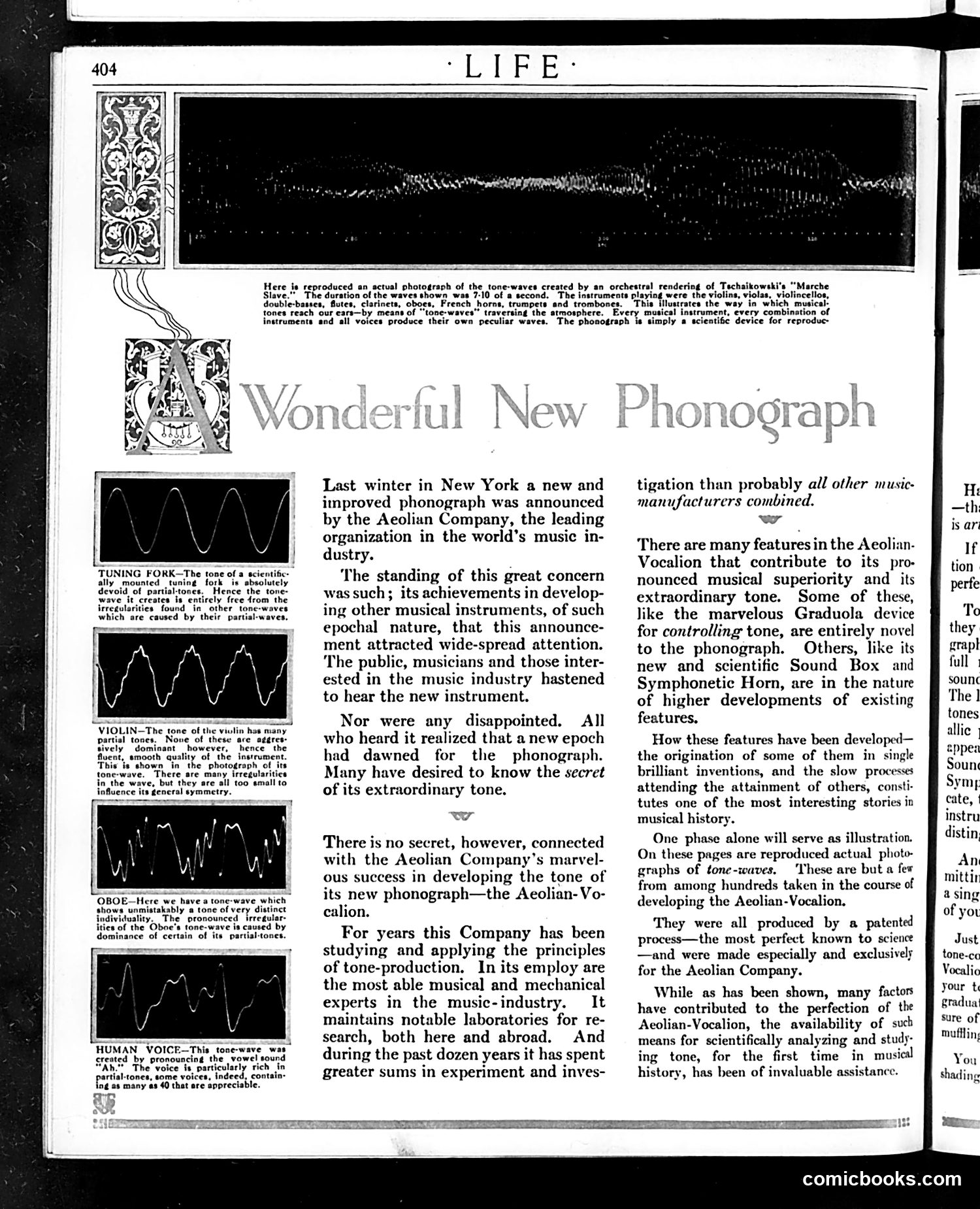
This is not political satire but rather a genuine technology article celebrating the **Aeolian Company's improved phonograph**. The page features actual sound-wave photographs—visual representations of musical tones captured from various instruments. The article describes how the Aeolian-Vocalization phonograph achieved superior sound quality through scientific tone-wave analysis. The wave diagrams shown (tuning fork, violin, oboe, human voice) demonstrate the magazine presenting cutting-edge audio technology to readers as genuinely marvelous innovation. This reflects early 20th-century enthusiasm for mechanical reproduction of sound and scientific visualization of music—treating phonograph development as a major industrial and cultural achievement worthy of detailed technical explanation.
📄 Transcribed text from this page (OCR, searchable)
Machine-transcribed from the original scan — historical spelling and the odd misread are preserved.
double-bai tones reach our ears—by me: TUNING FORK—The tone of a scientific ally mounted tuning fork is absolutely of partial-tones. Hence the tone- rea is entirely free from the found in other tone-waves in the photograph tone-wave. There are many irregul inthe wave, but they are all too em ve a tone-wave which ‘one of very distinct HUMAN VOICE—This tone-wave was by pronouncing the vowel sound ticular! The voice i ones, some v 3s many as 40 that ar: reproduced en sctual photograph of the tone-waves created by an orchestra! rendering of Tachaikowshi’s “Marche 1e duration of the waves t, fates, clarinets, yosphere. Last winter in New York a new and improved phonograph was announced by the Aeolian Company, the leading organization in the world’s music in- dustry. ‘The standing of this great concern was such; its achievements in develop- ing other musical instruments, of such epochal nature, that this announce- ment attracted wide-spread attention. The public, musicians and those inter- ested in the music industry hastened to hear the new instrument. Nor were any disappointed. All who heard it realized that a new epoch had dawned for the phonograph. Many have desired to know the secret of its extraordinary tone. wer There is no secret, however, connected with the Aeolian Company's marvel- ous success in developing the tone of its new phonograph—the Aeolian-Vo- calion. For years this Company has been studying and applying the principles of tone-production. In its employ are the most able musical and mechanical experts in the music-industry. It maintains notable laboratories for re- search, both here and abroad. And during the past dozen years it has spent greater sums in experiment and inves- shown was 7-10 of a second. The instruments p! ¥ 4 trombones. 1g were the violins, violas, violincellos, This illustrates the way in which musical: 1 instrument, every combination of very al |. The phonograph is simply # scientific device for reproduc tigation than probably all other music- manufacturers combined. ww There are many features in the Aeolian- Vocalion that contribute to its pro- nounced musical superiority and its extraordinary tone. Some of these, like the marvelous Graduola device for controlling tone, are entirely novel to the phonograph. Others, like its new and scientific Sound Box and Symphonetic Horn, are in the nature of higher developments of existing features, How these features have been developed— the origination of some of them in single brilliant inventions, and the slow processes attending the attainment of others, consti- tutes one of the most interesting stories in musical history. One phase alone will serve as illustration. On these pages are reproduced actual photo- graphs of tone-zwaves. ‘These are but a fer from among hundreds taken in the course of developing the Aeolian-Vocalion, They were all produced by a patented process—the most perfect known to science —and were made especially and exclusively for the Aeolian Company. While as has been shown, many factors have contributed to the perfection of the Aeolian-Vocalion, the availability of such means for scientifically analyzing and study- ing tone, for the first time in musical history, has been of invaluable assistance. full sounc The | tones allic | eppea Soun Symy cate, | instru distin An mittir asing of you Just tone-co Vocalio your t gradua sure of nufllin, You shading —— comicbooks.com