
Life, 1915-09-02 · page 28 of 48
Life — September 2, 1915 — page 28: what you’re looking at
What you’re looking at
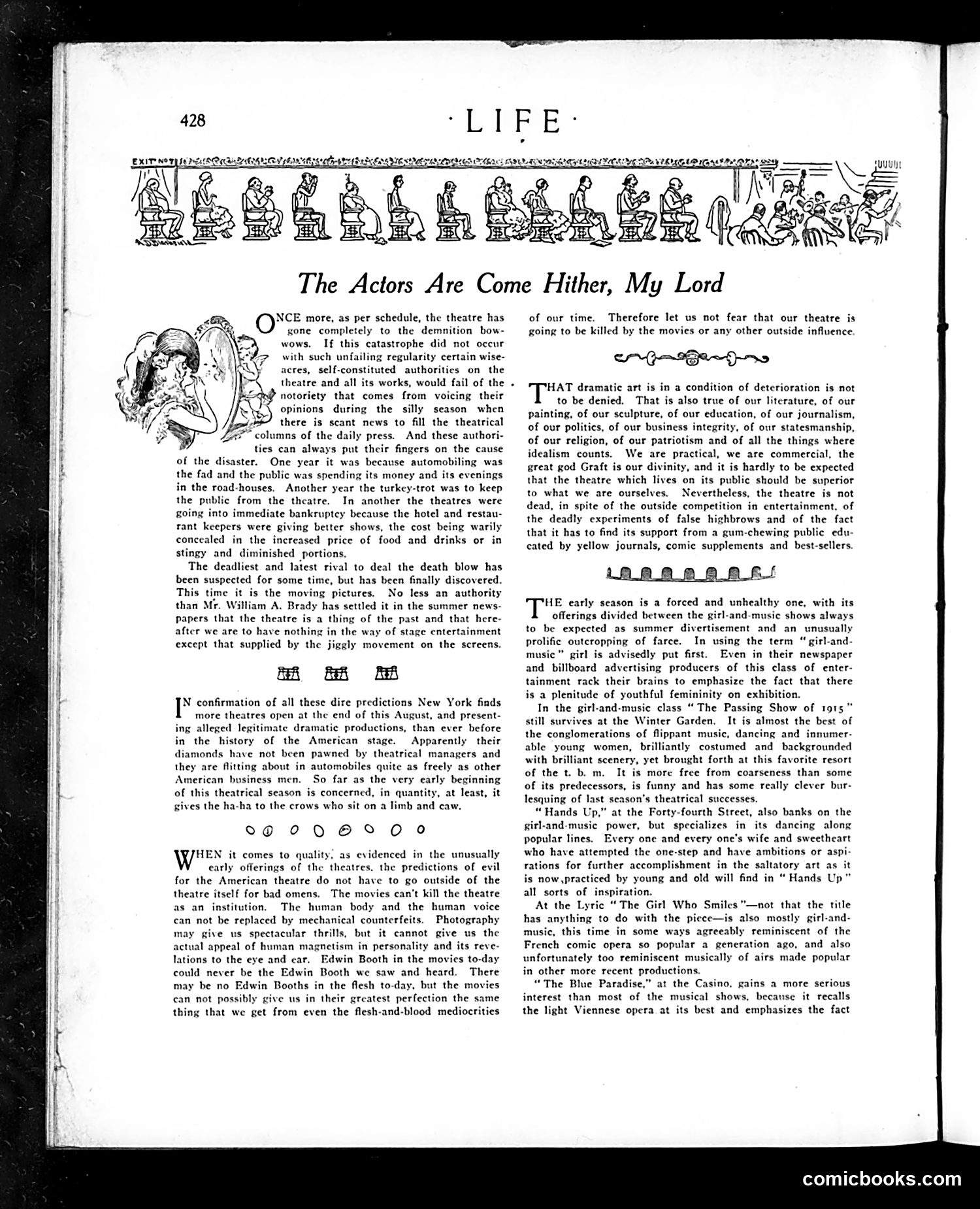
This article satirizes theatrical industry doomsayers who repeatedly predict the stage's imminent collapse. The cartoon header shows a procession of actors, illustrating the ironic abundance of theatre despite doom-mongering. The piece mocks so-called "authorities" who annually blame different scapegoats for theatre's supposed demise: automobiles, the turkey-trot dance craze, fancy restaurants. The latest culprit: moving pictures. Critic William A. Brady allegedly declared theatre "a thing of the past." The satire's punch: Life reports New York actually has *more* legitimate theatres open than ever before—undermining these predictions entirely. The author argues theatre cannot be killed by film because human magnetism and personality cannot be mechanically replicated. Even mediocre live actors surpass screen performances. The essay concludes that theatre's actual problem isn't external competition but internal decline reflecting broader American moral decay—corruption, commercialism, and lost idealism permeating society, not just entertainment.
📄 Transcribed text from this page (OCR, searchable)
Machine-transcribed from the original scan — historical spelling and the odd misread are preserved.
428 EXIT NOM se PUSCecds? Ik \| ‘LIFE: The Actors Are Come Hither, My Lord NCE more, as per schedule, the theatre has gone completely to the demnition bow- wows. If this catastrophe did not occur with such unfailing regularity certain wise- acres, self-constituted authorities on the theatre and all its works, would fail of the bY notoriety that comes from voicing their KAJ opinions during the silly season when 2 there is scant news to fill the theatrical ZZP™ columns of the daily press. And these authori- ties can always put their fingers on the cause of the disaster. One year it was because automobiling was the fad and the public was spending its money and its evenings in the road-houses. Another year the turkey-trot was to keep the public from the theatre. In another the theatres were going into immediate bankruptcy because the hotel and restau- rant keepers were giving better shows, the cost being warily concealed in the increased price of food and drinks or in stingy and diminished portions. The deadliest and latest rival to deal the death blow has been suspected for some time, but has been finally discovered. This time it is the moving pictures. No less an authority than Mr. William A. Brady has settled it in the summer news. Papers that the theatre is a thing of the past and that here- after we are to have nothing in the way of stage entertainment except that supplied by the jiggly movement on the screens. i GA mA N confirmation of all these dire predictions New York finds more theatres open at the end of this August, and present- ing alleged legitimate dramatic productions, than ever before in the history of the American stage. Apparently their nonds have not been pawned by theatrical managers and they are flitting about in automobiles quite as freely as other American business men. So far as the very early beginning of this theatrical season is concerned, in quantity, at least, it gives the ha-ha to the crows who sit on a limb and caw. °0 006200 HEN it comes to quality, as evidenced in the unusually early offerings of the theatres, the predictions of evil for the American theatre do not have to go outside of the theatre itself for bad omens, The movies can't kill the theatre as an institution, The human body and the human voice can not be replaced by mechanical counterfeits. Photography may give us spectacular thrills, but it cannot give us the actual appeal of human magnetism in personality and its reve- lations to the eye and ear. Edwin Booth in the movies to-day could never be the Edwin Booth we saw and heard. There may be no Edwin Booths in the flesh to-day, but the movies can not possibly give us in their greatest perfection the same thing that we get from even the flesh-and-blood mediocrities of our time. Therefore let us not fear that our theatre is going to be killed by the movies or any other outside influence IG 9GR— fy HAT dramatic art is in a condition of deterioration is not to be denied, That is also true of our literature, of our painting, of our sculpture, of our education, of our journalism, of our politics, of our business integrity, of our statesmanship, of our religion, of our patriotism and of all the things where idealism counts. We are practical, we are commercial, the great god Graft is our divinity, and it is hardly to be expected that the theatre which lives on its public should be superior to what we are ourselves. Nevertheless, the theatre is not dead, in spite of the outside competition in entertainment, of the deadly experiments of false highbrows and of the fact that it has to find its support from a gum-chewing public edu- cated by yellow journals, comic supplements and best-sellers. IM AMO 9 A FS HE early season is a forced and unhealthy one, with its offerings divided between the girl-and-music shows always to be expected as summer divertisement and an unusually prolific outcropping of farce. In using the term “ girl-and- music” girl is advisedly put first. Even in their newspaper and billboard advertising producers of this class of enter- tainment rack their brains to emphasize the fact that there is a plenitude of youthful femininity on exhibition. In the girl-and-music class “ The Passing Show of 1915” still survives at the Winter Garden. It is almost the best of the conglomerations of flippant music, dancing and innumer- able young women, brilliantly costumed and backgrounded with brilliant scenery, yet brought forth at this favorite resort of the t. b. m. It is more free from coarseness than some of its predecessors, is funny and has some really clever bur- lesquing of last season's theatrical successes. “Hands Up,” at the Forty-fourth Street, also banks on the girl-and-music power, but specializes in its dancing along popular lines. Every one and every one's wife and sweetheart who have attempted the one-step and have ambitions or aspi- rations for further accomplishment in the saltatory art as it is now,practiced by young and old will find in “Hands Up” all sorts of inspiration. At the Lyric “The Girl Who Smiles "—not that the title has anything to do with the picce—is also mostly girl-and- music, this time in some ways agreeably reminiscent of the French comic opera so popular a generation ago, and also unfortunately too reminiscent musically of airs made popular in other more recent productions. “The Blue Paradise,” at the Casino, gains a more serious interest than most of the musical shows, because it recalls the light Viennese opera at its best and emphasizes the fact comicbooks.com