
Life, 1915-09-02 · page 29 of 48
Life — September 2, 1915 — page 29: what you’re looking at
What you’re looking at
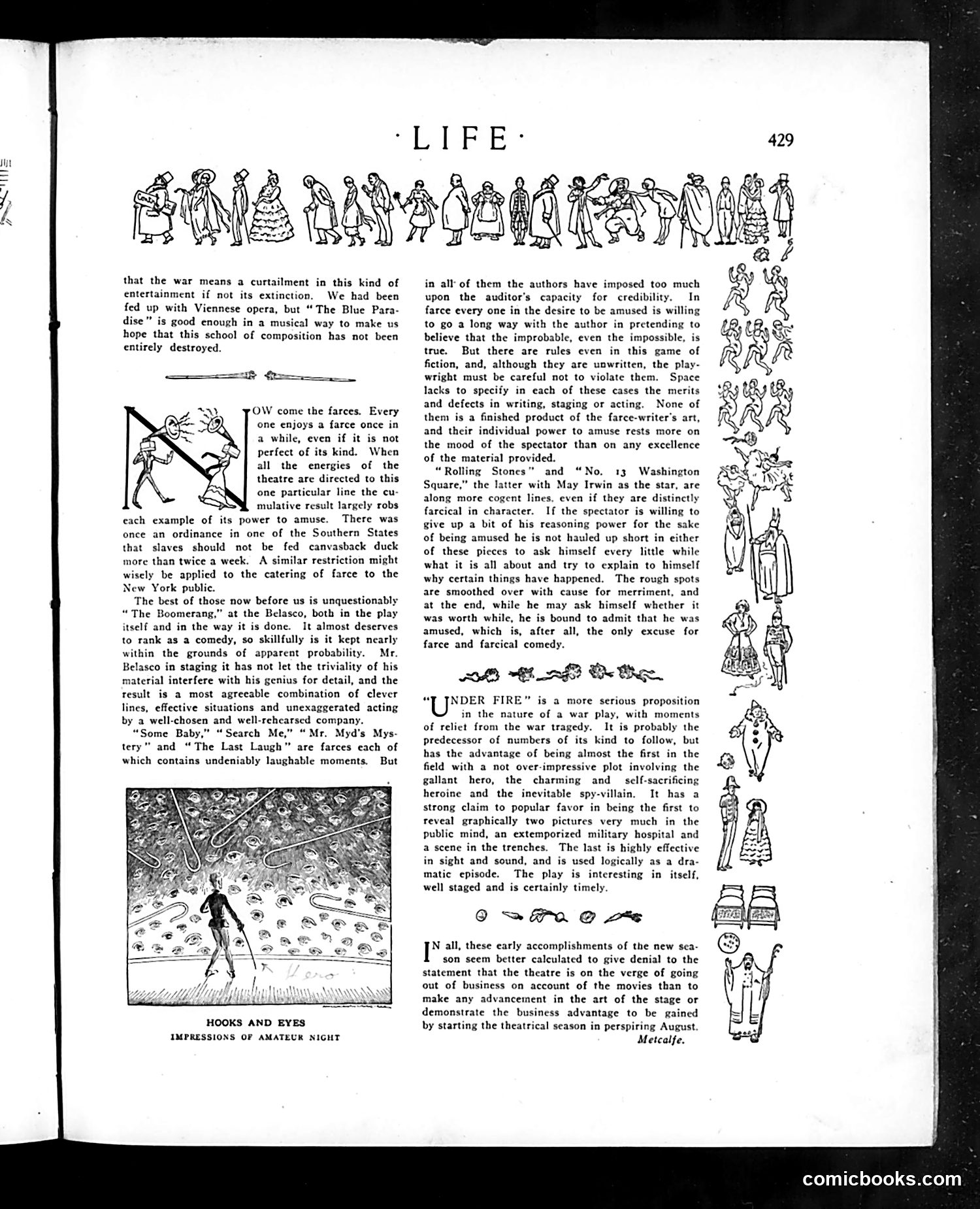
This page reviews recent Broadway theatrical productions during World War I. The main cartoon, "Hooks and Eyes: Impressions of Amateur Night," depicts a figure on stage surrounded by audience members—a satirical commentary on amateur theatrical performances. The text critiques contemporary farces, noting that New York audiences are oversaturated with them. The reviewer praises "The Boomerang" at the Belasco Theatre for skillfully maintaining probability, while dismissing other farces ("Some Baby," "Search Me," "Mr. Myd's Mystery," "The Last Laugh") as violating basic dramatic rules by asking audiences to suspend too much disbelief. The review also discusses "Under Fire," a war play capitalizing on public interest in trench warfare and military hospitals—timely subject matter given America's recent WWI involvement. The author (signed "Metcalfe") argues these theatrical efforts demonstrate the stage can still compete with cinema, despite wartime disruptions to entertainment.
📄 Transcribed text from this page (OCR, searchable)
Machine-transcribed from the original scan — historical spelling and the odd misread are preserved.
that the war means a curtailment in this kind of entertainment if not its extinction. We had been fed up with Viennese opera, but “The Blue Para- dise" is good enough in a musical way to make us hope that this school of composition has not been entirely destroyed. Sn OW come the farces. Every one enjoys a farce once in a while, even if it is not perfect of its kind. When all the energies of the theatre are directed to this one particular line the cu- mulative result largely robs example of its power to amuse. There was once an ordinance in one of the Southern States that slaves should not be fed canvasback duck more than twice a week. A similar restriction might wisely be applied to the catering of farce to the New York public. The best of those now before us is unquestionably “The Boomerang,” at the Belasco, both in the play itself and in the way it is done. It almost deserves to rank as a comedy, so skillfully is it kept nearly within the grounds of apparent probability. Mr. Belasco in staging it has not let the triviality of his material interfere with his genius for detail, and the result is a most agreeable combination of clever lines, effective situations and unexaggerated acting by a well-chosen and well-rehearsed company. “Some Baby,” “Search Me,” “Mr. Myd’s Mys- tery" and “The Last Laugh” are farces each of which contains undeniably laughable moments. But HOOKS AND EYES IMPRESSIONS OF AMATEUR NIGHT in all of them the authors have imposed too much upon the auditor's capacity for credibility. In farce every one in the desire to be amused is willing to go a long way with the author in pretending to believe that the improbable, even the impossible, is true. But there are rules even in this game of fiction, and, although they are unwritten, the play- wright must be careful not to violate them. Space lacks to specify in each of these cases the merits and defects in writing, staging or acting. None of them is a finished product of the farce-writer’s art, and their individual power to amuse rests more on the mood of the spectator than on any excellence of the material provided. “Rolling Stones” and “No. 13 Washington Square,” the latter with May Irwin as the star, are along more cogent lines. even if they are distinctly farcical in character. If the spectator is willing to give up a bit of his reasoning power for the sake of being amused he is not hauled up short in either of these pieces to ask himself every little while what it is all about and try to explain to himself why certain things have happened. The rough spots are smoothed over with cause for merriment, and at the end, while he may ask himself whether it was worth while, he is bound to admit that he was amused, which is, after all, the only excuse for farce and farcical comedy. OH BAG Or Chee. “[pNmen FIRE” is a more serious proposition in the nature of a war play, with moments of relict from the war tragedy. It is probably the predecessor of numbers of its kind to follow, but has the advantage of being almost the first in the field with a not over-impressive plot involving the gallant hero, the charming and self-sacrificing heroine and the inevitable spy-villain. It has a strong claim to popular favor in being the first to reveal graphically two pictures very much in the public mind, an extemporized military hospital and a scene in the trenches. The last is highly effective in sight and sound, and is used logically as a dra- matic episode. The play is interesting in itself, well staged and is certainly timely. 9 D&O. Oo 2 N all, these early accomplishments of the new sea- son seem better calculated to give denial to the statement that the theatre is on the verge of going out of business on account of the movies than to make any advancement in the art of the stage or demonstrate the business advantage to be gained by starting the theatrical season in perspiring August. Metcalfe. comicbooks.com