
Life, 1915-09-02 · page 20 of 48
Life — September 2, 1915 — page 20: what you’re looking at
What you’re looking at
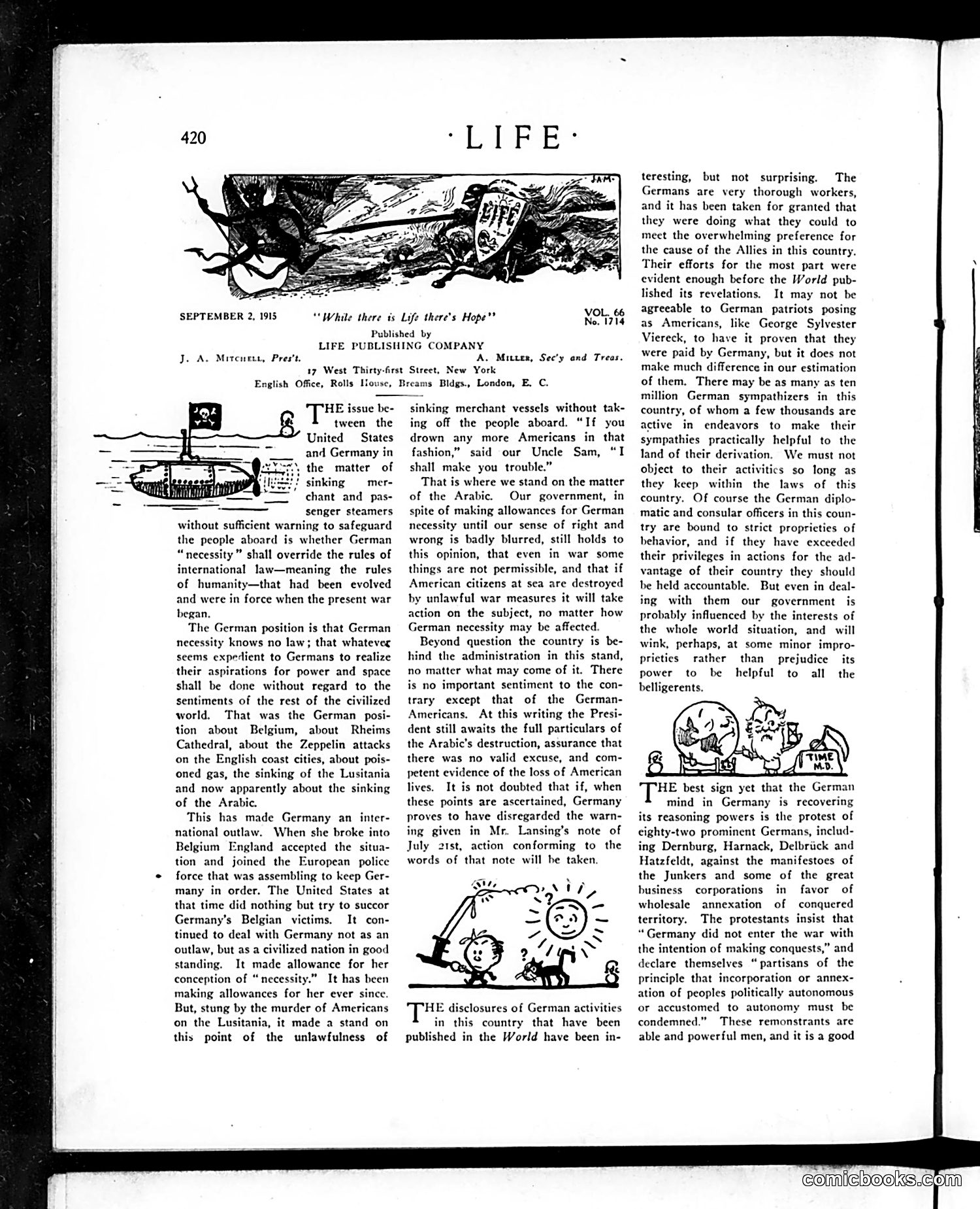
This editorial page addresses two major German-American controversies of WWI: **The Arabic Sinking**: The main text argues that Germany's policy of sinking merchant and passenger vessels without warning violates international humanitarian law. Life characterizes Germany as an "international outlaw" whose claim that "German necessity knows no law" is unacceptable. The U.S. government demands Germany cease these attacks or face consequences. **German Propaganda in America**: The article references revelations published in the *World* newspaper about German spy and propaganda activities in the U.S., specifically naming **George Sylvester Viereck** as a German agent posing as an American. Life dismisses German-American protests about these exposures, noting they don't change public estimation of such operatives. The cartoons (illustrations of children playing) appear to accompany discussions of hope and innocence amid wartime tensions. **Context**: This reflects 1915 America's growing frustration with Germany's submarine warfare and covert operations, before U.S. entry into WWI in 1917.
📄 Transcribed text from this page (OCR, searchable)
Machine-transcribed from the original scan — historical spelling and the odd misread are preserved.
SEPTEMBER 2, 1915 “While there ts Life there's Hope"* No, 1714 Published by LIFE PUBLISHING COMPANY J. A. Mitcuent, Pres't. A. Mites, Sec’y and Treas. 17 West Thirty-first Street, New York English Office, Rolls 1 'HE issue be- tween the United — States and Germany in the matter of sinking — mer- chant and pas- senger steamers without sufficient warning to safeguard the people aboard is whether German necessity” shall override the rules of international law—meaning the rules of humanity—that had been evolved and were in force when the present war began. The German position is that German necessity knows no law; that whatever seems expedient to Germans to realize their aspirations for power and space shall be done without regard to the sentiments of the rest of the civilized world. That was the German posi- tion about Belgium, about Rheims Cathedral, about the Zeppelin attacks on the English coast cities, about pois- oned gas, the sinking of the Lusitania and now apparently about the sinking of the Arabic. This has made Germany an inter- national outlaw. When she broke into Belgium England accepted the situa- tion and joined the European police force that was assembling to keep Ger- many in order. The United States at that time did nothing but try to succor Germany’s Belgian victims. It con- tinued to deal with Germany not as an outlaw, but as a civilized nation in good standing. It made allowance for her conception of “necessity.” It has been making allowances for her ever since. But, stung by the murder of Americans on the Lusitania, it made a stand on this point of the unlawfulness of Breams Bldgs., London, E, C. sinking merchant vessels without tak- ing off the people aboard. “If you drown any more Americans in that fashion,” said our Uncle Sam, “I shall make you trouble.” That is where we stand on the matter of the Arabic. Our government, in spite of making allowances for German necessity until our sense of right and wrong is badly blurred, still holds to this opinion, that even in war some things are not permissible, and that if American citizens at sea are destroyed by unlawful war measures it will take action on the subject, no matter how German necessity may be affected. Beyond question the country is be- hind the administration in this stand, no matter what may come of it. There is no important sentiment to the con- trary except that of the German- Americans. At this writing the Pres dent still awaits the full particulars of the Arabic’s destruction, assurance that there was no valid excuse, and com- petent evidence of the loss of American lives. It is not doubted that if, when these points are ascertained, Germany proves to have disregarded the warn- ing given in Mr. Lansing’s note of July a2tst, action conforming to the words of that note will he taken. 0; HE disclosures of German activities in this country that have been published in the World have been in- teresting, but not surprising. The Germans are very thorough workers, and it has been taken for granted that they were doing what they could to meet the overwhelming preference for the cause of the Allies in this country. Their efforts for the most part were evident enough before the World pub- lished its revelations. It may not be agreeable to German patriots posing as Americans, like George Sylvester Viereck, to have it proven that they were paid by Germany, but it does not make much difference in our estimation of them. There may be as many as ten million German sympathizers in this country, of whom a few thousands are active in endeavors to make their sympathies practically helpful to the land of their derivation. We must not object to their activitics so long as they keep within the laws of this country. Of course the German diplo- matic and consular officers in this coun- try are bound to strict propricties of behavior, and if they have exceeded their privileges in actions for the ad- vantage of their country they should be held accountable. But even in deal- ing with them our government is probably influenced by the interests of the whole world situation, and will wink, perhaps, at some minor impro- prietics rather than prejudice its power to be helpful to all the belligerents. THE best sign yet that the German mind in Germany is recovering its reasoning powers is the protest of cighty-two prominent Germans, includ- ing Dernburg, Harnack, Delbriick and Hatzfeldt, against the manifestoes of the Junkers and some of the great business corporations in favor of wholesale annexation of conquered territory. The protestants insist that “Germany did not enter the war with the intention of making conquests,” and declare themselves “partisans of the principle that incorporation or annex- ation of peoples politically autonomous or accustomed to autonomy must be condemned.” These remonstrants are able and powerful men, and it is a good comichooks.com