
Life, 1915-09-02 · page 14 of 48
Life — September 2, 1915 — page 14: what you’re looking at
What you’re looking at
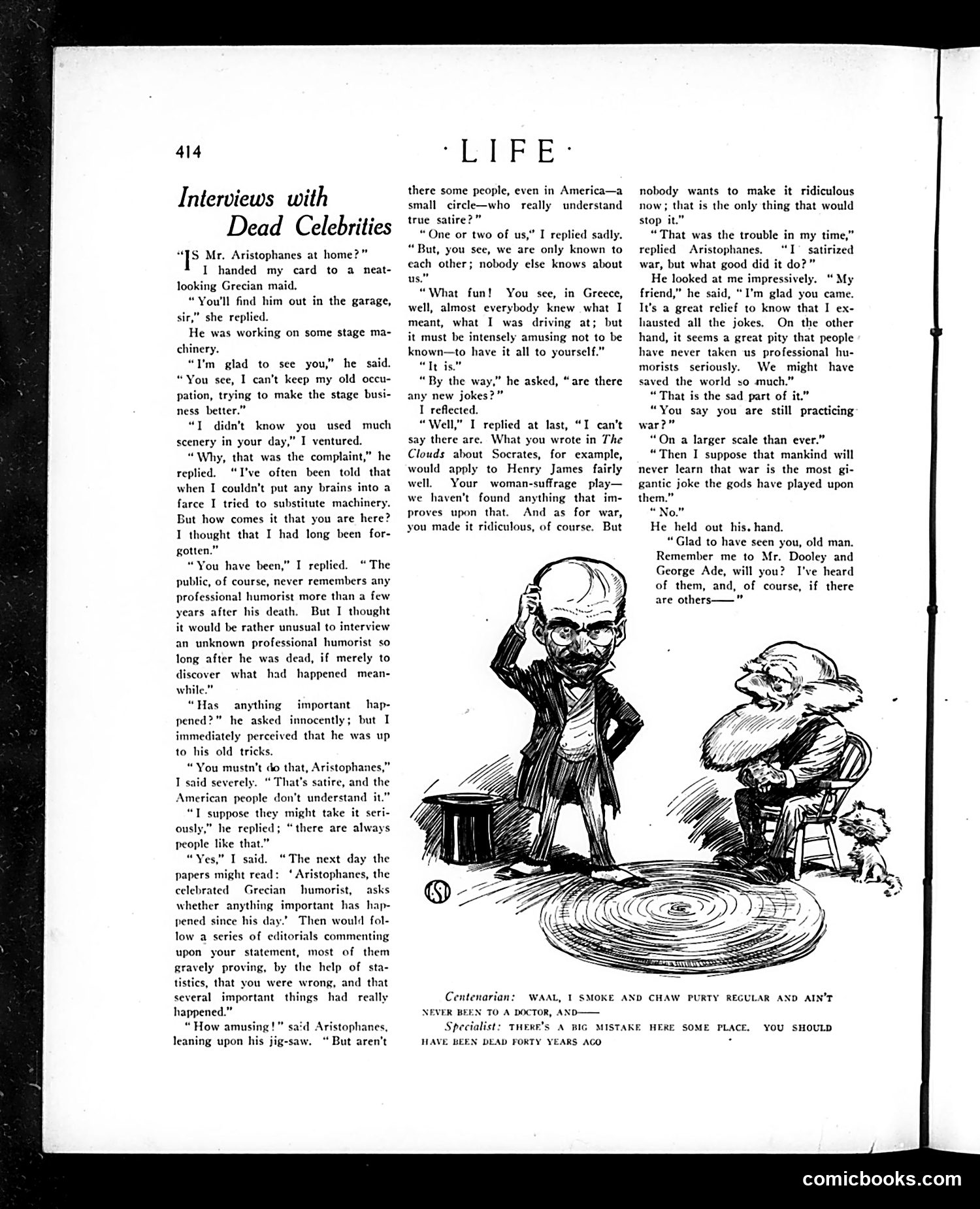
This satirical piece interviews the ancient Greek playwright **Aristophanes**, presented as a ghost. The humor relies on several layers: 1. **The Central Joke**: A modern interviewer visits Aristophanes' home to discuss whether anything important has happened since his death—implying centuries of human activity might bore an ancient comic genius. 2. **Social Commentary**: The text critiques modern American life, particularly women's suffrage and warfare. Aristophanes observes that current events (war, social change) are so absurd they'd be rejected as too ridiculous for his own comedic plays. 3. **The Caricature**: The illustration shows Aristophanes as a wizened, bald figure—standard period caricature style—listening to a modern specialist explain contemporary concerns. The satire suggests modern society has become too chaotic for even satirical treatment.
📄 Transcribed text from this page (OCR, searchable)
Machine-transcribed from the original scan — historical spelling and the odd misread are preserved.
414 Interviews with Dead Celebrities $ Mr. Aristophanes at home?” I handed my card to a neat- looking Grecian maid. “You'll find him out in the garage, sir,” she replied. He was working on some stage ma- chinery. “I'm glad to see you,” he said. “You see, I can't keep my old occu- pation, trying to make the stage busi- ness better.” “I didn’t know you used much scenery in your day,” I ventured. “Why, that was the complaint,” he replied. “I've often been told that when I couldn't put any brains into a farce I tried to substitute machinery. But how comes it that you are here? I thought that I had long been for- gotten.” “You have been,” I replied. “The public, of course, never remembers any professional humorist more than a few years after his death. But I thought it would be rather unusual to interview an unknown professional humorist so. long after he was dead, if merely to discover what had happened mean- while.” “Has anything important —hap- pened?” he asked innocently; but I immediately perceived that he was up to his old tricks. “You mustn't do that, Aristophanes,” I said severely. tire, and the American people don’t understand it.” “TL suppose they might take it seri- ously,” he replied; “there are always people like that.” “Yes,” I said. “The next day the papers might read: ‘Aristophanes, the celebrated Grecian humorist, asks whether anything important has hap- pened since his day.” Then would fol- low a series of editorials commenting upon your ement, most of them gravely proving, by the help of sta- tistics, that you were wrong, and that several important things had really happened.” “ How amusing! leaning upon his jig-saw. said Aristophanes, “But aren't “EIPFE- there some people, even in America—a small circle—who really understand true satire?” “One or two of us,” I replied sadly. “But, you see, we are only known to each other; nobody else knows about us.” “What fun! You see, in Greece, well, almost everybody knew what I meant, what I was driving at; but it must be intensely amusing not to be known—to have it all to yourself.” “Tr is.” “By the way any new jokes? I reflected. “Well,” I replied at last, “I can't say there are. What you wrote in The Clouds about Socrates, for example, would apply to Henry James fairly well. Your woman-suffrage play— we haven't found anything that im- proves upon that. And as for war, you made it ridiculous, of course. But he asked, “are there Centenarian: NEVER BEEN TO A DOCTOR, AND— Specialist: THERE'S A BIG HAVE BEEN DEAD FORTY YEARS ACO MISTAKE nobody wants to make it ridiculous hat is the only thing that would “That was the trouble in my time,” replied Aristophanes. “I satirized war, but what good did it do?” He looked at me impressively. “ My friend,” he said, “I’m glad you came. It’s a great relief to know that I ex- hausted all the jokes, On the other hand, it seems a great pity that people have never taken us professional hu- morists seriously. We might have saved the world so much.” “That is the sad part of it.” “You say you are still practicing war?” “On a larger scale than ever.” “Then I suppose that mankind will never learn that war is the most gi- gantic joke the gods have played upon them.” “No.” He held out his. hand. “Glad to have seen you, old man. Remember me to Mr. Dooley and George Ade, will you? I've heard of them, and, of course, if there are others——” WAAL, | SMOKE AND CHAW PURTY REGULAR AND AIN’T HERE SOME PLACE. You SHOULD comicbooks.com