
A complete issue · 44 pages · 1915
Life — August 5, 1915
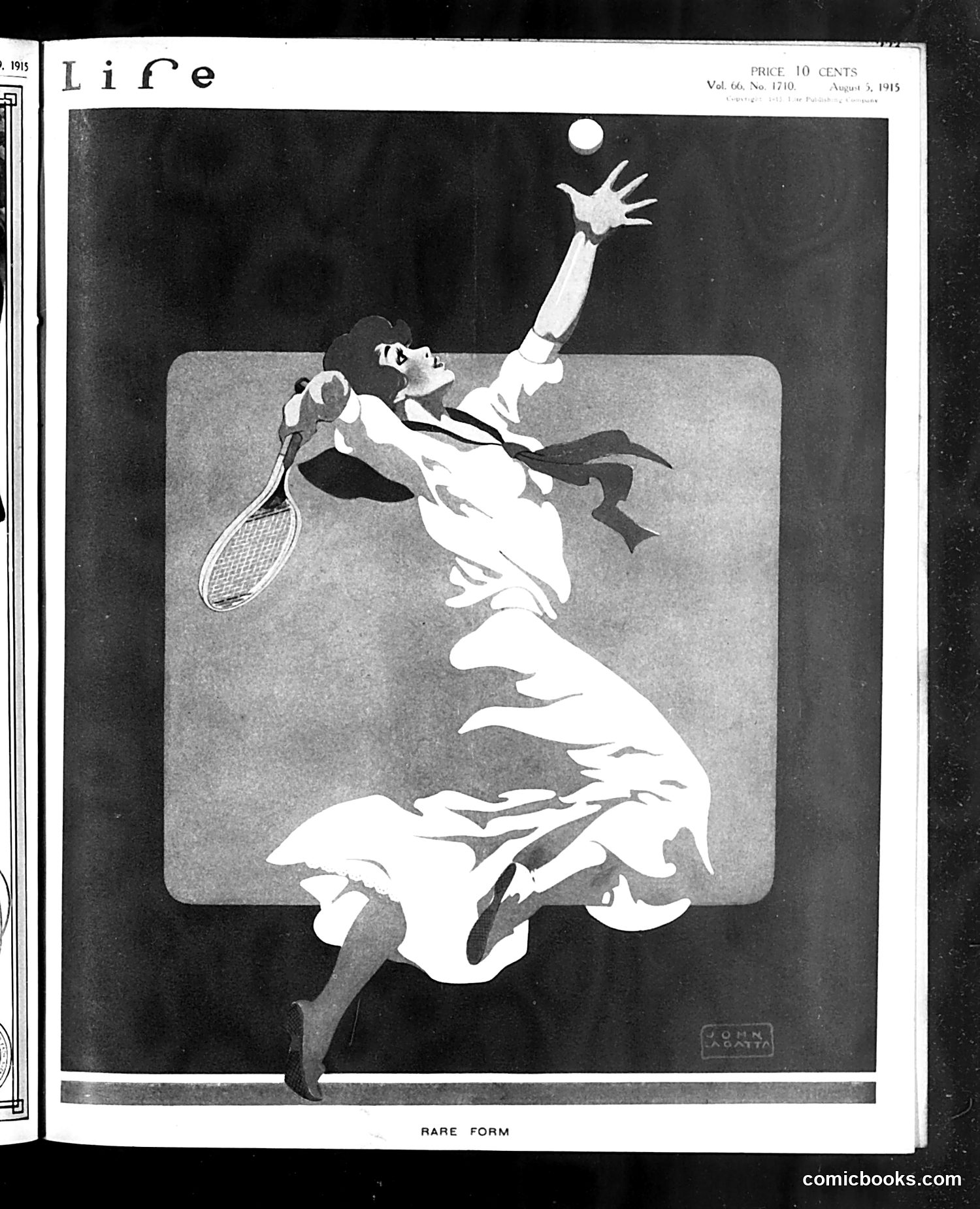
This 1915 *Life* magazine cover depicts a tennis player in an exaggerated athletic pose, captured mid-serve with dramatic body contortion. The figure launches the ball skyward while wielding a tennis racket, legs splayed in an impossibly dynamic stretch. The caption "Rare Form" is likely satirical—the cartoon exaggerates the athletic extremes of competitive tennis, poking fun at either the sport itself or the intensity with which players pursued it in the early 20th century. The illustration's art deco style and dynamic movement emphasize the absurdity of the pose, suggesting mockery of both athletic pretension and the increasingly competitive nature of recreational sports among the leisure class during this era.
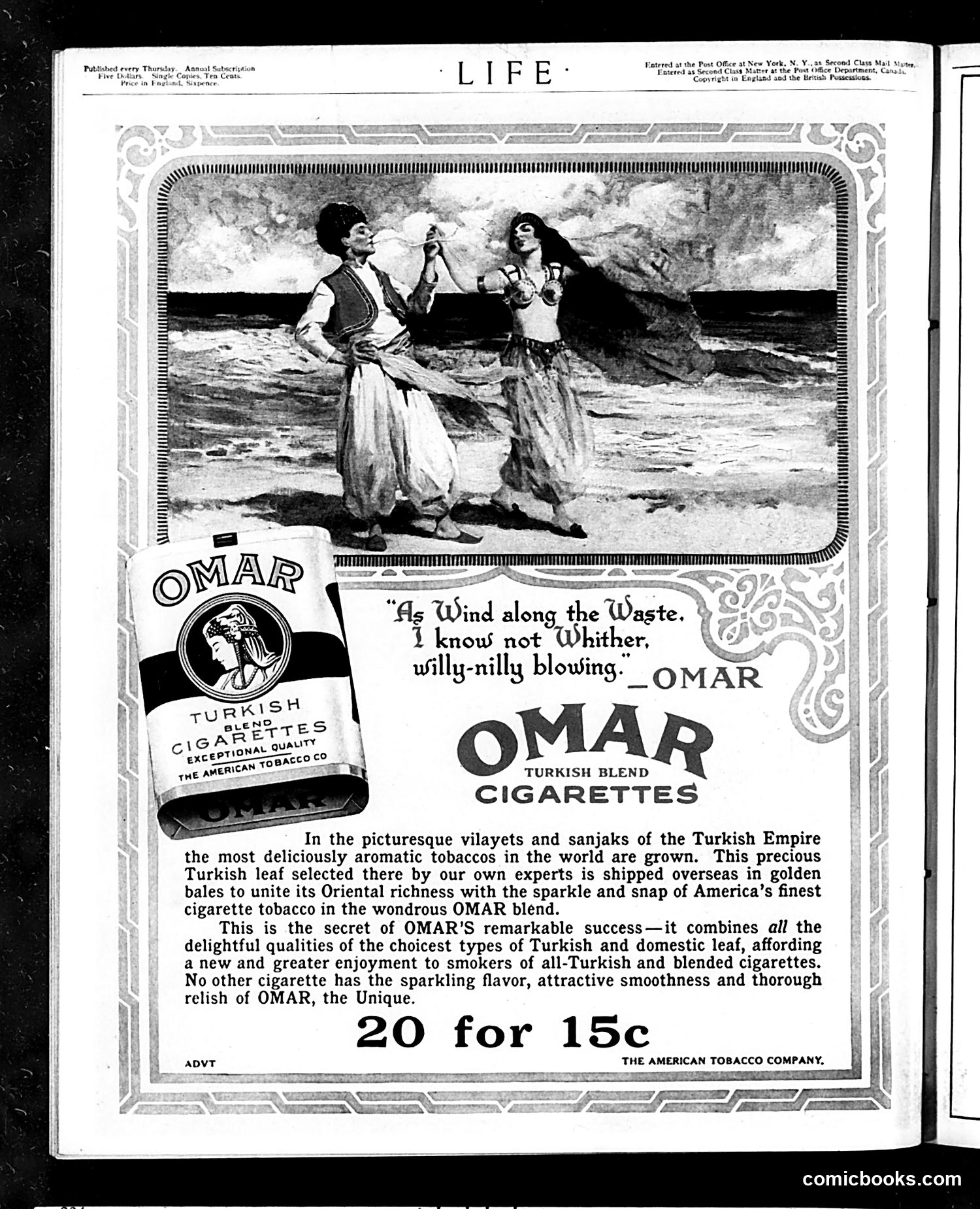
This page is primarily an **advertisement for Omar Turkish Blend Cigarettes**, not political satire. The image depicts two people in exotic costume on a beach, apparently referencing orientalist aesthetics popular in early 20th-century American marketing. The quoted text—"As Wind along the Waste, / I know not Whither, / willy-nilly blowing"—appears to be a literary allusion, possibly from Edward FitzGerald's *Rubaiyat of Omar Khayyam*, lending the product an air of sophistication and romance. The ad emphasizes the product's blend of Turkish tobacco with American cigarette quality, marketed at "20 for 15c." This represents typical early 1900s advertising strategy: exoticizing foreign goods while assuring American consumers of quality control. There is no apparent political commentary or satire on this page.
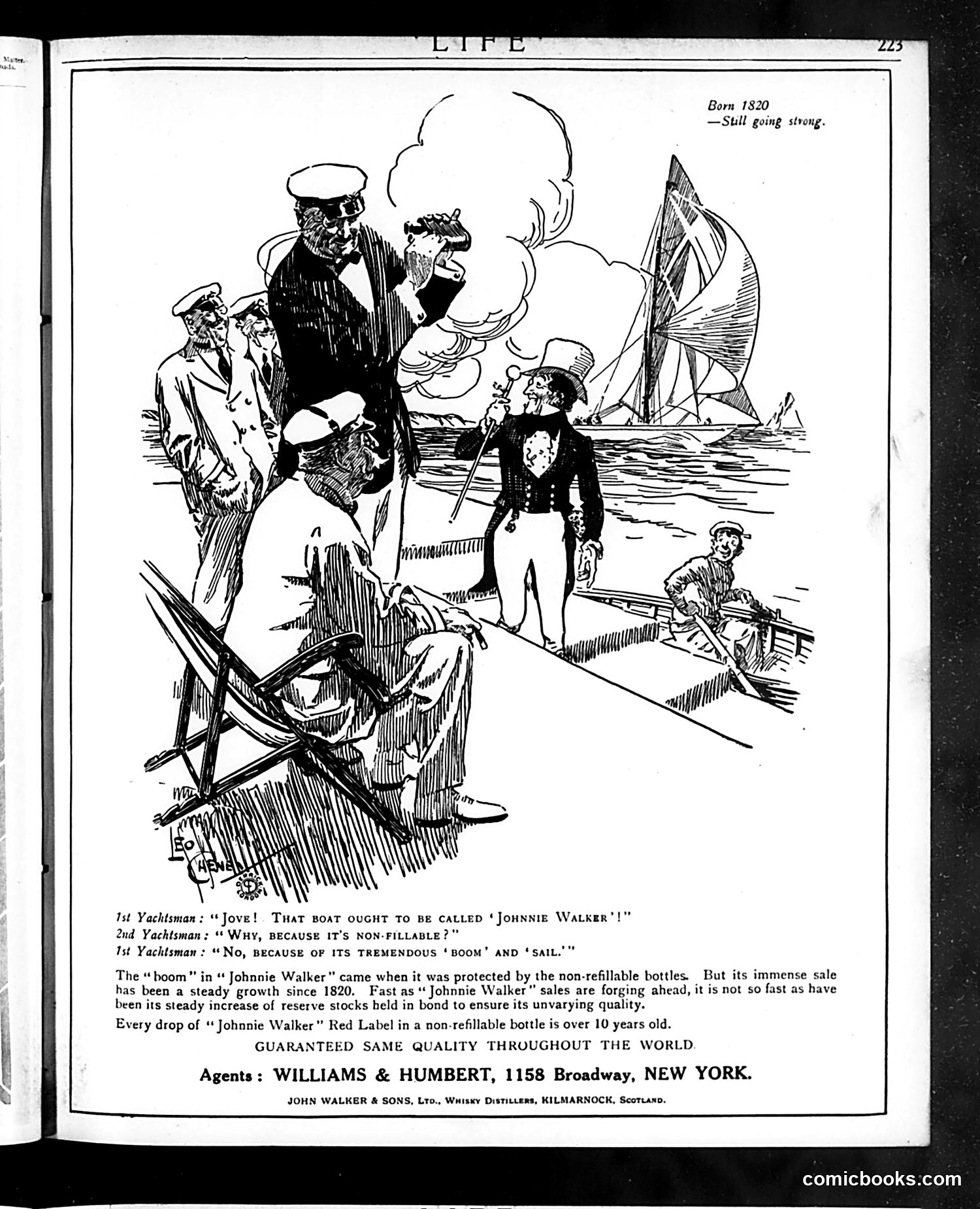
This is primarily a **commercial advertisement**, not political satire, though it uses a humorous nautical scene for marketing purposes. The cartoon depicts yachtsmen discussing a boat they've nicknamed "Johnnie Walker" because, according to the joke, it's "non-fillable" (can't be refilled with water—implying it maintains consistent quality). The second yachtsman misinterprets this as the boat being unsinkable due to its "tremendous boom and sail." The ad emphasizes that Johnnie Walker whisky, first produced in 1820, has maintained steady growth and consistent quality for over a decade. The "Red Label in a non-refillable bottle" guarantees authenticity worldwide. The agents listed are Williams & Humbert in New York, with production by John Walker & Sons in Kilmarnock, Scotland.
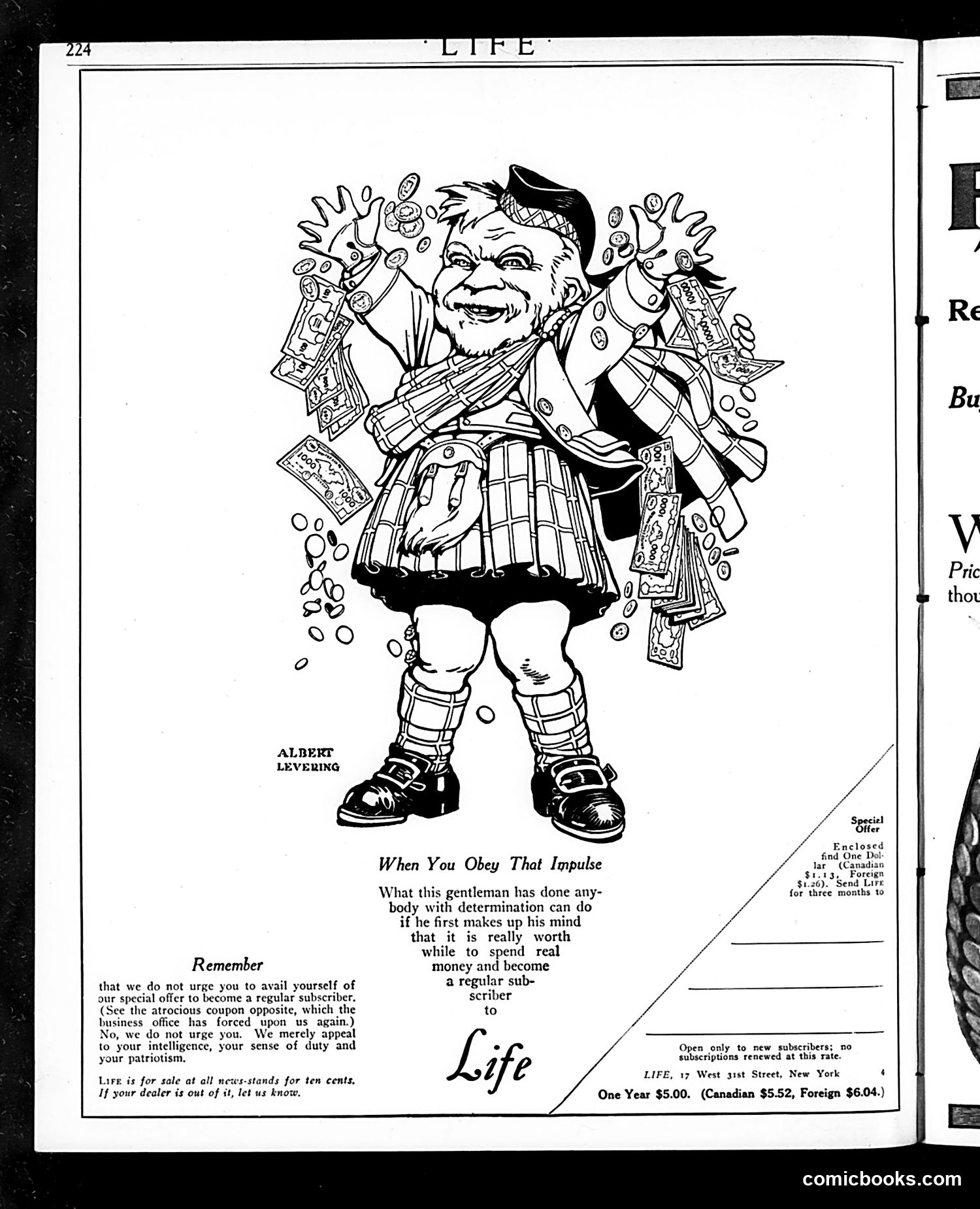
This page features a political cartoon by Albert Levering titled "When You Obey That Impulse." The central caricature depicts a grotesquely drawn figure—appearing to be a wealthy or powerful man—flaunting money and luxury goods with an exaggerated, manic expression. He wears Scottish-style attire (kilt and sporran) and is literally surrounded by cascading currency and material possessions. The accompanying text urges readers to resist impulsive spending on luxuries, appealing to patriotic duty and financial prudence. The cartoon satirizes wealthy individuals who ostentatiously display riches despite economic concerns. The overall message suggests the cartoon critiques conspicuous consumption and material excess as unpatriotic behavior, likely during a period when restraint was considered a civic virtue—possibly WWI or the Great Depression era.

This is primarily a **Fisk Rubber Company advertisement**, not satirical content. It occupies page 225 of Life magazine and promotes Fisk Non-Skid tires. The ad features technical tire illustrations and pricing for various tire sizes (ranging from $12.20 to $33.90). The copy emphasizes quality, low prices, and helpful service at Fisk branches nationwide. The only potentially humorous element is a small mascot image in the lower right—appears to be a fish character (visual pun on "Fisk"), labeled as a trademark, promoting the brand name recognition. This represents typical early-twentieth-century magazine advertising: straightforward product promotion with illustrations, pricing tables, and claims about superior quality and customer service. There is no political satire or social commentary present.
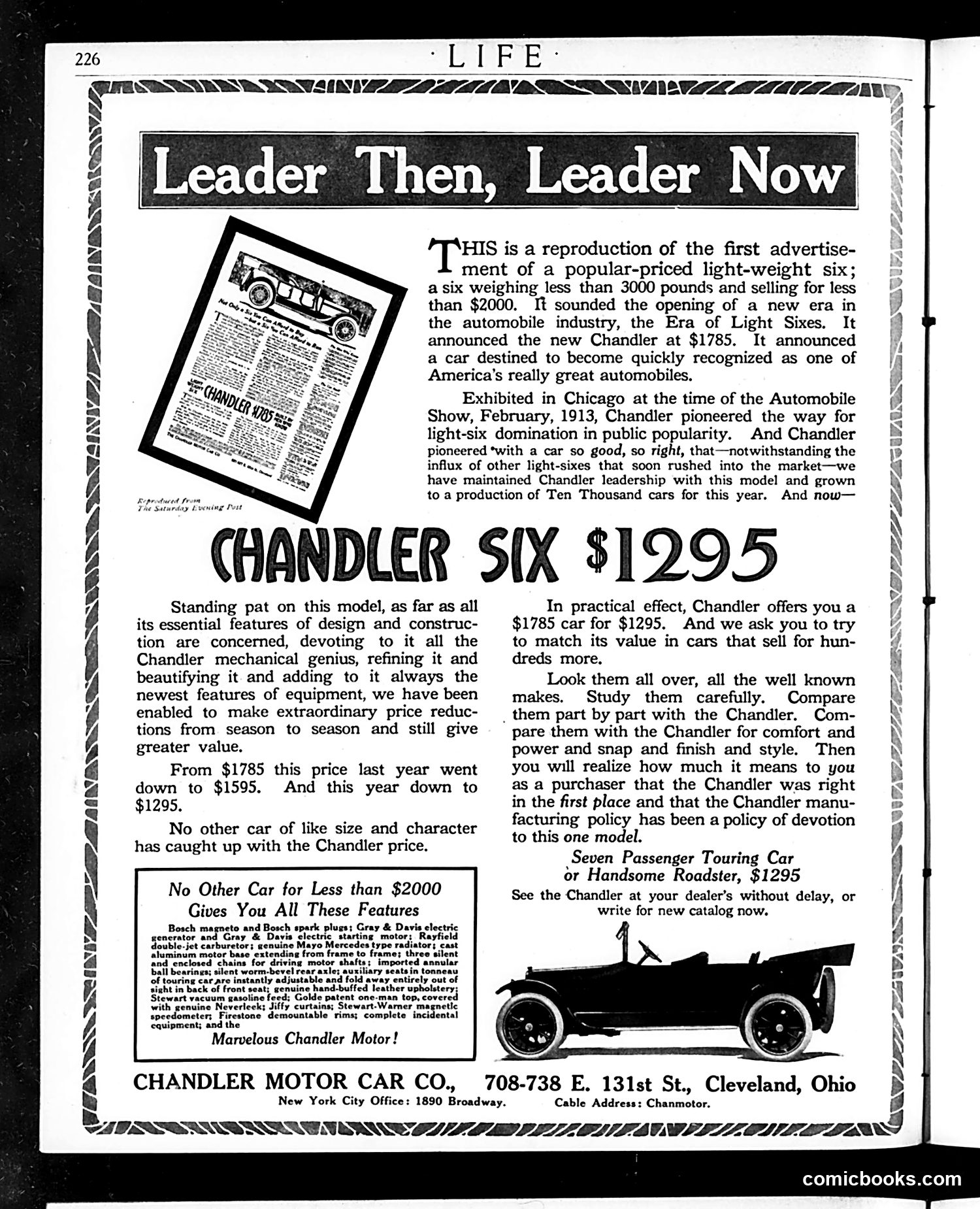
This page is **not a cartoon or satire—it's a straightforward automobile advertisement** from Life magazine (page 226). The ad promotes the Chandler Six automobile, emphasizing its dramatic price reduction from $1,785 (original 1913 price) to $1,295 (current year). The headline "Leader Then, Leader Now" claims the car maintains market dominance despite the lower cost. The ad includes a reproduction of the original 1913 Chandler advertisement (shown tilted in the upper left) and a silhouette of the vehicle. Key selling points emphasize engineering quality, numerous features, and value compared to competitors costing hundreds more. This reflects early automotive industry competition and marketing strategies positioning price cuts as evidence of manufacturing efficiency rather than reduced quality.
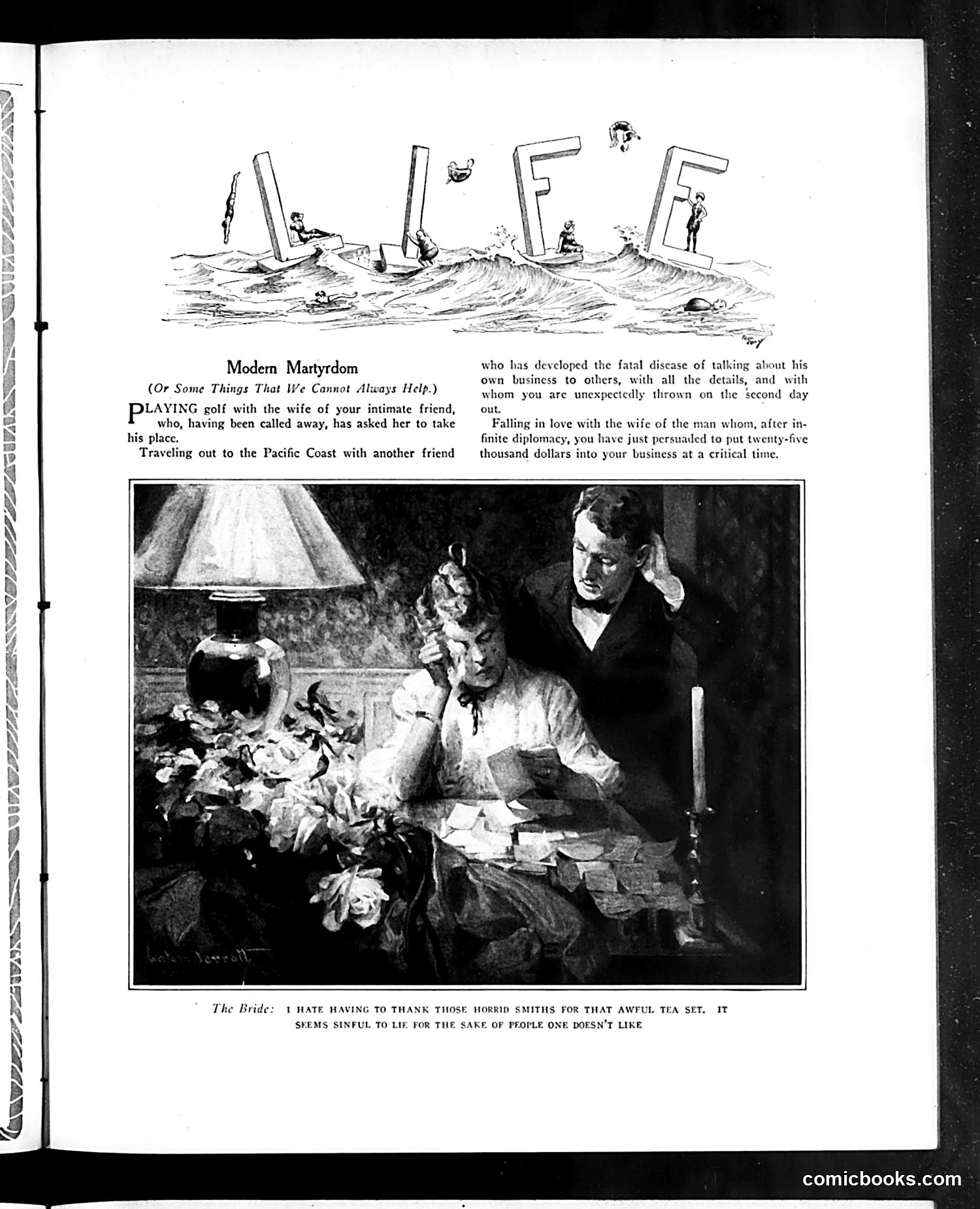
This piece satirizes the social difficulties of helping friends in need. The top cartoon shows the word "LIFE" sinking like a ship, with tiny figures drowning—a visual metaphor for how one's life can be destroyed by helping others. The text describes a specific scenario: your intimate friend asks you to take his place on a Pacific Coast trip. This seemingly simple favor cascades into disasters: you're unexpectedly stuck with his wife for days, you fall in love with her, and you've invested twenty-five thousand dollars into a failing business at a critical moment. The photograph shows a bride receiving a gift (a tea set), with the caption sarcastically noting she must "lie for the sake of people one doesn't like"—suggesting forced gratitude for unwanted gifts is another form of modern social torment.
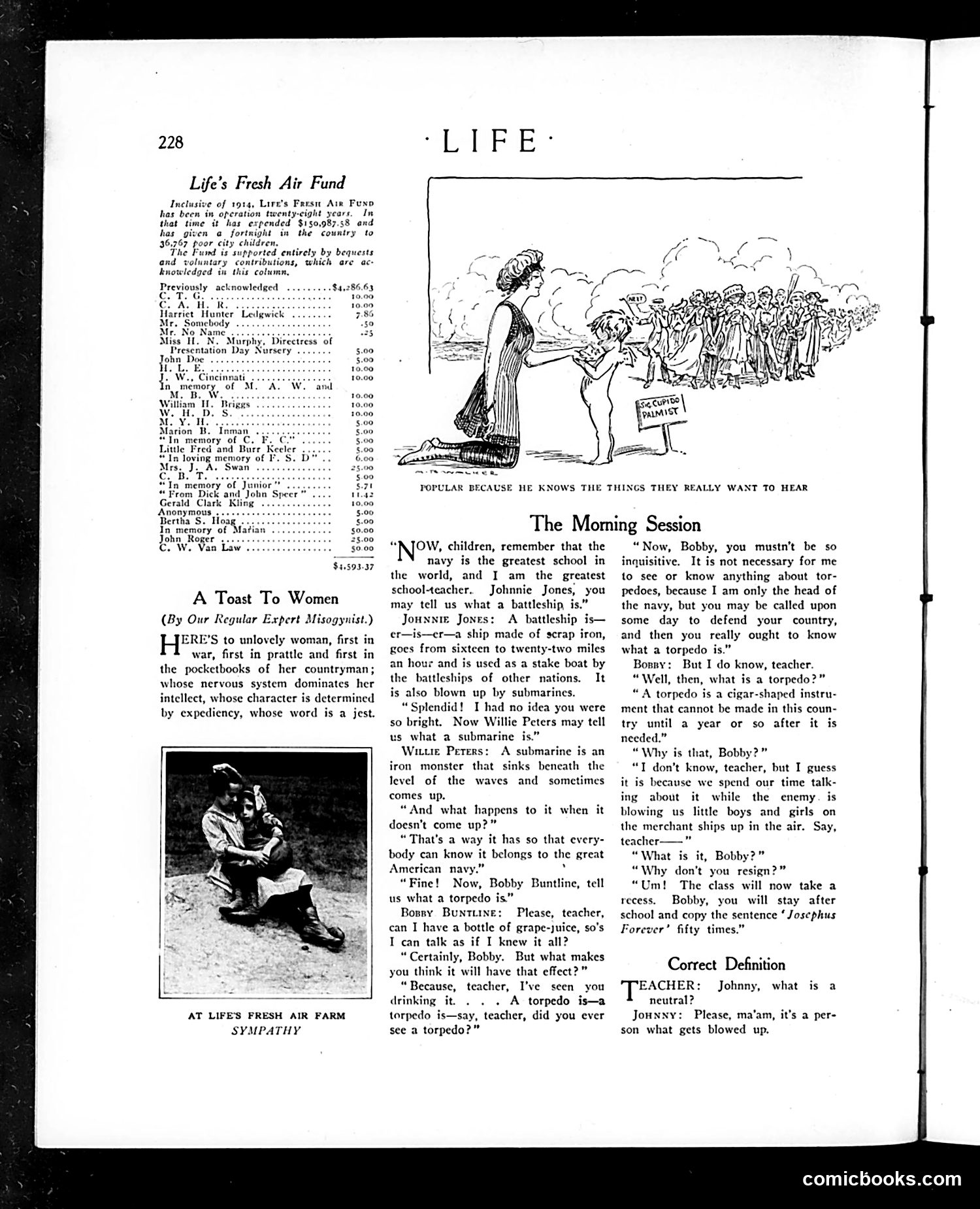
This page contains three distinct sections: a fundraising list for "Life's Fresh Air Fund" (providing poor children countryside vacations), a satirical piece titled "A Toast to Women" with an accompanying photograph, and "The Morning Session"—a humorous dialogue between a teacher and students about naval vessels. The main cartoon depicts a woman addressing children, illustrating the caption "POPULAR BECAUSE HE KNOWS THE THINGS THEY REALLY WANT TO HEAR." The subsequent dialogue satirizes how teachers oversimplify complex military topics (battleships, submarines, torpedoes) for children's understanding, using increasingly absurd student definitions. The final "Correct Definition" joke plays on a child's innocent misinterpretation of "neutral" as "a person what gets blowed up." The humor targets both educational methods and wartime anxieties of the era.
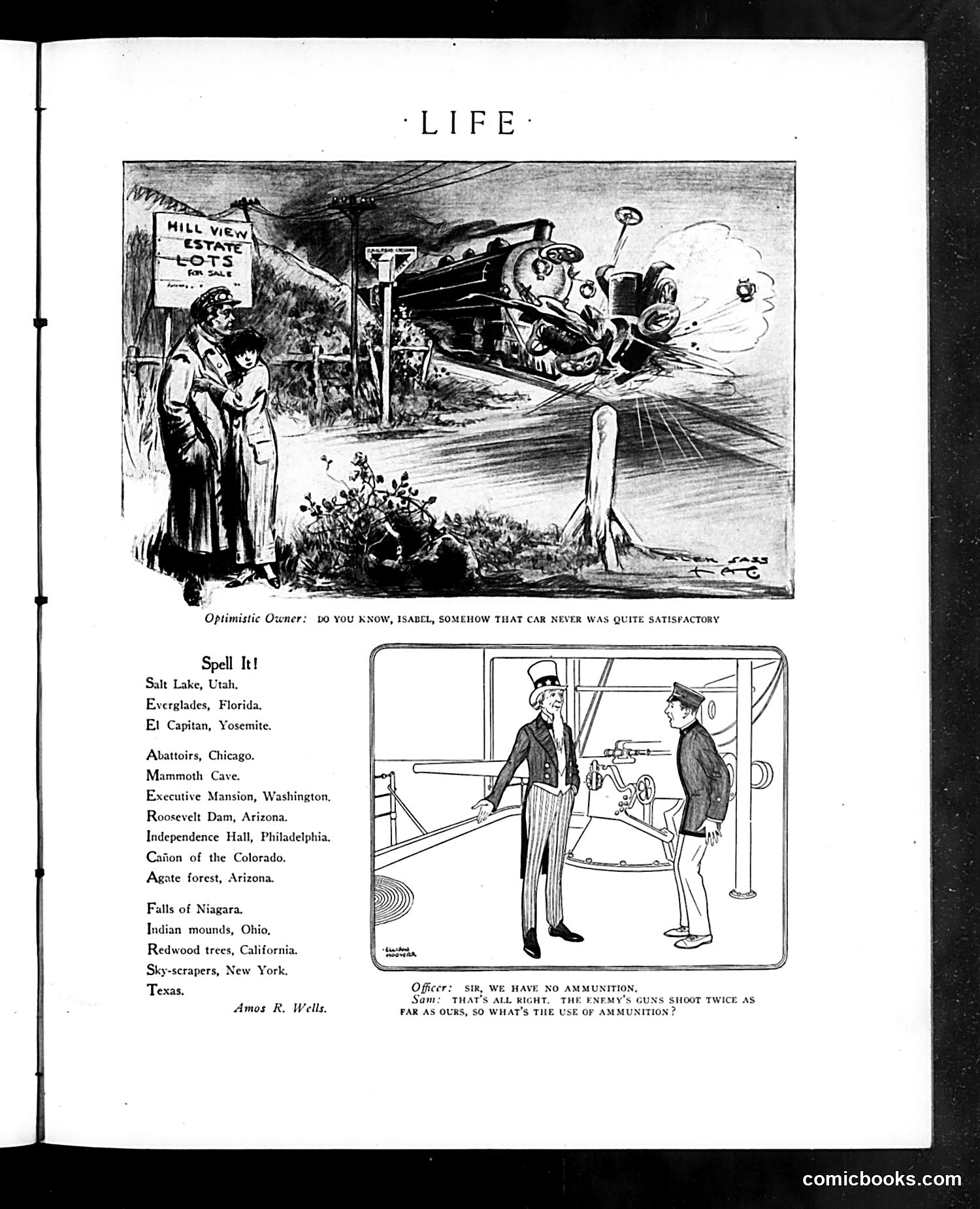
This page contains two satirical cartoons about American development and militarism. **Top cartoon**: Shows a couple viewing a dangerous, malfunctioning early automobile near a "Mill View Lots for Sale" sign. The optimistic realtor insists cars are never satisfactory—dark humor about both automobile unreliability and predatory real estate sales. **Bottom cartoon**: An officer tells a sailor they have no ammunition. The sailor responds that enemy guns shoot twice as far, questioning the logic of fighting without ammunition. This appears to be WWI-era satire criticizing military preparedness or inadequate naval armament. The "Spell It!" section lists American landmarks (Salt Lake, Everglades, Yosemite, etc.), likely a word puzzle or geography game for readers. Attributed to Amos R. Wells.
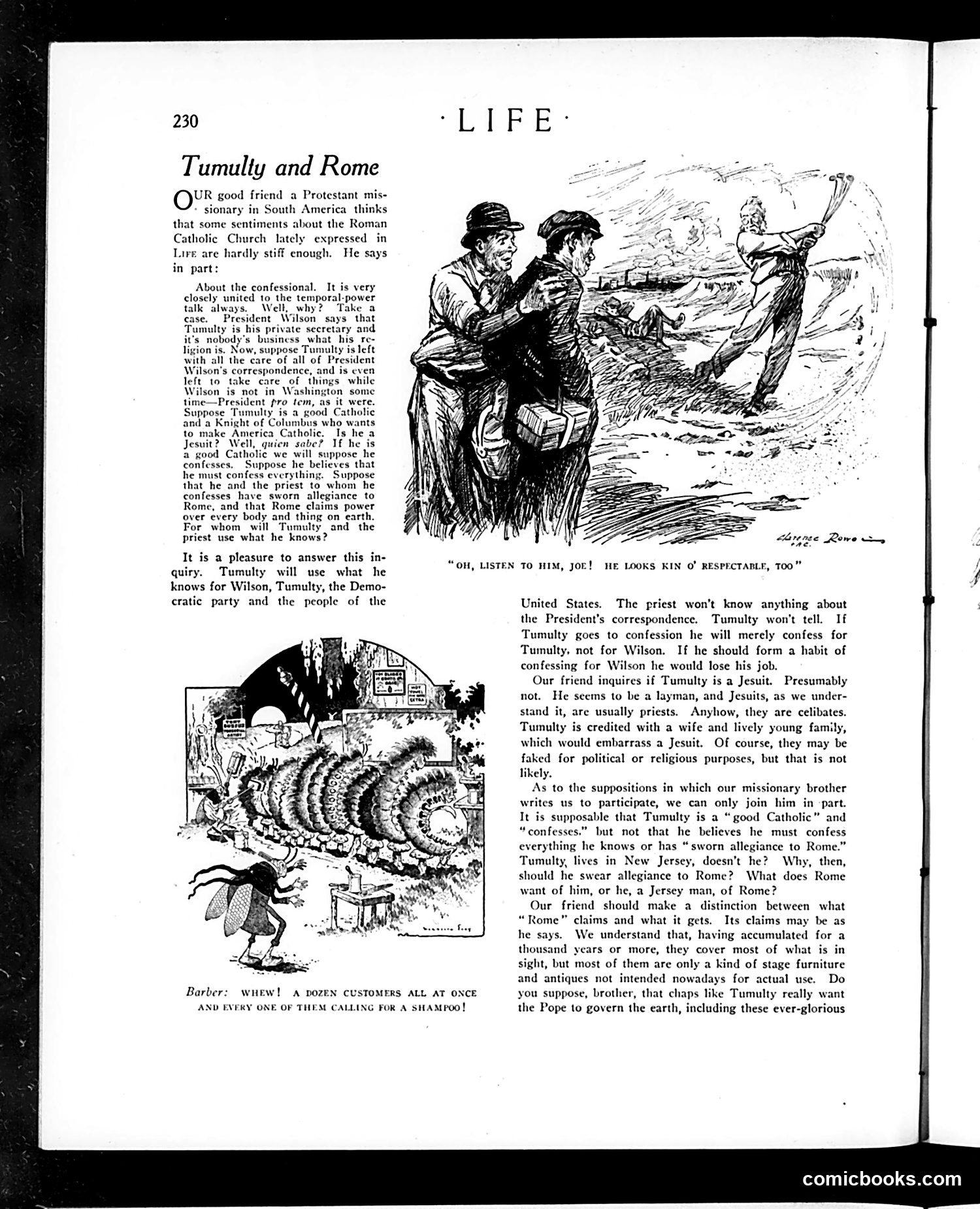
This satirical article discusses whether a Catholic politician, Tumulty, should confess his involvement with President Wilson's correspondence to a priest. The cartoon shows two men in discussion with the caption "Oh, listen to him, Joe! He looks kin' o' respectable, too." The satire targets anti-Catholic prejudice prevalent in early 20th-century America. The article defends Tumulty against suspicions that his Catholic faith means he owes allegiance to Rome rather than the U.S. government. It mocks the notion that Catholics cannot be trusted with political power. A second illustration depicts a barber overwhelmed with customers demanding haircuts, captioning the absurdity with humor. The piece argues that Tumulty's religious beliefs are personal and don't determine his political loyalty—addressing common nativist concerns about Catholic Americans' patriotism.
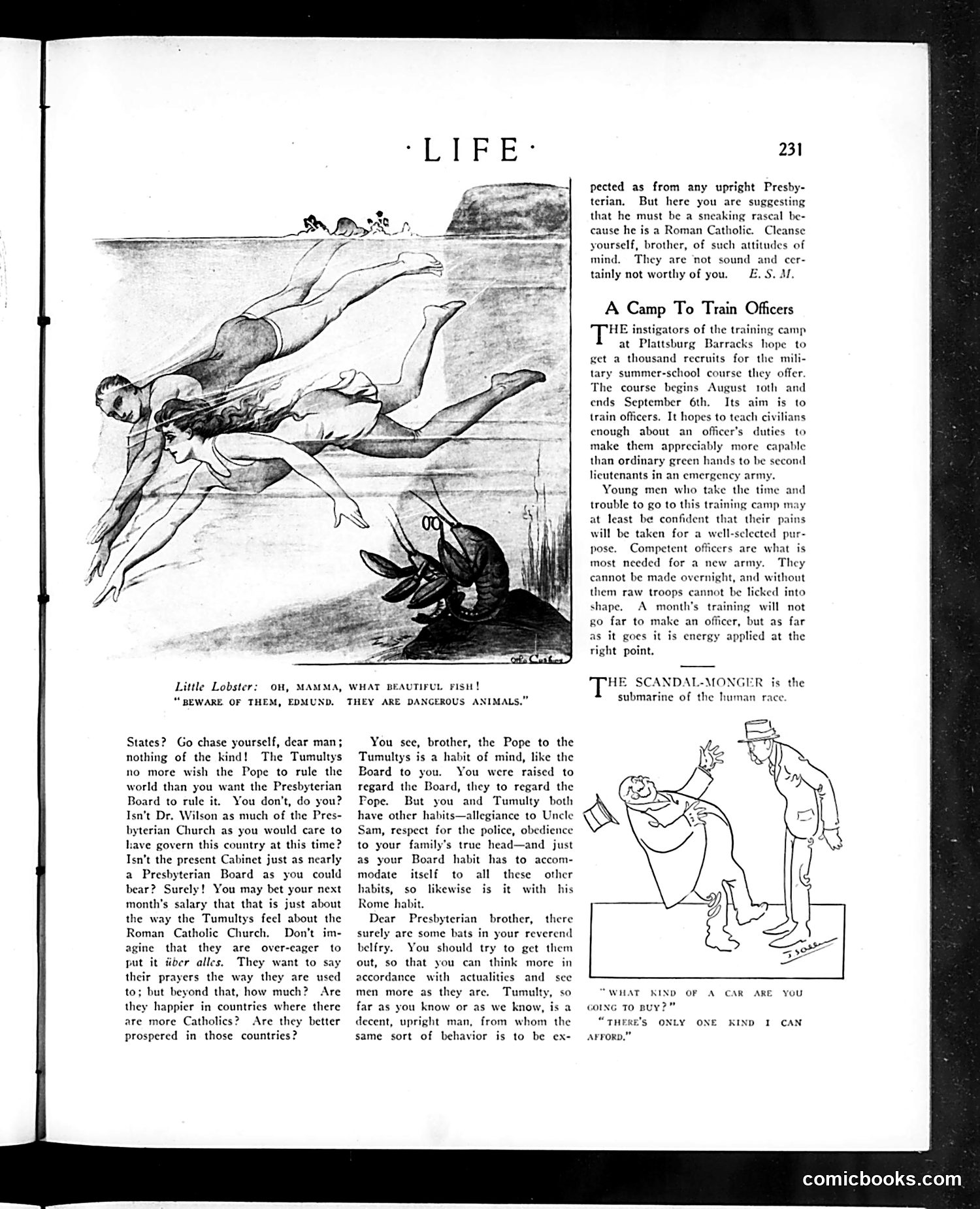
The top illustration depicts two figures swimming underwater, captioned "Little Lobster: Oh, Mamma, what beautiful fish! 'Beware of them, Edmund. They are dangerous animals.'" This appears to be a satirical cartoon about religious prejudice, using sea creatures as metaphor. The accompanying text criticizes someone named "Tummulty" (likely Joseph Tummulty, Woodrow Wilson's secretary) for allegedly promoting Catholic interests while serving in a Presbyterian-dominated government. The satire suggests Tummulty's loyalty to Rome conflicts with his American duties. The bottom cartoon shows two figures negotiating over a car purchase—straightforward commercial humor with no apparent political content. The page primarily addresses anti-Catholic prejudice in American politics circa WWI era.
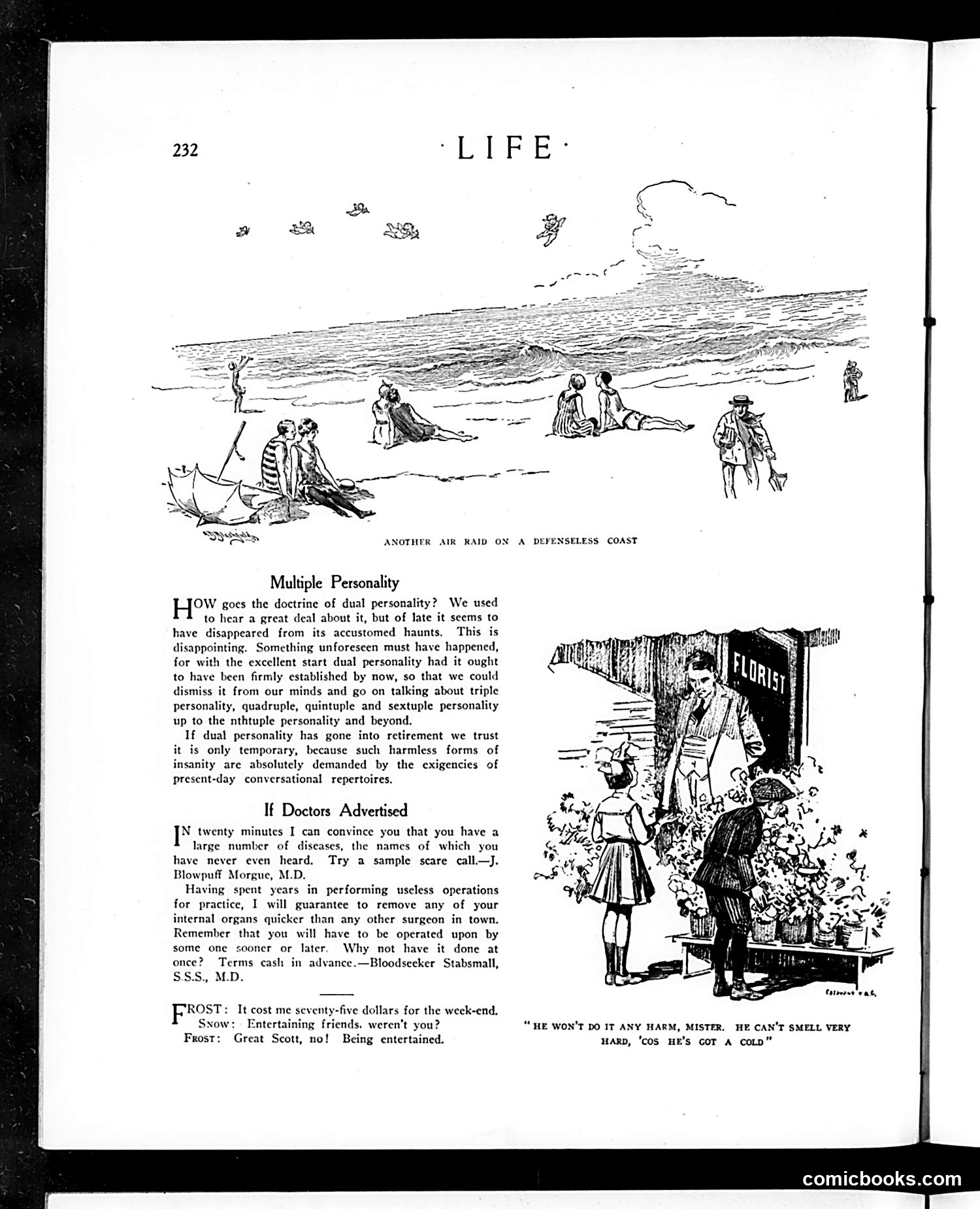
This page contains three separate satirical pieces: 1. **"Another Air Raid on a Defenseless Coast"** (top illustration): A dark wartime sketch showing civilians on a beach during what appears to be a bombing raid, with people scattered and seeking shelter. The title's emphasis on "defenseless" suggests critique of military vulnerability or civilian exposure. 2. **"Multiple Personality"** (middle essay): Mocks the psychological trend of discussing "dual personality" disorders, suggesting the concept has become overused and diluted into absurdity (now extended to "quintuple" and "sextuple" personalities). 3. **"If Doctors Advertised"** (right): A humorous piece imagining doctors competing like commercial vendors, with exaggerated claims about surgical skills and cost-cutting. The florist shop cartoon below illustrates the absurdity through juxtaposition. The page satirizes wartime anxieties, psychological fads, and medical ethics.
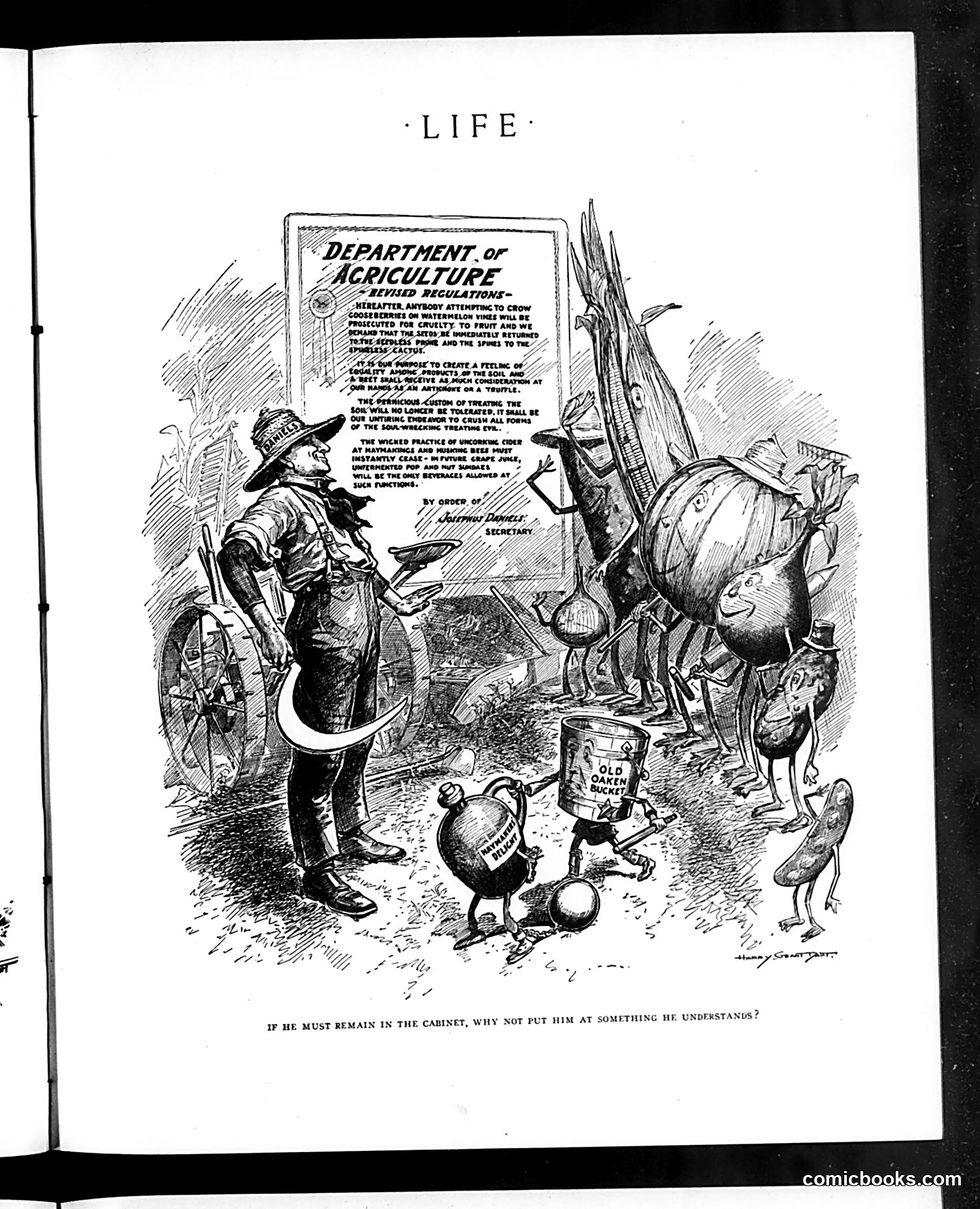
This cartoon satirizes a Secretary of Agriculture (identified by the document he holds) who implements strict farming regulations while remaining ignorant of agricultural realities. The "Department of Agriculture Revised Regulations" poster lists bureaucratic restrictions on farming practices. The Secretary, dressed formally in town clothes, is shown giving orders to confused farm animals and implements—depicted as bewildered, anthropomorphic creatures including what appears to be farm equipment personified as characters holding items labeled "Old Oath Bucket" and other farming tools. The caption's ironic question—"If he must remain in the cabinet, why not put him at something he understands?"—mocks his incompetence. The cartoon criticizes a disconnect between Washington bureaucrats and practical farming knowledge, a common complaint during agricultural regulation debates of the early 20th century.
This is a short story submission for Life's contest, not a political cartoon. The narrative satirizes newspaper journalism culture in New York City, specifically mocking the ego and self-importance of editors and reporters. The plot concerns Johnson, an ambitious but struggling reporter who attempts to gain access to a newspaper owner to pitch a story idea. Instead of meeting the owner, Johnson encounters various office staff and bureaucratic obstacles—ultimately being dismissed by the city editor as insignificant. The satire targets the hierarchical, dismissive nature of big-city newspaper offices and the inflated egos of those controlling editorial decisions. It's social commentary on workplace power dynamics and journalistic pretension rather than political satire.
This page contains a short story titled "Approximating the Ultimate With Aunt Sarah" by Charles Earl Gaymon. The narrative follows a newspaper office during a busy day when Johnson, a new reporter, successfully writes and files a story before deadline—an accomplishment celebrated by his editor and colleagues as exceptional newspaper work. The story is satirical about journalism standards: it mocks the "ultimate" achievement of simply getting a story written and published on time, suggesting that competence itself is remarkable in the newspaper business. The piece gently ridicules both the industry's low expectations and the characters' inflated sense of accomplishment over routine professional tasks. There are no political cartoons visible on this page—it's primarily text-based satirical fiction about newspaper culture.
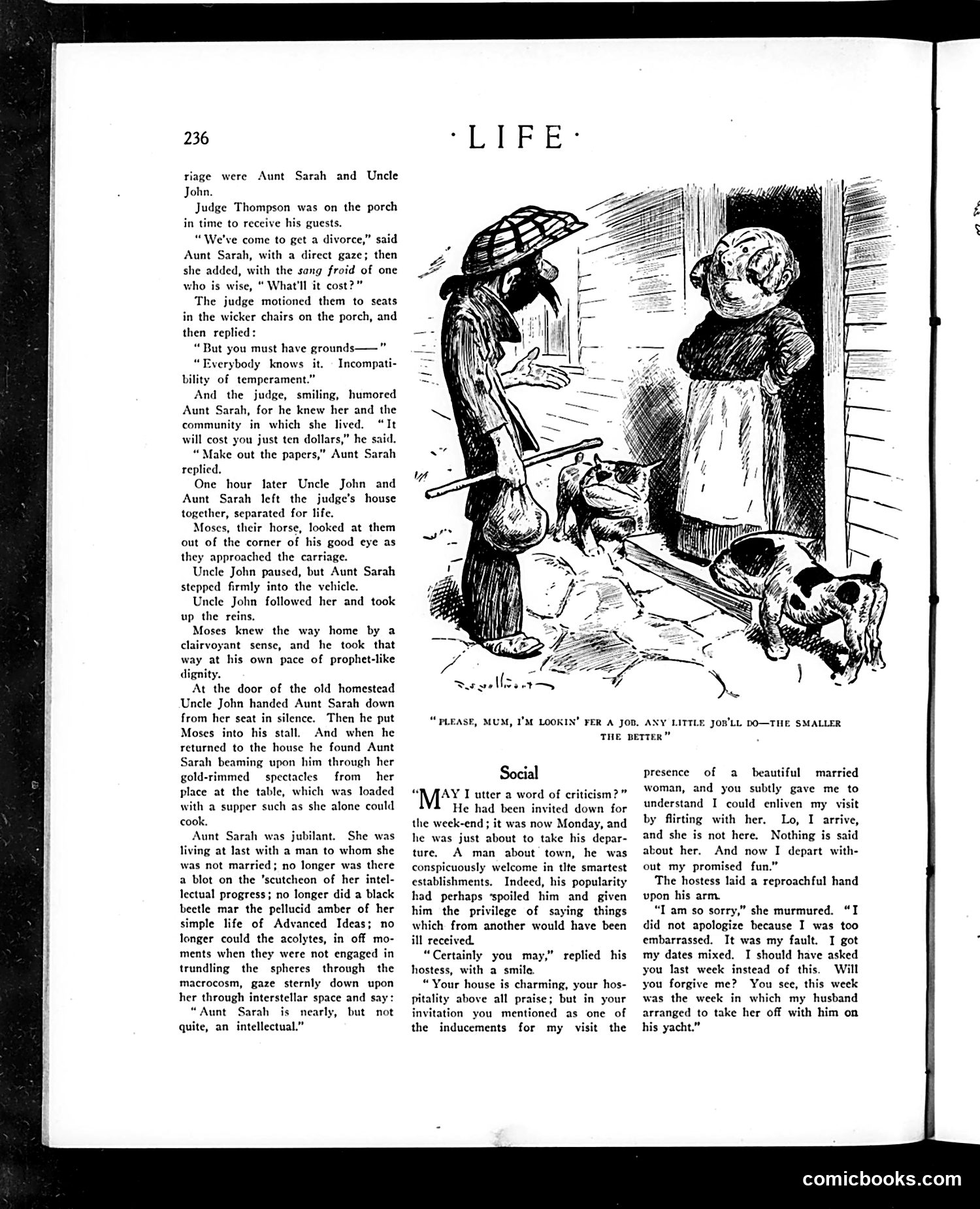
This page contains two separate satirical narratives mocking early-20th-century social pretensions. **Top story**: "Aunt Sarah" seeks a divorce on flimsy grounds (incompatibility of temperament) for just ten dollars. The joke is that she's so intellectually ambitious—worried about being "nearly, but not quite, an intellectual"—that she divorces her husband simply to escape social judgment about unmarried cohabitation. The irony: she immediately remarries him, achieving nothing but the appearance of progressiveness. The illustration shows her arrival at the judge's house with Uncle John and their horse Moses. **Bottom story ("Social")**: A sophisticated houseguest complains that his hostess invited him specifically to flirt with a beautiful married woman as entertainment, but that woman is absent. The hostess awkwardly admits she mixed up her dates—the woman is actually off on a yacht *with the hostess's own husband*. Both stories satirize upper-class hypocrisy and the gap between claimed values and actual behavior.
This page critiques American literary pretensions through satirical commentary on English writer James Stephens's dismissal of American letters. Stephens argues Americans lack the critical intelligence and social order necessary for "real" literature, writing only for "old women"—an insulting proxy for lowbrow audiences. Life's response is gently mocking: the magazine agrees America hasn't yet produced great literature but suggests that with time and virtue, it might. The satire targets both Stephens's snobbery and American cultural anxiety about European superiority. The accompanying cartoons are humorous vignettes (buffalo on prairie; fishing scene; newborn's first cry) illustrating ordinary life—implying everyday American experience contains more vitality and humor than pretentious European "literary" societies like Germany, England, and Turkey that Stephens praises. The overall point: America's youthful vigor may eventually produce genuine literature superior to ossified Old World establishments.
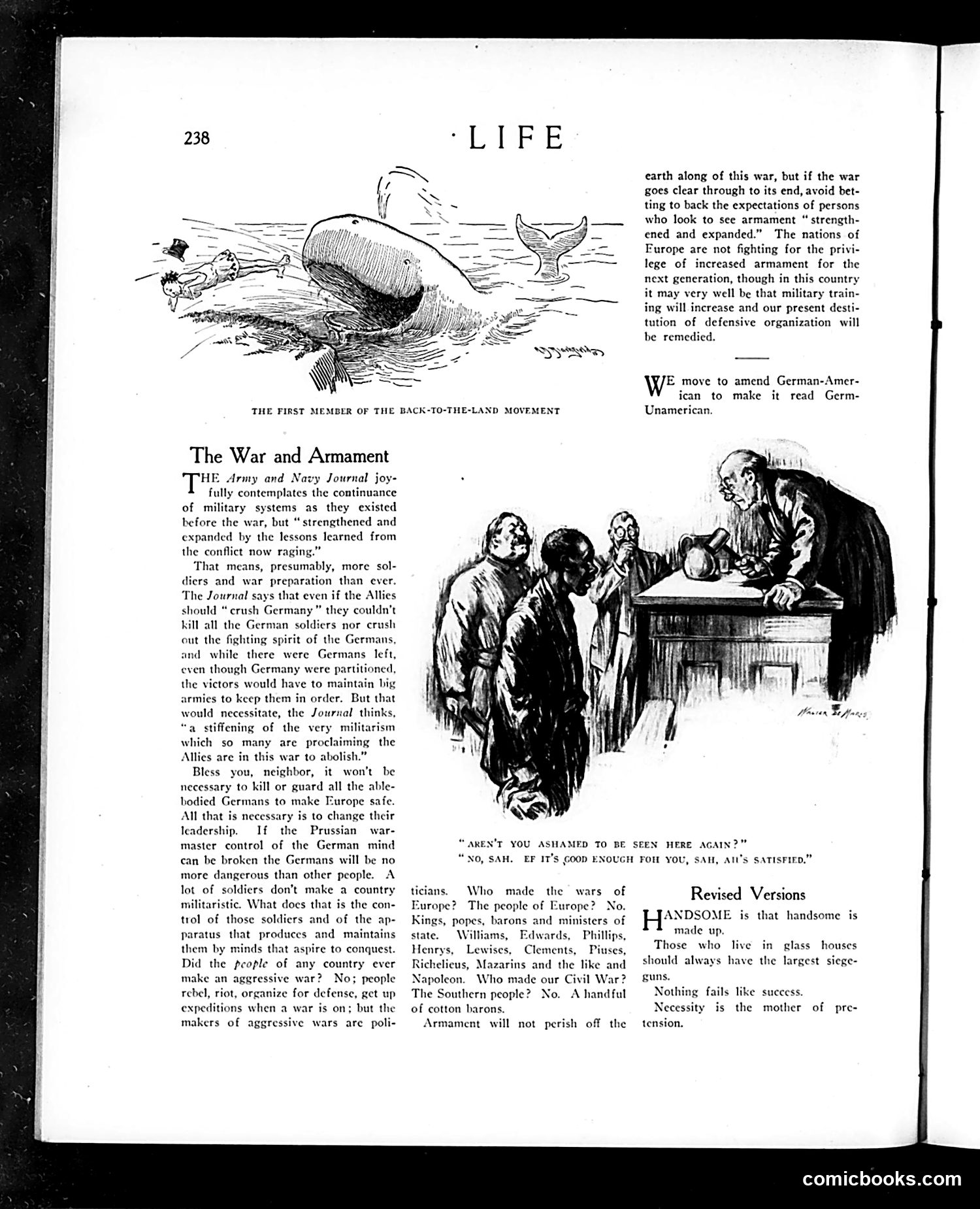
**Top Cartoon:** "The First Member of the Back-to-the-Land Movement" depicts a dead whale washing ashore—satirizing the post-WWI "back-to-the-land" agricultural movement as futile or absurd. **Main Article:** Life criticizes the *Army and Navy Journal's* argument that winning WWI requires permanent militarism and large standing armies to control Germans. The magazine rebuts this by arguing wars result from leaders' ambitions, not peoples' desires—citing historical examples (Napoleon, kings, "cotton barons" causing the Civil War) to show ordinary citizens don't make aggressive wars. **Bottom Cartoon:** Shows an official at a desk dismissing someone's concerns about "German-American" citizens, proposing it be renamed "Germ-Unamerican"—reflecting anti-German sentiment and xenophobia during/after WWI, mocking both German-Americans and patriotic zealotry. **"Revised Versions" section:** Satirical aphorisms mocking militarism, hypocrisy, and pretension—likely targeting post-war attitudes. The page overall argues against permanent war preparation while acknowledging contemporary anti-German prejudice.
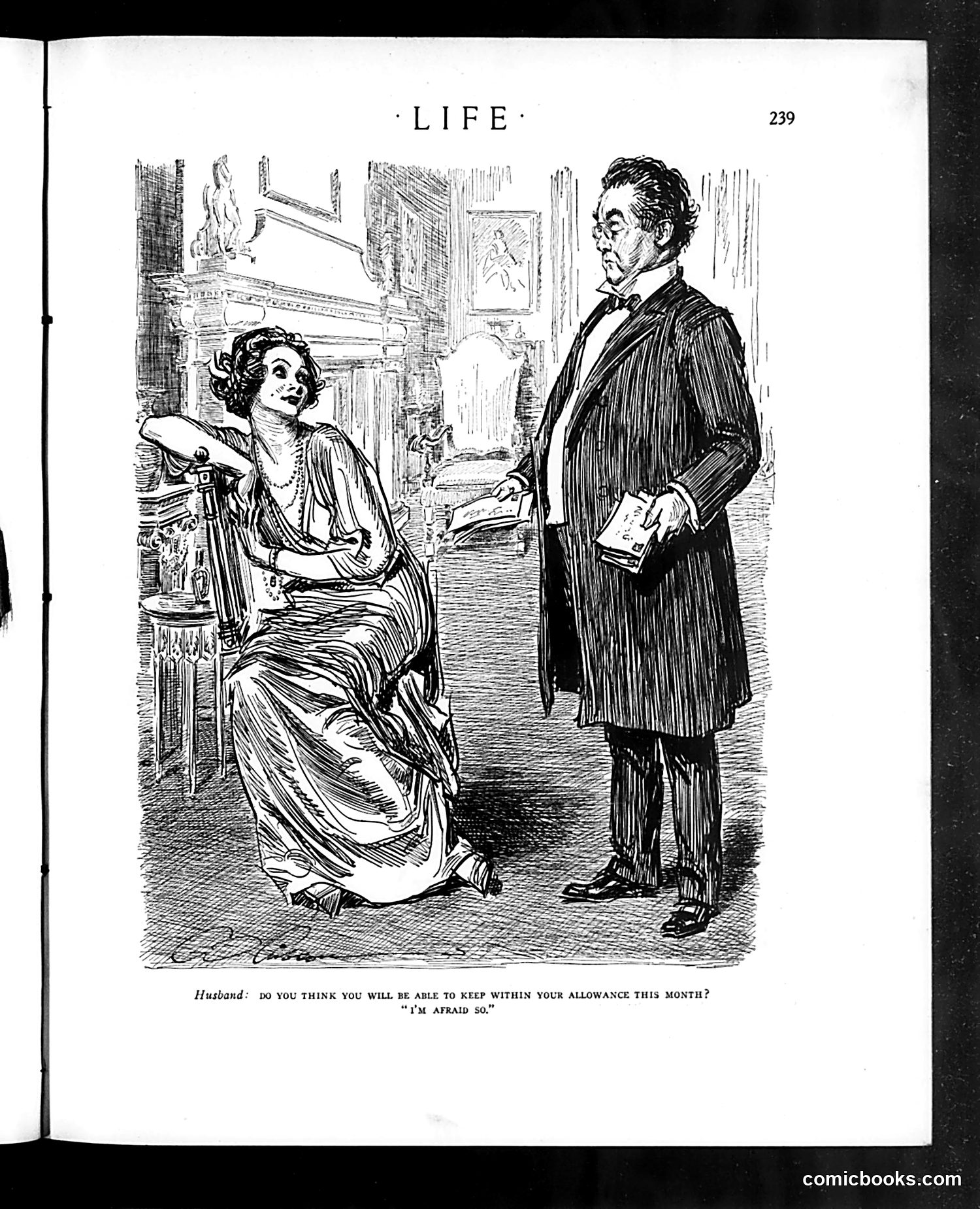
This single-panel cartoon satirizes domestic financial dynamics of the early 20th century. A husband holds papers (likely bills or accounts) while questioning his wife about staying within her monthly allowance. Her reply—"I'm afraid so"—delivers the joke: she's worried she *will* manage to live within budget, implying the allowance is so meager that restriction feels depressing rather than challenging. The satire targets the era's practice of husbands controlling household finances by giving wives limited monthly budgets. The woman's anxious expression and the husband's austere appearance reinforce the tension. The joke inverts expectations—instead of wives being concerned about overspending, she dreads the constraint itself, highlighting how inadequate her financial allocation apparently is.
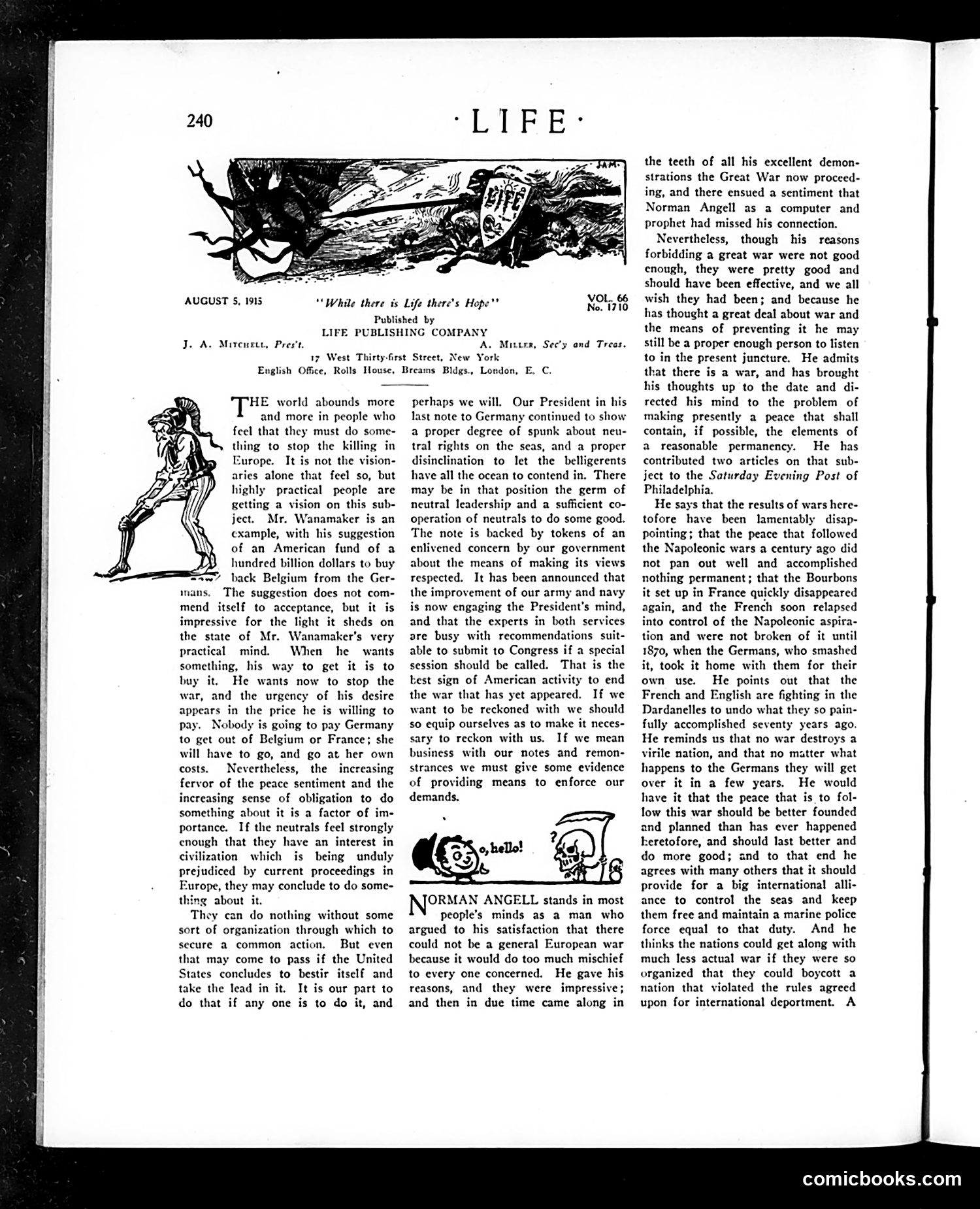
This page discusses efforts to stop World War I, which is then ongoing in Europe. The text critiques businessman John Wanamaker's impractical suggestion to spend a hundred billion dollars to buy Belgium back from Germany—mocking the idea that war can be resolved through money rather than military force. The article argues that if America wants influence in peace negotiations, it must strengthen its military and demonstrate resolve through action, not just diplomatic notes. The page also reassesses Norman Angell, a peace theorist whose pre-war arguments against a general European war proved wrong when WWI erupted. The writer acknowledges Angell's reasoning was "pretty good" but ultimately ineffective, yet suggests his continued thinking on preventing war remains valuable despite his failed prediction. The cartoons (visible but unclear in detail) appear to satirize these peace-related discussions.
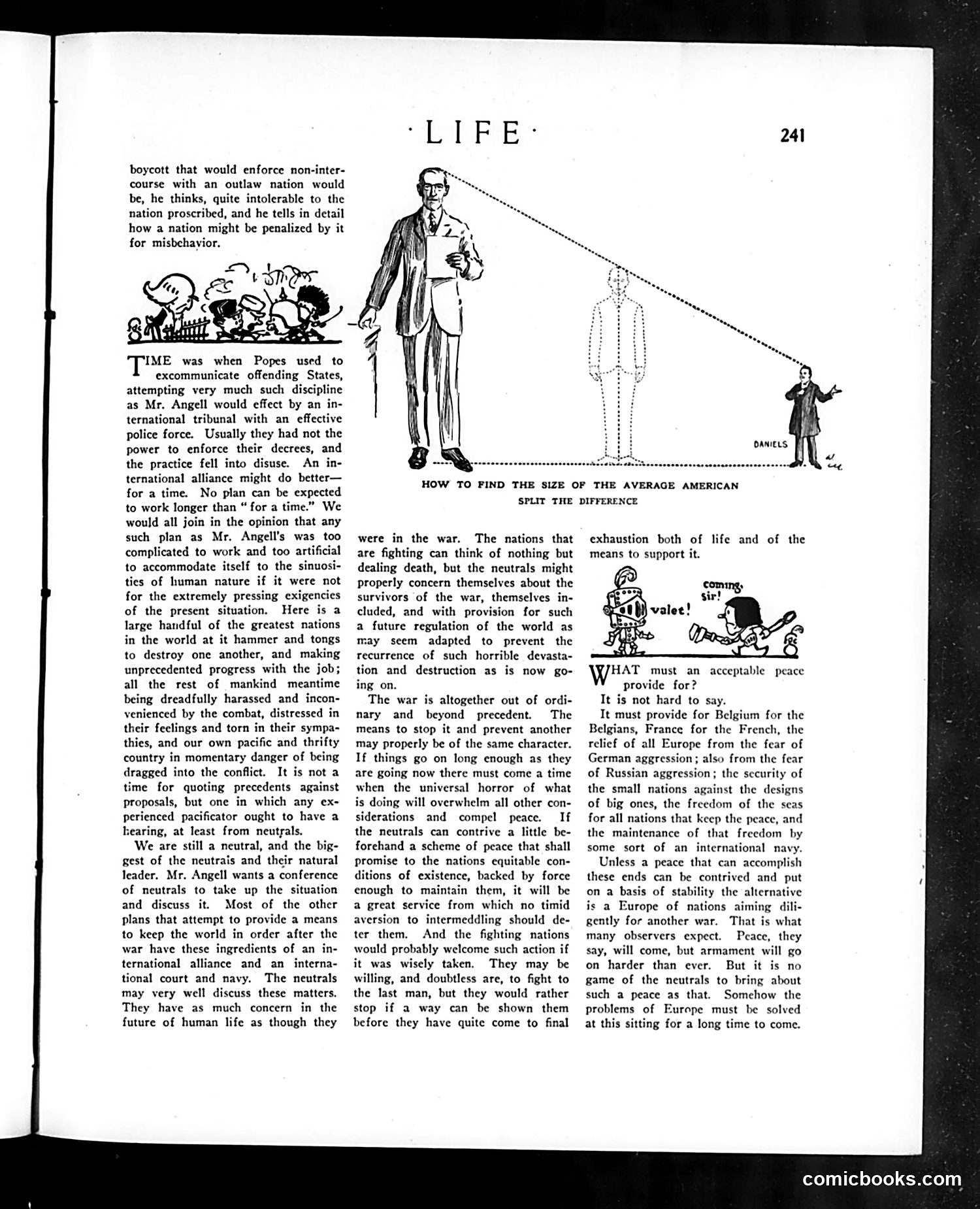
This page from *Life* magazine addresses post-World War I peace proposals, likely from around 1916-1917 when the U.S. remained neutral. **Main Cartoon:** "How to Find the Size of the Average American" depicts a tall man and tiny figure with a dotted line between them, labeled "split the difference." This ridicules American neutrality—the U.S. claimed impartiality while actually leaning toward the Allies, so the "average American" position fell comically between genuine neutrality and active involvement. **Text Content:** The article discusses Norman Angell's proposal for an international tribunal with enforcement power to maintain post-war peace. The author compares this to papal excommunications—theoretically powerful but historically ineffective without enforcement capability. **Political Context:** The piece advocates for American neutrals to conference on peace terms before total exhaustion forces settlement. It argues neutrals have legitimate interest in preventing future wars, implying the U.S. should proactively shape peace rather than remain passively neutral. The satire critiques the logical impossibility of true American neutrality during this global conflict.
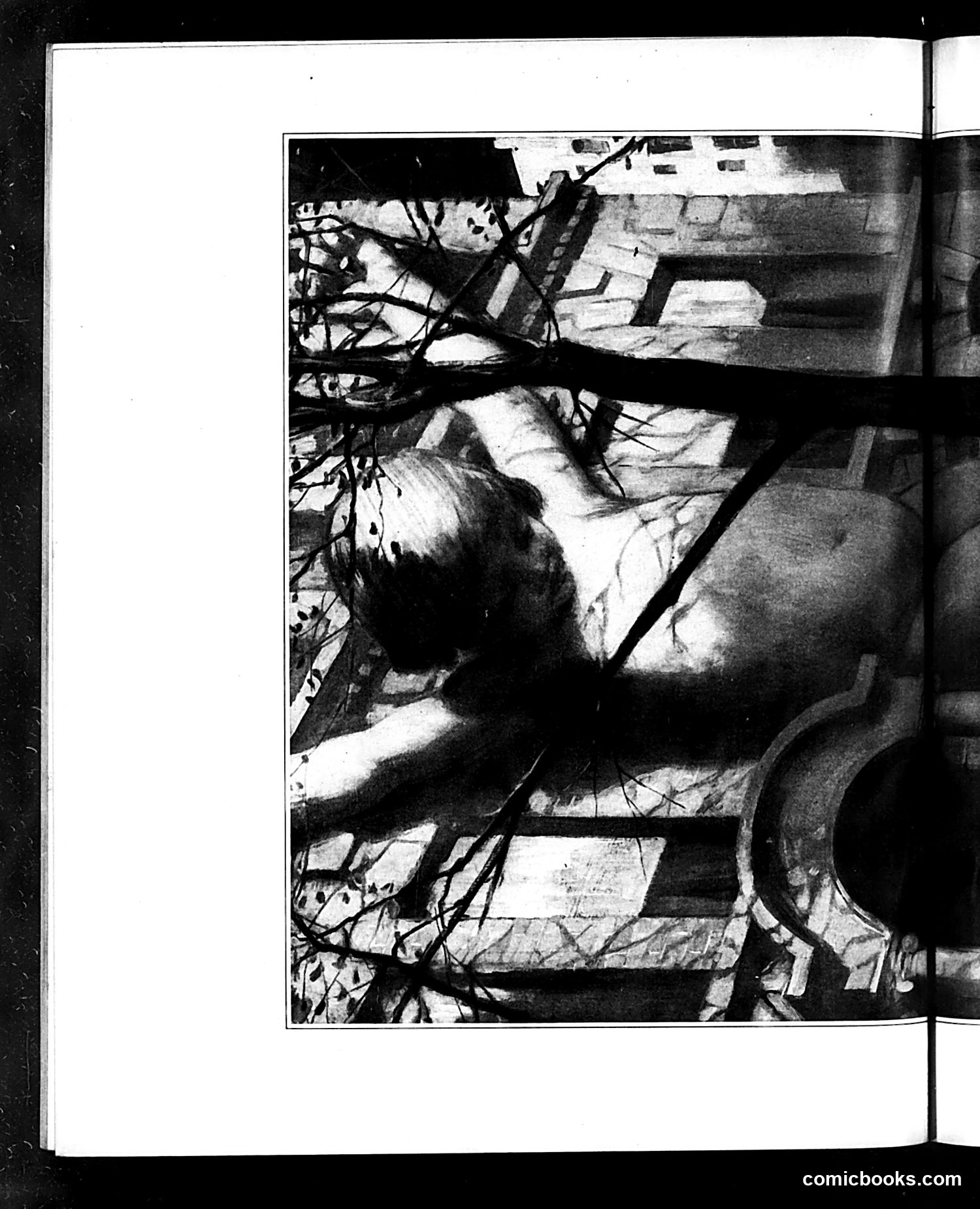
I can see this is a black and white photograph printed in what appears to be a magazine or book, but the image is rotated and quite dark, making it difficult to read specific details clearly. The photo shows what appears to be people in an interior setting with various objects around them, but without legible text on the page itself or clearer visibility of the subjects, I cannot reliably identify the specific figures, political references, or satirical point being made. The watermark "comicbooks.com" suggests this may be from a comics or satirical publication archive, but I cannot accurately explain the cartoon's meaning without being able to clearly see the identifying details or accompanying text. I'd need a clearer, properly oriented image to provide the accurate historical context you're requesting.
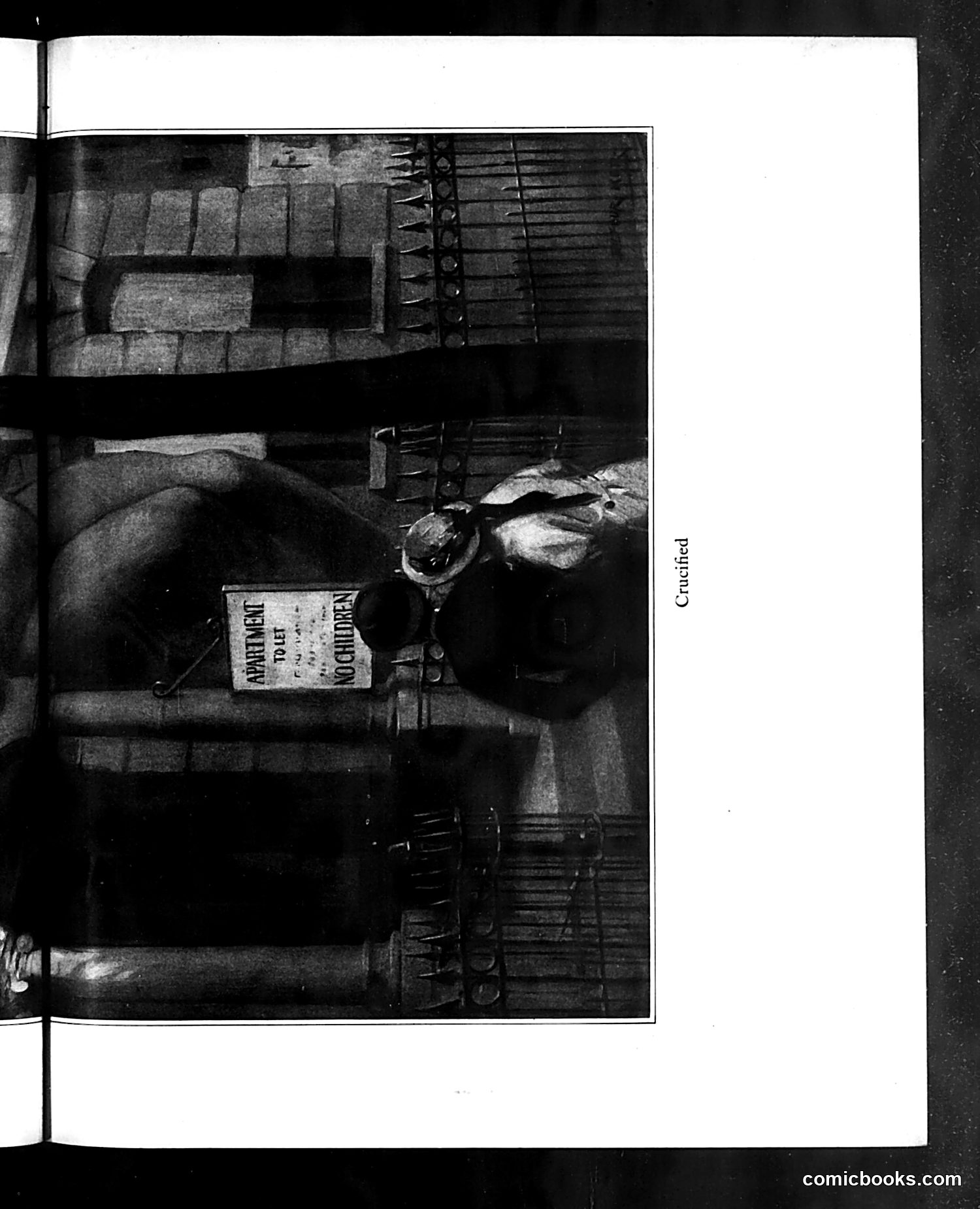
This appears to be a political cartoon critiquing treatment or conditions of a named subject (label visible reading "AMENDMENT TO LET" or similar). The image shows a figure in a crucifixion pose, bound to what resembles industrial or mechanical apparatus with various mechanical elements and gears surrounding it. The cartoon uses Christian crucifixion imagery as satire—comparing the subject's suffering or mistreatment to martyrdom. This was a common rhetorical device in early-to-mid 20th century American satirical magazines to suggest something or someone was being unfairly victimized or destroyed by policy. Without clearer text visibility, the specific legislative or political target remains unclear, but the composition suggests Life magazine was condemning some contemporary law, amendment, or treatment as cruel or destructive.
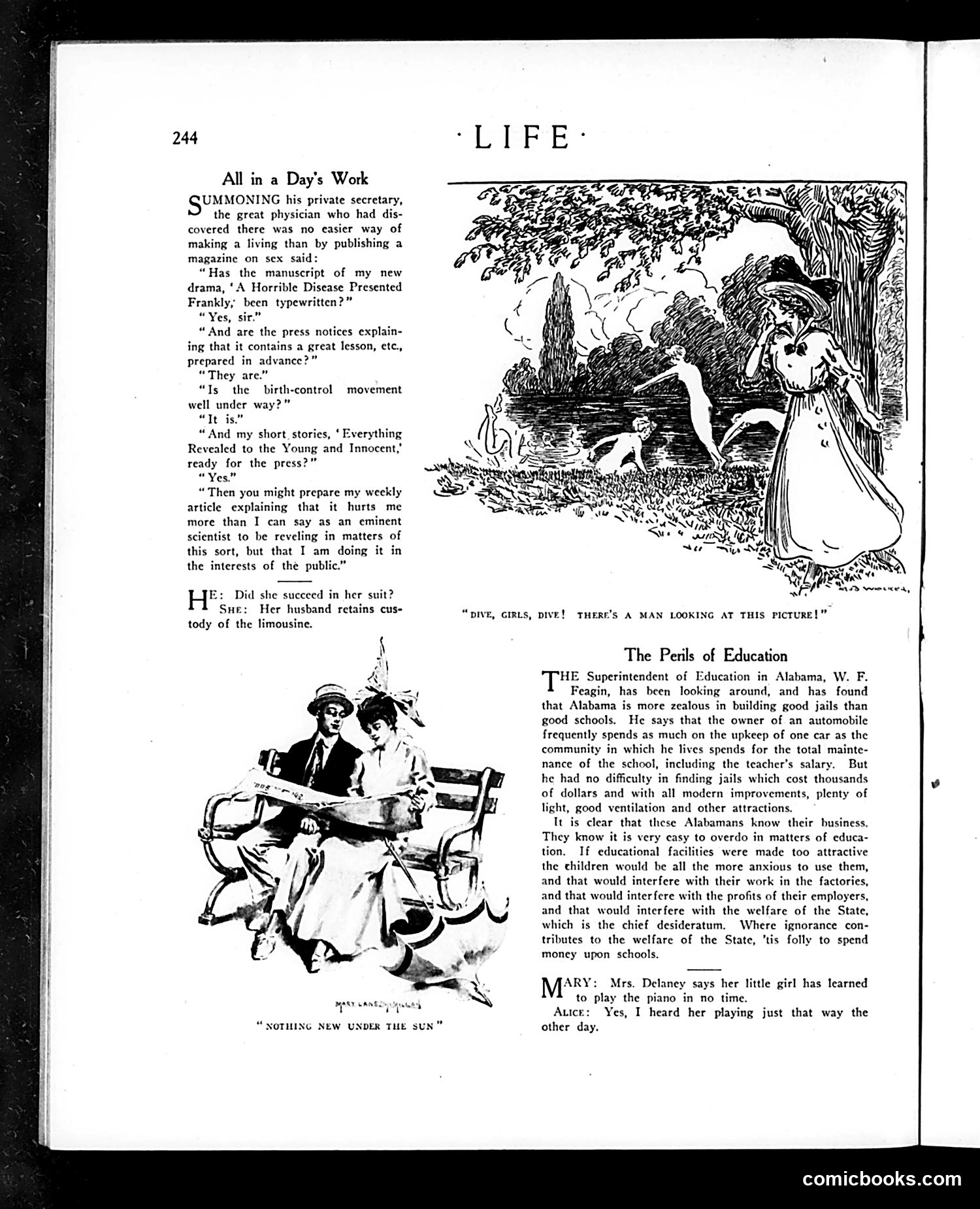
**"All in a Day's Work"**: This cartoon satirizes a hypocritical physician-publisher who profits from sensationalist sex education content while claiming moral motives. He cynically instructs his secretary to prepare advance press notices praising his "Horrible Disease" drama and birth-control stories as educational, while privately admitting he's "reveling in matters of this sort" for profit. The satire targets early 20th-century publishers exploiting public curiosity about taboo subjects under the guise of scientific education. **"The Perils of Education"**: This piece sarcastically critiques Alabama's priorities—spending lavishly on jails while neglecting schools. The ironic argument suggests authorities deliberately underfund education to keep children ignorant and available for factory work, thereby maximizing employer profits. Life mocks this economic logic, exposing how industrial interests subordinate public education to labor exploitation and corporate welfare.
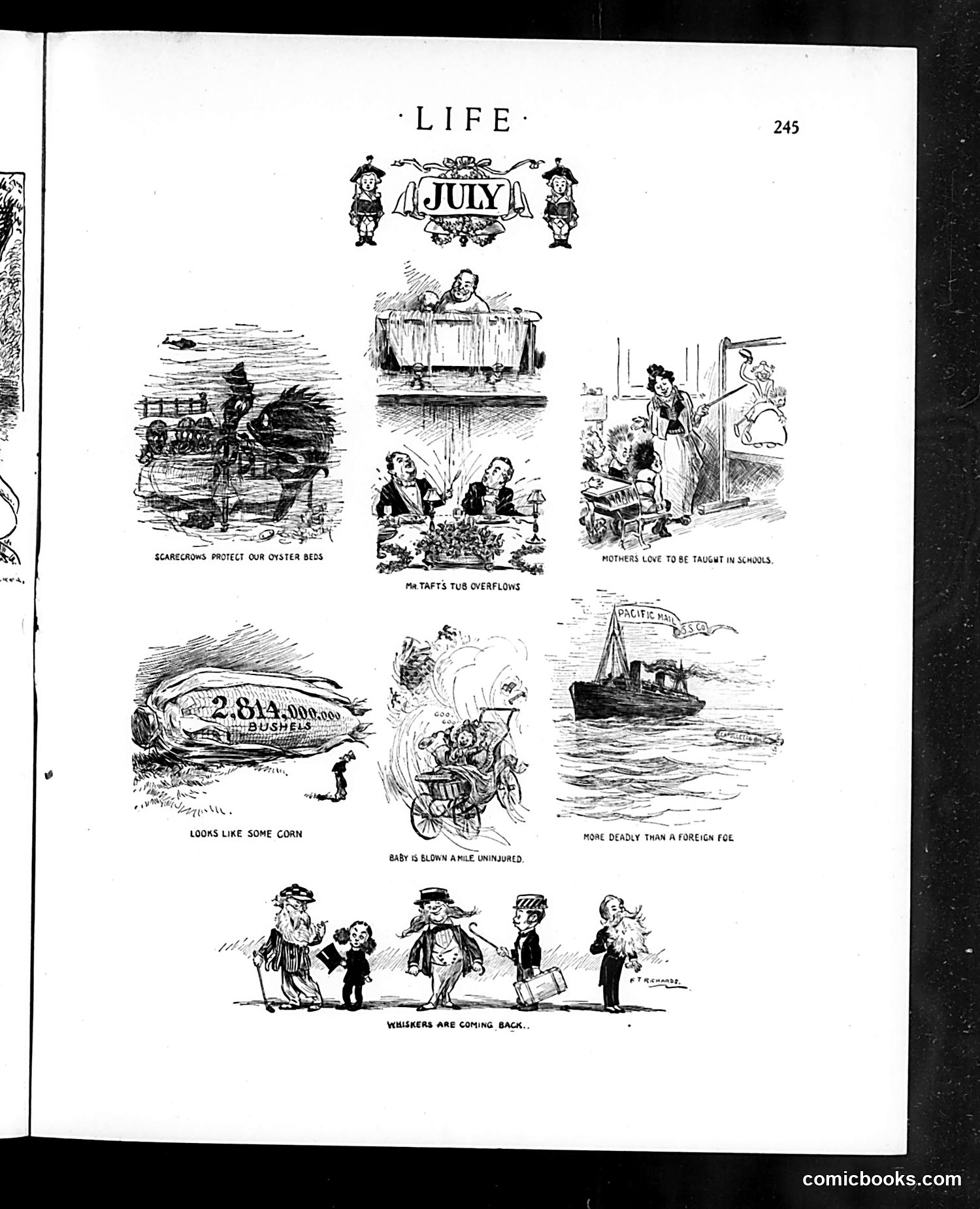
This page contains satirical cartoons commenting on early 20th-century American issues: **"Scarecrows Protect Our Oyster Beds"** - likely mocks inadequate coastal defense or resource management. **"Mr. Taft's Tub Overflows"** - appears to reference President William Howard Taft, possibly satirizing his administration's policies or expenditures as excessive or out of control. **"Looks Like Some Corn"** - references a large quantity (2,814,000,000 bushels) of corn, suggesting commentary on agricultural surplus or market conditions. **"Baby is Blown a Mile Uninjured"** and **"More Deadly Than a Foreign Foe"** - appear to address industrial accidents or safety hazards. **"Mothers Love to Be Taught in Schools"** - satirizes education policy or teaching methods. **"Whiskers Are Coming Back"** - suggests a fashion trend commentary, possibly political in nature. The cartoons collectively address contemporary social, political, and economic concerns through visual humor.
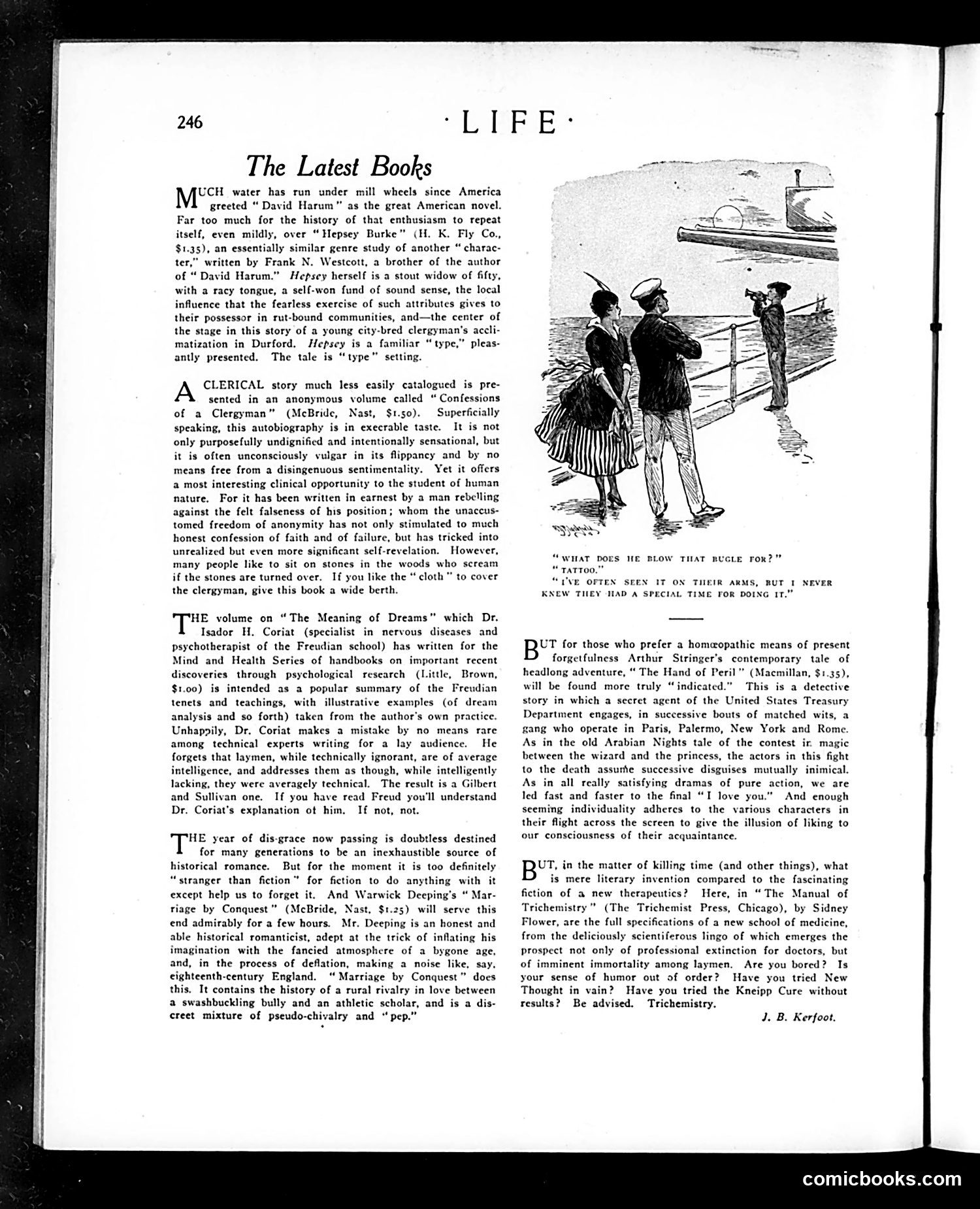
The sketch depicts a young woman and man at a waterfront, with a steamship visible. The woman asks "What does he blow that bugle for?" The man replies "Tattoo," prompting her to say "I've often seen it on their arms, but I never knew they had a special time for doing it." **The joke:** The woman misunderstands "tattoo" (the bugle call signaling soldiers to return to barracks) as referring to tattoos—the permanent ink markings on sailors' and soldiers' arms. Her confusion plays on the double meaning of the word, and her comment about seeing tattoos "on their arms" suggests she's observing sailors, making the misunderstanding plausible in a waterfront setting. **Satire level:** Mild and gentle—poking fun at urban civilian unfamiliarity with military terminology and practices, a common source of humor in period magazines.
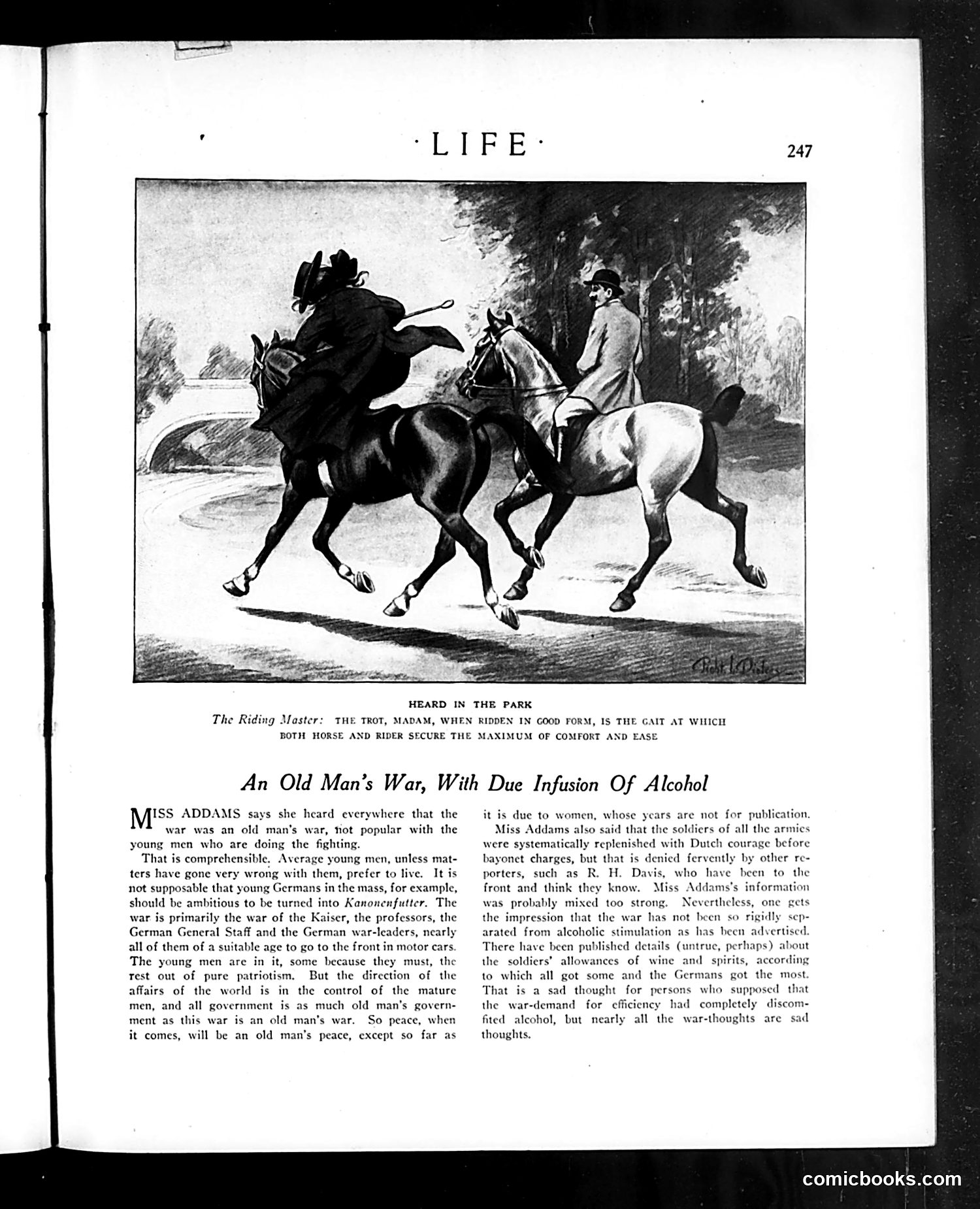
The page contains a small illustration titled "The Riding Master" showing a woman on horseback receiving instruction from a male riding instructor—a conventional social scene about proper equestrian form. This appears unrelated to the main article. The substantive content is an essay titled "An Old Man's War, With Due Infusion Of Alcohol," referencing statements by Jane Addams (the Progressive reformer). The piece argues that World War I is fundamentally controlled by older men—the Kaiser, generals, and war leaders—while young men do the actual fighting and dying ("Kanonenfutter," German slang for cannon fodder). The article also addresses Addams's claim that soldiers were given alcohol before bayonet charges to boost courage. The author notes this is disputed by other war correspondents but suggests alcohol *was* systematically supplied to troops, more generously to German soldiers. The satire's point: despite propaganda claiming wartime demanded military efficiency and sobriety, soldiers were actually fortified with liquor—an ironic contradiction revealing the war's true nature as an old men's enterprise using young men's bodies.
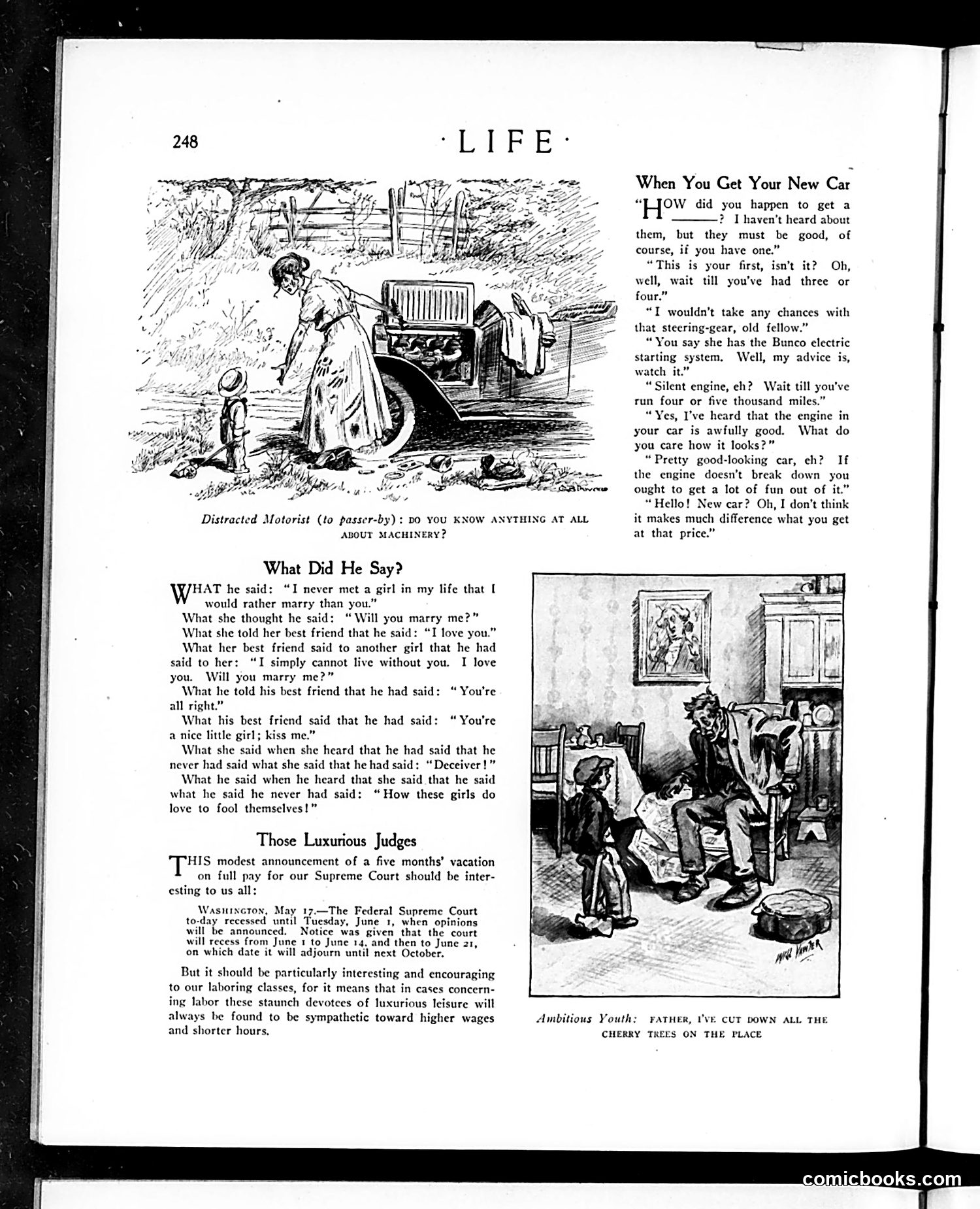
This page contains three satirical pieces targeting early 20th-century American attitudes: **Top cartoon**: A motorist, broken down on the roadside, asks a passerby about machinery—the joke being that early automobiles were so unreliable and mechanically complex that drivers were frequently stranded. **"What Did He Say?"**: This piece satirizes how communication becomes distorted through repetition. A man's modest statement ("I never met a girl I'd rather marry") transforms dramatically as it passes through multiple people, eventually making him sound passionate and the woman accusing him of deception. It mocks romantic miscommunication and gossip. **"Those Luxurious Judges"**: A political critique of Supreme Court justices taking extended paid vacations (five months total) while claiming sympathy for labor causes. The sarcasm suggests hypocrisy—judges enjoying "luxurious leisure" while supposedly supporting workers' demands for shorter hours and higher wages. **Bottom cartoon**: References the Washington cherry tree legend (young George Washington confessing to cutting down his father's tree), humorously updated to modern ambition.
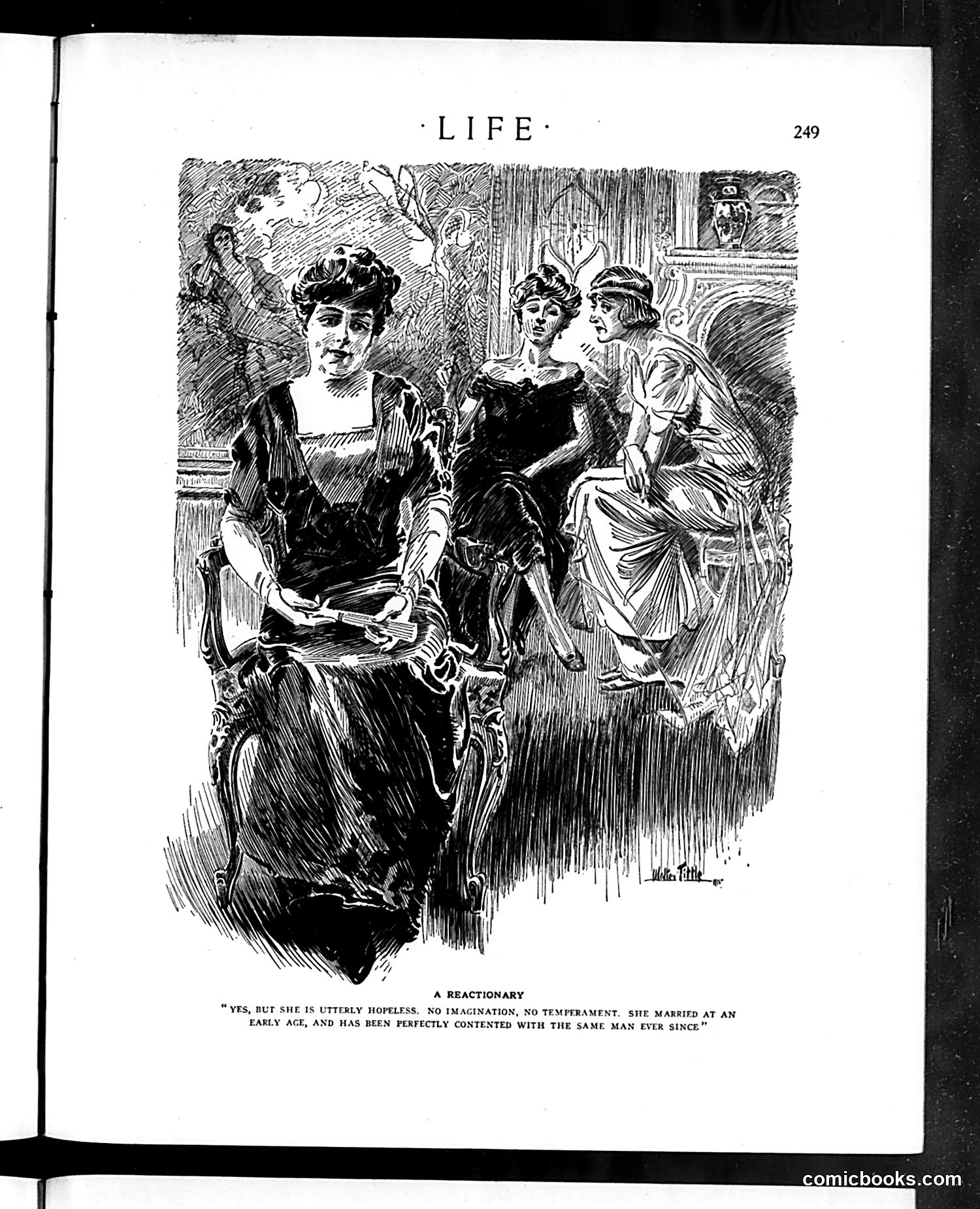
This satirical sketch mocks rigid, old-fashioned attitudes about women. The scene depicts fashionable women gossiping about another woman, whom they dismiss as a "reactionary"—someone hopelessly behind the times. Their criticism reveals the satire's target: they scorn her for lacking "imagination" and "temperament," and worst of all, for being satisfied in a long marriage to one man. The joke inverts expectations. What these modern women treat as pathetic conservatism (marital contentment) was traditionally considered a virtue. Life magazine satirizes the era's dismissive attitude toward domestic stability, suggesting that early-20th-century sophistication valued novelty and emotional drama over traditional commitment. The women's condescension exposes the period's shifting social values around marriage and female identity.
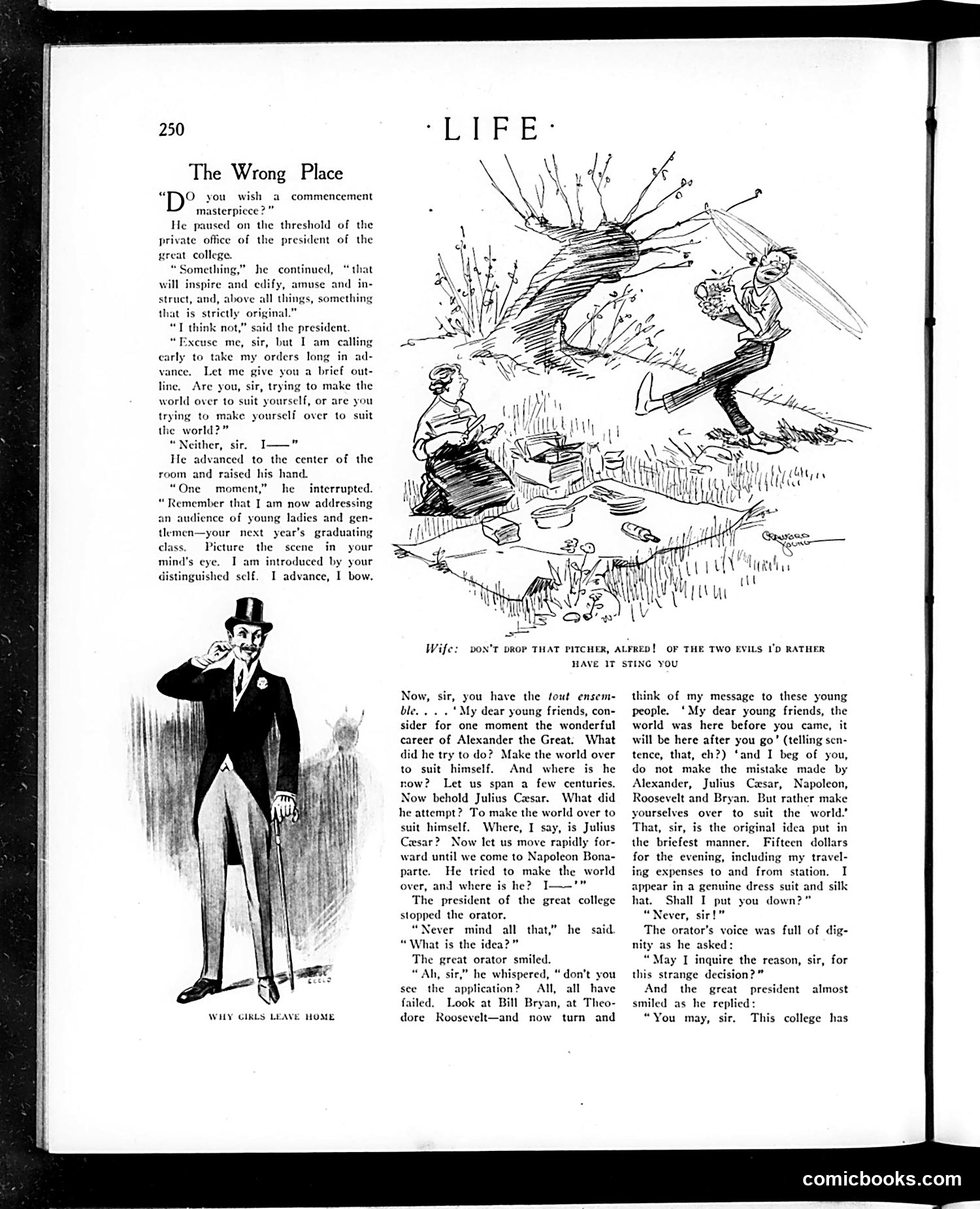
This satire mocks the pretentious commencement speaker industry of the era. A bombastic orator visits a college president seeking a $15 engagement fee, pitching his "original" speech about Alexander the Great, Julius Caesar, and Napoleon—all historical figures who tried reshaping the world and failed. The joke: his "brilliant" conclusion is to tell graduating students the *opposite*—don't try to change the world, adapt to it instead. The college president rejects him, recognizing the speech's hollow pomposity and contradictory logic. The accompanying cartoon "Why Girls Leave Home" shows a woman threatening her husband with a pitcher, sardonically captioning it as "of two evils I'd rather have it sting you"—criticizing men's incompetence or mistreatment in domestic life. Together, these pieces satirize early-20th-century American pretension: failed male ambition and empty rhetoric (the orator) alongside domestic dysfunction (the marriage).
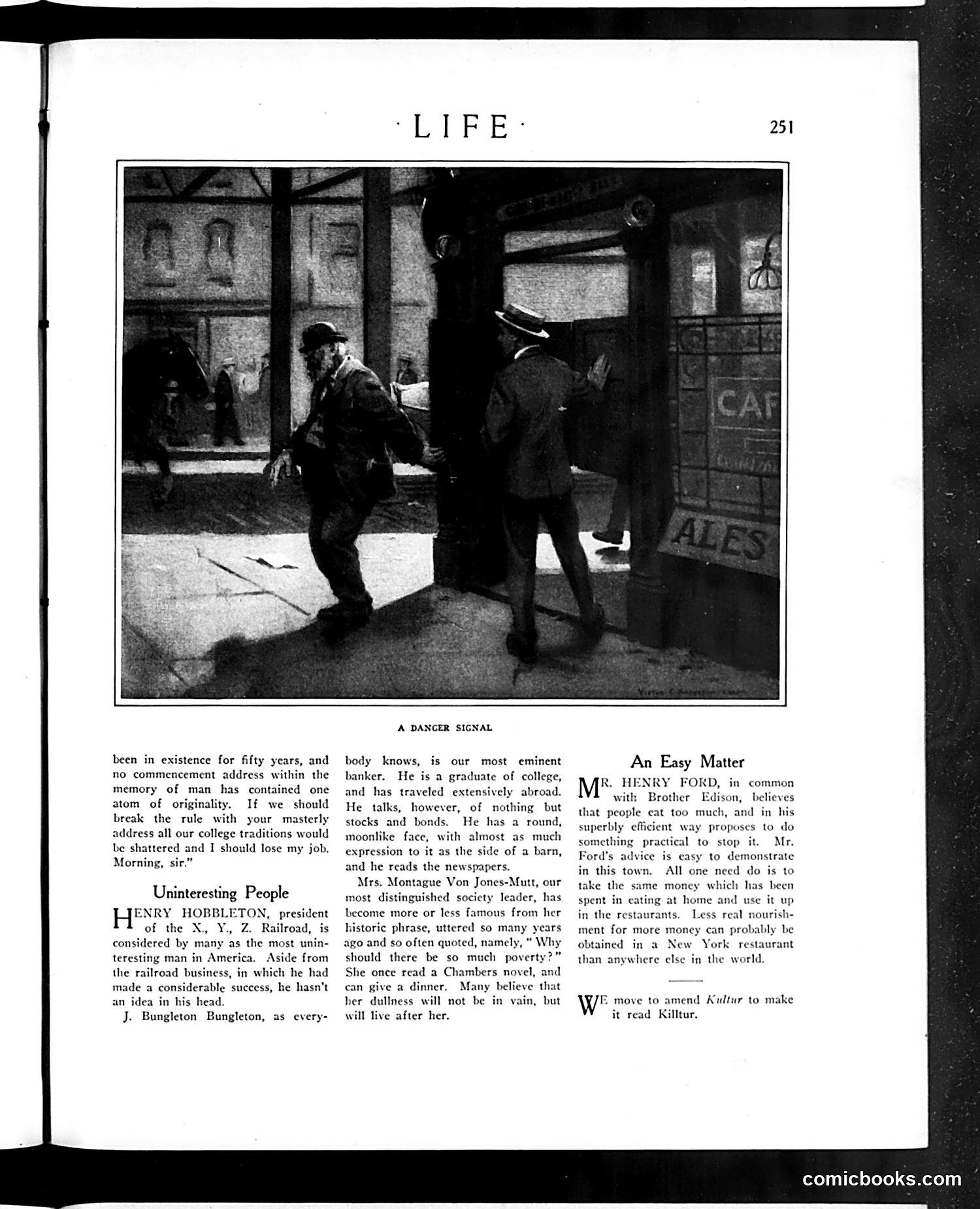
This page satirizes wealthy American elites as profoundly uninteresting and intellectually shallow. The cartoon depicts what appears to be a street confrontation, captioned "A Danger Signal"—likely illustrating one of the character sketches below. The text presents three wealthy figures: a railroad president with no ideas beyond business; a banker who discusses only stocks and bonds despite his cultured appearance; and a society matron famous for asking "Why should there be so much poverty?" yet incapable of meaningful thought. A final jab targets Henry Ford's recent dietary advice, suggesting that following his suggestion to eat less by patronizing expensive restaurants would paradoxically waste money while providing worse nutrition—mocking Ford's faith in "efficient" solutions to complex social problems. The satire's point: America's wealthy and powerful are vapid conformists lacking genuine intellect or originality, despite their social status. The closing reference to "Kultur" versus "Killtur" appears to mock Germanic intellectual pretension.
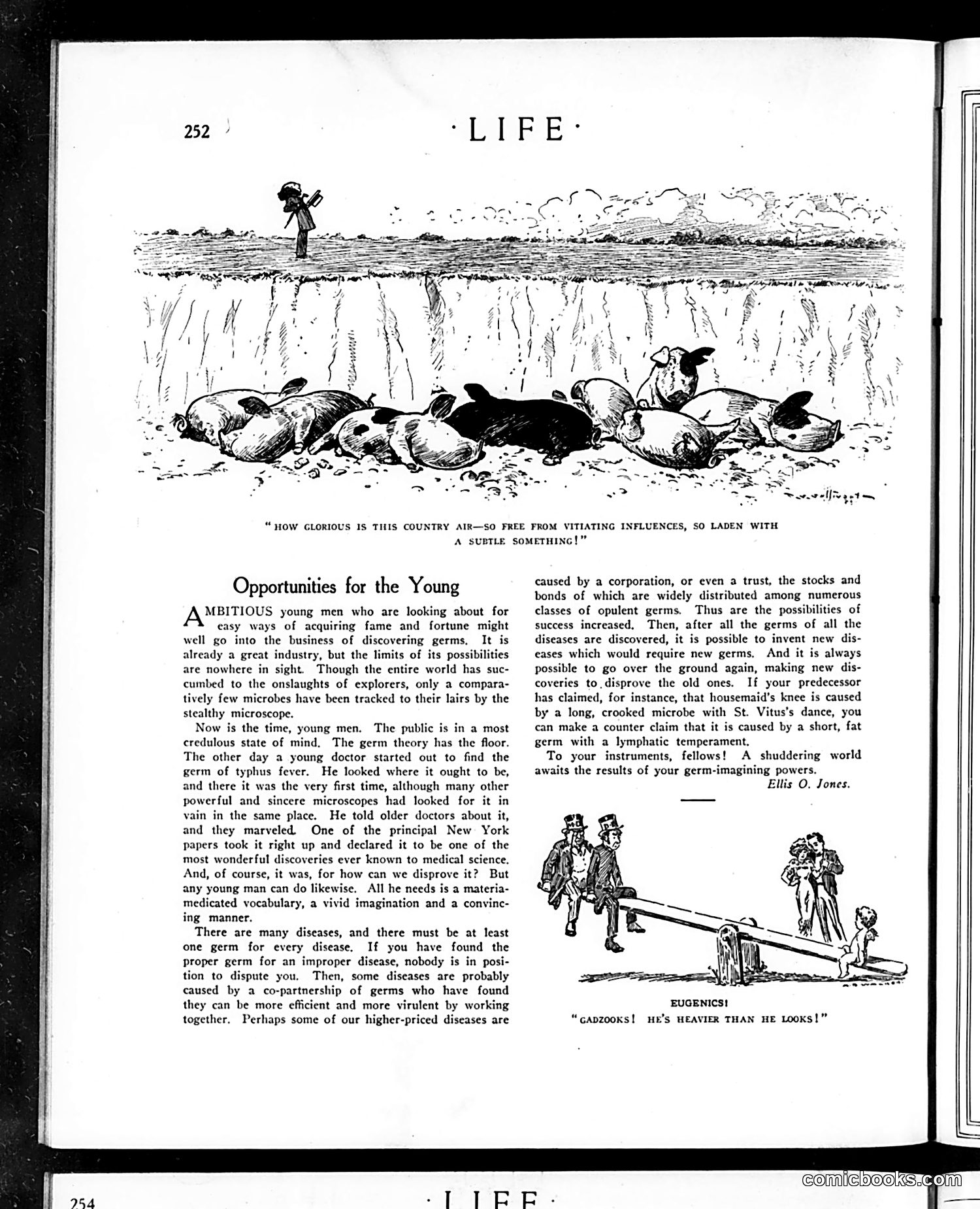
The top cartoon satirizes naive tourists praising country air as pure and wholesome, unaware they're surrounded by disease-carrying organisms—depicted as sleeping pigs and animals in filth. The joke undercuts false pastoral romanticism with germ-theory reality. The article "Opportunities for the Young" is a scathing satire of early-20th-century germ discovery mania. It mocks ambitious doctors who could gain fame by "discovering" new microbes, suggesting the process requires only "a materially-medicated vocabulary, a vivid imagination and a convincing manner"—not actual rigor. The piece sarcastically proposes inventing diseases, corporate "germ trusts," and endlessly contradicting predecessors' findings. It implies the public's gullibility and the scientific community's uncritical acceptance enable fraudulent claims. The bottom cartoon captioned "Eugenics!" appears to joke about judging someone's weight or health against eugenic standards—though the specific reference remains unclear without fuller context.
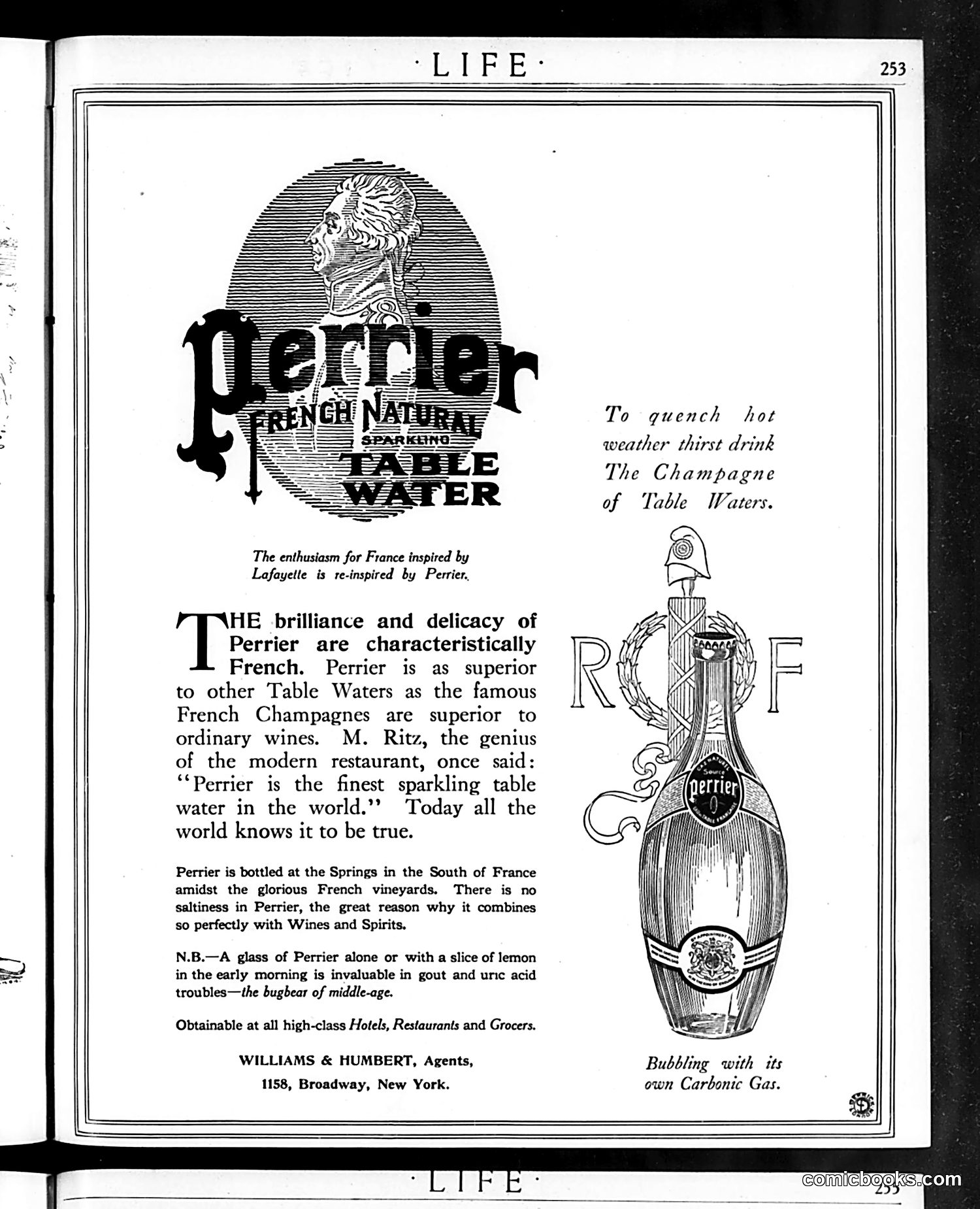
This is a **full-page advertisement**, not satire or political cartoon. It promotes Perrier sparkling water to American consumers. The ad employs **patriotic association** by linking Perrier to Lafayette and French superiority—a marketing strategy leveraging American Francophilia. It references **M. Ritz**, the famous Swiss hotelier, as an authority endorsing the product's quality. The copy positions Perrier as elite: "the Champagne of Table Waters," available only at "high-class Hotels, Restaurants and Grocers." A notable health claim appears in the fine print: that Perrier treats gout and "uric acid troubles," common ailments among middle-aged, wealthy men—the target demographic. The bottle illustration emphasizes elegance and the "own Carbonic Gas" carbonation process. This reflects early-20th-century marketing emphasizing scientific sophistication and Continental refinement to justify premium pricing.
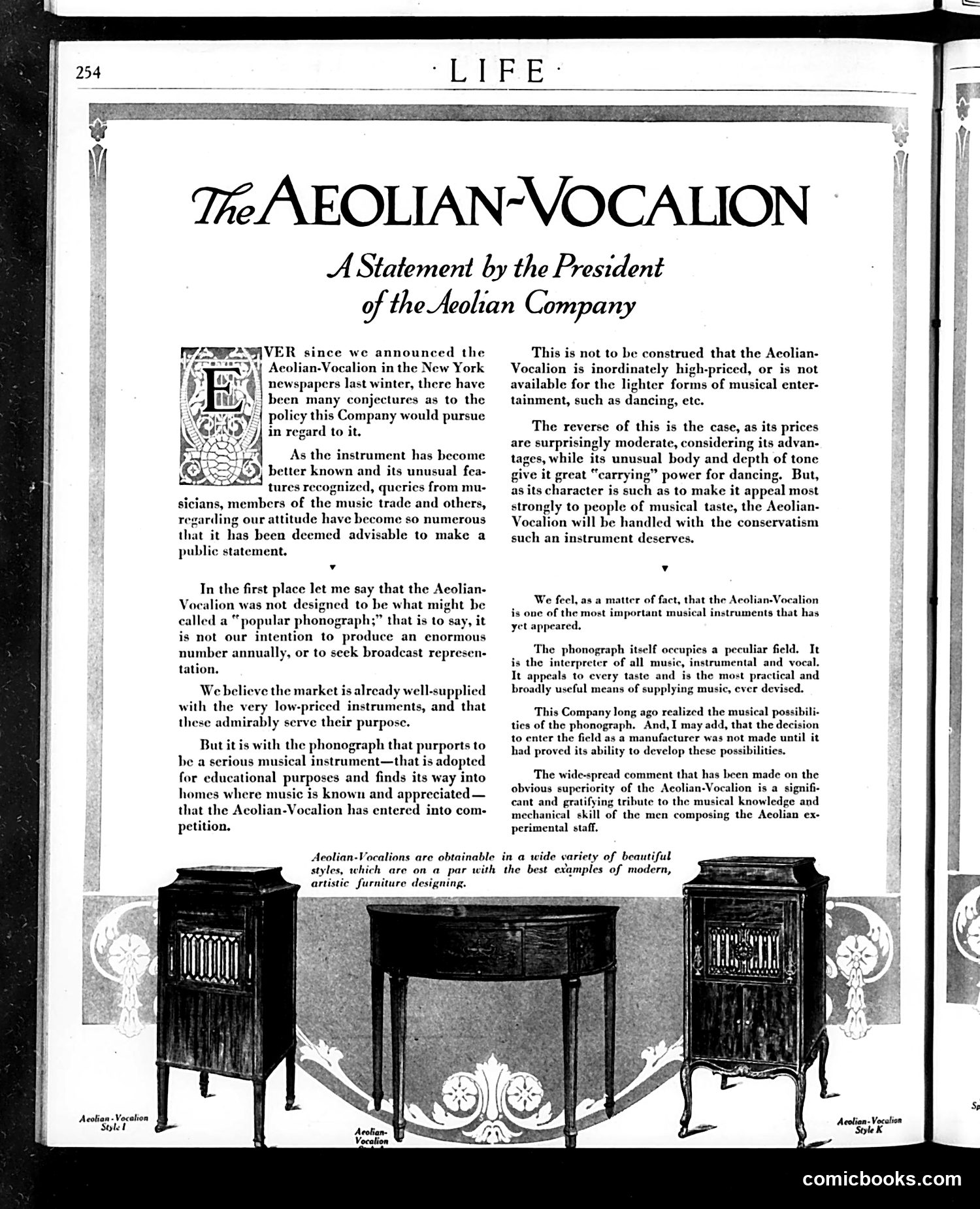
This is **not a cartoon or satire**—it's a straightforward corporate advertisement disguised as editorial content. The page features a statement from the president of the Aeolian Company defending their new phonograph model, the Aeolian-Vocalion. The "point" is a marketing strategy: rather than crude advertising, the company positions itself as a serious, quality manufacturer targeting educated consumers with musical taste, not mass-market buyers seeking cheap machines. The president emphasizes the instrument's moderate (not low) pricing, superior tone quality, and suitability for homes "where music is known and appreciated." The three furniture-style phonograph cabinets shown at bottom reinforce this positioning—they're presented as fine furnishings, not mere gadgets. This represents early 20th-century *advertorial* content: paid corporate messaging presented in editorial style to gain credibility with readers of *Life* magazine's upscale audience.
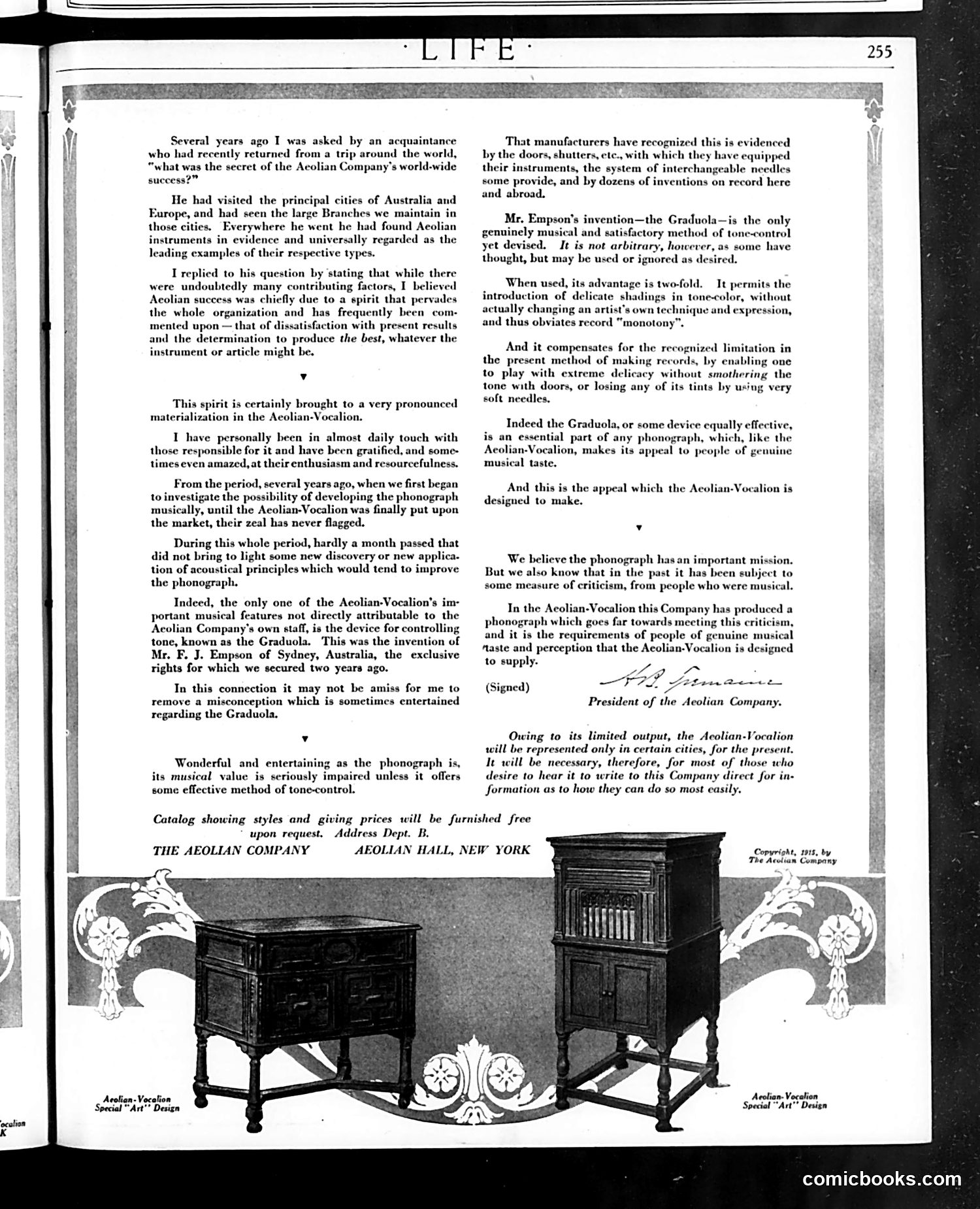
This is primarily **advertising content**, not satire or political commentary. It's a full-page advertisement for The Aeolian Company's phonograph product, the "Aeolian-Vocalion." The text is a corporate message from the company president defending their phonograph's musical superiority against criticism from serious musicians. The key claim: previous phonographs lacked proper "tone-control," but their device—the Graduola (invented by F.J. Empson of Sydney)—solves this by allowing delicate volume adjustments without degrading sound quality. The page addresses a real historical tension: early phonographs were considered crude toys unsuitable for genuine music appreciation. The Aeolian-Vocalion positioned itself as the first phonograph meeting professional musical standards. Two furniture-style cabinet models are pictured at the bottom. This represents pre-1920s marketing to affluent, musically-educated consumers who previously dismissed recorded music as inferior.
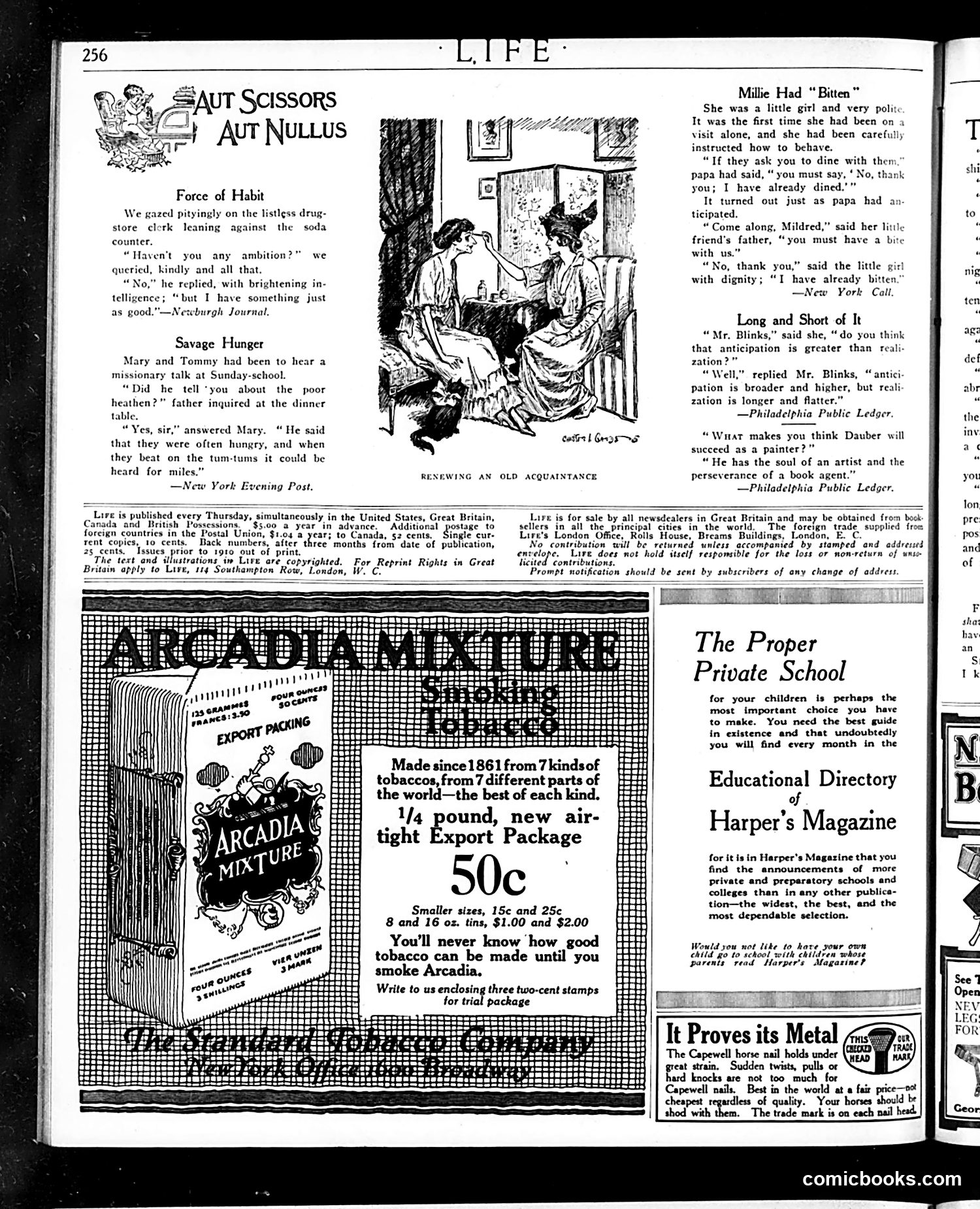
This page contains four brief satirical jokes typical of early 20th-century American humor magazines: **"Force of Habit"** mocks a listless drugstore clerk who admits having "something just as good" as ambition—implying complacency or acceptance of mediocrity. **"Savage Hunger"** jokes about children's misunderstanding: a girl describes heathen people beating "tum-tums" (drums) when hungry, confusing the word with stomach sounds. **"Renewing an Old Acquaintance"** plays on a polite child's mishearing—she says she's already "bitten" instead of "dined," creating an absurd but innocent malapropism. **"Long and Short of It"** presents a clever wordplay about anticipation versus realization: anticipation is "broader and higher," while realization is "longer and flatter"—suggesting disappointment. The remainder consists of period advertisements (Arcadia Mixture tobacco, Harper's Magazine's school directory, Capewell horse nails) typical of such publications. The illustration shows two women greeting—likely accompanying one of these anecdotes.
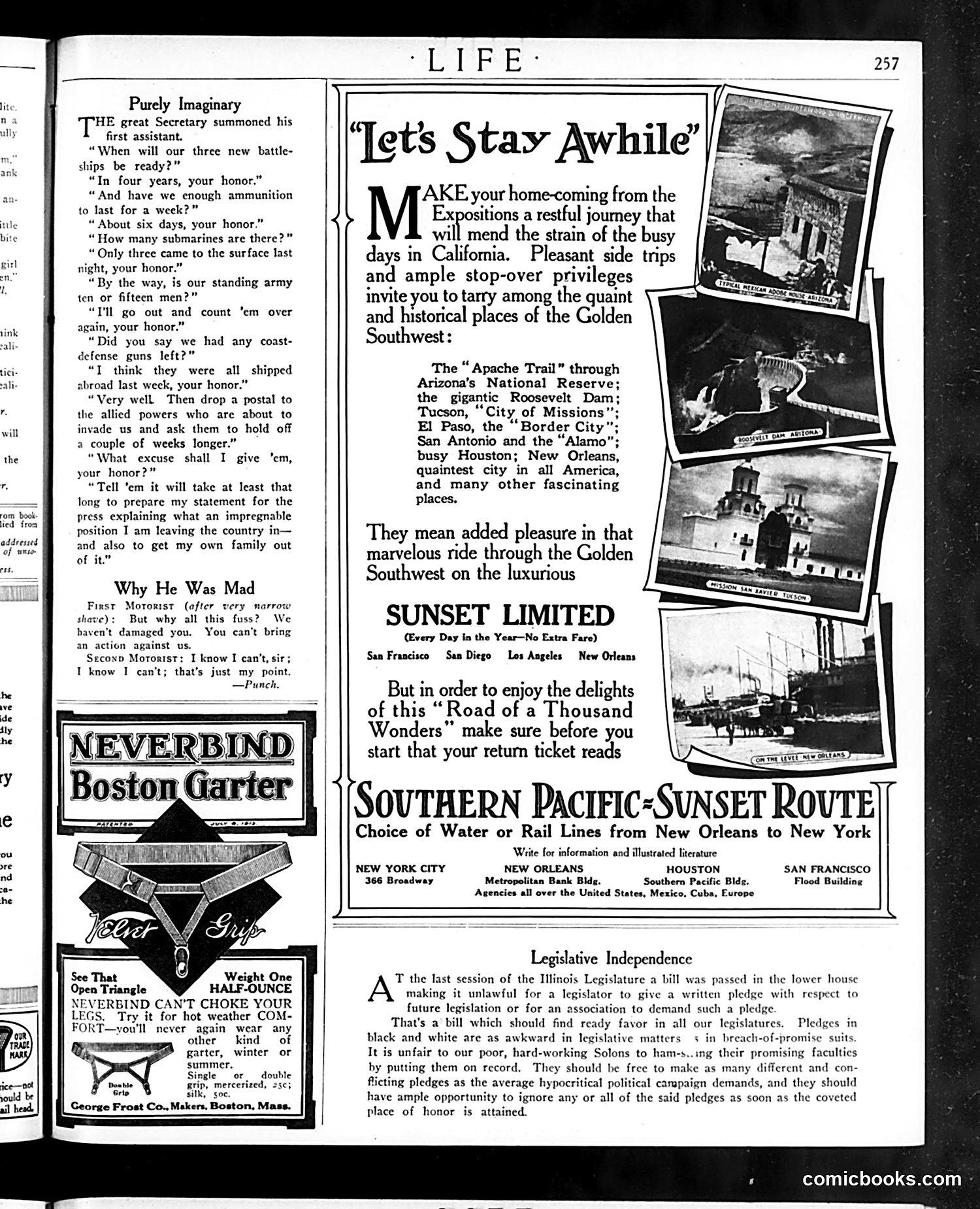
This page contains three distinct items: ## "Purely Imaginary" Cartoon A satirical dialogue mocking military unpreparedness. A government Secretary admits to an official that the country has only three submarines, minimal ammunition, a tiny standing army, and no coast-defense guns. The punchline: he'll ask invading allied powers to delay their invasion while he prepares a press statement claiming the country is in an "impregnable position" and evacuates his own family. The satire targets governmental incompetence and official dishonesty—officials making false public claims while privately aware of serious deficiencies. ## "Why He Was Mad" (Punch) A brief joke about two motorists: one hits the other but claims no legal liability exists, so the victim can't sue. The victim's frustration is that the law provides no recourse for reckless behavior. ## Remaining Content The bulk is transportation and travel advertising (Sunset Limited railroad, Boston Garter garter belts) and a brief political commentary on Illinois legislation protecting lawmakers from being bound by written pledges—satirizing legislators' freedom to make and break promises without consequence.
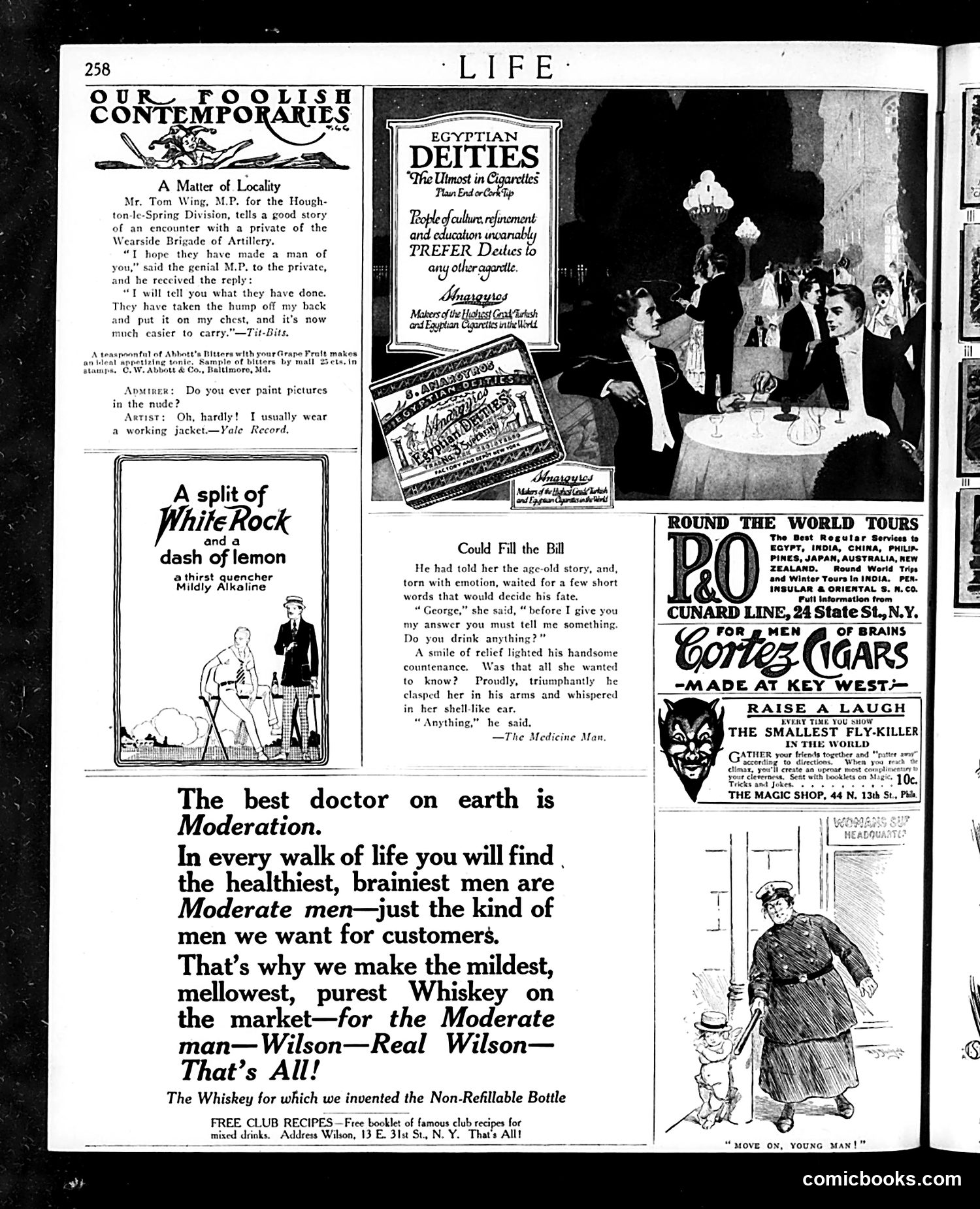
This page mixes humor columns with period advertisements. The "Our Foolish Contemporaries" section contains three brief anecdotes: one about a British M.P. joking with a soldier about military training (the soldier's quip about his "hump" moving from back to chest is wordplay on posture/burden), a Yale Record joke about a painter working clothed rather than nude, and "Could Fill the Bill"—a romance story where a woman asks if her suitor drinks, and he eagerly answers "Anything," implying drinking is desirable rather than problematic. The advertisements are notable: White Rock mineral water, Egyptian Deities cigarettes, Cunard cruise lines, Cortez cigars "made at Key West," and a magic trick shop. A large Wilson Whiskey ad ironically promotes "moderation" while marketing alcohol as a sign of health and intelligence. The cartoon at bottom shows a police officer or authority figure telling a young man to "move on"—likely satirizing urban policing or vagrancy laws, though context is limited.
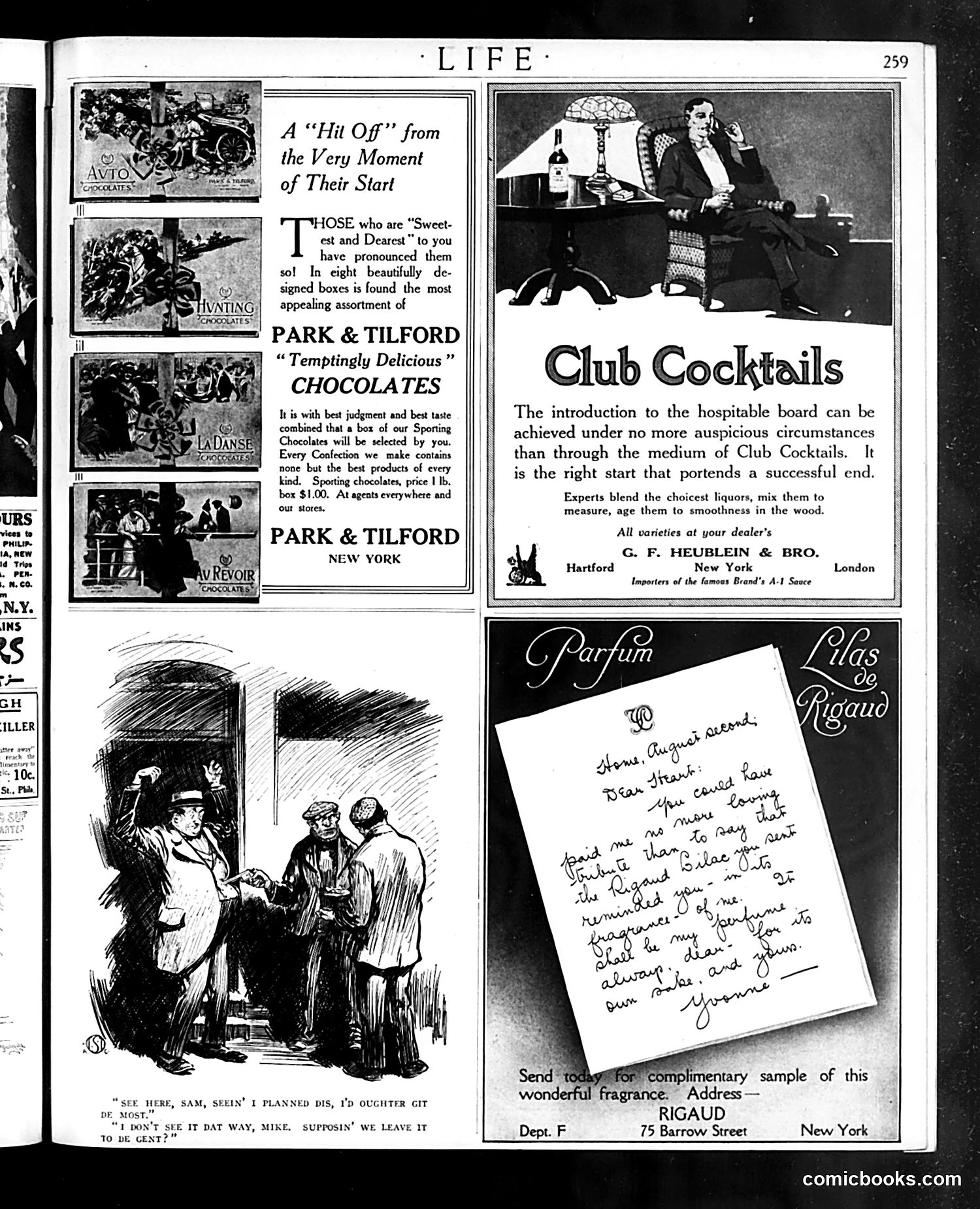
This page is primarily **advertising** rather than satirical editorial content. The main elements are: **Upper left:** Park & Tilford chocolate advertisements featuring film stills, promoting their "Sporting Chocolates" in decorative boxes as luxury gifts. **Upper right:** A Club Cocktails advertisement showing well-dressed men in a gentlemen's club setting. The ad promotes cocktails as the proper introduction to entertaining, with text about experts blending liquors to smoothness—reflecting 1920s sophistication culture. **Lower left:** A small cartoon sketch depicting two working-class men (suggested by dialogue spelling and caps) discussing leaving a site, possibly commenting on labor or construction work, though the context is unclear. **Lower right:** A Parfum Lilas de Rigaud fragrance advertisement featuring a handwritten note testimonial. The page reflects **Prohibition-era advertising strategy**: despite alcohol being illegal, cocktail ads used coded language about "clubs" and social exclusivity to reach affluent readers. The overall tone emphasizes luxury consumption and upper-class leisure.
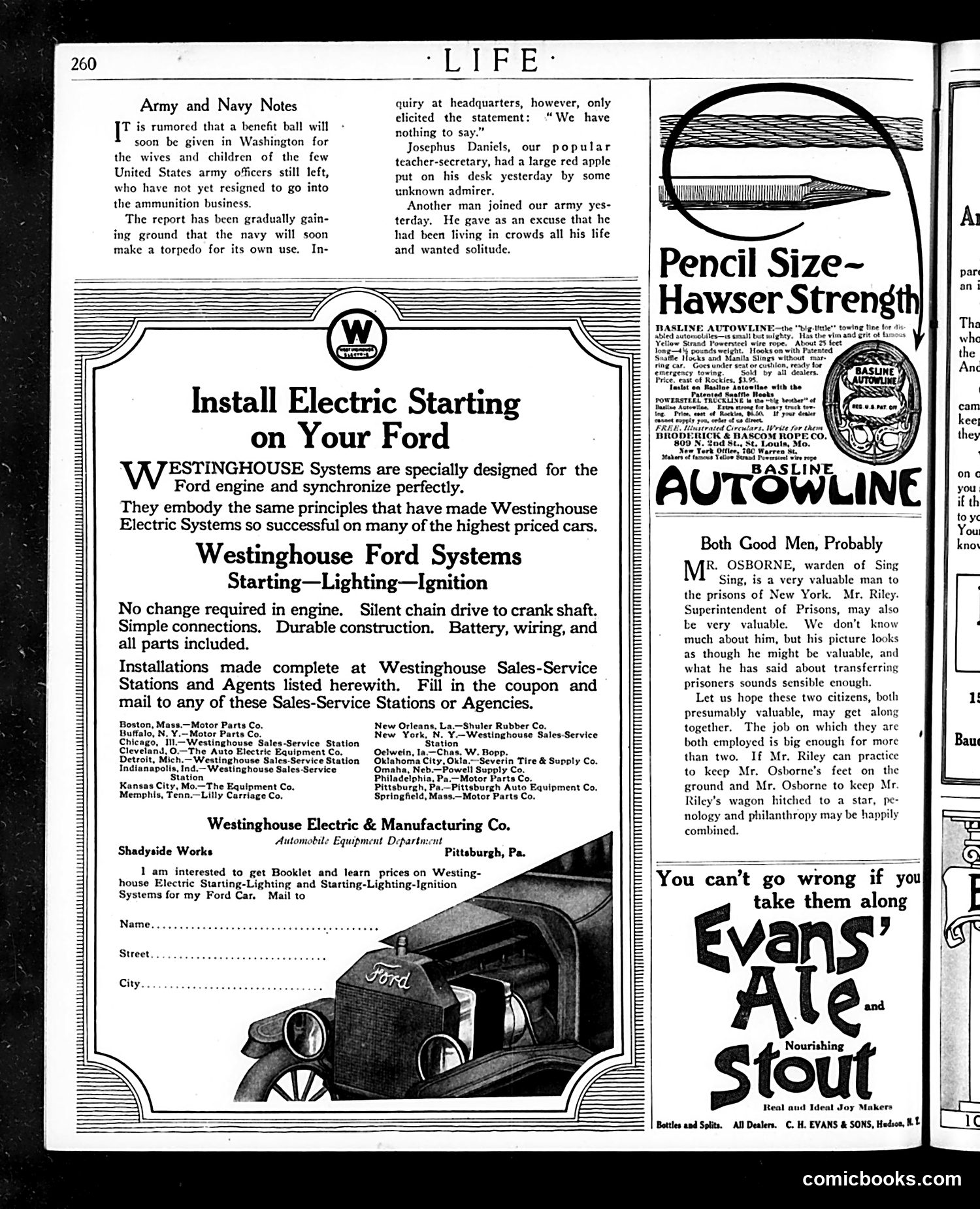
This page from *Life* magazine contains primarily **advertisements** rather than political cartoons. The dominant content includes: 1. **Westinghouse Electric Starting Systems ad** — promoting electric starters for Ford automobiles, with installation details and a coupon. 2. **Baseline Autowline ad** — advertising towing equipment. 3. **Evans' Ale and Stout ad** — beer promotion. The only editorial content is a brief **"Army and Navy Notes"** column containing three unrelated items: rumors of a Washington benefit ball for Army officers' families, speculation about the Navy manufacturing torpedoes, and anecdotes about Josephus Daniels (Secretary of the Navy) receiving a red apple and a new Army recruit seeking solitude. There is also a short piece titled **"Both Good Men, Probably"** discussing R. Osborne (warden of Sing Sing) and Mr. Riley (Superintendent of Prisons), suggesting their combined efforts could improve prison administration. The page is primarily commercial rather than satirical.
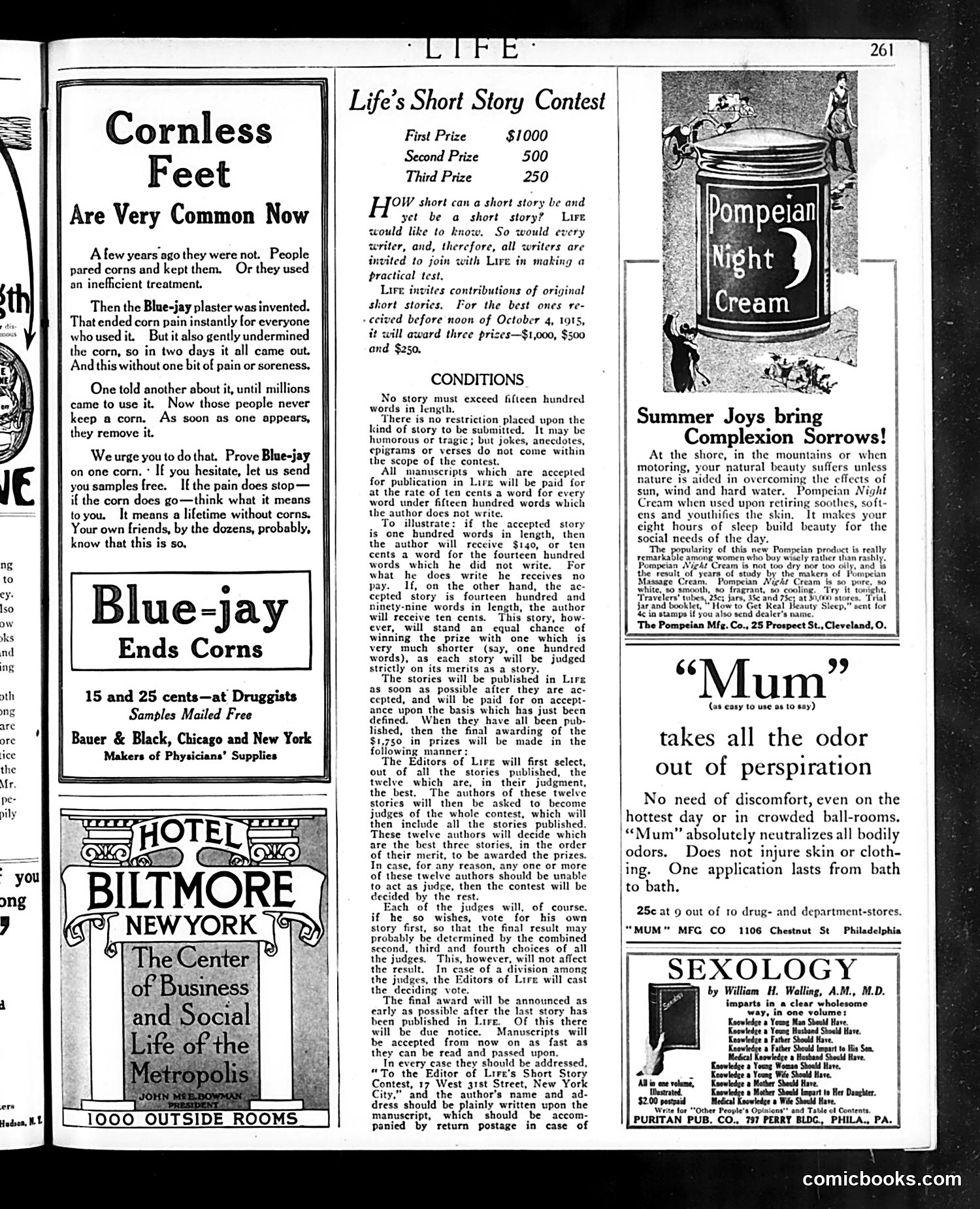
This page is primarily **advertising and announcements** rather than satire or political content. The main items are: 1. **Blue-Jay Corn Plaster ad**: A straightforward product advertisement claiming the plaster painlessly removes corns in two days. The "cornless feet" headline plays on emerging consumer culture—suggesting corns were once accepted as inevitable, but modern products eliminated them. 2. **Life's Short Story Contest**: An announcement inviting writers to submit stories under 1,500 words, with prizes totaling $1,750. The contest's unique gimmick: authors are paid ten cents per *word they *didn't* write*—rewarding brevity. 3. **Minor ads**: Pompeian Night Cream, "Mum" deodorant, Hotel Biltmore, and a Sexology book. The page reflects early 20th-century consumer advertising culture and Life magazine's role promoting both fiction contests and commercial products to middle-class readers.
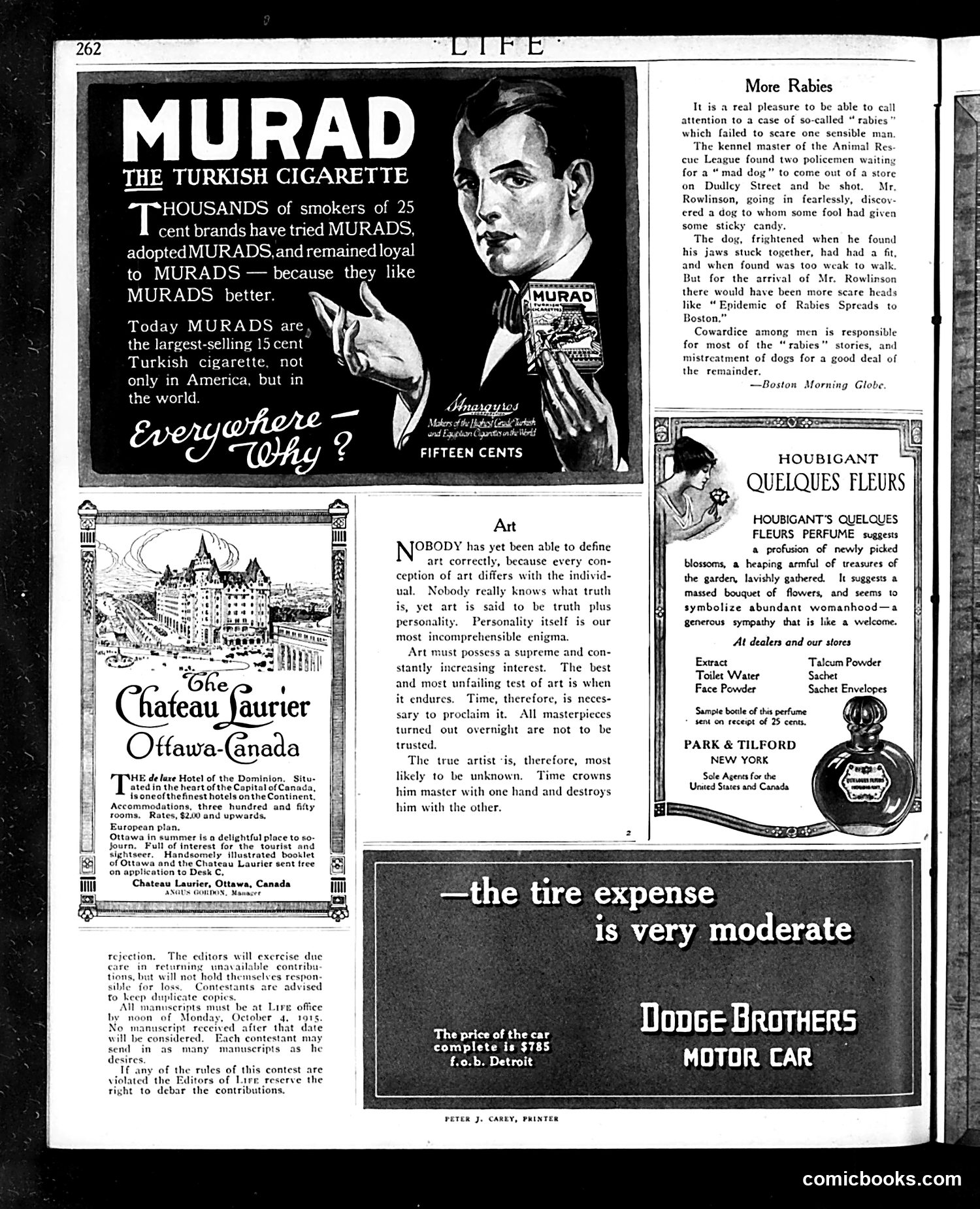
This page is primarily **advertising**, not editorial satire. It contains four distinct advertisements typical of early 1910s consumer magazines: 1. **Murad Cigarettes**: Promotes Turkish cigarettes as the best-selling 15-cent brand, emphasizing quality and consumer loyalty. 2. **Chateau Laurier Hotel** (Ottawa): Markets a luxury Canadian hotel at $2.00+ per night, targeting tourists. 3. **Houbigant Quelques Fleurs Perfume**: A high-end fragrance advertisement emphasizing elegance and femininity. 4. **Dodge Brothers Motor Car**: Highlights affordability ($785 complete) with moderate tire expenses. The page also includes an editorial piece on "More Rabies" discussing a false rabies scare caused by a dog choking on candy—a brief cautionary tale about public panic and cowardice. The art essay discussing what constitutes true art appears to be editorial filler. **No political cartoon or satire is present on this page.**
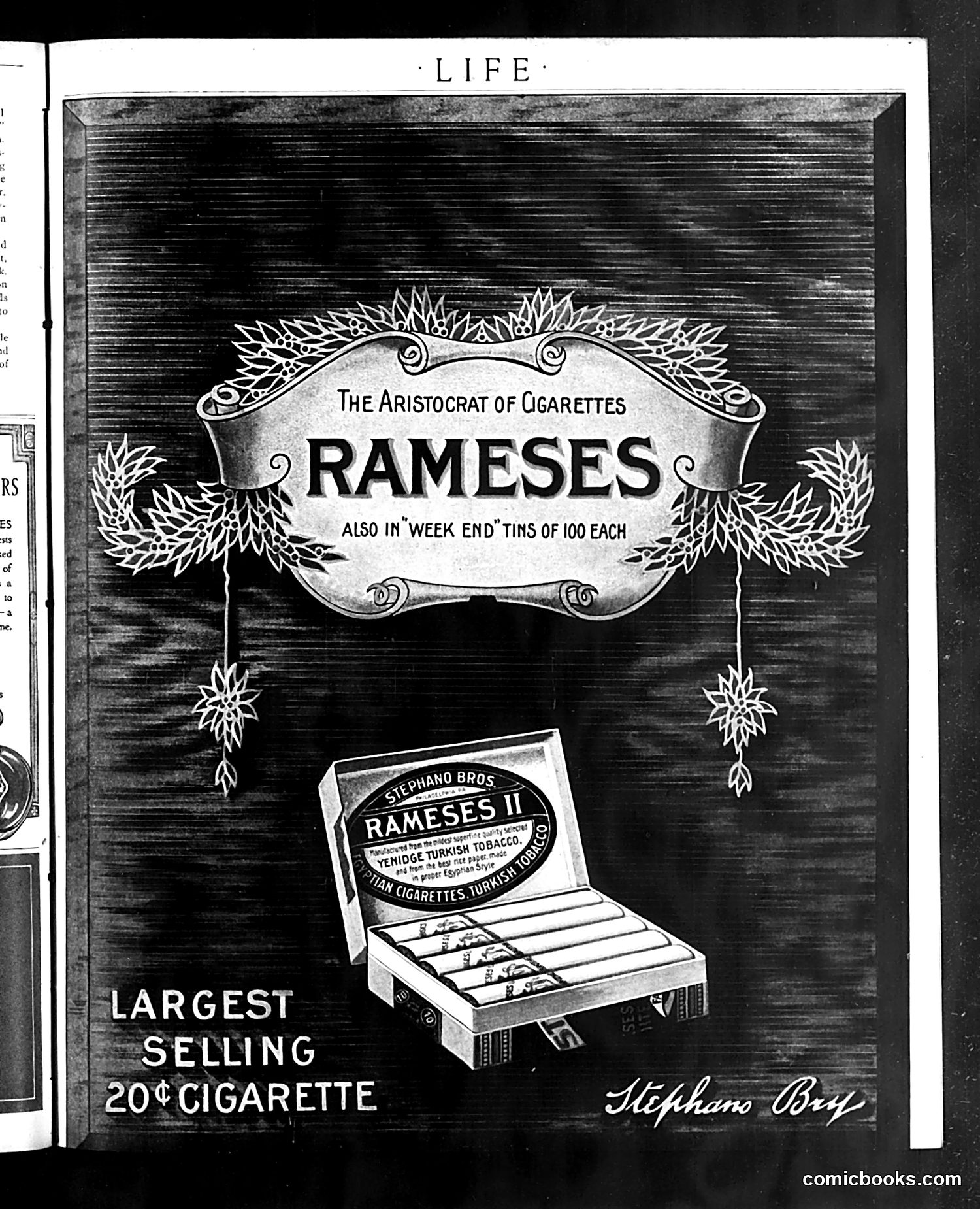
This is an advertisement for Rameses cigarettes by Stephano Bros, not a political cartoon. The page promotes what the ad claims is "The Aristocrat of Cigarettes" and "Largest Selling 20¢ Cigarette." The ad features an ornate label design with decorative flourishes and shows an open cigarette box displaying the product. The advertisement notes that Rameses cigarettes are "Also in 'Week End' Tins of 100 Each," indicating packaging options for consumers. The ad emphasizes the product's premium positioning and market dominance through price point and sales claims. This represents early 20th-century cigarette marketing typical of Life magazine's advertising content.
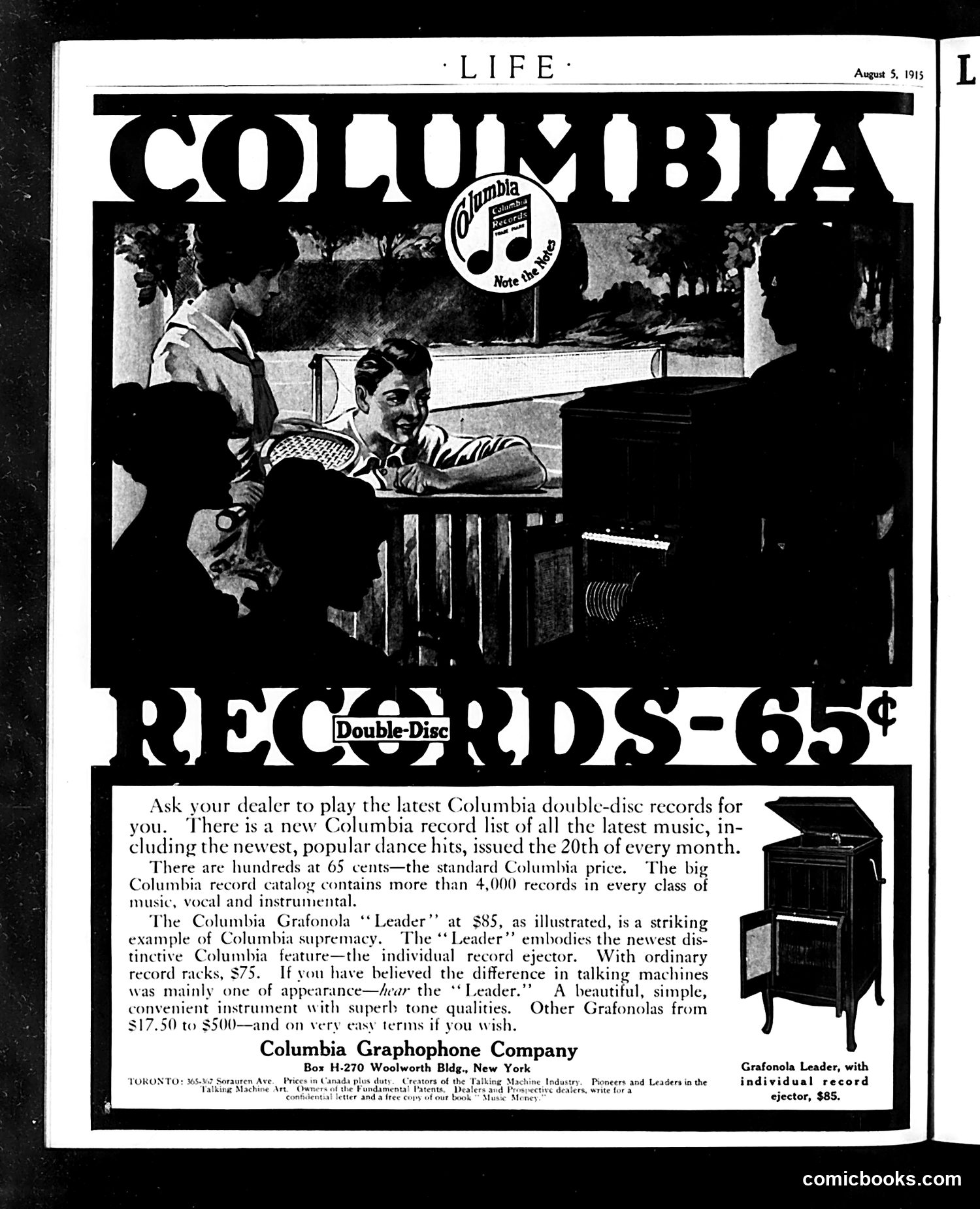
This is primarily an **advertisement**, not a political cartoon. It appears in *Life* magazine from August 5, 1915, promoting Columbia Graphophone Company's "Grafonola Leader" record player. The illustration shows a domestic scene: a man and woman enjoying music together outdoors (likely on a porch), with the Grafonola visible. The image reinforces the product's appeal as a leisure and entertainment device for middle-class homes. The ad emphasizes Columbia's competitive advantages: affordable records at 65 cents, a large catalog (4,000+ titles), and the "Leader" model's innovative "individual record ejector" feature—presented as a technological advancement that distinguishes Columbia from competitors. The price ($85) and financing options ("easy terms") target consumers with moderate means. The social context: this represents early 20th-century consumer culture, when phonographs were emerging as domestic status symbols and entertainment staples. The advertisement sells not just a machine, but a lifestyle of refined leisure.