
Life, 1915-08-05 · page 20 of 44
Life — August 5, 1915 — page 20: what you’re looking at
What you’re looking at
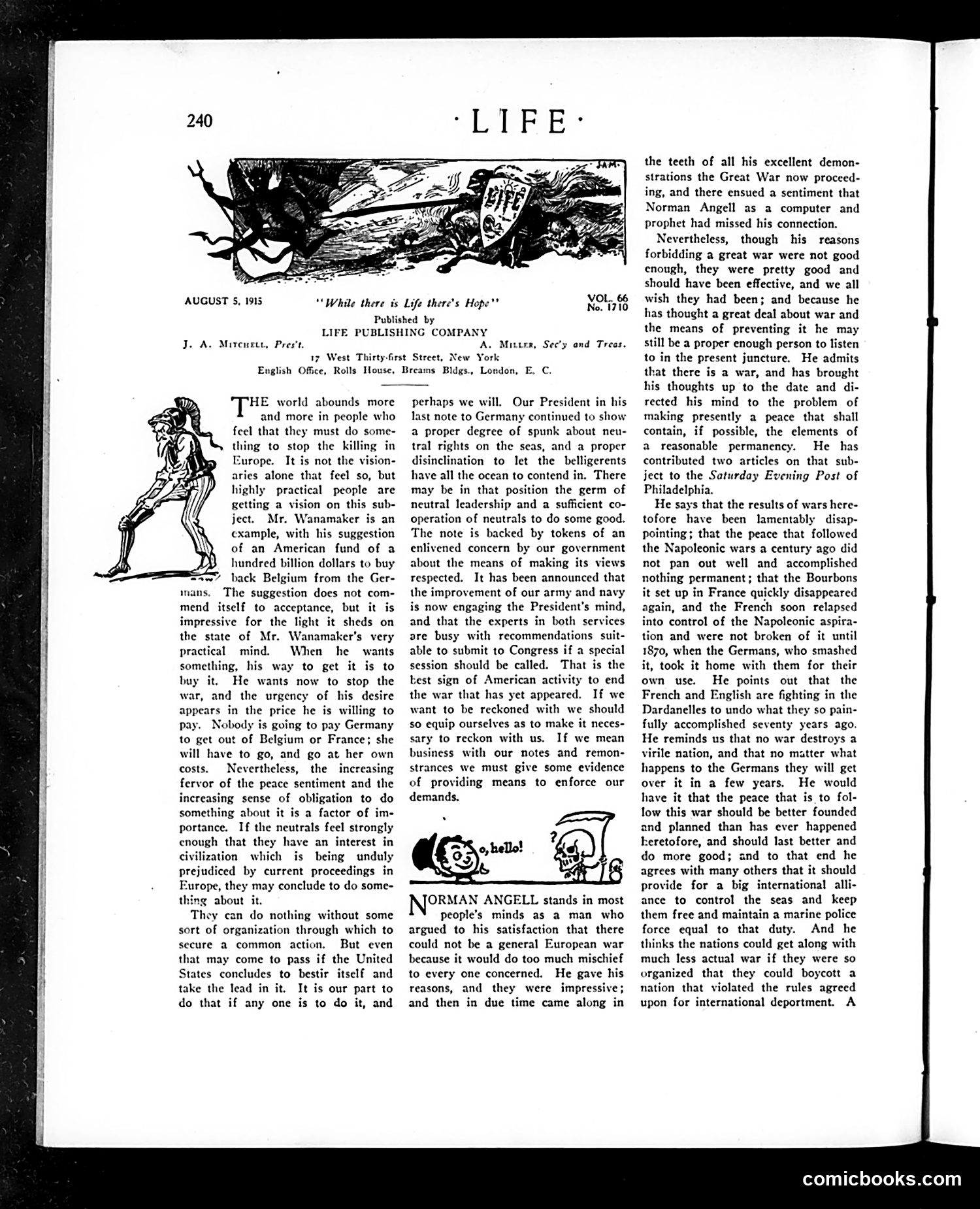
This page discusses efforts to stop World War I, which is then ongoing in Europe. The text critiques businessman John Wanamaker's impractical suggestion to spend a hundred billion dollars to buy Belgium back from Germany—mocking the idea that war can be resolved through money rather than military force. The article argues that if America wants influence in peace negotiations, it must strengthen its military and demonstrate resolve through action, not just diplomatic notes. The page also reassesses Norman Angell, a peace theorist whose pre-war arguments against a general European war proved wrong when WWI erupted. The writer acknowledges Angell's reasoning was "pretty good" but ultimately ineffective, yet suggests his continued thinking on preventing war remains valuable despite his failed prediction. The cartoons (visible but unclear in detail) appear to satirize these peace-related discussions.
📄 Transcribed text from this page (OCR, searchable)
Machine-transcribed from the original scan — historical spelling and the odd misread are preserved.
AUGUST 5, 1913 ‘While there is Life there's Hope"* VOL. 66 No. 1710 Published by LIFE PUBLISHING COMPANY J. A. Mitenret, Pres't. A. Muse, Sec’y and Treas. 17 West Thirty-first Street, New York English Office, Rolls House, Breams Bldgs., London, E. C. HE world abounds more and more in people who feel that they must do some- thing to stop the killing in Europe. It is not the vision- aries alone t! feel so, but highly practical people are getting a vision on this sub- ject. Mr. Wanamaker is an cxample, with his suggestion of an American fund of a hundred billion dollars to buy back Belgium from the Ger- mans. The suggestion does not com- mend itself to acceptance, but it is impressive for the light it sheds on the state of Mr. Wanamaker’s very practical mind. When he wants something, his way to get it is to buy it. He wants now to stop the war, and the urgency of his desire appears in the price he is willing to pay. Nobody is going to pay Germany to get out of Belgium or France; she will have to go, and go at her own costs. Nevertheless, the increasing fervor of the peace sentiment and the increasing sense of obligation to do something about it is a factor of im- portance. If the neutrals feel strongly enough that they have an interest in civilization which is being unduly prejudiced by current proceedings in Europe, they may conclude to do some- g about it. They can do nothing without some sort of organization through which to secure a common action, But even that may come to pass if the United States concludes to bestir itself and take the lead in it. It is our part to do that if any one is to do it, and perhaps we will. Our President in his last note to Germany continued to show a proper degree of spunk about neu- tral rights on the seas, and a proper disinclination to let the belligerents have all the ocean to contend in. There may be in that position the germ of neutral leadership and a sufficient co- operation of neutrals to do some good. The note is backed by tokens of an enlivened concern by our government about the means of making its views respected. It has been announced that the improvement of our army and navy is now engaging the President's mind, and that the experts in both services are busy with recommendations suit- able to submit to Congress if a special session should be called. That is the best sign of American activity to end the war that has yet appeared. If we want to be reckoned with we should so equip ourselves as to make it neces- sary to reckon with us. If we mean business with our notes and remon- strances we must give some evidence of providing means to enforce our ORMAN ANGELL stands in most people’s minds as a man who argued to his satisfaction that there could not be a general European war because it would do too much mischief to every one concerned. He gave his reasons, and they were impressive; and then in due time came along in the teeth of all his excellent demon- strations the Great War now proceed- ing, and there ensued a sentiment that Norman Angell as a computer and prophet had missed his connection. Nevertheless, though his reasons forbidding a great war were not good enough, they were pretty good and should have been effective, and we all wish they had been; and because he has thought a great deal about war and the means of preventing it he may still be a proper enough person to listen to in the present juncture. He admits that there is a war, and has brought his thoughts up to the date and di- rected his mind to the problem of making presently a peace that shall contain, if possible, the elements of a reasonable permanency. He has contributed two articles on that sub- ject to the Saturday Evening Post of Philadelphia. He says that the results of wars here- tofore have been lamentably disap- pointing; that the peace that followed the Napoleonic wars a century ago did not pan out well and accomplished nothing permanent; that the Bourbons it set up in France quickly disappeared again, and the French soon relapsed into control of the Napoleonic aspira- tion and were not broken of it until 1870, when the Germans, who smashed it, took it home with them for their own use. He points out that the French and English are fighting in the Dardanelles to undo what they so pain- fully accomplished seventy years ago. He reminds us that no war destroys a virile nation, and that no matter what happens to the Germans they will get over it in a few years. He would have it that the peace that is to fol- low this war should be better founded and planned than has ever happened heretofore, and should last better and do more good; and to that end he agrees with many others that it should provide for a big international alli- ance to control the seas and keep them free and maintain a marine police force equal to that duty. And he thinks the nations could get along with much less actual war if they were so organized that they could boycott a nation that violated the rules agreed upon for international deportment. A comicbooks.com