
Life, 1915-08-05 · page 21 of 44
Life — August 5, 1915 — page 21: what you’re looking at
What you’re looking at
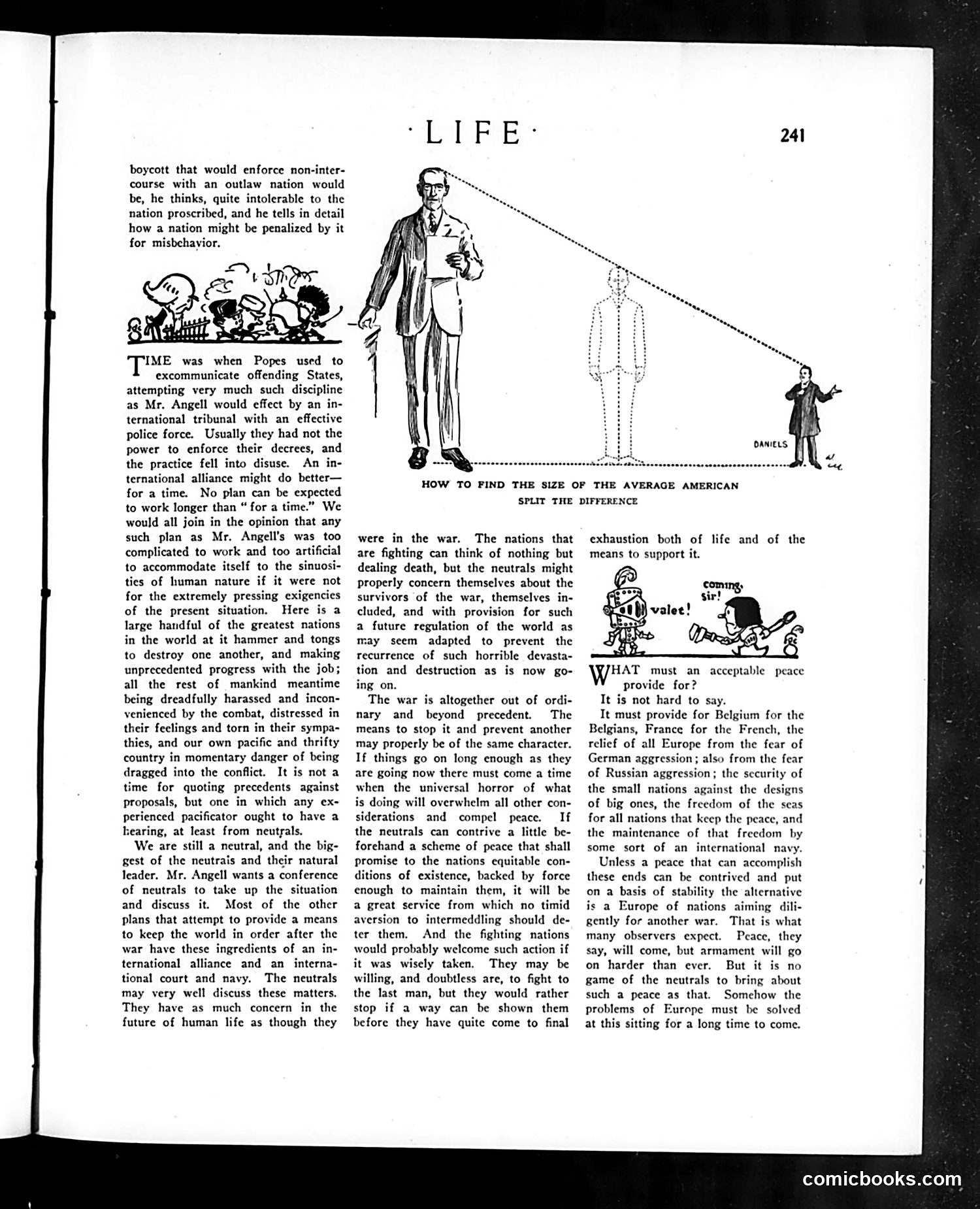
This page from *Life* magazine addresses post-World War I peace proposals, likely from around 1916-1917 when the U.S. remained neutral. **Main Cartoon:** "How to Find the Size of the Average American" depicts a tall man and tiny figure with a dotted line between them, labeled "split the difference." This ridicules American neutrality—the U.S. claimed impartiality while actually leaning toward the Allies, so the "average American" position fell comically between genuine neutrality and active involvement. **Text Content:** The article discusses Norman Angell's proposal for an international tribunal with enforcement power to maintain post-war peace. The author compares this to papal excommunications—theoretically powerful but historically ineffective without enforcement capability. **Political Context:** The piece advocates for American neutrals to conference on peace terms before total exhaustion forces settlement. It argues neutrals have legitimate interest in preventing future wars, implying the U.S. should proactively shape peace rather than remain passively neutral. The satire critiques the logical impossibility of true American neutrality during this global conflict.
📄 Transcribed text from this page (OCR, searchable)
Machine-transcribed from the original scan — historical spelling and the odd misread are preserved.
boycott that would enforce non-inter- course with an outlaw nation would be, he thinks, quite intolerable to the nation proscribed, and he tells in detail how a nation might be penalized by it for misbehavior. TE was when Popes used to excommunicate offending States, attempting very much such discipline as Mr. Angell would effect by an in- ternational tribunal with an effective police force. Usually they had not the power to enforce their decrees, and the practice fell into disuse. An in- ternational alliance might do better— for a time. No plan can be expected to work longer than “ for a time.” We would all join in the opinion that any such plan as Mr. Angell’s was too complicated to work and too artificial to accommodate itself to the sinuosi- ties of human nature if it were not for the extremely pressing exigencies of the present situation. Here is a large handful of the greatest nations in the world at it hammer and tongs to destroy one another, and making unprecedented progress with the job; all the rest of mankind meantime being dreadfully harassed and incon- venienced by the combat, distressed in their feelings and torn in their sympa- thies, and our own pacific and thrifty country in momentary danger of being dragged into the conflict. It is not a time for quoting precedents against proposals, but one in which any ex- perienced pacificator ought to have a hearing, at least from neutgals. We are still a neutral, and the big- gest of the neutrais and their natural leader. Mr. Angell wants a conference of neutrals to take up the situation and discuss it. Most of the other plans that attempt to provide a means to keep the world in order after the war have these ingredients of an in- ternational alliance and an interna- tional court and navy. The neutrals may very well discuss these matters. They have as much concern in the future of human life as though they DANIELS, HOW TO FIND THE SIZE OF THE AVERAGE AMERICAN SPLIT THE DIFFERENCE were in the war. The nations that are fighting can think of nothing but dealing death, but the neutrals might properly concern themselves about the survivors of the war, themselves in- cluded, and with provision for such a future regulation of the world as may seem adapted to prevent the recurrence of such horrible devasta- tion and destruction as is now go- ing on. The war is altogether out of ordi- nary and beyond precedent. The means to stop it and prevent another may properly be of the same character. If things go on long enough as they are going now there must come a time when the universal horror of what is doing will overwhelm all other con- siderations and compel peace. If the neutrals can contrive a little be- forehand a scheme of peace that shall promise to the nations equitable con- ditions of existence, backed by force enough to maintain them, it will be a great service from which no timid aversion to intermeddling should de- ter them. And the fighting nations would probably welcome such action if it was wisely taken, They may be willing, and doubtless are, to fight to the last man, but they would rather stop if a way can be shown them before they have quite come to final exhaustion both of life and of the means to support it. Ww provide for? It is not hard to say. It must provide for Belgium for the Belgians, France for the French, the relief of all Europe from the fear of German aggression ; also from the fear of Russian aggression; the security of the small nations against the designs of big ones, the freedom of the seas for all nations that keep the peace, the maintenance of that freedom by some sort of an international navy. Unless a peace that can accomplish these ends can be contrived and put on a basis of stability the alternative is a Europe of nations aiming dili- gently for another war. That is what many observers expect. Peace, they say, will come, but armament will go on harder than ever. But it is no game of the neutrals to bring about such a peace as that. Somehow the problems of Europe must be solved at this sitting for a long time to come. comicbooks.com