
Life, 1915-08-05 · page 17 of 44
Life — August 5, 1915 — page 17: what you’re looking at
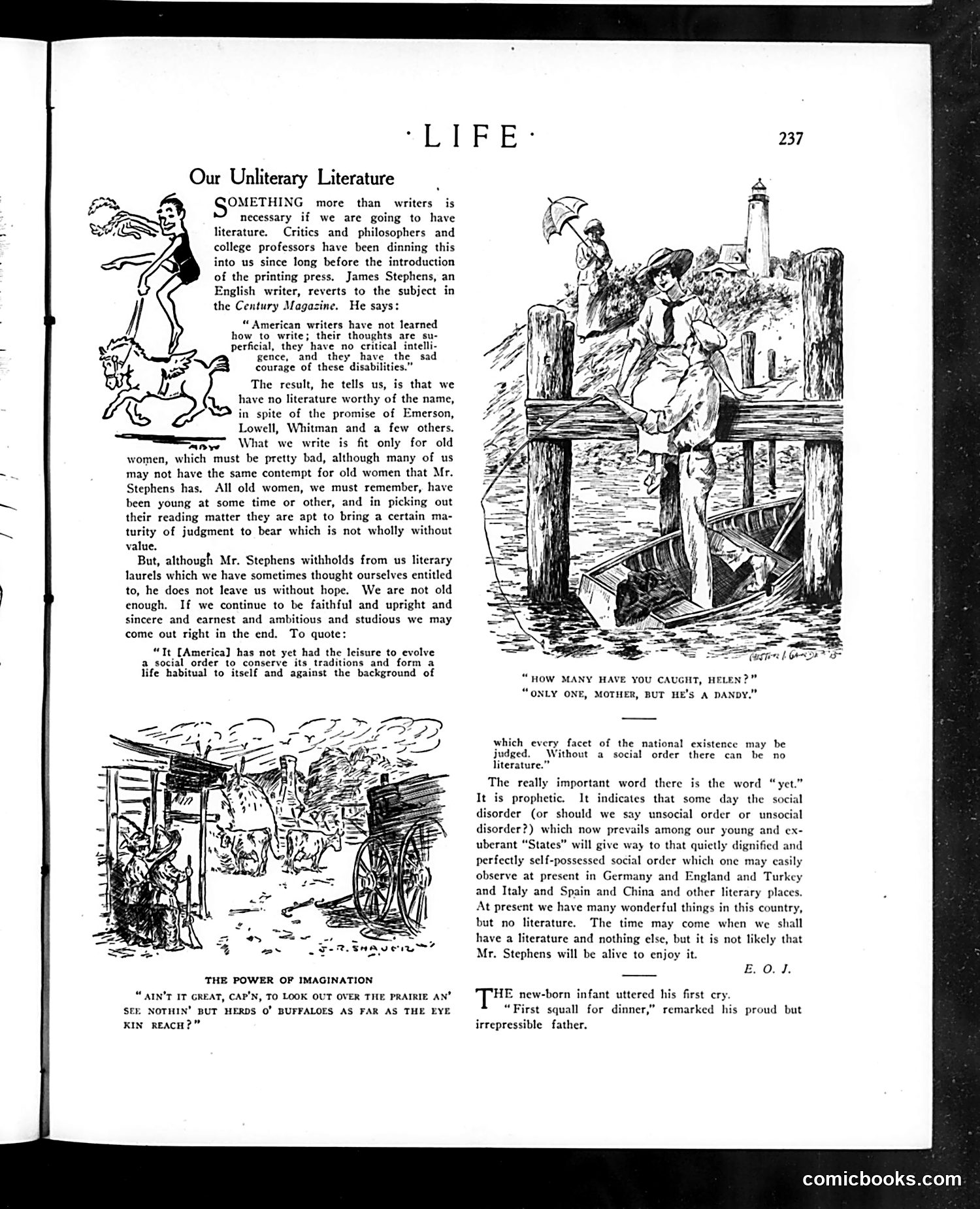
What you’re looking at
This page critiques American literary pretensions through satirical commentary on English writer James Stephens's dismissal of American letters. Stephens argues Americans lack the critical intelligence and social order necessary for "real" literature, writing only for "old women"—an insulting proxy for lowbrow audiences. Life's response is gently mocking: the magazine agrees America hasn't yet produced great literature but suggests that with time and virtue, it might. The satire targets both Stephens's snobbery and American cultural anxiety about European superiority. The accompanying cartoons are humorous vignettes (buffalo on prairie; fishing scene; newborn's first cry) illustrating ordinary life—implying everyday American experience contains more vitality and humor than pretentious European "literary" societies like Germany, England, and Turkey that Stephens praises. The overall point: America's youthful vigor may eventually produce genuine literature superior to ossified Old World establishments.
📄 Transcribed text from this page (OCR, searchable)
Machine-transcribed from the original scan — historical spelling and the odd misread are preserved.
"LIP E- Our Ualiterary Literature OMETHING more than writers is necessary if we are going to have literature. Critics and philosophers and college professors have been dinning this into us since long before the introduction of the printing press. James Stephens, an English writer, reverts to the subject in the Century Magazine. He says: “ American writers have not learned how to write; their thoughts are su- perficial, they have no critical intelli- gence, and they have the sad courage of these disabilities.” The result, he tells us, is that we have no literature worthy of the name, ts in spite of the promise of Emerson, Lowell, Whitman and a few others. “anys What we write is fit only for old women, which must be pretty bad, although many of us may not have the same contempt for old women that Mr. Stephens has. All old women, we must remember, have been young at some time or other, and in picking out their reading matter they are apt to bring a certain ma- turity of judgment to bear which is not wholly without value. But, although Mr. Stephens withholds from us literary laurels which we have sometimes thought ourselves entitled to, he does not leave us without hope. We are not old enough. If we continue to be faithful and upright and sincere and earnest and ambitious and studious we may come out right in the end. To quote: “Tt [America] has not yet had the leisure to evolve a social order to conserve its traditions and form a life habitual to itself and against the background of THE POWER OF IMAGINATION “ AIN'T IT GREAT, CAP'N, TO LOOK OUT OVER THE PRAIRIE AN’ SEE NOTHIN’ BUT HERDS 0’ BUFFALOES AS FAR AS THE EYE KIN REACH?” arn (aston b “HOW MANY HAVE YOU CAUGHT, HELEN?” which every facet of the national existence may be judged, Without a social order there can be no literature.” The really important word there is the word “yet.” It is prophetic. It indicates that some day the sc disorder (or should we say unsocial order or unsocial disorder?) which now prevails among our young and cx- uberant “States” will give way to that quietly dignified and perfectly self-possessed social order which one may casily observe at present in Germany and England and Turkey and Italy and Spain and China and other literary places. At present we have many wonderful things in this country, but no literature. The time may come when we shall have a literature and nothing else, but it is not likely that Mr. Stephens will be alive to enjoy it. EB. 0.45 'HE new-born infant uttered his first cry. “First squall for dinner,” remarked his proud but irrepressible father. comicbooks.com