
Life, 1915-08-05 · page 14 of 44
Life — August 5, 1915 — page 14: what you’re looking at
What you’re looking at
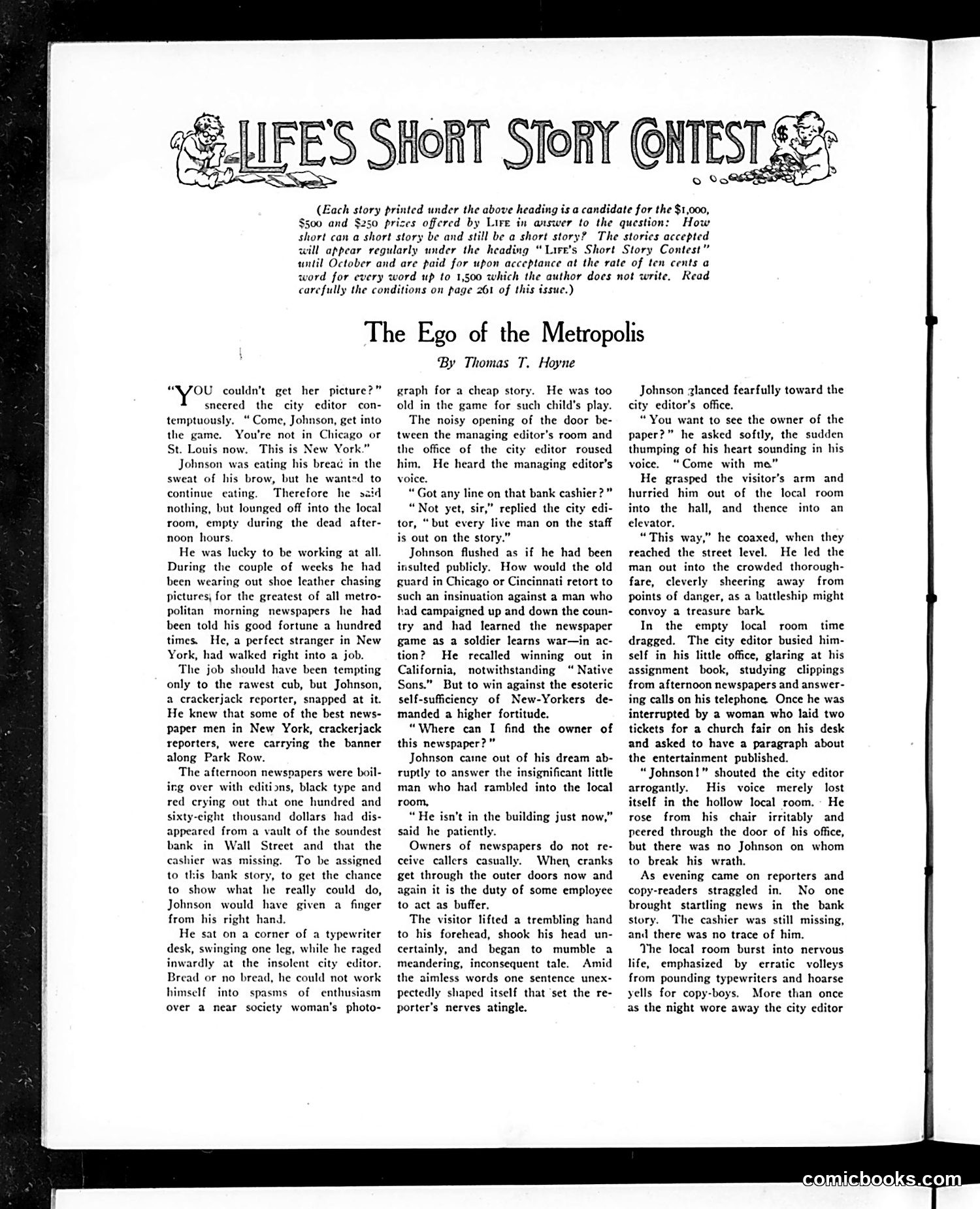
This is a short story submission for Life's contest, not a political cartoon. The narrative satirizes newspaper journalism culture in New York City, specifically mocking the ego and self-importance of editors and reporters. The plot concerns Johnson, an ambitious but struggling reporter who attempts to gain access to a newspaper owner to pitch a story idea. Instead of meeting the owner, Johnson encounters various office staff and bureaucratic obstacles—ultimately being dismissed by the city editor as insignificant. The satire targets the hierarchical, dismissive nature of big-city newspaper offices and the inflated egos of those controlling editorial decisions. It's social commentary on workplace power dynamics and journalistic pretension rather than political satire.
📄 Transcribed text from this page (OCR, searchable)
Machine-transcribed from the original scan — historical spelling and the odd misread are preserved.
JIFES SHORT STORY GNTESTS (Each story printed under the above heading is a candidate for the $1,000, $500 and $250 prizes offered by Lire in answer to the question: How short cana short story be and still be a short story? The stories accepted will appear regularly under the heading “Lire’s Short Story Contest” until October and are paid for upon acceptance at the rate of ten cents a word for every word up to 1,500 which the author does not write. carefully the conditions on page 261 of this issue.) Read The Ego of the Metropolis By Thomas T. Hoyne “you sneered temptuously. couldn't get her picture?” the city editor con- Come, Johnson, get into the game. You're not in Chicago or St. Louis now. This is New York.” Johnson was eating his bread in the sweat of his brow, but he wanted to continue eating. Therefore he said nothing, but lounged off into the local room, empty during the dead after- noon hours He was lucky to be working at all. During the couple of weeks he had been wearing out shoe leather chasing pictures, for the greatest of all metro- politan morning newspapers he had been told his good fortune a hundred times. He, a perfect stranger in New York, had walked right into a job. The job should have been tempting only to the rawest cub, but Johnson, a crackerjack reporter, snapped at it. He knew that some of the best news- paper men in New York, crackerjack reporters, were carrying the banner along Park Row. The afternoon newspapers were boil- ing over with editions, black type and red crying out that one hundred and sixty-eight thousand dollars had dis- appeared from a vault of the soundest bank in Wall Street and that the cashier was missing. To be assigned to this bank story, to get the chance to show what he really could do, Johnson would have given a finger from his right hand. He sat on a corner of a typewriter desk, swinging one leg, while he raged inwardly at the insolent city editor. Bread or no bread, he could not work himself into spasms of enthusiasm over a near society woman's photo- graph for a cheap story. He was too old in the game for such child’s play. The noisy opening of the door be- tween the managing editor’s room and the office of the city editor roused him, He heard the managing editor’s voice. “Got any line on that bank cashier?” “Not yet, sir,” replied the city edi- tor, “but every live man on the staff is out on the story.” Johnson flushed as if he had been insulted publicly. How would the old guard in Chicago or Cincinnati retort to such an insinuation against a man who had campaigned up and down the coun- try and had learned the newspaper game as a soldier learns war—in ac- tion? He recalled winning out in California, notwithstanding “ Native Sons.” But to win against the esoteric self-sufficiency of New-Yorkers de- manded a higher fortitude. “Where can I find the owner of this newspaper?” Johnson caine out of his dream ab- ruptly to answer the insignificant little man who had rambled into the local room, “He isn’t in the building just now,” said he patiently. Owners of newspapers do not re- ceive callers casually. When cranks get through the outer doors now and again it is the duty of some employee to act as buffer. The visitor lifted a trembling hand to his forehead, shook his head un- certainly, and began to mumble a meandering, inconsequent tale. Amid the aimless words one sentence unex- pectedly shaped itself that ‘set the re- porter’s nerves atingle. Johnson glanced fearfully toward the city editor's office. “You want to see the owner of the paper?” he asked softly, the sudden thumping of his heart sounding in his voice. “Come with ma” He grasped the visitor's arm and hurried him out of the local room into the hall, and thence into an elevator. “This way,” he coaxed, when they reached the street level. He led the man out into the crowded thorough- fare, cleverly sheering away from points of danger, as a battleship might convoy a treasure bark In the empty local room time dragged. The city editor busied him- self in his little office, glaring at his assignment book, studying clippings from afternoon newspapers and answer- ing calls on his telephone Once he was interrupted by a woman who laid two tickets for a church fair on his desk and asked to have a paragraph about the entertainment published. “Johnson!” shouted the city editor arrogantly. His voice merely lost itself in the hollow local room. - He rose from his chair irritably and peered through the door of his office, but there was no Johnson on whom to break his wrath. As evening came on reporters and copy-readers straggled in. No one brought startling news the bank story. The cashier was still missing, and there was no trace of him. The local room burst into nervous life, emphasized by erratic volleys from pounding typewriters and hoarse yells for copy-boys. More than once as the night wore away the city editor