
Life, 1915-08-05 · page 26 of 44
Life — August 5, 1915 — page 26: what you’re looking at
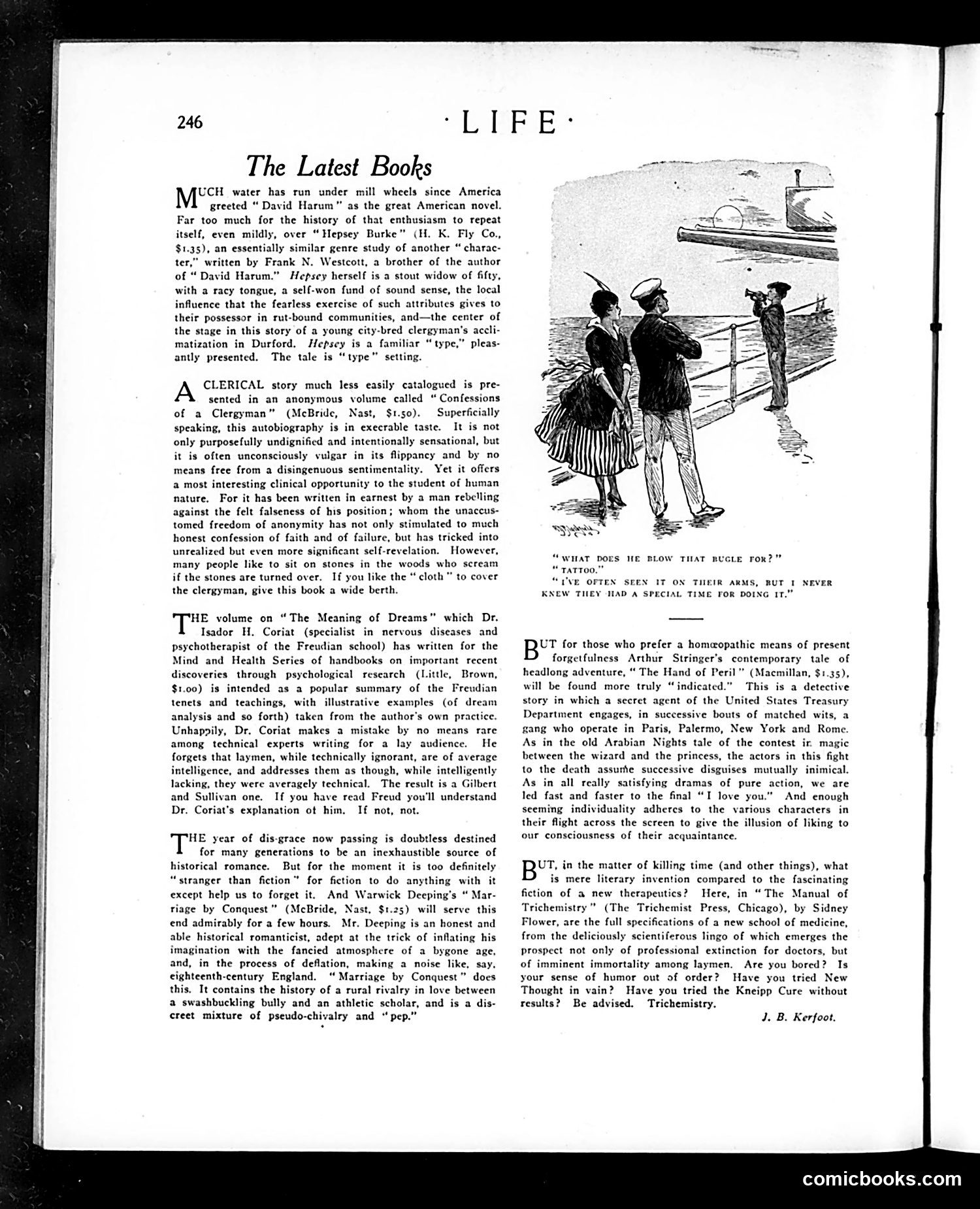
What you’re looking at
The sketch depicts a young woman and man at a waterfront, with a steamship visible. The woman asks "What does he blow that bugle for?" The man replies "Tattoo," prompting her to say "I've often seen it on their arms, but I never knew they had a special time for doing it." **The joke:** The woman misunderstands "tattoo" (the bugle call signaling soldiers to return to barracks) as referring to tattoos—the permanent ink markings on sailors' and soldiers' arms. Her confusion plays on the double meaning of the word, and her comment about seeing tattoos "on their arms" suggests she's observing sailors, making the misunderstanding plausible in a waterfront setting. **Satire level:** Mild and gentle—poking fun at urban civilian unfamiliarity with military terminology and practices, a common source of humor in period magazines.
📄 Transcribed text from this page (OCR, searchable)
Machine-transcribed from the original scan — historical spelling and the odd misread are preserved.
ge Da bale The Latest Books UCH water has run under mill wheels since America greeted “ David Harum” as the great American novel. Far too much for the history of that enthusiasm to repeat itself, even mildly, over “Hepsey Burke” (H. K. Fly Co., $1.35), an essentially similar genre study of another “ charac- ter,” written by Frank N. Westcott, a brother of the author of “ David Harum.” Hepsey herself is a stout widow of fifty, with a racy tongue, a self-won fund of sound sense, the local influence that the fearless exercise of such attributes gives to their possessor in rut-bound communities, and—the center of the stage in this story of a young city-bred clergyman’s accli- matization in Durford. Hepsey is a familiar “type,” pleas- antly presented. The tale is “type” setting. CLERICAL story much less easily catalogued is pre- sented in an anonymous volume called “Confessions of a Clergyman” (McBride, Nast, $1.50). Superficially speaking, this autobiography is in execrable taste. It is not only purposefully undignified and intentionally sensational, but it is often unconsciously vulgar in its flippancy and by no means free from a disingenuous sentimentality. Yet it offers a most interesting clinical opportunity to the student of human nature. For it has been written in earnest by a man rebelling against the felt falseness of his position; whom the unaccus- tomed freedom of anonymity has not only stimulated to much honest confession of faith and of failure, but has tricked into unrealized but even more significant self-revelation. However, many people like to sit on stones in the woods who scream if the stones are turned over. If you like the “cloth " to cover the clergyman, give this book a wide berth. HE volume on “The Meaning of Dreams” which Dr. Isador H. Coriat (specialist in nervous diseases and psychotherapist of the Freudian school) has written for the Mind and Health Series of handbooks on important recent discoveries through psychological research (Little, Brown, $1.00) is intended as a popular summary of the Freudian tenets and teachings, with illustrative examples (of dream analysis and so forth) taken from the author's own practice. Unhappily, Dr. Coriat makes a mistake by no means rare among technical experts writing for a lay audience. He forgets that laymen, while technically ignorant, are of average intelligence, and addresses them as though, while intelligently lacking, they were averagely technical. The result is a Gilbert and Sullivan one. If you have read Freud you'll understand Dr. Coriat's explanation ot him. If not, not. HE year of dis-grace now passing is doubtless destined for many generations to be an inexhaustible source of historical romance. But for the moment it is too definitely “stranger than fiction” for fiction to do anything with it except help us to forget it. And Warwick Deeping’s “ Mar- riage by Conquest” (McBride, Nast, $1.25) will serve this end admirably for a few hours. Mr. Deeping is an honest and able historical romanticist, adept at the trick of inflating his imagination with the fancied atmosphere of a bygone age, and, in the process of deflation, making a noise like, say. eighteenth-century England. “ Marriage by Conquest” does this, It contains the history of a rural rivalry in love between a swashbuckling bully and an athletic scholar, and is a dis- creet mixture of pseudo-chivalry and “pep.” “WITAT DOES NE BLOW THAT RUGLE rox?” “ TaTT00." “UVE OFTEN 5: IT ON THEIR ARMS, BUT T NEVER KNEW THEY JAD A SPECIAL TIME TOR DOING IT.” UT for those who prefer a homaopathic means of present forgetfulness Arthur Stringer’s contemporary tale of headlong adventure, “ The Hand of Peril” (Macmillan, $1.35), will be found more truly “indicated.” This is a detective story in which a secret agent of the United States Treasury Department engages, in successive bouts of matched wits, a gang who operate in Paris, Palermo, New York and Rome As in the old Arabian Nights tale of the contest ir. magic between the wizard and the princess, the actors in this fight to the death assunte successive disguises mutually inimical. As in all really satisfying dramas of pure action, we are led fast and faster to the final “I love you." And enough seeming individuality adheres to the various characters in their flight across the screen to give the illusion of liking to our consciousness of their acquaintance. B in the matter of killing time (and other things), what is mere literary invention compared to the fascinating fiction of a new therapeutics? Here, in “The Manual of Trichemistry” (The Trichemist Press, Chicago), by Sidney Flower, are the full specifications of a new school of medicine, from the deliciously scientiferous lingo of which emerges the prospect not only of professional extinction for doctors, but of imminent immortality among laymen. Are you bored? Is your sense of humor out of order? Have you tried New Thought in vain? Have you tried the Kneipp Cure without results? Be advised. Trichemistry. J. B. Kerfoot. comicbooks.com