
A complete issue · 44 pages · 1915
Life — April 29, 1915
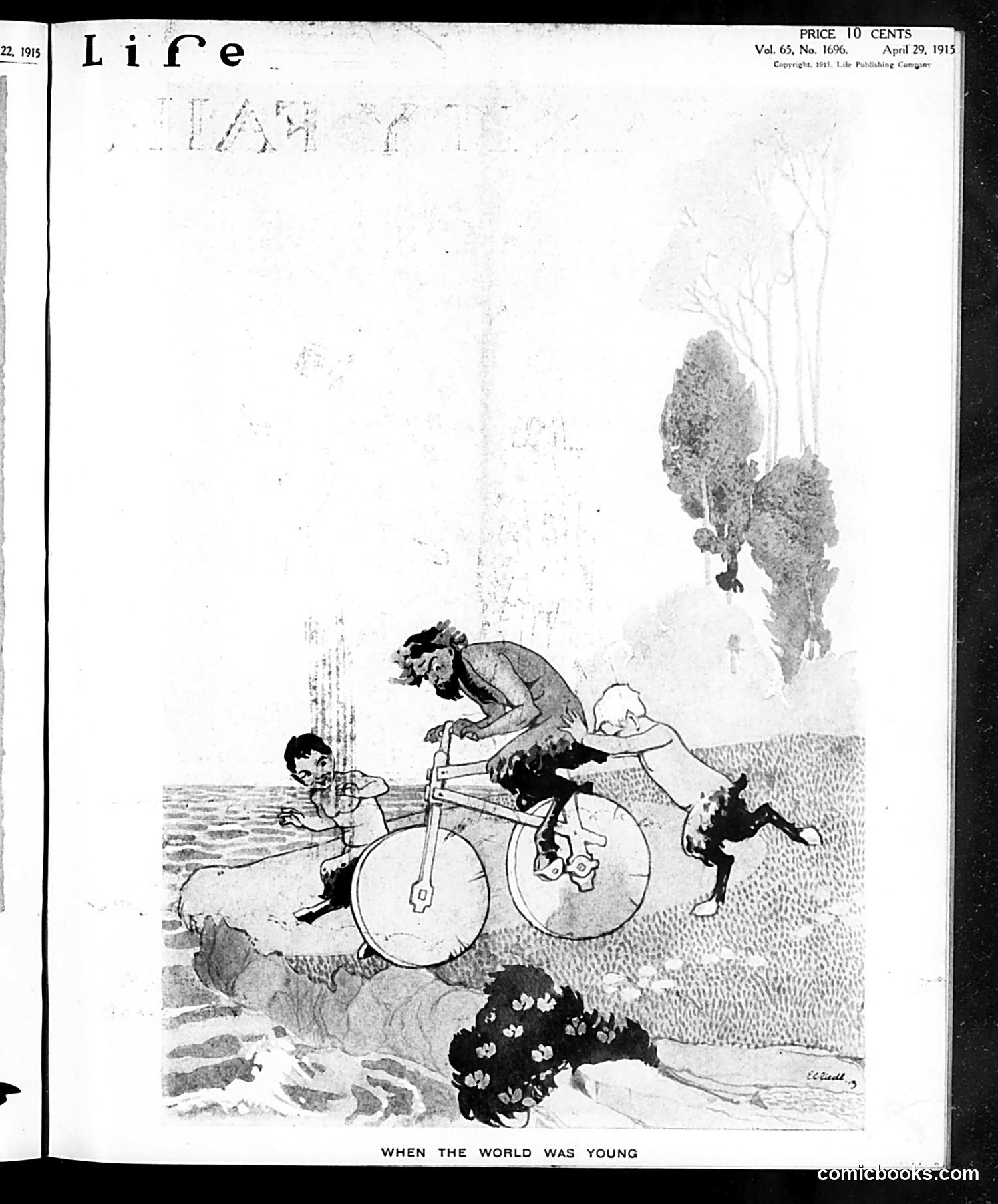
This April 1915 *Life* magazine cover depicts a nostalgic, whimsical scene titled "When the World Was Young." The illustration shows children riding a bicycle together through an idyllic pastoral landscape with trees and flowers. The satire likely comments on innocence and simpler times, possibly offering escapist comfort during World War I, which had begun in Europe the previous year. The "world was young" framing suggests longing for an earlier, less complicated era before modern industrial warfare. By 1915, America remained officially neutral but increasingly concerned about the conflict. The image's dreamlike quality and focus on childhood innocence contrasts sharply with contemporary wartime realities, making it characteristic of *Life*'s satirical social commentary during this period.
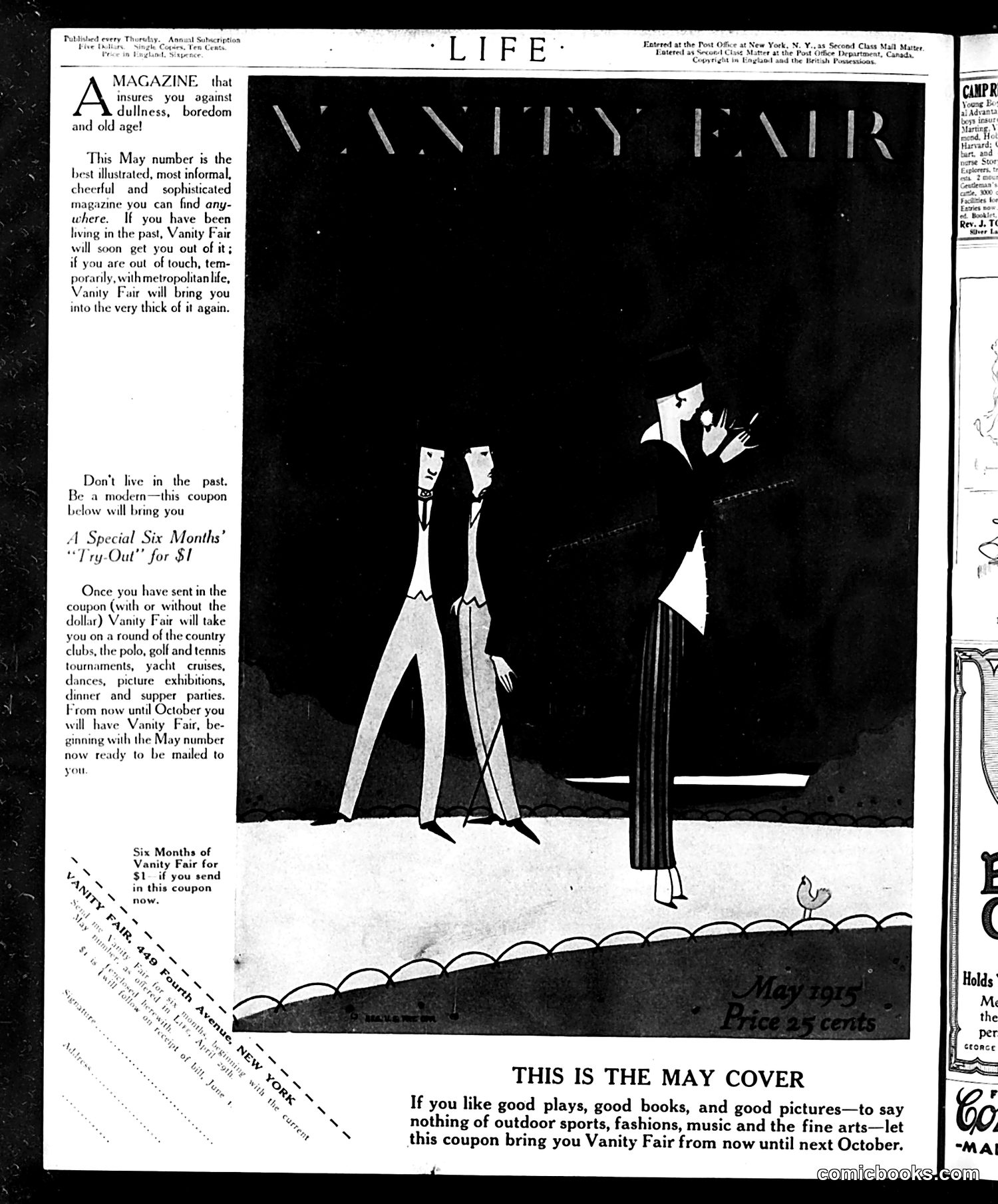
This cover illustration depicts a stylized nighttime scene with elongated, modernist figures in formal attire. Two tall figures appear to converse while a third figure in a top hat stands to the right, with dramatic angular shapes suggesting a cityscape or theatrical setting. The accompanying text describes Vanity Fair as an antidote to dullness and old age, promoting a six-month subscription for $1. The magazine promises coverage of "country clubs, the polo, golf and tennis tournaments, yacht cruises, dances, picture exhibitions, dinner and supper parties." The satire likely mocks the leisure activities and social pretensions of the wealthy elite during the pre-WWI era. The geometric, exaggerated style reflects Art Deco influences popular in 1915. The overall message: sophisticated urban entertainment awaits subscribers willing to pay.
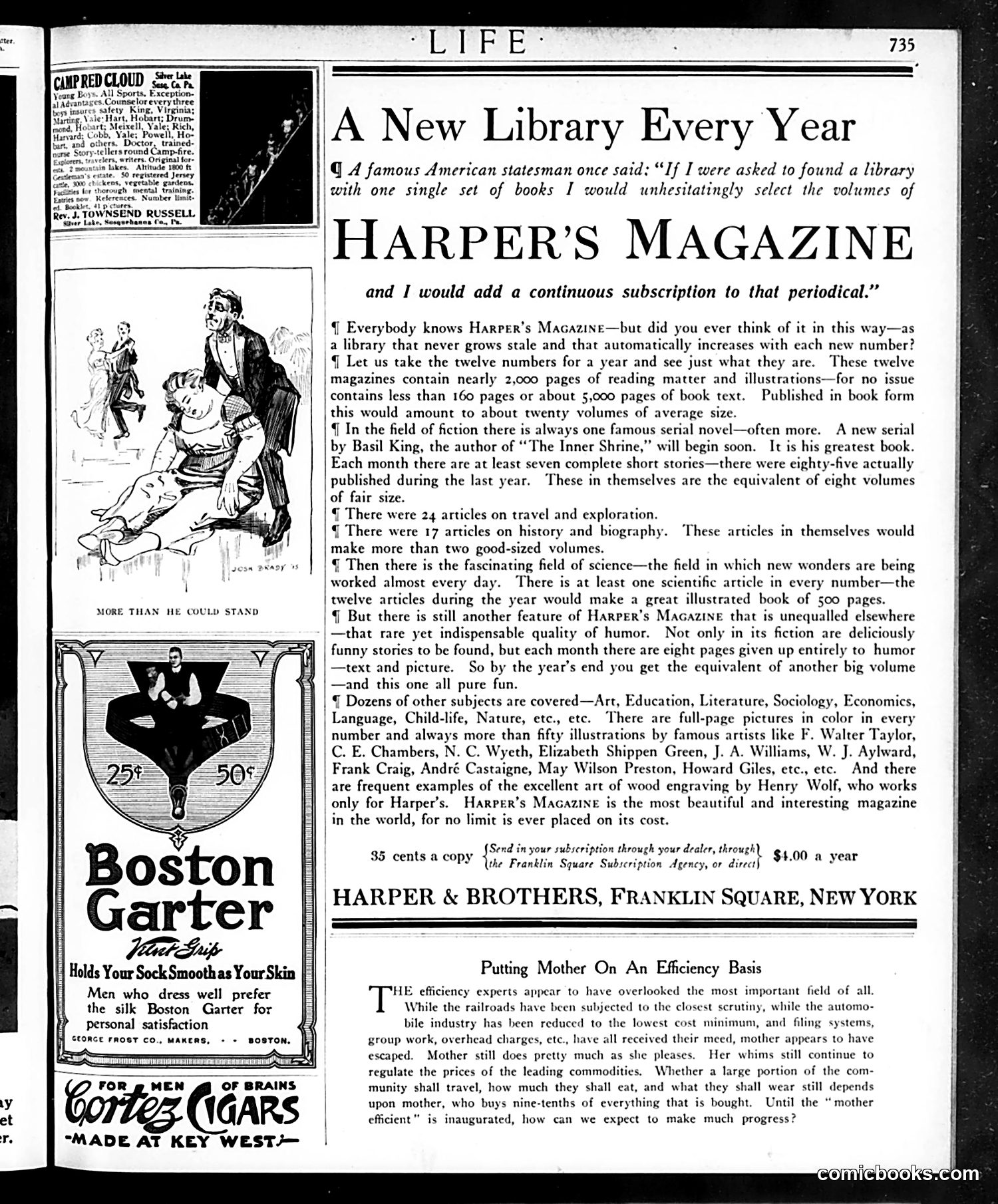
This page is primarily **advertising and editorial content** rather than political satire. The main feature is a full-page advertisement for **Harper's Magazine**, promoting its annual value as a "library" of twelve issues containing 2,000 pages of diverse content: fiction (including serial novels), travel articles, history, biography, science, and humor. The ad emphasizes Harper's affordability ($1.00/year, 35¢/copy) and artistic quality, citing illustrators like F. Walter Taylor and wood engraver Henry Wolf. Below is an editorial piece, "Putting Mother On An Efficiency Basis," criticizing the "efficiency experts" movement for overlooking household management—specifically mothers' roles in managing family consumption and budgets. The sidebar contains **product advertisements**: Boston Garter socks and Cortez Cigars. No significant political satire is evident on this page.
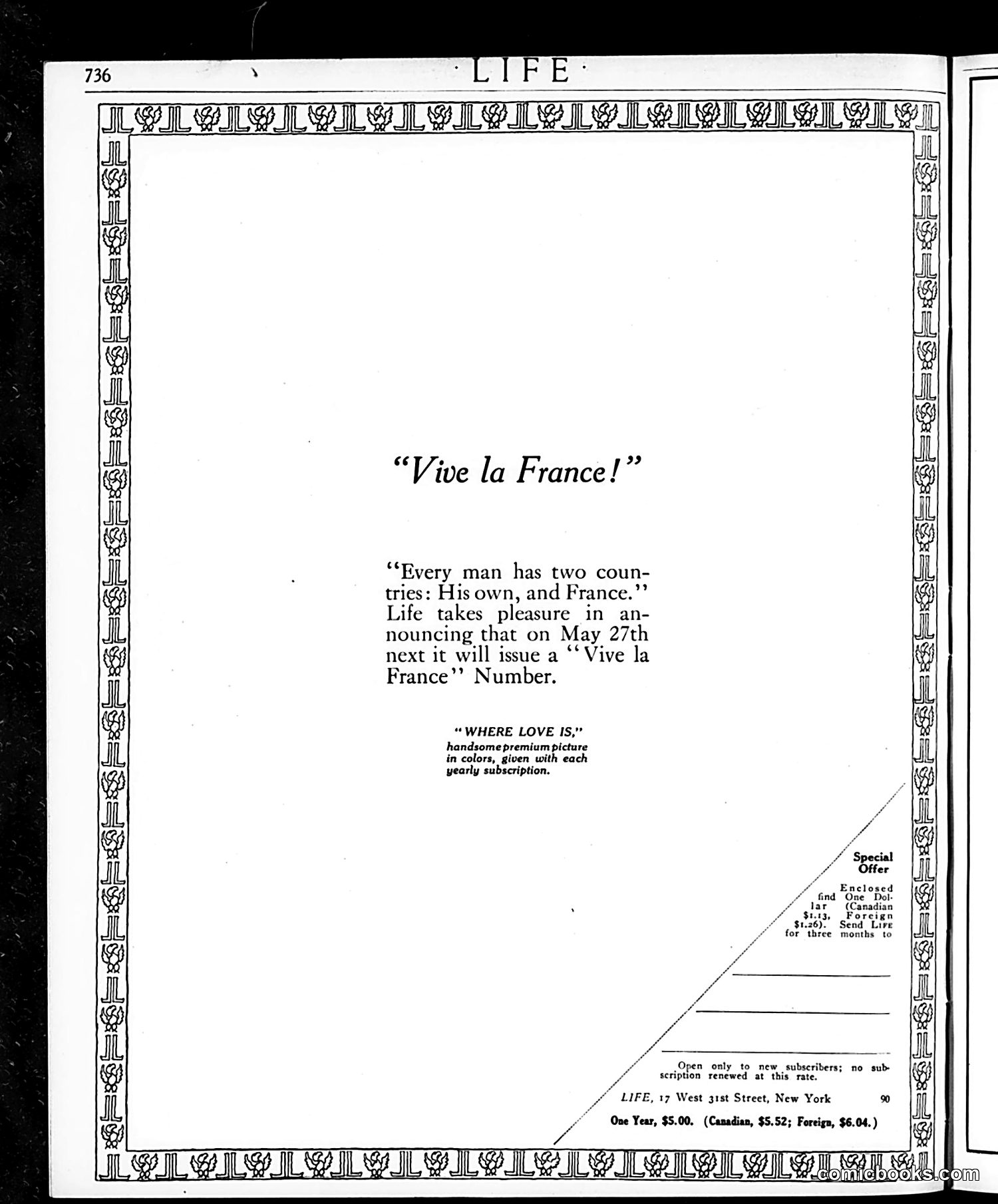
This page is primarily **advertising content** rather than editorial material. It announces an upcoming "Vive la France!" special issue for Life magazine, scheduled for May 27th. The advertisement features a patriotic French sentiment—"Every man has two countries: His own, and France"—reflecting early 20th-century American Francophilia and likely related to either World War I or Franco-American cultural ties of that era. The page offers a premium colored picture titled "Where Love Is" with pearl subscriptions. Subscription rates are listed: $5.00 annually for U.S., $5.52 Canadian, $6.04 foreign. The offer targets new subscribers only. The ornamental border features repeated floral/classical motifs typical of Life's design aesthetic from this period.
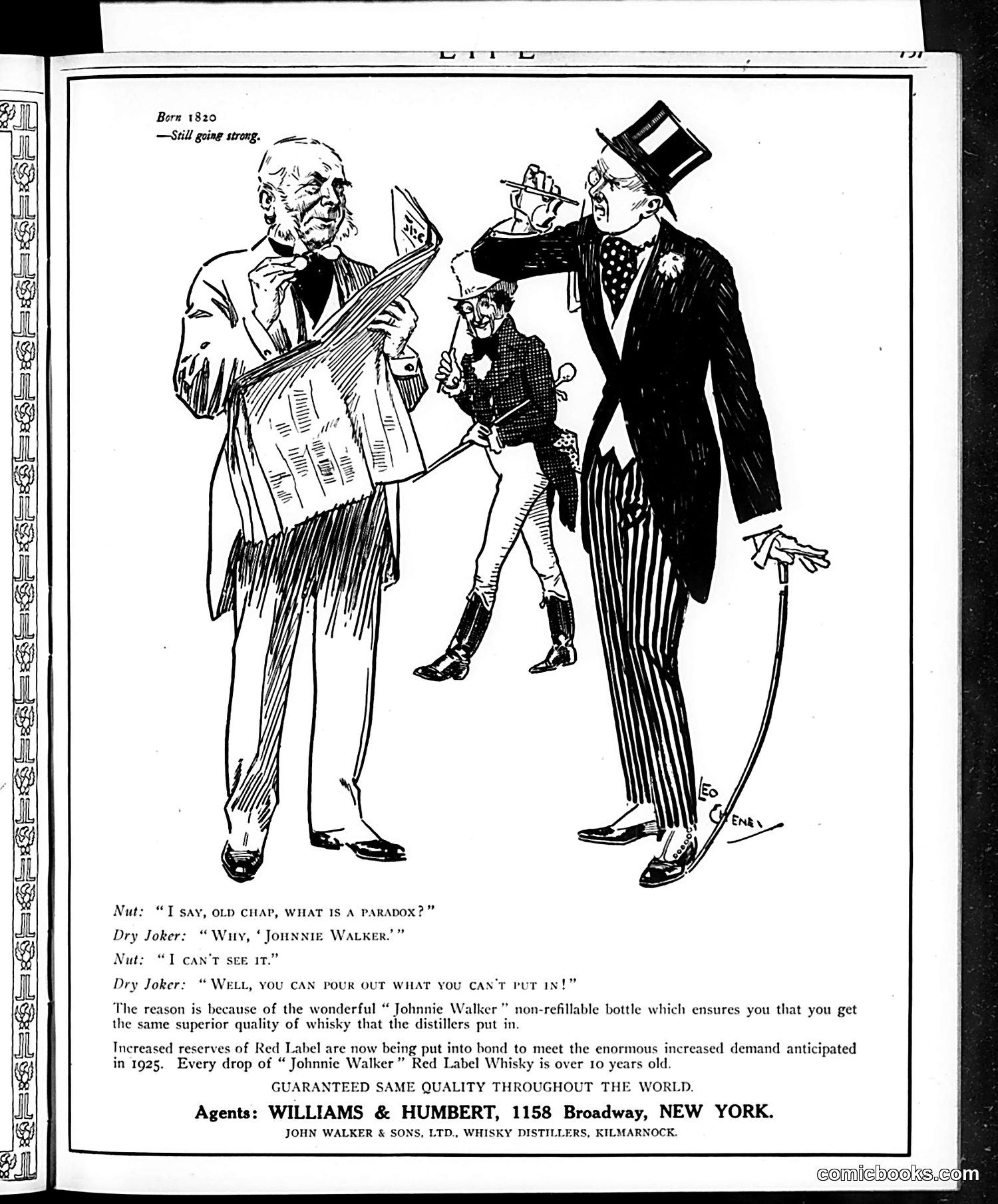
This is a **Johnnie Walker whisky advertisement** disguised as satirical humor, dated 1820. The cartoon shows three figures: an old man reading a newspaper labeled "Born 1820—Still going strong," a small jester or comedic figure in the middle, and a well-dressed gentleman on the right wearing a top hat. The "joke" is a pun: when asked what a "paradox" is, the Dry Joker responds "Why, 'Johnnie Walker.'" The paradox being that you can "pour out" whisky from the bottle without depleting it—implying the bottle's superior quality and value. The advertisement emphasizes the whisky's age (over 10 years old by 1925) and guaranteed quality, positioning Johnnie Walker as a luxury product through this clever wordplay.
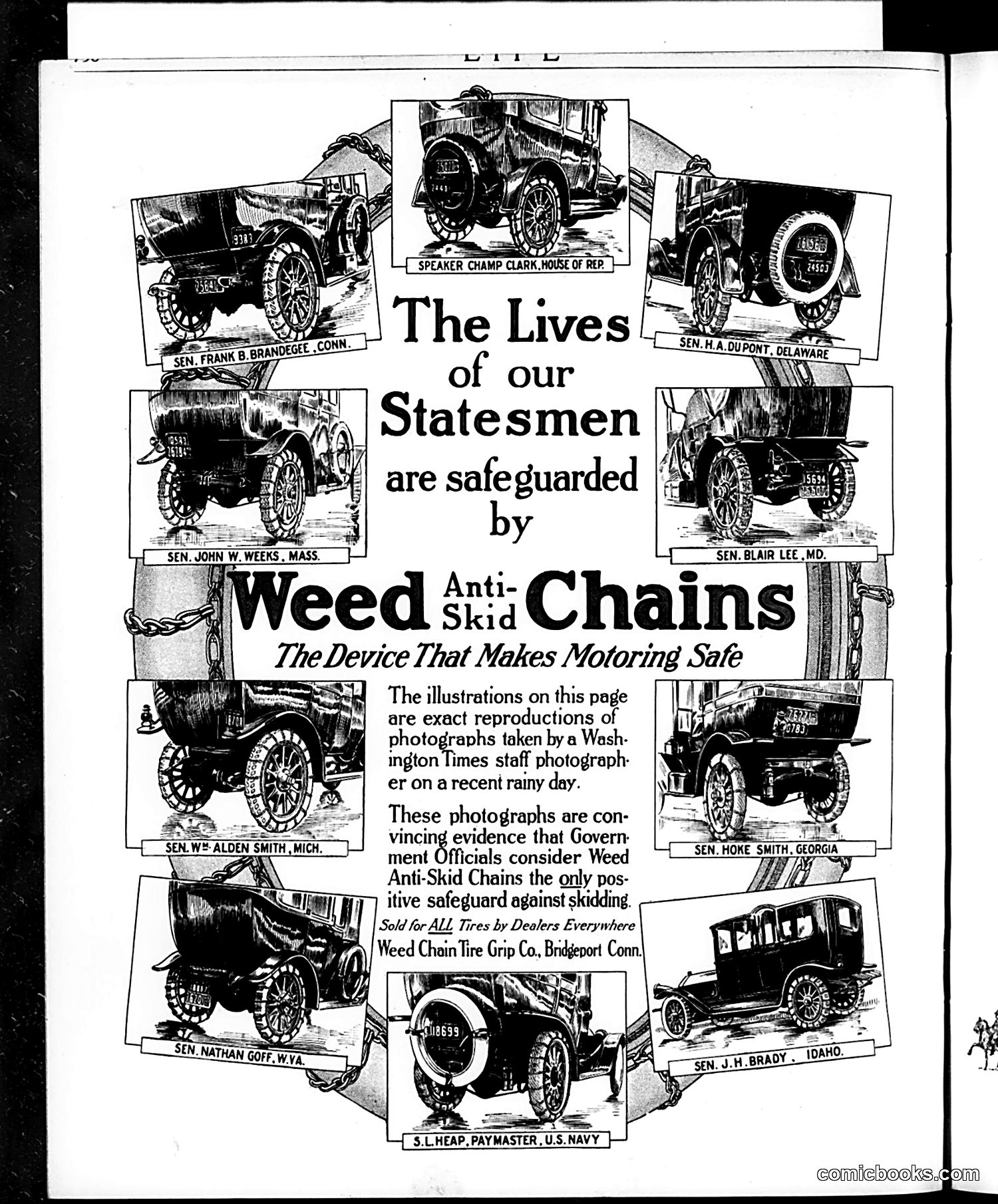
This is **primarily advertising**, not satire or political commentary. It's a promotional page for Weed Anti-Skid Chains, a tire safety device. The advertisement features photographs of early 1900s automobiles belonging to prominent U.S. senators (named in captions: Brandegee, Dupont, Weeks, Lee, Smith, Goff, and Brady), taken "on a recent rainy day" by a Washington Times photographer. The messaging claims that government officials trust Weed Anti-Skid Chains as essential safety equipment for preventing vehicle skidding in wet conditions. By associating the product with respected senators, the advertisement attempts to establish credibility and encourage consumer purchases. The text notes these are "exact reproductions of photographs"—essentially a testimonial advertisement leveraging political figures' names and images for product promotion.
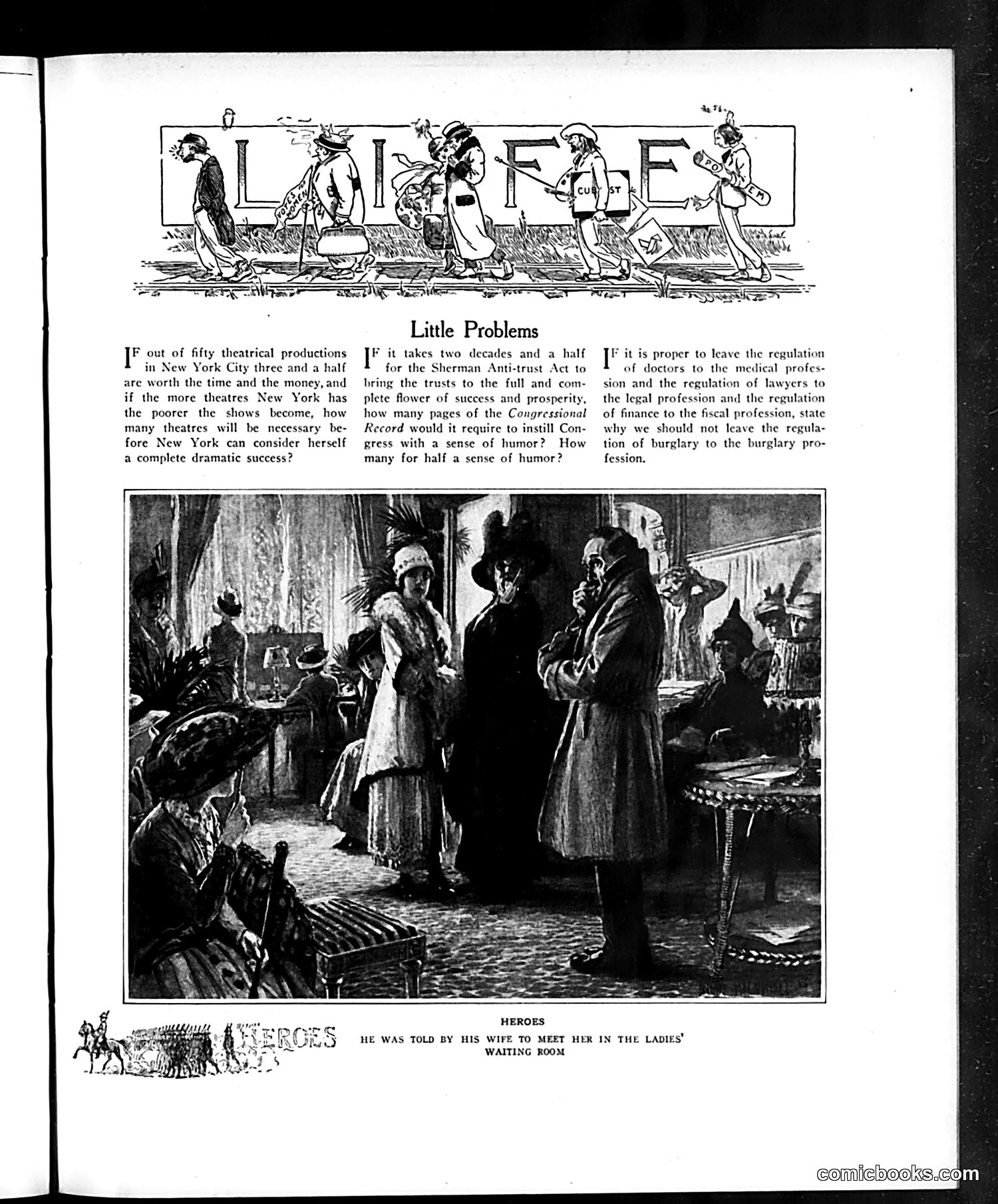
This page contains three separate satirical pieces under the heading "Little Problems": 1. **Top left**: A critique of New York theater economics—mocking the poor financial state of theaters while questioning how many more theaters the city needs before achieving "dramatic success." 2. **Center right**: Commentary on antitrust legislation, suggesting the Sherman Anti-Trust Act will take decades to address corporate trusts, sarcastically questioning whether Congress has any sense of humor about the slow pace of reform. 3. **Bottom right**: A piece titled "Heroes" with an illustration depicting a social scene. The caption reads "He was told by his wife to meet her in the ladies' waiting room"—apparently satirizing marital dynamics or domestic obedience, likely mocking a man's submissive position toward his wife's demands. All reflect early 20th-century American social and political concerns.
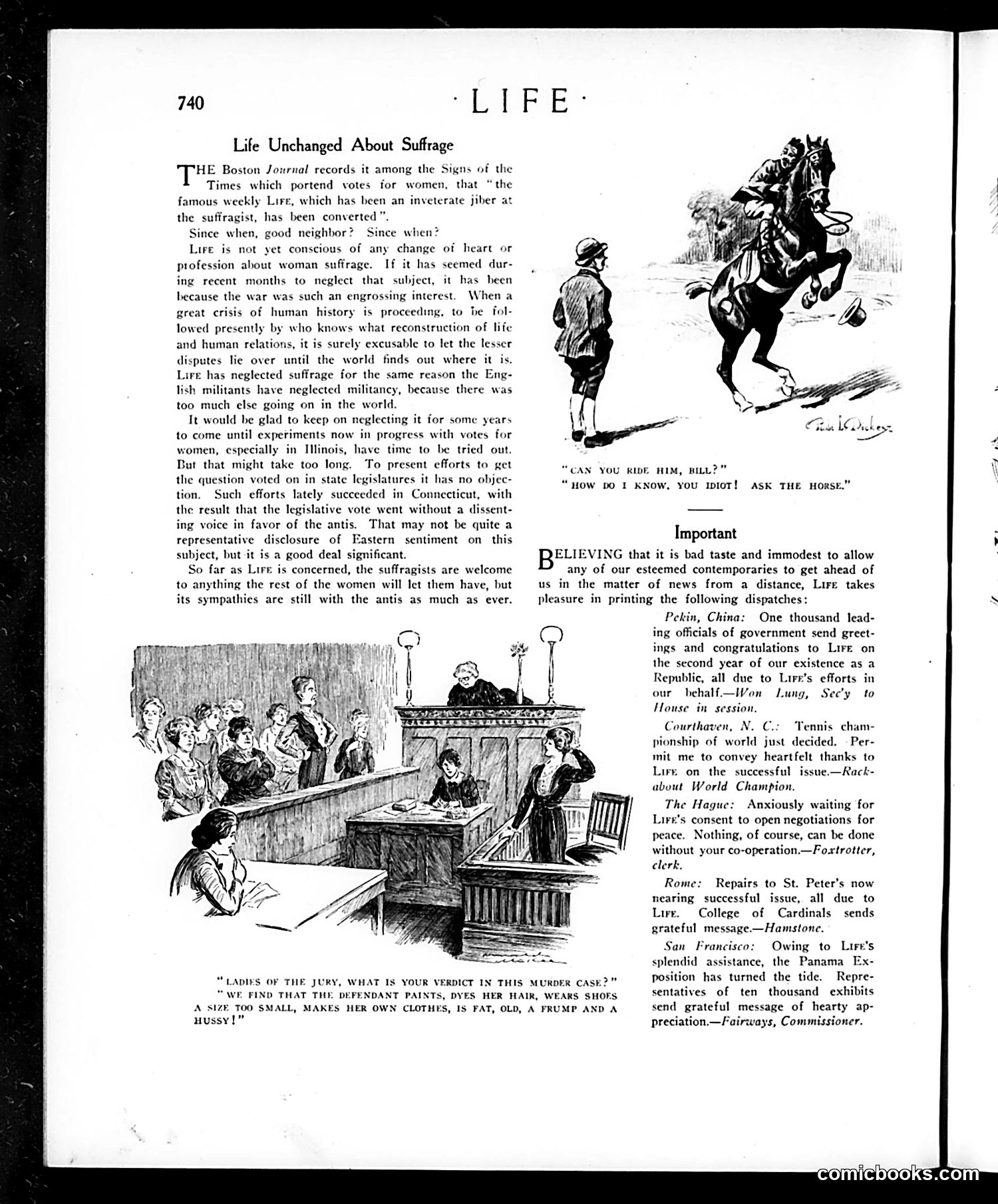
This page contains two satirical cartoons about women's suffrage. The upper cartoon depicts a mounted soldier or official on a rearing horse confronting a pedestrian, captioned "Can you ride him, Bill?" / "How do I know, you idiot? Ask the horse." This appears to mock the unpredictability of the suffrage debate. The lower cartoon shows a courtroom scene where a judge addresses a jury, with the caption suggesting jurors must evaluate a defendant described as wearing shoes, being fat and old—critiquing how women might be judged superficially rather than fairly. The accompanying text notes Life magazine's historically satirical stance on women's suffrage, explaining their recent silence is due to wartime concerns taking precedence. The piece expresses willingness to resume skepticism once peace returns.
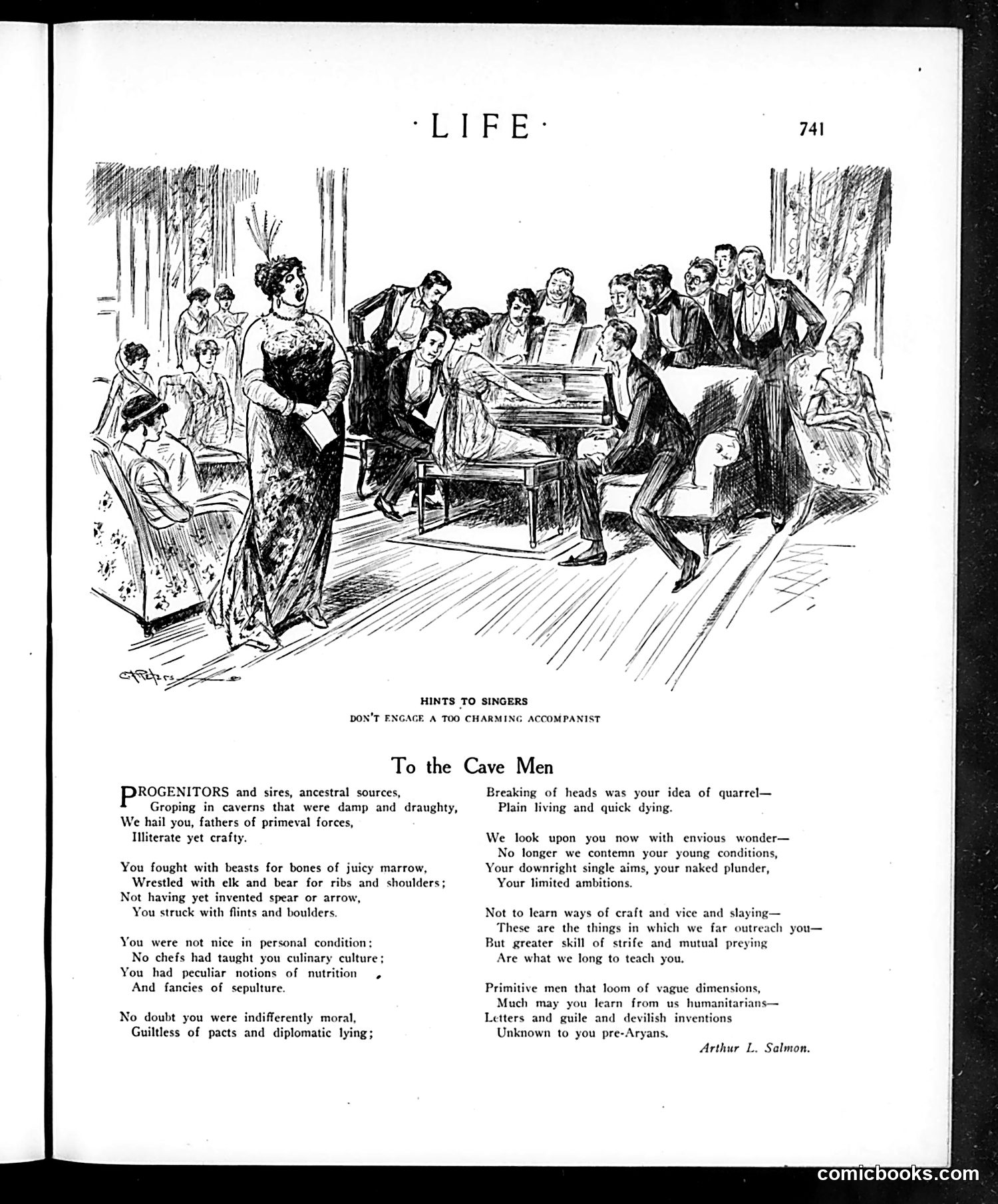
This page contains two distinct items: **Top illustration**: A satirical cartoon titled "Hints to Singers: Don't Engage a Too Charming Accompanist." It depicts a musical performance where an attractive female accompanist at the piano has distracted the male singer—he's gazing at her rather than performing. The gathered audience observes this awkward situation. The joke concerns romantic distraction undermining professional performance. **Bottom poem**: "To the Cave Men" by Arthur L. Salmon is a mock-serious verse addressing prehistoric humans. It ironically praises their simplicity while suggesting modern civilization has introduced unnecessary complexity—"craft and vice and slaying"—that primitive people avoided. The tone is satirical commentary on modern society's complications versus imagined primitive authenticity.
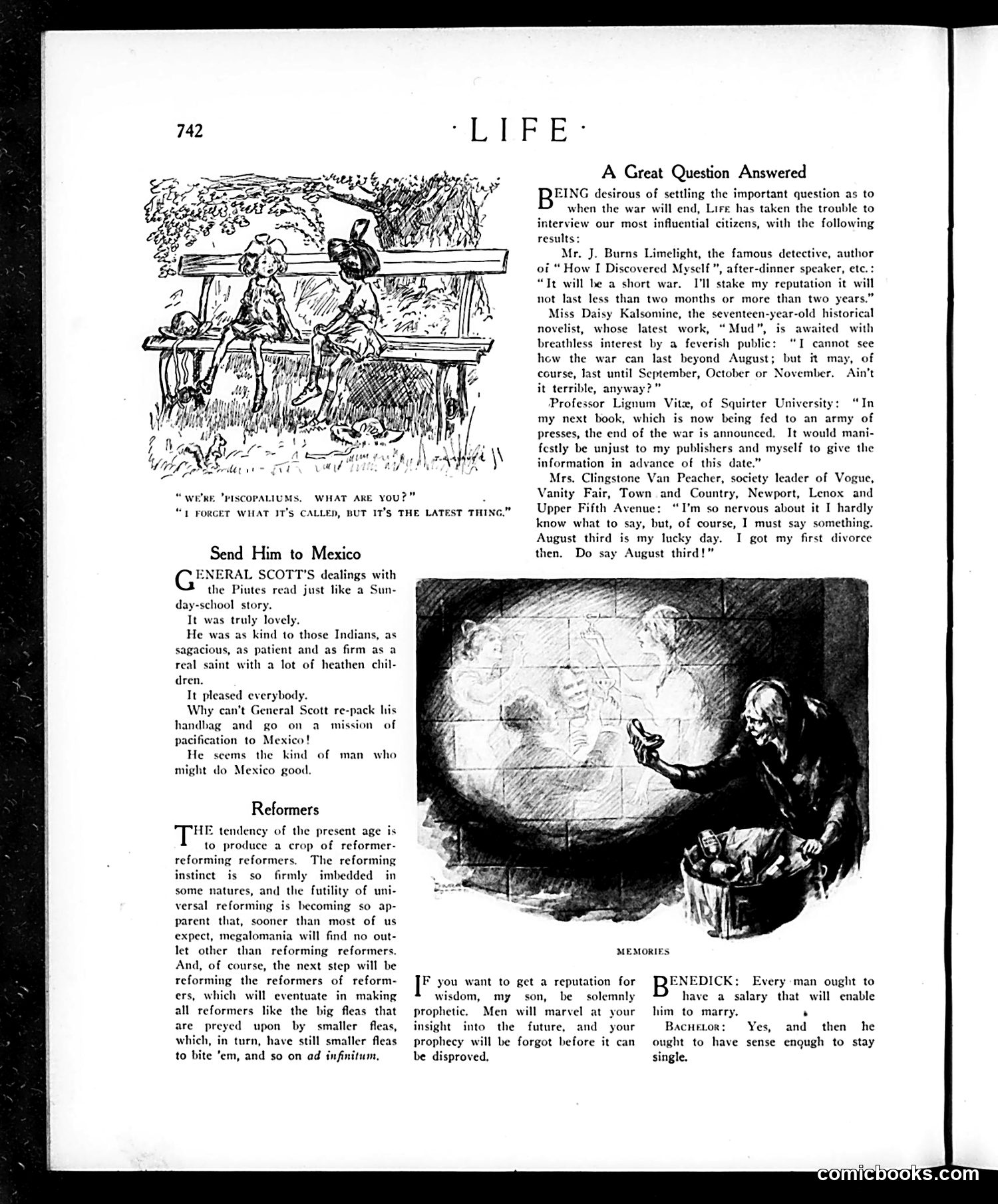
The top cartoon shows two figures on a bench labeled "We're Piscohilums. What are you?" with the caption "I forget what it's called, but it's the latest thing." This satirizes the era's trend toward newly coined or fashionable terms and social labels—people adopting trendy identities without fully understanding them. "Piscohilums" appears to be a made-up word, mocking how the wealthy classes adopted obscure terminology to signal sophistication. The "Send Him to Mexico" and "Reformers" sections below are editorial commentary. The Mexico reference suggests sending someone abroad to solve domestic problems. The "Reformers" section satirizes how reform movements breed endless "reform of reformers"—a cycle of activism eating itself, with each generation of reformers becoming targets for the next.
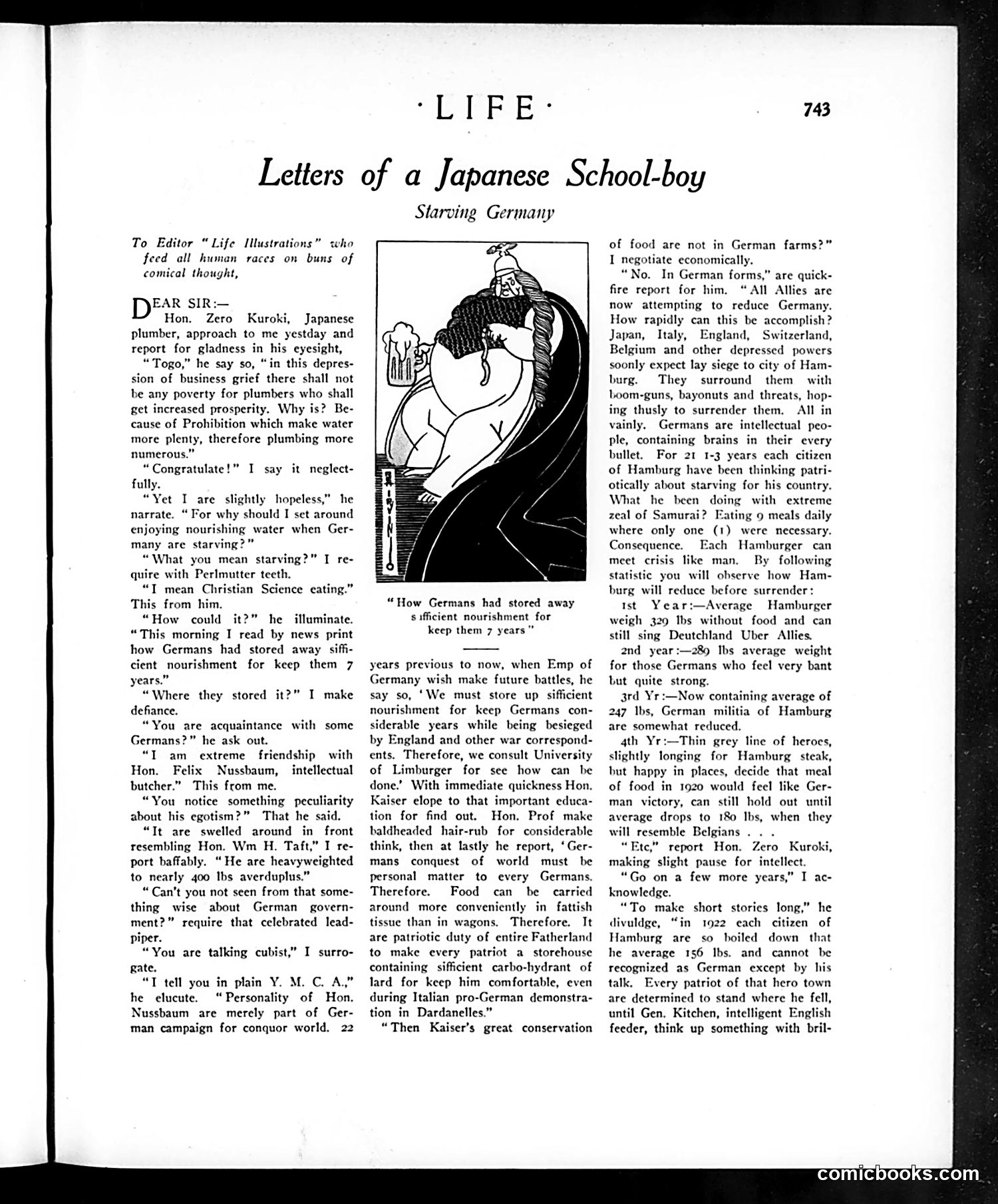
This satirical piece mocks Germany's supposed food storage claims during what appears to be WWI or the interwar period. A Japanese correspondent reports on Hon. Zero Kuroki's visit to Germany, where officials claimed to have stored sufficient nourishment to sustain the population through years of siege. The cartoon depicts a grossly obese German official hoarding food, visually contradicting the narrative of deprivation. The satire targets German propaganda about self-sufficiency while the text reveals the reality: Hamburg citizens face starvation, averaging 160-180 lbs (down from 329 lbs). The piece uses a foreign observer's perspective to expose the gap between German governmental claims and the actual suffering of civilians—a common satirical technique to highlight wartime propaganda and hypocrisy.
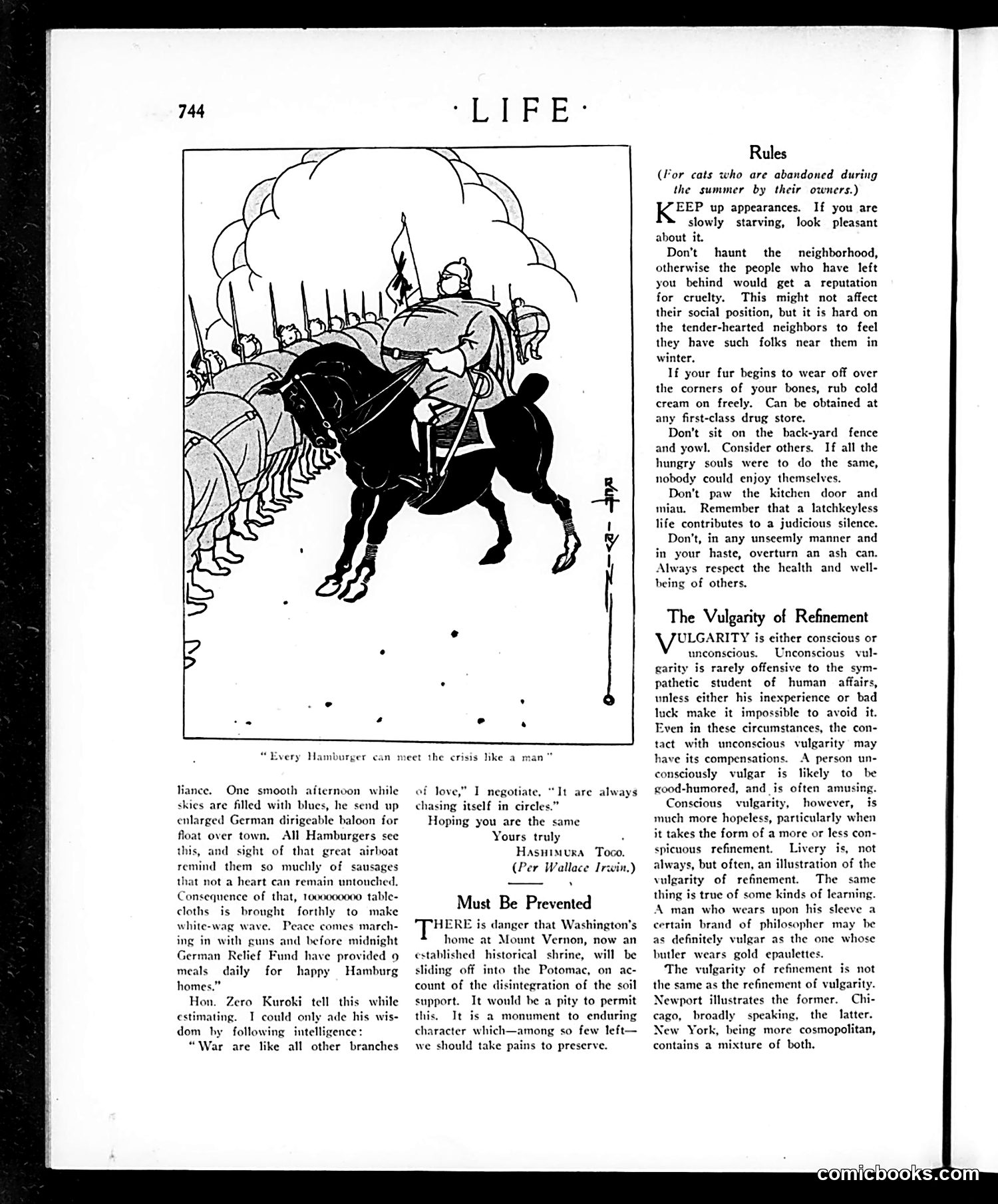
The main illustration depicts a figure on horseback entering what appears to be a fortified position or trench, captioned "Every Hamburger can meet the crisis like a man." This satirizes German resilience during wartime hardship—specifically referencing food shortages and the morale-boosting propaganda surrounding ordinary citizens' endurance. The text discusses abandoned cats left by summer vacationers, offering humorous "rules" for their conduct to avoid damaging owners' reputations. Below this are two pieces: one about German airship nostalgia, and another titled "The Vulgarity of Refinement" examining social pretension. The page appears to be from WWI-era Life magazine, mixing satirical commentary on the war with lighter domestic humor about American social manners and class anxiety.
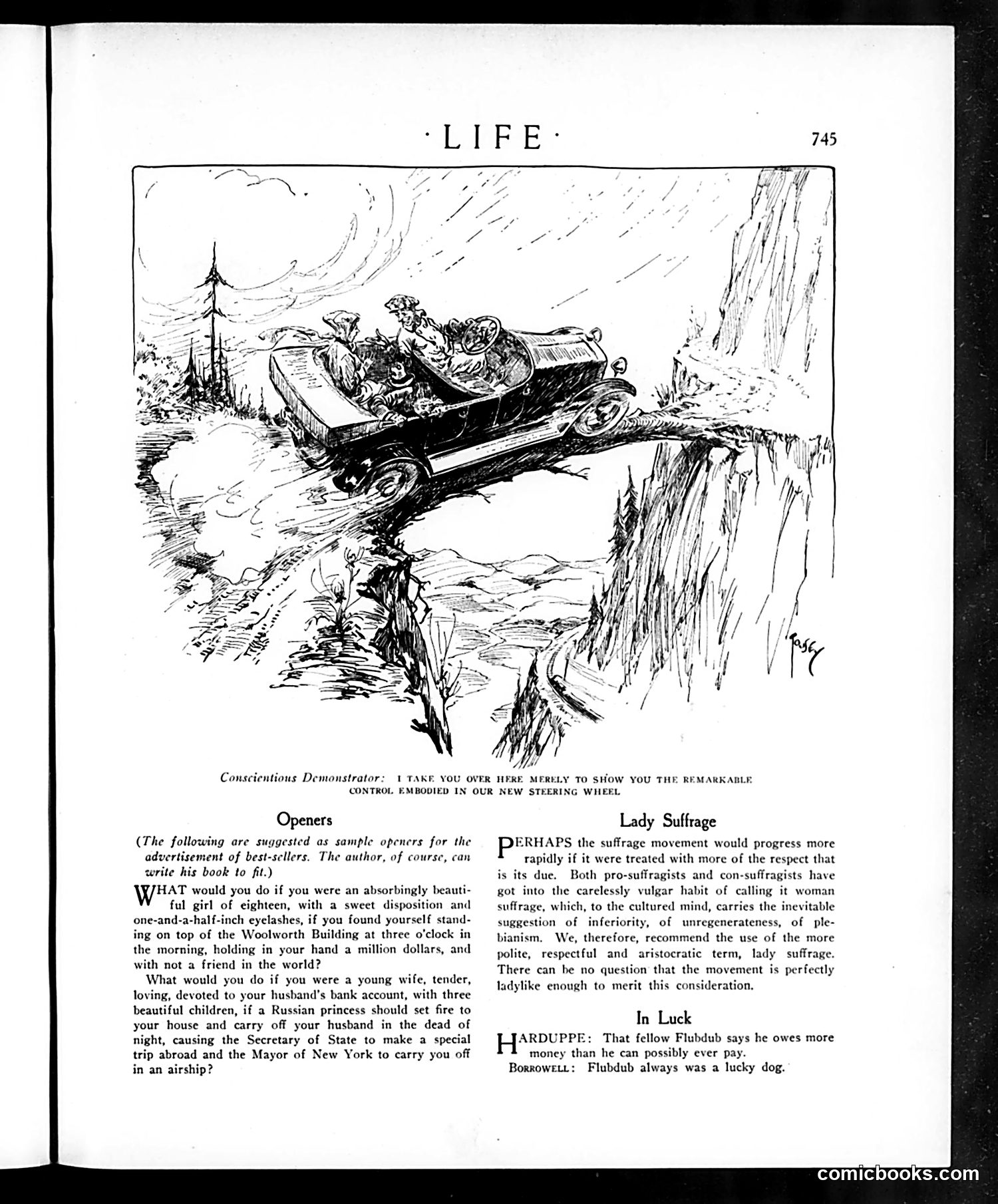
**Main Cartoon:** A dramatic sketch depicts an early automobile precariously balanced on a cliff edge, with passengers inside appearing distressed. The caption reads: "Conscientious Demonstrator: I TAKE YOU OVER HERE MERELY TO SHOW YOU THE REMARKABLE CONTROL EMBODIED IN OUR NEW STEERING WHEEL." This is satirical commentary on automobile safety advertising—the joke being that demonstrating steering control by driving dangerously near a cliff edge proves the opposite point. It mocks overzealous salesmen who use reckless stunts to promote vehicles. **Lower Content:** Three short humor pieces follow, including "Lady Suffrage" (discussing the women's voting movement) and "In Luck" (a brief joke about gambling debts). The cartoon reflects early-1900s automotive skepticism and advertising culture.
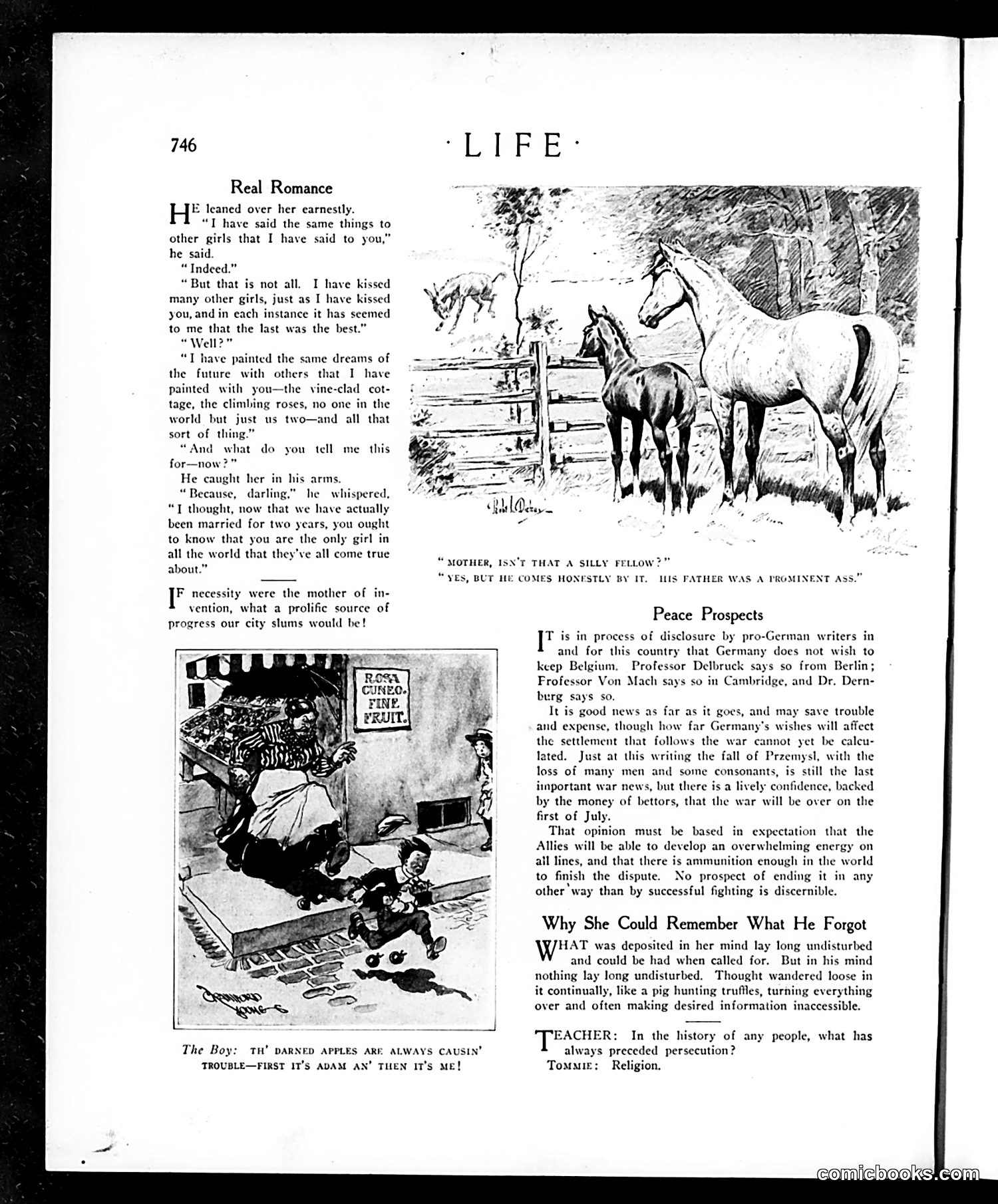
This page contains three distinct items: 1. **"Real Romance"** - A short story excerpt about a romantic couple, illustrated with a sketch of horses by a fence. 2. **"Peace Prospects"** - An article discussing German peace overtures regarding Belgium, likely from WWI era. It references Professor Delbrück from Berlin and Dr. Dernberg, suggesting diplomatic negotiations. 3. **"The Boy"** - A cartoon showing a child amid household items with the caption about "damned apples" causing trouble, playing on the Adam and Eve biblical reference as a joke about childhood mischief and blame-shifting. 4. **"Why She Could Remember What He Forgot"** - A brief humorous piece about memory and distraction. The page mixes romantic fiction, war commentary, and domestic humor typical of early 20th-century satirical magazine content.
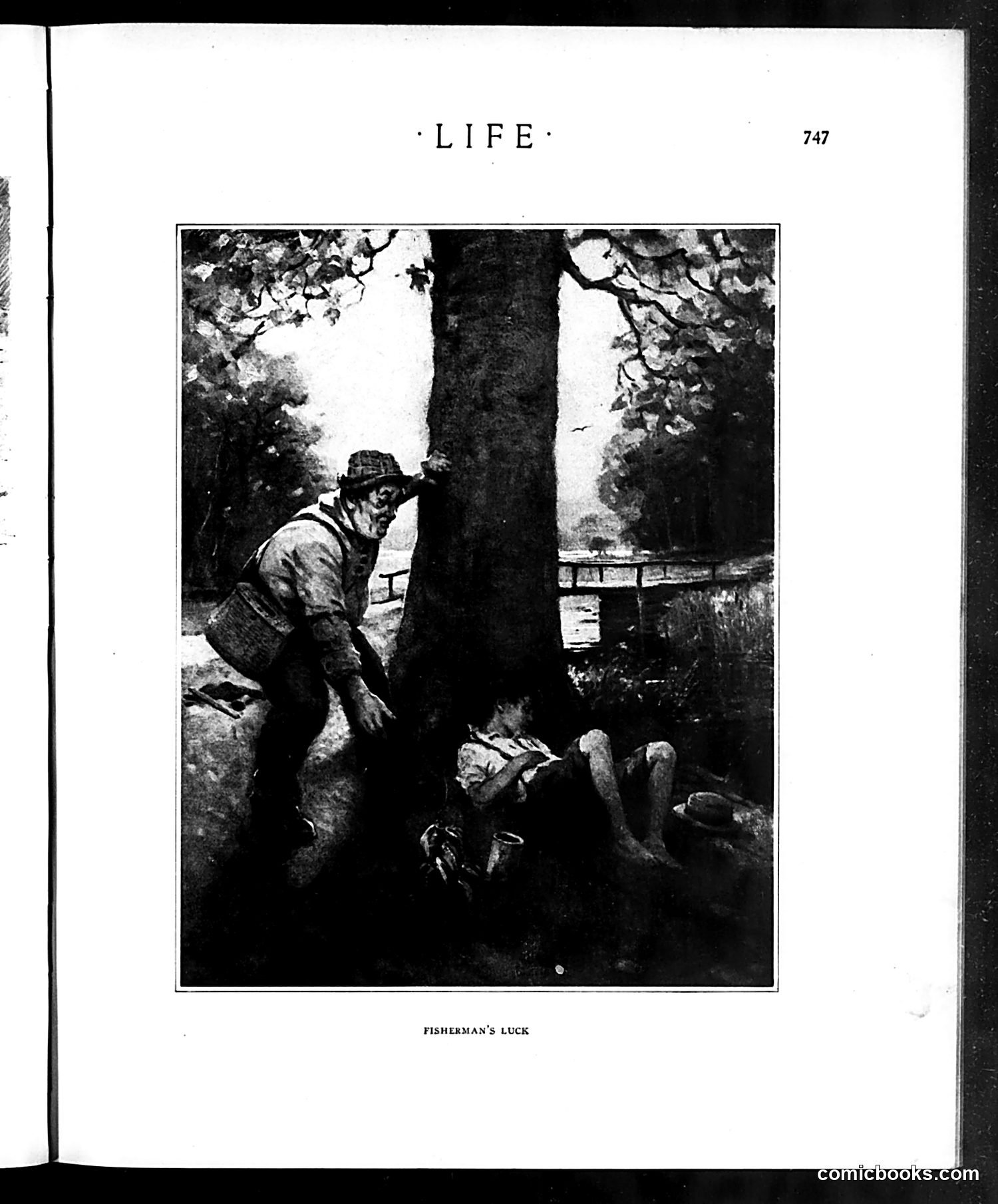
This illustration depicts a humorous fishing scene. A man in work clothes and a hat bends over what appears to be his fishing catch near a large tree trunk by a waterway. Rather than a fish, he has apparently caught a person—another man lying on the ground in the shallow water or muddy bank. The caption "Fisherman's Luck" is a play on words, suggesting an unexpected or absurd catch. The satire likely comments on either the unpredictability of fishing, the foolishness of anglers, or possibly the surreal nature of what one might encounter. Without additional context about Life magazine's specific publication date or political climate, the exact satirical target remains unclear, though it appears to be simple comedic wordplay rather than pointed social commentary.
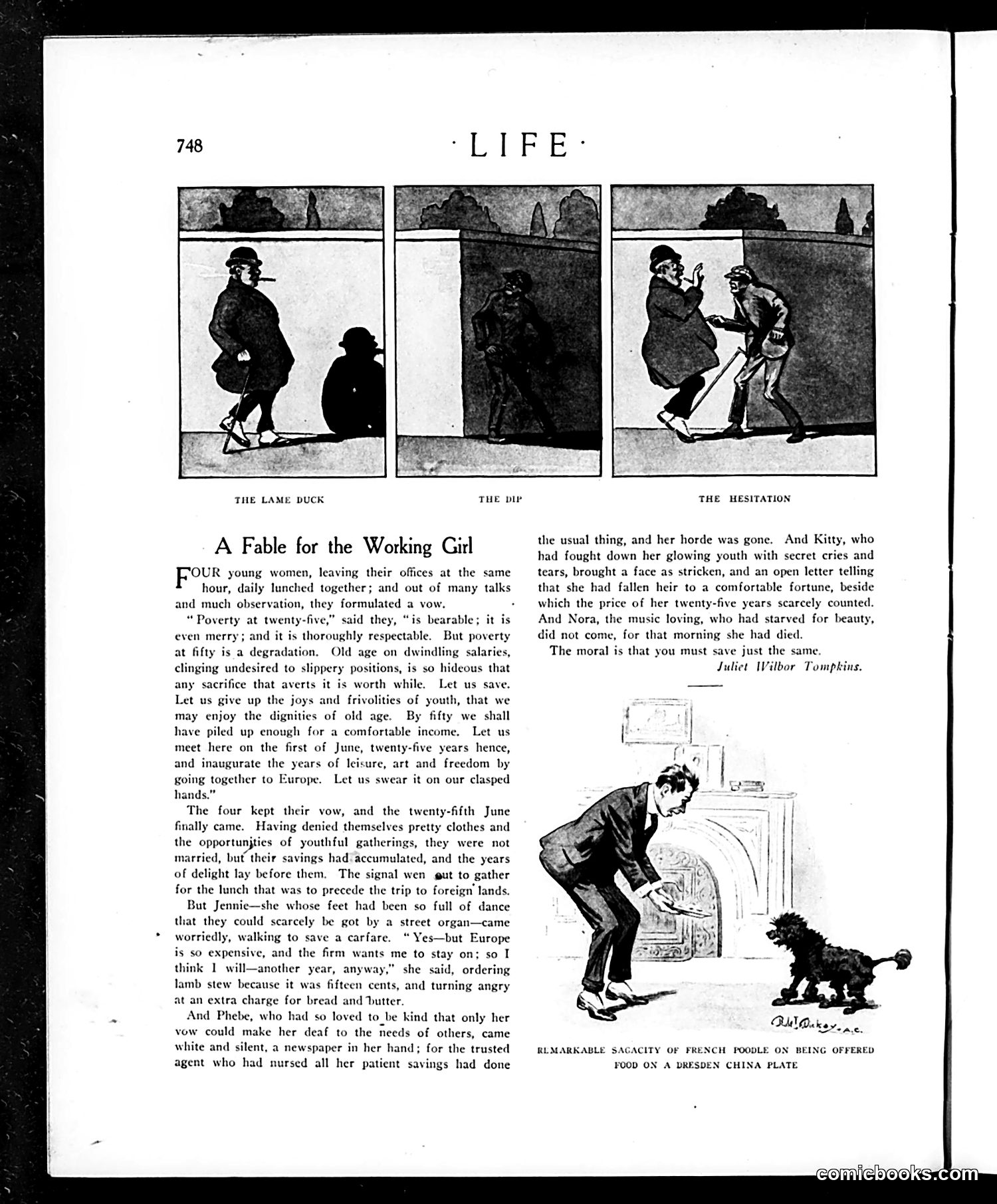
This satirical story depicts four young office workers who vow to sacrifice youth's pleasures—fine clothes, social gatherings, entertainment—to accumulate savings by age 50, enabling a European retirement. The accompanying comic panels ("The Lame Duck," "The Dip," "The Hesitation") illustrate their struggle between temptation and discipline. Twenty-five years later, their plan collapses: Jennie postpones the trip indefinitely; Phebe's trusted agent embezzled her savings; Kitty unexpectedly inherits wealth, making her sacrifice pointless; Nora died before reaching retirement. The satire critiques both the false promise of self-denial and the precarious economic reality for working women of this era. Despite the moral ("you must save just the same"), the story suggests that saving alone cannot guarantee security—theft, death, and circumstance undermine individual effort. The cartoon mockingly highlights the futility of the working girl's financial aspirations against systemic vulnerability.
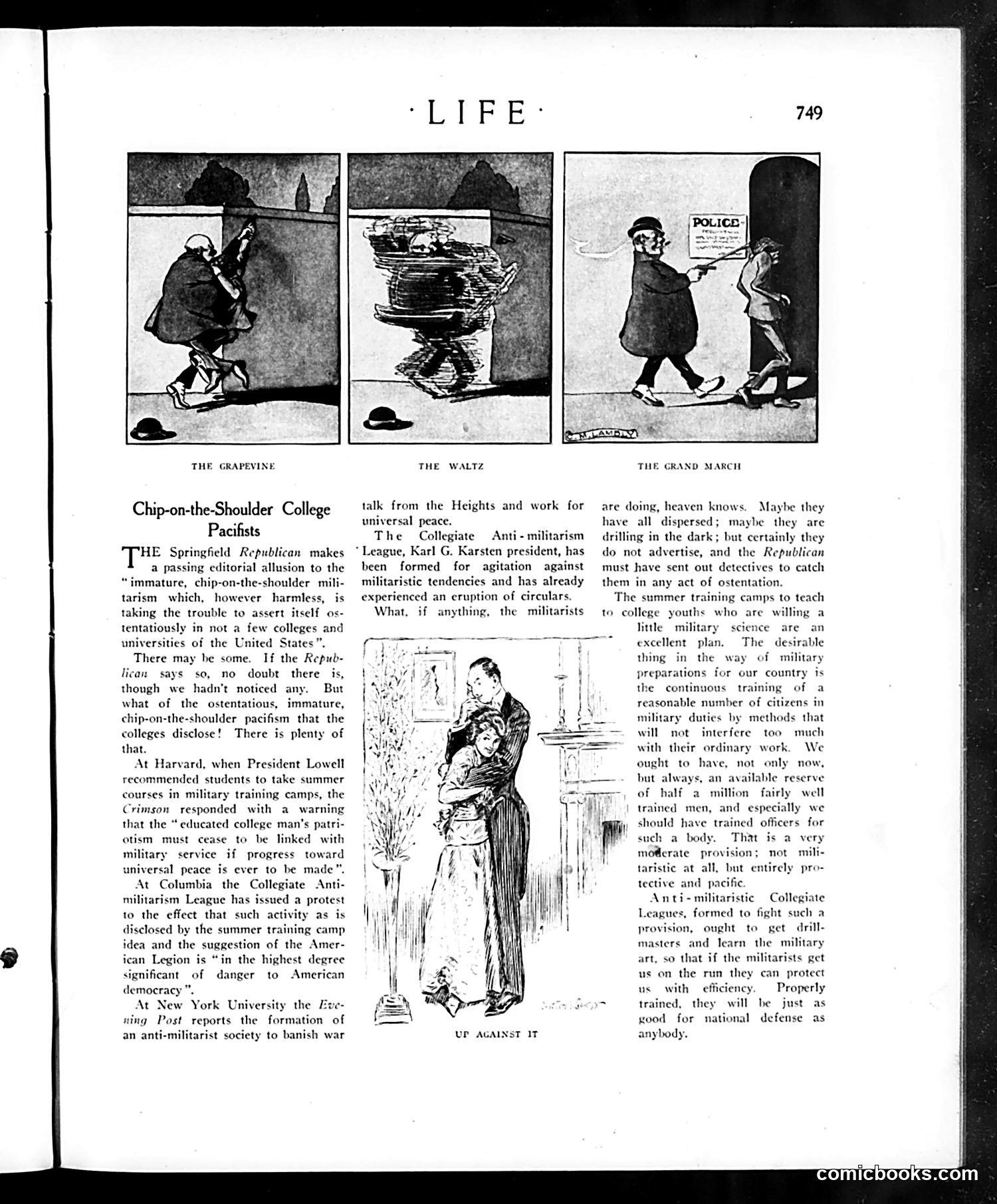
This *Life* editorial satirizes anti-militarism activism on American college campuses (Harvard, Columbia, NYU) circa the 1910s-1920s. The piece mocks student pacifist leagues formed to oppose military training camps and ROTC programs, characterizing their activism as immature and hypocritical—"chip-on-the-shoulder" posturing comparable to militarism itself. The author argues pacifists loudly advertise their cause while actual militarists operate quietly. The three cartoons above ("The Grapevine," "The Waltz," "The Grand March") use dance metaphors to ridicule the activists' theatrical, performative protests. The core argument: maintaining a trained military reserve isn't militaristic but *protective*. Pacifist students should either accept modest military preparedness or, ironically, learn to fight themselves—otherwise they'll need militarists to "protect us" during conflict. The satire suggests pacifist idealism is naive and performative rather than principled. This reflects early 20th-century American debates over preparedness preceding WWI entry.
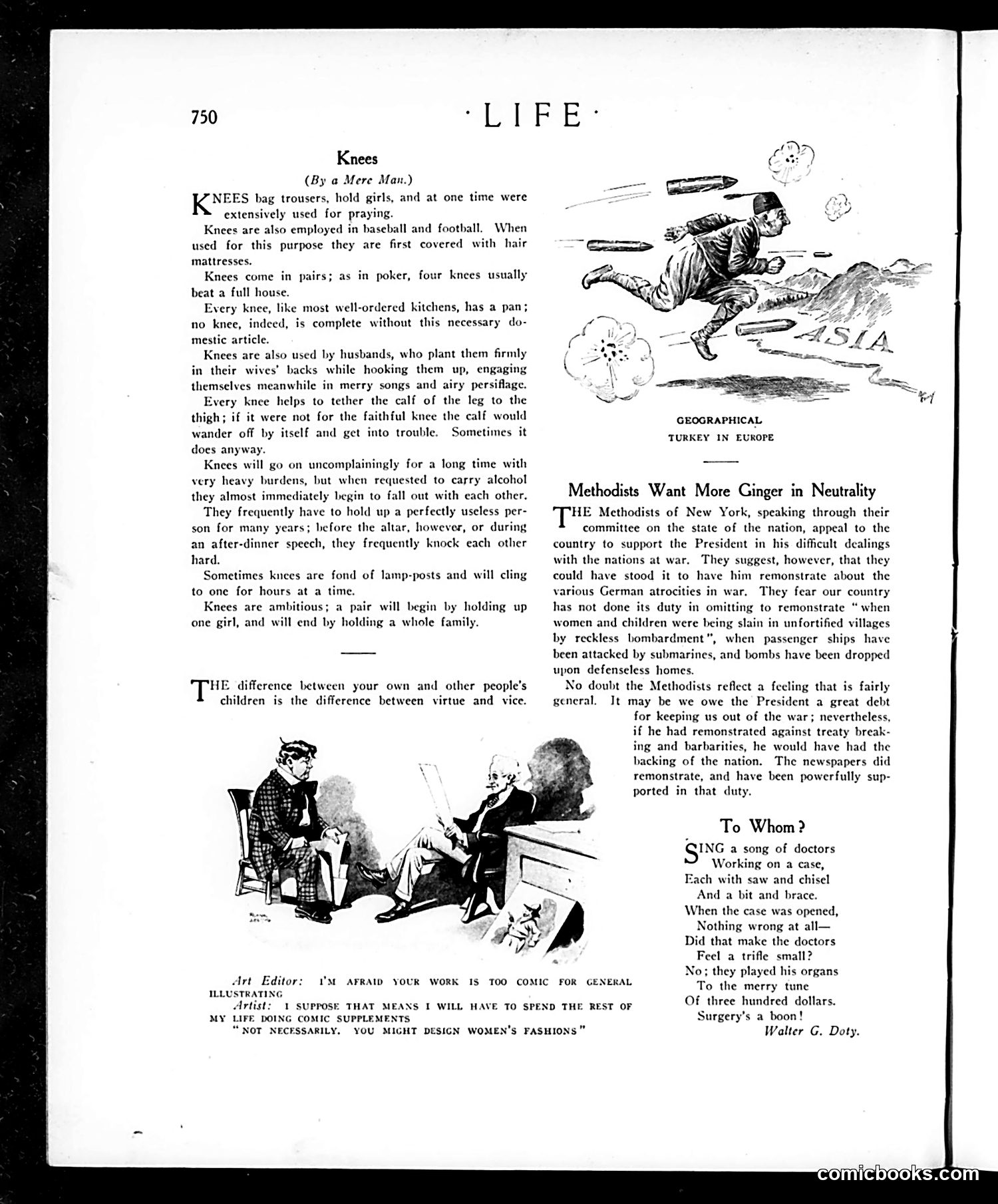
This page contains three distinct satirical pieces: **"Knees" essay**: A humorous male perspective on women's knees, treating them as objects of utility and aesthetic interest. The piece mocks both masculine obsession and domestic life—knees "hold girls," assist in dressing wives, and famously fail when "requested to carry alcohol" (drunk men). The wit lies in the clinical yet absurd cataloging of knees' social functions. **Art Director cartoon**: An editor rejects an artist's comic work as "too comic for general illustrating" in Life supplements, suggesting it needs to be less humorous. The irony is sharp—the publication itself is satirical, yet commercial departments demand toned-down comedy. **Methodist statement & "To Whom?" poem**: The Methodists criticized President Wilson's neutrality as insufficiently forceful against German atrocities in WWI. The accompanying poem mocks surgeons who perform unnecessary procedures (opening a patient finding "nothing wrong") yet bill handsomely anyway—three hundred dollars being substantial money at the time. The page satirizes contemporary attitudes: masculine consumption, commercial compromise, wartime politics, and medical profiteering.
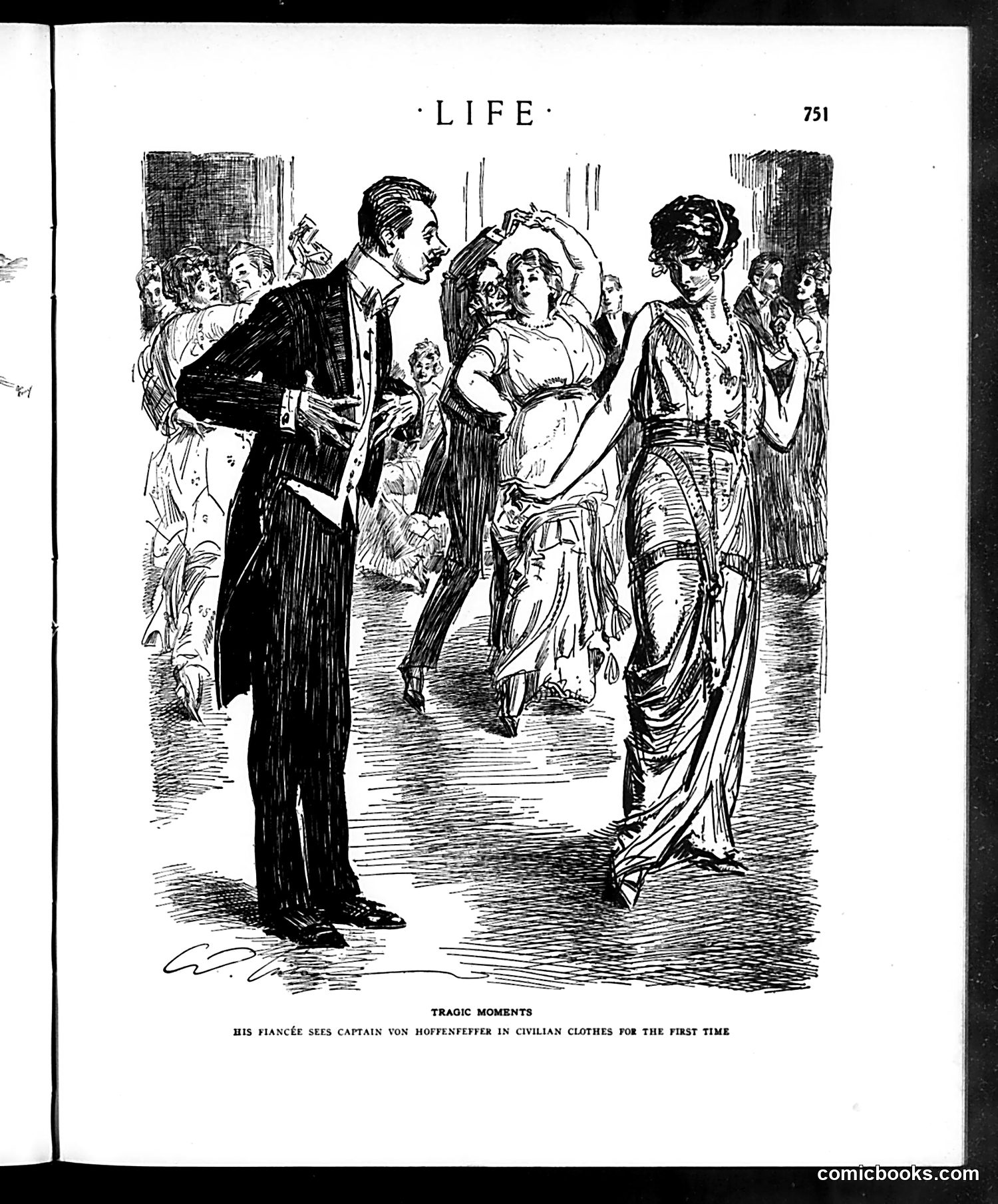
This is a satirical illustration from Life magazine depicting a comedic "tragic moment." The caption identifies the central male figure as "Captain von Hoffenfeffer," a Germanic name suggesting a military officer, likely from the early 20th century when such stereotypes were common in American satire. The joke hinges on the fiancée's shocked reaction upon seeing her betrothed in civilian clothes for the first time—implying that in his military uniform, he appeared so impressive and authoritative that civilian dress renders him unrecognizable or disappointing. The onlookers' reactions suggest social embarrassment. This satirizes both military vanity and the contrast between martial bearing and ordinary appearance, a common theme in period humor mocking European militarism and the inflated importance placed on military uniforms.
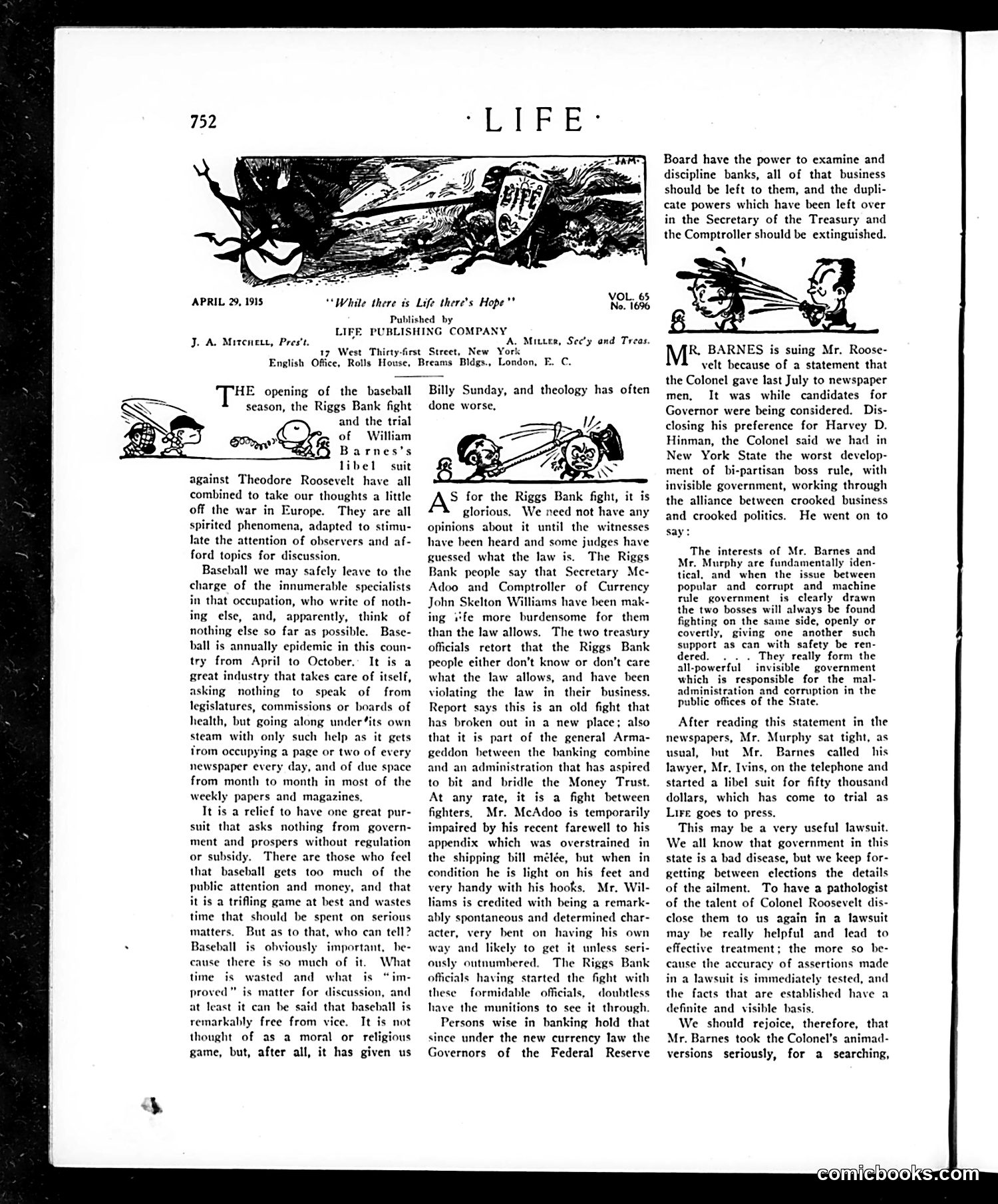
This editorial page discusses three major stories dominating American attention: baseball's spring opening, the Riggs Bank regulatory dispute, and William Barnes's libel suit against Theodore Roosevelt. The **Riggs Bank fight** represents a conflict between the Wilson administration (Treasury Secretary McAdoo and Comptroller Williams) and banking interests over regulatory authority. The piece frames it as part of a larger struggle between the administration's efforts to control the "Money Trust" and entrenched financial power. The **Barnes v. Roosevelt lawsuit** concerns a statement Roosevelt allegedly made about Colonel Barnes during gubernatorial campaign discussions, which the article suggests may expose government dysfunction and partisan conflict. The cartoons (top right) appear to caricature figures involved in these disputes, though specific identities are unclear from the image quality. The editorial adopts a wry, detached tone—treating these conflicts as entertaining public spectacles while suggesting they reveal genuine tensions in American governance regarding banking regulation and political accountability.
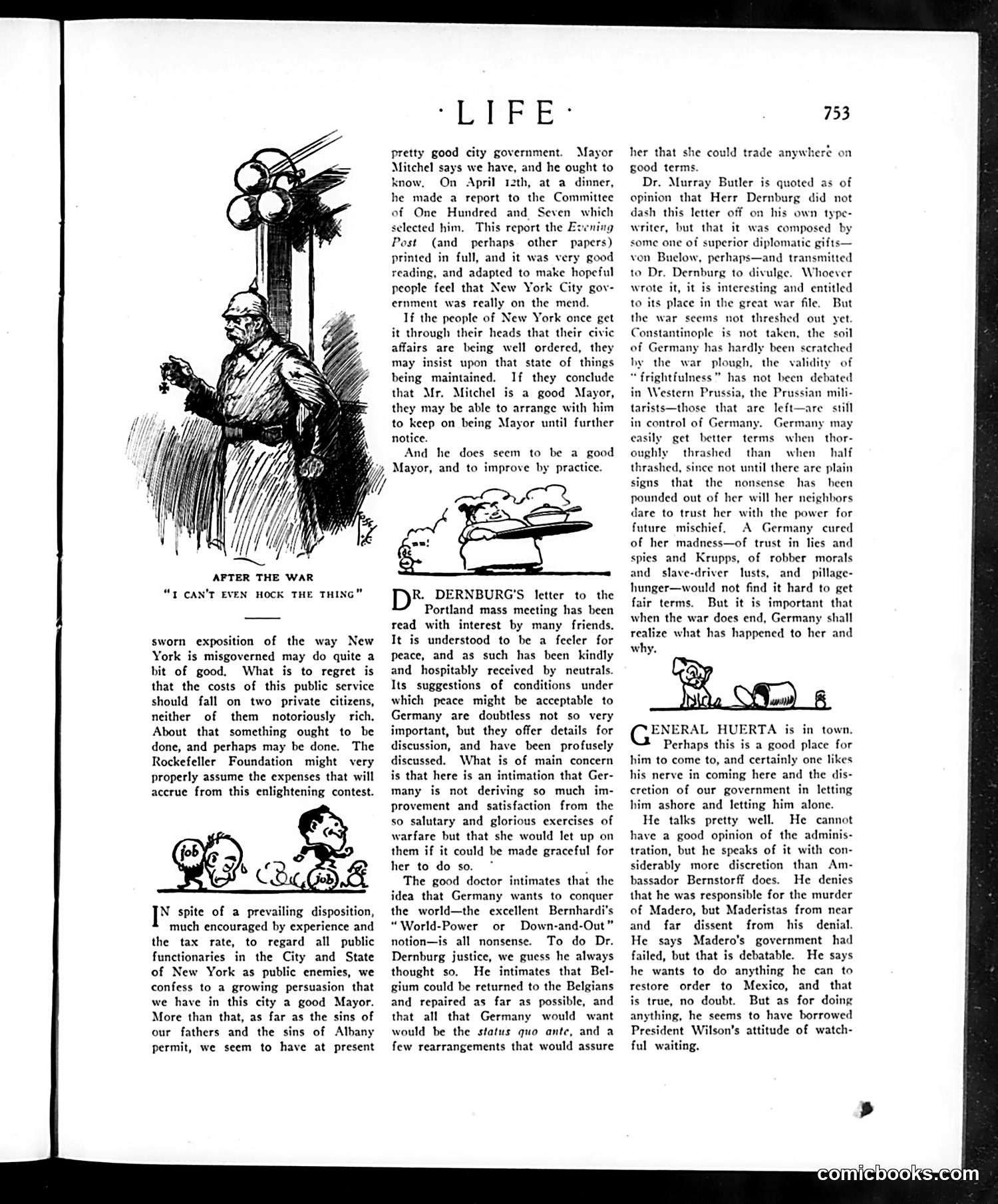
The cartoon depicts a German soldier standing beneath a street lamp, holding what appears to be a military helmet or piece of military equipment, saying "I can't even hock the thing." The image satirizes Germany's post-war destitution and defeat. The accompanying text discusses peace feeler proposals from Dr. Dernburg (a German diplomat) to Portland, suggesting Germany might accept a return to pre-war conditions. Life magazine's editors argue Germany shouldn't be trusted with favorable peace terms—that Germany needs to be thoroughly defeated first before its neighbors can safely negotiate. They suggest only when "nonsense has been pounded out of her" can Germany be trusted. The cartoon's humor rests on the grim image of a defeated German soldier so impoverished he cannot even pawn his military equipment. It reinforces the editorial argument that Germany must face complete military collapse before peace talks should occur.
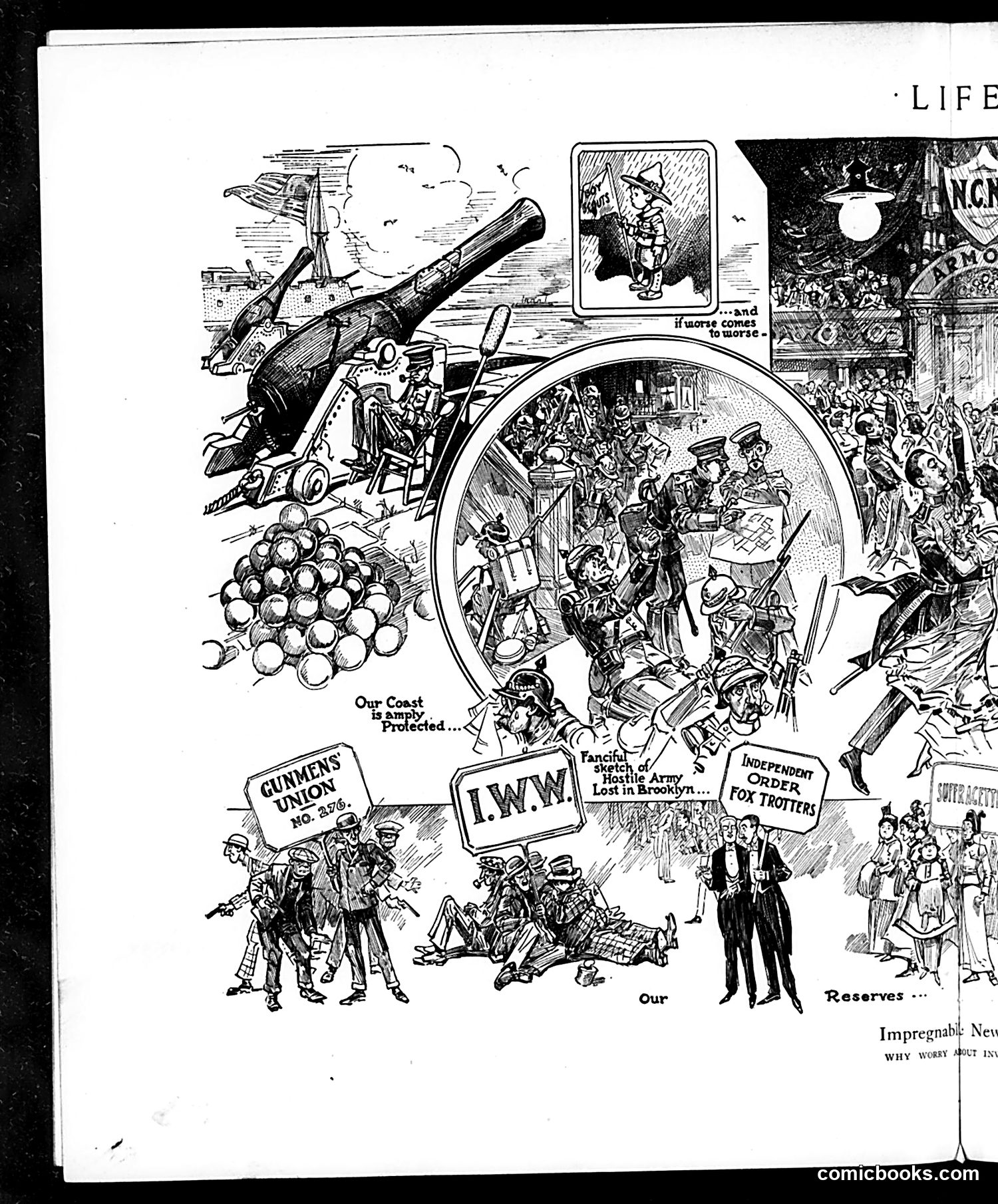
This appears to be a WWI-era satirical cartoon from *Life* magazine. The main illustration depicts America's military readiness and domestic organizations during wartime. Key labeled elements include: - **"Our Coast is Saintly Protected"** - featuring large artillery and ammunition - **"Gunmens Union No. 206"** - satirizing labor organizations - **"I.W.W."** - referring to the Industrial Workers of the World, a radical labor group - **"Independent Order Fox Trotters"** - mocking frivolous social clubs - A large circular vignette showing crowded street scenes, possibly referencing Brooklyn or urban civilian life The cartoon's satire appears to contrast serious military preparedness with the absurdity of various civilian groups and organizations, suggesting social fragmentation or misplaced priorities during wartime. The tone seems critical of non-essential organizations during national crisis.
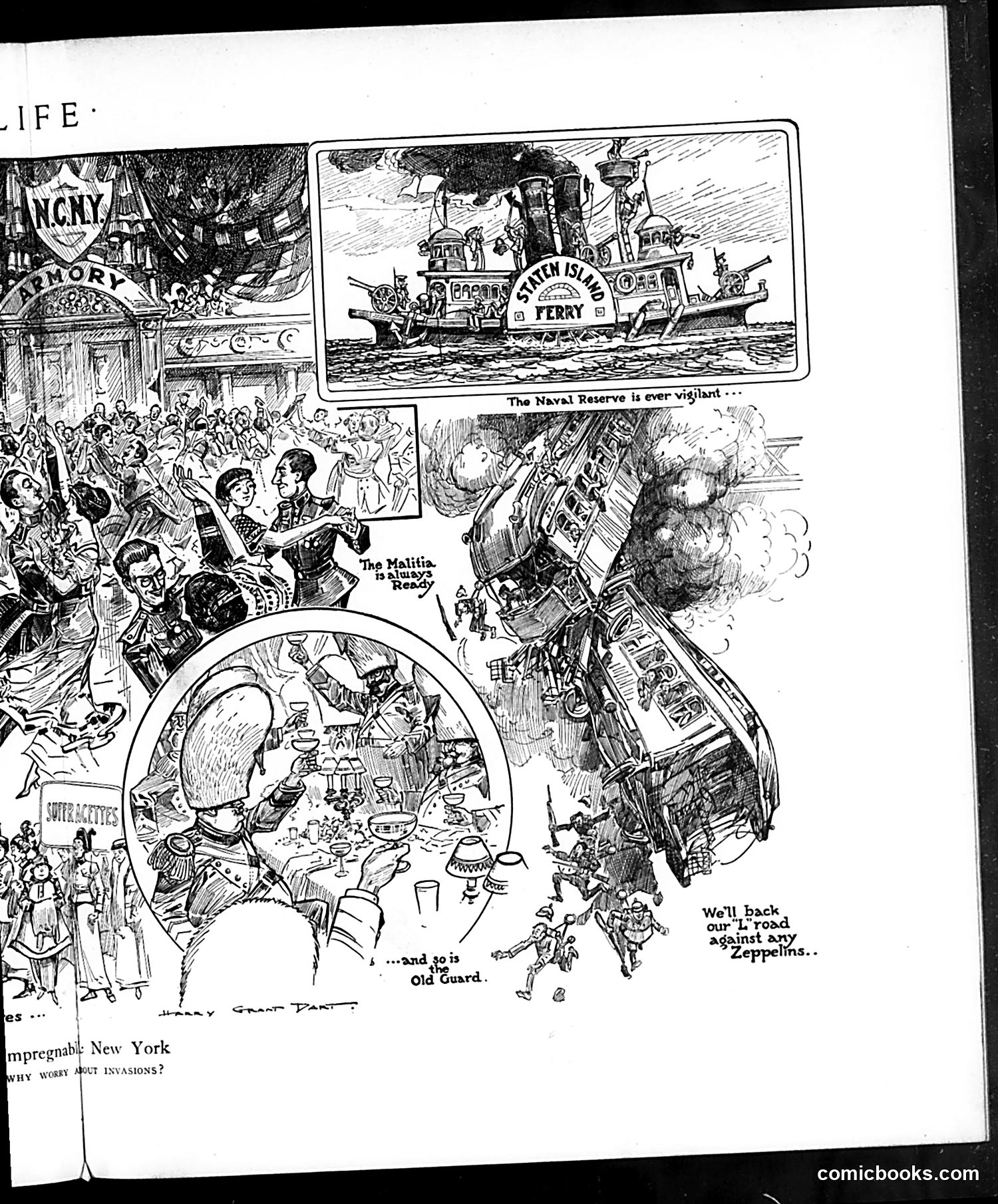
This is a multi-panel satirical cartoon from *Life* magazine addressing American military preparedness and defense anxiety, likely from World War I era (given references to Zeppelins—German airships). The panels mock various institutions' claimed readiness: an armory hosts civilians in formal dress ("The Militia is always ready"), the Staten Island Ferry represents naval defense ("The Naval Reserve is ever vigilant"), and a airship/dirigible scene depicts military response ("We'll back our L-road against any Zeppelins"). The final large panel shows the "old Guard"—apparently elderly or established military figures—seemingly unprepared despite boasts. The bottom caption sarcastically asks "Why worry about invasions?" The satire suggests that despite official reassurances of national defense capabilities, actual preparedness was questionable, with outdated or inadequate forces in charge.
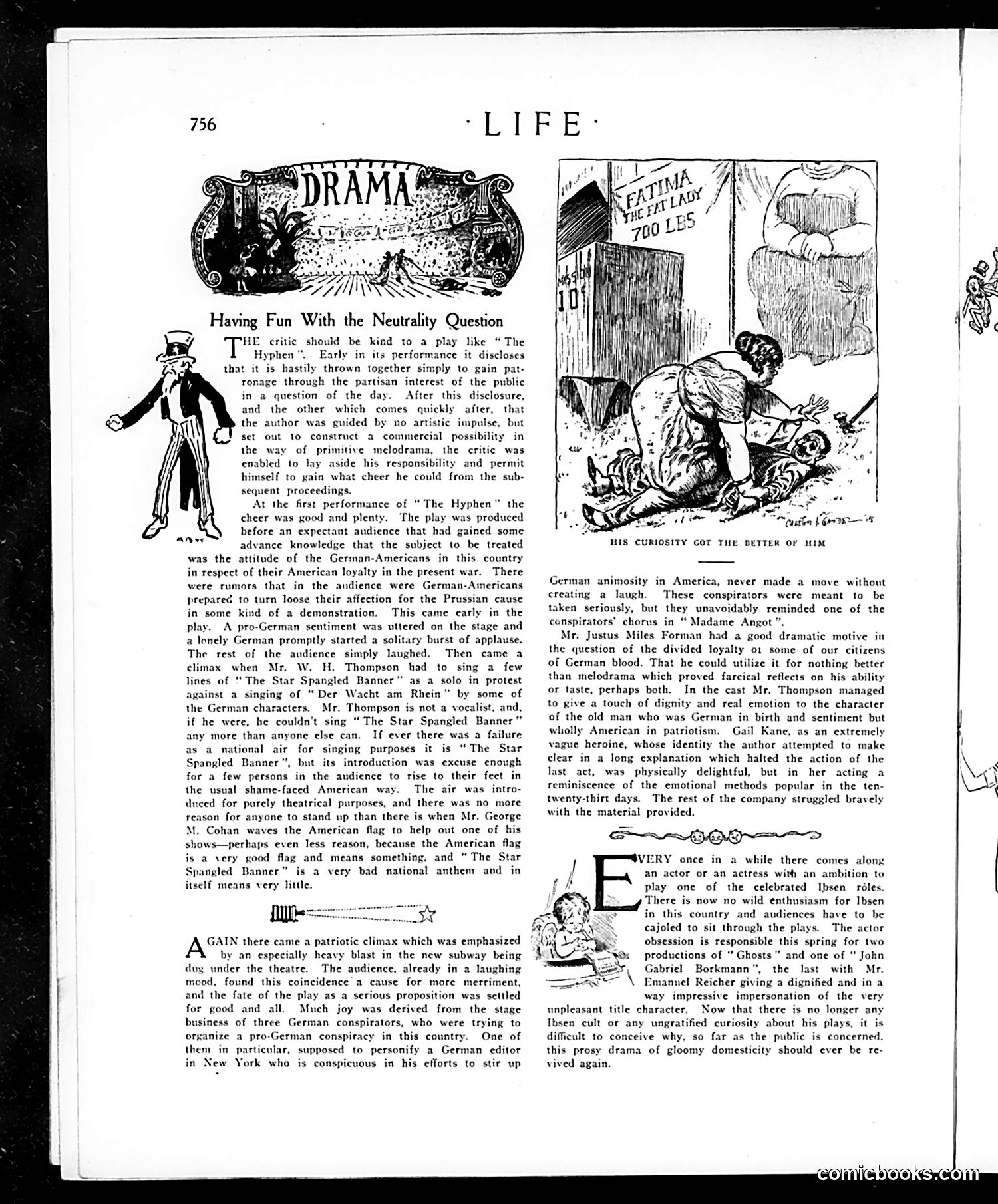
This page reviews a play called "The Hyphen," which dramatizes German-American loyalty during World War I—a heated contemporary issue. The critic describes the play as cynical melodrama exploiting public anxiety about German-Americans' divided allegiances. The cartoon (captioned "His Curiosity Got the Better of Him") depicts a rotund figure labeled "Fatima, the Fat Lady" from a sideshow, satirizing how the play itself is exploitative spectacle rather than serious drama. The review details audience reactions: when pro-German sentiment was expressed onstage, one German-American applauded alone while others laughed; when "The Star-Spangled Banner" was sung as protest, some stood awkwardly. A subway explosion provided unintended comic relief. The critic finds the supposed German conspirators—meant to evoke a real New York German-American newspaper editor—become farcical rather than threatening, undermining the play's dramatic intent.
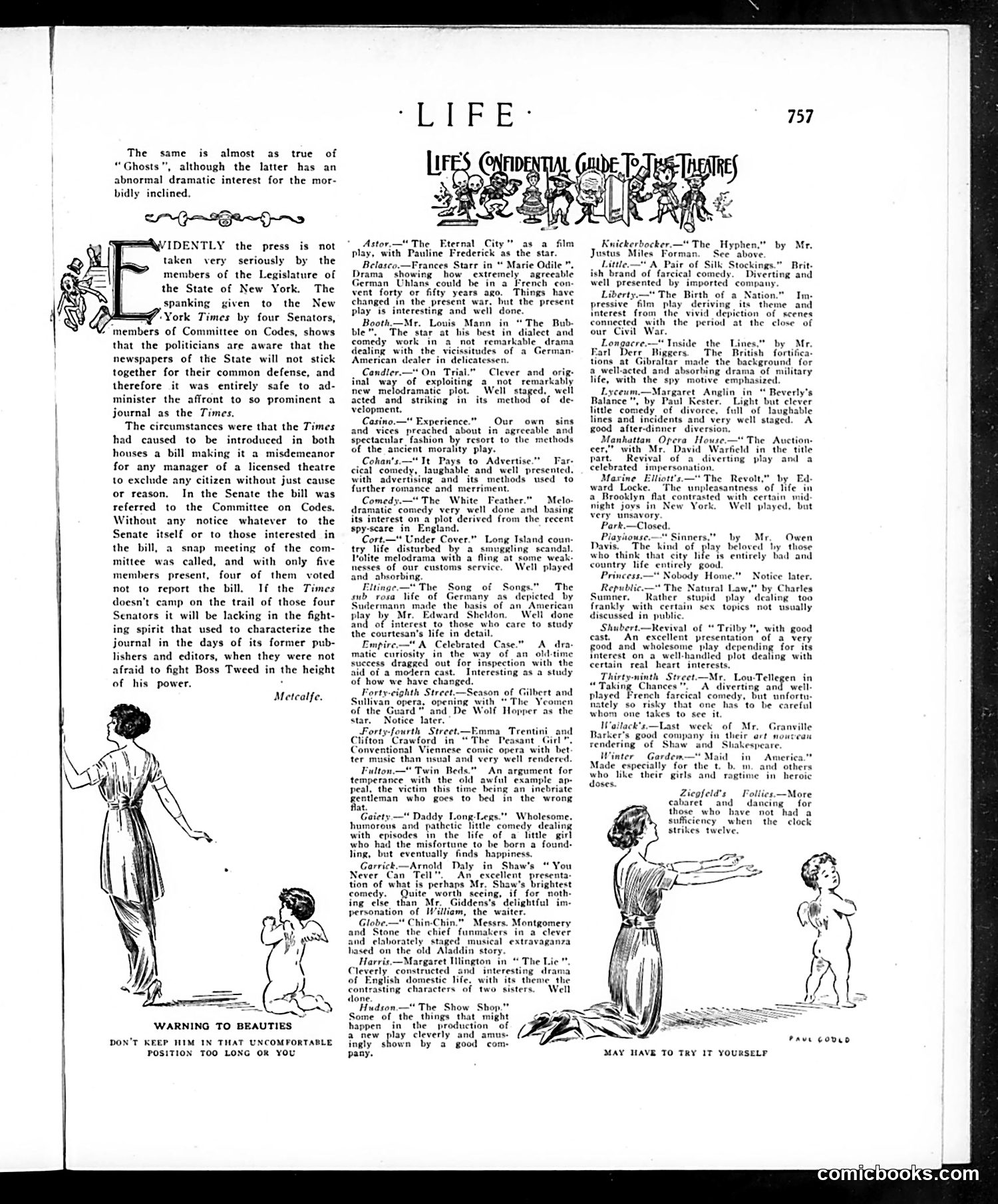
This page combines theater criticism with a political editorial. The main commentary attacks New York State legislators for disrespecting the *New York Times*. The *Times* had introduced a bill requiring theater managers to serve all citizens without discrimination. Four senators on the Committee on Codes killed the bill in a snap meeting without proper notice, deliberately snubbing the newspaper. The editorial shames these politicians, invoking the *Times*' historical courage against Boss Tweed (a notorious 19th-century political boss). The implication: modern newspapers lack the fighting spirit of their predecessors and won't defend each other against political retaliation. The cartoons at left—illustrating "Warning to Beauties"—appear to show courtship postures, though their exact satirical target is unclear from context alone. The bulk of the page consists of theater reviews covering contemporary Broadway productions with themes of war, German life, melodrama, and morality plays.
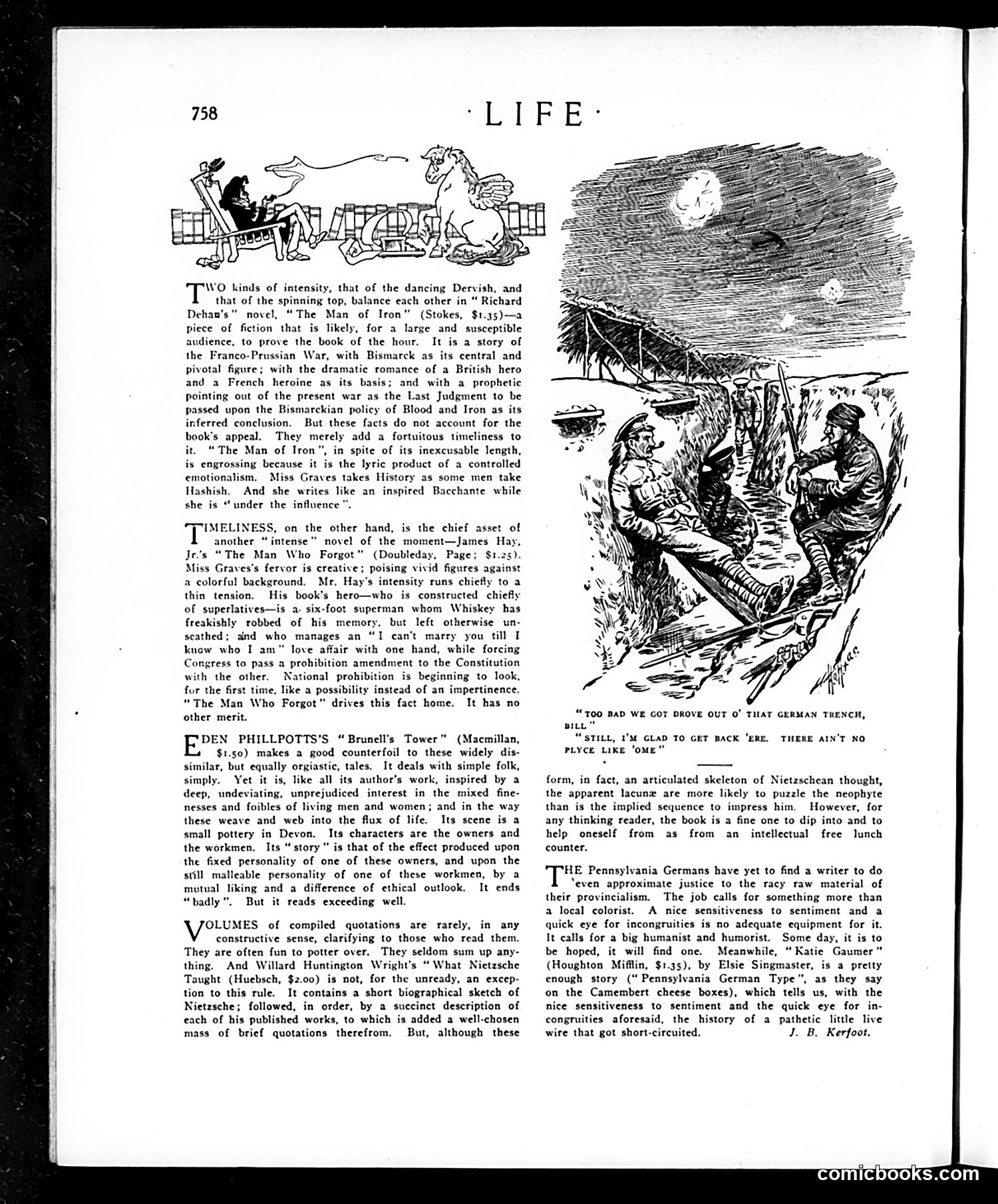
This page reviews contemporary novels, with one accompanying illustration. The cartoon depicts two soldiers in a World War I trench, speaking in working-class dialect. One says they're "glad to get back 'ere" because "there ain't no plyce like 'ome" (home), despite being driven out of a German trench. The illustration satirizes the disconnect between soldiers' experiences and civilian romantic notions of war. The soldiers' casual, colloquial speech and acknowledgment of hardship contrast with propagandistic portrayals of combat. The phrase "there ain't no plyce like 'ome" ironically undercuts heroic narratives—soldiers simply want to escape danger and return to normalcy. The book reviews discuss war-themed fiction, including *The Man of Iron* (set during the Franco-Prussian War) and *The Man Who Forgot* (featuring prohibition politics). The cartoon complements these literary discussions by grounding wartime experience in soldiers' actual perspectives rather than literary dramatization.
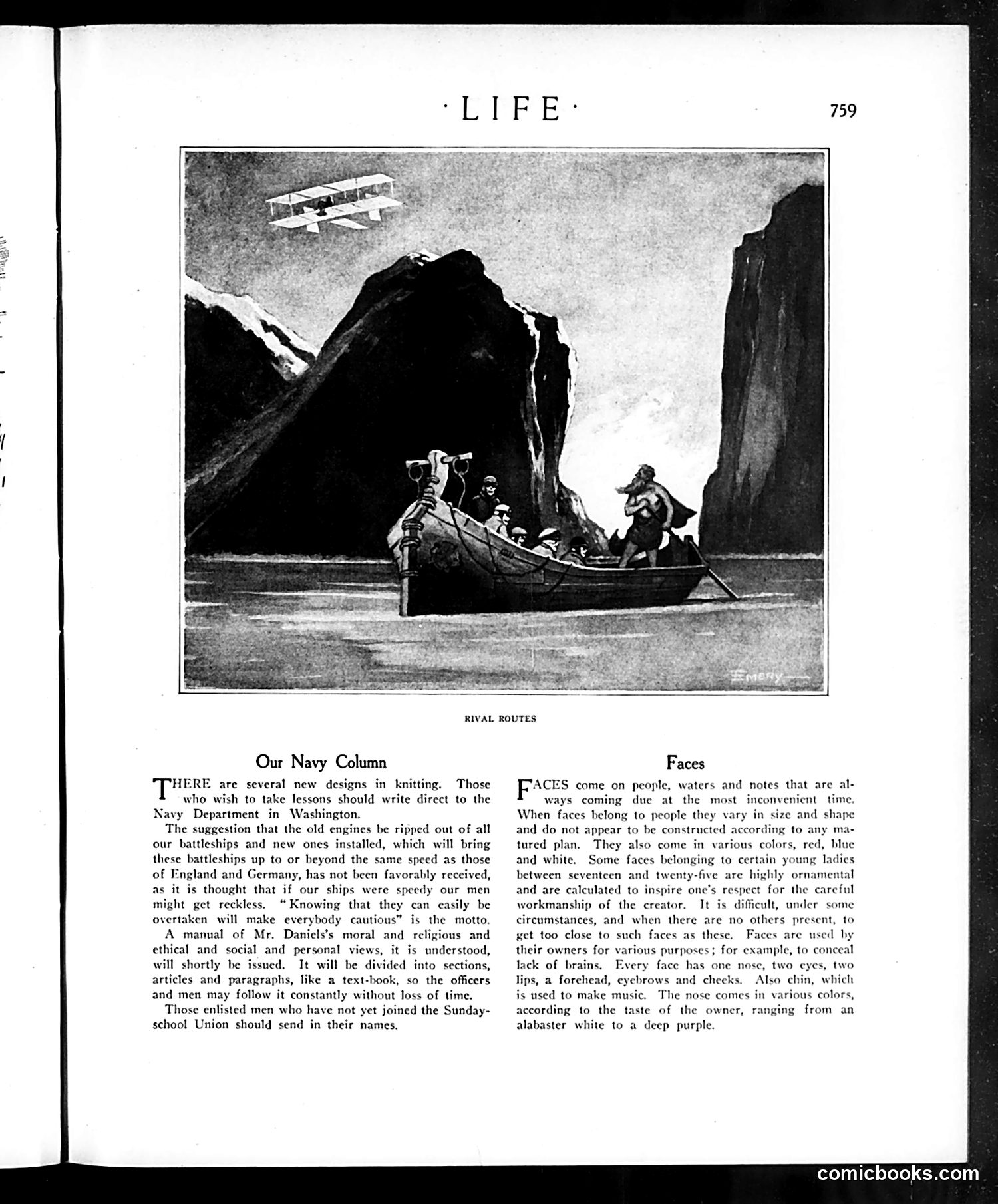
The top illustration, titled "Rival Routes," depicts a biplane flying over mountainous coastal terrain while sailors in a rowboat navigate below—a visual metaphor comparing competing transportation methods. The accompanying "Our Navy Column" is satirical commentary on Secretary of the Navy Josephus Daniels's policies. It mocks: 1. **Battleship modernization**: The Navy rejected upgrading engines because faster ships would make sailors "reckless"—absurd logic that satirizes conservative military thinking. 2. **Daniels's moral agenda**: References to his "manual" of religious and ethical views being distributed to officers, and pressure for enlisted men to join Sunday-school—mocking his attempts to impose personal morality on the Navy. The satire suggests Daniels prioritized moral instruction and caution over military readiness and speed, a serious concern during the pre-WWI naval arms race with England and Germany. The "Faces" column that follows is unrelated—merely whimsical descriptive prose about facial features.
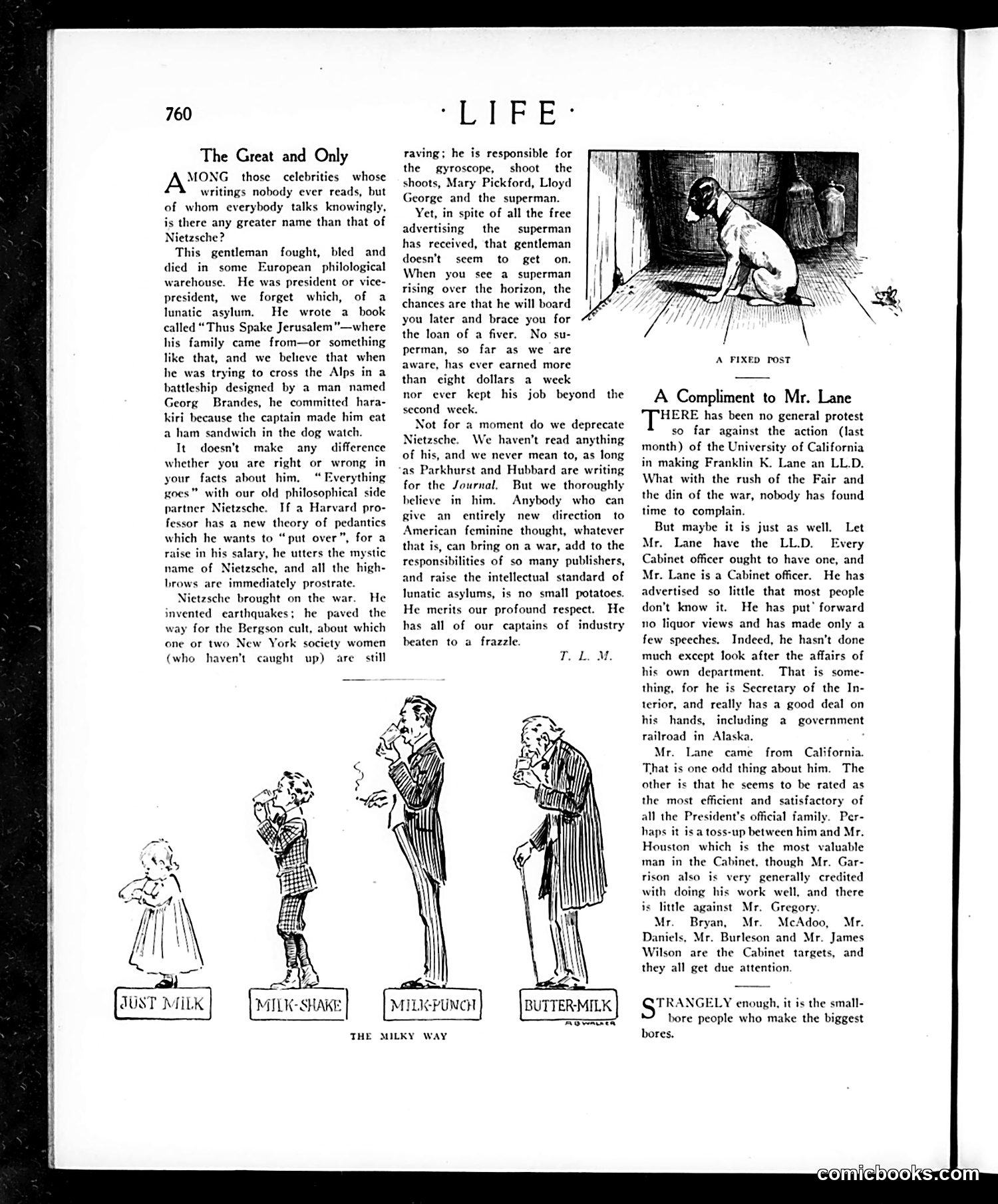
This *Life* magazine page contains two satirical pieces: **"The Great and Only" (left):** A mock-serious essay lampooning Nietzsche's reputation in American intellectual circles. The author admits knowing nothing about Nietzsche's actual work but notes that invoking his name grants instant credibility to any half-baked theory. The satire targets how intellectuals and academics weaponize obscure philosophical references for career advancement. It concludes that despite Nietzsche's supposed influence on the "superman" ideal, real supermen apparently earn only eight dollars weekly and can't hold jobs. **"The Milky Way" (bottom cartoon):** Four illustrated panels showing progressively more diluted milk products—visual wordplay on degradation. **"A Compliment to Mr. Lane" (right):** Praises Franklin K. Lane, Secretary of the Interior, for receiving an honorary degree while doing his actual job competently and quietly—unlike other Cabinet members (Bryan, McAdoo, Daniels, Burleson, Wilson) who attract criticism. The satire is backhanded: Lane's invisibility and lack of scandal are presented as virtues.
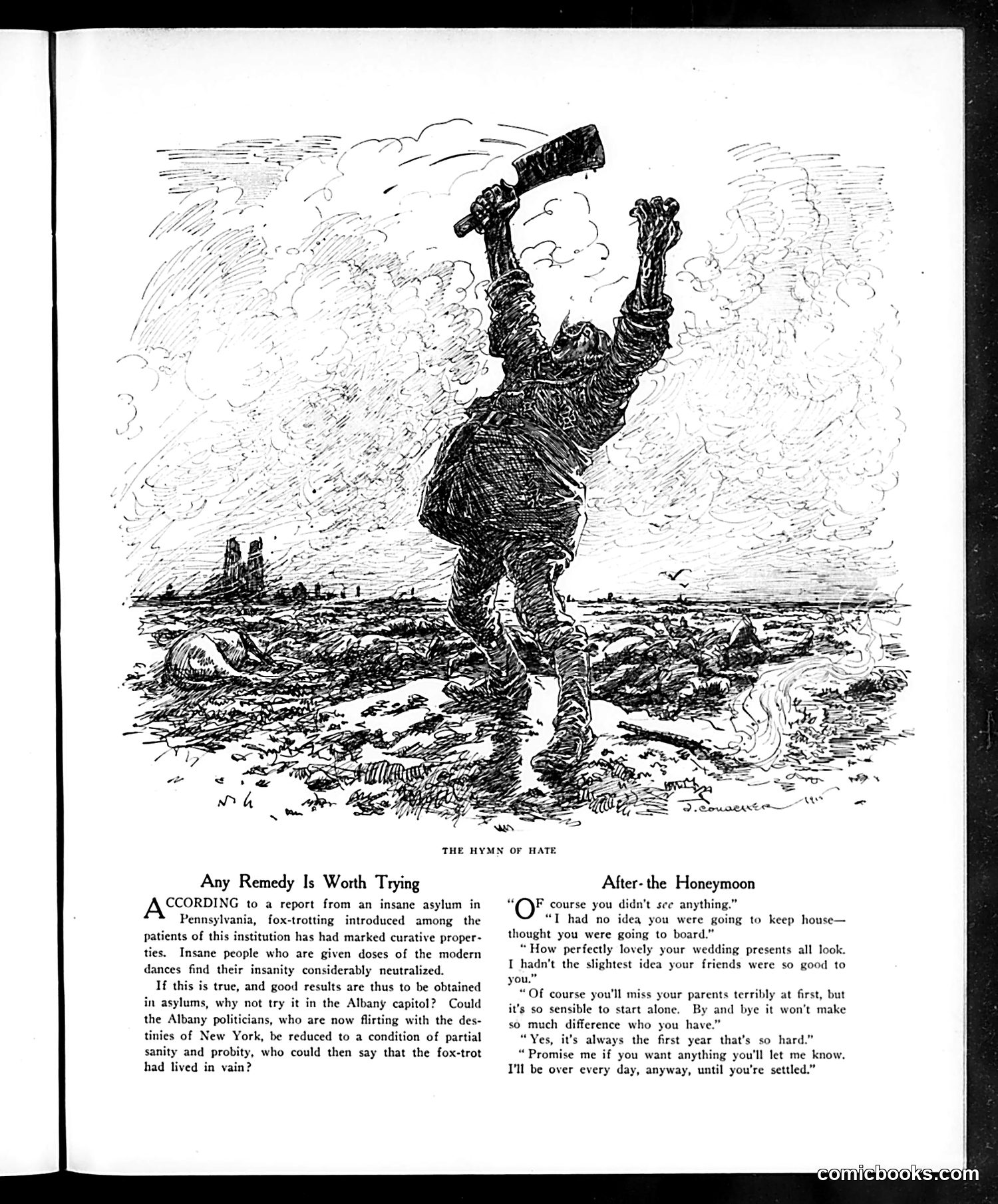
**The main cartoon** depicts a soldier standing triumphantly amid a devastated WWI battlefield, holding a telescope and a fist aloft. This illustrates the accompanying article's satirical proposal: if fox-trotting (the modern dance craze of the 1920s) can cure insanity in Pennsylvania asylums, why not use it on Albany politicians to restore "sanity and probity"? The cartoon suggests the battlefield carnage results from the moral insanity of corrupt New York legislators. **"After the Honeymoon"** is a comedic dialogue satirizing intrusive mothers-in-law. The unseen speaker makes patronizing observations about a newlywed couple's choices—their sparse wedding gifts, living independently rather than boarding elsewhere, missing parents—before promising daily visits. It mocks the overbearing maternal figure and newlyweds' loss of privacy. Both pieces target contemporary social anxieties: political corruption and generational family dynamics.
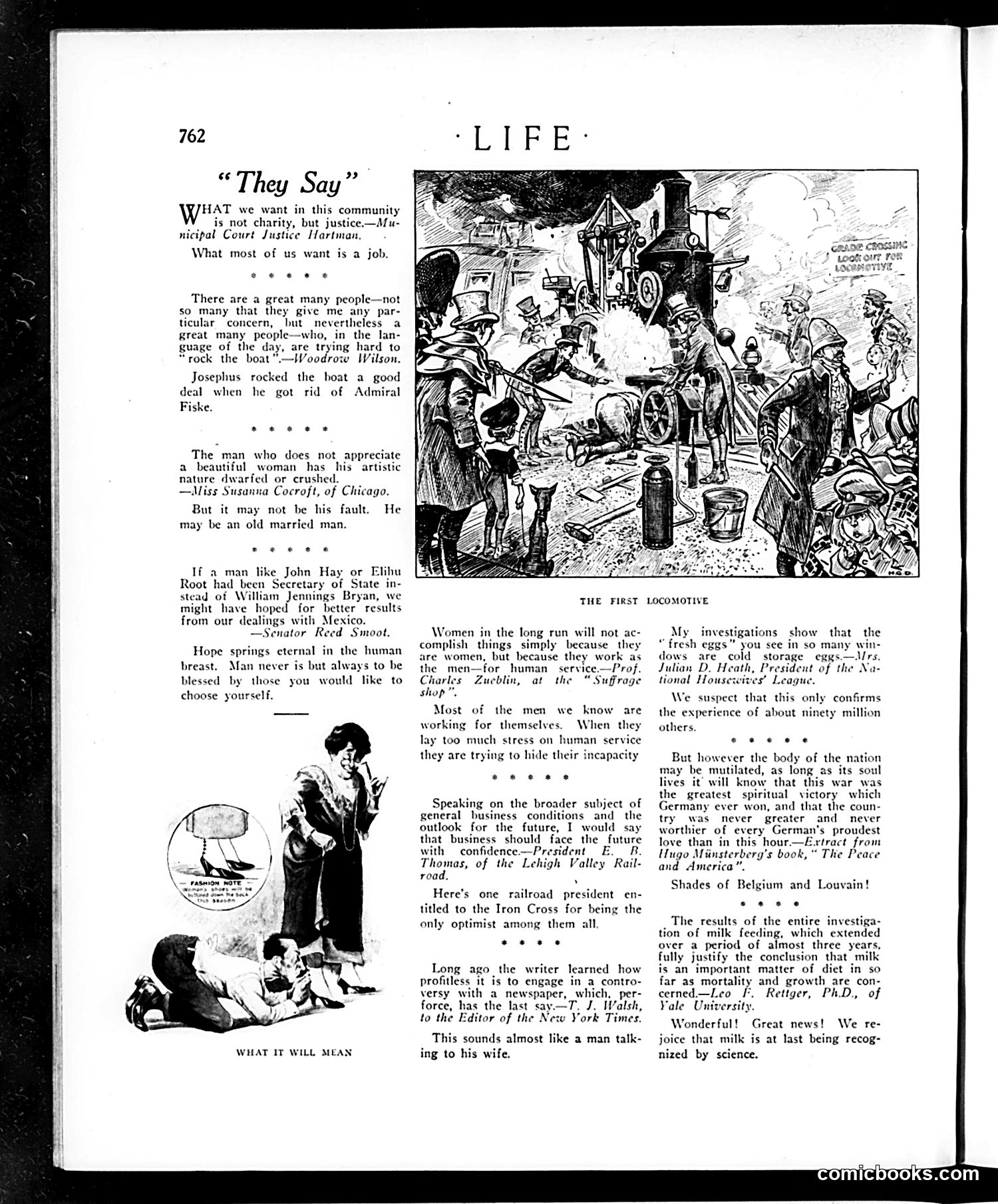
This "They Say" column presents satirical quotations from public figures, with commentary exposing hypocrisy or absurdity. Key targets include: **Political figures**: President Wilson's quote about "rocking the boat" is juxtaposed with Secretary of the Navy Josephus Daniels literally removing Admiral Fiske—mocking Wilson's cautious rhetoric against actual upheaval. **William Jennings Bryan**: Senators criticize his diplomatic handling of Mexico, implying he was inadequate compared to predecessors like John Hay. **Hugo Münsterberg**: His German propaganda claiming WWI as a "spiritual victory" is sarcastically undercut with "Shades of Belgium and Louvain!"—referencing German atrocities. **The illustrations** include "The First Locomotive" (satirizing progress) and "What It Will Mean" (domestic discord). The column mocks pretense: a railroad president's unfounded optimism, suffragists claiming women work "for human service" while men serve themselves, and scientists announcing the obvious—that milk aids child development.
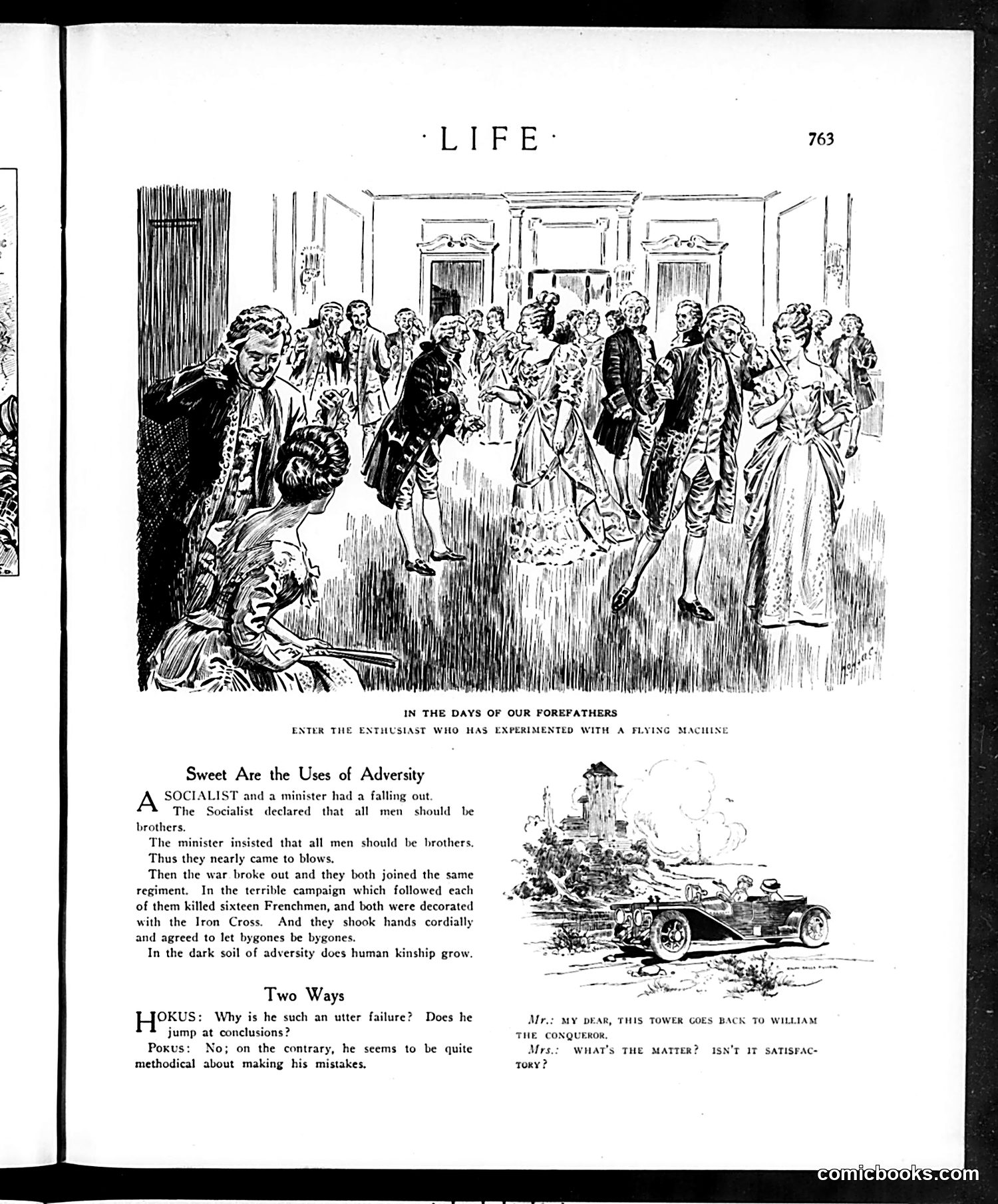
The top illustration shows a historical scene captioned "In the Days of Our Forefathers" depicting someone entering with a flying machine—an anachronistic joke about introducing modern technology to the past. The main satirical piece, "Sweet Are the Uses of Adversity," mocks the reconciliation between ideological opponents through warfare. A Socialist and minister initially argue about brotherhood—ironically agreeing on the same principle but nearly fighting over it. War unites them; both kill French soldiers and receive Iron Crosses (German military honors), then shake hands. The satire suggests war artificially creates kinship among those who share nothing else, and that shared violence binds people more effectively than shared ideology. The brief exchanges below ("Two Ways" and the tower dialogue) are mild observational humor: one about methodical failure, another likely playing on class differences regarding historical appreciation. This reflects early 20th-century skepticism about war's supposed unifying benefits and the absurdity of ideological conflict.
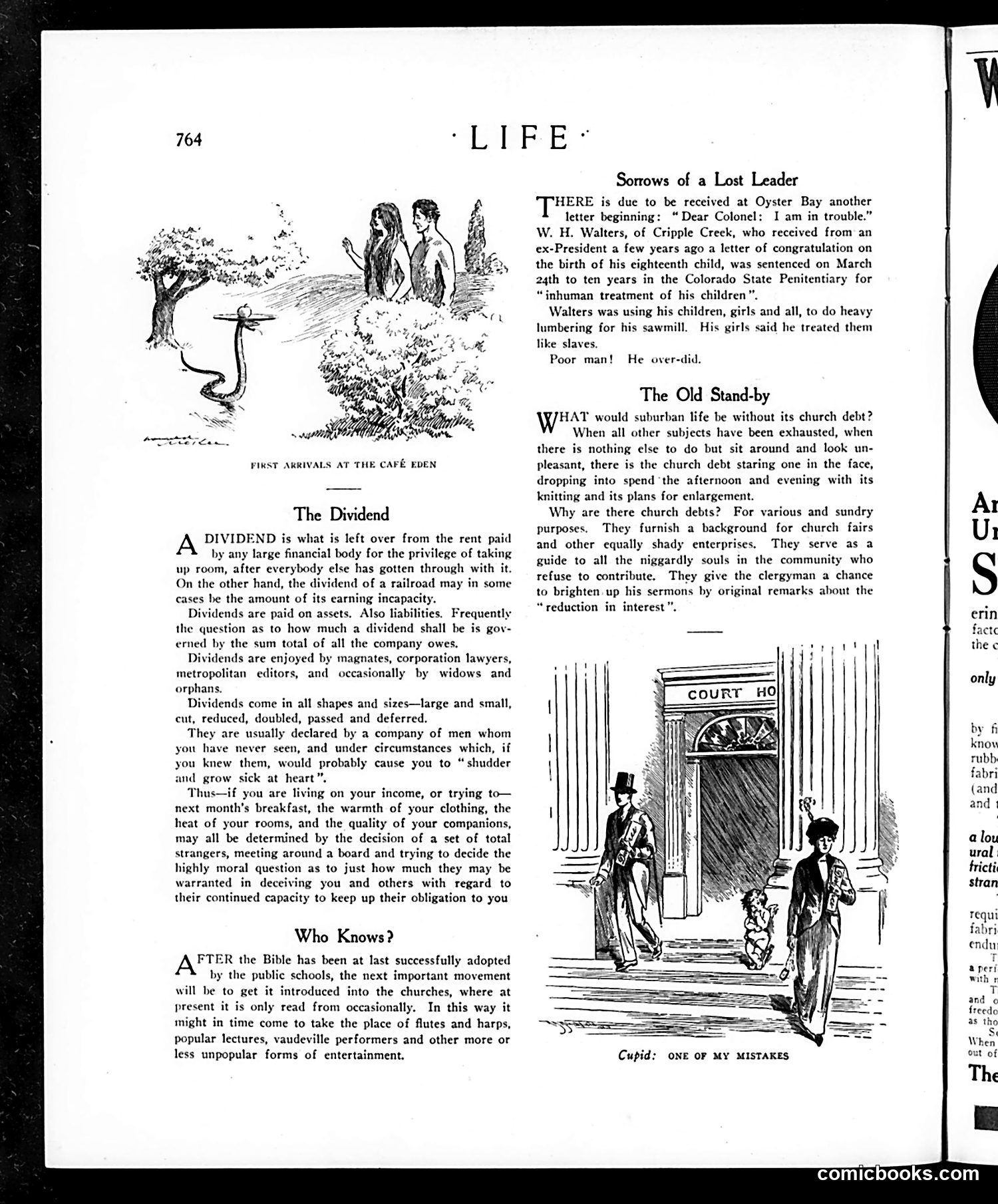
This page from *Life* magazine contains three satirical pieces targeting early 1900s American society: **"The Dividend"** mocks corporate financial practices, describing how dividend payments to wealthy shareholders (magnates, lawyers, editors) are determined by secretive boardroom decisions that ordinary people—living on dividends or modest incomes—cannot influence or understand. The satire's point: your basic needs (food, heat, companions) depend on the arbitrary moral choices of strangers. **"Sorrows of a Lost Leader"** references Theodore Roosevelt at Oyster Bay, suggesting he receives letters from troubled men seeking his advice. It describes W.H. Walters, sentenced for forcing his eighteen children into brutal sawmill labor. The satire implies Roosevelt enabled such abuse through casual encouragement. **"The Old Stand-by"** satirizes suburban church culture, portraying perpetual church debt as a social fixture that keeps congregations occupied with fundraising rather than genuine spirituality—a convenient excuse for avoiding real moral engagement. The cartoon "Cupid: One of My Mistakes" (bottom) appears to show Cupid outside a courthouse, illustrating romantic follies.
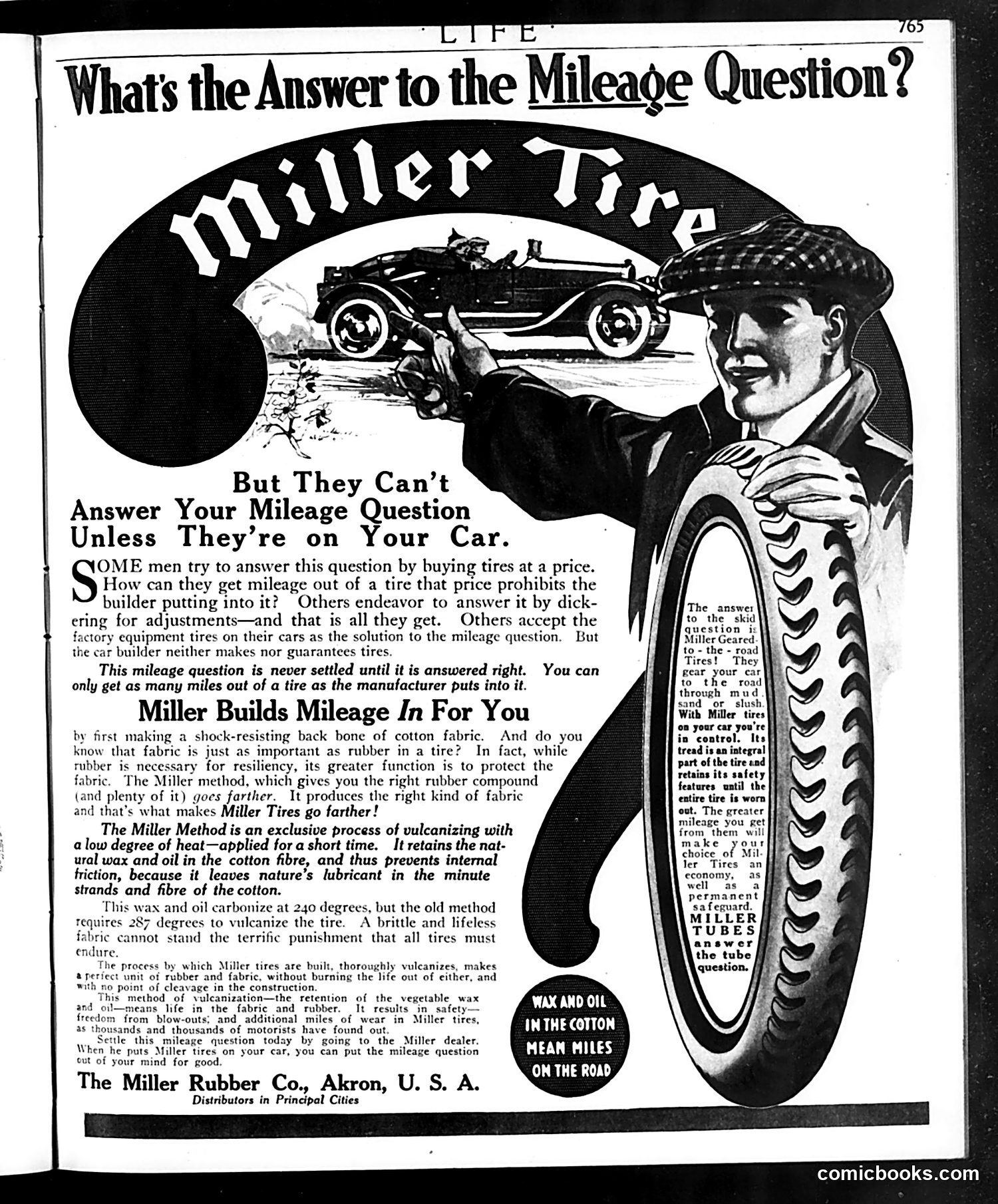
This is a **tire company advertisement**, not political satire. The Miller Rubber Company uses a rhetorical device to sell tires by framing the "mileage question"—how many miles will a tire last?—as an unsolvable problem unless customers buy Miller brand. The illustration shows a cheerful salesman pointing to a Miller tire, emphasizing that cheap tires or dealer haggling cannot answer durability questions. Only the manufacturer's quality engineering determines mileage. The ad's central claim is that Miller's exclusive vulcanization process—using lower heat (240 degrees vs. the industry standard 287 degrees)—preserves natural wax and oil in cotton fibers, reducing internal friction and extending tire life. The "WAX AND OIL IN THE COTTON MEAN MILES ON THE ROAD" slogan drives home the message: superior tire construction equals better value for motorists. This reflects early 20th-century automotive marketing, when tire quality was genuinely variable and a legitimate consumer concern.
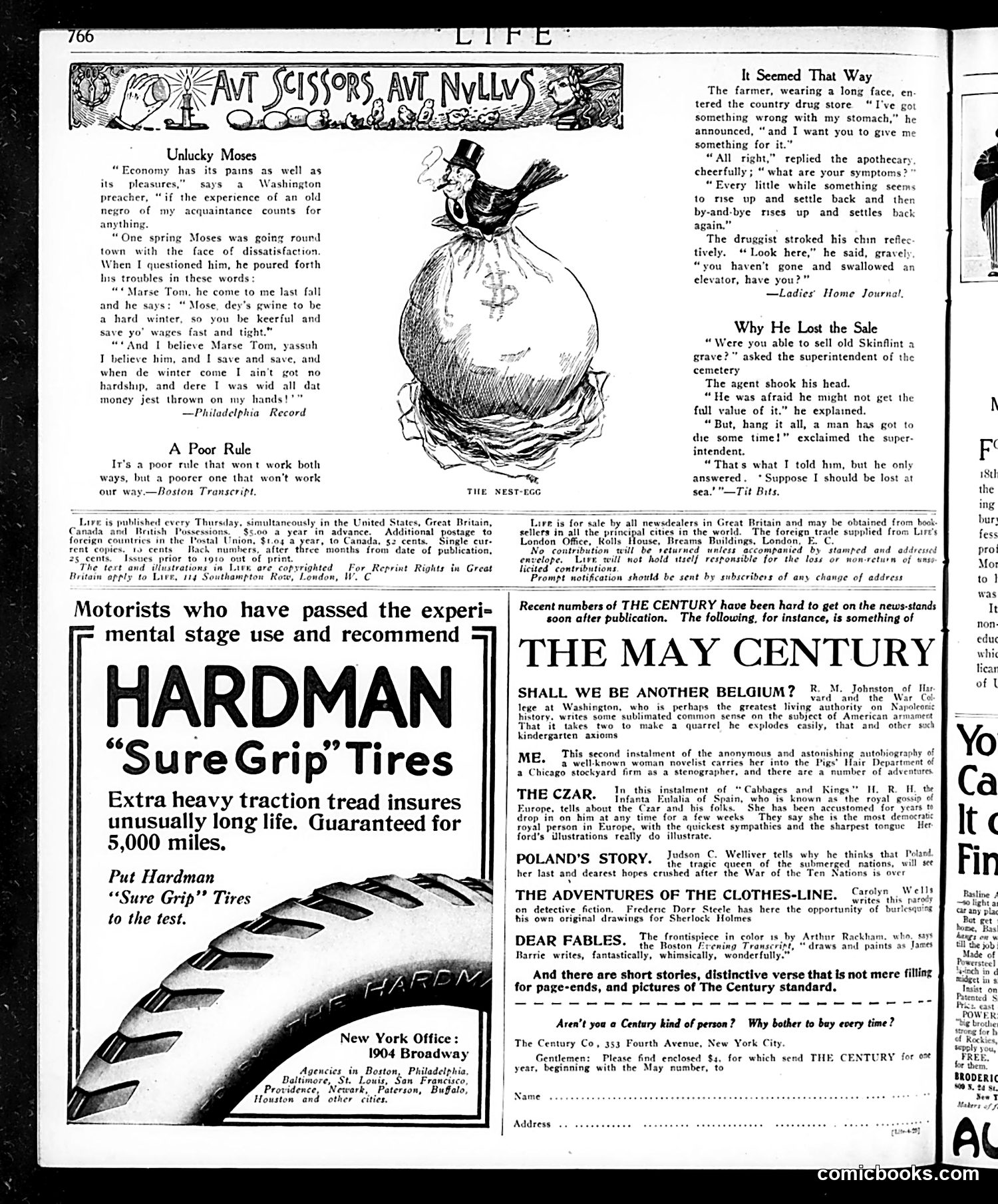
This page contains three humorous anecdotes typical of early 1900s Life magazine satire: **"Unlucky Moses"** presents a dialect-heavy story about an enslaved or formerly enslaved man whose employer warns him of a harsh winter. Moses dutifully saves money, but the winter proves mild—leaving him with unexpected savings he views as a burden rather than a blessing. The joke relies on inverting expectations: economic prudence backfires through good fortune. **"It Seemed That Way"** and **"Why He Lost the Sale"** are brief jokes about misunderstanding and stinginess respectively. The page also advertises **Hardman "Sure Grip" Tires** and promotes *The Century* magazine's May issue, featuring articles on Belgian neutrality and women's experiences. Modern readers should note: the "Moses" piece reflects period racial stereotypes through dialect humor common to early 20th-century American publications, presenting such caricatures as entertainment.
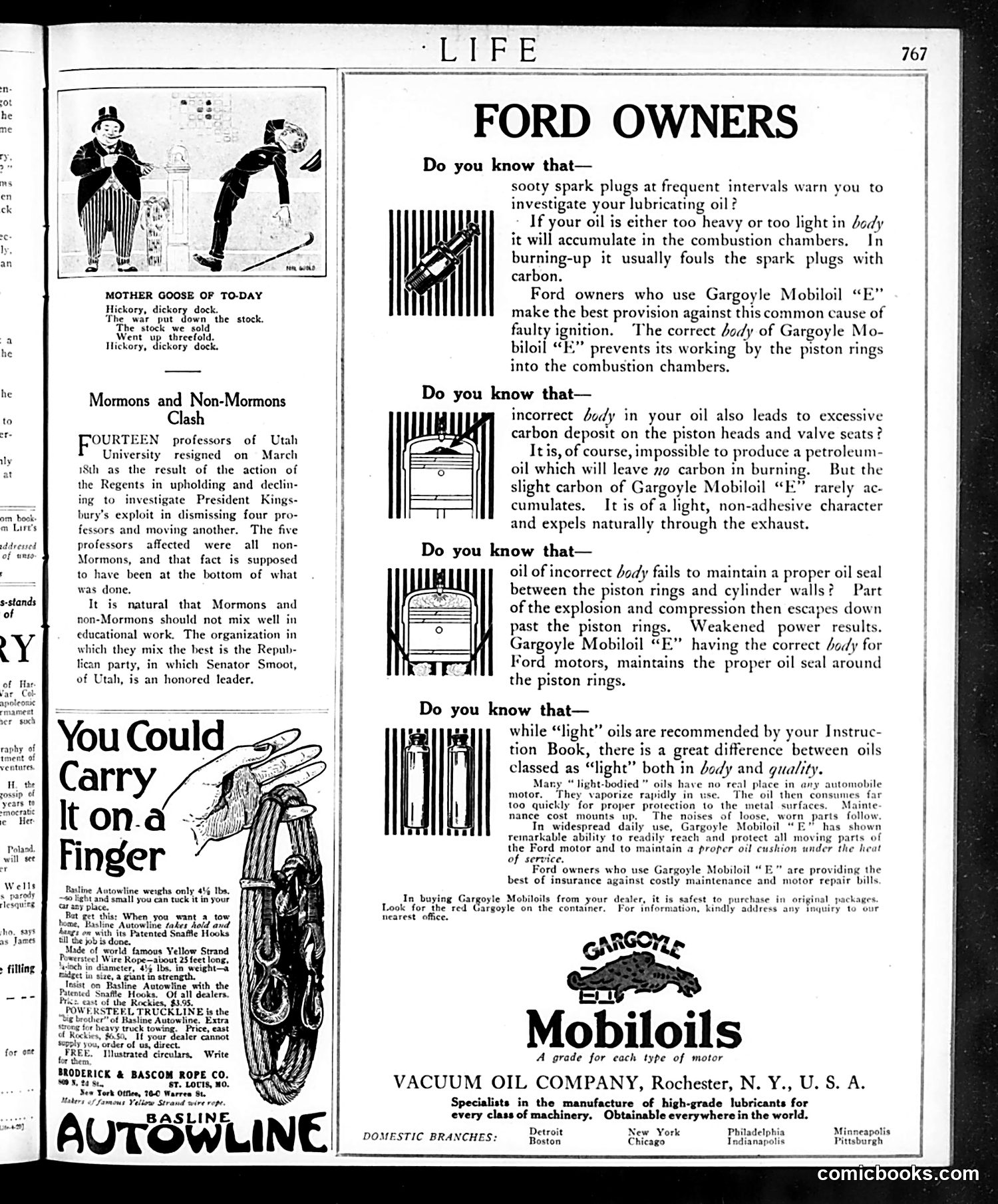
This page contains two distinct pieces of content: **Left side:** A brief political commentary titled "Mormons and Non-Mormons Clash" reports on fourteen professors resigning from Utah University following the university president's dismissal of four professors. The piece notes the dismissed professors were all non-Mormons and suggests religious affiliation lay "at the bottom" of the conflict. It concludes with a sardonic observation that Mormons and non-Mormons "should not mix well" in education, but do mix successfully in the Republican Party, where Utah's Senator Smoot holds an honored position—implying political expediency trumps religious tension. **Right side:** Entirely Gargoyle Mobiloil motor oil advertising, featuring technical diagrams explaining why Ford owners should use this specific oil grade to prevent spark plug fouling, carbon buildup, and engine wear. The page also includes unrelated advertisements (Autoline rope and Basline Autowline products).
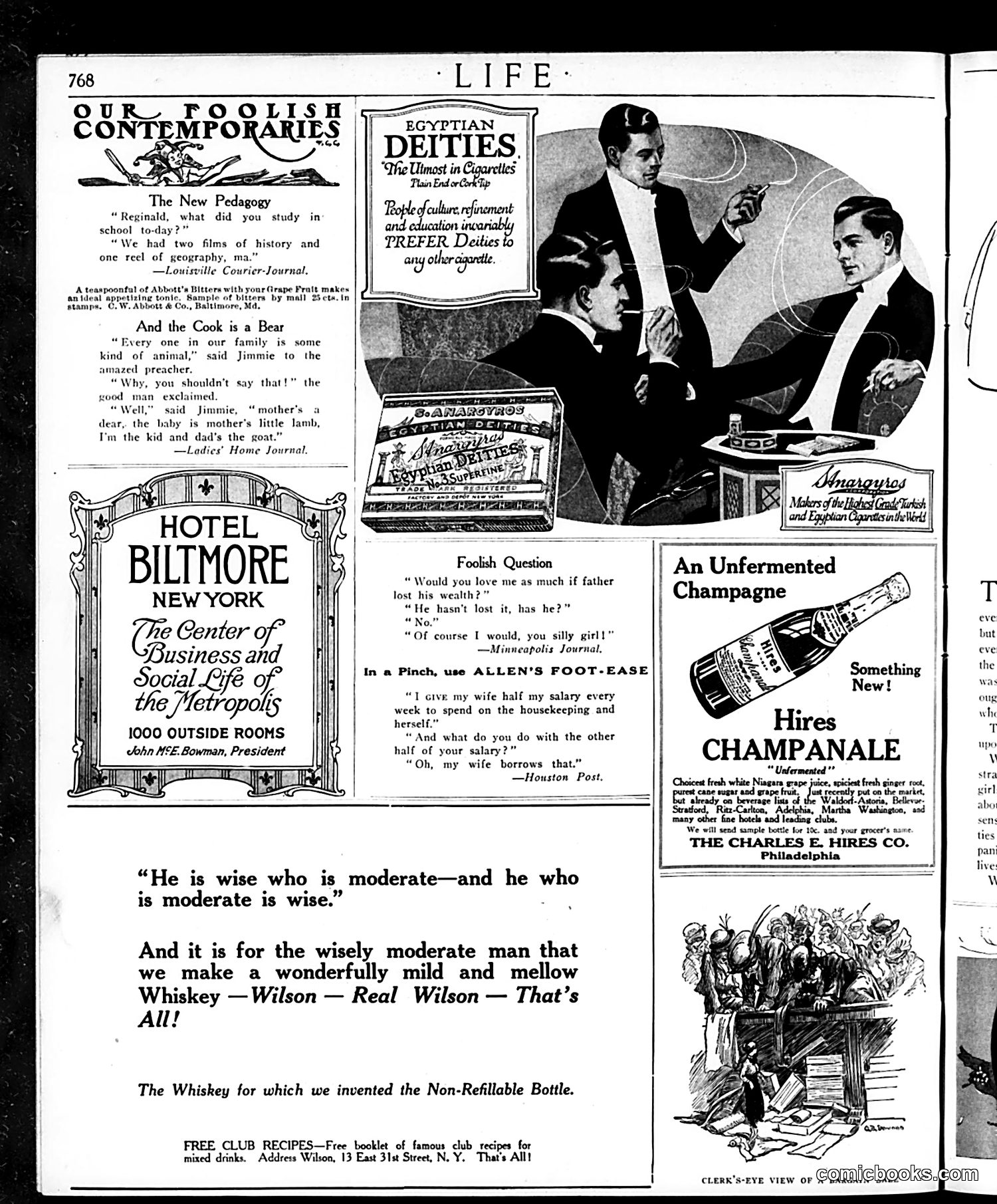
This page contains several brief satirical jokes typical of *Life* magazine's humor section, plus advertisements. **"The New Pedagogy"** mocks modern education by showing a child has learned only from film reels rather than traditional instruction—a jab at emerging film-based teaching methods. **"And the Cook is a Bear"** is a family joke where each member is humorously called an animal (mother's a "dear," baby's a "lamb," father's a "goat," boy's a "kid"). The joke plays on how these animal names double as family terms. **"Foolish Question"** presents a typical joke format: someone asks if a poor man would love being rich, and receives a sarcastic response suggesting only a foolish person would ask such an obvious question. The page is otherwise dominated by **advertisements** for Egyptian Deities cigarettes, Hotel Biltmore, Hires Champale (a non-alcoholic beverage), Wilson Whiskey, and foot-ease products—reflecting early 20th-century consumer goods marketed to middle-class readers.
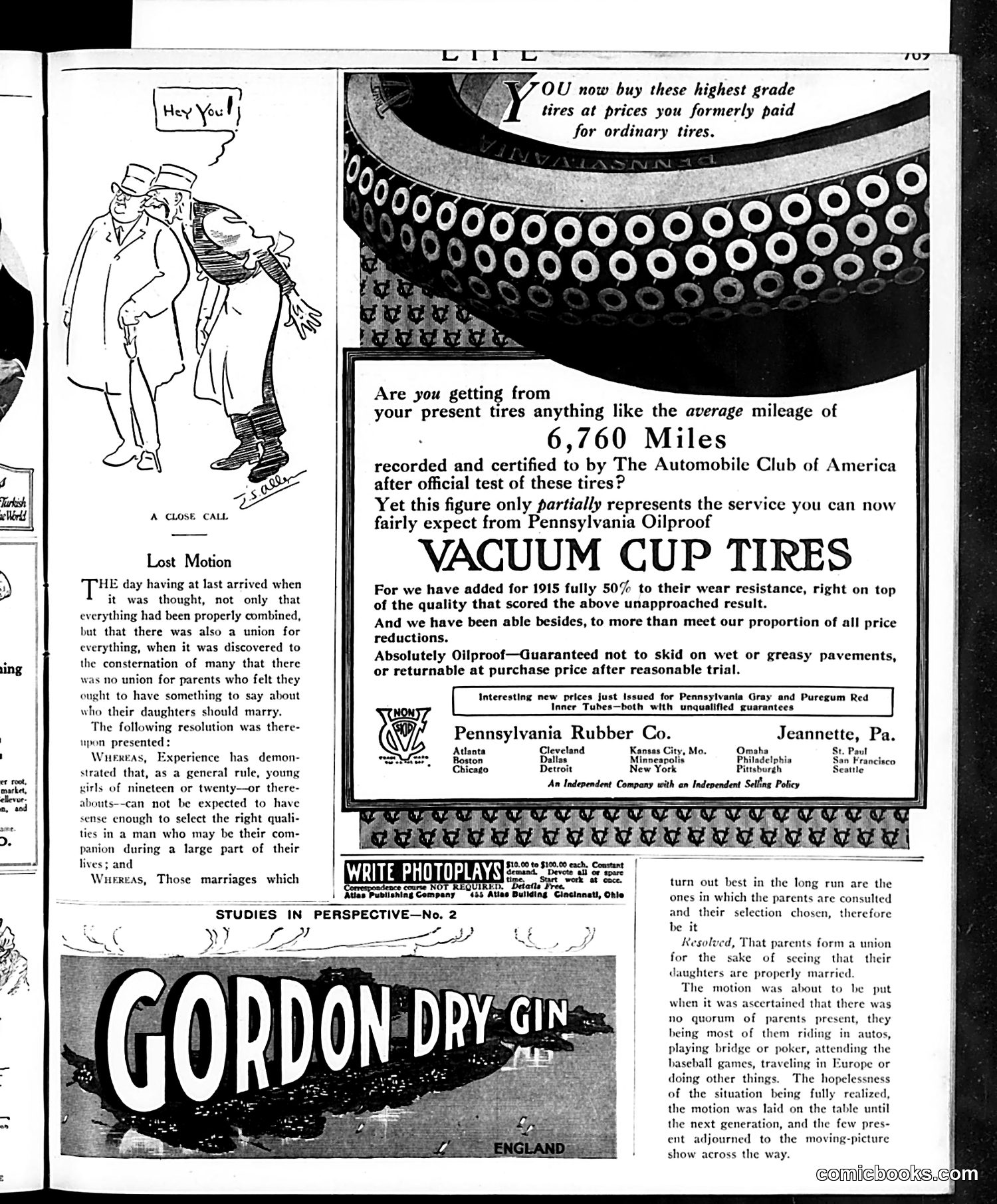
**"A Close Call" cartoon** (top left): Two men in conversation; one says "Hey You!" This appears to be a satirical piece about a proposed "Parents' Union." The text describes how parents discovered there was no union to control whom their daughters marry. A resolution proposes parents form a union to oversee daughters' marriages, assuming young women of 19-20 lack judgment. The joke's ironic punchline: the motion fails because parents themselves are too busy with leisure activities (autos, bridge, poker, baseball, Europe, movies) to attend the meeting. The satire mocks both parental pretensions to control adult children AND the self-absorbed lifestyle of the era's affluent class who claim to care about family governance while neglecting their actual responsibilities. The page also contains period advertisements for **Vacuum Cup Tires** and **Gordon Dry Gin**, typical of Life's revenue model.
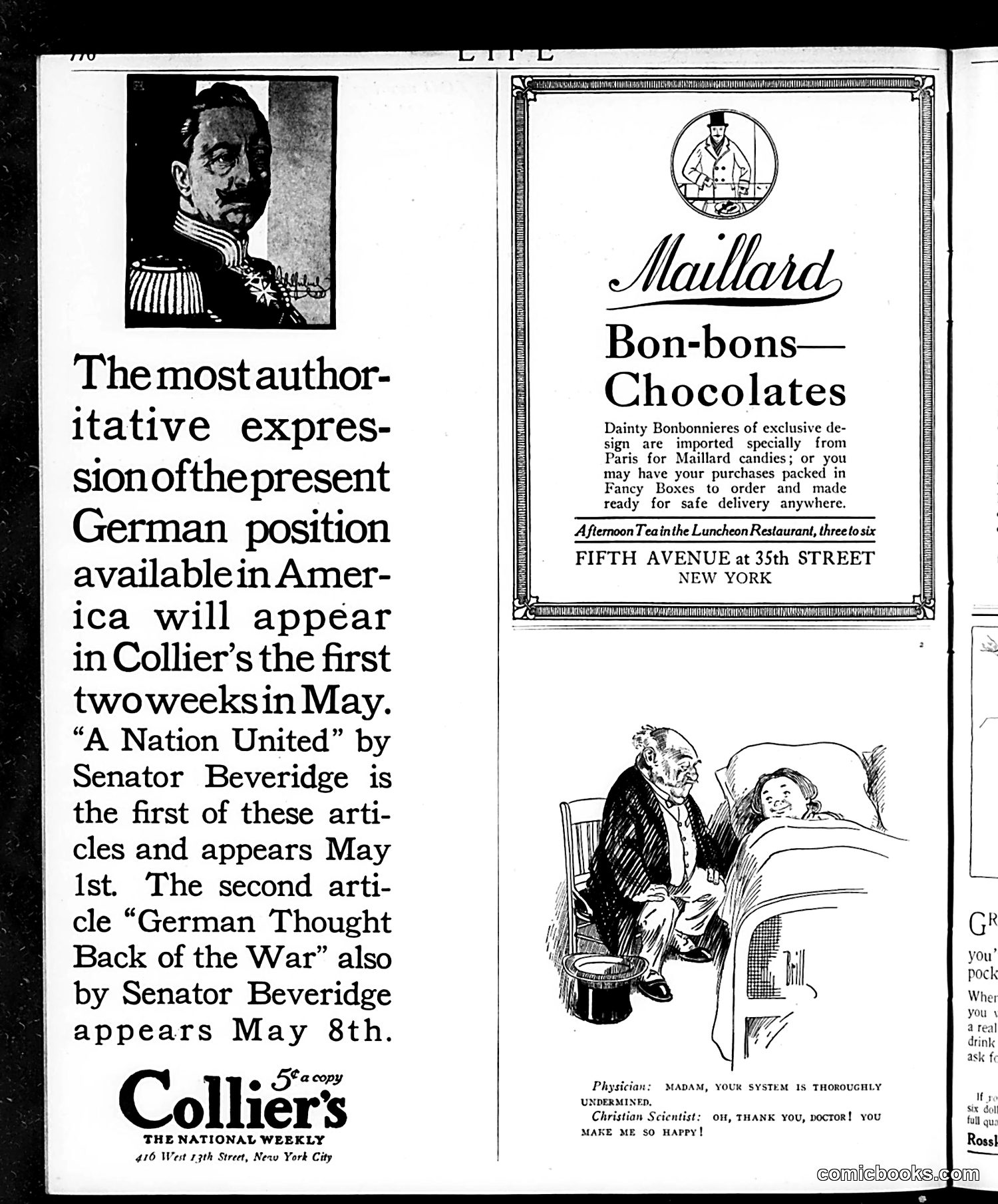
This page mixes editorial promotion with advertising and a single cartoon. **The Cartoon**: A doctor tells a bedridden Christian Scientist patient her system is "thoroughly undermined." She responds with joy: "Oh, thank you, doctor! You make me so happy!" The joke satirizes Christian Science belief—the religion denies the reality of illness and material suffering. By her logic, being told she's undermined is actually good news since physical ailment is supposedly illusion. The cartoon mocks Christian Scientists as logically inconsistent or delusional. **The Editorial**: Life announces that Senator Albert Beveridge will contribute articles to *Collier's* magazine presenting "the most authoritative expression of the present German position available in America"—appearing May 1st and 8th. This references World War I-era debates about German war justifications and American neutrality. **The Advertising**: A Maillard chocolates ad for upscale New York shoppers.
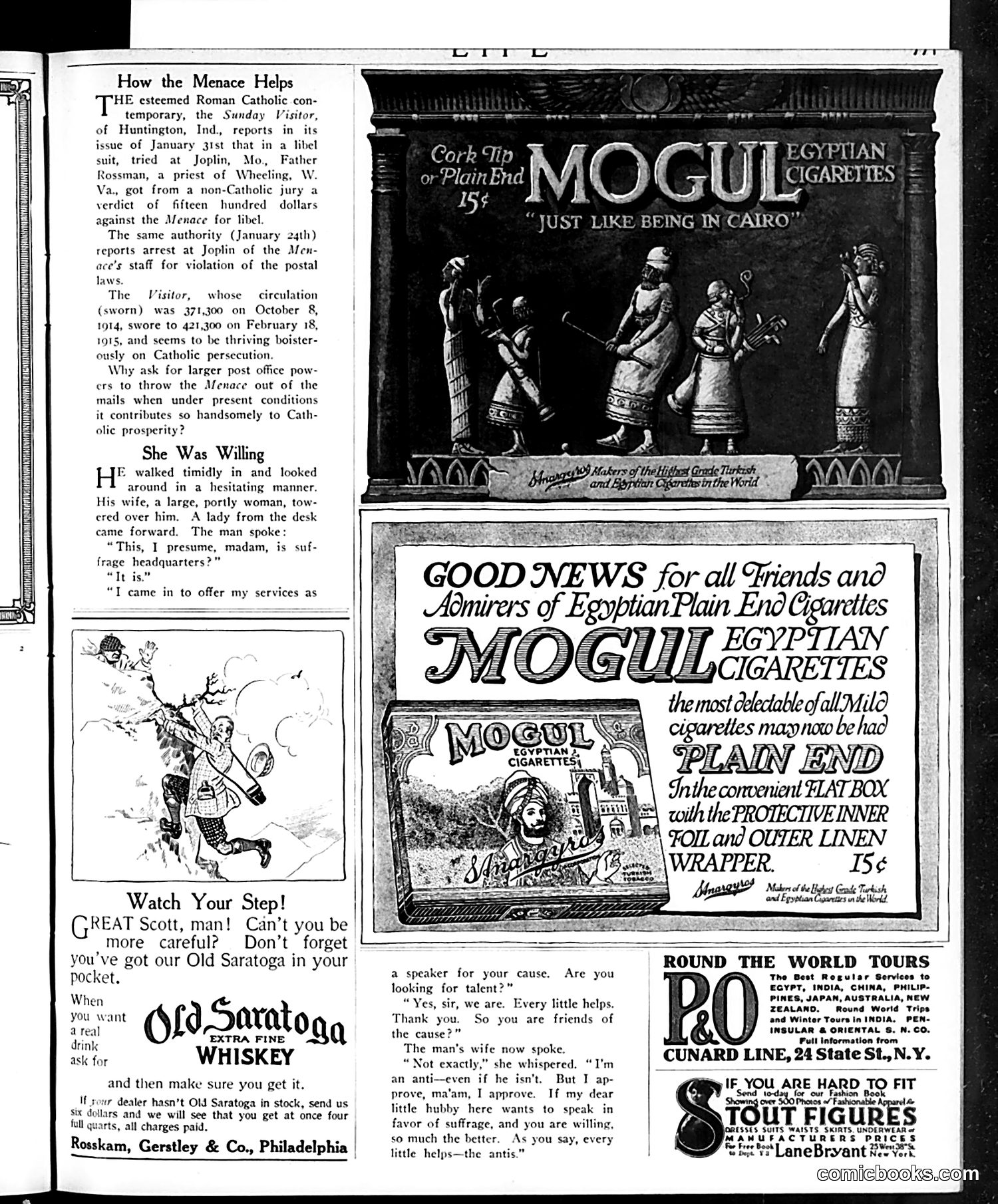
This page contains satirical commentary on early 20th-century American social and religious controversies. **"How the Menace Helps"**: This article critiques *The Menace*, an anti-Catholic publication that faced libel suits and postal violations. Life ironically notes that persecution actually *benefits* Catholic publications like the *Sunday Visitor*—their circulation grew substantially after the legal troubles, suggesting that controversy drives readership and donations. The satire implies that both sides profit from manufactured outrage. **"She Was Willing"**: A joke about women's suffrage. A timid man visits suffrage headquarters to volunteer, but his domineering wife reveals she's actually *anti-suffrage*—she's only allowing his participation to humor him. The humor targets both henpecked husbands and women's political divisions on the suffrage question. The remaining content consists primarily of period advertisements (whiskey, cigarettes, tours, clothing), typical of Life's revenue model.
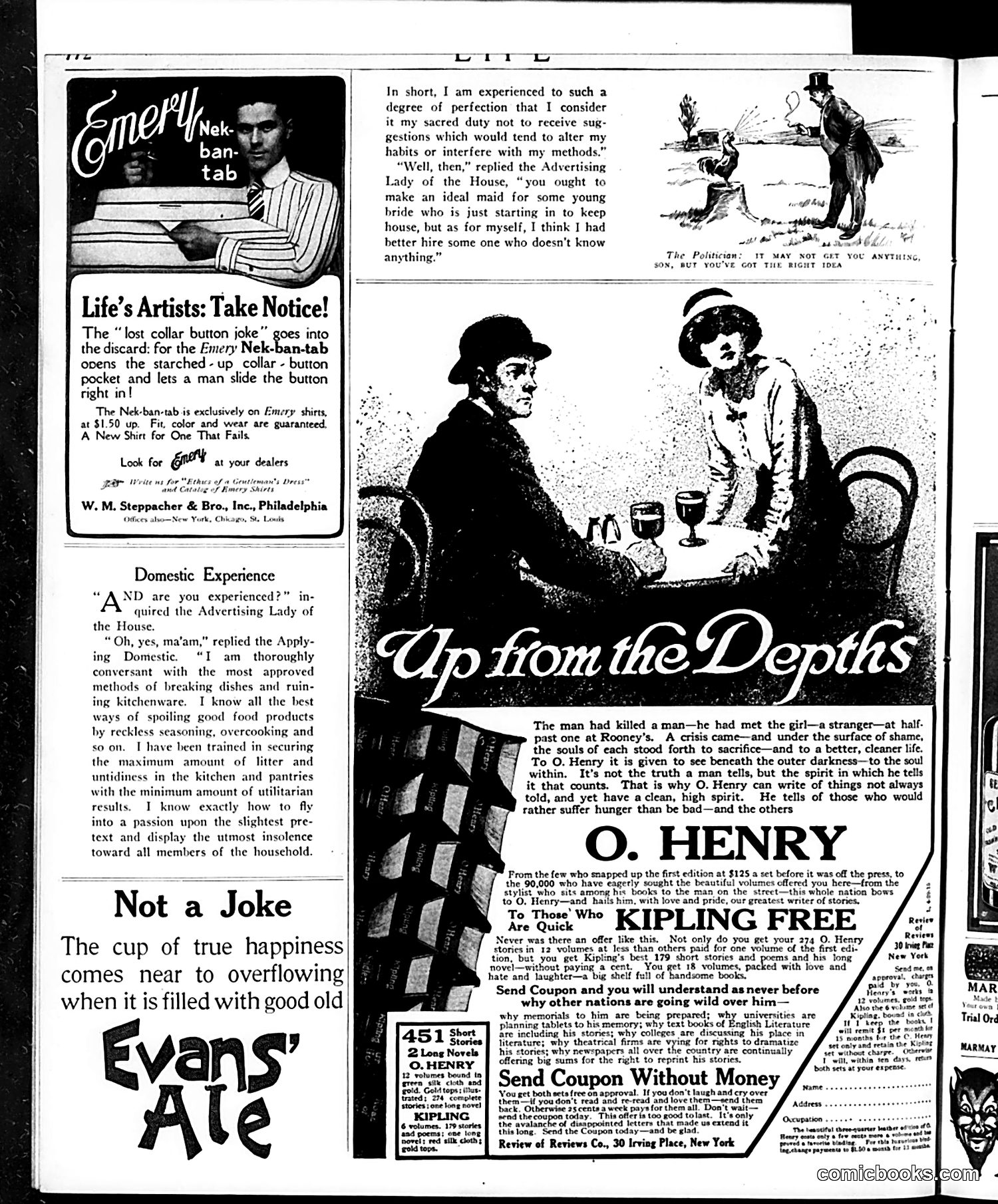
This page mixes humor with advertising. The main cartoon, "The Politician," shows a man speaking to a boy, saying the boy won't "get you anything, son, but you've got the right idea"—satirizing political ambition or naive idealism as impractical but well-intentioned. The "Domestic Experience" section is a satirical dialogue between an employer and a job applicant. The maid claims expertise in *ruining* households—breaking dishes, wasting food, creating mess—while remaining utterly oblivious. The joke mocks servants (or workers) who are confidently incompetent, and by extension, those who boast of experience without actual competence. The remainder of the page is dominated by advertising: Emery shirts (with a "nek-ban-tab" collar feature), and a large promotional campaign for an O. Henry book collection. These are not satirical—they're straightforward commercial content typical of Life magazine's era.
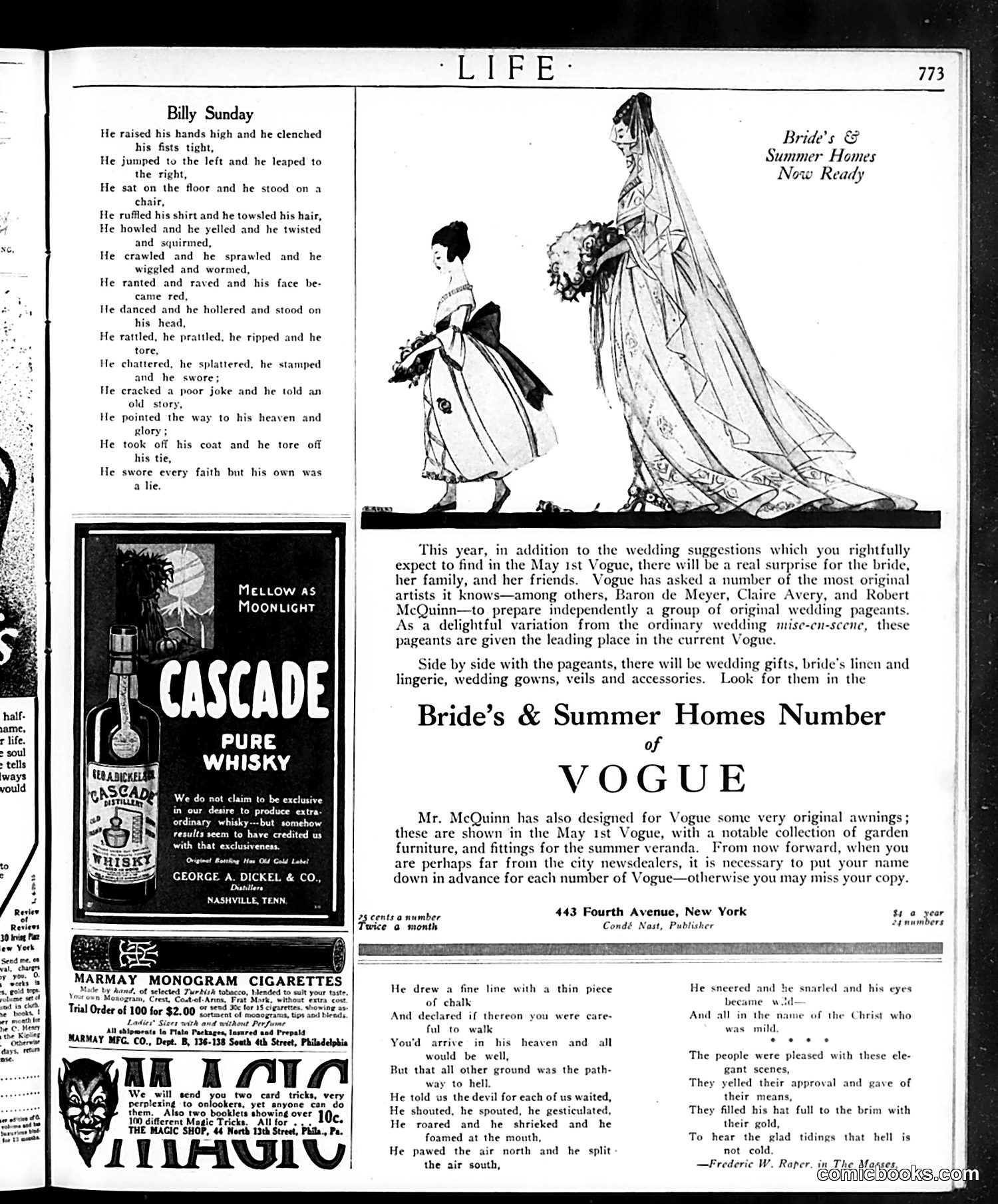
This page is primarily **advertising and fashion editorial**, not political satire. The top half features a **bridal fashion illustration** for Vogue's "Bride's & Summer Homes Number," showing a bride in an elaborate wedding gown with veil and attendant. The text promotes original wedding pageants designed by artists including Baron de Meyer and Robert McQuinn. Below are **commercial advertisements**: a Cascade Pure Whisky ad ("Mellow as Moonlight"), Marmay Monogram Cigarettes, and a Magic tricks advertisement. The left column contains a poem titled "Billy Sunday" listing physical behaviors (jumping, crawling, dancing, etc.), likely satirizing the famous evangelist's energetic preaching style, though the specific context isn't entirely clear from this page alone. This is a typical early 20th-century magazine page mixing editorial content with paid advertising.
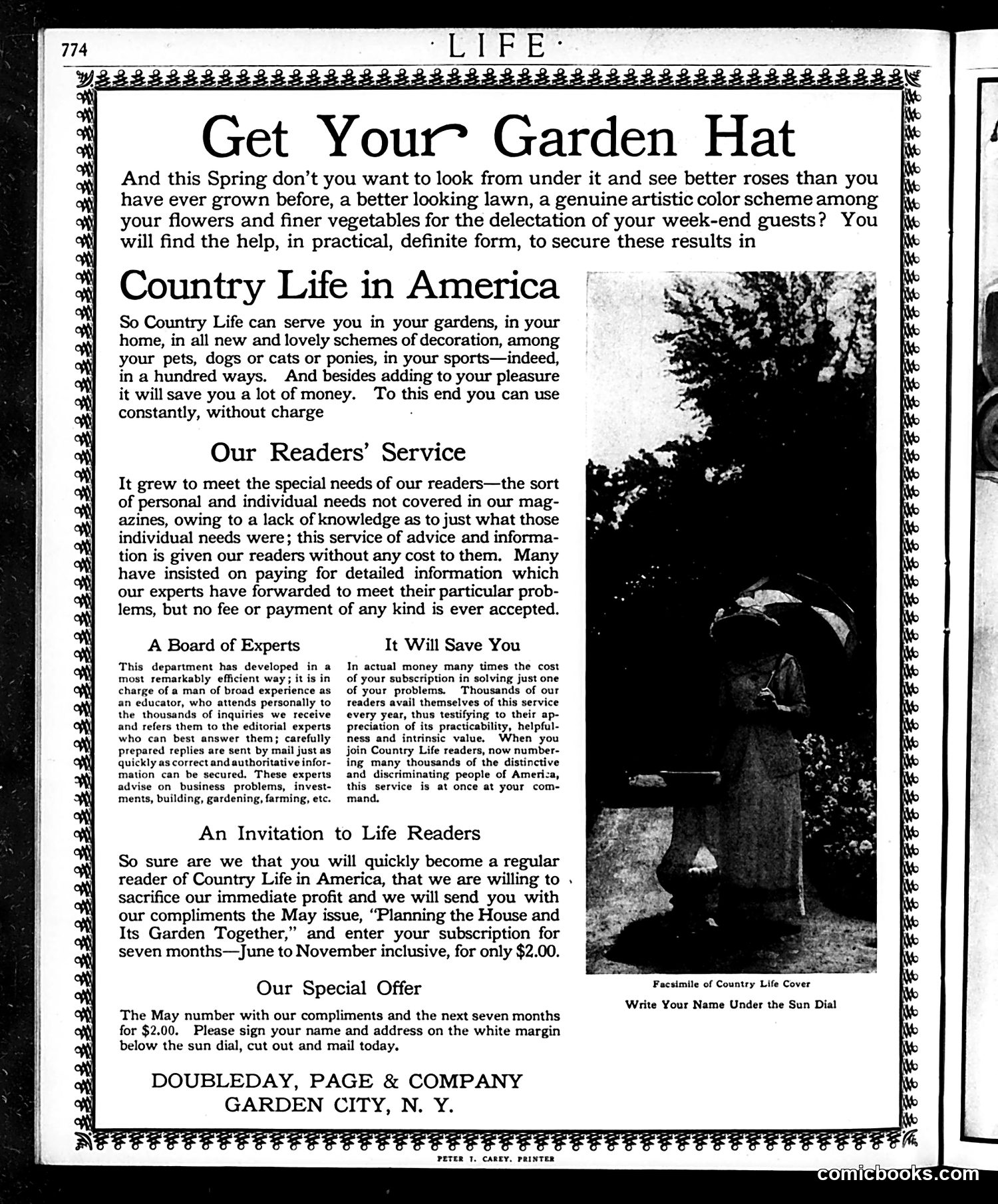
This page is **primarily advertising**, not satire or political commentary. It's a subscription promotion for *Country Life in America* magazine, published by Doubleday, Page & Company. The ad targets affluent readers interested in gardening, home decoration, and rural pursuits—positioning the magazine as essential for achieving superior gardens and entertaining weekend guests. The "Readers' Service" section highlights a free advisory service for subscribers on gardening, business, building, and farming matters, staffed by experts. The right side shows a "facsimile of Country Life Cover" (a photograph or illustration, now illegible in this reproduction) meant to entice potential subscribers. The sales pitch is straightforward: subscribe for seven months (June-November) for $2.00, and receive the May issue free. The tone reflects early 20th-century genteel marketing to the American gentry class interested in cultivating refined country estates and gardens.
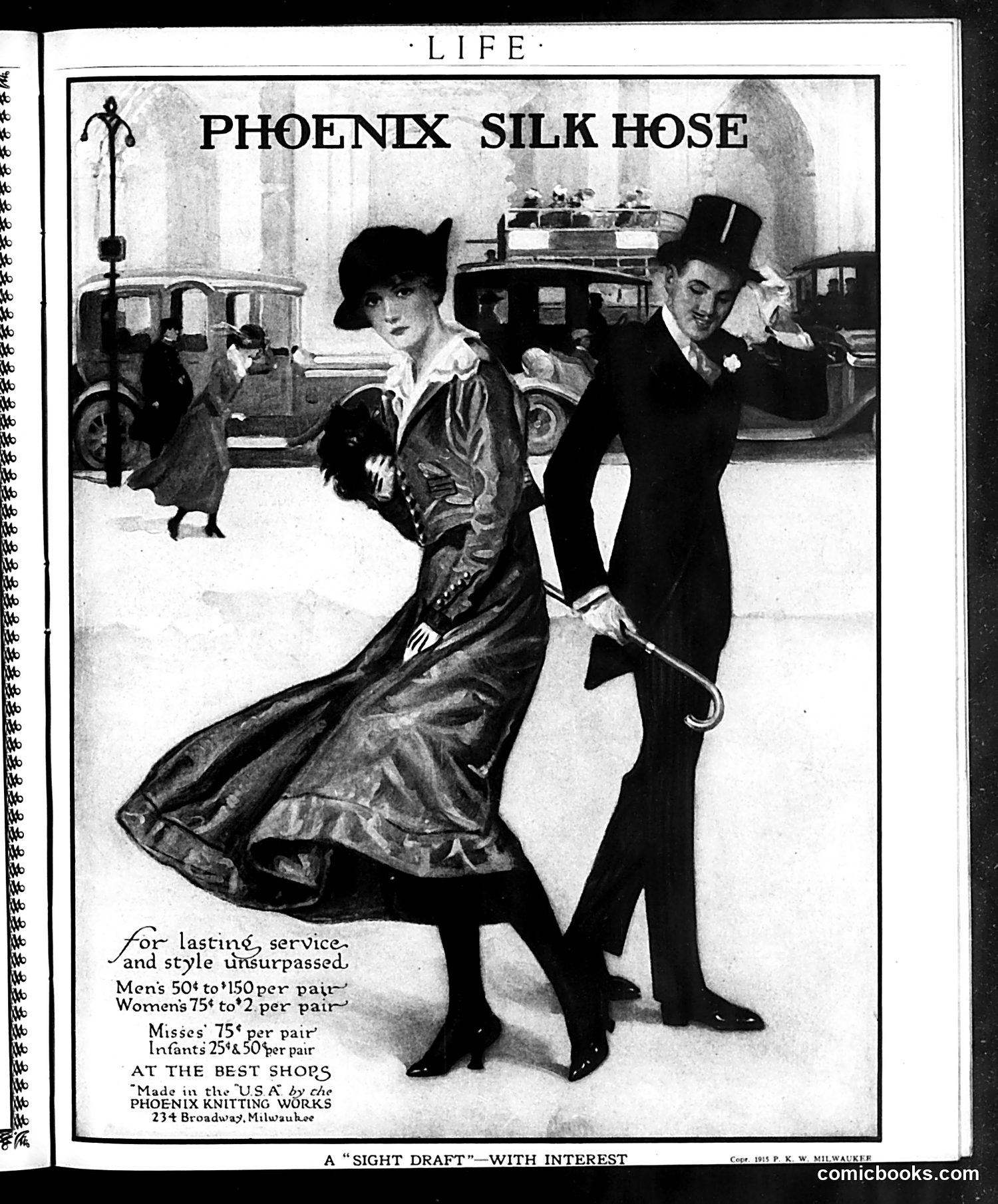
This is primarily a **product advertisement**, not political satire. It promotes Phoenix Silk Hose stockings made by Phoenix Knitting Works in Milwaukee. The image shows a elegantly dressed couple—a woman in a fashionable silk coat and cloche hat with a man in formal attire (top hat, tails)—posed dramatically on a city street with automobiles in the background. The caption "A 'Sight Draft'—With Interest" is a financial pun: a "sight draft" is a banking term for payment on demand, while the joke suggests interest accrues from the visual appeal of the woman's hosiery. The ad emphasizes quality ("lasting, service, and style unsurpassed") and lists prices for different categories: men's, women's, misses', and infants' stockings, ranging from 25¢ to $1.50 per pair. The fashionable styling and elegant presentation were typical advertising strategies of this era to sell silk hosiery as a luxury good.
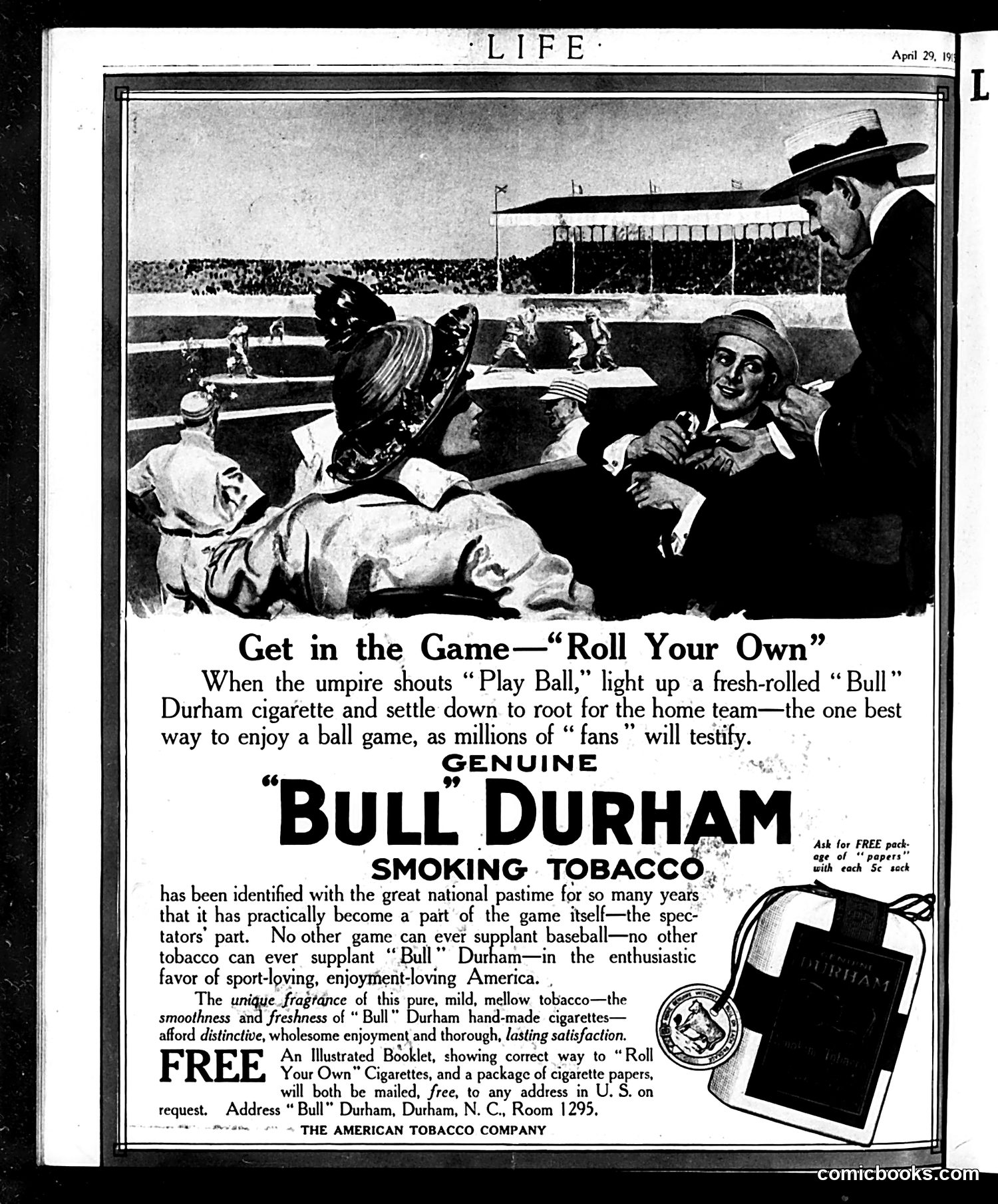
This is primarily a **cigarette advertisement**, not satire. It depicts spectators at a baseball stadium enjoying a game while smoking Bull Durham rolling tobacco. The ad associates smoking with baseball fandom, portraying it as integral to the American sporting experience. The headline "Get in the Game—'Roll Your Own'" uses baseball terminology as marketing, suggesting that smoking Durham cigarettes enhances enjoyment of the sport. Key appeals: The tobacco company emphasizes that millions of fans smoke their product at ballgames, positioning it as a patriotic leisure activity tied to "sport-loving, enjoyment-loving America." The ad offers a free illustrated booklet on rolling cigarettes and complimentary cigarette papers as promotional inducements. By modern standards, this represents aggressive tobacco marketing to a mass audience without health warnings—practices now prohibited in most countries. The casual integration of smoking into family entertainment contexts reflects early 20th-century attitudes vastly different from contemporary public health policies.