
Life, 1915-04-29 · page 24 of 44
Life — April 29, 1915 — page 24: what you’re looking at
What you’re looking at
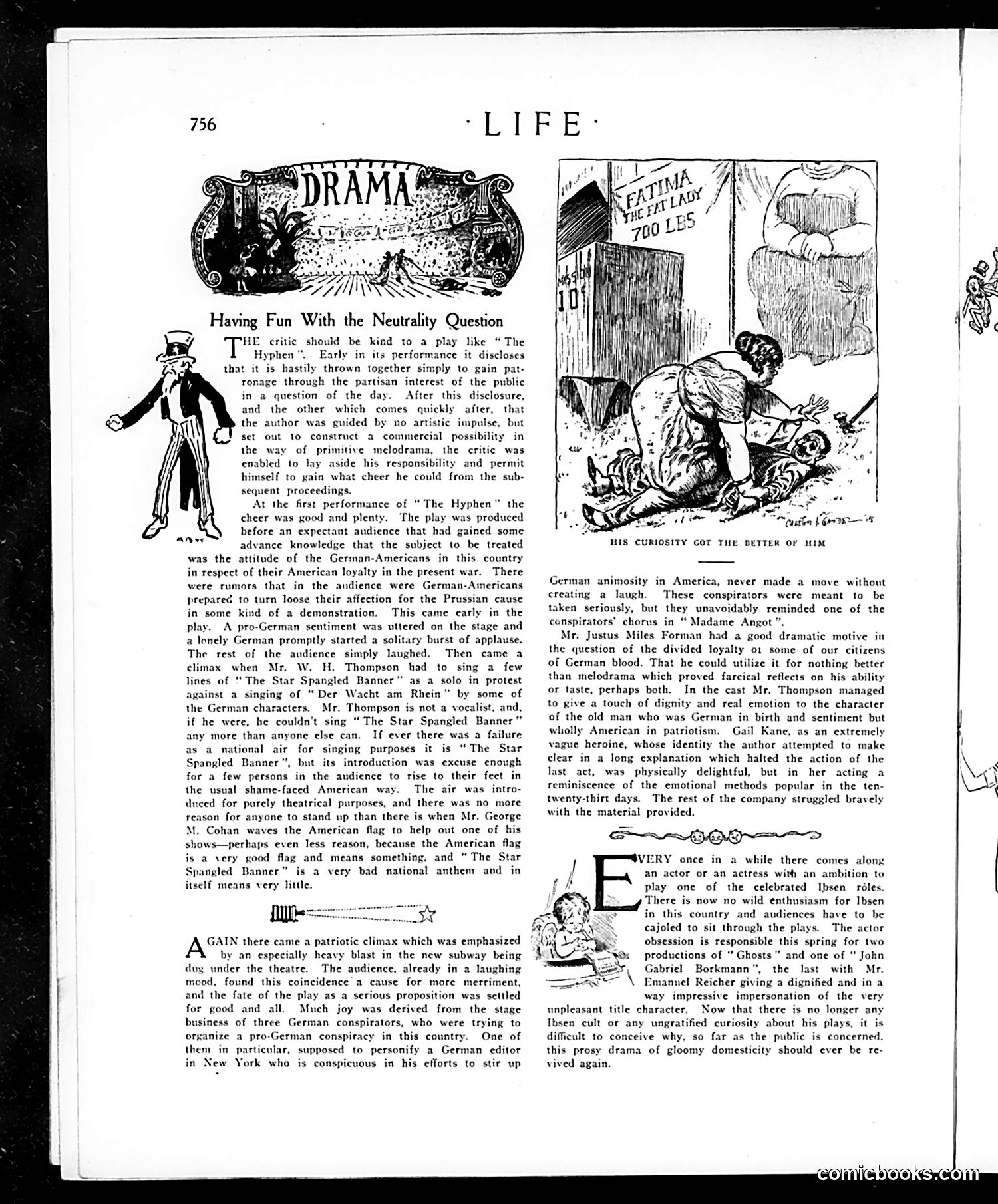
This page reviews a play called "The Hyphen," which dramatizes German-American loyalty during World War I—a heated contemporary issue. The critic describes the play as cynical melodrama exploiting public anxiety about German-Americans' divided allegiances. The cartoon (captioned "His Curiosity Got the Better of Him") depicts a rotund figure labeled "Fatima, the Fat Lady" from a sideshow, satirizing how the play itself is exploitative spectacle rather than serious drama. The review details audience reactions: when pro-German sentiment was expressed onstage, one German-American applauded alone while others laughed; when "The Star-Spangled Banner" was sung as protest, some stood awkwardly. A subway explosion provided unintended comic relief. The critic finds the supposed German conspirators—meant to evoke a real New York German-American newspaper editor—become farcical rather than threatening, undermining the play's dramatic intent.
📄 Transcribed text from this page (OCR, searchable)
Machine-transcribed from the original scan — historical spelling and the odd misread are preserved.
. SoS —N NS Having Fun With the Neutrality Question HE critic should be kind to a play like “The Hyphen. Early in its performance it discloses that it is hastily thrown together simply to gain pat- ronage through the partisan interest of the public in a question of the day. After this disclosure, and the other which comes quickly after, that the author was guided by no artistic impulse, but set out to construct a commercial possibility in the way of primitive melodrama, the critic was enabled to lay aside his responsibility and permit himself to gain what cheer he could from the sub- sequent proceedings. At the first performance of “The Hyphen” the cheer was good and plenty. The play was produced before an expectant audience that had gained some advance knowledge that the subject to be treated was the attitude of the German-Americans in this country in respect of their American loyalty in the present war. There were rumors that in the andience were German-Americans prepared to turn loose their affection for the Prussian cause in some kind of a demonstration. This came early in the play. A pro-German sentiment was uttered on the stage and a lonely German promptly started a solitary burst of applause. The rest of the audience simply laughed. Then came a climax when Mr. W. H, Thompson had to sing a few lines of “The Star Spangled Banner” as a solo in protest against a singing of “Der Wacht am Rhein” by some of the German characters. Mr. Thompson is not a vocalist, and, if he were, he couldn't sing “ The Star Spangled Banner” any more than anyone else can. If ever there was a failure as a national air for singing purposes it is “The Star Spangled Banner", but its introduction was excuse enough for a few persons in the audience to rise to their feet in the usual shame-faced American way. The air was intro- duced for purely theatrical purposes, and there was no more reason for anyone to stand up than there is when Mr. George M. Cohan waves the American flag to help out one of his shows—perhaps even less reason, because the American flag is a very good flag and means something, and “The Star Spangled Banner” is a very bad national anthem and in itself means very little. sag h_ was emphasized GAIN there came a patriotic climax w by an especially heavy blast in the new subway being dug under the theatre. The audience, already in a laughing mood, found this coincidence’ a cause for more merriment, and the fate of the play as a serious proposition was settled for good and all. Much joy was derived from the stage business of three German conspirators, who were trying to organize a pro-German conspiracy in this country. One of them in particular, supposed to personify a German editor in New York who is conspicuous in his efforts to stir up naw MIS CURIOSITY GOT THE BETTER OF MIM German animosity in America, never made a move without creating a laugh. These conspirators were meant to be taken seriously, but they unavoidably reminded one of the conspirators’ chorus in “ Madame Angot ”. Mr. Justus Miles Forman had a good dramatic motive in the question of the divided loyalty 01 some of our citizens of German blood. That he could utilize it for nothing better than melodrama which proved farcical reflects on his ability or taste, perhaps both. In the cast Mr. Thompson managed to give a touch of dignity and real emotion to the character of the old man who was German in birth and sentiment but wholly American in patriotism. Gail Kane, as an extremely vague heroine, whose identity the author attempted to make clear in a long explanation which halted the action of the last act, was physically delightful, but in her acting a reminiscence of the emotional methods popular in the ten- twenty-thirt days. The rest of the company struggled bravely with the material provided. ! VERY once in a while there comes alony an actor or an actress with an ambition to play one of the celebrated Ibsen roles. There is now no wild enthusiasm for Ibsen in this country and audiences have to be cajoled to sit through the plays. The actor obsession is responsible this spring for two productions of “ Ghosts” and one of “John Gabriel Borkmann”, the last with Mr. Emanuel Reicher giving a dignified and in a way impressive impersonation of the very unpleasant title character. Now that there is no longer any Ibsen cult or any ungratified curiosity about his plays, it is difficult to conceive why, so far as the public is concerned. this prosy drama of gloomy domesticity should ever be re- vived again.