
Life, 1915-04-29 · page 21 of 44
Life — April 29, 1915 — page 21: what you’re looking at
What you’re looking at
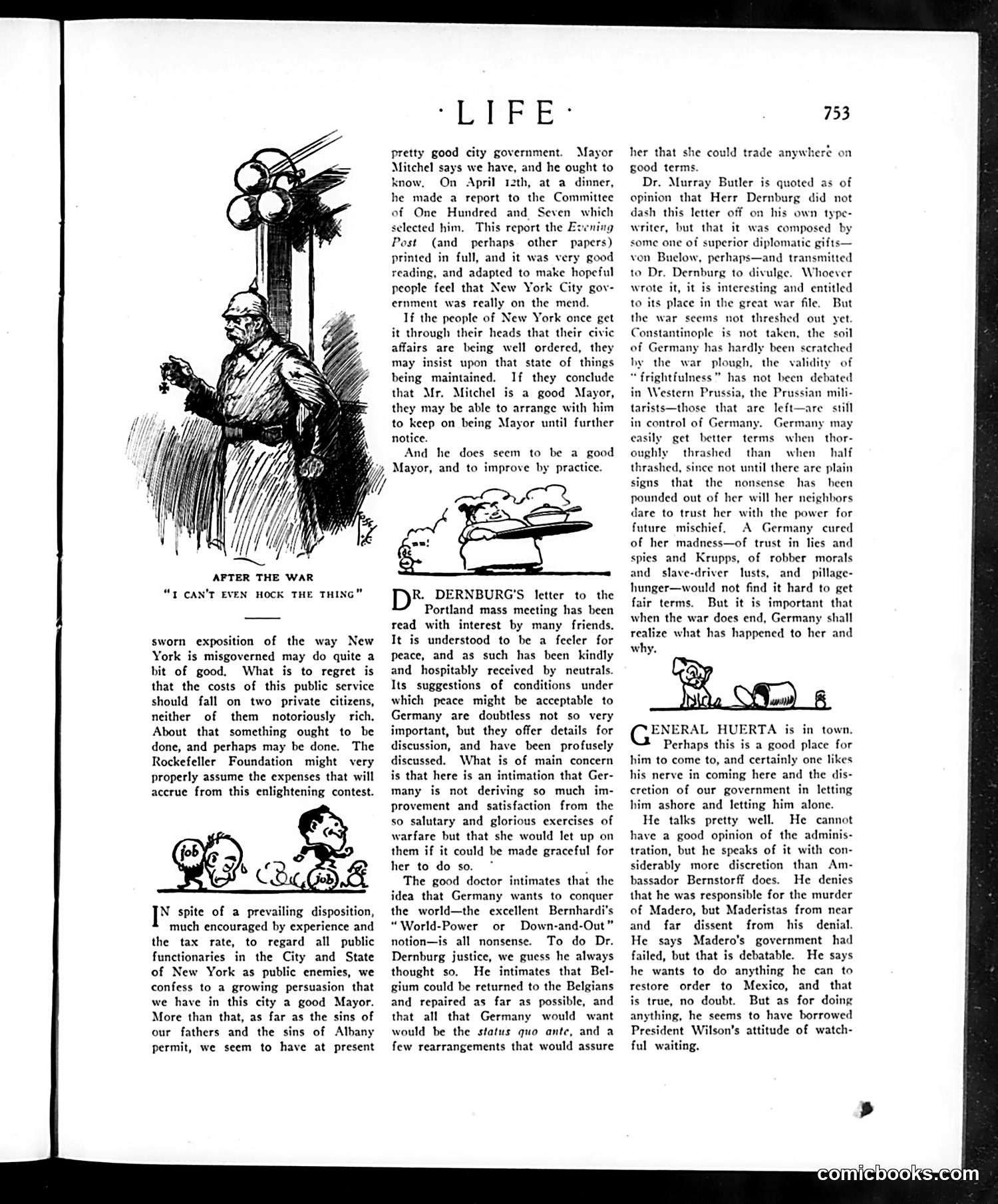
The cartoon depicts a German soldier standing beneath a street lamp, holding what appears to be a military helmet or piece of military equipment, saying "I can't even hock the thing." The image satirizes Germany's post-war destitution and defeat. The accompanying text discusses peace feeler proposals from Dr. Dernburg (a German diplomat) to Portland, suggesting Germany might accept a return to pre-war conditions. Life magazine's editors argue Germany shouldn't be trusted with favorable peace terms—that Germany needs to be thoroughly defeated first before its neighbors can safely negotiate. They suggest only when "nonsense has been pounded out of her" can Germany be trusted. The cartoon's humor rests on the grim image of a defeated German soldier so impoverished he cannot even pawn his military equipment. It reinforces the editorial argument that Germany must face complete military collapse before peace talks should occur.
📄 Transcribed text from this page (OCR, searchable)
Machine-transcribed from the original scan — historical spelling and the odd misread are preserved.
AFTER THE WAR “I CAN'T EVEN HOCK THE THING” sworn exposition of the way New York is misgoverned may do quite a bit of good. What is to regret is that the costs of this public service should fall on two private citizens, neither of them notoriously rich, About that something ought to be done, and perhaps may be done. The Rockefeller Foundation might very properly assume the expenses that will accrue from this enlightening contest. N spite of a prevailing disposition, much encouraged by experience and the tax rate, to regard all public functionaries in the City and State of New York as public enemies, we confess to a growing persuasion that we have in this city a good Mayor. More than that, as far as the sins of our fathers and the sins of Albany permit, we seem to have at present *LIFE- pretty good city government. Mayor Mitchel says we have, and he ought to know, On April 12th, at a dinner, he made a report to the Committee which of One Hundred and Seven selected him. This report the Post (and perhaps other papers) printed in full, and it was very good reading, and adapted to make hopeful people feel that New York City gov- ernment was really on the mend. If the people of New York once get it through their heads that their civic affairs are being well ordered, they may insist upon that state of things being maintained. If they conclude that Mr. Mitchel is a good Mayor, they may be able to arrange with him to keep on being Mayor until further notice. And he does seem to be a good Mayor, and to improve by practice. R. DERNBURG'S letter to the Portland mass meeting has been read with interest by many friends. It is understood to be a feeler for peace, and as such has been kindly and hospitably received by neutrals. Its suggestions of conditions under which peace might be acceptable to Germany are doubtless not so very important, but they offer details for discussion, and have been profusely discussed. What is of main concern is that here is an intimation that Ger- many is not deriving so much im- provement and satisfaction from the so salutary and glorious exercises of warfare but that she would Iet up on them if it could be made graceful for her to do so. . The good doctor intimates that the idea that Germany wants to conquer the world—the excellent Bernhardi's “World-Power or Down-and-Out” notion—is all nonsense. To do Dr. Dernburg justice, we guess he always thought so. He intimates that Bel- gium could be returned to the Belgians and repaired as far as possible, and that all that Germany would want would be the status quo ante, and a few rearrangements that would assure 753 her that she could trade anywhere on good terms. Dr. Murray Butler is quoted as of opinion that Herr Dernburg did not dash this letter off on his own type- writer, but that it was composed by some one of superior diplomatic gifts: von Buelow, perhaps—and transmitted to Dr. Dernburg to divulge. Whoever wrote it, it is interesting and entitled to its place in the great war file. But the war seems not threshed out yet. Constantinople is not taken, the soil of Germany has hardly been scratched by the war plough, the validity of “ frightfulness” has not heen debated in Western Prussia, the Prussian mili- tarists—those that are left—are still in control of Germany. Germany may easily get better terms when thor- oughly thrashed than when half thrashed, since not until there are plain signs that the nonsense has heen pounded out of her will her neighbors dare to trust her with the power for future mischief, A Germany cured of her madness—of trust in lies and spies and Krupps, of robber morals and slave-driver lusts, and pillage- hunger—would not find it hard to get fair terms. But it is important that when the war does end, Germany shall realize what has happened to her and why, AL HUERTA is in town. Perhaps this is a good place for him to come to, and certainly one likes his nerve in coming here and the dis- cretion of our government in letting him ashore and letting him alone. He talks pretty well. He cannot have a good opinion of the adminis- tration, but he speaks of it with con- siderably more discretion than Am- bassador Bernstorff does. He denies that he was responsible for the murder of Madero, but Maderistas from near and far dissent from his denial. He says Madero’s government had failed, but that is debatable. He says he wants to do anything he can to restore order to Mexico, and that is true, no doubt. But as for doing anything, he seems to have borrowed President Wilson's attitude of watch- ful waiting.