
Life, 1915-04-29 · page 26 of 44
Life — April 29, 1915 — page 26: what you’re looking at
What you’re looking at
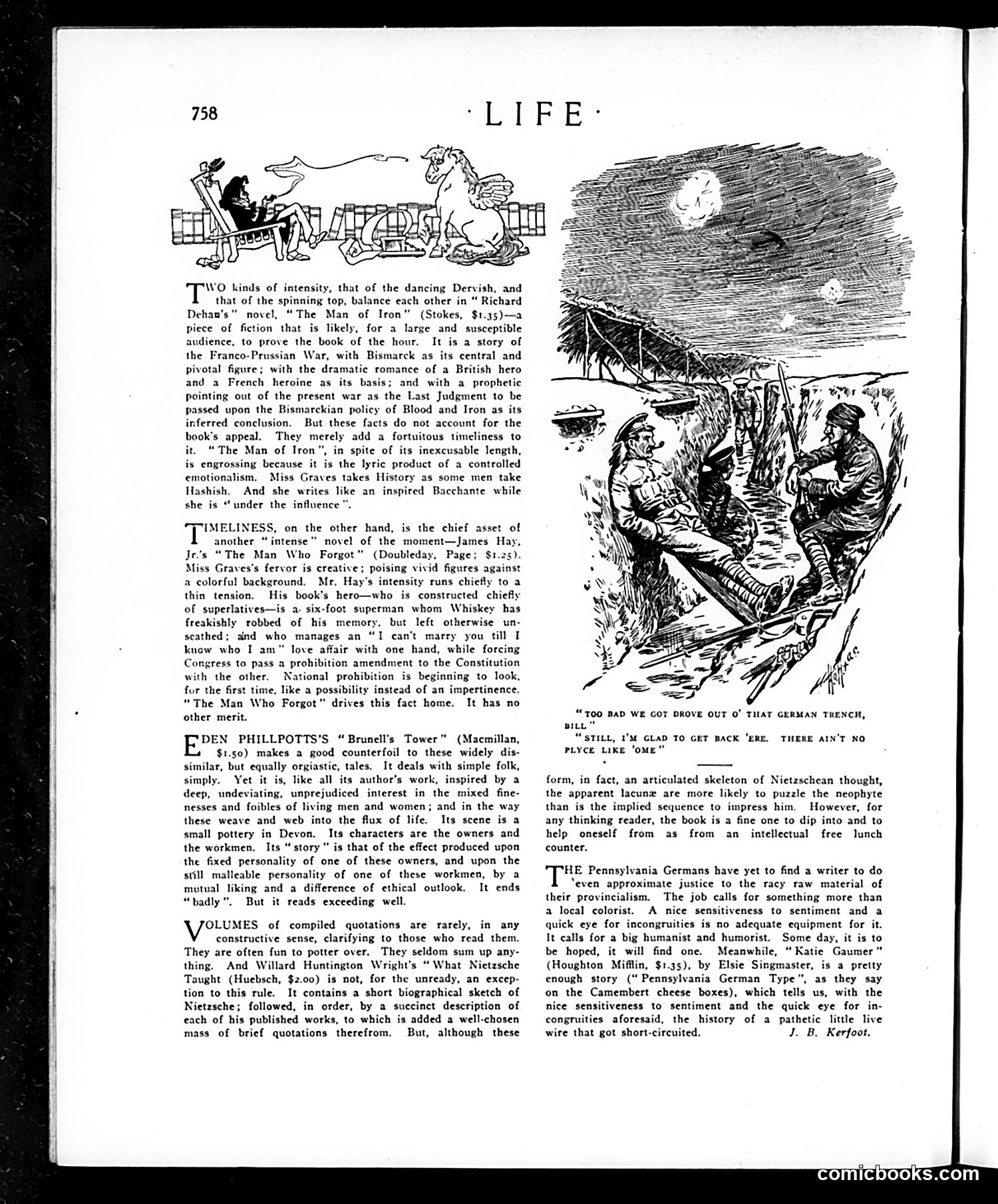
This page reviews contemporary novels, with one accompanying illustration. The cartoon depicts two soldiers in a World War I trench, speaking in working-class dialect. One says they're "glad to get back 'ere" because "there ain't no plyce like 'ome" (home), despite being driven out of a German trench. The illustration satirizes the disconnect between soldiers' experiences and civilian romantic notions of war. The soldiers' casual, colloquial speech and acknowledgment of hardship contrast with propagandistic portrayals of combat. The phrase "there ain't no plyce like 'ome" ironically undercuts heroic narratives—soldiers simply want to escape danger and return to normalcy. The book reviews discuss war-themed fiction, including *The Man of Iron* (set during the Franco-Prussian War) and *The Man Who Forgot* (featuring prohibition politics). The cartoon complements these literary discussions by grounding wartime experience in soldiers' actual perspectives rather than literary dramatization.
📄 Transcribed text from this page (OCR, searchable)
Machine-transcribed from the original scan — historical spelling and the odd misread are preserved.
WO kinds of intensity, that of the dancing Dervish, and that of the spinning top, balance each other in “ Richard Dehan’s" novel, “The Man of Iron” (Stokes, $1.35)—a piece of fiction that is likely, for a large and susceptible audience, to prove the book of the hour. It is a story of the Franco-Prussian War, with Bismarck as its central and pivotal figure; with the dramatic romance of a British hero and a French heroine as its basis; and with a prophetic pointing out of the present war as the Last Judgment to be passed upon the Bismarckian policy of Blood and Iron as its inferred conclusion. But these facts do not account for the book's appeal. They merely add a fortuitous timeliness to it. “The Man of Iron”, in spite of its inexcusable length, is engrossing because it is the lyric product of a controlled emotionalism. Miss Graves takes History as some men take Hashish, And she writes like an inspired Bacchante while she is “under the influence ”. Tees on the other hand, is the chief asset of another “intense” novel of the moment—James Hay, Je’s “The Man Who Forgot” (Doubleday, Page; $1.25). Miss Graves’s fervor is creative; poising vivid figures against a colorful background. Mr. Hay's intensity runs chiefly to a thin tension. His book’s hero—who is constructed chiefly of superlatives—is a. six-foot superman whom Whiskey has freakishly robbed of his memory, but left otherwise un- scathed; and who manages an “I can't marry you till T know who I am” love affair with one hand, while forcing Congress to pass a prohibition amendment to the Constitution with the other. National prohibition is beginning to look, for the first time, like a possibility instead of an impertinence. “The Man Who Forgot” drives this fact home. It has no other merit. DEN PHILLPOTTS’S “Brunell's Tower” (Macmillan, $1.50) makes a good counterfoil to these widely dis- similar, but equally orgiastic, tales. It deals with simple folk, simply. Yet it is, like all its author's work, inspired by a deep, undeviating, unprejudiced interest in the mixed fine- nesses and foibles of living men and women; and in the way these weave and web into the flux of life. Its scene is a small pottery in Devon, Its characters are the owners and the workmen, Its “story” is that of the effect produced upon the fixed personality of one of these owners, and upon the still malleable personality of one of these workmen, by a mutual liking and a difference of ethical outlook. It ends “badly”. But it reads exceeding well. 'OLUMES of compiled quotations are rarely, in any constructive sense, clarifying to those who read them. They are often fun to potter over. They seldom sum up any- thing. And Willard Huntington Wright's “ What Nietzsche Taught (Huebsch, $2.00) is not, for the unready, an excep- tion to this rule. It contains a short biographical sketch of Nietzsche; followed, in order, by a succinct description of each of his published works, to which is added a well-chosen mass of brief quotations therefrom. But, although these “TOO BAD WE GOT DROVE OUT 0’ THAT GERMAN TRENCH, BILL” “STILL, I'M GLAD TO GET BACK "ERE. THERE AIN'T NO PLYCE LIKE 'OME” form, in fact, an articulated skeleton of Nietzschean thought, the apparent lacunz are more likely to puzzle the neophyte than is the implied sequence to impress him. However, for any thinking reader, the book is a fine one to dip into and to help oneself from as from an intellectual free lunch counter. HE Pennsylvania Germans have yet to find a writer to do “even approximate justice to the racy raw material of their provincialism. The job calls for something more than a local colorist. A nice sensitiveness to sentiment and a quick eye for incongruities is no adequate equipment for it. It calls for a big humanist and humorist. Some day, it is to be hoped, it will find one. Meanwhile, “Katie Gaumer” (Houghton Mifflin, $1.35), by Elsie Singmaster, is a pretty enough story (“Pennsylvania German Type”, as they say on the Camembert cheese boxes), which tells us, with the nice sensitiveness to sentiment and the quick eye for in- congruities aforesaid, the history of a pathetic little live wire that got short-circuited. J. B. Kerfoot. comicbooks.com