
Life, 1915-04-29 · page 25 of 44
Life — April 29, 1915 — page 25: what you’re looking at
What you’re looking at
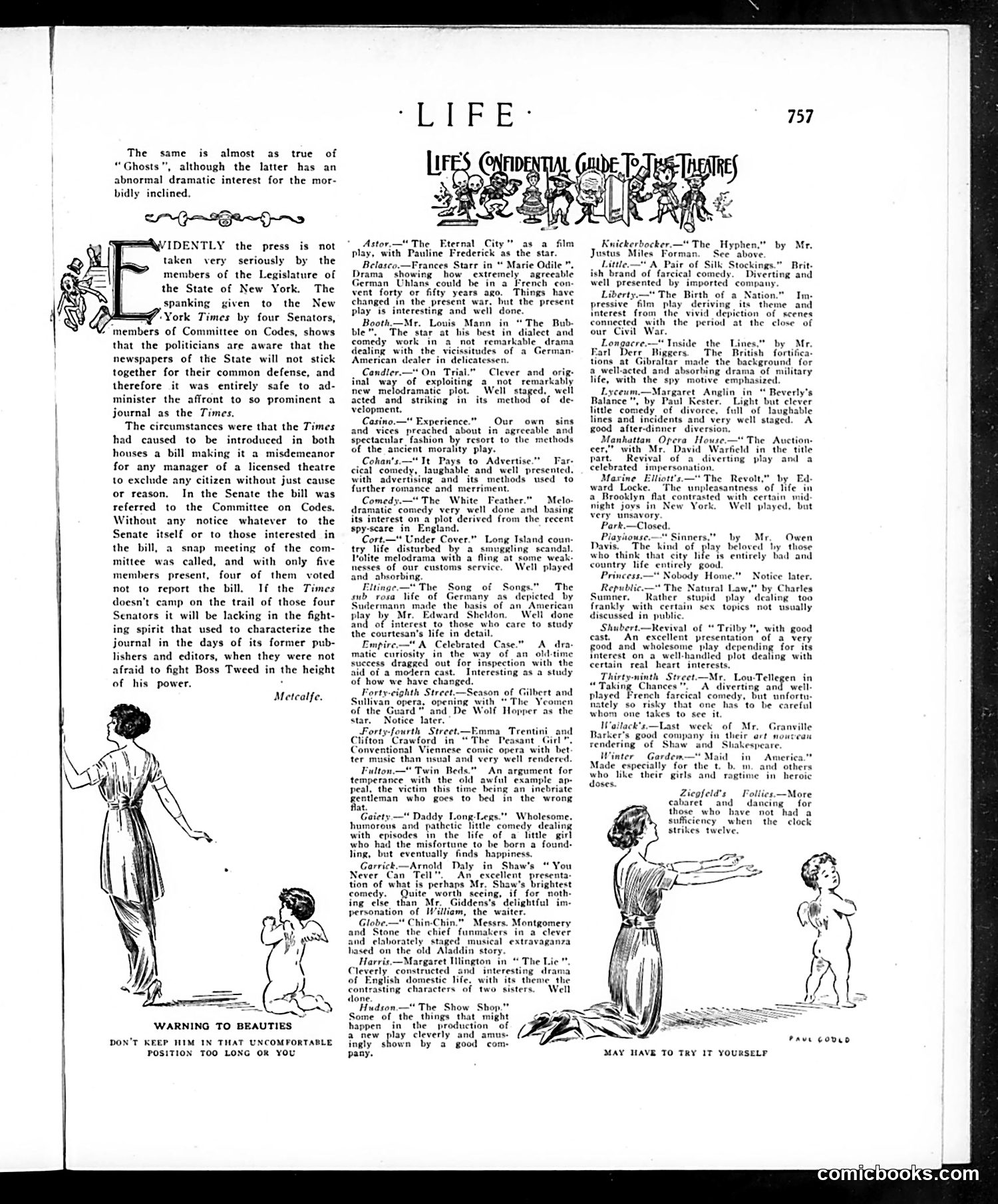
This page combines theater criticism with a political editorial. The main commentary attacks New York State legislators for disrespecting the *New York Times*. The *Times* had introduced a bill requiring theater managers to serve all citizens without discrimination. Four senators on the Committee on Codes killed the bill in a snap meeting without proper notice, deliberately snubbing the newspaper. The editorial shames these politicians, invoking the *Times*' historical courage against Boss Tweed (a notorious 19th-century political boss). The implication: modern newspapers lack the fighting spirit of their predecessors and won't defend each other against political retaliation. The cartoons at left—illustrating "Warning to Beauties"—appear to show courtship postures, though their exact satirical target is unclear from context alone. The bulk of the page consists of theater reviews covering contemporary Broadway productions with themes of war, German life, melodrama, and morality plays.
📄 Transcribed text from this page (OCR, searchable)
Machine-transcribed from the original scan — historical spelling and the odd misread are preserved.
The same is almost as true of “Ghosts”, although the latter has an abnormal dramatic interest for the mor- bidly inclined, eG eGee gene WVIDENTLY the press is not taken very seriously by the members of the Legislature of the State of New York. The spanking given to the New "York Times by four Senators, members of Committee on Codes, show: that the politicians are aware that the newspapers of the State will not stick together for their common defense, and therefore it was entirely safe to ad- minister the affront to so prominent a journal as the Times. The circumstances were that the Times had caused to be introduced in both houses a bill making it a misdemeanor for any manager of a licensed theatre to exclude any citizen without just cause or reason. In the Senate the bill was referred to the Committee on Codes. Without any notice whatever to the Senate itself or to those interested in the bill, a snap meeting of the com- mittee was called, and with only five members present, four of them voted not to report the bill. If the Times doesn’t camp on the trail of those four Senators it will be lacking in the fight- ing spirit that used to characterize the journal in the days of its former pub- lishers and editors, when they were not afraid to fight Boss Tweed in the height of his power. : Metcalfe. ‘WARNING TO BEAUTIES DON’T KEEP HIM IN THAT UNCOMFORTABLE POSITION TOO LONG OR YOU Astor.—" The Eternal City" asa film play, with Pauline Frederick as the star. Belasco.—Frances Starr in “ Marie Odile . Drama showing how extremely agreeable German Uhlans could be in a French con- vent forty or fifty years ago. Ks have changed in the present war. hut the present play is interesting and well done. Booth.—Mr. Louis Mann in “The Bub- ble". The star at his best in dialect and comedy work in a not remarkable drama dealing with the vicissitudes of a German: American dealer in delicatessen. Candler-—" On Trial.” Clever and orig. ly inal way of exploiting a not remarkabl new. melodramatic plot. Well. staged, well acted and striking in its method of de- velopment. Casino.—" Experience.” Our own sins and vices preached about in agreeable and spectacular fashion by resort to the methods of the ancient morality play. Cohan’s.—"It Pays to Advertise.” Far- cical comedy, laughable and well presented. with advertising and its methods used to further romance and merriment. Comedy.—" The White Feather." Melo- dramatic comedy very well done and basing its interest on_a plot derived from the recent spy-scare in England, Cort.—" Under Cover.” Long Island coun: try life disturbed by a smuggling scandal. Volite melodrama with a fling at some weak: nesses of our customs service, Well played and absorbing. Eltinge—" The Song of Songs.” The sub rosa life of Germany as depicted by Sudermann made the basis an American play by Mr. Edward Sheldon. Well done And of interest to those who care to study the courtesan’s life in detail. mpire-—""A Celebrated Case." A. dra- matic curiosity in the way of an old-time success dragged out for inspection with the aid of a modern cast. Interesting as a study of how we have changed. Forty-eighth Street.—Season of Gilbert and Sullivan opera, opening with “The Yeomen of the Guard” and De Wolf Hopper as the star, Notice later. Forty-fourth Street—Emma_ Trentini Clifton Crawford in “The Peasant ¢ Conventional Viennese comic opera with bet ter music than nsual and very well rendered. Fulton.—" Twin Beds." An argument for temperance with the old awful example ap- peal, the victim this time being an inebriate gentleman who goes to bed in the wrong flat. Gaiety “Daddy Long-Legs.” Wholesome. humorous and pathetic little comedy dealing with episodes in the life of a little girl who had the misfortune to be born a found- ling, but eventually finds happiness. Garrick —Arnold Daly in Shaw's “ You Never Can Teil". An excellent presenta- tion of what is perhaps Mr. Shaw's brightest comedy. Quite worth sceing, if for noth: ing else than Mr. Giddens’s delightful in personation of IMilliem, the waiter. Globe.—" Chin-Chin.” Messrs. Montgomery and Stone the chief funmakers in a clever and elaborately staged musical extravaganza, hased on the old Aladdin story. Harris. —Margaret Il in “ The Lie". Cleverly, constructed teresting dram ish domestic life, with its theme the contrasting characters of two sisters. Well done. Hudson. —“ The Show Sho Some of the things that might happen in the production of a new play cleverly and amus- ingly shown by a good com+ pany. 757 Knickerbocker.—" The Hyphen,” by Mr. Justus Miles Forman. See above. Little.—" A Pair of Silk Stockings.” Brit. ish brand of farcical comedy. Diverting and well presented by imported compa: Liberty.—" The Birth of a Nation." In pressive film play deriving its theme and Interest from the vivid depiction of scenes connected with the period at the close of our Civil War. Longacre.—" Inside the Lines," by Mr. Farl Derr Biggers. The British fortifica- J for itary tions at Gibraltar made the backgrou a well-acted and absorbing drama of 1 life, with the spy motive emphasized. Lyceum.—Margaret Anglin in“ Beverly's Balance", by Paul Kester. Light but clever little coniedy of divorce, full of laughable lines and incidents and very well staged. A good after-dinner diversion. Manhattan Opera House-—* The Auction cer,” with Mr. David Warfield in the title part. Revival of a diverting play and a celebrated impersonation. Maxine Elliott's— The Revolt,” by Ed- ward Locke. The unpleasantness ‘of life in a Brooklyn flat contrasted with certain mid: night jovs in New York. Well played, but very unsavory. Park.—Closed. Piayiiouse,—"* Sinners.” by Mr, Owen Davis. The ki y beloved hy those Hof pl who think that city life is entirely bad and country life entirely good Princess.—* Nobody Home." Notice later. Repudlic.—" The Natural Law," by Charles Sumner, “Rather stupid play’ dealing too frankly with certain sex topics not tsually discussed in public Shubert—Kevival of “ Trilby ", with good cast, An excellent presentation of a very good and wholesome play depending for its interest on a. well-handled plot dealing with certain real heart interests, Thirty-ninth Street—Mr. Lou-Tellegen in Chances". “A diverting and well- played French farcical comedy, but unfortu: ately so risky that one has to be careful whom one takes to see it, Waitack's.—Last week of Mr. Rarker's good company rendering of Shaw and Winter Gardem—" Maid in America."* Made especially for the t. b. im. and others who like their girls and ragtime in heroic doses. Zicofeld’s Follies.—More cabaret and dancing for those who have not had a sufficiency when the clock Granville strikes twelve. MAY HAVE TO TRY 1T YOURSELP Pave cove