
Life, 1915-04-29 · page 20 of 44
Life — April 29, 1915 — page 20: what you’re looking at
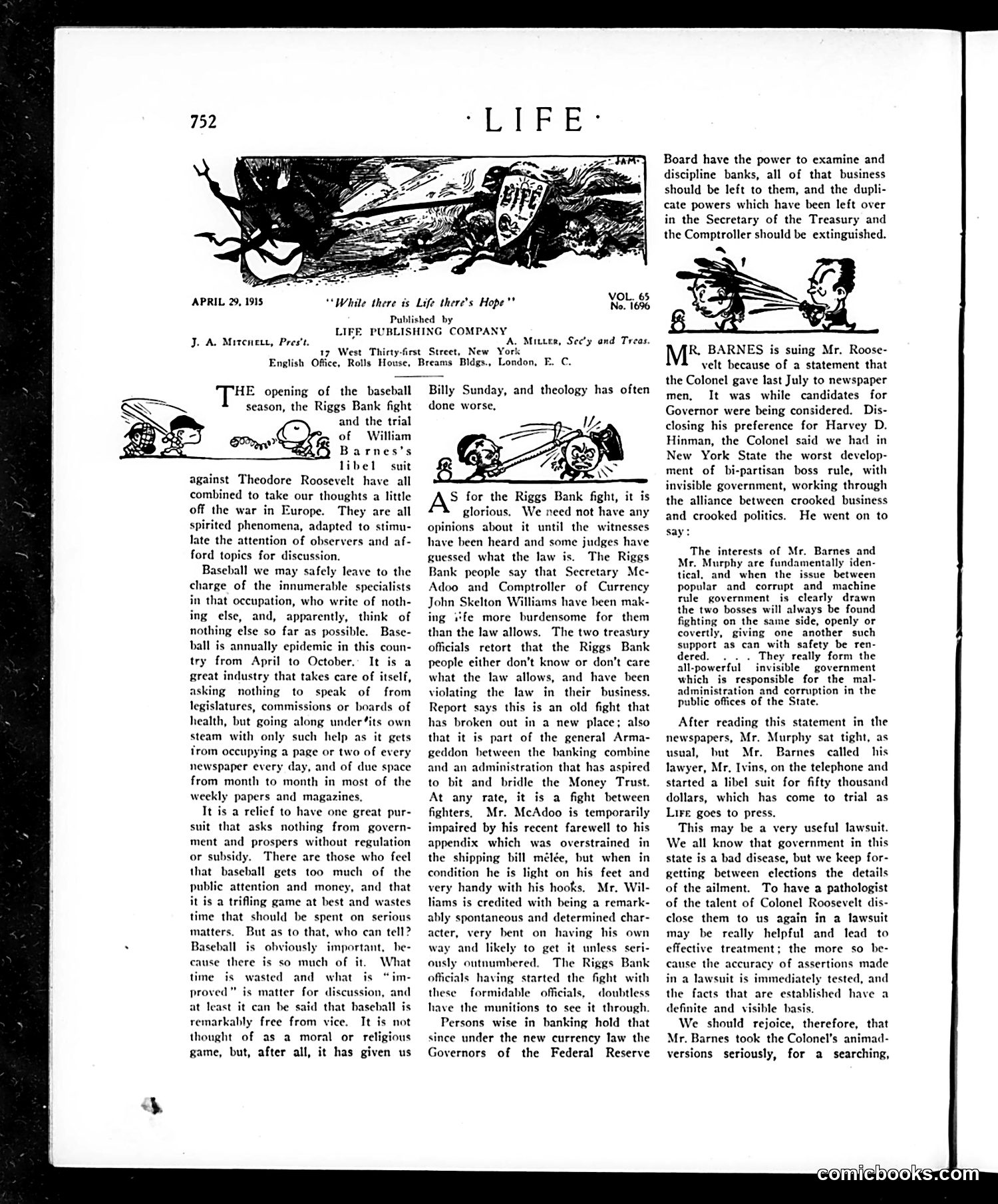
What you’re looking at
This editorial page discusses three major stories dominating American attention: baseball's spring opening, the Riggs Bank regulatory dispute, and William Barnes's libel suit against Theodore Roosevelt. The **Riggs Bank fight** represents a conflict between the Wilson administration (Treasury Secretary McAdoo and Comptroller Williams) and banking interests over regulatory authority. The piece frames it as part of a larger struggle between the administration's efforts to control the "Money Trust" and entrenched financial power. The **Barnes v. Roosevelt lawsuit** concerns a statement Roosevelt allegedly made about Colonel Barnes during gubernatorial campaign discussions, which the article suggests may expose government dysfunction and partisan conflict. The cartoons (top right) appear to caricature figures involved in these disputes, though specific identities are unclear from the image quality. The editorial adopts a wry, detached tone—treating these conflicts as entertaining public spectacles while suggesting they reveal genuine tensions in American governance regarding banking regulation and political accountability.
📄 Transcribed text from this page (OCR, searchable)
Machine-transcribed from the original scan — historical spelling and the odd misread are preserved.
APRIL 29, 1915 “While there is Life there's Hope"* Published by LIFE PUBLISHING COMPANY J. A. Mitenene, Pres't. A. Mittrr, Sec’y and Treas. 17 West Thirty-first. Street, New York English Office, Rolls House, Breams Bldgs., London, E. C. TH opening of the baseball season, the Riggs Bank fight and the trial of William Barnes’s libel suit against Theodore Roosevelt have all combined to take our thoughts a little off the war in Europe. They are all spirited phenomena, adapted to stimu- late the attention of observers and af- ford topics for discussion. Baseball we may safely leave to the charge of the innumerable specialists 1 that occupation, who write of noth- ing else, and, apparently, think of nothing else so far as possible. Base- ball is annually epidemic in this coun- try from April to October. It is a great industry that takes care of itself, asking nothing to speak of from legislatures, commissions or boards of health, but going along under‘its own steam with only such help as it gets trom occupying a page or two of every newspaper every day, and of due space from month to month in most of the weekly papers and magazines, It is a relief to have one great pur- suit that asks nothing from govern- ment and prospers without regulation or subsidy. There are those who feel that baseball gets too much of the public attention and money, and that it is a trifling game at best and wastes time that should be spent on serious matters. But as to that, who can tell? Baseball is obviously important, he- cause there is so much of it. What time is wasted and what is “im- proved” is matter for discussion, and at least it can be said that baseball is remarkably free from vice. It is not thought of as a moral or religious game, but, after all, it has given us Billy Sunday, and theology has often done worse, © AS for the Riggs Bank fight, it is glorious. We need not have any opinions about it until the witnesses have been heard and some judges have guessed what the law is. The Riggs Bank people say that Secretary Me- Adoo and Comptroller of Currency John Skelton Williams have been mak- ing fe more burdensome for them than the law allows. The two treasury officials retort that the Riggs Bank people either don’t know or don’t care what the law allows, and have been violating the law in their business. Report s this is an old fight that has broken out in a new place; also that it is part of the general Arma- geddon between the banking combine and an administration that has aspired to bit and bridle the Money Trust. At any rate, it is a fight between fighters, Mr. McAdoo is temporarily impaired by his recent farewell to his appendix which was overstrained in the shipping bill mélée, but when in condition he is light on his feet and very handy with his hooks, Mr. Wil- ams is credited with being a remark- ably spontaneous and determined char- acter, very bent on having his own way and likely to get it unless seri- ously outnumbered. The Riggs Bank officials having started the fight with these formidable officials, doubtless have the munitions to see it through. Persons wise in banking hold that since under the new currency law the Governors of the Federal Reserve Board have the power to examine and discipline banks, all of that business should be left to them, and the dupli- cate powers which have been left over in the Secretary of the Treasury and the Comptroller should be extinguished. R, BARNES is suing Mr. Roose- velt because of a statement that the Colonel gave last July to newspaper men, It was while candidates for Governor were being considered. Dis- closing his preference for Harvey D. Hinman, the Colonel said we had in New York State the worst develop- ment of bi-partisan boss rule, with invisible government, working through the alliance between crooked business and crooked politics. He went on to say: The interests of Mr. Barnes and Mr. Murphy are fundamentally iden- tical, and when the issue between popular and corrupt and machine rule government is clearly drawn the two bosses will always be found fighting on the same side, openly or covertly, giving one another such support as can with safety be ren- dered. + They really form the all-powerful invisible government which is responsible for the mal- administration and corruption in the public offices of the State. After reading this statement in the newspapers, Mr. Murphy sat tight, as usual, but Mr. Barnes called his lawyer, Mr, Ivins, on the telephone and started a libel suit for fifty thousand dollars, which has come to trial as Lire goes to press. This may be a very useful lawsuit. We all know that government in this state is a bad disease, but we keep for- getting between elections the details of the ailment. To have a pathologist of the talent of Colonel Roosevelt dis- close them to us again in a lawsuit may be really helpful and lead to effective treatment; the more so be- cause the accuracy of assertions made in a lawsuit is immediately tested, and the facts that are established have a definite and visible basis. We should rejoice, therefore, that Mr. Barnes took the Colonel's animad- versions seriously, for a searching,