
A complete issue · 44 pages · 1915
Life — April 22, 1915
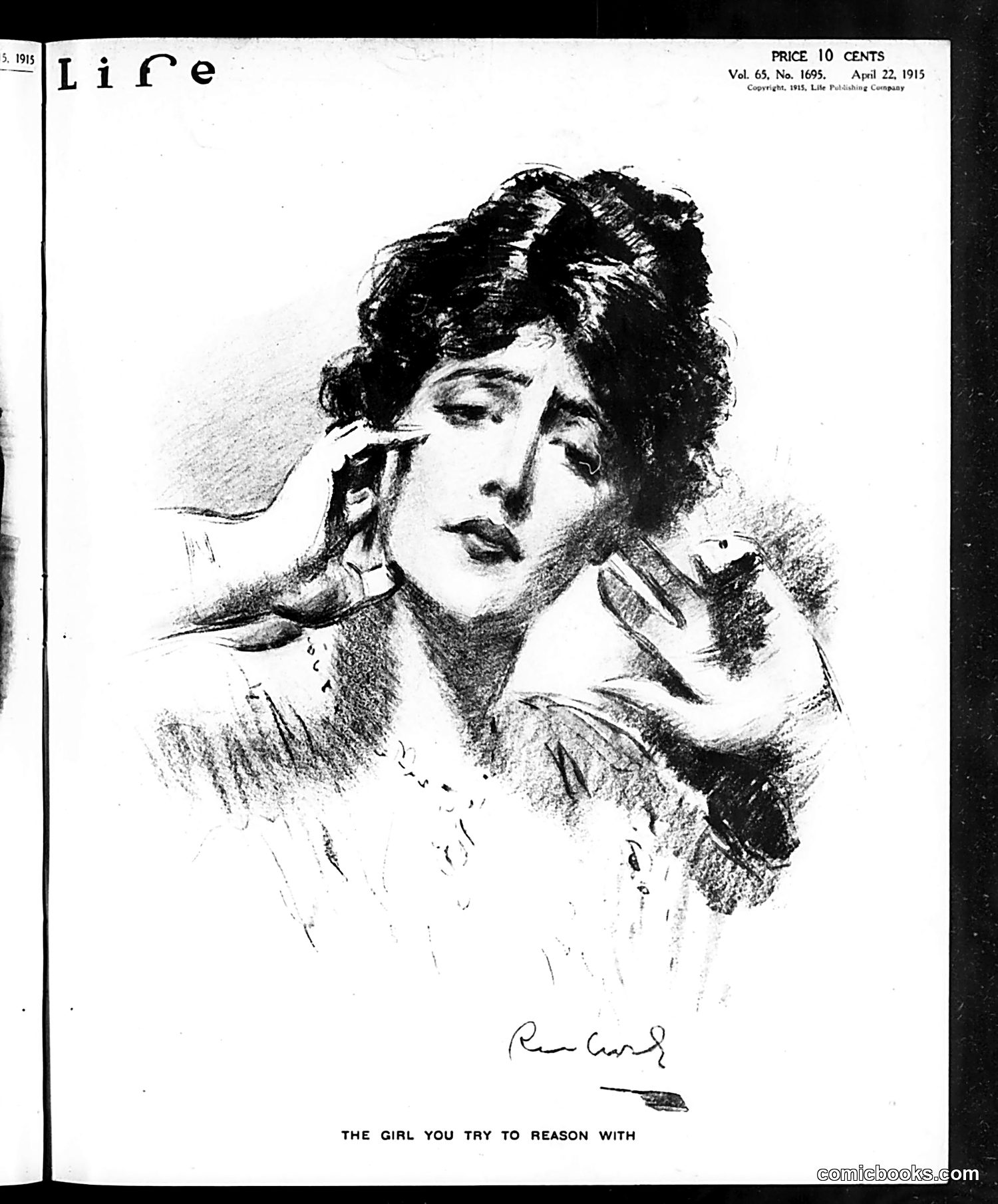
This is a portrait sketch titled "The Girl You Try to Reason With," showing a woman in early 1900s dress with her hand to her face in a thoughtful or dismissive pose. The signature appears to be "Cesare," likely the artist's mark. The caption's phrasing suggests satire about the futility of rational argument with women—a common comedic trope of the era. Without additional context on the page, the specific reference remains unclear, though it likely mocks either gender relations generally or a particular public figure or social debate of 1915. The piece exemplifies Life magazine's satirical approach to contemporary social dynamics, using portraiture and clever captions rather than overt cartooning.
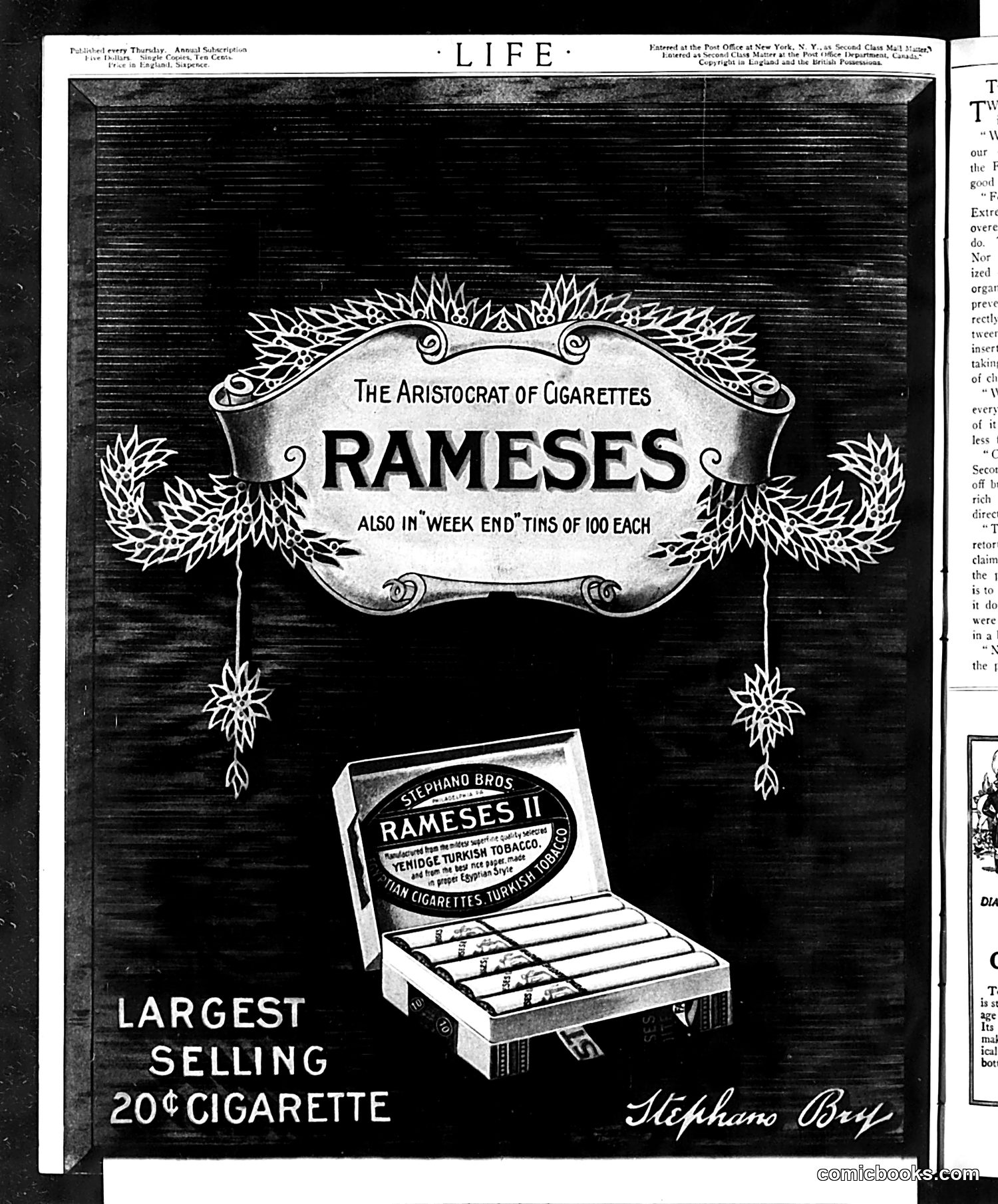
This page is primarily **a cigarette advertisement**, not political satire. It advertises "Rameses" cigarettes by Stephano Bros., marketed as "The Aristocrat of Cigarettes" and promoted as the "Largest Selling 20¢ Cigarette." The ad features an ornate decorative border with Egyptian-style motifs (lotus flowers, hieroglyphic-like designs) surrounding the product name and an image of an open cigarette box labeled "Rameses II." The Egyptian theme references the historical pharaoh Rameses II, likely chosen to suggest luxury and antiquity. The advertisement emphasizes availability in bulk "Week End" tins of 100 cigarettes. This is straightforward commercial advertising with no discernible political or social satire—it's simply a vintage tobacco product promotion typical of early 20th-century magazine advertising.
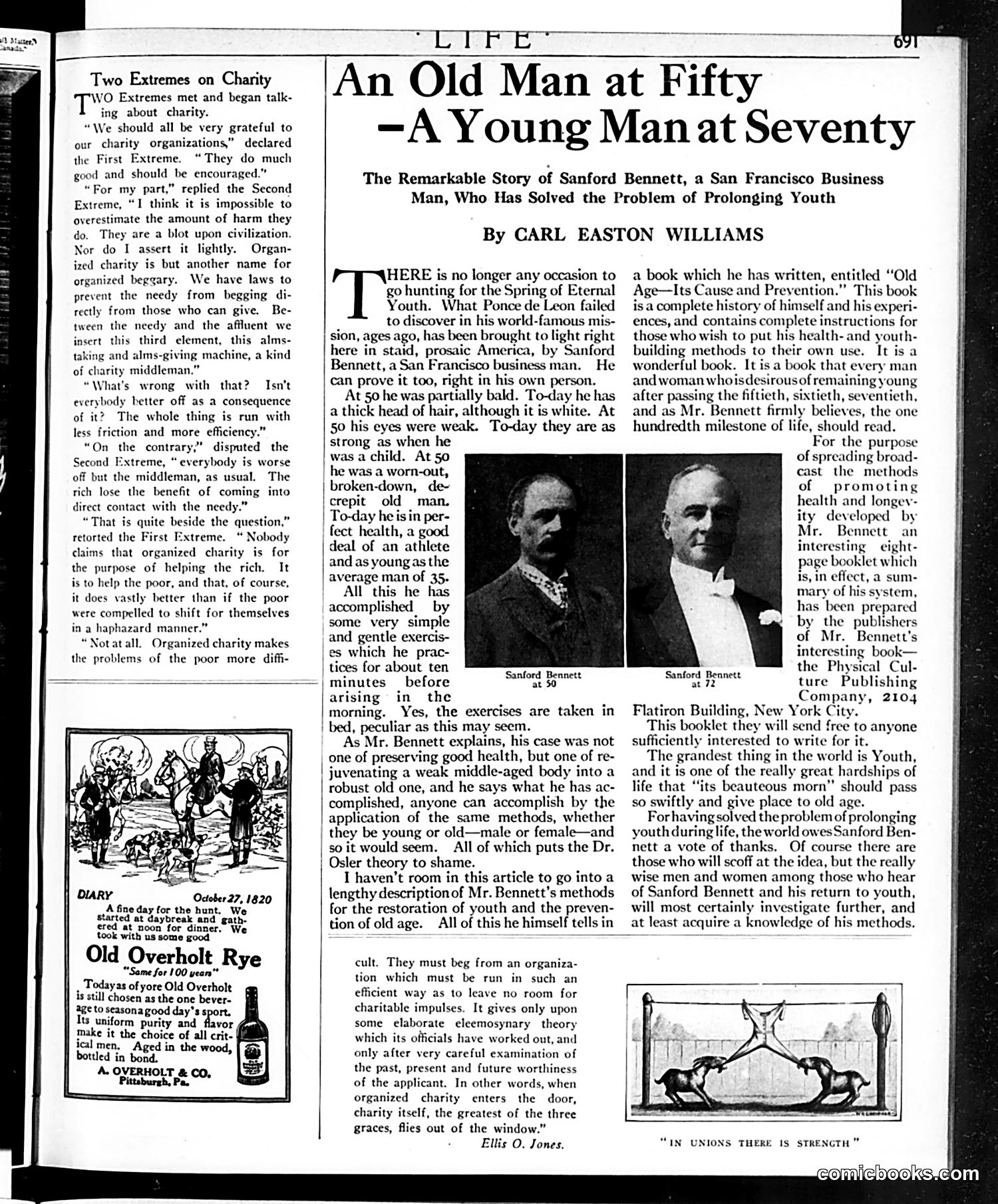
This page contains two distinct elements: **Main Article:** "An Old Man at Fifty — A Young Man at Seventy" profiles Sanford Bennett, a San Francisco businessman who claims to have developed methods for prolonging youth and vitality. The article promotes his book on health and longevity exercises, describing his physical transformation through daily regimens. **Left Column Cartoon:** "Two Extremes on Charity" depicts a debate between two men about organized charity. One argues charities help the poor; the other contends they primarily benefit the rich and middlemen, making poverty worse. The cartoon satirizes disagreements over whether charitable organizations effectively serve their stated purpose or merely enrich administrators. **Bottom Advertisement:** Promotes Old Overholt Rye whiskey as a quality product aged in wood.
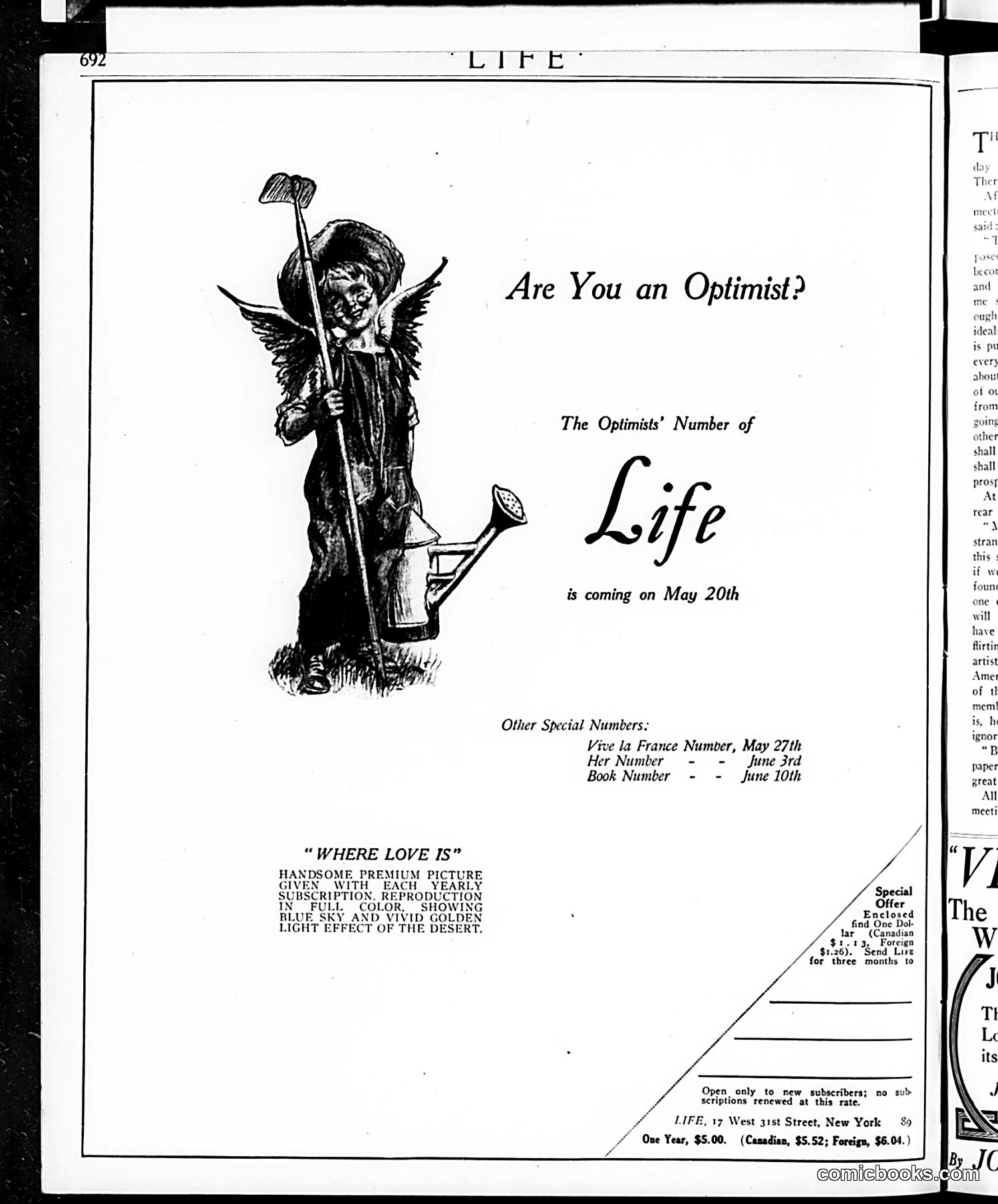
This is primarily a **subscription advertisement** for *Life* magazine rather than political satire. The central image depicts a winged cherub or cupid figure holding a watering can and flower stem—a personification of optimism tending to growth. The ad promotes "The Optimists' Number of *Life*" arriving May 20th, alongside other special issues (Vive la France Number, Her Number, Book Number). The accompanying text describes a premium picture offer: "Where Love Is," described as a handsome premium picture with full color showing blue sky and vivid golden light effect of the desert. The page functions as a marketing piece announcing upcoming themed issues and subscription incentives rather than containing satirical commentary on current events or political figures.
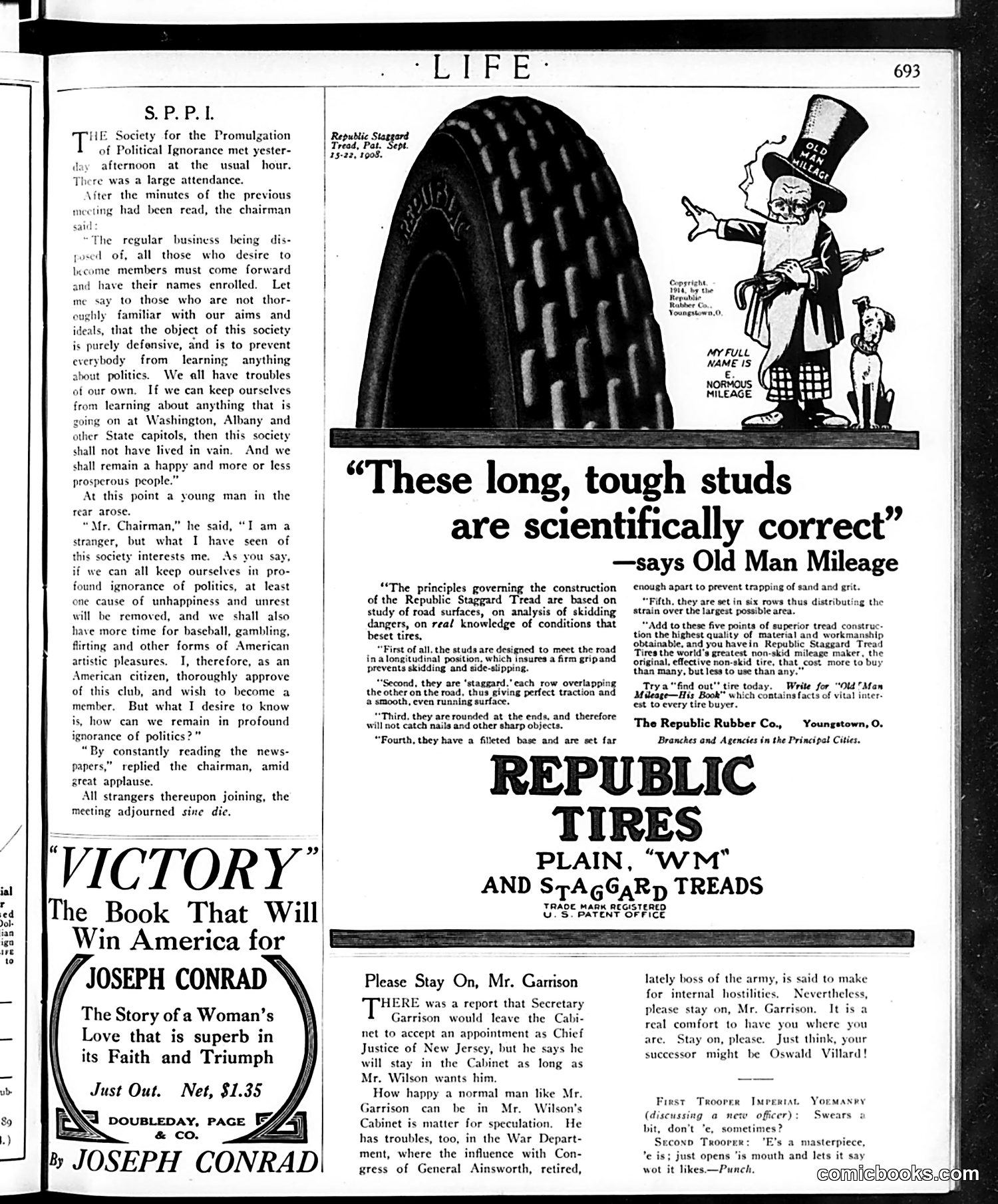
The page combines political satire with advertising. The main cartoon features "Old Man Mileage," a character promoting Republic Tires. He's depicted with exaggerated features, wearing a top hat, alongside a small dog. The advertisement claims the tire treads are "scientifically correct" and lists four design principles supporting durability and safety. The left column contains an S.P.P.I. (Society for the Promulgation of Political Ignorance) meeting transcript—satirizing political apathy by advocating deliberate ignorance of current events as a solution to social discord. This appears to mock isolationist or anti-intellectual movements of the era. A book advertisement for Joseph Conrad's "Victory" rounds out the page, marketing it as a tale of faith and triumph.
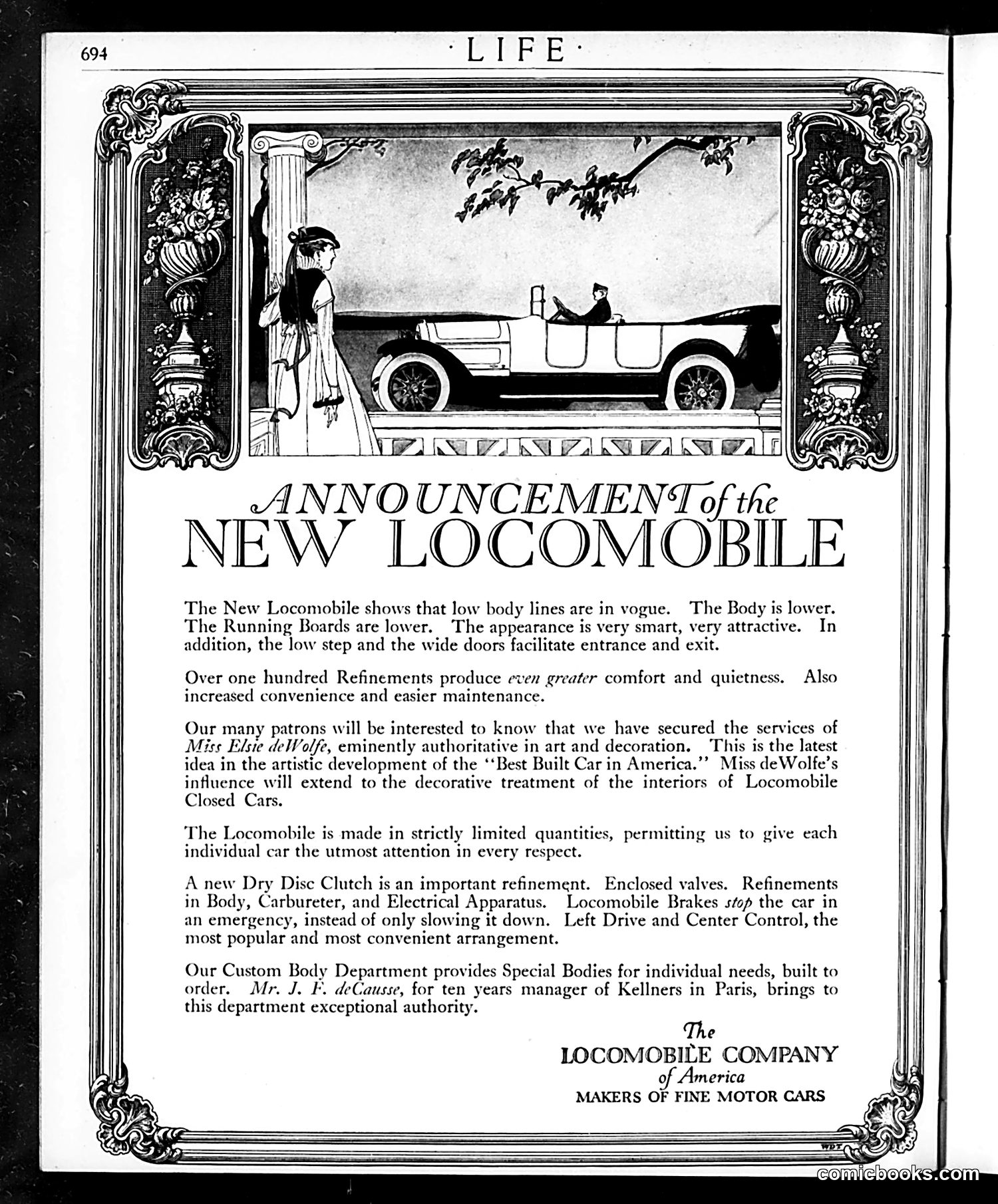
This is **not a cartoon or satire**—it's a straightforward automobile advertisement from *Life* magazine's early 20th century. The page announces the "New Locomobile," a luxury car. The illustration shows a fashionably dressed woman admiring the vehicle, which features a low body design, running boards, and wide doors. The ad emphasizes modern refinements: a new dry disc clutch, enclosed valves, improved brakes, left-hand drive, and center control. A notable detail: the company hired **Miss Elie de Wolfe**, a prominent interior decorator and arbiter of taste, to oversee the car's interior design. This positioning the Locomobile as America's "Best Built Car"—a luxury product for wealthy consumers who valued both engineering and artistic refinement. This reflects early automotive marketing targeting affluent buyers.
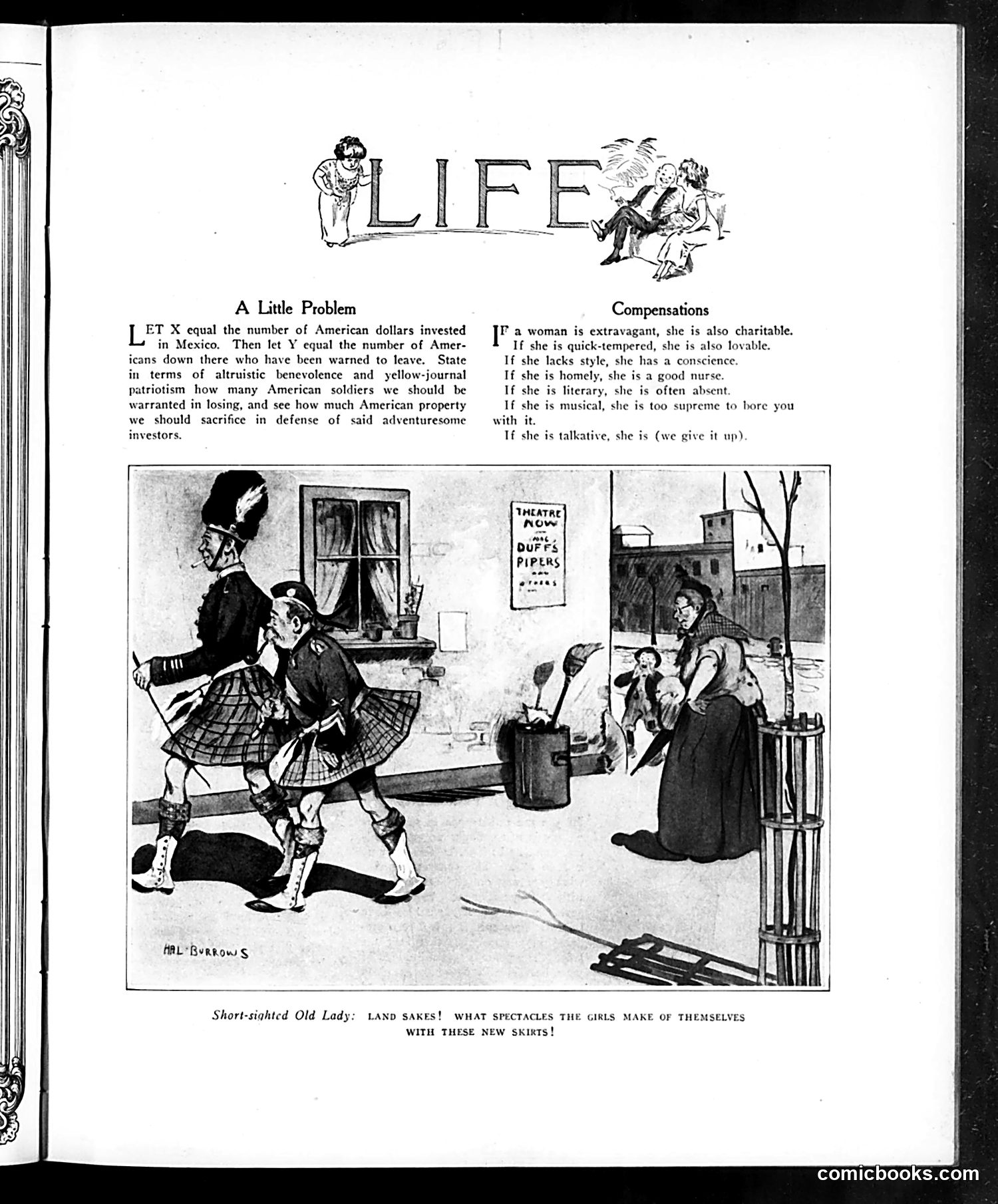
This page contains two distinct pieces of social satire: **"A Little Problem"** presents a mathematical equation mocking American foreign investment in Mexico, sarcastically asking how many soldiers should be "sacrificed" to protect investors' interests. **"Compensations"** lists supposed trade-offs for women with various temperaments and qualities—a tongue-in-cheek catalog stereotyping female behavior (extravagance paired with charity, quick-temper with lovability, etc.). The cartoon below illustrates the latter, showing an elderly woman scandalized by young girls' short skirts at what appears to be a public venue. The caption "Land sakes! What spectacles the girls make of themselves with these new skirts!" reflects generational anxiety about changing women's fashion and morality—a common theme in early 20th-century satire. The humor derives from the old lady's prudish shock contrasting with modern fashion liberalization.
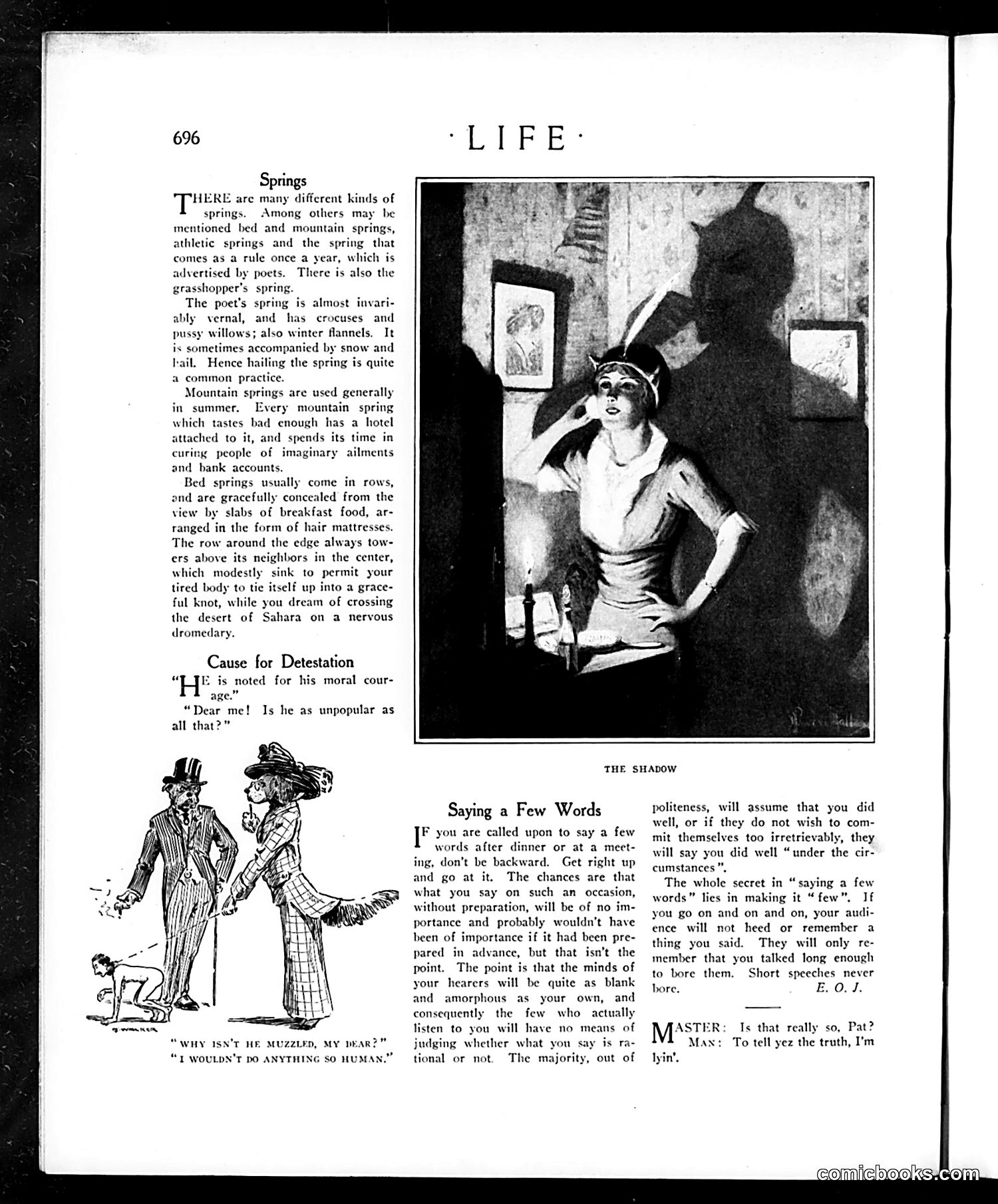
This page contains humor about social etiquette rather than political satire. The main cartoon depicts a couple where the man says "Why isn't he muzzled, my dear?" and the woman responds "I wouldn't do anything so human" — mocking a man's verbose behavior at social gatherings. The accompanying article "Saying a Few Words" advises readers on giving brief speeches. It satirizes people who drone on at dinners and meetings without preparation, boring their audiences. The article suggests that most listeners won't remember lengthy speeches anyway, so brevity is preferable. A small dialogue between "Master" and "Man" at bottom appears to be a humorous exchange about truthfulness, though context is unclear from this excerpt alone. The page emphasizes early 20th-century social anxieties about proper public behavior and conversational restraint.
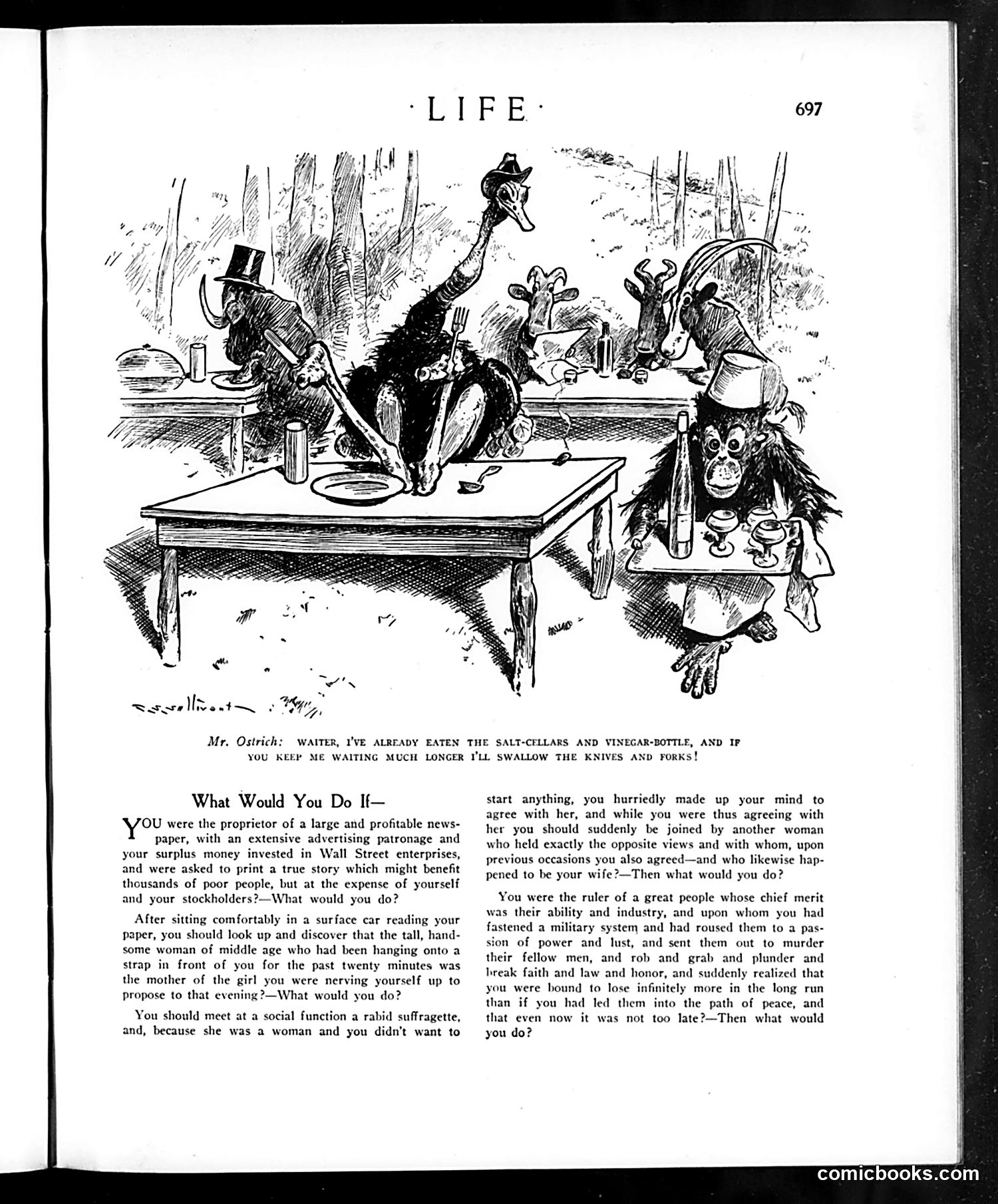
This page features a satirical cartoon of animals at a formal dinner, with an ostrich as the central figure addressing a waiter. The ostrich complains about being kept waiting, threatening to "swallow the knives and forks"—a reference to the old myth that ostriches eat anything. Below is an editorial feature titled "What Would You Do If—" presenting three hypothetical moral dilemmas for readers: 1. A newspaper proprietor discovering his paper championed a woman whose views oppose his wife's 2. A military leader realizing his pursuit of power contradicts peace 3. (Third scenario partially visible) The feature invites reader contemplation of ethical conflicts between personal ambition and principle. The ostrich cartoon and text together satirize how people—like the mythical ostrich—sometimes avoid difficult truths rather than address them directly.
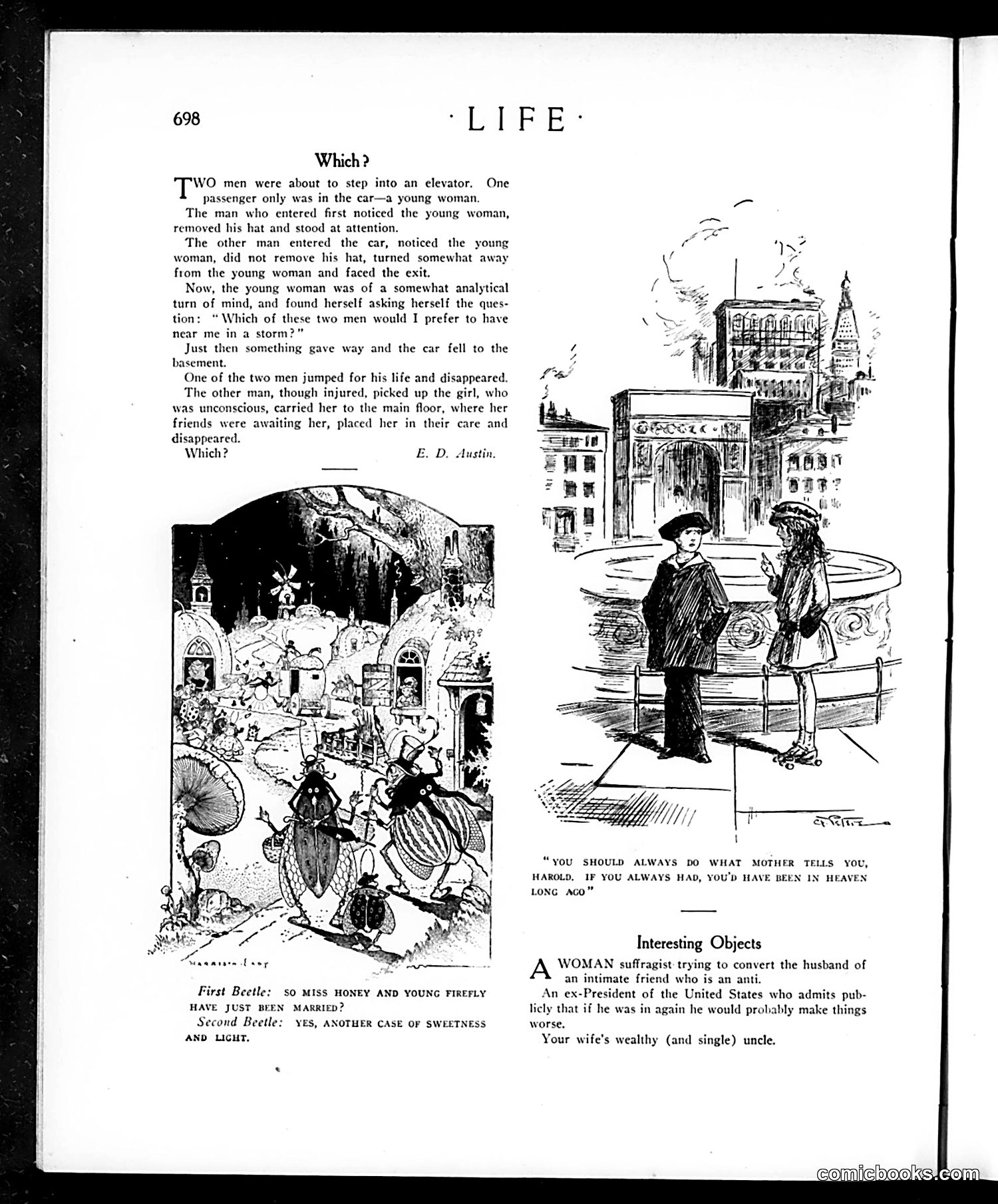
This page contains three distinct pieces of satirical content: 1. **"Which?" riddle** by E.D. Austin: A moral puzzle about two men in an elevator with an injured young woman. One man removes his hat respectfully; the other doesn't. An elevator failure kills both men. The riddle asks which man the woman would prefer nearby in a storm—testing whether courtesy or self-preservation matters more. 2. **Two illustrated jokes**: One about newlywed beetles (sweetness and light); another about following mother's advice leading to heaven. 3. **"Interesting Objects" section**: Brief satirical notes about a suffragist trying to convert an anti-husband, and a U.S. ex-President admitting he'd make things worse if re-elected. The overall tone reflects early 20th-century American humor mixing morality puzzles with light social commentary.
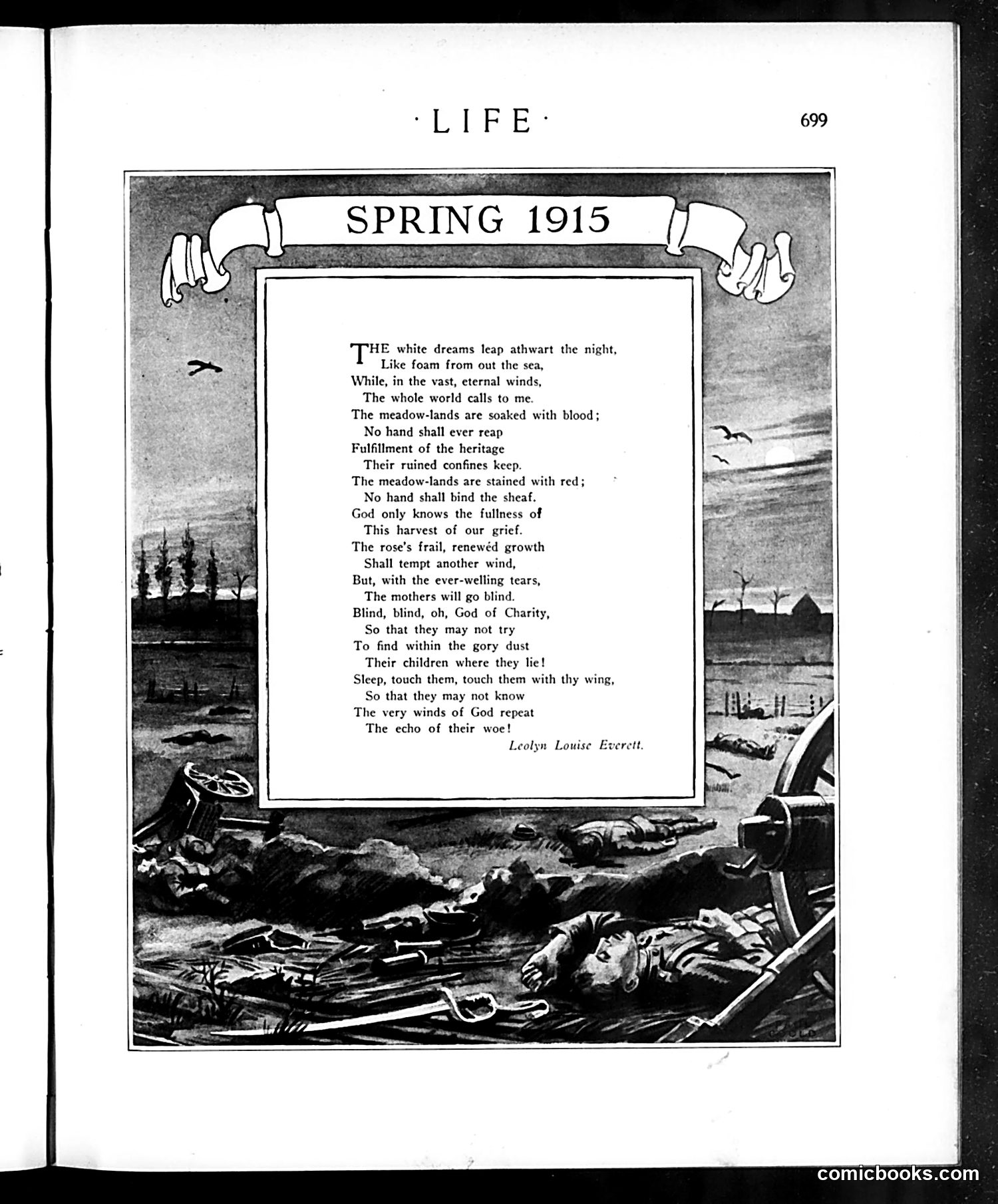
This is a solemn memorial poem by Leolyn Louise Everett, accompanying stark imagery of a World War I battlefield. The illustration shows fallen soldiers and military debris scattered across devastated ground, with peaceful pastoral landscapes visible in the framing borders—a stark contrast emphasizing loss. The poem laments the war's carnage, addressing "meadow-lands soaked with blood" and children lost in "gory dust." It appeals to God to spare mothers from knowing their sons' fates, asking divine mercy for those who suffer. The tone is elegiac and anti-war, mourning the human cost rather than celebrating military glory. Published Spring 1915 (before U.S. entry), this reflects American literary responses to the European conflict's devastating scale.
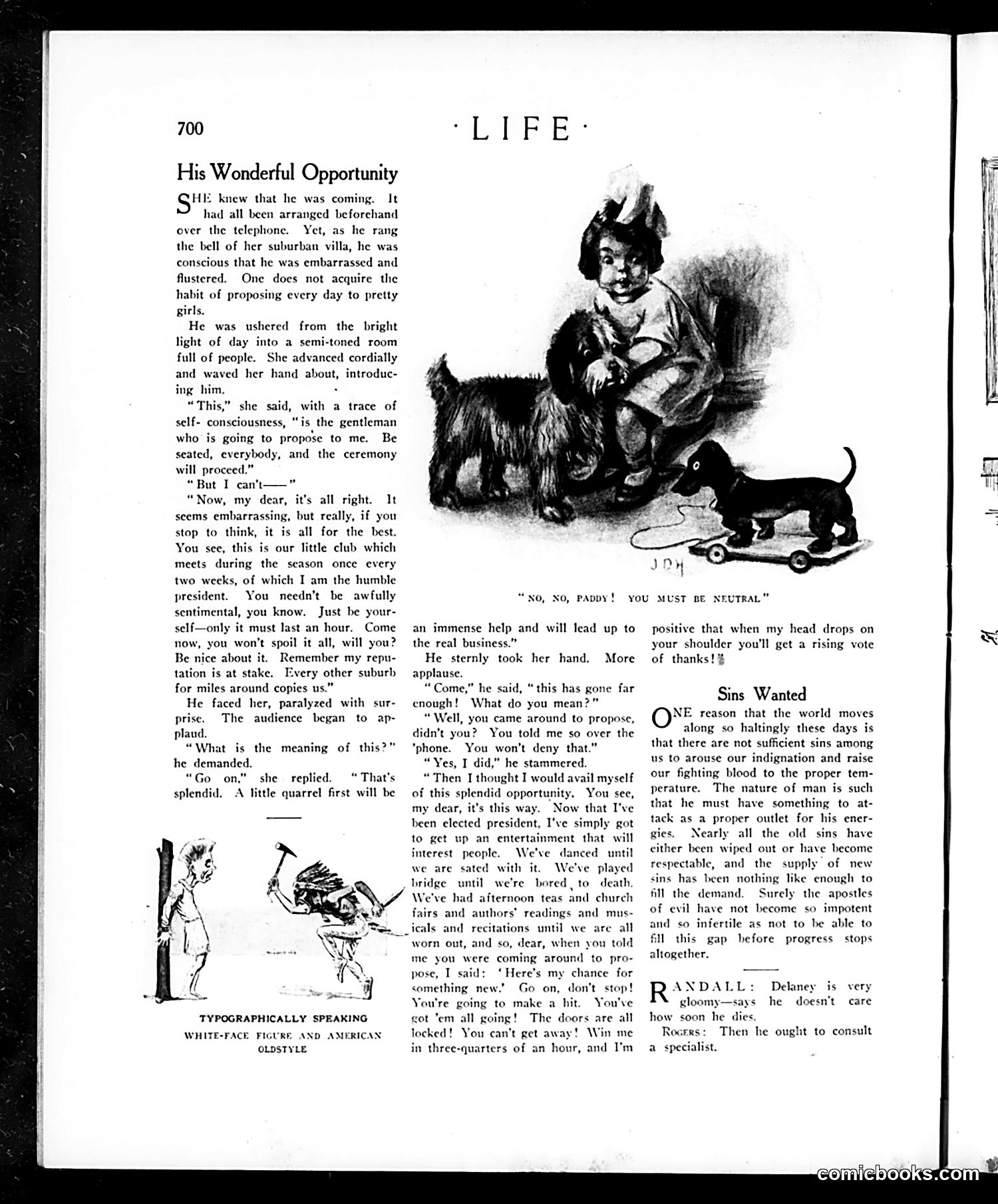
This page contains a narrative story titled "His Wonderful Opportunity" about a man proposing to a woman, accompanied by satirical illustrations. The main cartoon at bottom left, captioned "TYPOGRAPHICALLY SPEAKING: WHITE-FACE FIGURE AND AMERICAN OLDSTYLE," depicts two figures in exaggerated poses—one appearing distressed or theatrical. This is a typography/design joke playing on font names ("white-face" and "American oldstyle" are actual typeface classifications), treating human figures as if they were letter forms. The illustration at right shows a child with dogs and toys, captioned "NO, NO, DADDY! YOU MUST BE NEUTRAL"—likely satirizing parental behavior or political neutrality rhetoric of the era. The "Sins Wanted" section below discusses humanity's need for moral outlets, using satirical commentary on human nature and vice.
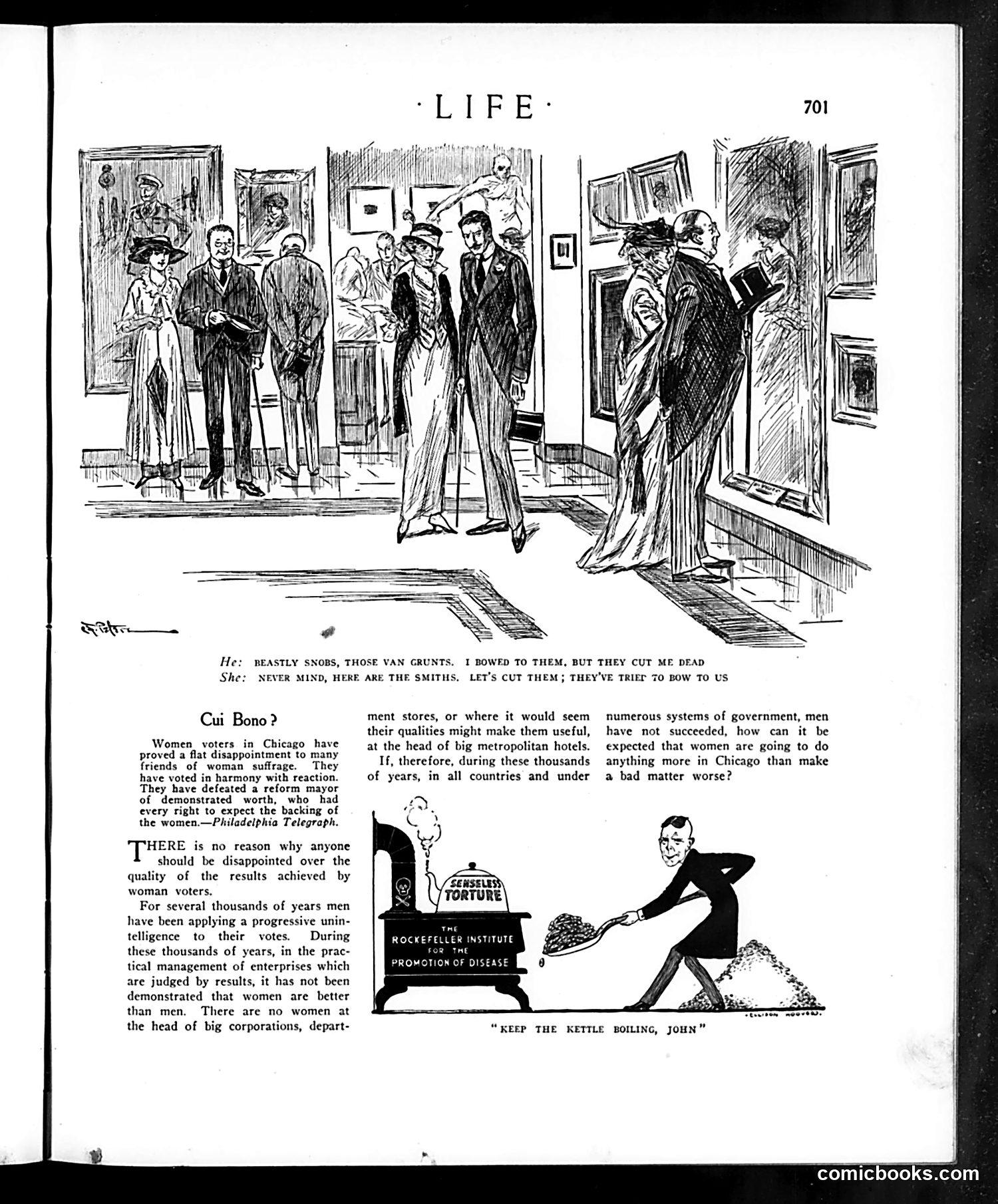
This page addresses **women's voting rights in Chicago**. The top cartoon depicts a social scene where a woman mentions "beastly snobs" and "van Grunts" who "cut me dead," while she proposes cutting the "Smiths" in return—a satirical commentary on wealthy social hierarchies and their irrelevance to voting. The main article, "Cui Bono?" (Latin: "who benefits?"), defends women voters against critics. It argues that men have managed enterprises for thousands of years without demonstrating superiority, so women deserve equal voting opportunities. The text refutes the claim that women voters have caused worse outcomes in Chicago than male politicians. The lower cartoon, "Keep the Kettle Boiling, John," satirizes the **Rockefeller Institute's promotion of disease**, likely critiquing how political establishments maintain public health problems to consolidate power.
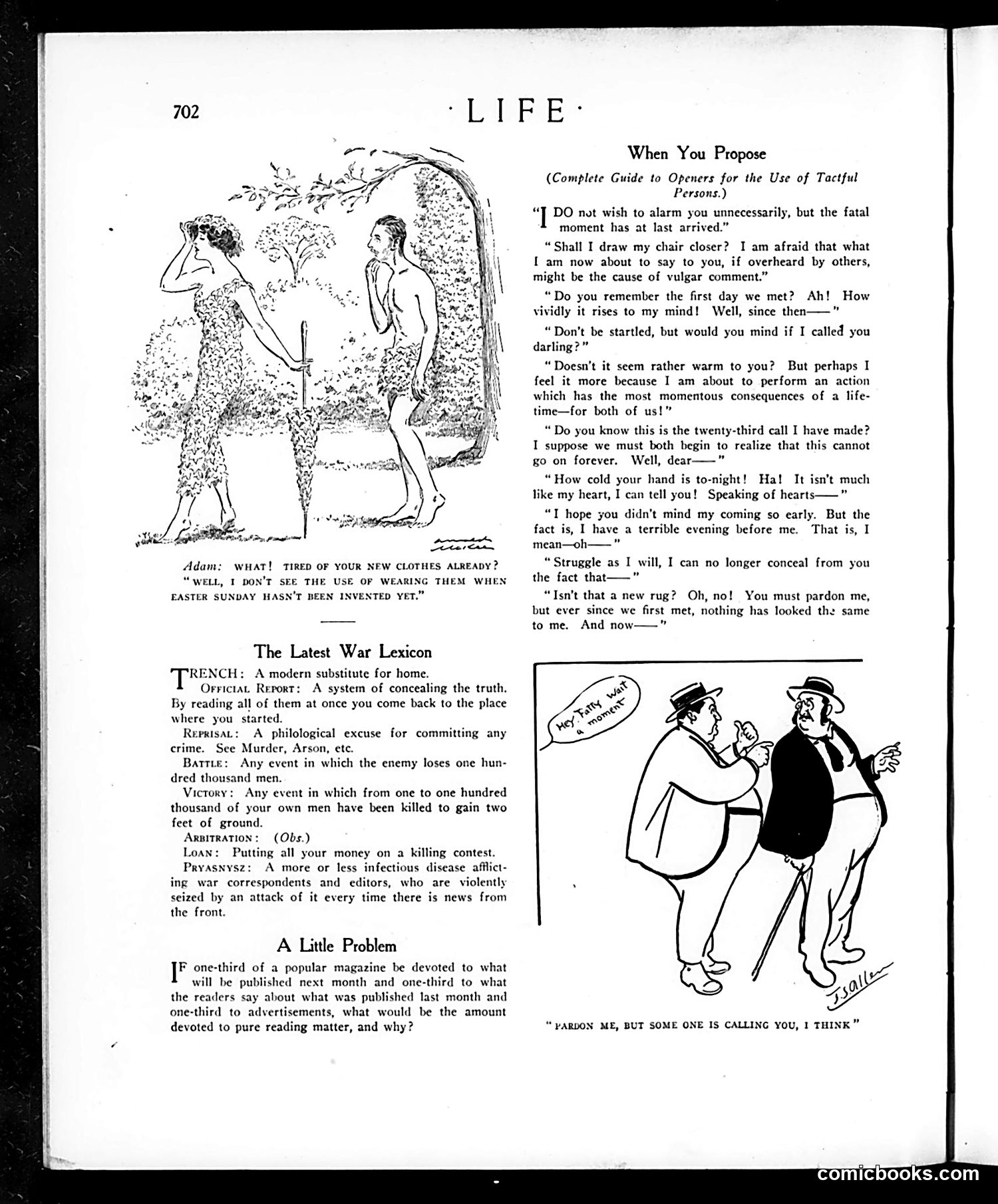
This page contains three satirical pieces from *Life* magazine: **"When You Propose"** presents romantic dialogue openings, mocking the overwrought language men supposedly use when proposing marriage. The humor derives from the contrast between flowery declarations and the woman's practical, skeptical responses. **"The Latest War Lexicon"** is a humorous glossary redefining military terms used during World War I (the magazine references "Easter Sunday," suggesting early 1900s). Terms like "Battle" and "Victory" are redefined cynically—a "Battle" involves massive casualties for minimal territorial gain, while a "Victory" means losing hundreds of thousands to gain two feet of ground. This satirizes the brutal futility of trench warfare. The cartoon at bottom appears to show two men discussing gossip or scandal, with one deflecting blame.
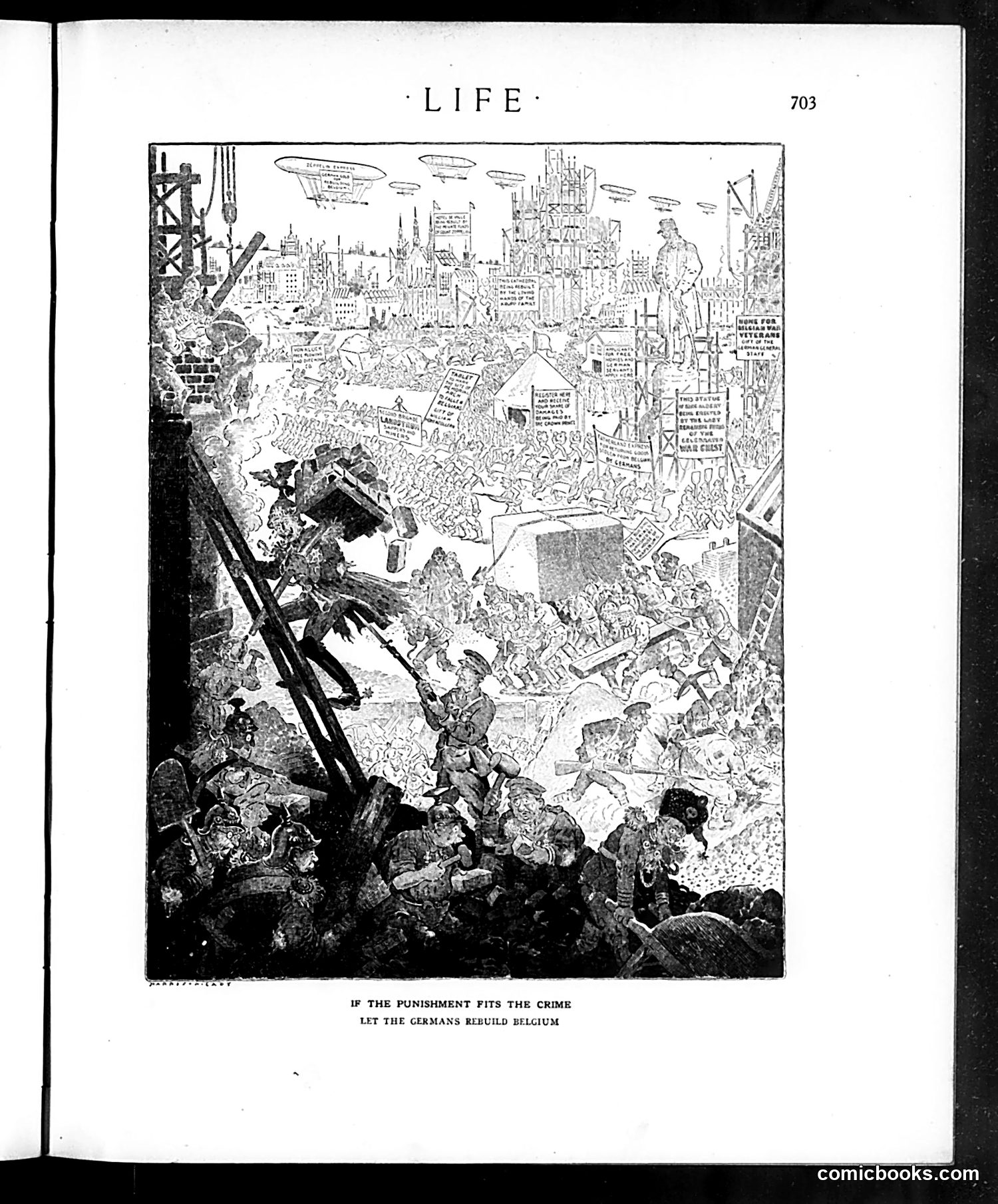
This is a World War I-era satirical cartoon from Life magazine depicting the destruction of Belgium. The image shows a devastated cityscape with airships overhead, masses of civilian casualties and rubble in the foreground, and soldiers surveying the destruction. The caption's dark irony proposes that Germany's punishment for invading and destroying Belgium should be to rebuild it—implying the destruction was so catastrophic that reconstruction would itself constitute severe punishment. The cartoon criticizes German military conduct during WWI, when Belgium suffered massive civilian casualties and infrastructure destruction during the German invasion (1914). By suggesting "let the Germans rebuild," the artist sarcastically argues this alone would be inadequate recompense for the documented atrocities and devastation inflicted on Belgian civilians and cities.
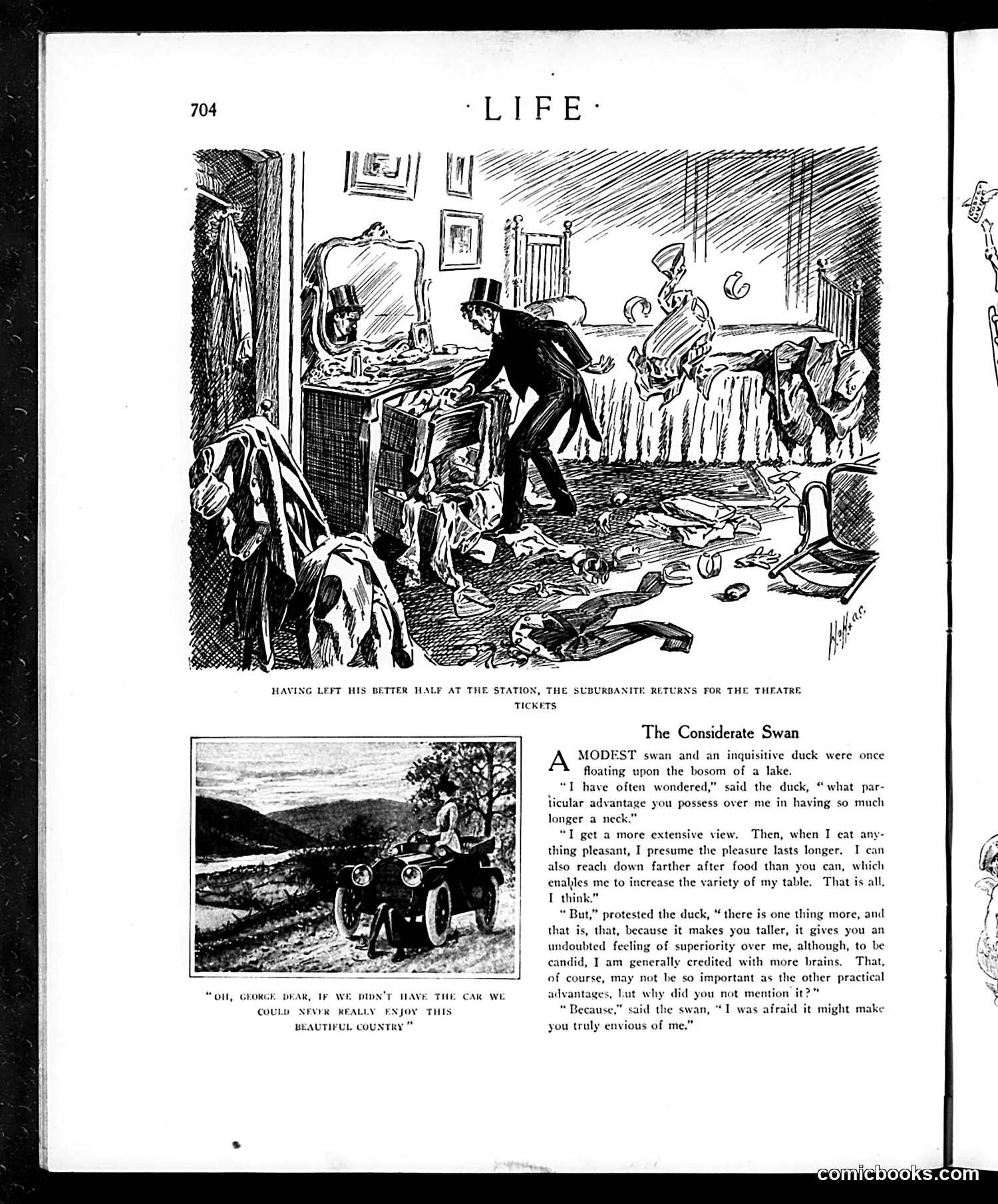
This page contains two separate satirical pieces from *Life* magazine: **Top cartoon**: Shows a man in formal dress returning home in disarray—his wife apparently left at the train station—discovering he forgot theatre tickets. The joke satirizes the absent-minded suburban husband, a common *Life* trope mocking middle-class domesticity and male forgetfulness. **Bottom cartoon and story**: Illustrates "The Considerate Swan," a fable-like tale where a duck asks a swan why it has a longer neck. The swan lists practical advantages (better view, prolonged eating pleasure, reaching food). When the duck suggests the swan must feel superior, the swan politely demurs, claiming modesty. The satire targets false humility—the swan admits superiority exists but pretends not to mention it out of consideration, which is itself a boastful form of superiority. This likely critiques wealthy or privileged individuals who claim not to flaunt their advantages while obviously doing so.
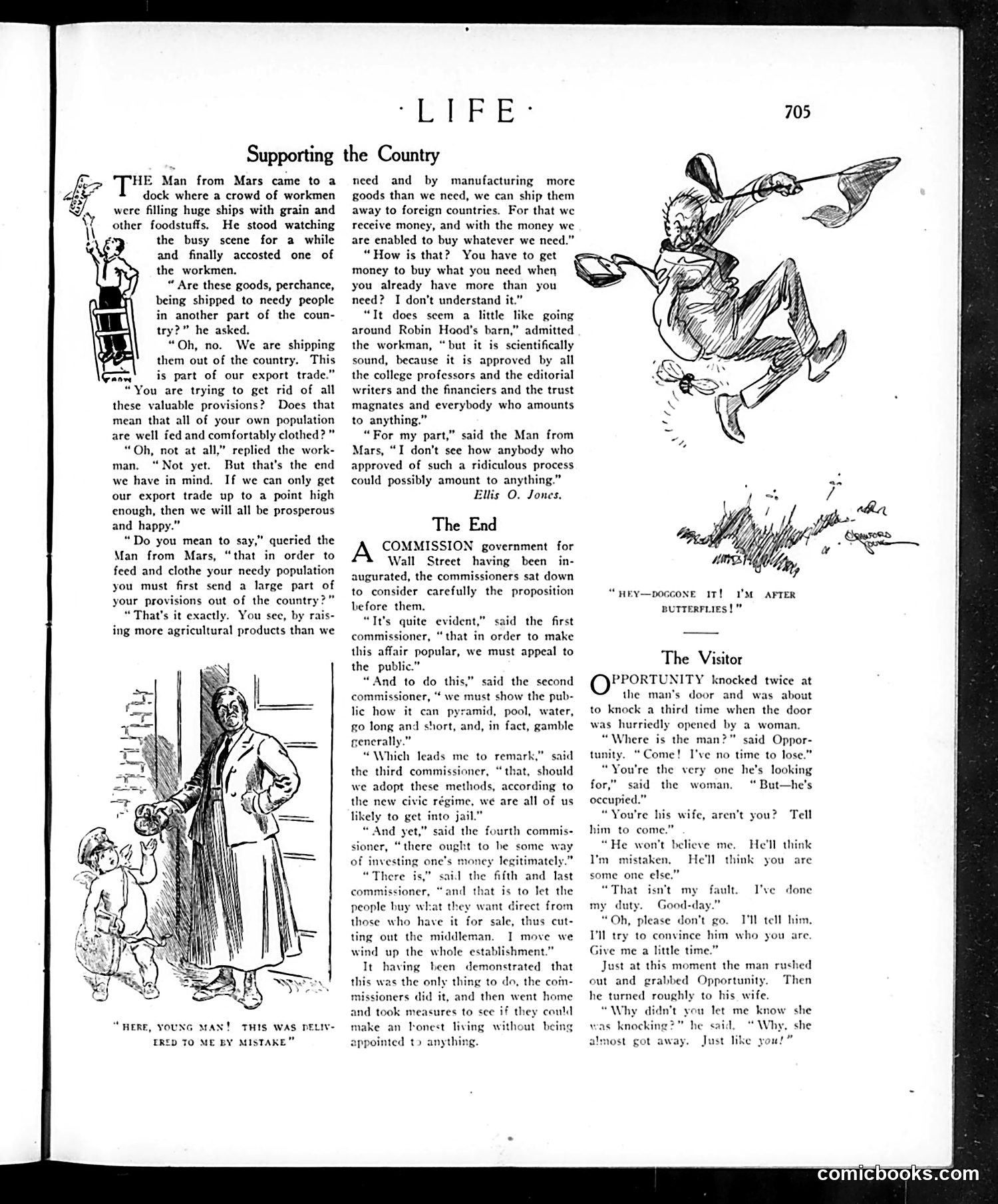
This page contains three satirical pieces critiquing early 20th-century American economic theory and practice. **"Supporting the Country"**: A Martian visitor observes American workers exporting grain while the population goes hungry. The workman explains they must export surplus goods to earn money to buy necessities—a circular logic the alien finds absurd. The satire targets economic orthodoxy taught by "college professors and editorial writers" that prioritizes export trade over domestic welfare. By having an outsider question the system, the author (Ellis O. Jones) exposes how nonsensical the theory sounds when stated plainly. **"The End"**: Commissioners debating how to make Wall Street "gambling" popular conclude the only honest approach is eliminating middlemen—then disband rather than implement it. This mocks financial manipulation masked as legitimate investment. **"The Visitor"**: Opportunity personified repeatedly tries contacting a man, but his wife insists he won't recognize her. Dark humor suggesting people ignore their own chances through skepticism or misfortune. Together, these pieces critique economic systems that harm ordinary citizens while being defended by elites as scientifically sound.
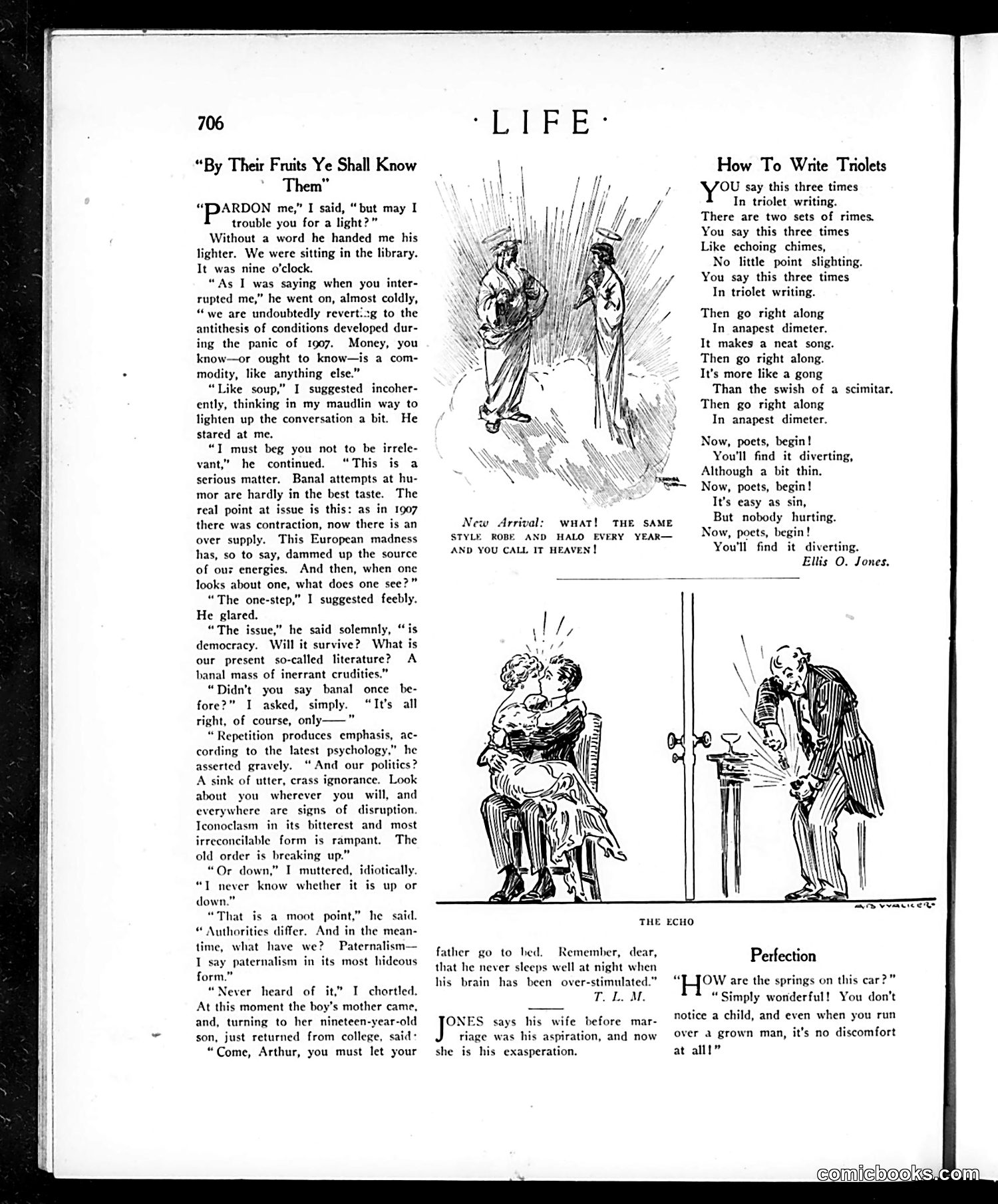
**Main Story: "By Their Fruits Ye Shall Know Them"** This satirizes pompous intellectualism. A pretentious college-aged man (Arthur) lectures the narrator at length about economics, democracy, and social decline—using grandiose language about the 1907 panic, "paternalism," and "iconoclasm." The joke: his mother must interrupt to send him to bed because his "brain has been over-stimulated." The satire targets young men who return from college spouting pseudo-intellectual rhetoric they barely understand, mistaking verbosity for wisdom. **"The Echo" Cartoon** Shows the pretentious young man's words bouncing back mockingly—visual representation of empty rhetoric. **"New Arrival" Cartoon** Mocks heaven's unchanging nature: angels wear identical robes and halos every year—a jab at religious repetition and conformity. **"Perfection"** A car advertisement joke: its superior springs mean you won't notice hitting pedestrians—dark humor about indifference to human suffering. The page satirizes early 20th-century affectation, intellectual posturing, and consumer culture indifference.
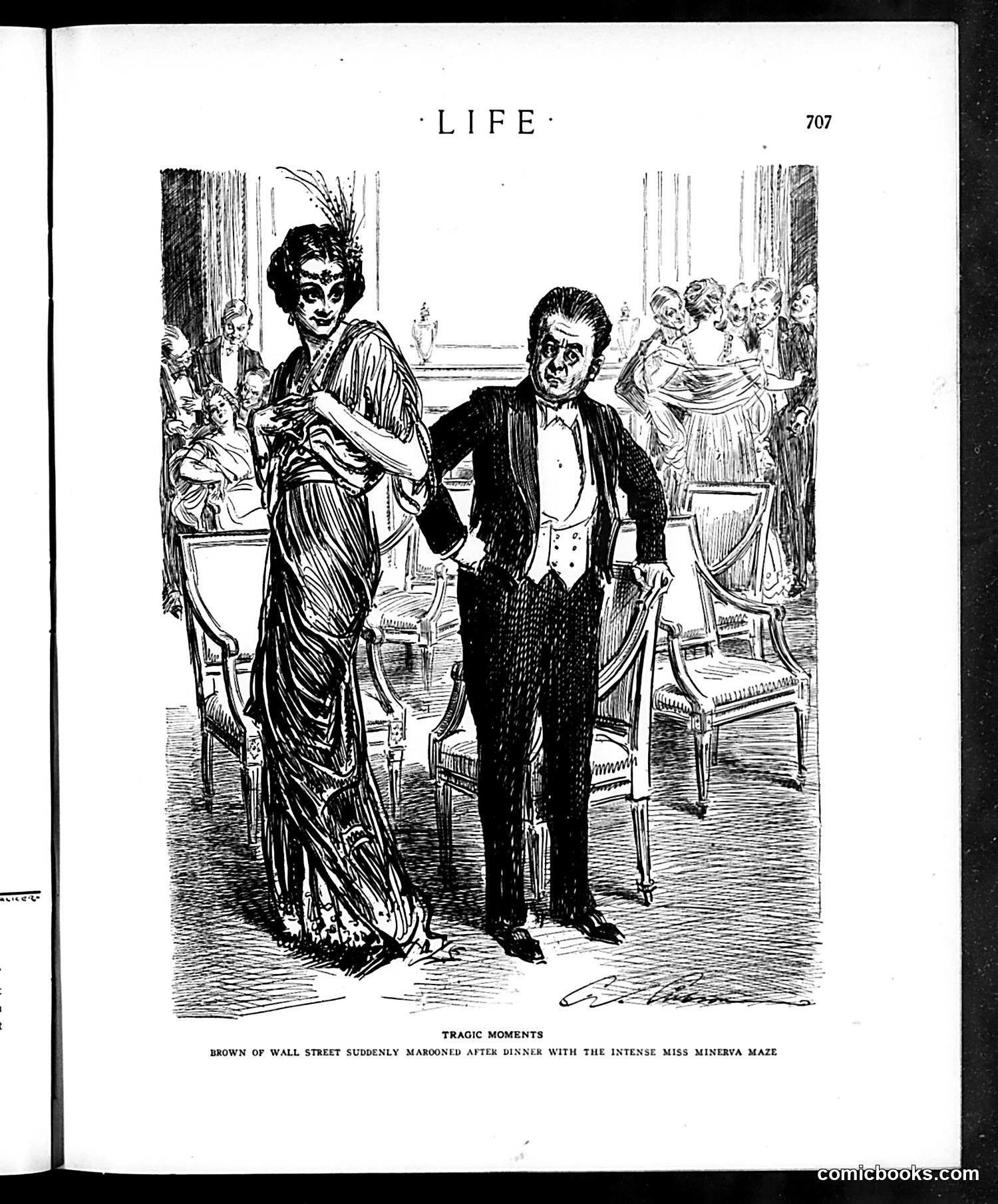
This satirical cartoon depicts a social embarrassment at what appears to be an elegant dinner party. A man identified as "Brown of Wall Street" stands awkwardly beside a woman labeled "the intense Miss Minerva Maze." The caption's use of "marooned" suggests he's been abandoned or left in an uncomfortable position after dining with her. The humor targets both figures: Brown appears distressed and out of place among the formally-dressed guests in the background, while the woman's characterization as "intense" implies she's socially difficult or overbearing. The satire likely mocks Wall Street financiers' social pretensions and anxieties, as well as satirizing certain types of women in high society—suggesting that even wealthy, powerful businessmen could be socially undone by challenging female personalities at fashionable events.
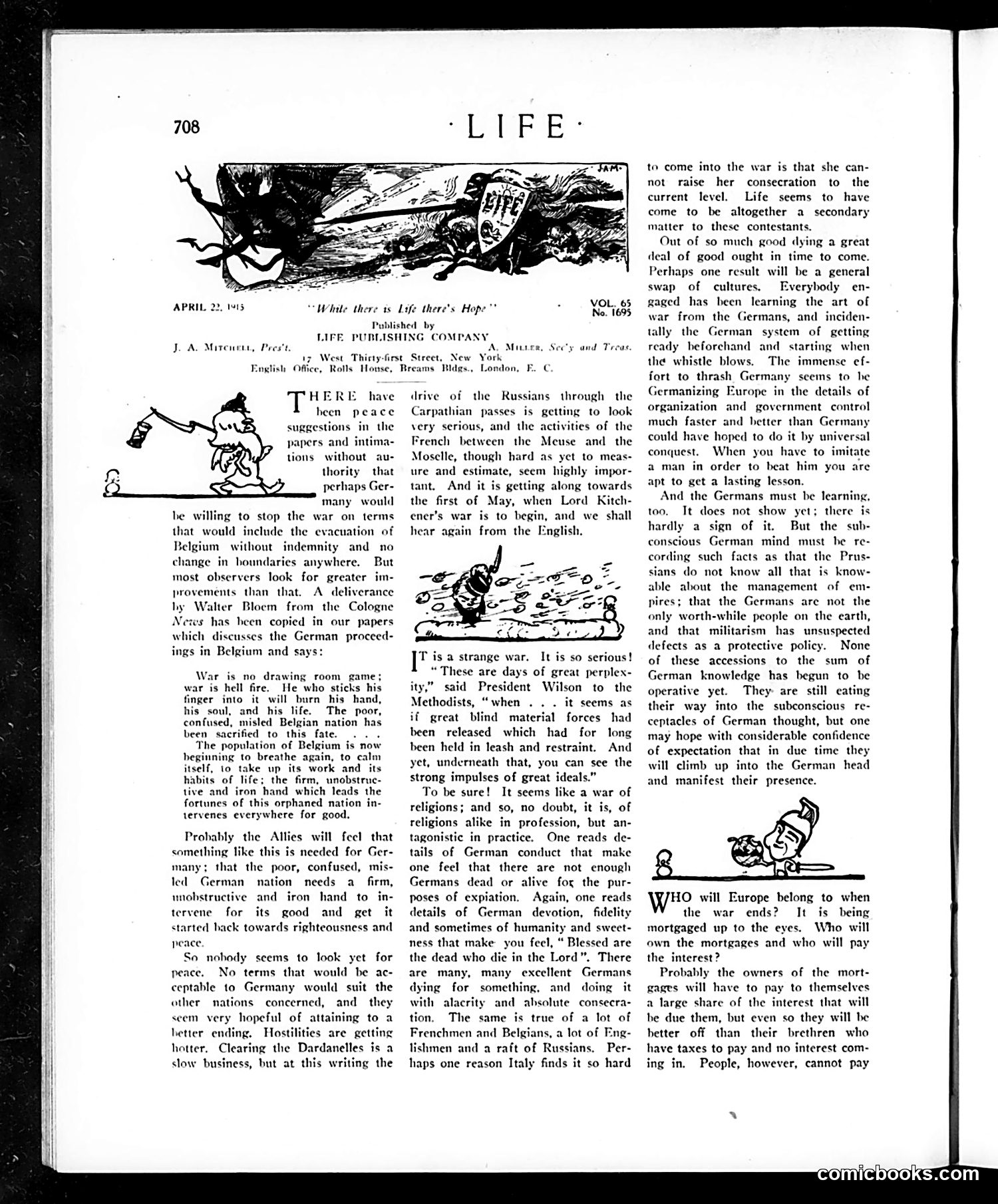
This editorial page discusses WWI peace rumors and German conduct in Belgium. The cartoon at top shows a figure labeled "Life" offering "Hope"—a visual pun on the magazine's title. The main text quotes a German writer (Walter Bloem) defending Germany's harsh occupation of Belgium as necessary "firm" governance, then sarcastically suggests Germany itself needs similar treatment. This is pointed satire: the author uses Germany's own brutal logic against it. The piece wrestles with WWI's moral complexity—acknowledging both German atrocities and German soldiers' genuine idealism, while criticizing President Wilson's vague rhetoric about "blind material forces" versus "great ideals." The author notes Italy's reluctance to join the Allies, suggesting their commitment lacks the "consecration" of other nations. Overall, this reflects American ambivalence about the war in 1915, before U.S. entry (1917)—acknowledging the conflict's ideological stakes while remaining skeptical of all parties' claims.
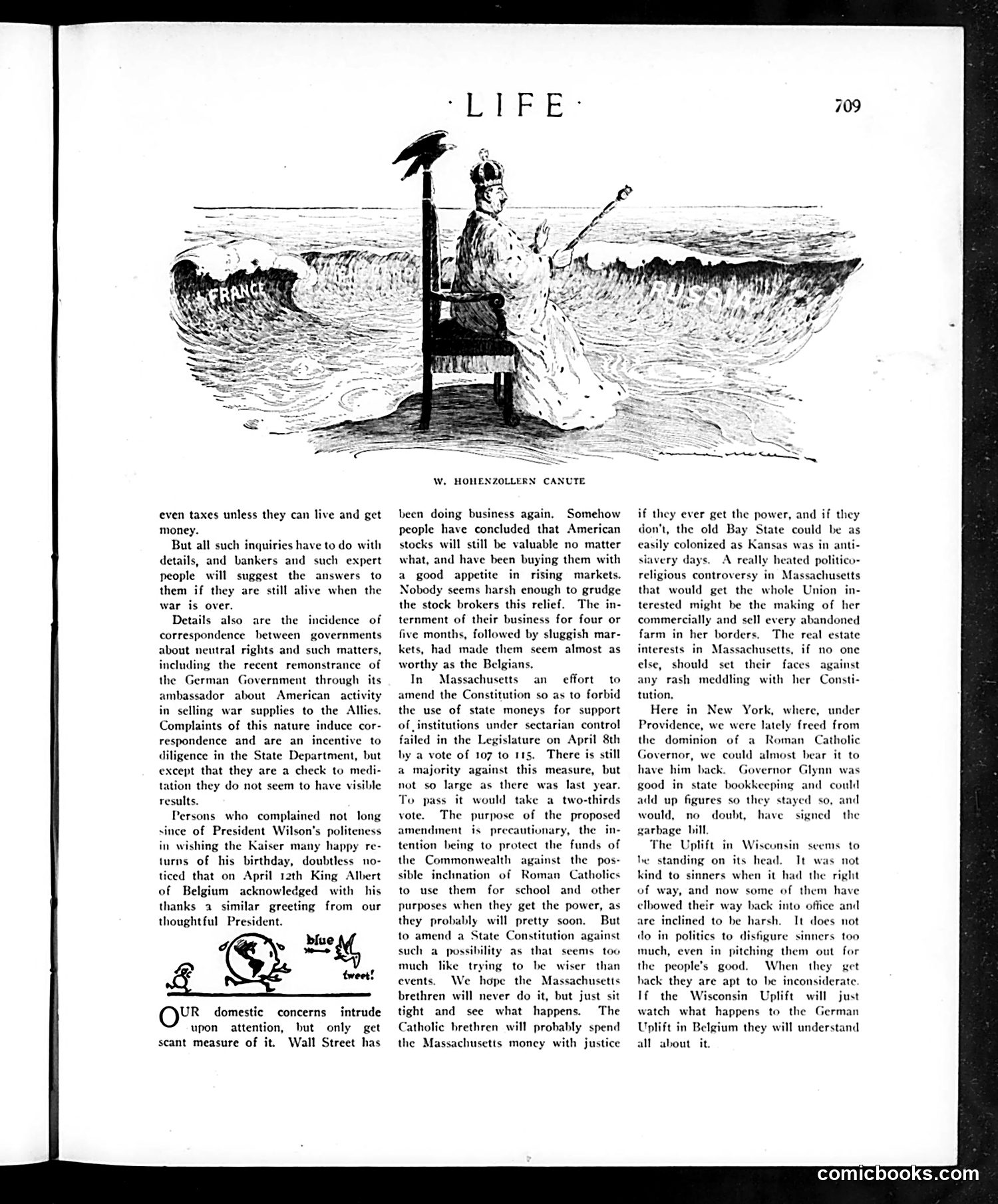
## The Main Cartoon The illustration titled "W. HOHENZOLLERN CANUTE" depicts a crowned figure (likely **Kaiser Wilhelm II of Germany**, referenced by "Hohenzollern," the German royal house) seated on a throne in turbulent waters, attempting to command waves—a reference to the medieval legend of King Canute trying to hold back the tide. ## The Satire The cartoon mocks **Germany's attempts to control events through military force**, particularly regarding American neutrality. The text references German diplomatic protests about American arms sales to the Allies. The satire suggests Germany's threats are as futile as Canute's—they cannot command neutral nations' behavior any more than one can command nature. ## Context Published during **WWI** (references to "the war," German complaints, Belgian suffering), this satirizes **German imperial overreach** while defending American commercial activity supporting Allied powers, despite official neutrality claims. The page's text discusses domestic American concerns—Massachusetts constitutional amendments regarding Catholic institutions and Wisconsin political corruption—suggesting American attention is scattered despite war's importance.
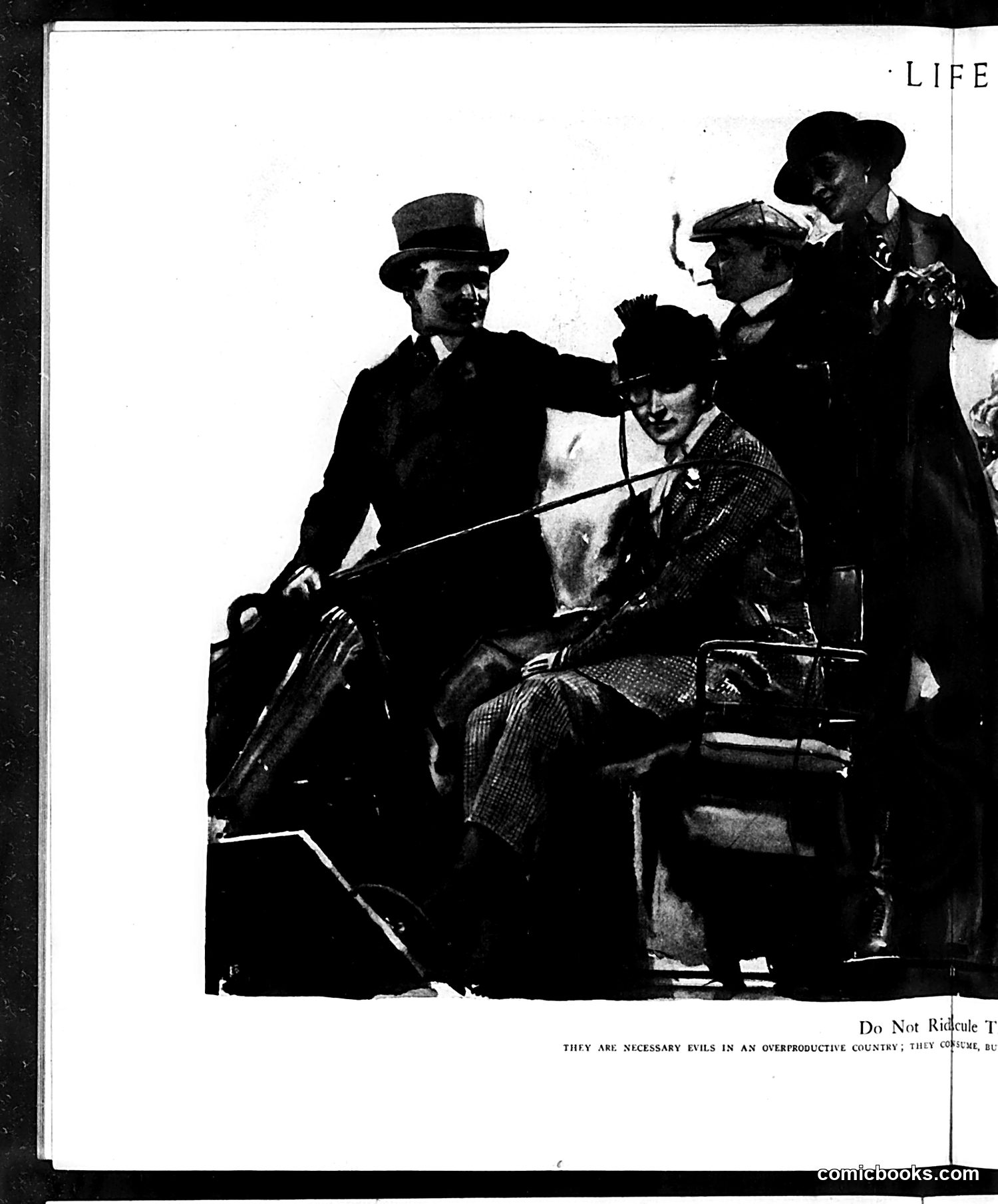
This Life magazine page depicts a political cartoon about population control and agricultural policy. The visible text reads "Do Not Ridicule T[hem]" and references "necessary evils in an overproductive country; they co[me, bu...]" The image shows several men in formal dress (top hats and suits) surrounding a seated figure, appearing to discuss or point at something. The cartoon appears to satirize discussions about controlling population or agricultural output in an overstocked/overproductive economy. Without the complete caption and publication date, I cannot definitively identify the specific figures or pinpoint the exact historical context—whether this references Depression-era farm policy, Malthusian concerns, or another contemporary issue. The formal presentation suggests commentary on elite economic policy discussions affecting ordinary people.
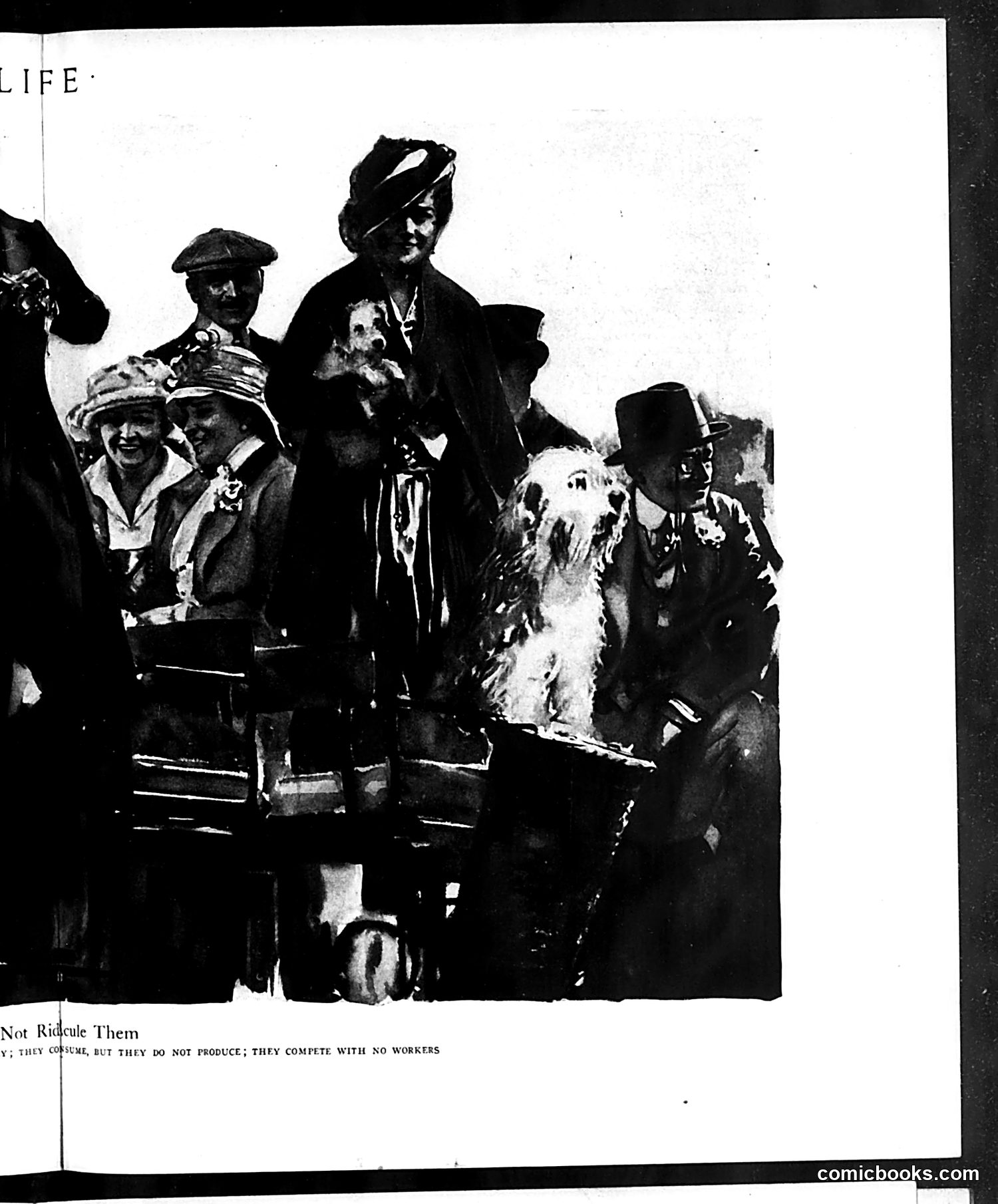
This is a satirical cartoon critiquing wealthy people or the idle rich class. The image shows well-dressed figures (including what appears to be a woman in elaborate clothing and a dog) in a group setting, rendered in stark black and white. The caption's message—"they consume, but they do not produce; they compete with no workers"—suggests the cartoon argues that this class lives off wealth without contributing economically or taking jobs from working people. This appears to be social commentary defending wealthy individuals against criticism, or possibly ironic commentary mocking their parasitic status. The specific context and publication date remain unclear, but the satire targets class distinctions and economic contribution debates common to early 20th-century American discourse.
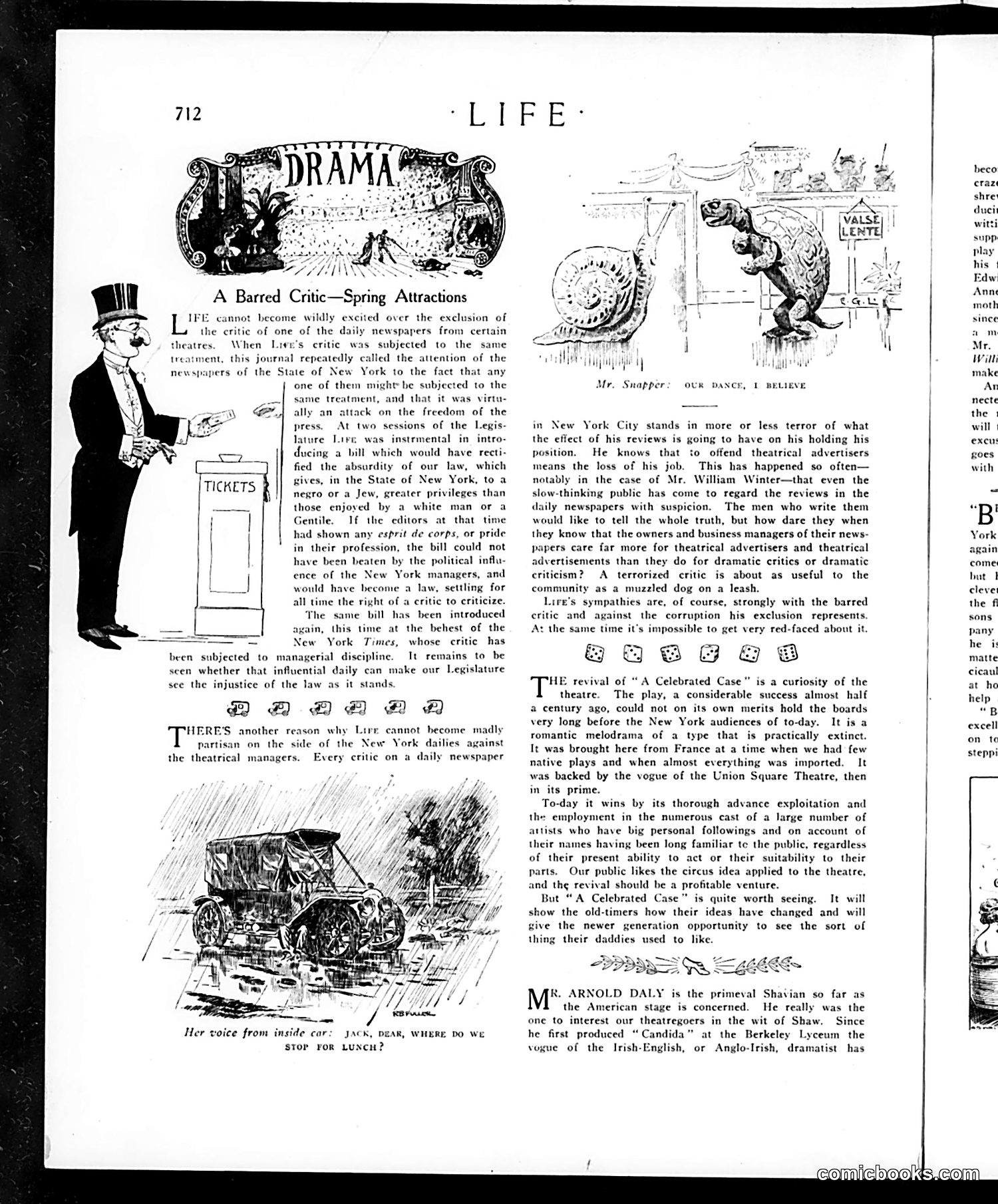
This page satirizes theatrical censorship and critical corruption in early 20th-century New York theater. **Main Issue**: Theater managers excluded unfavorable critics from venues, attacking press freedom. Life argues this is unjust—even worse than discrimination laws (the text controversially compares it to laws privileging white gentiles over Black people and Jews). **The Cartoons**: The top illustration shows a well-dressed man at a ticket window labeled "TICKETS"—likely representing a barred critic. The bottom cartoon depicts a couple in a car asking where to stop for lunch, captioned "Our dance, I believe"—a visual joke about theatrical distraction or superficiality. **Core Argument**: Newspaper owners prioritize theatrical *advertising revenue* over honest criticism. Critics self-censor from fear of losing jobs, making their reviews unreliable. A "terrorized critic is about as useful to the community as a muzzled dog on a leash." The page also reviews "A Celebrated Case," noting its old-fashioned melodrama succeeds through star power and spectacle rather than artistic merit—illustrating the corruption described above.
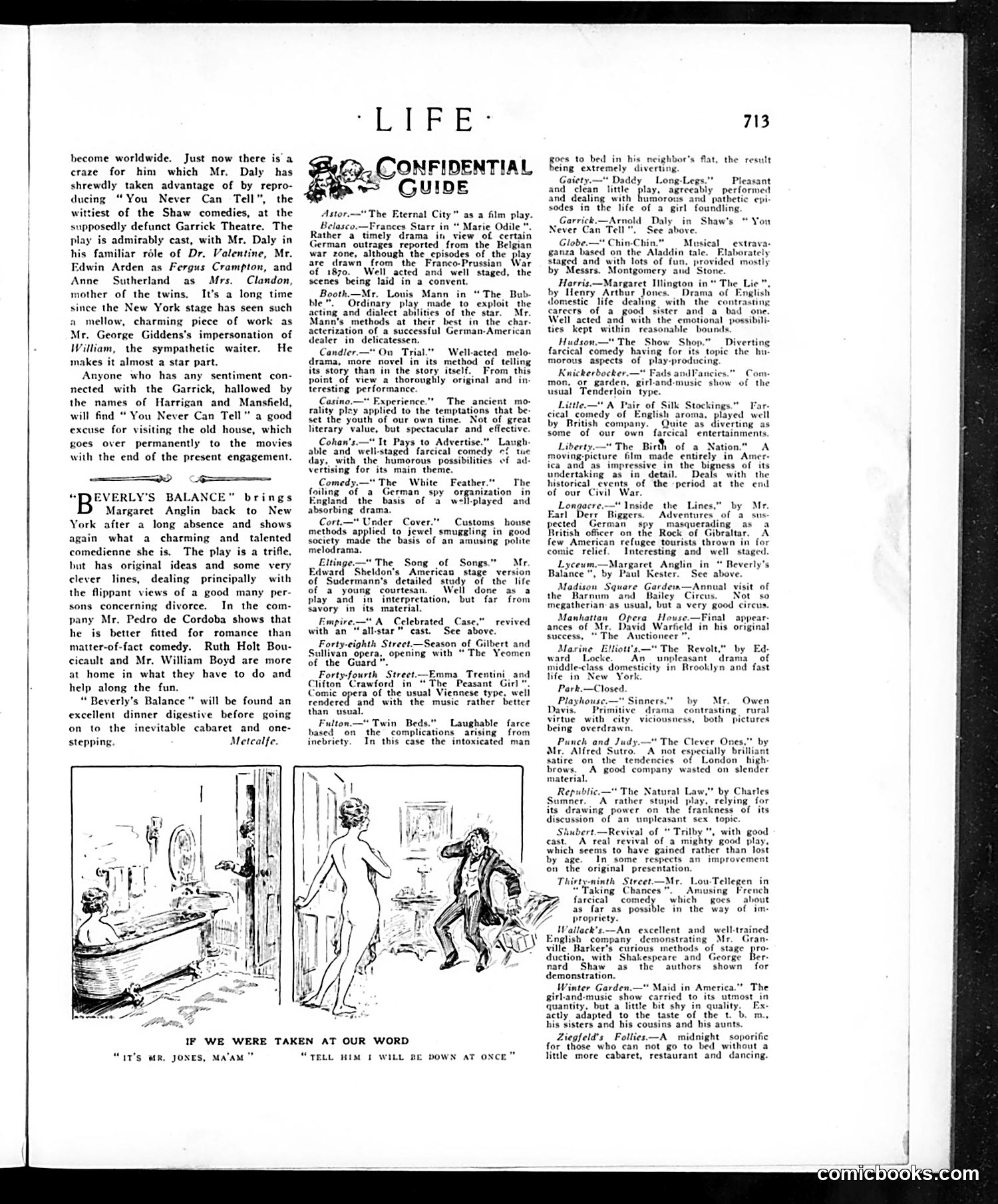
This single-panel cartoon depicts a domestic scene where a man sits in a bathtub while a woman stands nearby. The caption reads: "It's Mr. Jones, Ma'am" / "Tell Him I WILL BE DOWN AT ONCE." The satire plays on marital dynamics and gender relations of the era. The joke appears to be about a wife's prioritization—she's willing to keep a visitor (Mr. Jones) waiting while she attends to her bathing, suggesting either her comfort takes precedence or she's making a point about her independence. The title "If We Were Taken At Our Word" likely refers to women's emerging assertion of equality and autonomy in the 1910s, humorously suggesting what might happen if women acted on feminist ideals in everyday domestic life.
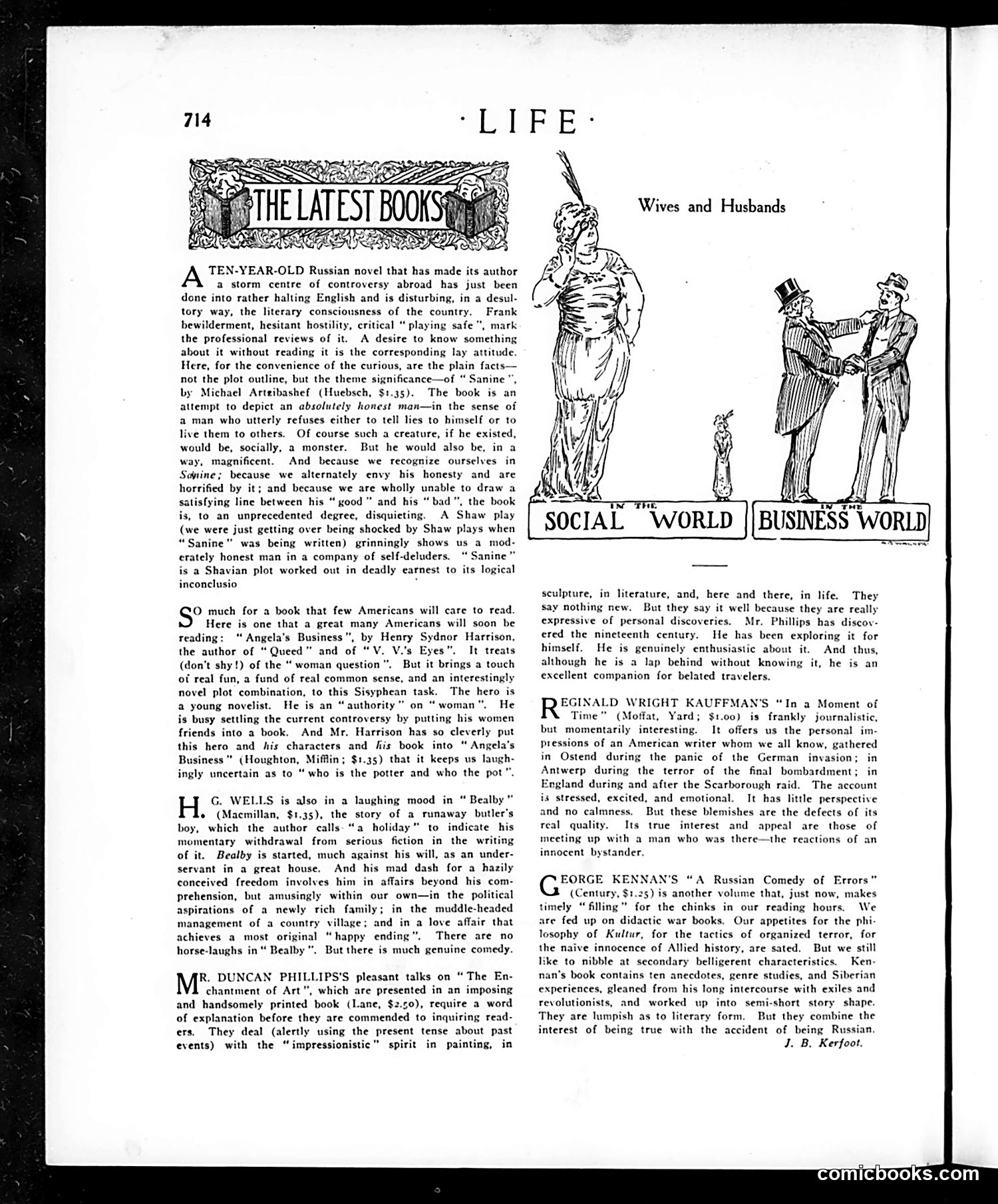
This page contains literary reviews from Life magazine, a satirical publication. The three illustrations labeled "Social World" and "Business World" are decorative dividers showing fashionable figures—likely representing the society and commercial spheres referenced in the book discussions. The reviews discuss recently published novels, including a Russian work called "Sanine" by Michael Artsybashef, which caused controversy for depicting an "absolutely honest man" who refuses social conventions. The reviewer compares it to George Bernard Shaw's plays for its frank treatment of morality. Other books reviewed include "Angela's Business" by Henry Sydnor Harrison (about the "woman question") and H.G. Wells's "Bealby" (described as Wells's lighthearted departure from serious fiction). The page essentially catalogs contemporary literature for educated American readers, offering brief synopses and critical commentary. The cartoons are secondary to the text—simple visual breaks rather than satirical commentary on the books themselves.
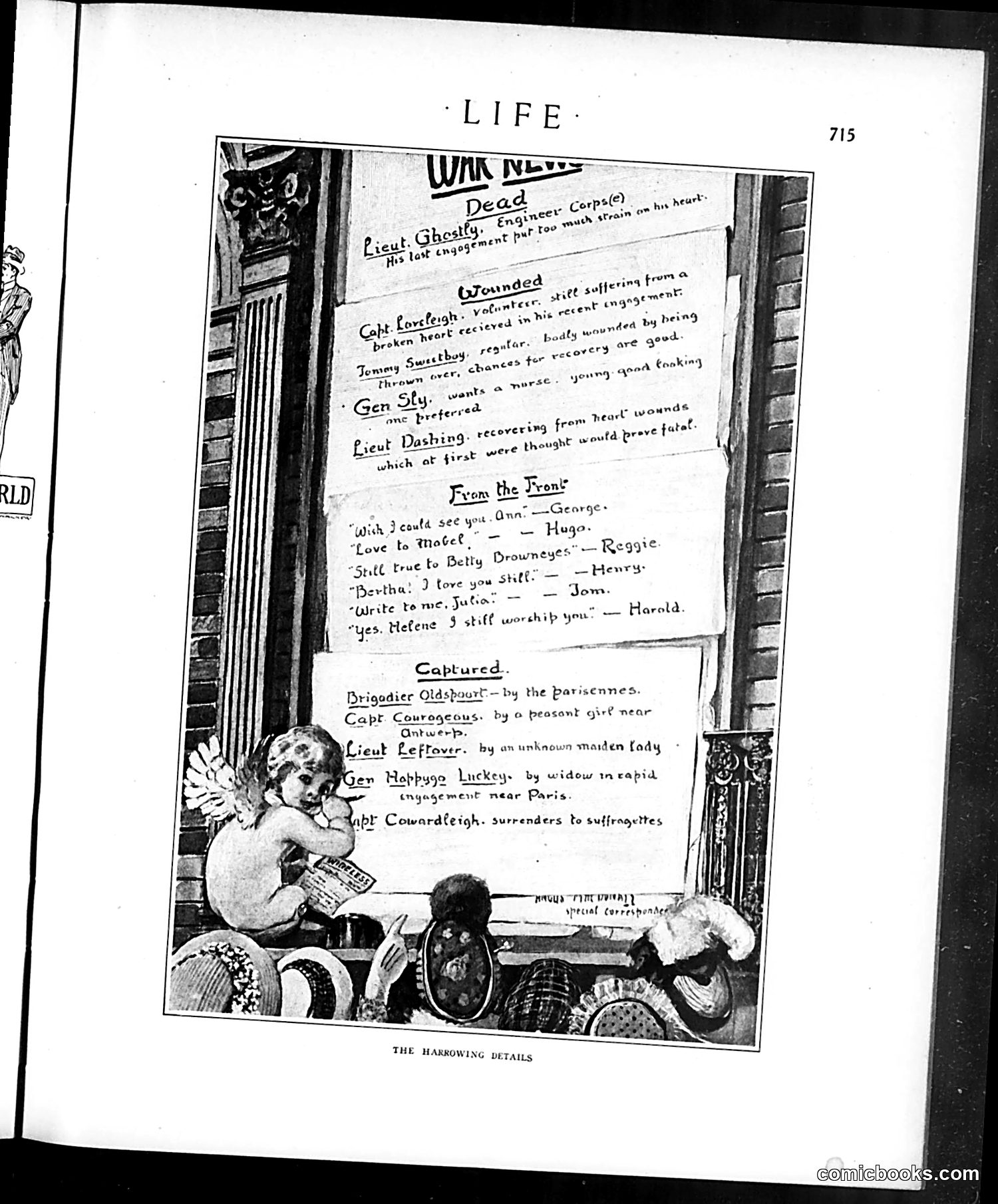
This page satirizes sensationalized British newspaper reporting about World War I. The central image shows a newspaper stand display with dramatic war headlines, flanked by cherubs (likely representing classical "truth" or "fame" figures from journalism iconography). The cartoon mocks how London papers reported casualties and military happenings with melodramatic flair. Categories like "Dead," "Wounded," and "Captured" list officers with invented romantic or tragic details—a suitor with "too much strain on his heart," a soldier wanting "a nurse," love letters "from the front," and suffragettes capturing officers. The satire targets the British press's tendency to sensationalize war news with human-interest angles and sentimental narratives rather than straightforward reporting. The overwrought tone—mixing genuine military losses with absurd romantic subplots—suggests Life magazine's American perspective on British media's treatment of the conflict as both tragedy and entertainment spectacle.
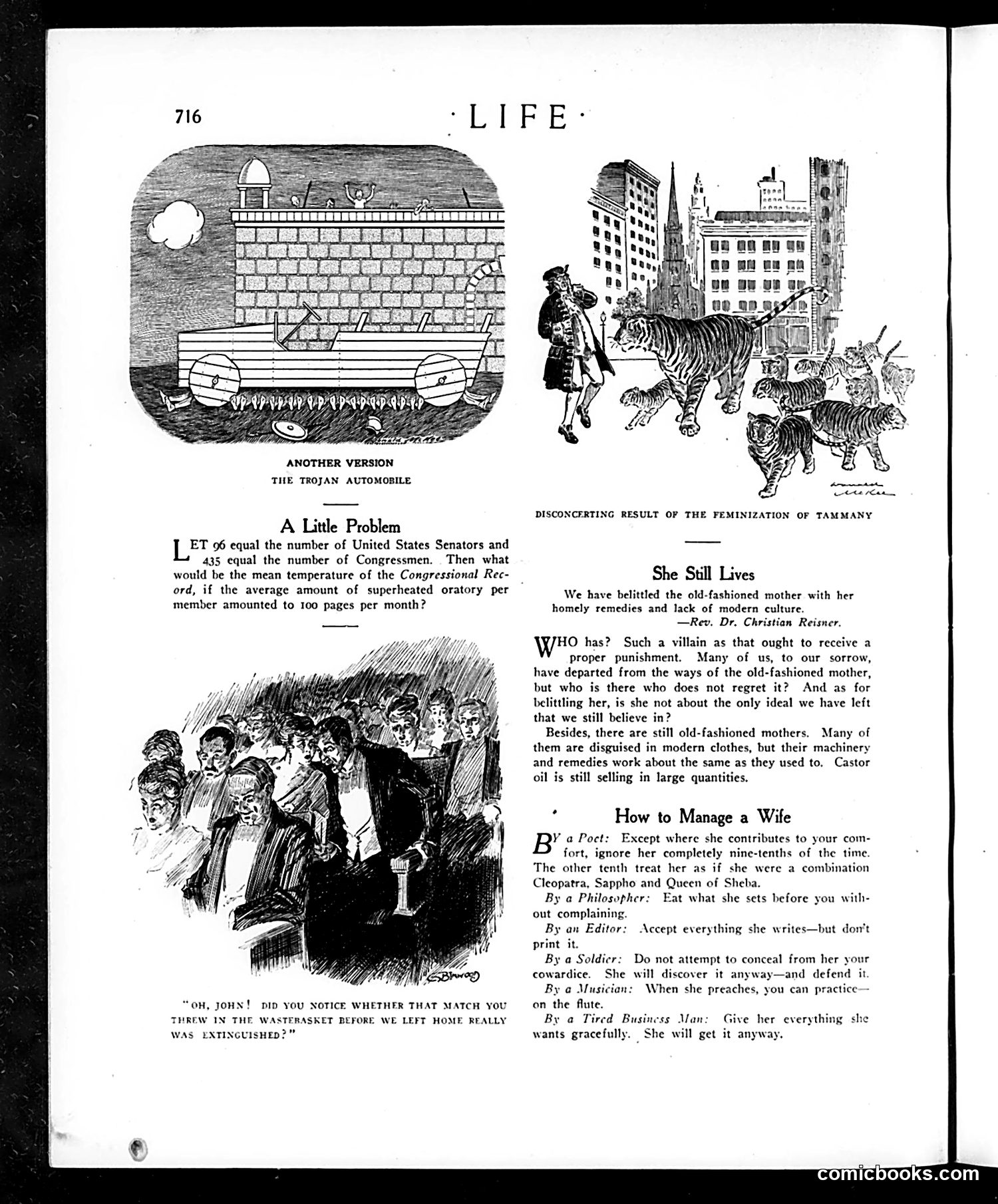
This satirical page contains three distinct pieces of social commentary: **"A Little Problem"** is a mock math puzzle mocking Congress's verbosity—asking readers to calculate the "temperature" of the Congressional Record if 531 members each produce 100 pages of "superheated oratory" monthly. It's a jab at politicians' long-winded speeches. **"Disconcerting Result of the Feminization of Tammany"** shows a woman leading tigers through a city street, referencing Tammany Hall (New York's Democratic political machine). The joke appears to satirize women gaining political influence, presenting it as chaotic or dangerous—a common anti-suffrage/anti-feminism trope of the era. **"She Still Lives"** defends traditional mothers against modern criticism, while **"How to Manage a Wife"** offers humorous "advice" from various professions, all treating wives as either nuisances to ignore or adversaries who'll get their way regardless. The humor relies on cynical marital stereotypes typical of early 20th-century magazines. The page reflects contemporary anxieties about women's changing roles and expanding political participation.
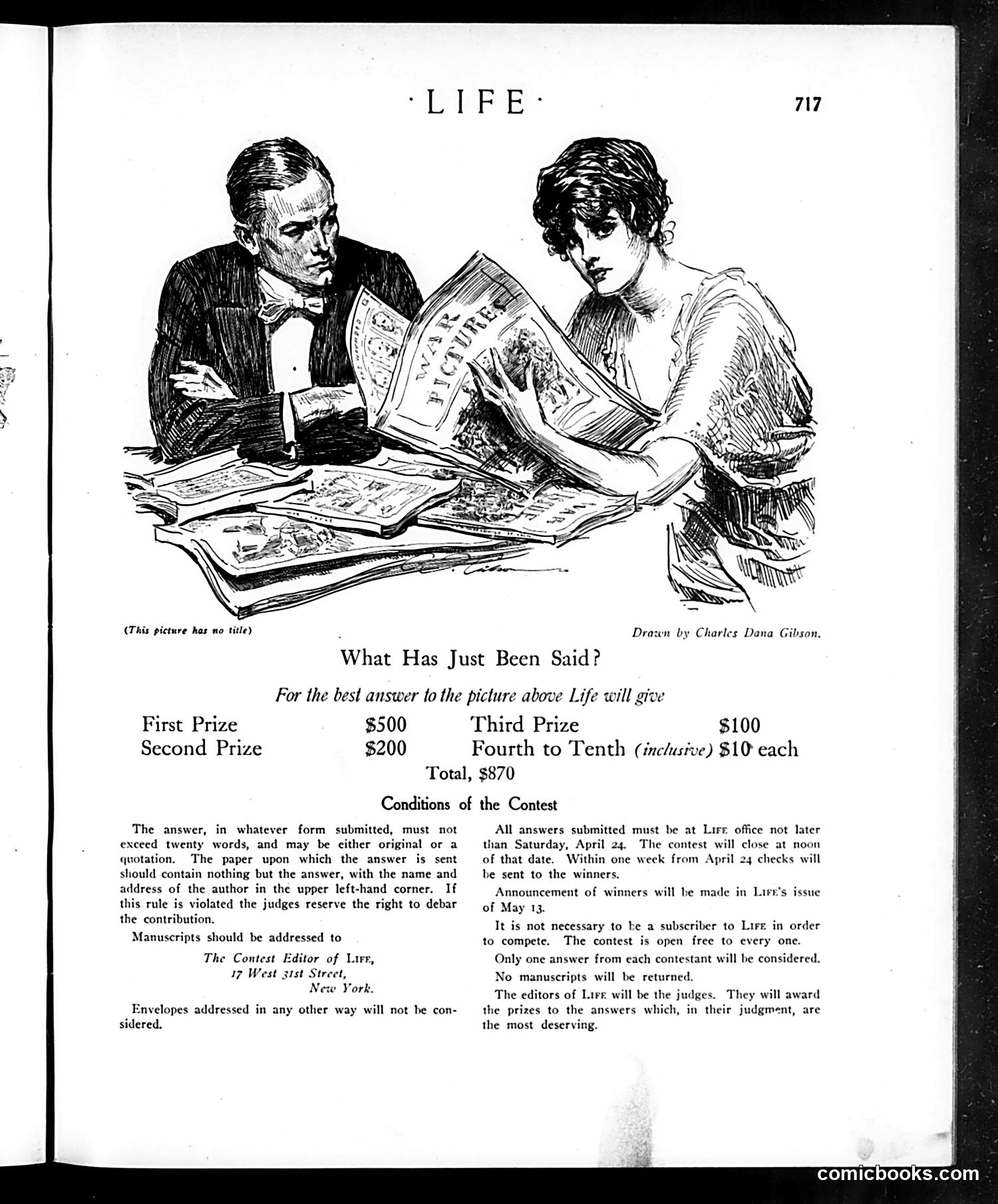
This page features a **reader-participation contest** rather than a political cartoon. The illustration by Charles Dana Gibson—a famous American illustrator known for depicting fashionable society—shows a well-dressed couple examining illustrated publications together, likely magazines or picture books. The contest asks readers: "What Has Just Been Said?"—inviting them to caption or interpret what conversation is occurring between the two figures. This was a popular entertainment format in early 20th-century magazines, engaging readers while generating content and reader loyalty. The substantial prize pool ($870 total, with $500 for first place) reflects the magazine's resources and the appeal of such contests. The detailed rules emphasize the contest's legitimacy and seriousness. The specific context—who these figures represent or what publications they're examining—remains unclear from the image alone, but the satire likely involves upper-class leisure activities or contemporary social dynamics around reading and taste.
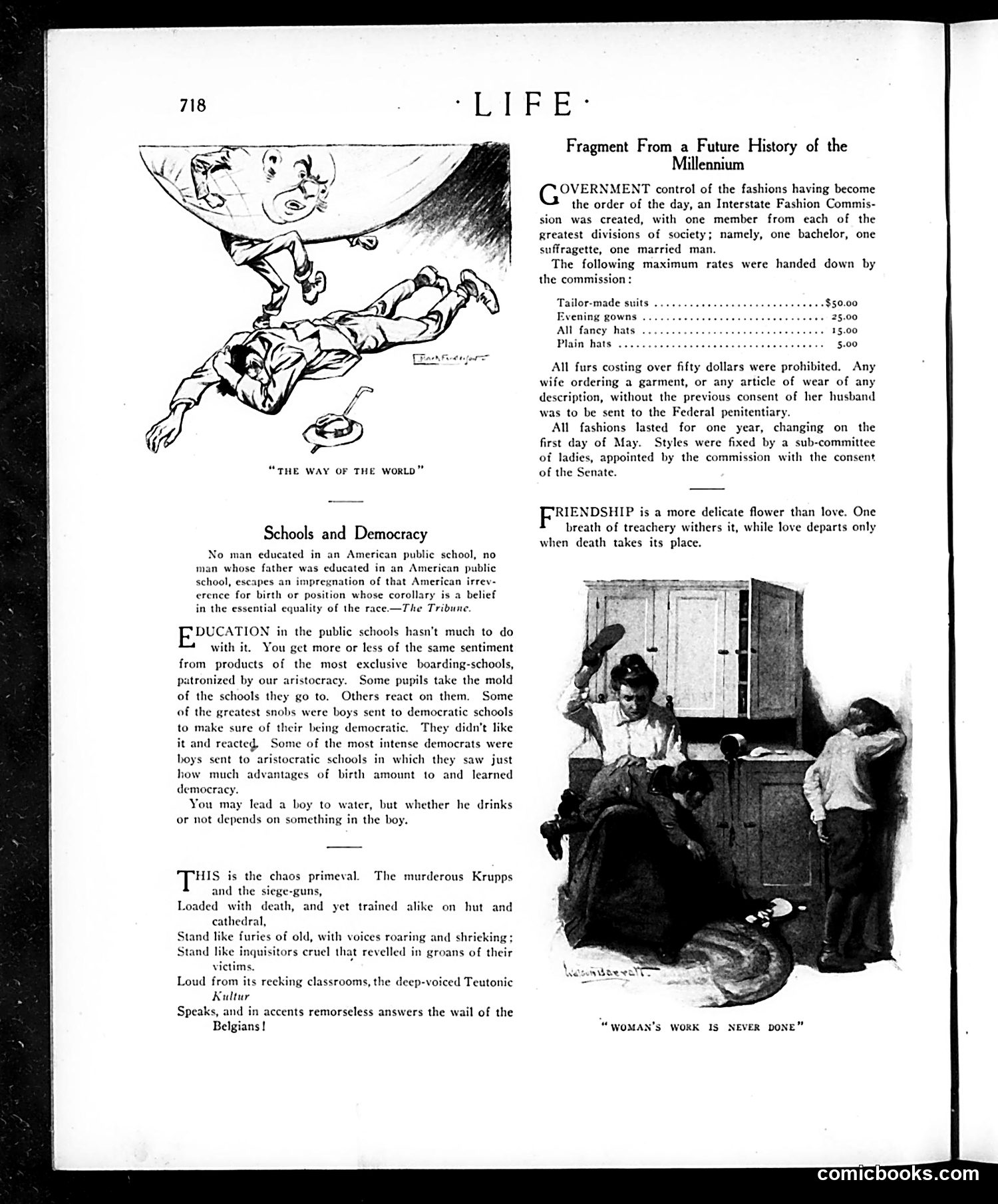
**Top cartoon "The Way of the World"**: Shows figures being crushed under a large wheel—likely representing fate or social forces. This illustrates the satirical article below about government fashion control. **"Fragment From a Future History"**: Satirizes both government overreach and gender politics. The piece imagines a future where the government regulates clothing prices and styles through a commission. The satirical punch: wives need *husband permission* to buy clothes or face federal prison—mocking both bureaucratic control and marital authority. The price restrictions ($50 for suits, $25 for gowns) ridicule wage-and-price controls. **"Schools and Democracy"**: Argues that education type doesn't determine democratic values—character does. References American belief in equality and critique of both aristocratic snobbery and assuming public schools automatically create democrats. **Bottom section**: References Krupp (German munitions manufacturer) and WWI destruction of Belgium, criticizing German militarism and "Kultur" (civilization). The final illustration "Woman's Work Is Never Done" shows domestic drudgery, complementing the fashion-control satire above.
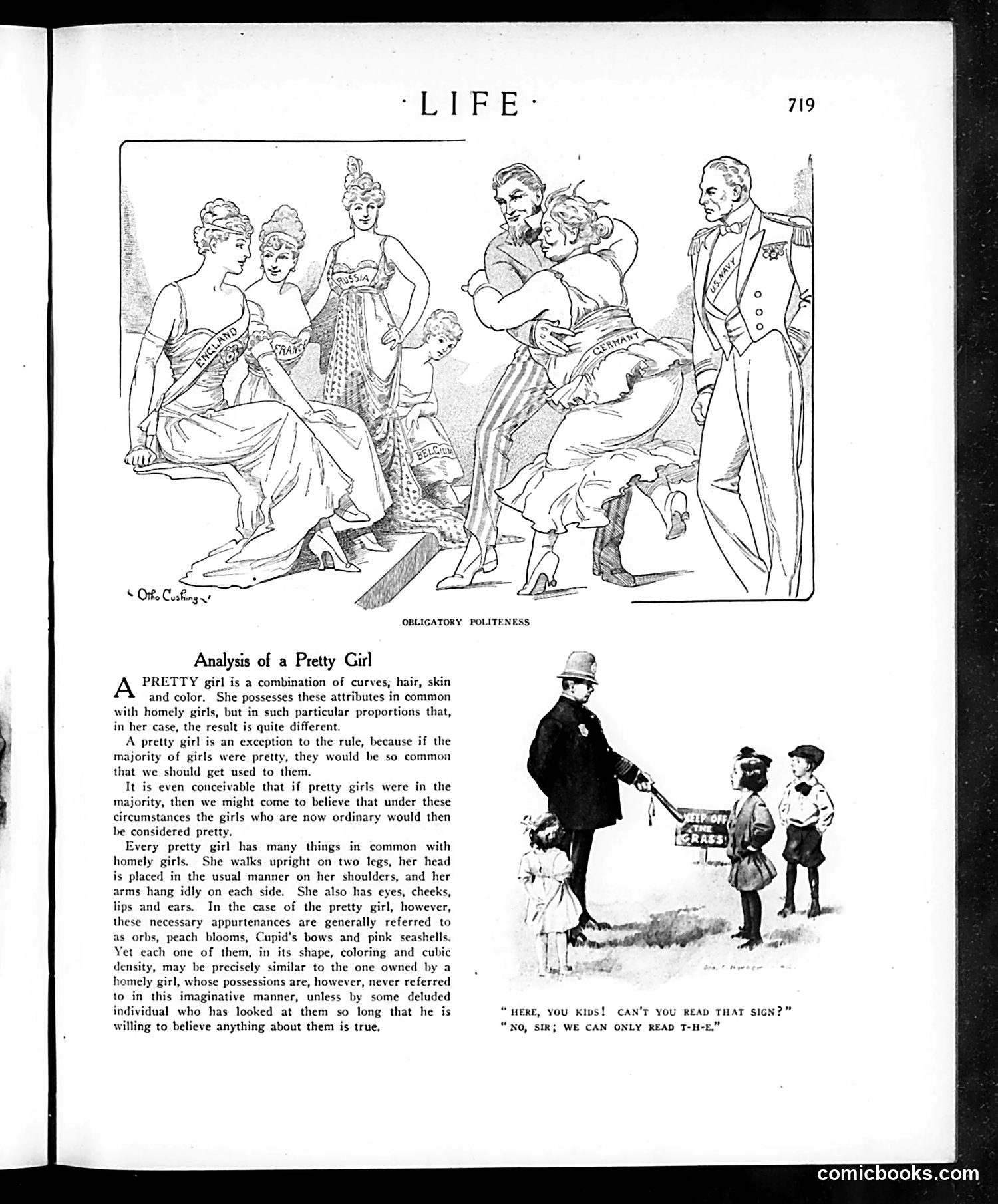
The page contains two separate satirical pieces: **Top cartoon ("Obligatory Politeness"):** Shows well-dressed aristocratic figures (identifiable by their formal attire and military decorations) being awkwardly polite to each other at what appears to be a social gathering. The satire mocks the excessive formality and forced courtesy of high society—the "obligatory" politeness of the title that requires stiff, insincere social performance. **Bottom cartoon and essay:** The text humorously analyzes what makes a "pretty girl," using pseudo-intellectual reasoning to note that prettiness is merely proportion and perspective—women called "pretty" have identical features to "homely" girls, but society romanticizes their appearance with flowery language ("orbs," "peach blooms," "Cupid's bows"). The separate cartoon below shows children who can only read the letter "T-H-E," missing the full sign—a joke about limited literacy or understanding. Together, these pieces satirize social pretension and the subjective nature of beauty and social convention.
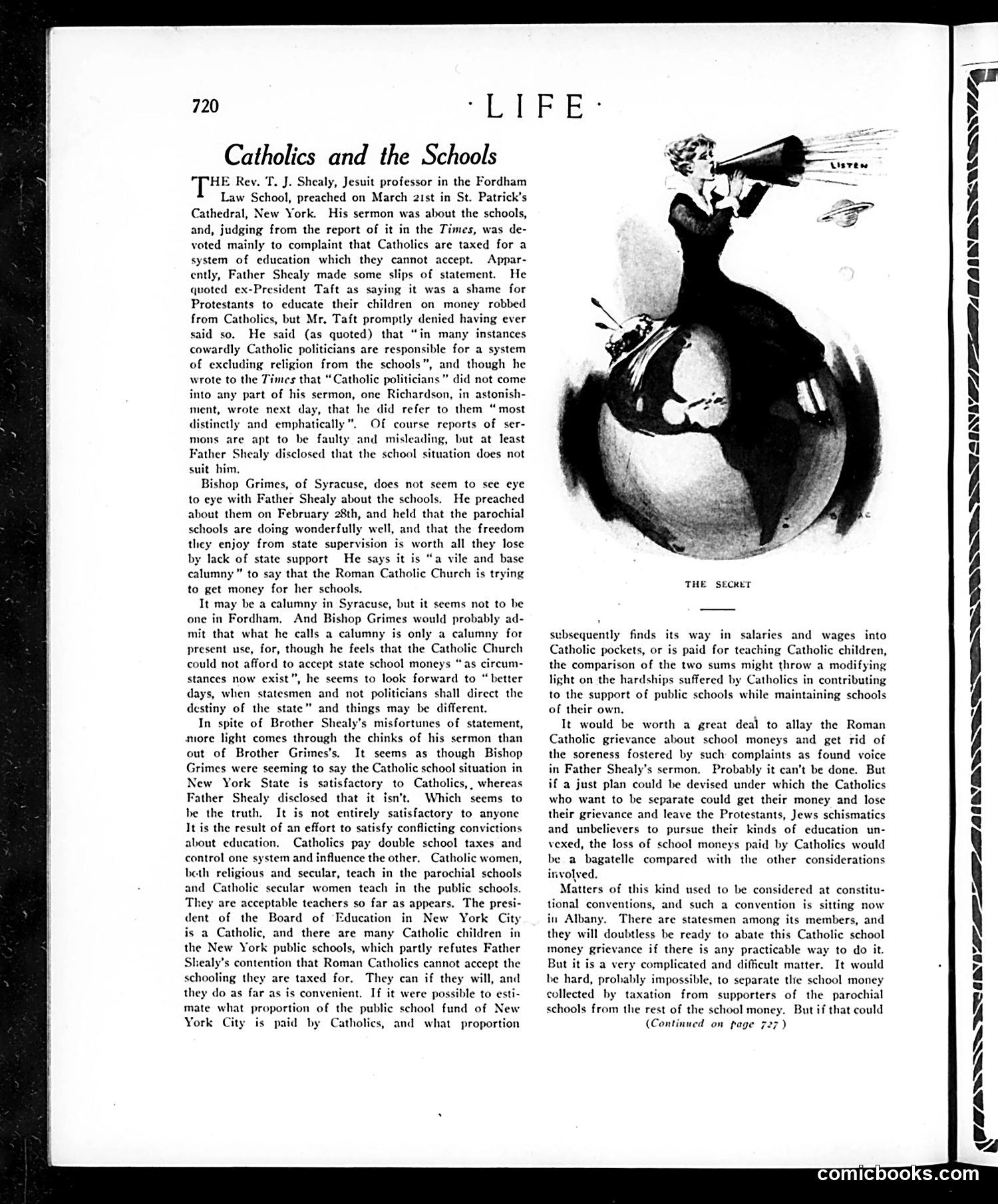
This article satirizes Catholic complaints about public school funding. The cartoon titled "THE SECRET" depicts a figure using a telescope to peer into a globe, illustrating the article's central point: Catholics claim financial hardship from supporting public schools they reject on religious grounds, yet Catholic teachers and workers actually benefit when tax dollars are paid as salaries to Catholic employees or used to educate Catholic children in public schools. The article contrasts two Catholic leaders: Father Shealy (Fordham) complains Catholics are unfairly taxed for unacceptable secular education, while Bishop Grimes (Syracuse) defends parochial schools' independence. Life's satirical position: Catholics simultaneously object to public school taxes while conveniently participating in and profiting from the same system—the "secret" being their selective hypocrisy about what they'll accept when financially advantageous.
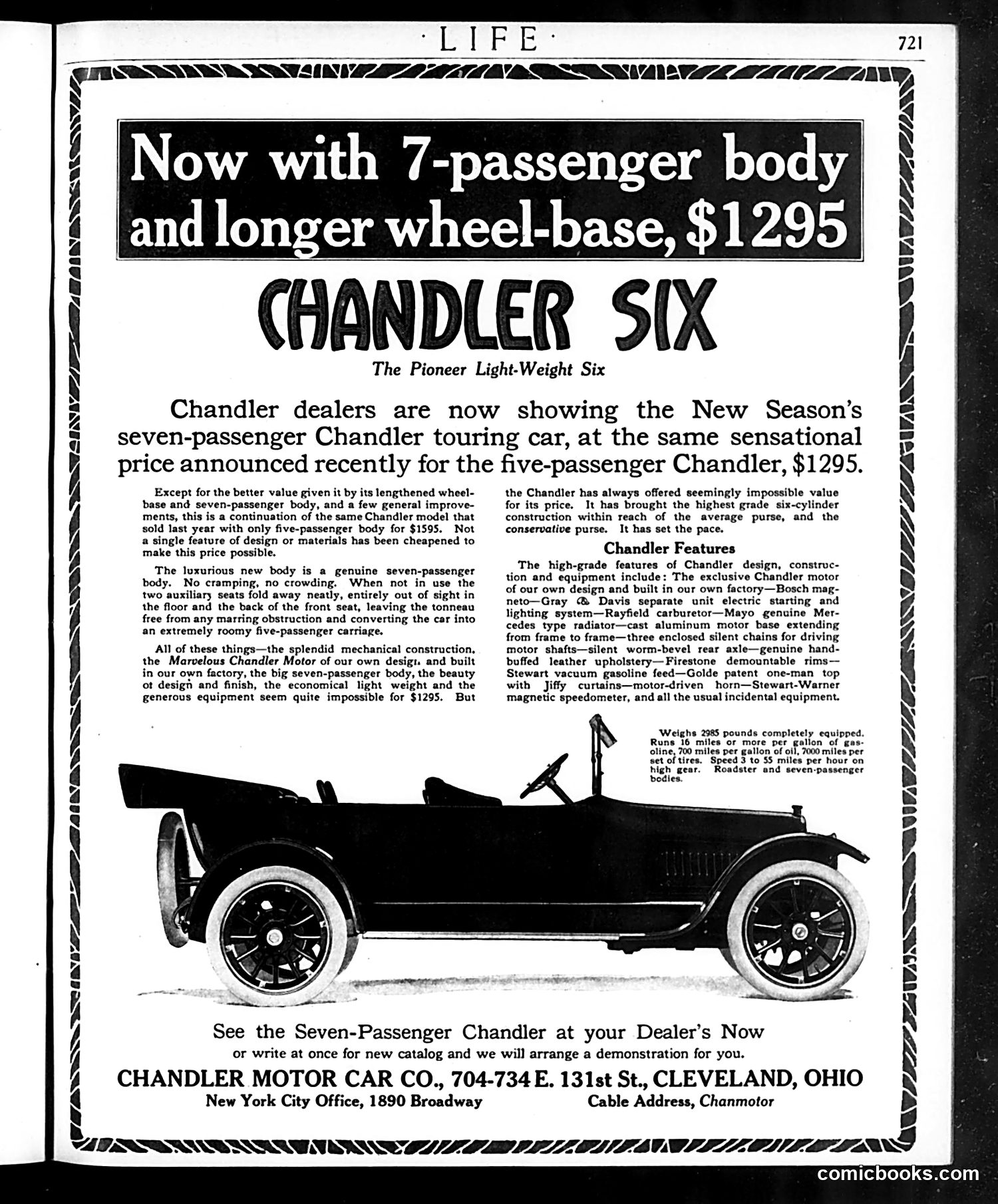
This page is **not a cartoon or satire**—it's a straightforward automobile advertisement from Life magazine (page 721). The ad promotes the **Chandler Six**, a luxury automobile manufactured by Chandler Motor Car Company in Cleveland, Ohio. The key selling point: a new seven-passenger touring car priced at $1,295, the same price as their previous five-passenger model. The advertisement emphasizes value and engineering quality, listing technical features like the proprietary Chandler motor, electric starting system, and leather upholstery. It positions the car as offering "seemingly impossible value" for the price—suggesting competitors charged significantly more for comparable features. The simple side-profile illustration shows the vehicle's extended wheelbase and open-air design typical of 1920s touring cars. This represents early automotive marketing, targeting middle-to-upper-class buyers seeking quality construction at reasonable cost during the competitive early automobile era.
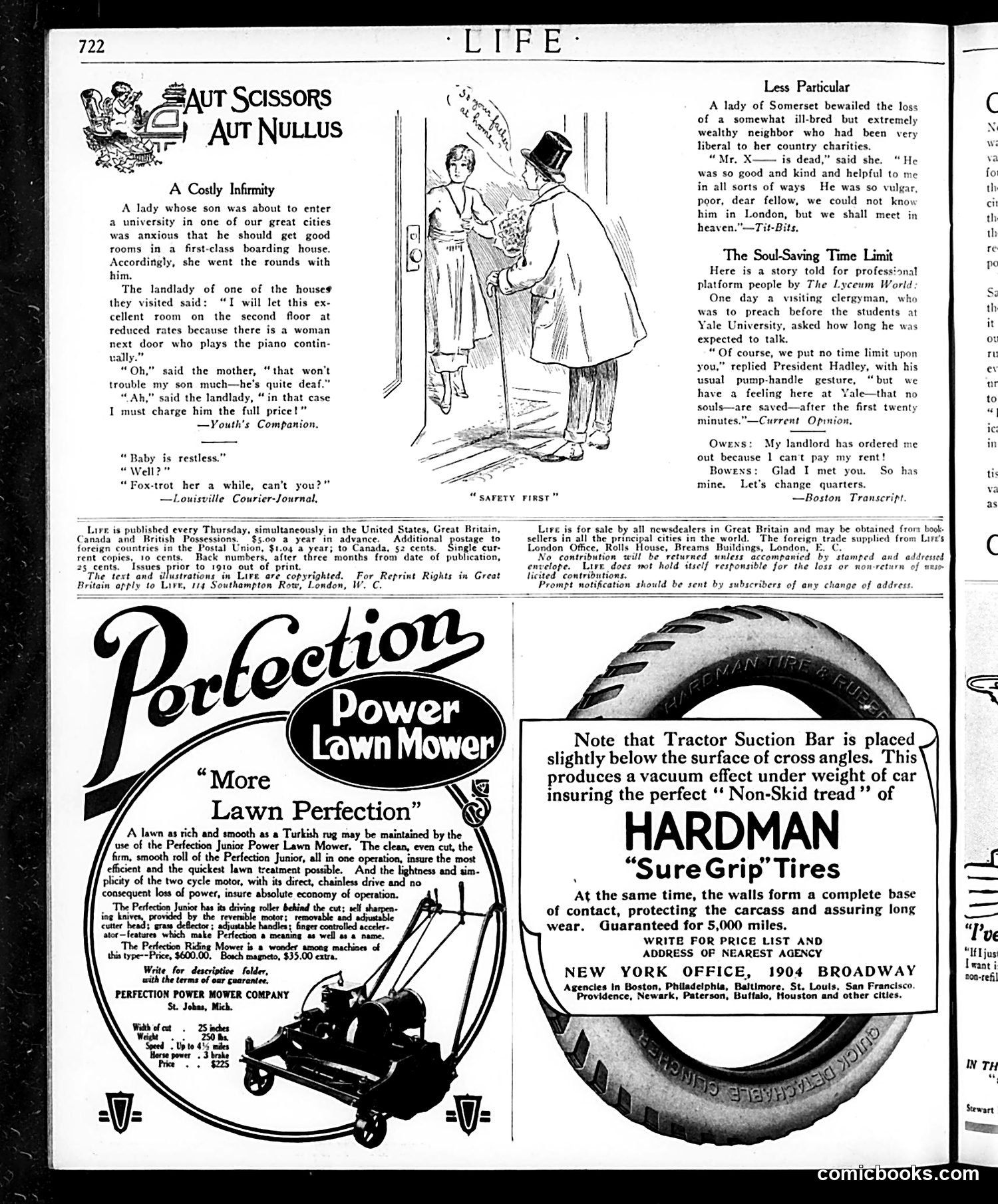
This page contains **light satirical humor columns and advertisements** rather than political cartoons. The humor pieces mock social pretensions and practicalities: - **"A Costly Infirmity"**: A landlady offers reduced rent because a neighbor plays piano constantly—until learning the prospective tenant is deaf, whereupon she charges full price (the deaf son's deafness becomes marketable). - **Baby/Fox-trot joke**: Suggests dancing calms a restless infant—topical to 1920s dance crazes. - **"Less Particular"** and **"Soul-Saving Time Limit"**: Gentle jabs at social hypocrisy and religious formality. The Yale president's quip suggests even spiritual salvation has time constraints. - **Housing shortage exchange**: Two men bond over shared eviction troubles. The **advertisements**—Perfection Power Lawn Mower and Hardman "Sure Grip" Tires—represent typical early 20th-century consumer goods marketing, featuring mechanical innovation appeals. The page reflects post-WWI American middle-class concerns: university education, housing costs, domestic conveniences, and social propriety.
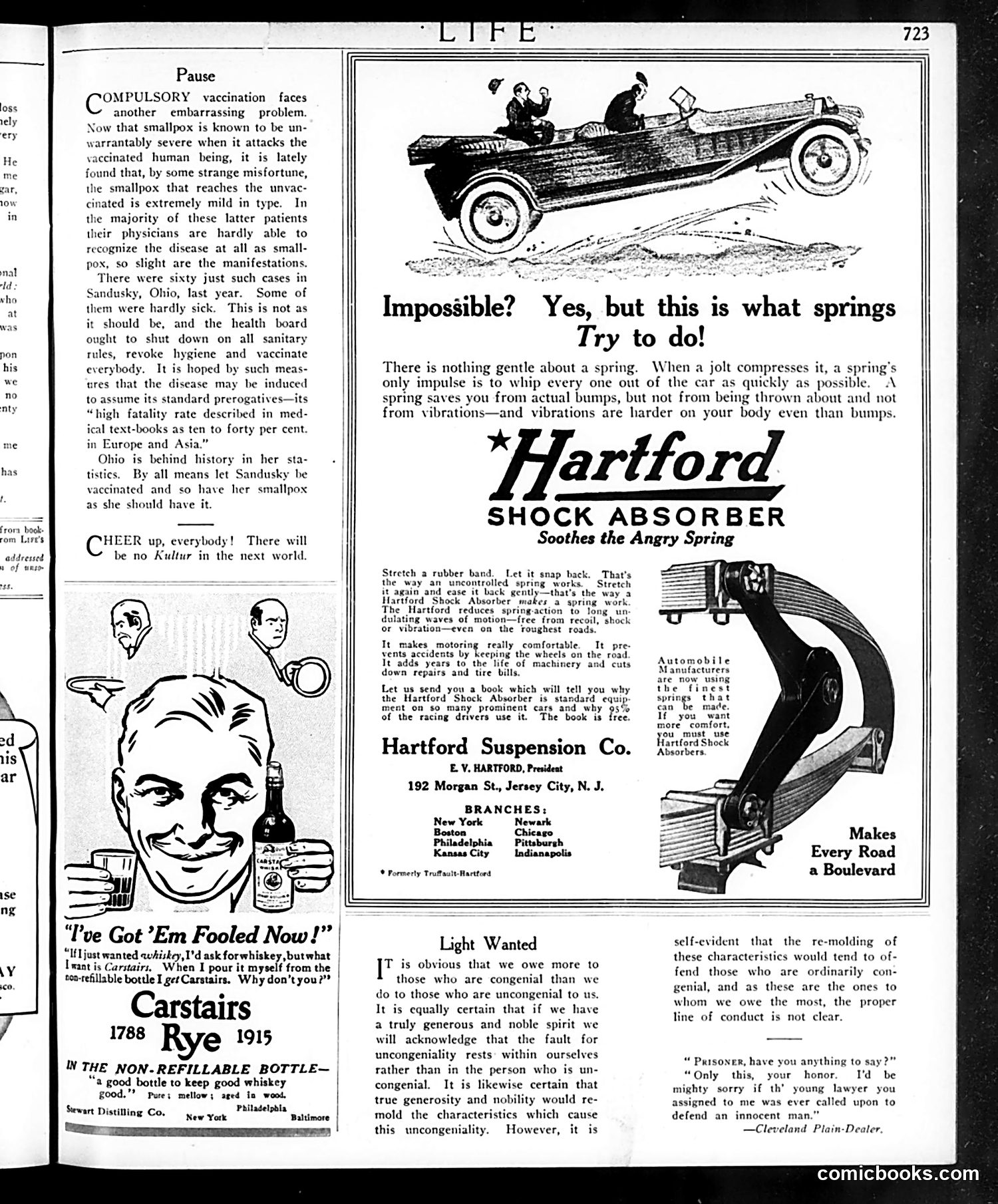
This page contains satirical commentary and advertisements from an early 20th-century American magazine. **"Pause" Editorial Satire:** The opening column mocks public health policy, specifically compulsory smallpox vaccination. The satirist notes an apparent paradox: vaccinated people who contract smallpox experience severe illness, while unvaccinated cases in Sandusky, Ohio are mild. The piece sarcastically suggests health boards should enforce vaccination to restore smallpox's expected deadliness ("ten to forty per cent" fatality rate). This appears to critique either vaccination skepticism or heavy-handed public health mandates—the sarcasm suggests absurdity in the policy debate itself. **Advertisements:** The page features two product ads—Hartford Shock Absorber for automobiles and Carstairs Rye whiskey—typical of Life's commercial content. **"Light Wanted" Essay:** A philosophical reflection on human nature and generosity, discussing how we blame others for incompatibility rather than examining our own character flaws. The page primarily showcases Life's mix of satirical social commentary and period advertising.
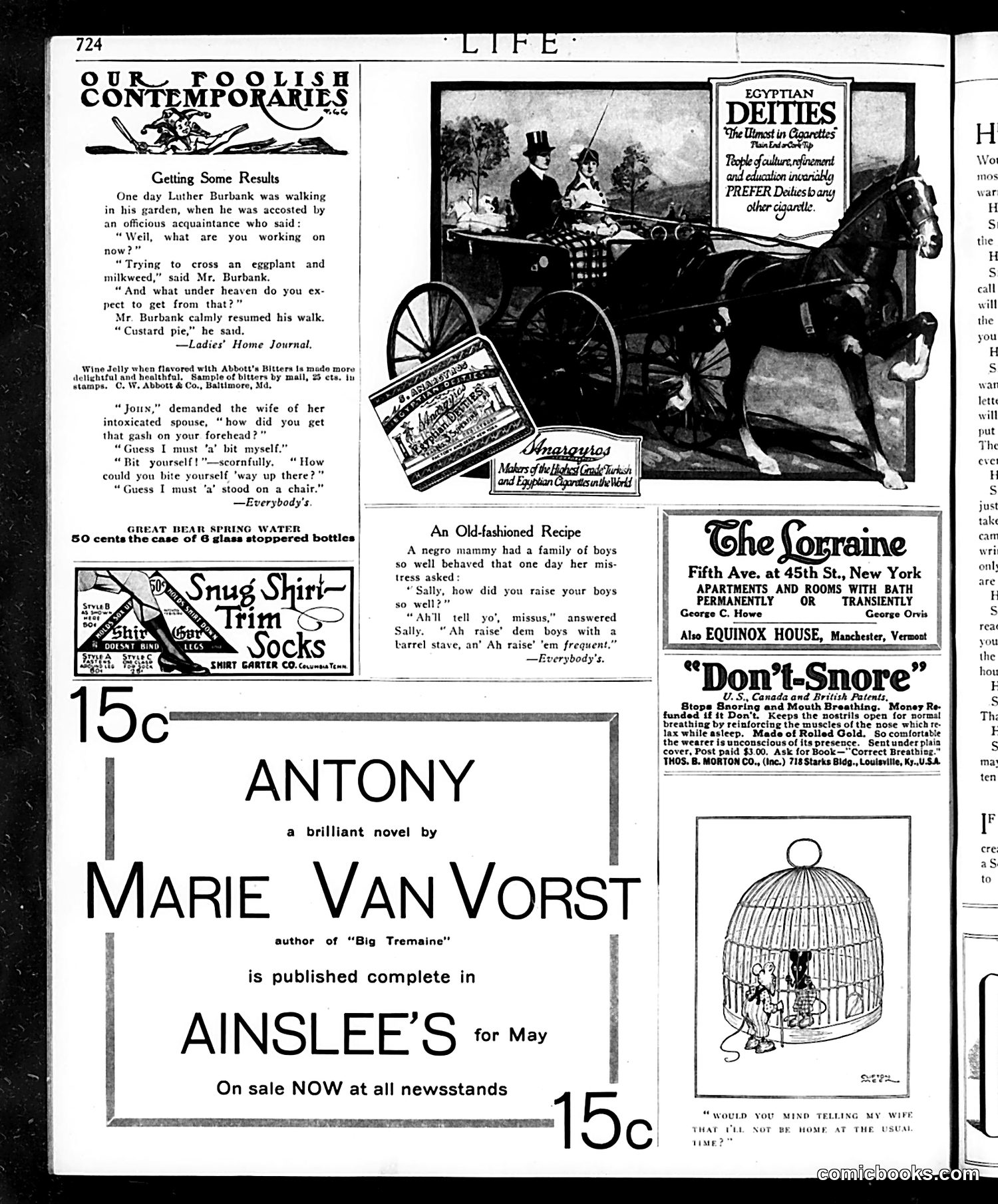
This page contains several satirical humor pieces typical of early 20th-century Life magazine: **"Getting Some Results"** mocks horticulturist Luther Burbank through a joke where someone asks what he's breeding an eggplant and milkweed to create. His deadpan answer—"custard pie"—satirizes how absurd cross-breeding experiments can seem to ordinary people. **The intoxication jokes** use common domestic humor: a drunk man claims he bit himself, then admits he stood on a chair. The "Sally" piece uses a racist caricature of a Black woman describing corporal punishment as old-fashioned child-rearing. **The birdcage cartoon** (bottom right) shows a man asking his wife's permission to stay out late, a visual gag about domestic control and henpecked husbands—a recurring comedic theme of the era. The page is primarily **advertising** interspersed with these brief jokes, typical of Life's mixed editorial-commercial format. The humor relies on stereotypes and domestic situations that modern readers would find outdated or offensive.
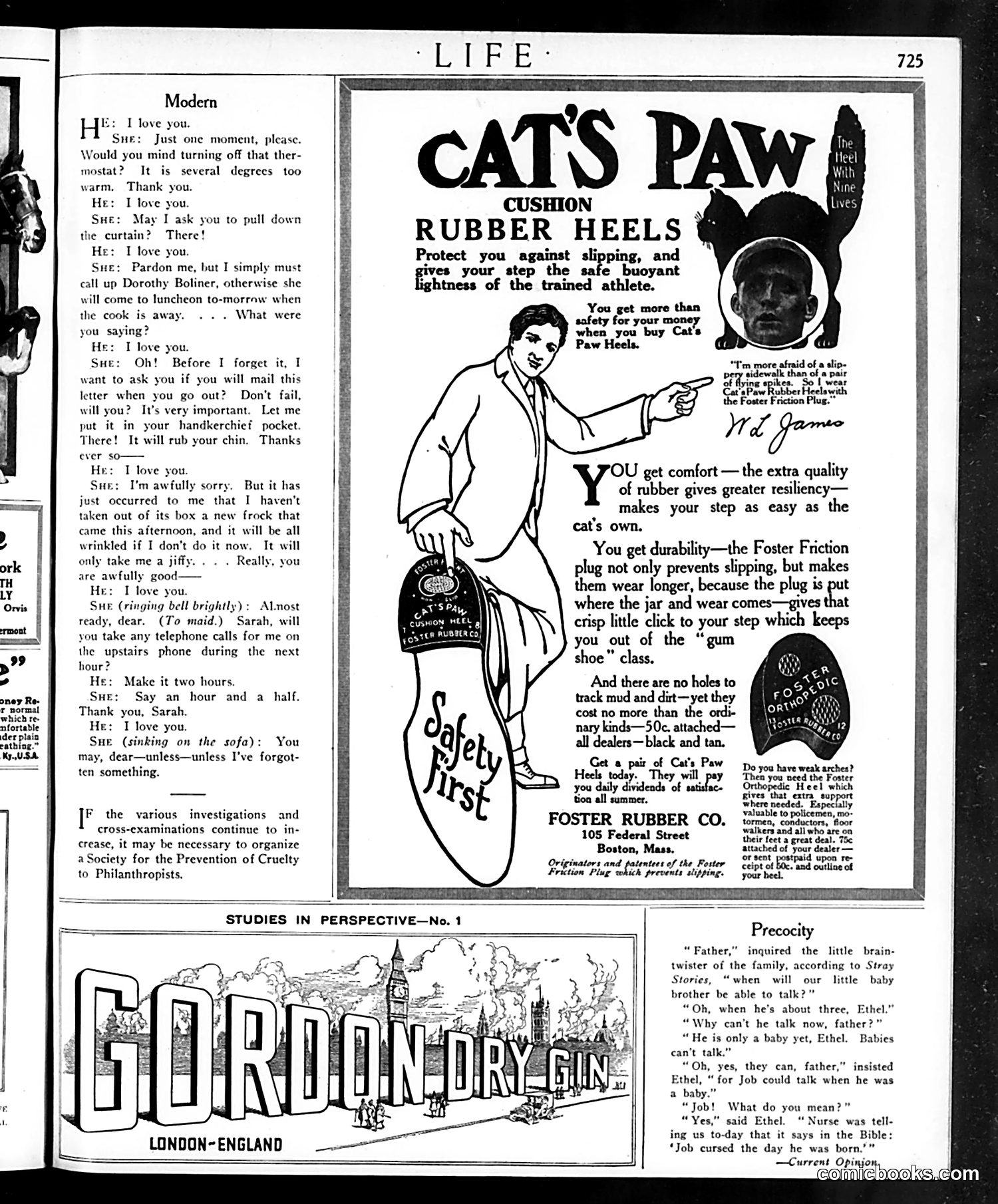
## "Modern" Dialogue (Left Column) This satirical sketch mocks modern married life and women's "nagging." A husband repeatedly declares "I love you," but his wife constantly interrupts with domestic demands—adjusting the thermostat, pulling curtains, calling a friend, mailing letters, retrieving a dress, arranging phone calls. The joke is that romantic sentiment collides with the mundane realities of household management and wives' endless errands, suggesting women are incapable of receiving affection without immediately pivoting to practical concerns. ## Advertisements (Center & Right) Two period ads: Cat's Paw Cushion Rubber Heels (promising slip-prevention and durability) and Gordon's Gin (London). ## "Precocity" (Bottom Right) A brief humorous anecdote where a child misinterprets Biblical language—confusing Job's name with the phrase "Job cursed" from the Bible, believing babies can speak because Job spoke as a baby. The joke plays on literal versus figurative interpretation. The page reflects early 20th-century attitudes toward gender roles and domestic comedy.
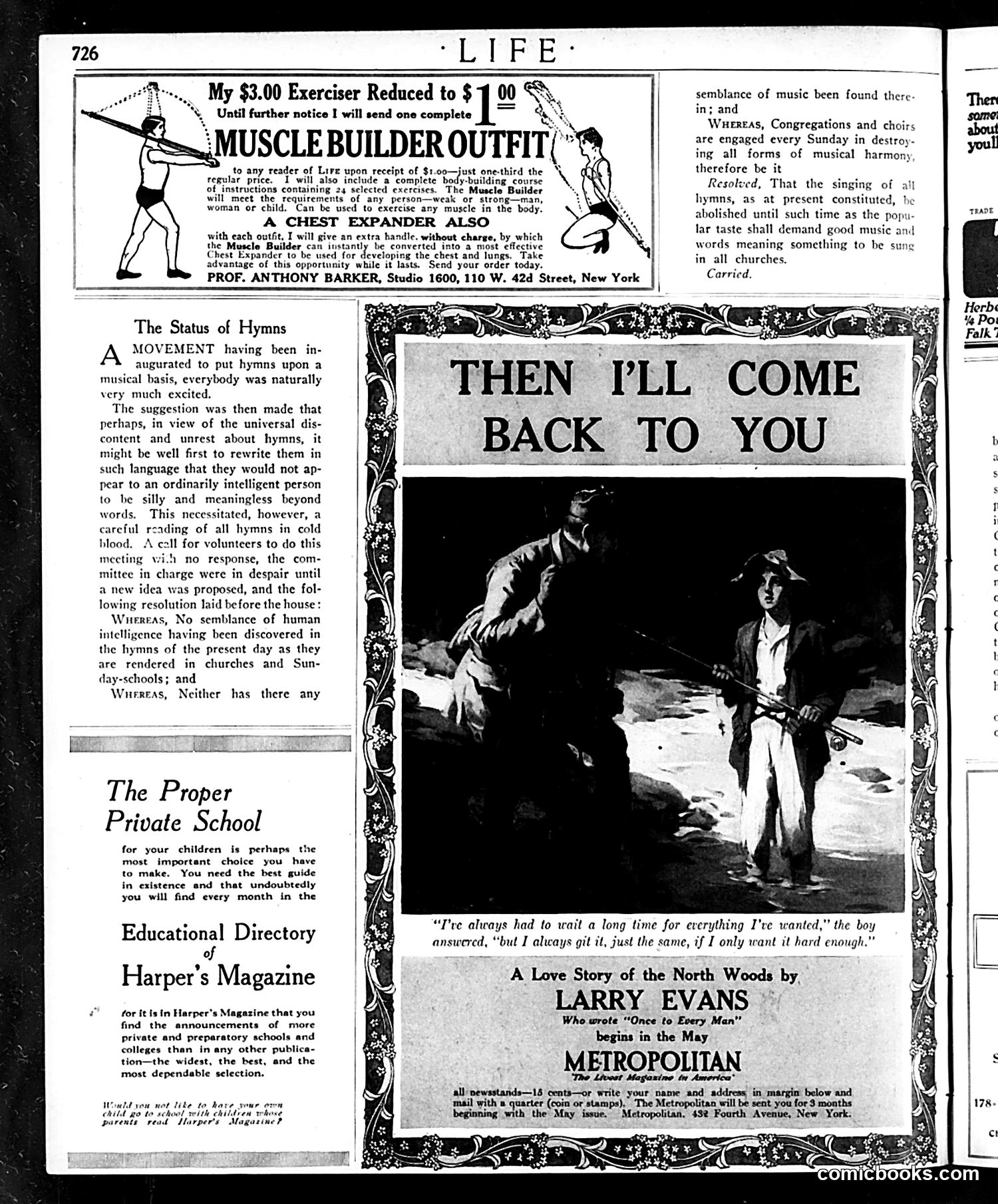
This page satirizes a church movement to modernize hymns by rewriting them in contemporary language. The humor lies in the stated problem: existing hymns appear "silly and meaningless" to ordinary intelligent people when sung in churches and Sunday schools. The satire proposes a formal resolution noting that hymns lack "semblance of human intelligence." The implication is that traditional hymn lyrics—archaic, obscure, or theologically dense—have become incomprehensible to modern congregations. The page is primarily text-based commentary rather than visual cartoon. The "joke" targets both the hymns themselves and the church's bureaucratic response (forming committees, passing resolutions) to address religious irrelevance. It captures early 20th-century tension between traditional religious practice and modernizing sensibilities—suggesting that churches were losing audiences because their music and language felt antiquated and disconnected from contemporary life.
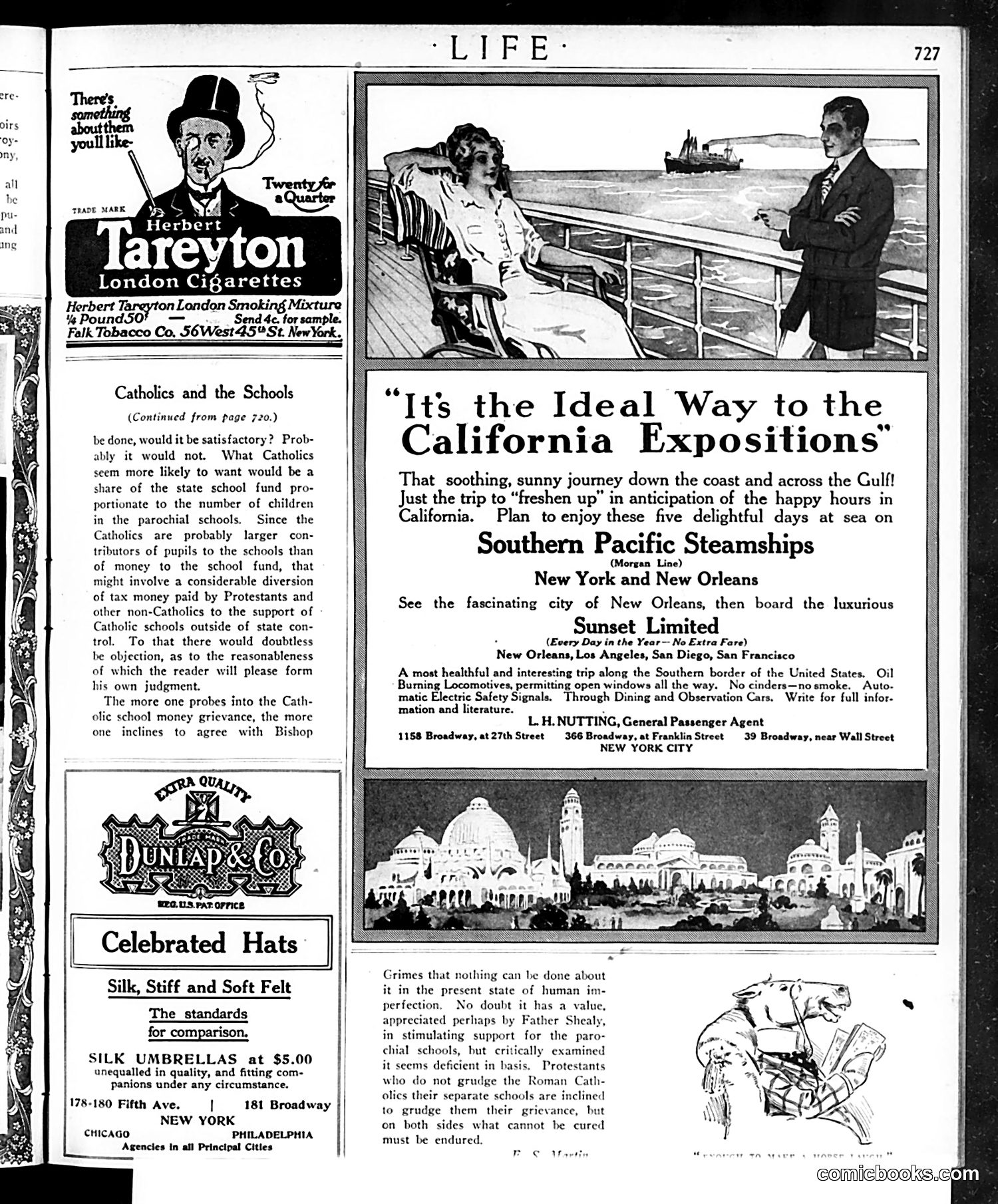
This page combines advertisements with a continuing editorial discussion on Catholic schools funding. **The Main Content:** The article "Catholics and the Schools" debates whether Catholic parochial schools deserve proportional state funding. The author argues Catholics contribute more pupils than tax dollars to public schools, making equal funding problematic. The piece suggests the Catholic "grievance" lacks solid basis, though acknowledges the issue involves competing fairness claims between Protestant and Catholic communities that cannot be easily resolved. **The Advertisements:** The page features typical period ads—Herbert Tareyton London Cigarettes, Dunlad & Co. hats, and prominently, the Southern Pacific Steamship Company advertising California Exposition travel via New Orleans. **The Satire/Commentary:** Rather than traditional cartoons, Life here uses editorial argument as satire—gently mocking both sides' positions while suggesting the dispute is intractable: "what cannot be cured must be endured." This reflects early 20th-century American tensions over public versus religious education funding and Catholic integration into predominantly Protestant institutions.
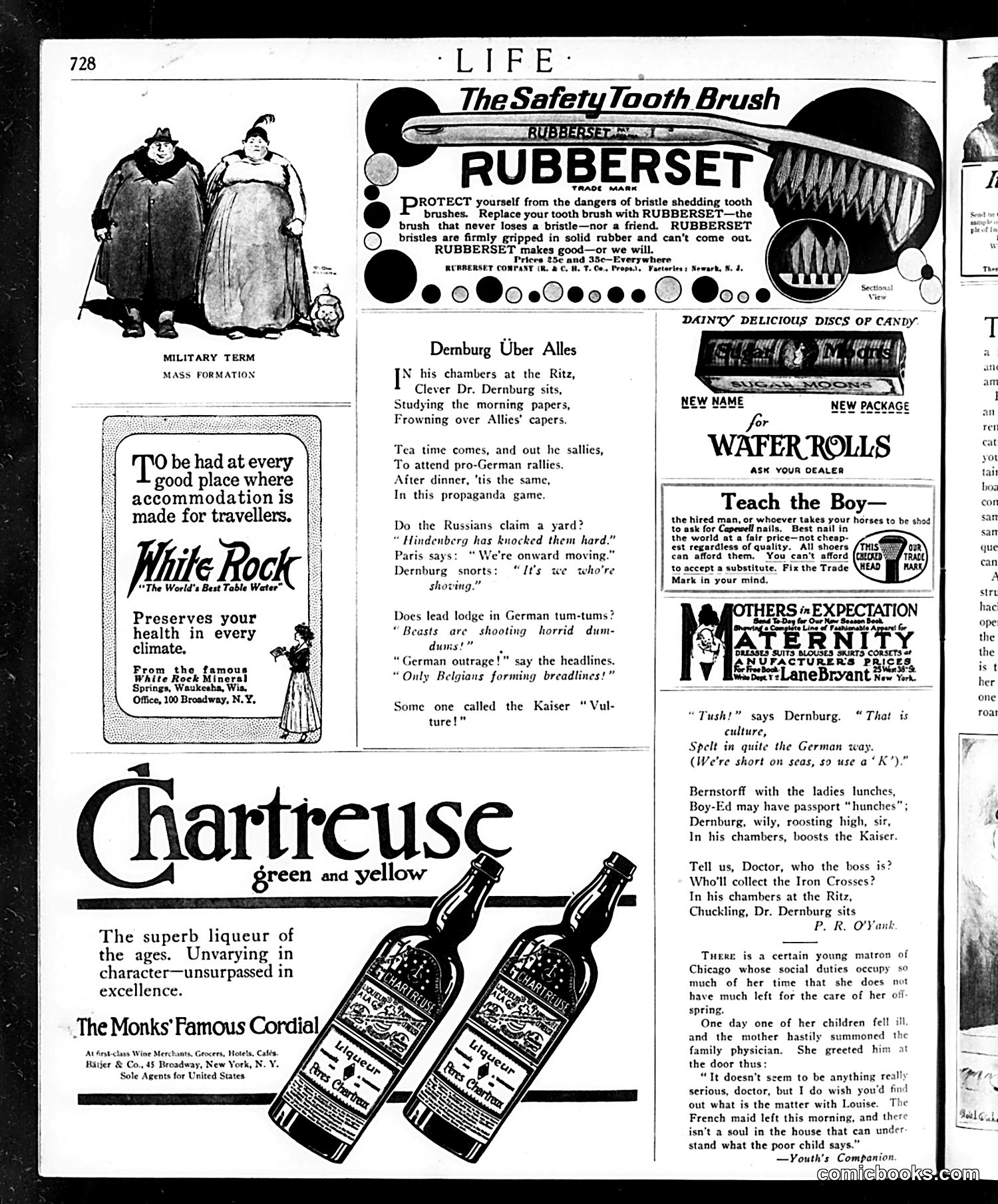
This poem satirizes **Dr. Heinrich Dernburg**, a German propaganda operative during World War I. The title mimics "Deutschland Über Alles" ("Germany Above All"), mocking his pro-German advocacy. **The satire targets:** - **Dernburg's propaganda work**: He's depicted studying papers at the Ritz Hotel, attending "pro-German rallies," and spinning German military narratives—spinning Russian losses as Hindenburg victories, dismissing Allied advances, justifying German atrocities (dum-dum bullets) as Allied brutality. - **German diplomatic manipulation**: References to "Bernstorff" and "Boy-Ed" (other German agents) coordinating influence campaigns, with Dernburg as the orchestrator "roosting high, sir, / In his chambers, boosts the Kaiser." - **Linguistic irony**: The final stanza jokes that Germans are "short on seas, so use a 'K'"—mocking how they rebranded concepts, and their shortage of naval power. The poem presents Dernburg as a cynical manipulator spinning propaganda from his hotel suite, representing American frustration with German wartime disinformation campaigns.
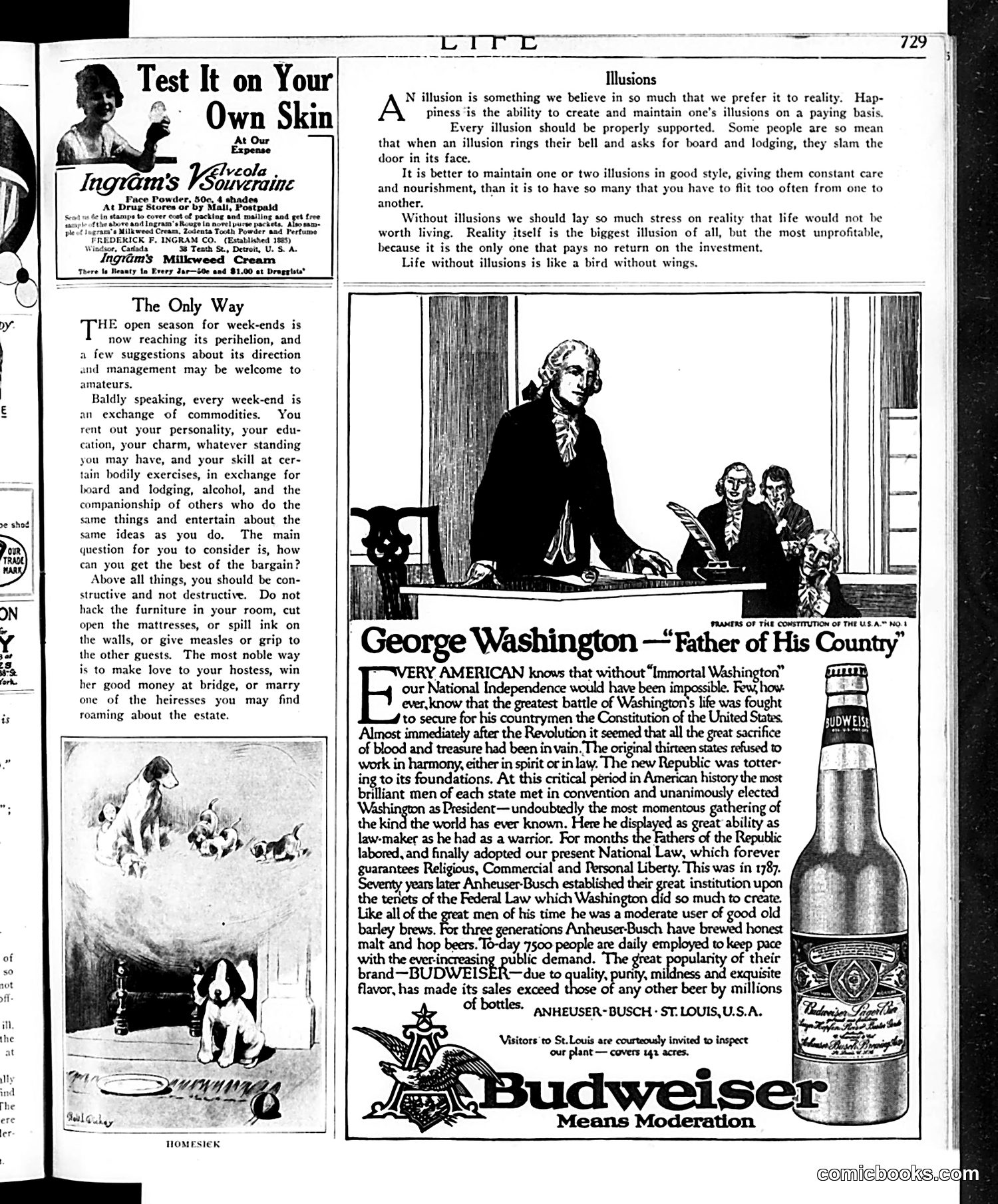
This page combines satirical editorial content with period advertising. **"Illusions" Essay:** A philosophical piece arguing that maintaining pleasant illusions is preferable to harsh reality for happiness—a tongue-in-cheek commentary on self-delusion as necessary for contentment. **"The Only Way":** Satirizes weekend social visits as transactional exchanges where guests rent their personalities and charm in exchange for hospitality. It advises guests to be constructive (don't damage property) and suggests winning favor through courtship, card games, or marrying wealthy heirs—mocking the social maneuvering of the era's leisure class. **Budweiser Advertisement:** Features George Washington as "Father of His Country," connecting the beer company to American patriotic values and constitutional liberty established in 1787. The ad claims Anheuser-Busch's 1857 founding followed Washington's principles, positioning beer consumption as patriotic moderation. This reflects pre-Prohibition era advertising (likely 1910s-1920s) when such associations were common marketing strategy.
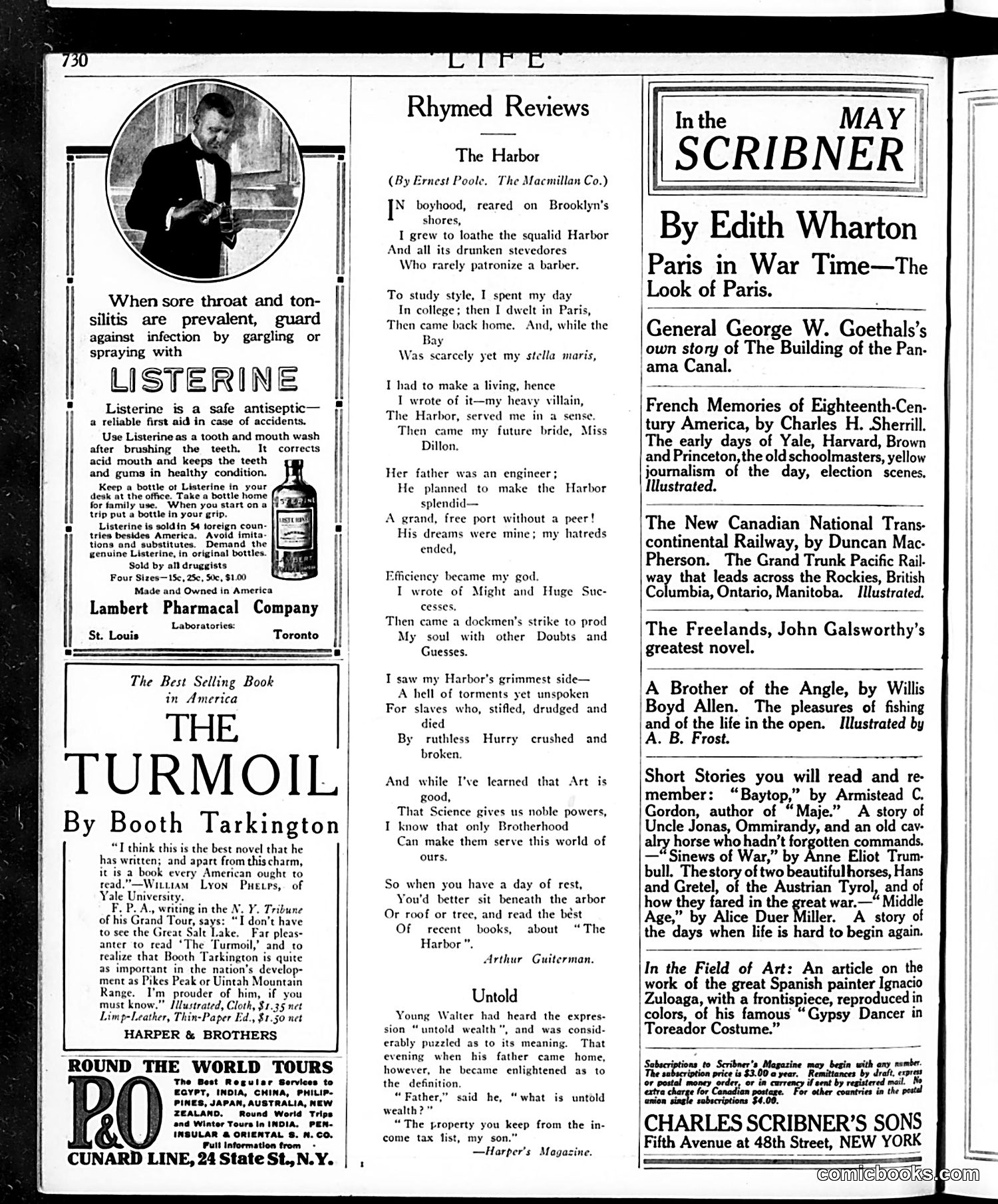
This page is primarily **advertisements and literary content** rather than political satire. However, it contains one joke worth noting: **"Untold" (bottom left):** A brief humor piece playing on tax evasion. A boy asks his father what "untold wealth" means (a period phrase for immense riches). The father cynically defines it as "property you keep from the income tax list"—a joke about wealthy people hiding assets from taxation. **Context:** This reflects early-20th-century American attitudes toward income taxes (newly implemented in 1913) and wealthy individuals' presumed dishonesty in reporting. The joke assumes readers will recognize and find humor in tax avoidance as a common practice among the rich. **The rest of the page** advertises Listerine mouthwash, Booth Tarkington's novel *The Turmoil*, and forthcoming articles in *Scribner's* magazine, including pieces by Edith Wharton about wartime Paris (suggesting this is from WWI era).
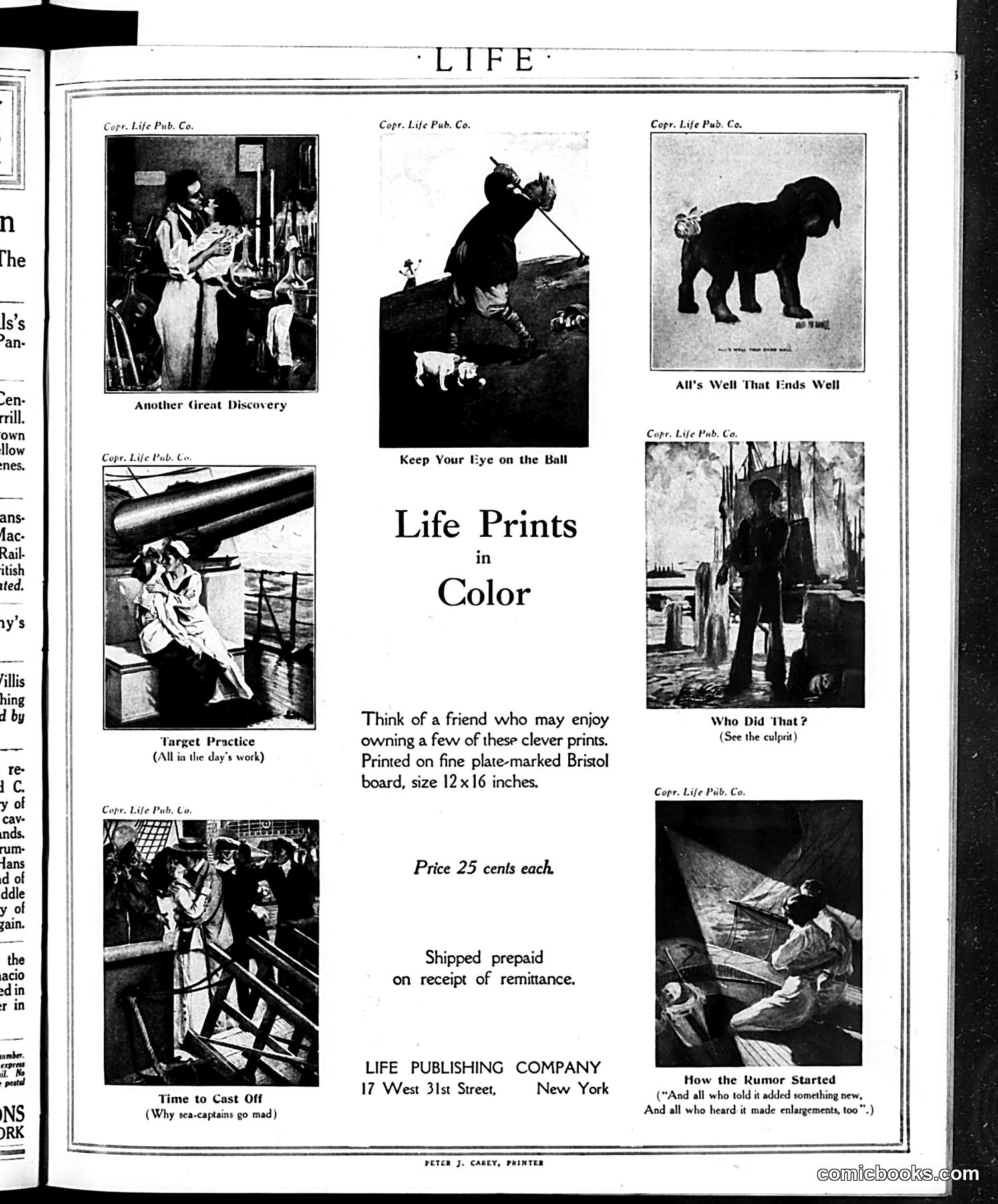
This page is primarily an **advertisement** for colored prints sold by Life Publishing Company. The prints themselves are humorous illustrations on everyday topics, priced at 25 cents each. The six cartoon scenes depict: - "Another Great Discovery" - domestic/romantic situation - "Keep Your Eye on the Ball" - unclear sporting or social reference - "All's Well That Ends Well" - a dog, suggesting a pet-related joke - "Target Practice" and "Time to Cast Off" - military/nautical humor - "Who Did That?" and "How the Rumor Started" - depicting gossip/rumor-spreading The final image caption quotes about rumors expanding as they spread ("added something new... made enlargements") references a common social observation about misinformation. These are lighthearted genre scenes typical of **early 20th-century satirical magazines**, poking fun at human behavior, romance, military life, and social folly rather than specific political figures or events.
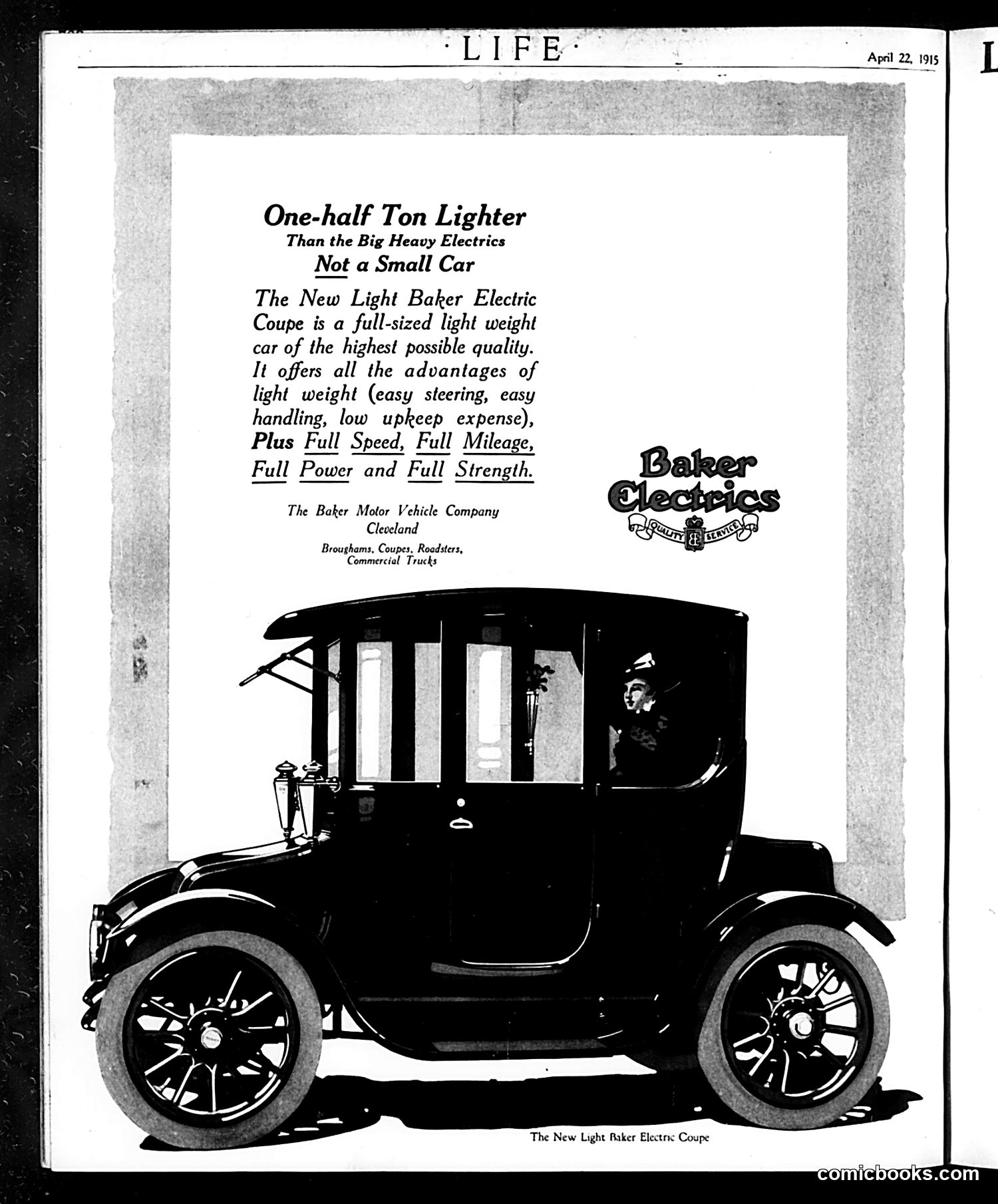
This is **not a political cartoon or satire** — it is a **straight advertisement** for the Baker Electric automobile, published in *Life* magazine on April 22, 1915. The page promotes the "Light Baker Electric Coupe," a full-sized electric vehicle manufactured by the Baker Motor Vehicle Company in Cleveland. The ad emphasizes that despite being half a ton lighter than competing heavy electric cars, it maintains full-sized quality and performance — offering easy steering, low maintenance costs, and full speed and power. The illustration shows a side view of the enclosed coupe with a passenger visible through the windows. Electric cars were a genuine competing technology in the early 1910s before gasoline engines dominated the market. This represents standard commercial advertising rather than satirical or political commentary.