
Life, 1915-04-22 · page 17 of 44
Life — April 22, 1915 — page 17: what you’re looking at
What you’re looking at
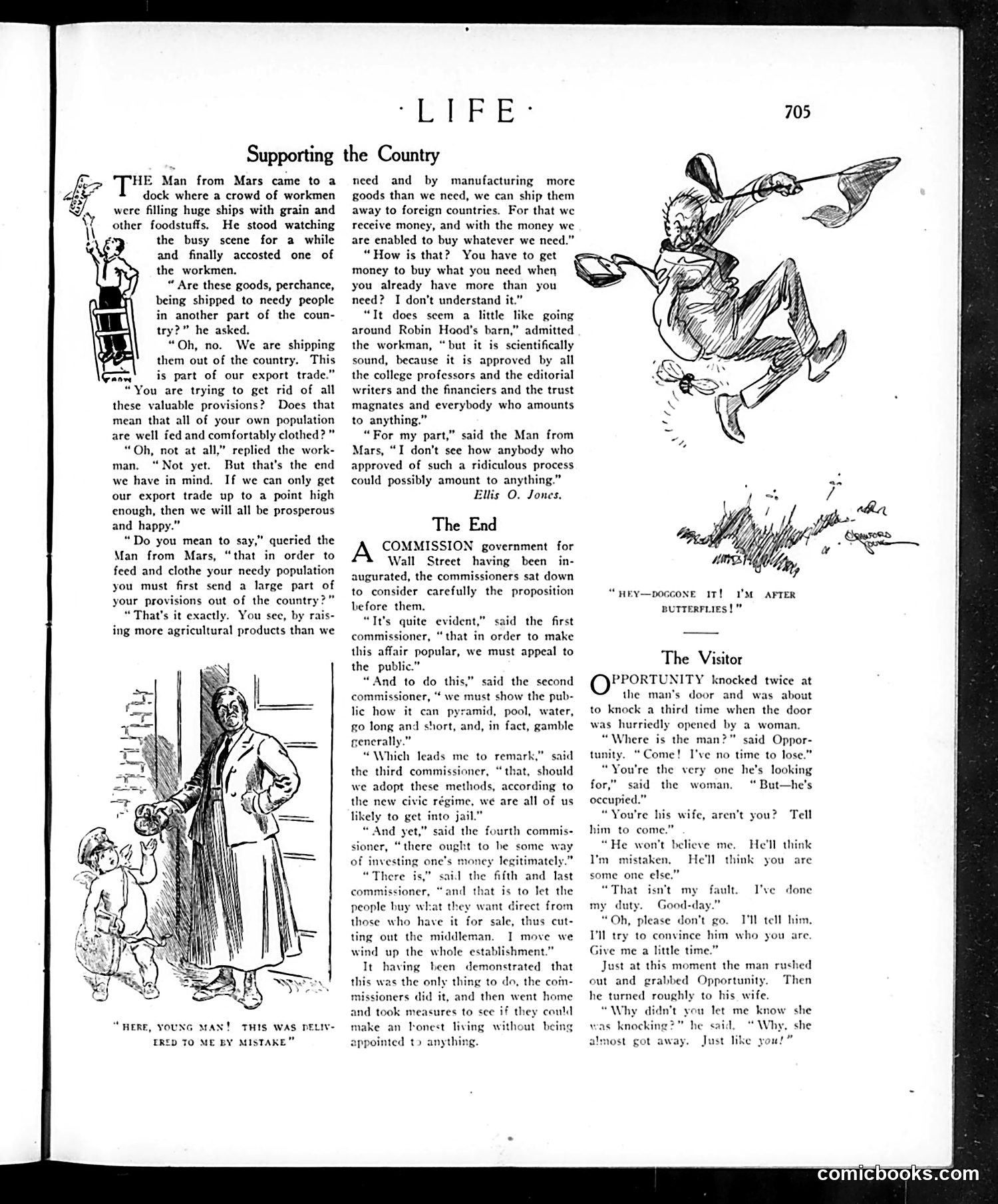
This page contains three satirical pieces critiquing early 20th-century American economic theory and practice. **"Supporting the Country"**: A Martian visitor observes American workers exporting grain while the population goes hungry. The workman explains they must export surplus goods to earn money to buy necessities—a circular logic the alien finds absurd. The satire targets economic orthodoxy taught by "college professors and editorial writers" that prioritizes export trade over domestic welfare. By having an outsider question the system, the author (Ellis O. Jones) exposes how nonsensical the theory sounds when stated plainly. **"The End"**: Commissioners debating how to make Wall Street "gambling" popular conclude the only honest approach is eliminating middlemen—then disband rather than implement it. This mocks financial manipulation masked as legitimate investment. **"The Visitor"**: Opportunity personified repeatedly tries contacting a man, but his wife insists he won't recognize her. Dark humor suggesting people ignore their own chances through skepticism or misfortune. Together, these pieces critique economic systems that harm ordinary citizens while being defended by elites as scientifically sound.
📄 Transcribed text from this page (OCR, searchable)
Machine-transcribed from the original scan — historical spelling and the odd misread are preserved.
Supporting Bie —& Man from Mars came to a a dock where a crowd of workmen were filling huge ships with grain and other foodstuffs. He stood watching the busy scene for a while and finally accosted one of the workmen. “ Are these goods, perchance, being shipped to needy people in another part of the coun- try?” he asked. “Oh, no. We are shipping them out of the country. This Gaon! is part of our export trade.” “You are trying to get rid of all these valuable provisions? Does that mean that all of your own population are well fed and comfortably clothed?” “Oh, not at all,” replied the work- man. “Not yet. But that's the end we have in mind. If we can only get our export trade up to a point high enough, then we will all be prosperous and happy.” “Do you mean to say,” queried the Man from Mars, “that in order to feed and clothe your needy population you must first send a large part of your provisions out of the country?” “That's it exactly. You see, by rais- ing more agricultural products than we “HERE, YOUNG Mt ERED TO ME B “ERE * the Country need and by manufacturing more goods than we need, we can ship them away to foreign countries. For that we receive money, and with the money we are enabled to buy whatever we need.” “How is that? You have to get money to buy what you need when you already have more than you need? I don’t understand it.” “It does scem a little like going around Robin Hood's barn,” admitted the workman, “but it is scientifically sound, because it is approved by all the college professors and the editorial writers and the financiers and the trust magnates and everybody who amounts to anything.” “For my part,” said the Man from Mars, “I don’t see how anybody who approved of such a ridiculous process could possibly amount to anything.” Ellis O. Jones. The End COMMISSION government for Wall Street having been in- augurated, the commissioners sat di to consider carefully the propost before them, “Tt's quite evident,” said the first commissioner, “that in order to make this affair popular, we must appeal to the public. “And to do this,” said the second commissioner, “ we must show the pub- lic how it can pyramid, pool, water, go long and short, and, in fact, gamble generally.” “Which leads me to remark,” said the third commissioner, “that, should we adopt these methods, according to the new civic régime, we are all of us likely to get into jail.” “And yet,” said the fourth commis- sioner, “there ought to he some way of investing one’s money legitimately "sail the fifth and last commissioner, “and that is to Jet the people huy what they want direct from those who have it for sale, thus cut- ting out the middleman. I move we wind up the whole establishment.” It having been demonstrated that this was the only thing to do, the coin- missioners did it, and then went home and took measures to sce if they could make an honest living without being appointed to anything. “HEY—poccoNE IT! I'm BUTTERFLIES |" The Visitor PPORTUNITY knocked twice at the man's door and was about to knock a third time when the door was hurriedly opened by a woman. “Where is the man?” said Oppor- tunity. “Come! I've no time to lose.” You're the very one he’s looking aid the woman. “ But—he's “You're his wife, aren't you? Tell him to come.” “He won't believe me. He'll think I'm mistaken, He'll think you are some one else.” “That my duty. “Oh, please don't I'll try to convince him who you are. Give me a little time.” Just at this moment the man rushed out and grabbed Opportunity. Then he turned roughly to his wife. “Why didn't you let me know she "he said, “Why, she Just like you!” I've done was knocking? almost got away.