
Life, 1915-04-22 · page 32 of 44
Life — April 22, 1915 — page 32: what you’re looking at
What you’re looking at
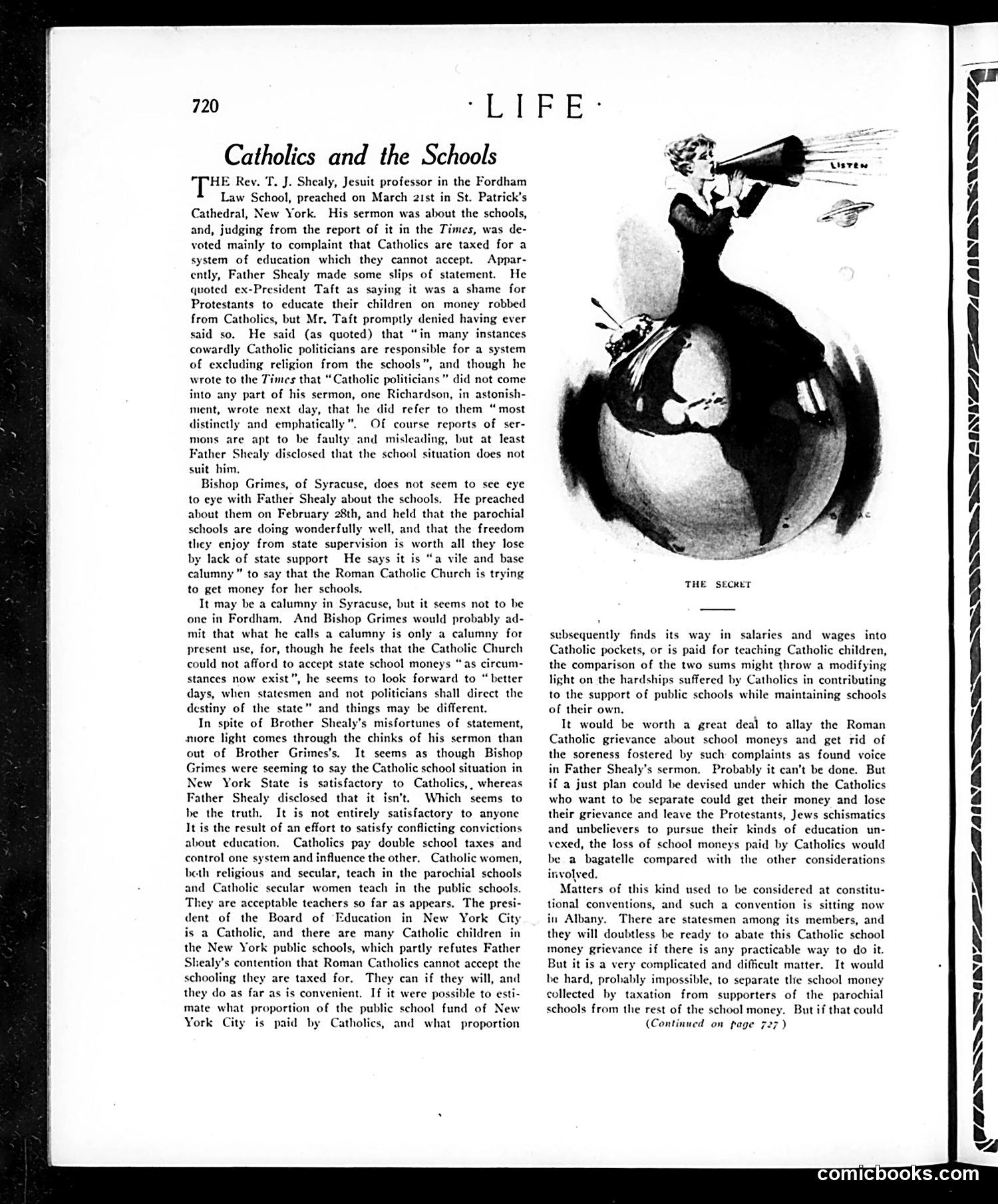
This article satirizes Catholic complaints about public school funding. The cartoon titled "THE SECRET" depicts a figure using a telescope to peer into a globe, illustrating the article's central point: Catholics claim financial hardship from supporting public schools they reject on religious grounds, yet Catholic teachers and workers actually benefit when tax dollars are paid as salaries to Catholic employees or used to educate Catholic children in public schools. The article contrasts two Catholic leaders: Father Shealy (Fordham) complains Catholics are unfairly taxed for unacceptable secular education, while Bishop Grimes (Syracuse) defends parochial schools' independence. Life's satirical position: Catholics simultaneously object to public school taxes while conveniently participating in and profiting from the same system—the "secret" being their selective hypocrisy about what they'll accept when financially advantageous.
📄 Transcribed text from this page (OCR, searchable)
Machine-transcribed from the original scan — historical spelling and the odd misread are preserved.
720 “E VEE * Catholics and the Schools HE Rev. T. J. Shealy, Jesuit professor in the Fordham Law School, preached on March 21st in St. Patrick’s Cathedral, New York. His sermon was about the schools, and, judging from the report of it in the Times, was de- voted mainly to complaint that Catholics are taxed for a system of education which they cannot accept. Appar- ently, Father Shealy made some slips of statement. He quoted ex-President Taft as saying it was a shame for Protestants to educate their children on money robbed from Catholics, but Mr. Taft promptly denied having ever said so. He said (as quoted) that “in many instances cowardly Catholic politicians are responsible for a system of excluding religion from the schools”, and though he wrote to the Times that “Catholic pol ns” did not come into any part of his sermon, one Richardson, in astonish- ment, wrote next day, that he did refer to them “most distinctly and emphatically”. Of course reports of ser- mons are apt to be faulty and misleading, but at least ther Shealy disclosed that the school situation does not suit him. Bishop Grimes, of Syracuse, does not seem to see eye to eye with Father Shealy about the schools. He preached about them on February 28th, and held that the parochial schools are doing wonderfully well, and that the freedom they enjoy from state supervision is worth all they lose by lack of state support He says it is “a vile and base calumny” to say that the Roman Catholic Church is trying to get money for her schools. It may be a calumny in Syracuse, but it seems not to be one in Fordham. And Bishop Grimes would probably ad- mit that what he calls a calumny is only a calumny for present use, for, though he feels that the Catholic Church could not afford to accept state school moneys “as circum- stances now exist”, he seems to look forward to “ better days, when statesmen and not politicians shall direct the destiny of the state” and things may be different. In spite of Brother Shealy’s misfortunes of statement, more light comes through the chinks of his sermon than out of Brother Grimes’s. It seems as though Bishop Grimes were seeming to say the Catholic school situation in New York State is satisfactory to Catholics, whereas Father Shealy disclosed that it isn’t. Which seems to be the truth. It is not entirely satisfactory to anyone It is the result of an effort to satisfy conflicting convictions about education, Catholics pay double school taxes and control one system and influence the other. Catholic women, beth religious and secular, teach in the parochial schools and Catholic secular women teach in the public school They are acceptable teachers so far as appears. The presi dent of the Board of ‘Education in New York City a Catholic, and there are many Catholic children in the New York public schools, which partly refutes Father Shealy’s contention that Roman Catholics cannot accept the schooling they are taxed for. They can if they will, and they do as far as is convenient. If it were possible to esti- mate what proportion of the public school fund of New York City is paid by Catholics, and what proportion THE SECRET subsequently finds its way in salaries and wages into Catholic pockets, or is paid for teaching Catholic children, the comparison of the two sums might throw a modifying light on the hardships suffered by Catholics in contributing to the support of public schools while maintaining schools of their own. It would be worth a great deal to allay the Roman Catholic grievance about school moneys and get rid of the soreness fostered by such complaints as found voice in Father Shealy’s sermon. Probably it can’t be done. But if a just plan could be devised under which the Catholics who want to be separate could get their money and lose their grievance and leave the Protestants, Jews schismatics and unbelievers to pursue their kinds of education un- vexed, the loss of school moneys paid by Catholics would be a bagatelle compared with the other considerations involved. Matters of this kind used to be considered at constitu- tional conventions, and such a convention is sitting now iu Albany. There are statesmen among its members, and they will doubtless be ready to abate this Catholic school money grievance if there is any practicable way to do it. But it is a very complicated and difficult matter. It would be hard, probably impossible, to separate the school money collected by taxation from supporters of the parochial schools from the rest of the school money, But if that could (Continued on page 727 Se S | NSN SNS ~~ TY CESS ek aaa NS SS comicbooks.com