
Life, 1915-04-22 · page 26 of 44
Life — April 22, 1915 — page 26: what you’re looking at
What you’re looking at
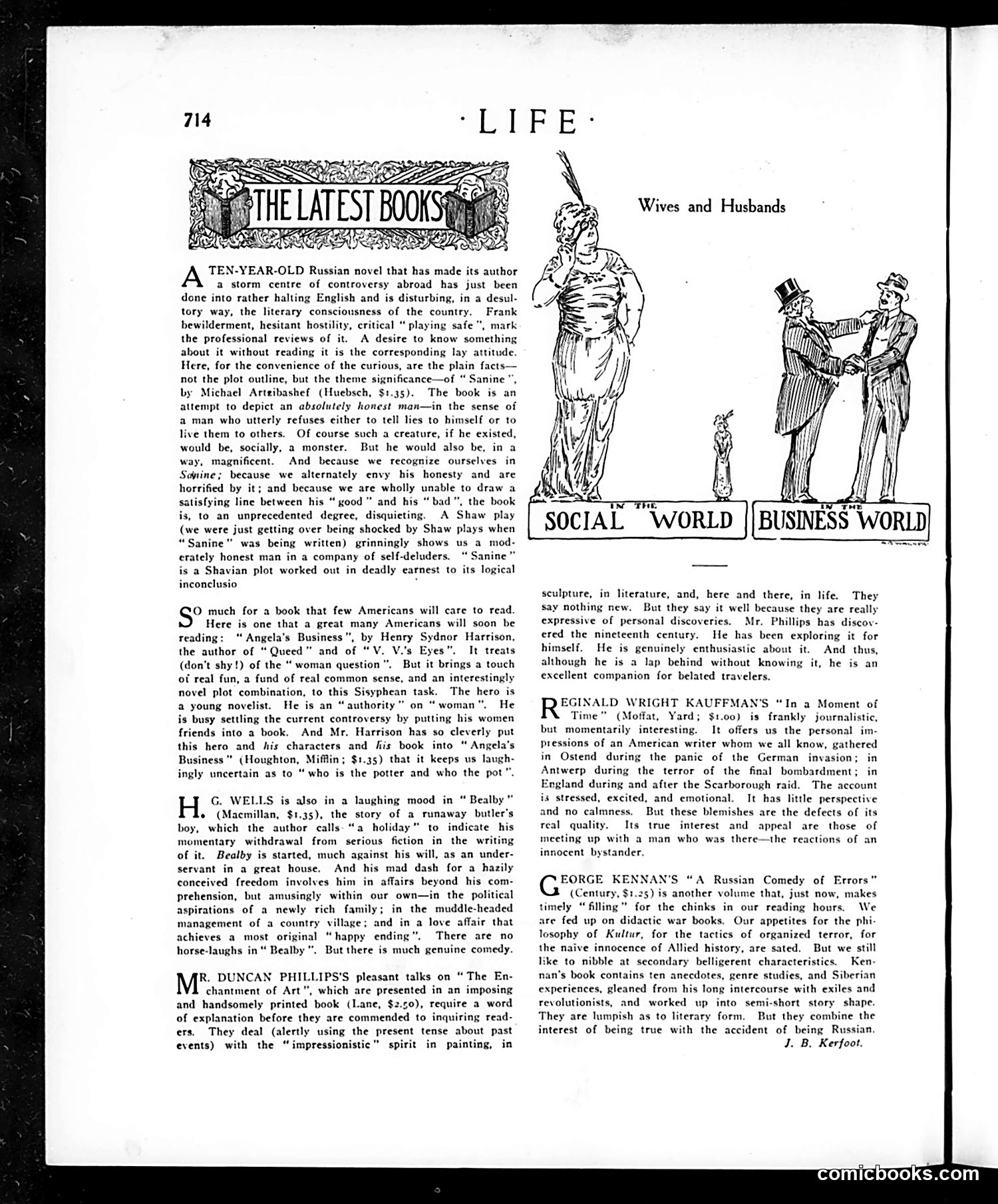
This page contains literary reviews from Life magazine, a satirical publication. The three illustrations labeled "Social World" and "Business World" are decorative dividers showing fashionable figures—likely representing the society and commercial spheres referenced in the book discussions. The reviews discuss recently published novels, including a Russian work called "Sanine" by Michael Artsybashef, which caused controversy for depicting an "absolutely honest man" who refuses social conventions. The reviewer compares it to George Bernard Shaw's plays for its frank treatment of morality. Other books reviewed include "Angela's Business" by Henry Sydnor Harrison (about the "woman question") and H.G. Wells's "Bealby" (described as Wells's lighthearted departure from serious fiction). The page essentially catalogs contemporary literature for educated American readers, offering brief synopses and critical commentary. The cartoons are secondary to the text—simple visual breaks rather than satirical commentary on the books themselves.
📄 Transcribed text from this page (OCR, searchable)
Machine-transcribed from the original scan — historical spelling and the odd misread are preserved.
TEN-YEAR-OLD Russian novel that has made its author a storm centre of controversy abroad has just been done into rather halting English and is disturbing, in a desul- tory way, the literary consciousness of the country, Frank bewilderment, hesitant hostility, critical “ playing safe", mark the professional reviews of it. A desire to know something about it without reading it is the corresponding lay attitude. Here, for the convenience of the curious, are the plain facts- not the plot outline, but the theme significance—of “ Sanine ™, by Michael Artgibashef (Huebsch, $1.35). The book is an attempt to depict an absolutely honest man—in the sense of a man who utterly refuses either to tell lies to himself or to live them to others. Of course such a creature, if he existed, would be, socially, a monster. But he would also be, in a way, magnificent. And because we recognize ourselves in Sdnine; because we alternately envy his honesty and are horrified by it; and because we are wholly unable to draw a satisfying line between his “ xood" and his “bad”, the book is, to an unprecedented degree, disquieting. A Shaw play (we were just getting over being shocked by Shaw plays when “Sanine"” was being written) grinningly shows a mod- crately honest man in a company of self-deluders. nine” is a Shavian plot worked out in deadly earnest to its logical inconclusio © much for a book that few Americans will care to read. Here is one that a great many Americans will soon be reading: “ Angela's Business", by Henry Sydnor Harrison, the author of “Queed” and of “V. V.'s Eyes”. It treats (don’t shy!) of the “ woman question", But it brings a touch ot real fun, a fund of real common sense, and an interestingly novel plot combination, to this Sisyphean task. The hero is a young novelist. He is an “authority” on “woman”, He is busy settling the current controversy by putting his women friends into a book, And Mr. Harrison has so cleverly put this hero and his characters and fis book into “ Angela's Business ” (Houghton, Miffin; $1.35) that it keeps us laugh- ingly uncertain as to “who is the potter and who the pot G. WELLS is also in a laughing mood in “ Bealby ” (Macmillan, $1.35), the story of a runaway butler's boy, which the author calls: “a holiday” to indicate his momentary withdrawal from serious fiction in the writing of Bealby is started, much against his will, as an under- servant in a great house. And his mad dash for a hazily conceived freedom involves him in affairs beyond his com- prehension, but amusingly within our own—in the political ions of a newly rich family; in the muddle-headed management of a country village; and in a love affair that achieves a most original “happy ending”. There are no horse-laughs in“ Bealby ". But there is much genuine comedy. 'R. DUNCAN PHILLIPS'’S pleasant talks on “ The En- chantment of Art”, which are presented in an imposing and handsomely printed book (Lane, $2.50), require a word of explanation before they are commended to inquiring read- ers. They deal (alertly using the present tense about past events) with the “impressionistic” spirit in painting, in and Husbands sculpture, in literature, and, here and there, in life. say nothing new. But they say it well because they are really expressive of personal discoveries. Mr. Phillips has discov- ered the nineteenth century. He has been exploring it for himself. He is genuinely enthusiastic about it. And thus, although he is a lap behind without knowing it, he is an excellent companion for belated travelers. They GINALD WRIGHT KAUFFMAN’S “In a Moment of fime” (Moffat, Yard; $1.00) is frankly journalistic, but momentarily interesting. It offers us the personal im- pressions of an American writer whom we all know, gathered in Ostend during the panic of the German invasion; i Antwerp during the terror of the final bombardment England during and after the Scarborough raid. The account stressed, excited, and emotional. It has little perspective and no calmness, But these blemishes are the defects of its real quality. Its true interest and appeal are those of meeting up with a man who was there—the reactions of an innocent bystander. EORGE KENNAN’S “A Russian Comedy of Errors” (Century, $1.25) is another volume that, just now, makes timely “filling” for the chinks in our reading hours. We are fed up on didactic war books. Our appetites for the phi. losophy of Kultur, for the tactics of organized terror, for the naive innocence of Allied history, are sated. But we still like to nibble at secondary belligerent characteristics. Ken- nan’s book contains ten anecdotes, genre studies, and Siberian experiences, gleaned from his long intercourse with exiles and revolutionists, and worked up into semi-short story shape. They are lumpish as to literary form. But they combine the interest of being true with the accident of being Russian. J. B. Kerfoot. Comicbooks.com