
Life, 1915-04-22 · page 18 of 44
Life — April 22, 1915 — page 18: what you’re looking at
What you’re looking at
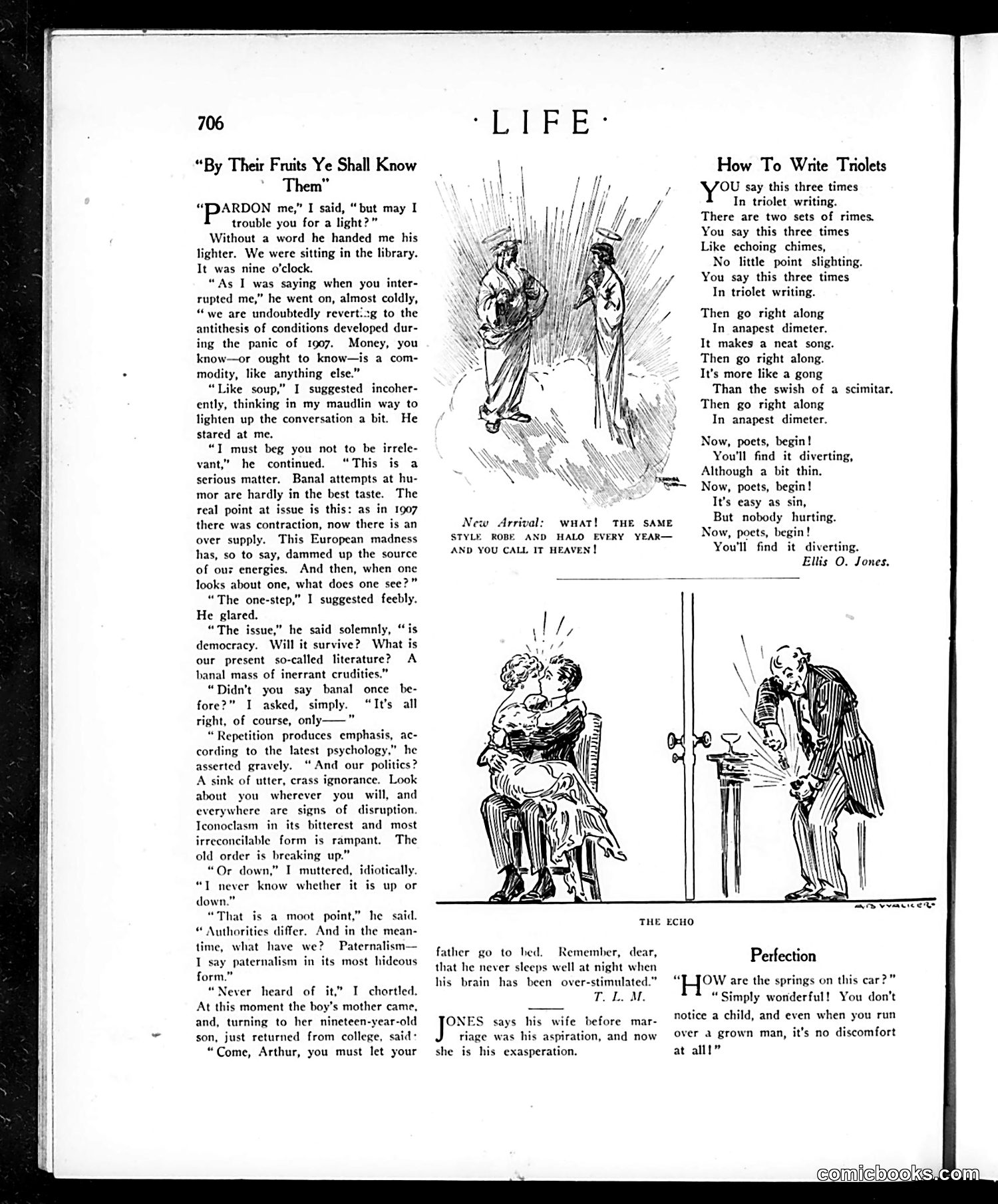
**Main Story: "By Their Fruits Ye Shall Know Them"** This satirizes pompous intellectualism. A pretentious college-aged man (Arthur) lectures the narrator at length about economics, democracy, and social decline—using grandiose language about the 1907 panic, "paternalism," and "iconoclasm." The joke: his mother must interrupt to send him to bed because his "brain has been over-stimulated." The satire targets young men who return from college spouting pseudo-intellectual rhetoric they barely understand, mistaking verbosity for wisdom. **"The Echo" Cartoon** Shows the pretentious young man's words bouncing back mockingly—visual representation of empty rhetoric. **"New Arrival" Cartoon** Mocks heaven's unchanging nature: angels wear identical robes and halos every year—a jab at religious repetition and conformity. **"Perfection"** A car advertisement joke: its superior springs mean you won't notice hitting pedestrians—dark humor about indifference to human suffering. The page satirizes early 20th-century affectation, intellectual posturing, and consumer culture indifference.
📄 Transcribed text from this page (OCR, searchable)
Machine-transcribed from the original scan — historical spelling and the odd misread are preserved.
“By Their Fruits Ye Shall Know Them” “DARDON me,” I said, “but may I trouble you for a light?” Without a word he handed me his lighter. We were sitting in the library. It was nine o'clock. “As I was saying when you inter- rupted me,” he went on, almost coldly, “we are undoubtedly revert:zg to the antithesis of conditions developed dur- ing the panic of 1907. Money, you know—or ought to know—is a com- modity, like anything else.” “Like soup,” I suggested incoher- ently, thinking in my maudlin way to lighten up the conversation a bit. He stared at me. “TI must beg you not to be irrele- vant,” he continued. “This is a serious matter. Banal attempts at hu- mor are hardly in the best taste. The real point at issue is this: as in 1907 there was contraction, now there is an over supply. This European madness has, so to say, dammed up the source of ouz energies. And then, when one looks about one, what does one see?” “The one-step,” I suggested feebly. He glared. “The issue,” he said solemnly, “is democracy. Will it survive? What is our present so-called literature? A banal mass of inerrant crudities.” “Didn't you say banal once be- fore?” I asked, simp, “Tt's all right, of course, only——" petition produces emphasis, ac- cording to the latest psychology,” he asserted gravely. “And our politics? A sink of utter, crass ignorance. Look about you wherever you will, and everywhere are signs of disruption. Iconoclasm in its bitterest and most irreconcilable form is rampant. The old order is breaking up.” “Or down,” I muttered, idiotically. “T never know whether it is up or down “That is a moot point,” he said. “ Authorities differ. And in the mean- time, what have we? Paternalism— I say paternalism in its most hideous form.” “Never heard of it,” I chortled. At this moment the boy’s mother came, and, turning to her nineteen-year-old son, just returned from college, said: “Come, Arthur, you must let your New Arrival: wat! THE SAME STYLE ROBE AND HALO EVERY YEAR— AND YOU CALL IT HEAVEN! THE ECHO father go to hed. Remember, dear, that he never sleeps well at night when his brain has been over-stimulated.” T. Le M. ONES says his wife before mar- riage was his aspiration, and now she is his exasperation. How To Write Triolets you say this three times In triolet writing. There are two sets of rimes. You say this three times Like echoing chimes, No little point slighting. You say this three times In triolet writing. Then go right along In anapest dimeter. It makes a neat song. Then go right along. It’s more like a gong Than the swish of a scimitar. Then go right along In anapest dimeter. Now, poets, begin! You'll find it diverting, Although a bit thin. Now, poets, begin! It’s easy as sin, But nobody hurting. Now, poets, begin! You'll find it diverting. Ellis O. Jones. mip veacce te Perfection OW are the springs on this car?” “Simply wonderful! You don't notice a child, and even when you run over a grown man, it’s no discomfort at all!”