
Life, 1915-04-22 · page 25 of 44
Life — April 22, 1915 — page 25: what you’re looking at
What you’re looking at
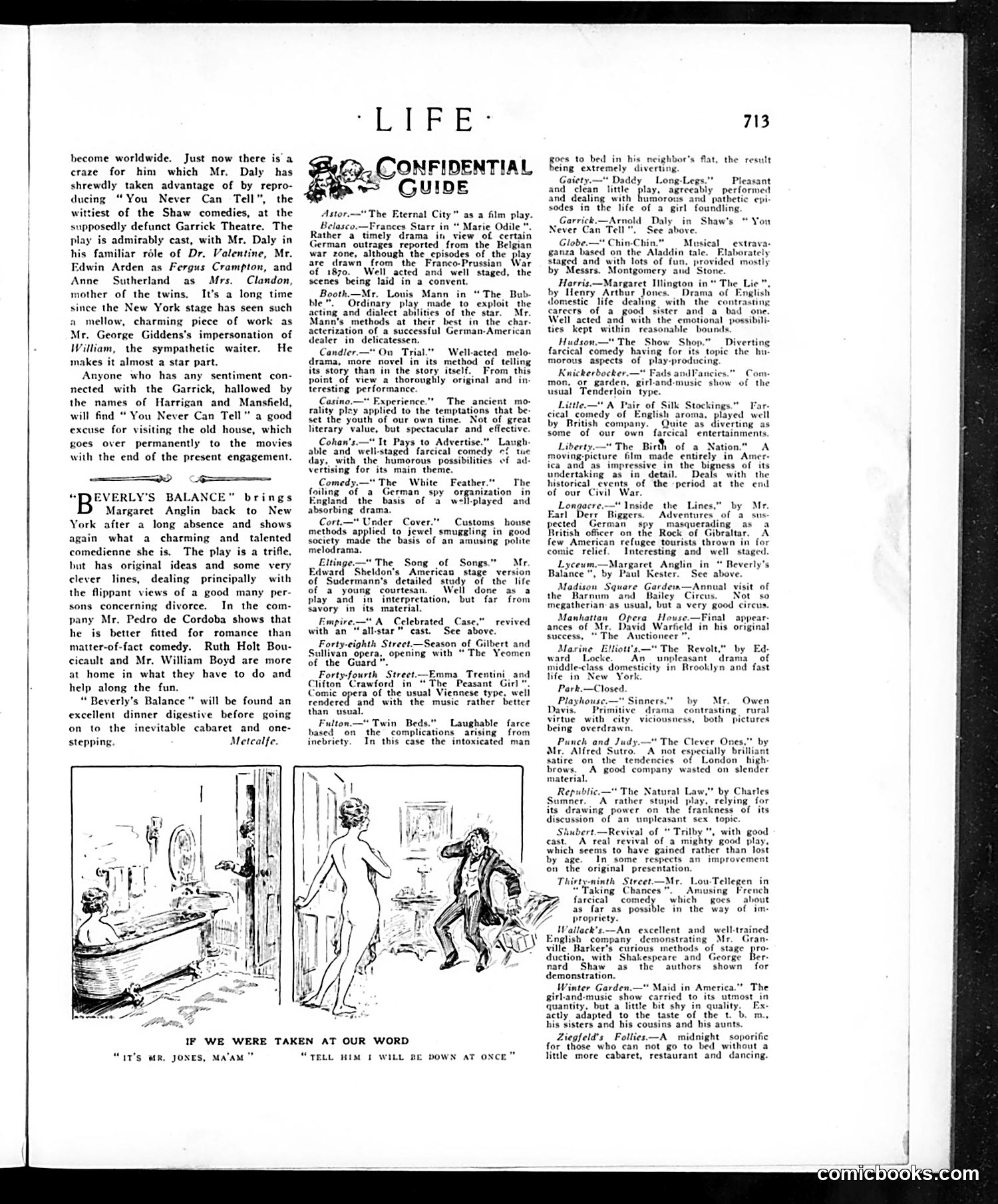
This single-panel cartoon depicts a domestic scene where a man sits in a bathtub while a woman stands nearby. The caption reads: "It's Mr. Jones, Ma'am" / "Tell Him I WILL BE DOWN AT ONCE." The satire plays on marital dynamics and gender relations of the era. The joke appears to be about a wife's prioritization—she's willing to keep a visitor (Mr. Jones) waiting while she attends to her bathing, suggesting either her comfort takes precedence or she's making a point about her independence. The title "If We Were Taken At Our Word" likely refers to women's emerging assertion of equality and autonomy in the 1910s, humorously suggesting what might happen if women acted on feminist ideals in everyday domestic life.
📄 Transcribed text from this page (OCR, searchable)
Machine-transcribed from the original scan — historical spelling and the odd misread are preserved.
become worldwide. Just now there is a craze for him which Mr. Daly has shrewdly taken advantage of by repro- ducing “You Never Can Tell”, the wittiest of the Shaw comedies, at the supposedly defunct Garrick Theatre. The play is admirably cast, with Mr. Daly in his familiar role of Dr, Valentine, Mr. Edwin Arden as Fergus Crampton, and Anne Sutherland as Mrs. Clandon, mother of the twins. It’s a long time since the New York stage has seen such a mellow, charming piece of work as Mr. George Giddens’s impersonation of William, the sympathetic waiter. He makes it almost a star part, Anyone who has any sentiment con- nected with the Garrick, hallowed by the names of Harrigan and Mansfeld, will find “ You Never Can Tell" a good excuse for visiting the old house, which goes over permanently to the movies with the end of the present engagement. —— ise EVERLY'S BALANC brings Margaret Anglin back to New York after a long absence and shows again what a charming and talented comedienne she is. The play is a trifle, but has original ideas and some very clever lines, dealing principally with the flippant views of a good many per- sons concerning divorce. In the com- pany Mr. Pedro de Cordoba shows that he is better fitted for romance than matter-of-fact comedy. Ruth Holt Bou- cicault and Mr. William Boyd are more at home in what they have to do and help along the fun, “ Beverly's Balance” will be found an excellent dinner digestive before going on to the inevitable cabaret and one- stepping. Metcalfe. “ELE * CONFIDENTIAL GUIDE Astor.—"The Eternal City” as a film play. Belasco.—Frances Starr in “ Marie Odile ". Rather a timely drama in view of certain, German outrages reported from the Belgian war zone, although the episodes of the play are drawn from the Franco-Prussian War of 1870. Well acted and well staged, the scenes being laid in a convent. Booth.—Mr. Louis Mann in “The Bub- Me". Ordinary play made to exploit the acting and dialect abilities of the star. Mr. Mann’s methods at their best in the char- acterization of a successful German-American dealer in delicatessen. Candter.—* On Trial? Well-acted _melo- drama, more novel in its method of telling its story than in the story itself. From this point of view a thoroughly original and in- teresting performance. Casino.—" Experience.” The ancient mo- rality ploy applied to the temptations that be- set the youth of our own time. Not of great literary value, but spectacular and effective. Cohan’s.— It Pays to Advertise.” Laugh: able and well-staged farcical comedy ©! tue day, with the humorous possibilities of ad- vertising for its main theme. Comedy.—"" The White Feather." The foiling of a German spy organization in England the basis of a wellplayed and absorbing drama. Cort.—" Under Cover." Customs house methods applied to jewel, smuggling in good society made the basis of an amusing polite melodrama. Eltinge-—" The Song of Songs." Mr. Edward Sheldon's American stage version of Sudermann's detailed study of the life of a young courtesan. Well done as a play and in interpretation, but far from savory in its material. Empire—" A Celebrated Case,” with an “allstar” cast. See above. Forty-eighth Street.—Season of Gilbert and Sullivan opera, opening with “The Yeomen of the Guard Forty-fourth Street—Emma_ Trentini_and Clifton Crawford in’ The Peasant Girl”. Comic opera of the usual Viennese type, well rendered and with ‘the music rather better than usual. Fulton.—" Twin Beds." Laughable farce hased on the complications arising from inebriety. In this case the intoxicated man revived IF WE WERE TAKEN AT OUR WORD “11's WR, JONES, MA’AM ” “TELL HIM 1 WILL RE DOWN aT ONCE" 713 goes to bed in his neighbor's flat, the resi being extremely diverting. Gaicty.—" Daddy Long-Leg: Pleasant and clean little play, agreeably performed and dealing with humorous and pathetic epi sodes. in life of a girl foundling. Garrick.—Arnoll Daly. in Shaw's “ Never Can Tell", See above. Globe.—* Chin-Chin.” | Musical extrava- ganza based on the Aladdin tale, Flaborately staged and with lots of fun, provided mostly by Messrs, Montgomery and Stone. Harris.—Margaret Mington in“ The Lie", by Henry Arthur Jones. Drama of English domestic life dealing with the contrasting garecrs of a good sister and a bad one. Well acted and with the emotional possibili- ties kept within reasonable bounds Hudson.—" The Show Shop Diverting farcical comedy having for its topic the hu morous aspects of play-produ Knickerbocker.—* Fads andF. " Com mon, or garden, girl-and-musi w of the usual Tenderloin type. Little. —" A Pair of Silk Stockings.” Far. cical comedy of English aroma, played well by British company. Quite as’ diverting as some of our own farcical entertainments, Liberty.—" The Birth of a Nation.” moving-picture film. made entirely in Ame ica and as impressive in the bigness of its undertaking as in detail. Deals with the historical events of the period at the end of our Civil War. Longacre." Inside the Lines." by Mr. Earl Derr Biggers. Adventures of a st pected German. spy masquerading as. a Rritish officer on the Rock of Gibraltar. A few American refugee tourists thrown in for comic relief. Interesting and well staged. Lyceum.—Margaret_ Anglin_in “ Beverly's Balance", by Paul Kester. See above. Madison Square Gardem—Annual visit of the Barnum and Bailey Circus. Not so megatherian-as usual, but a very good circus. Manhattan Opera House.—Final appear. ances of Mr. David Warficld in his original success, “The Auctioneer ™ Mar .—" The Revolt," by Ed: ward A An unpleasant drama of middle-ciass domesticity in Brooklyn and fast hfe in New York. Park.—Closed Playhouse.—" Sinners." by Mr. Owen Davis. Primitive drama contrasting rural virtue with city. viciousness, both pictures being overdrawn. Punch and Judy.—" The Clever Ones.” by Mr, Alfred Sutro. A not especially brilliant Satire on the tendencies of London high brows, A good company wasted on slender terial. Republic." The Natural Law." by Charles Sumner. ‘A rather stupid play, relying for its drawing power on the frankness of its discussion of an unpleasant sex. topic Shubert —Revival of “ Trilby", with good cast. A real revival of a mighty’ good play, which seems to have gained rather than lost by age. In some respects an improvement on the original presentation. Thirty-ninth Street.—Mr. Lou-Tellegen in “Taking Chances”. ° Amusing French Epp farcical comedy which goes about ZZ as'far as possible in the Way of im: (/ propriety. _ Wallack’s.—An excellent and well-trained English company demonstrating Mr. Gr: ville Barker's curious methods of stage pro- duction, with Shakespeare and George Ber- rard Shaw as the authors shown for demonstration. Winter Garden.— Maid in America.” The girl-and-music show carried to its utmost in quantity, bot a litte bit shy in quality. Ex- actly adapted to the taste of the t. b. m, his sisters and his cousins and his aunts. Ziegfeld’s Follies—A_ midnight soporific for those who can not go to bed without a little more cabaret, restaurant and dancing.