
Life, 1915-04-22 · page 20 of 44
Life — April 22, 1915 — page 20: what you’re looking at
What you’re looking at
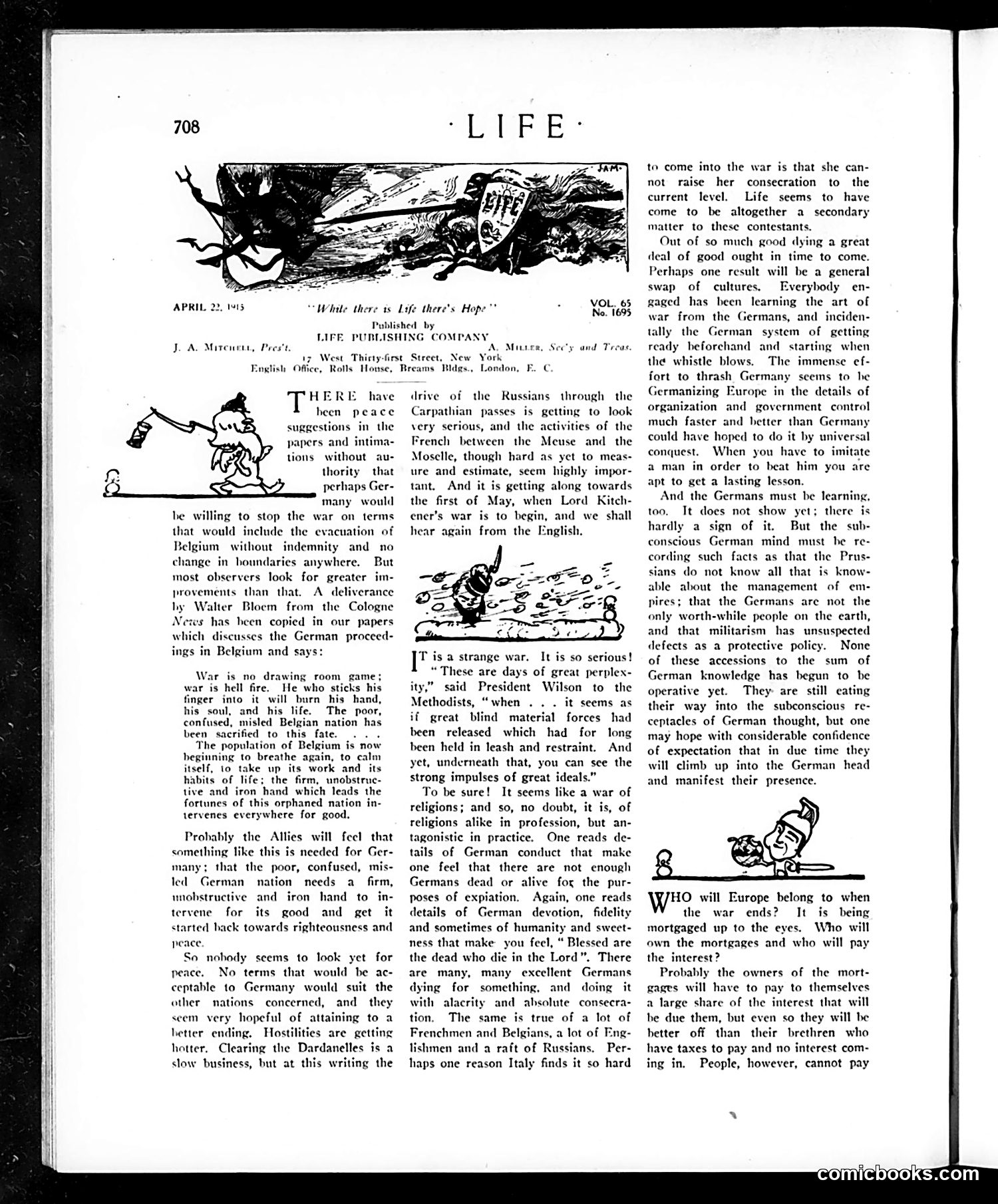
This editorial page discusses WWI peace rumors and German conduct in Belgium. The cartoon at top shows a figure labeled "Life" offering "Hope"—a visual pun on the magazine's title. The main text quotes a German writer (Walter Bloem) defending Germany's harsh occupation of Belgium as necessary "firm" governance, then sarcastically suggests Germany itself needs similar treatment. This is pointed satire: the author uses Germany's own brutal logic against it. The piece wrestles with WWI's moral complexity—acknowledging both German atrocities and German soldiers' genuine idealism, while criticizing President Wilson's vague rhetoric about "blind material forces" versus "great ideals." The author notes Italy's reluctance to join the Allies, suggesting their commitment lacks the "consecration" of other nations. Overall, this reflects American ambivalence about the war in 1915, before U.S. entry (1917)—acknowledging the conflict's ideological stakes while remaining skeptical of all parties' claims.
📄 Transcribed text from this page (OCR, searchable)
Machine-transcribed from the original scan — historical spelling and the odd misread are preserved.
“While there is Life there's: Hope” No. 1695 Published by LIFE J. A. Mitenent, Pres’t, West Thirty-first . Rolls House, HERE have heen peace suggestions in the papers and intima- tions without au- thority that perhaps Ger- many would be willing to stop the war on terms that would include the evacuation of Zelgium without indemnity and no change in boundaries anywhere. But most observers look for greater im- provements than that. A deliverance hy Walter Bloem from the Cologne ss has heen copied in our papers which discusses the German proceed- ings in Belgium and says: War is no drawing room game; war is hell fire. He who sticks his finger into it will burn his hand, his soul, and his life. The poor, confused, misled Belgian nation has been sacrified to this fate. . The population of Belgium is now beginning to breathe again, to calm itself, to take up its work and its habits of life; the firm, unobstruc- tive and iron hand which leads the fortunes of this orphaned nation in- tervenes everywhere for good. Probably the Allies will feel that something like this is needed for Ger- many; that the poor, confused, mis led German nation needs a_ firm, unohstructive and iron hand to i tervene for its good and get it rted back towards righteousness and peace. So nobody seems to look yet for peace. No terms that would be ac- ceptable to Germany would suit the other nations concerned, and they seem very hopeful of attaining to a letter ending. Hostilities are getting hotter. Clearing the Dardanelles is a slow business, but at this writing the PUBLISHING COMPANY A. Musee, Street, New York Rreams Bldgs, London, F.C Seety and Treas. the Carpathian passes is get! very serious, and the activities of the French between the Meuse and the Moselle, though hard as yet to meas- ure and estimate, seem highly impor- tant. And it is getting along towards the first of May, when Lord Kitch- ener’s war is to begin, and we shall hear again from the English. drive. of Russians through the ng to look T is a strange war. It is so serious! “These are days of great perplex- ity,” said President Wilson to the Methodists, “when . . . it seems as if great blind material forces had been released which had for long been held in leash and restraint. And yet, underneath that, you can sce the strong impulses of great ideals.” To be sure! It seems like a war of religions; and so, no doubt, it is, of religions alike in profession, but an- tagonistic in practice. One reads de- tails of German conduct that make one feel that there are not enough Germans dead or alive for the pur- poses of expiation. Again, one reads details of German devotion, fidelity and sometimes of humanity and sweet- ness that make you feel, “ Blessed are the dead who die in the Lord”. There are many, many excellent Germans dying for something, and doing it with alacrity and absolute consecra- tion. The same is true of a lot of Frenchmen and Belgians, a lot of Eng- lishmen and a raft of Russians, Per- haps one reason Italy finds it so hard to come into the war is that she can- not raise her consecration to the current level. Life seems to have come to be altogether a secondary matter to these contestants. Out of so much good dying a great deal of good ought in time to come. Perhaps one result will be a general swap of cultures. Everybody en- gaged has been learning the art of war from the Germans, and inciden- tally the German system of getting ready beforehand and starting when the whistle blows. The immense ef- fort to thrash Germany seems to he Germanizing Europe in the details of organization and government control much faster and better than Germany could have hoped to do it by universal conquest. When you have to imitate a man in order to beat him you are apt to get a lasting lesson. And the Germans must be learning, too. It does not show yet; there is hardly a sign of it. But the sub- conscious German mind must be re- cording such facts as that the Prus- sians do not know all that is know- able about the management of em- pires; that the Germans are not the only worth-while people on the earth, and that militarism has unsuspected defects as a protective policy. None of these accessions to the sum of German knowledge has begun to be operative yet. They are still cating their way into the subconscious re- ceptacles of German thought, but one may hope with considerable confidence of expectation that in due time they will climb up into the German head and manifest their presence. HO will Europe belong to when the war ends? It is being mortgaged up to the eyes. Who will own the mortgages and who will pay the interest? Probably the owners of the mort- gages will have to pay to themselves a large share of the interest that will be due them, but even so they will be better off than their brethren who have taxes to pay and no interest com- ing in. People, however, cannot pay