
Life, 1915-04-22 · page 24 of 44
Life — April 22, 1915 — page 24: what you’re looking at
What you’re looking at
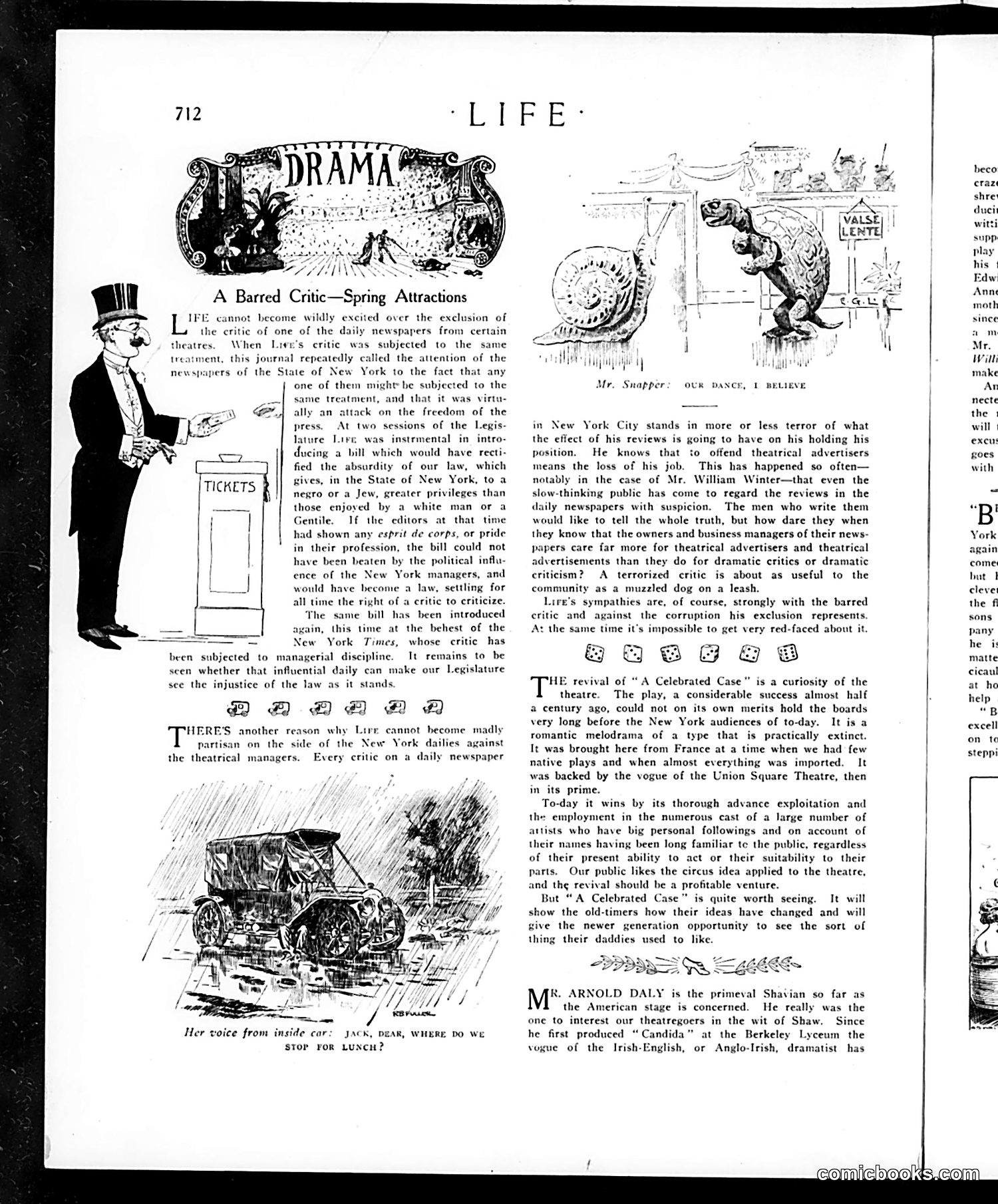
This page satirizes theatrical censorship and critical corruption in early 20th-century New York theater. **Main Issue**: Theater managers excluded unfavorable critics from venues, attacking press freedom. Life argues this is unjust—even worse than discrimination laws (the text controversially compares it to laws privileging white gentiles over Black people and Jews). **The Cartoons**: The top illustration shows a well-dressed man at a ticket window labeled "TICKETS"—likely representing a barred critic. The bottom cartoon depicts a couple in a car asking where to stop for lunch, captioned "Our dance, I believe"—a visual joke about theatrical distraction or superficiality. **Core Argument**: Newspaper owners prioritize theatrical *advertising revenue* over honest criticism. Critics self-censor from fear of losing jobs, making their reviews unreliable. A "terrorized critic is about as useful to the community as a muzzled dog on a leash." The page also reviews "A Celebrated Case," noting its old-fashioned melodrama succeeds through star power and spectacle rather than artistic merit—illustrating the corruption described above.
📄 Transcribed text from this page (OCR, searchable)
Machine-transcribed from the original scan — historical spelling and the odd misread are preserved.
acme ZT N\ : Ser A Barred Critic—Spring Attractions excited over the exclusion of IFE cannot become wildly the critic of one of the daily newspapers from certain theatres. When Live's critic was subjected to the ment, this journal repeatedly called the attention of the papers of the State of New York to the fact that any one of them might be subjected to the me treatment, and that it was virtu- ally an attack on the freedom of the press. At two sessions of the Legis- lature [ive was instrmental in_ intro- ducing a bill which would have recti- fied the absurdity of our law, which gives, in the State of New York, to a negro or a Jew, greater privileges than those enjoyed by a white man or a Gentile. If the editors at that time had shown any esprit de corps, or pride in their profession, the bill could not have been beaten by the political influ- ence of the New York managers, and would have become a law, settling for all time the right of a critic to criticize. The same bill has been introduced again, this time at the behest of the New York Times, whose critic has been subjected to managerial discipline. It remains to be an make our Legislature same seen whether that influential daily see the injustice of the law as it stands. DA AA & °S another 1 Lirr cannot become madly non the side of the New York dailies agai Every critic on a daily newspaper HER on why parti the theatrical man: Zers. JACK, DEAR, WHERE Do We Her voice from inside car: STOP FOR LUNCH? OUR DANCE, L BELIEVE in New York City stands in more or less terror of what the effect of his reviews is going to have on his holding his position, He knows that to offend theatrical advertisers means the loss of his job. This has happened so often— notably in the case of Mr. William Winter—that even the slow-thinking public has come to regard the reviews in the ly newspapers with suspicion. The men who write them would like to tell the whole truth, but how dare they when they know that the owners and business managers of their news- papers care far more for theatrical advertisers and theatrical advertisements than they do for dramatic critics or dramatic criticism? A terrorized critic is about as useful to the community as a muzzled dog on a leash. Lire’s sympathies are, of course, strongly with the barred critic and against the corruption his exclusion represents. At the same time it's impossible to get very red-faced about it. oe HE revival of “A Celebrated Case" is a curiosity of the theatre. The play, a considerable success almost half a century ago, could not on its own merits hold the boards very long before the New York audiences of to-day. It is a romantic melodrama of a type that is practically extinct. It was brought here from France at a time when we had few native plays and when almost everything was imported. It was backed by the vogue of the Union Square Theatre, then in its prime. To-day it wins by its thorough advance exploitation and the employment in the numerous cast of a large number of attists who have big personal followings and on account of their names having been long familiar te the public, regardless of their present ability to act or their suitability to their parts. Our public likes the circus idea applied to the theatre, and thg revival should be a profitable venture. But “A Celebrated Case” is quite worth seeing. It will show the old-timers how their ideas have changed and will give the newer generation opportunity to see the sort of thing their daddies used to like. R. ARNOLD DALY is the primeval Shavian so far as the American stage is concerned. He really was the one to interest our theatregoers in the wit of Shaw. Since he first produced “Candida” at the Berkeley Lyceum the vogue of the Irish-English, or Anglo-Irish, dramatist has beco craz shre' duci witti supp play his. Edw Anne moth since am Mr. Will make An necte the | will | exeus goes with “B' York again come bot | cleve the fi sons pany he i matte cicaul at ho help “B excell on tc steppi