
A complete issue · 44 pages · 1915
Life — March 25, 1915
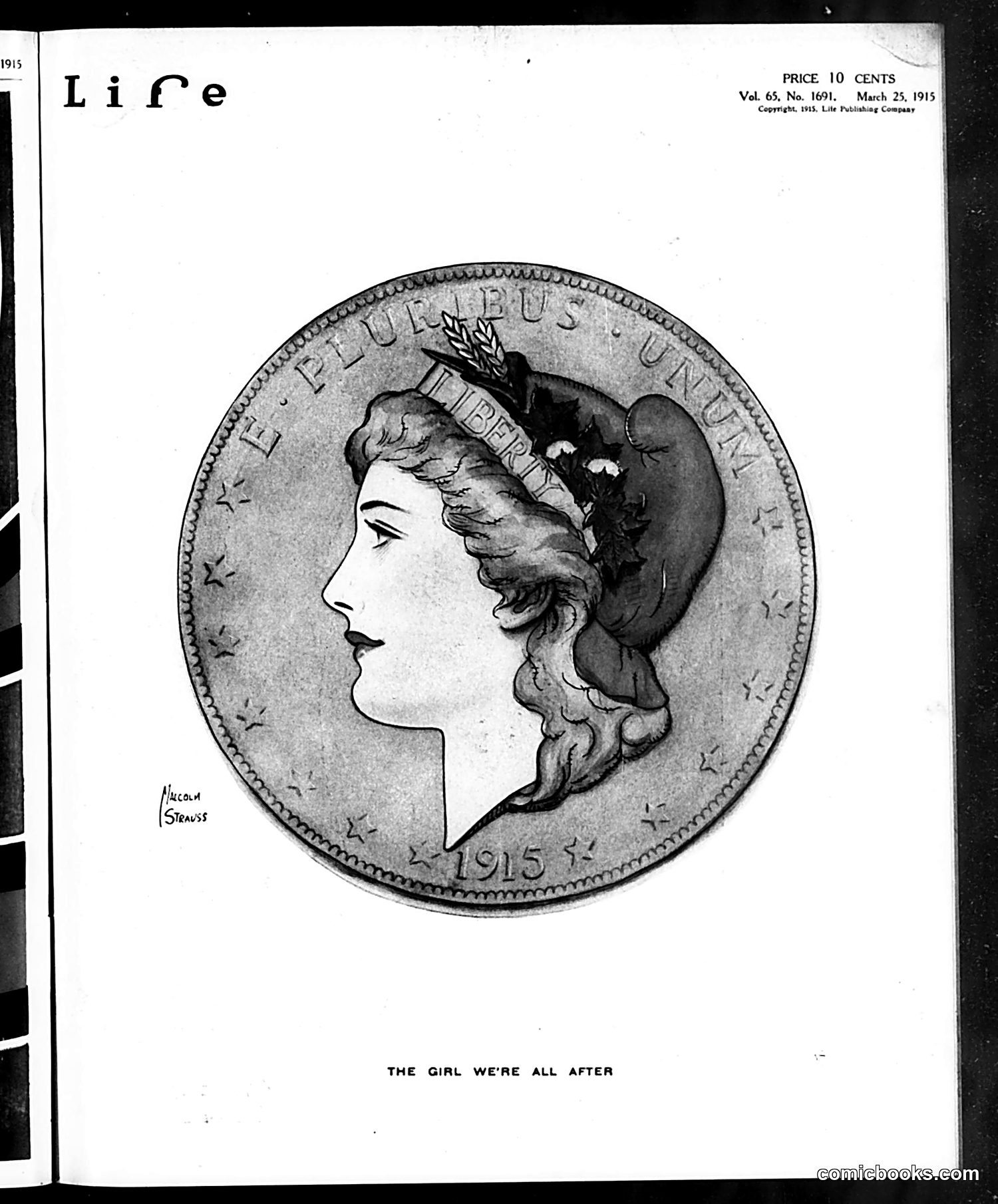
This Life magazine cover from March 25, 1915 features an illustration of a classical female profile on a coin, labeled "E PLURIBUS UNUS" (from many, one). The caption reads "THE GIRL WE'RE ALL AFTER." The cartoon appears to be satirizing the widespread romantic or social pursuit of an idealized American woman—likely referencing contemporary social attitudes about femininity and courtship. The coin imagery suggests she represents American values or national ideals that men collectively desire. The artist's signature reads "Lucian Strauss." Without additional context from the magazine's contents, the specific identity of "the girl" remains unclear, though the satire likely comments on popular culture or social trends of 1915 America.
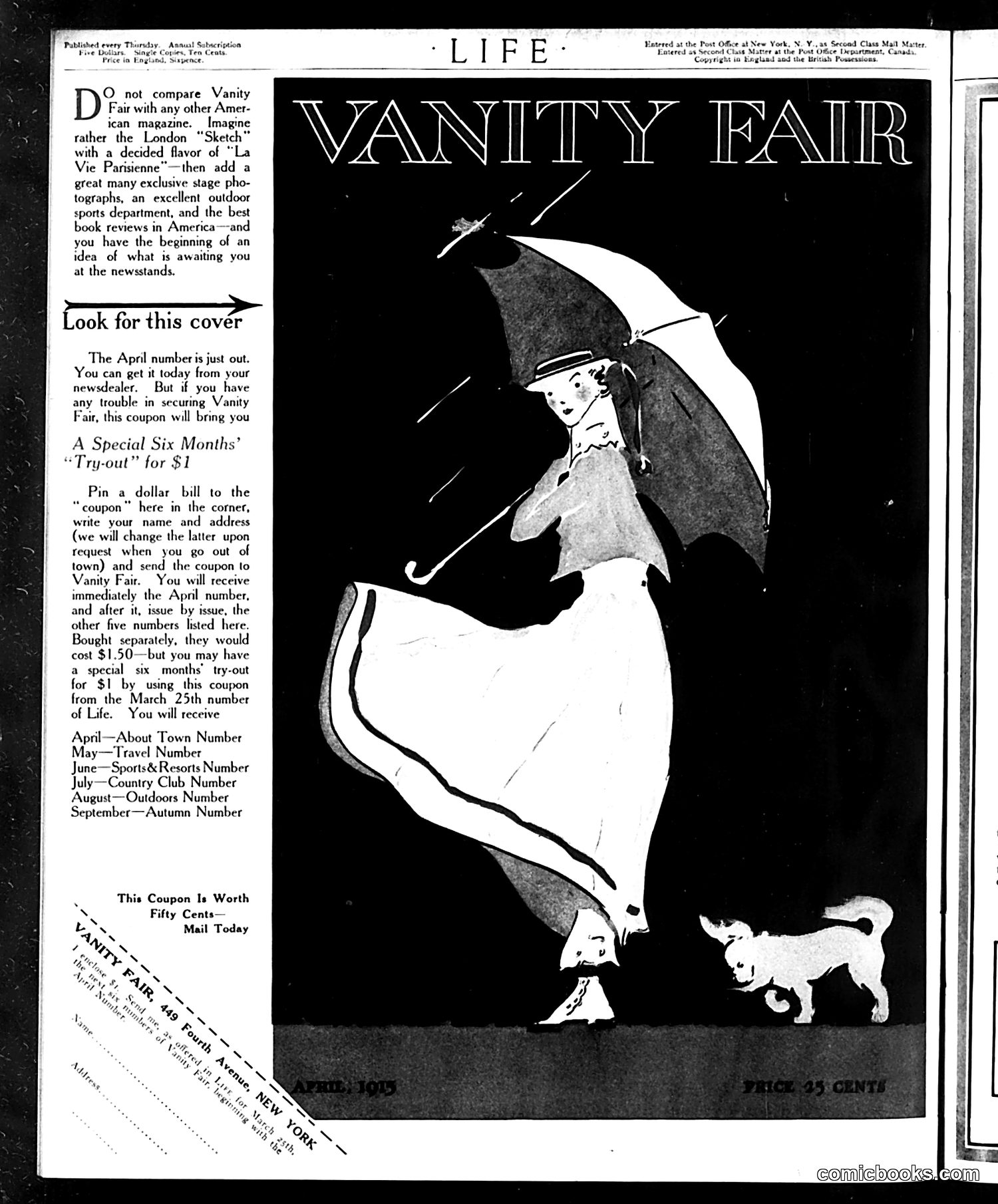
This is primarily an **advertisement for Vanity Fair magazine**, not political satire. The cover illustration shows a stylishly dressed woman with an umbrella in the rain, accompanied by a small dog—a typical fashion/lifestyle image for the era. The left panel is a subscription pitch comparing Vanity Fair favorably to London's *Sketch* magazine, highlighting its "exclusive stage photographs, an excellent outdoor sports department, and the best book reviews in America." The coupon offers a six-month trial subscription for $1 (versus $1.50 regular price), with different themed issues listed by month (April's "About Town Number," May's "Travel Number," etc.). **This is commercial promotion, not political commentary.**
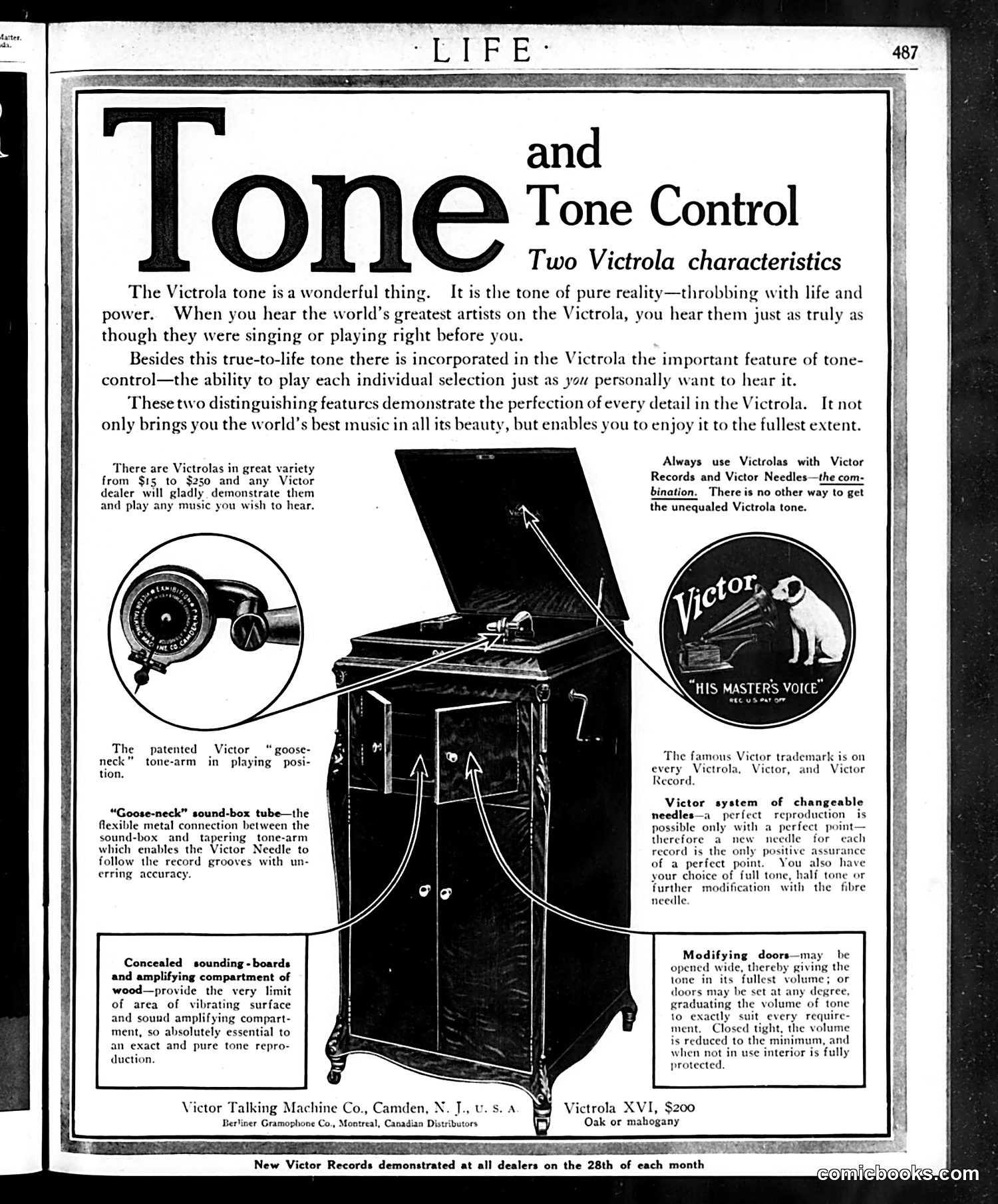
This is **not a cartoon or satirical content**—it's a straightforward **advertisement for Victrola phonographs**, published in *Life* magazine (page 487). The page promotes the Victrola XVI model ($200 in oak or mahogany) by highlighting two key features: superior tone quality and tone control via adjustable needles and doors. The text emphasizes that listeners hear "the world's greatest artists" with authenticity, "just as truly as though they were singing or playing right before you." The circular insets show the patented "goose-neck" tone-arm mechanism and the famous Victor trademark ("His Master's Voice" dog logo). This is period product marketing, not satire—reflecting early-20th-century consumer advertising standards in *Life*.
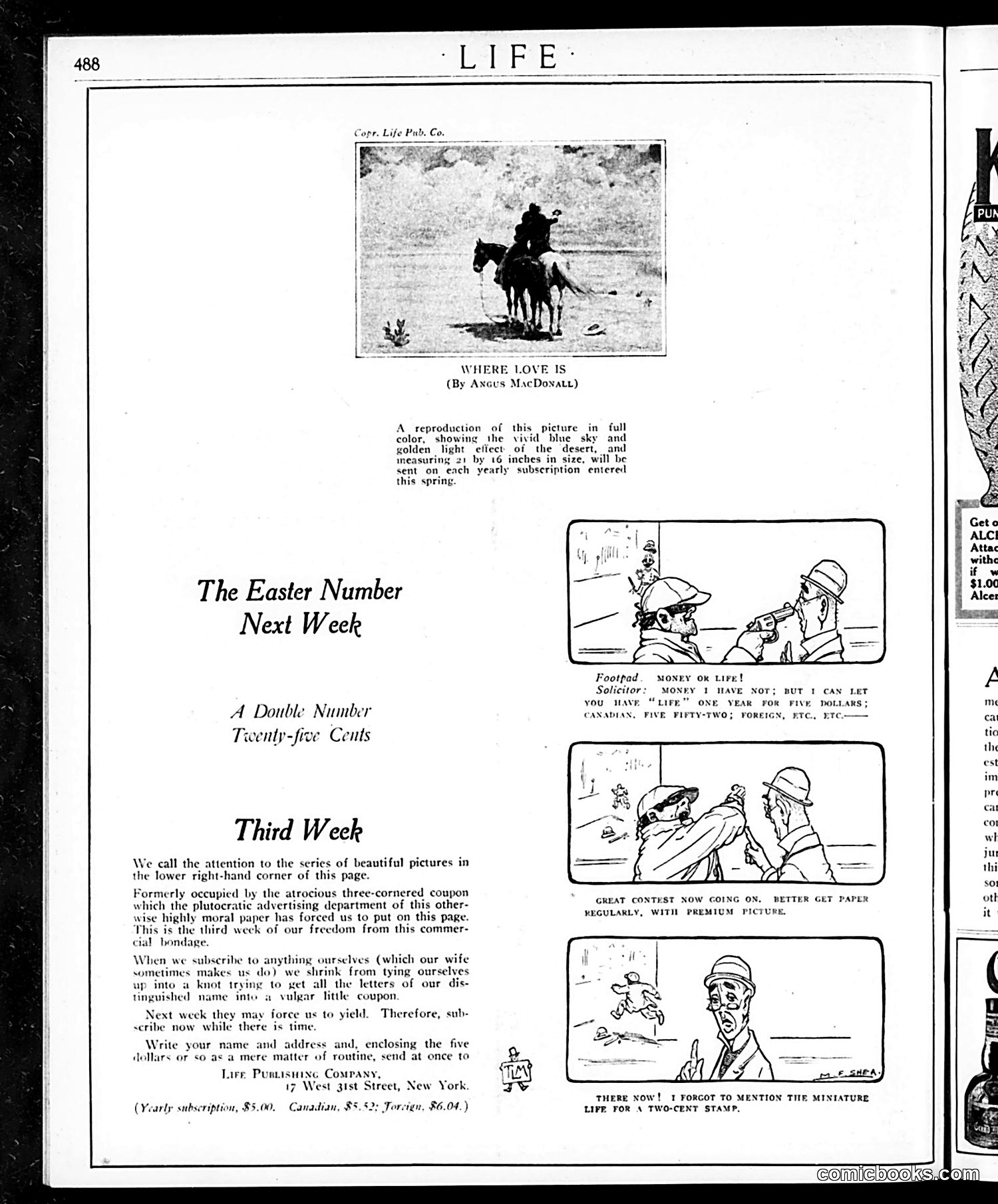
This page features three comic strips depicting a "Footpad Solicitor" scenario. The humor centers on a street robbery where a mugger attempts to extort money from a victim. The punchline progresses through three panels: 1. The mugger demands money, claiming he hasn't eaten in five dollars' worth 2. A "great contest" develops over premium picture subscriptions to Life magazine 3. The mugger ultimately forgets his robbery attempt, distracted by Life's two-cent stamp offer The satire mocks Life's aggressive subscription marketing tactics by comparing them to street robbery—suggesting the magazine's sales methods are as coercive and inescapable as mugging. The joke implies readers cannot escape Life's promotional pitches regardless of circumstance.
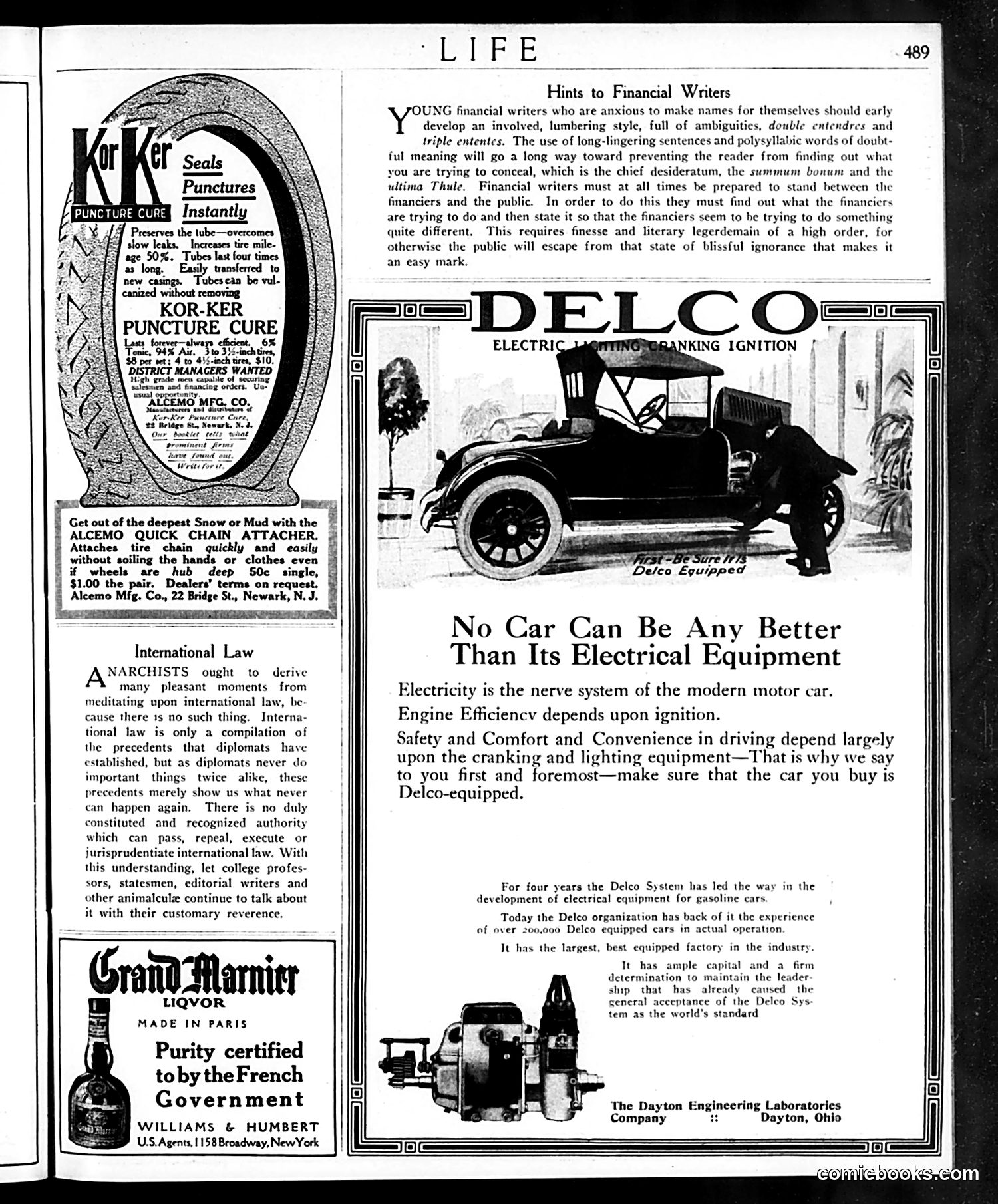
This page is primarily **advertising**, not satire or political commentary. The advertisements include: - **Kor-Ker Puncture Cure** (tire repair): promoting instant sealing of punctures, targeting owners of early automobiles - **Delco Electric Lighting and Ignition**: the main advertisement, featuring a vintage car and arguing that electrical equipment quality determines overall vehicle quality - **Alcemo Quick Chain Attacher**: snow/mud tire chains - **Grand Marnier Liquor**: certified French import - A brief essay on **International Law** (unrelated to images) The Delco ad emphasizes that electrical systems were crucial to modern cars—a significant selling point in this early automotive era. The other ads reflect practical concerns of early 1900s motorists: tire failures, winter driving, and starting difficulties. This is a commercial magazine page, not editorial satire.
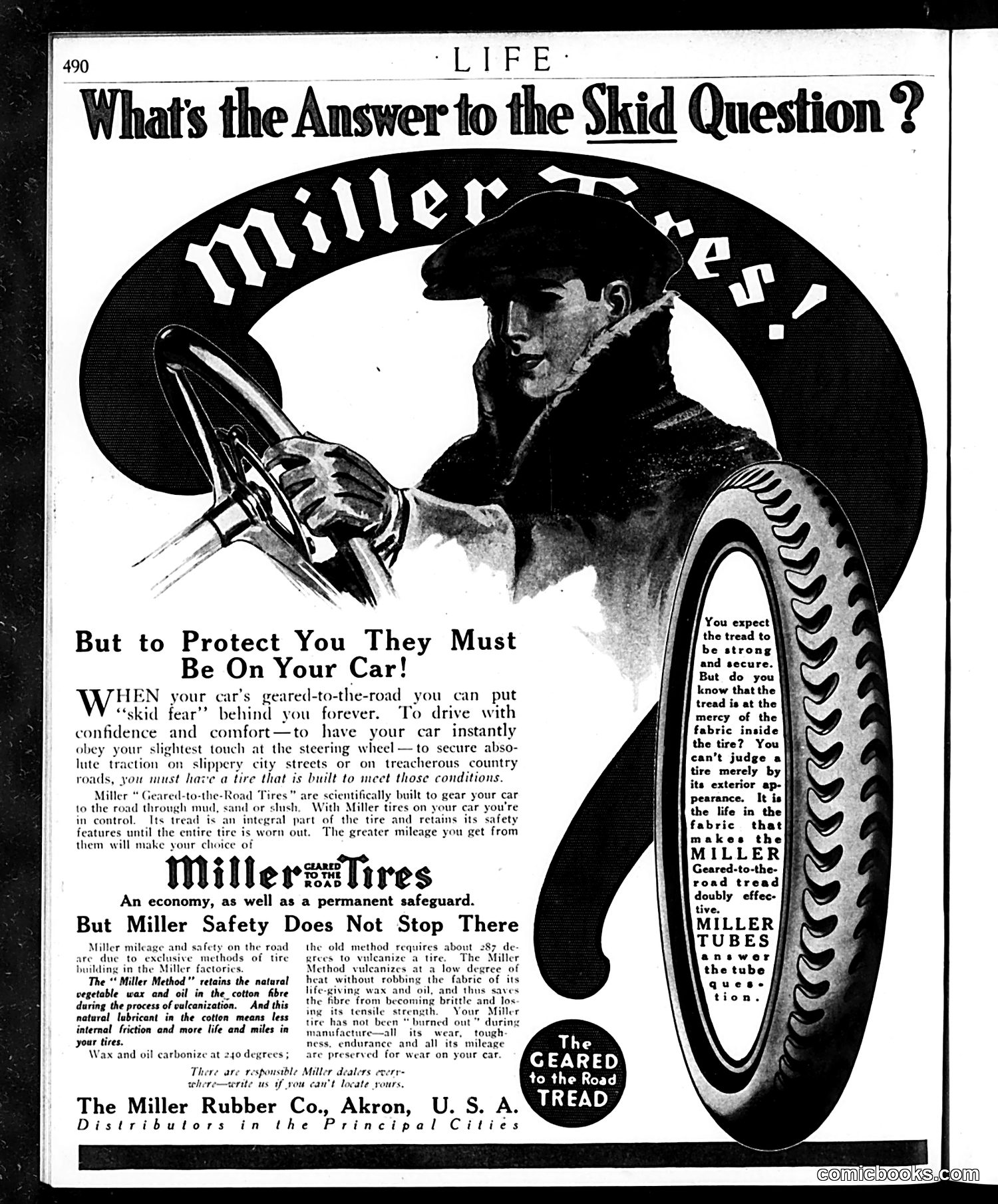
This is primarily a **Miller Tire advertisement**, not satirical content. The "Skid Question" headline uses a playful double meaning: it asks what prevents skidding while promoting Miller's "Geared-to-the-Road Tread" tires. The imagery shows a driver at a steering wheel with an oversized tire displayed prominently. The ad's actual message concerns tire safety and traction on poor road conditions—a serious concern for 1920s automobiles on unpaved or icy roads. The ad emphasizes Miller's manufacturing methods (the "Miller Method" involving wax and oil vulcanization) to explain why their tires provide superior grip and durability. The text stresses that tire *interior* construction, not just exterior appearance, determines safety. This is straightforward product advertising targeting safety-conscious motorists, not political or social satire.
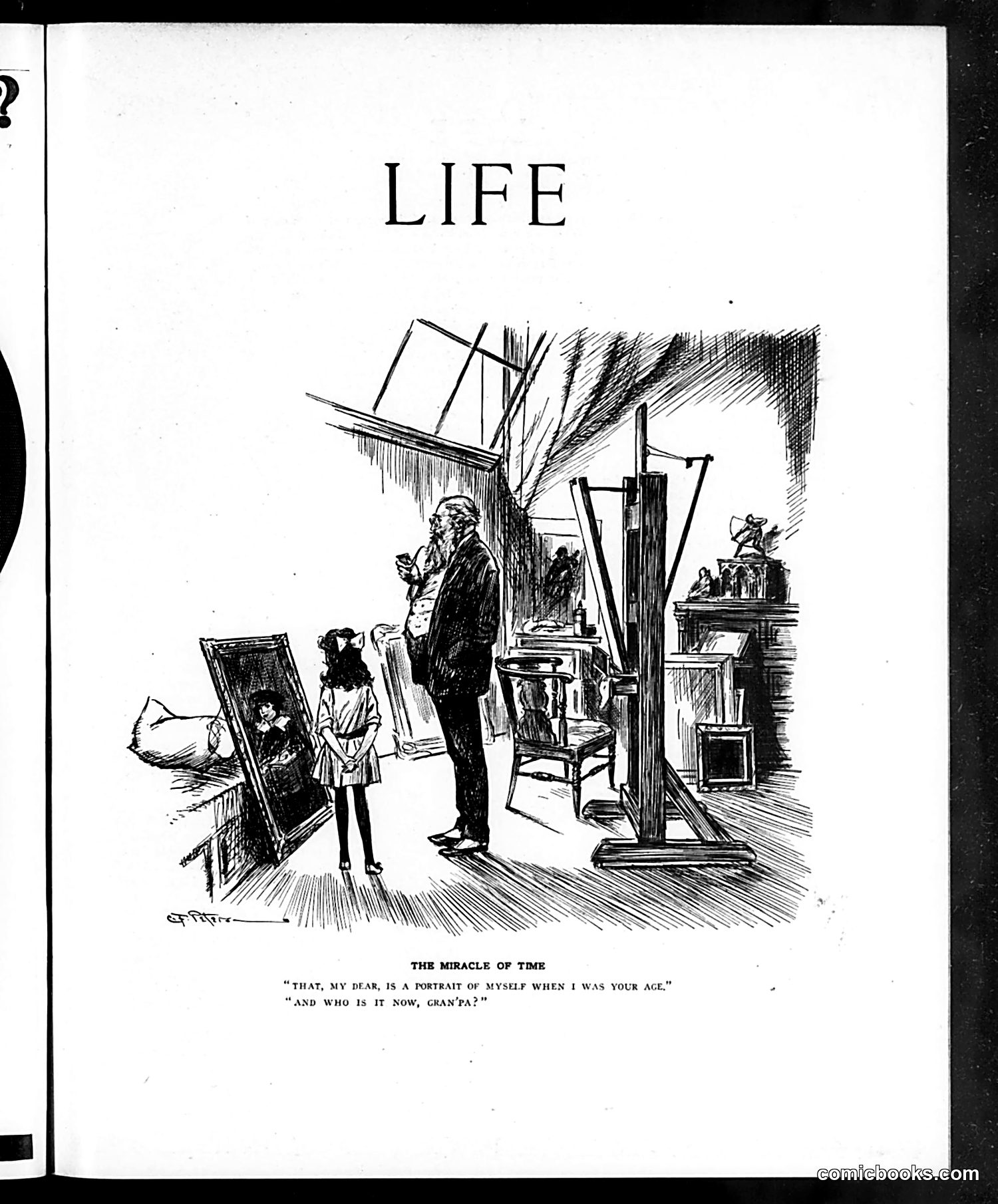
This is a title page illustration for a section called "LIFE," featuring a cartoon titled "The Miracle of Time." The scene depicts an elderly man viewing a portrait of a young girl with an adult (likely her father or guardian). The dialogue reads: "That, my dear, is a portrait of myself when I was your age" and "And who is it now, grandpa?" The satire comments on aging and the passage of time—the joke being the grandfather's implicit answer that the portrait no longer resembles him. It's a gentle, observational humor about how dramatically people change over decades. The cartoon reflects early-to-mid 20th-century Life magazine's characteristic style: sentimental yet witty commentary on everyday human experiences, particularly family dynamics and the inevitability of aging.
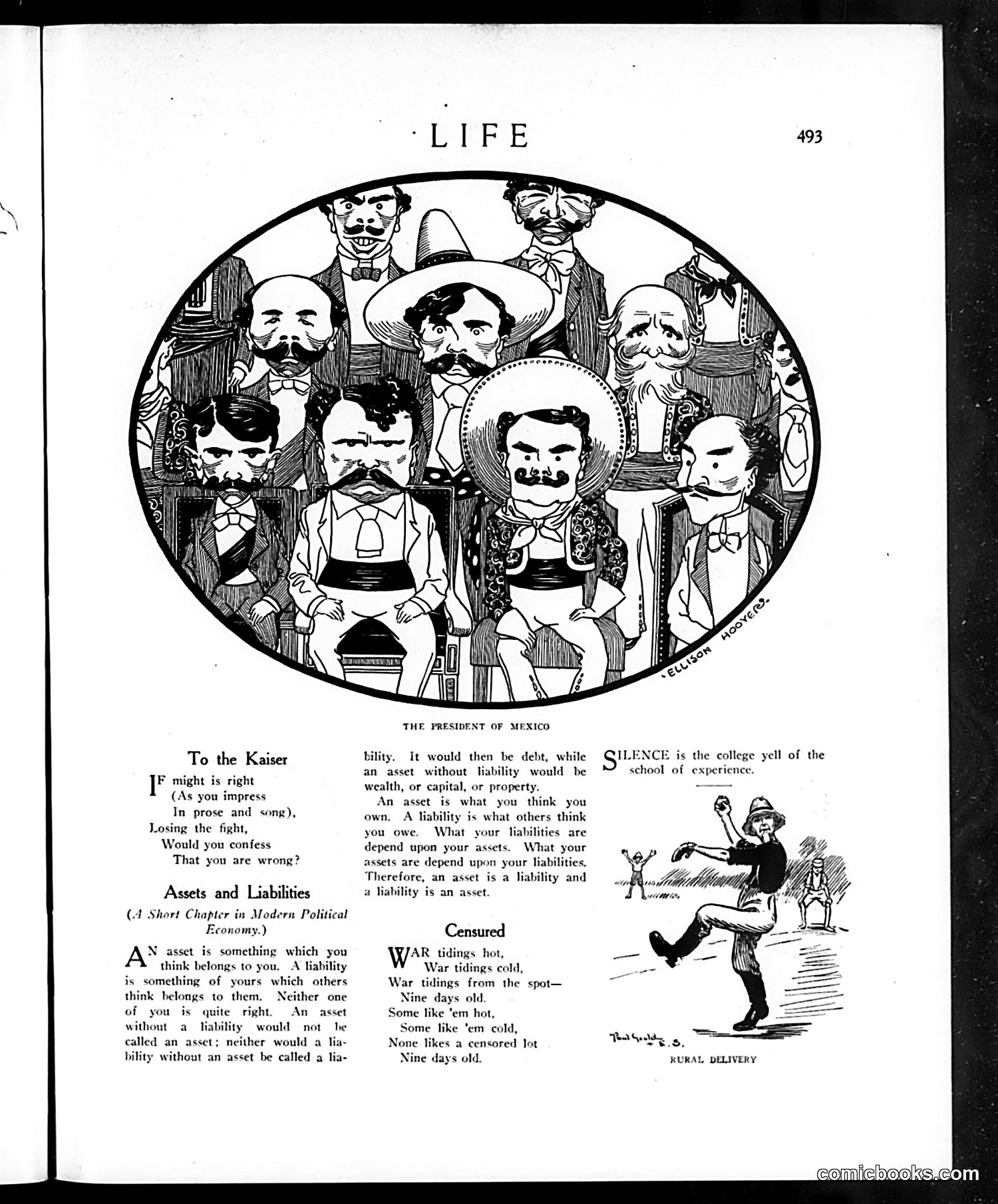
The main circular illustration titled "The President of Mexico" depicts a group of mustachioed men in various states of dress and military garb, arranged in a collage style. This appears to satirize Mexican political leadership during a period of instability, likely early 20th century, when Mexico experienced frequent changes in government and power struggles. The accompanying text includes a poem "To the Kaiser" and an educational section on "Assets and Liabilities" explaining economic concepts. A smaller cartoon titled "Rural Delivery" shows a figure in apparent distress. The satire suggests chaos and instability in Mexican governance through the exaggerated depiction of multiple competing figures claiming authority. The juxtaposition with the Kaiser reference indicates broader commentary on international political turmoil.
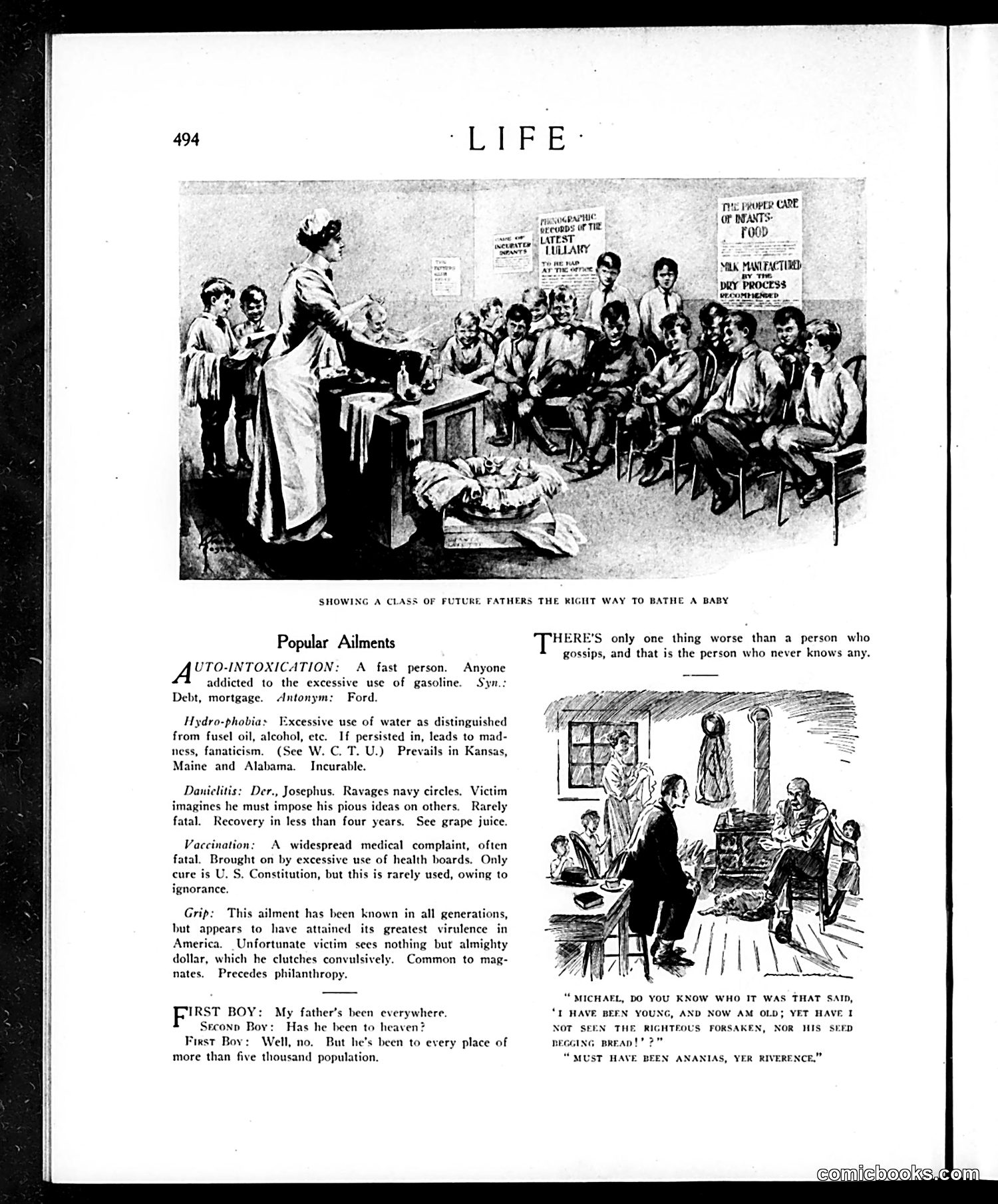
**Top Image:** Shows a woman instructing a class of men on proper infant bathing techniques. This satirizes early 20th-century shifts in childcare education—specifically, the emerging practice of teaching fathers domestic responsibilities rather than leaving all childcare to mothers. The "future fathers" learning from an instructor represents social commentary on changing gender roles. **Bottom Cartoon:** Depicts a domestic scene with dialogue mocking gossip and hypocrisy. An older woman criticizes a man's behavior while quoting scripture ("Ananias"), suggesting selective moral judgment—people condemn others while ignoring their own failings. **"Popular Ailments" Section:** Uses faux-medical terminology to satirize social complaints: "Auto-intoxication" (debt/mortgage), "Hydrophobia" (water shortages), etc. This employs humorous diagnosis-speak to critique contemporary societal problems.
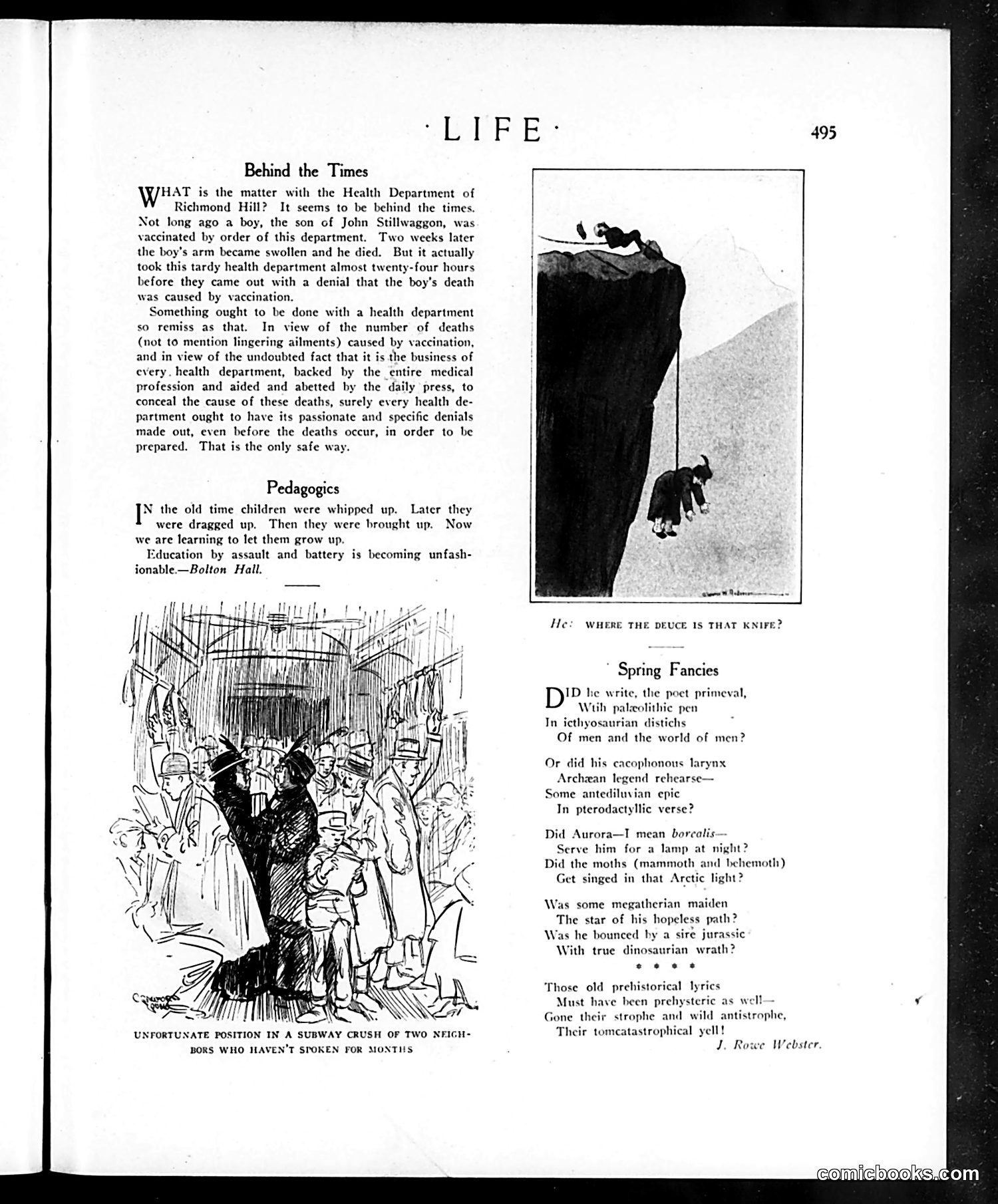
**"Behind the Times"** criticizes Richmond Hill's health department for concealing vaccination deaths. The article specifically mentions a boy (son of John Stillwaggen) who died after vaccination, with the department taking nearly 24 hours to issue a denial. The author argues health departments should publicly acknowledge and investigate vaccination-related deaths rather than cover them up. **"Pedagogics"** presents a cartoon showing crowded subway conditions with the caption about children not being whipped, dragged, or brought up—but now "learning to let them grow up." The satire critiques modern permissive parenting approaches as creating chaotic situations. **"Spring Fancies"** is a poem by J. Roscoe Webster playing with prehistoric and mythological references.
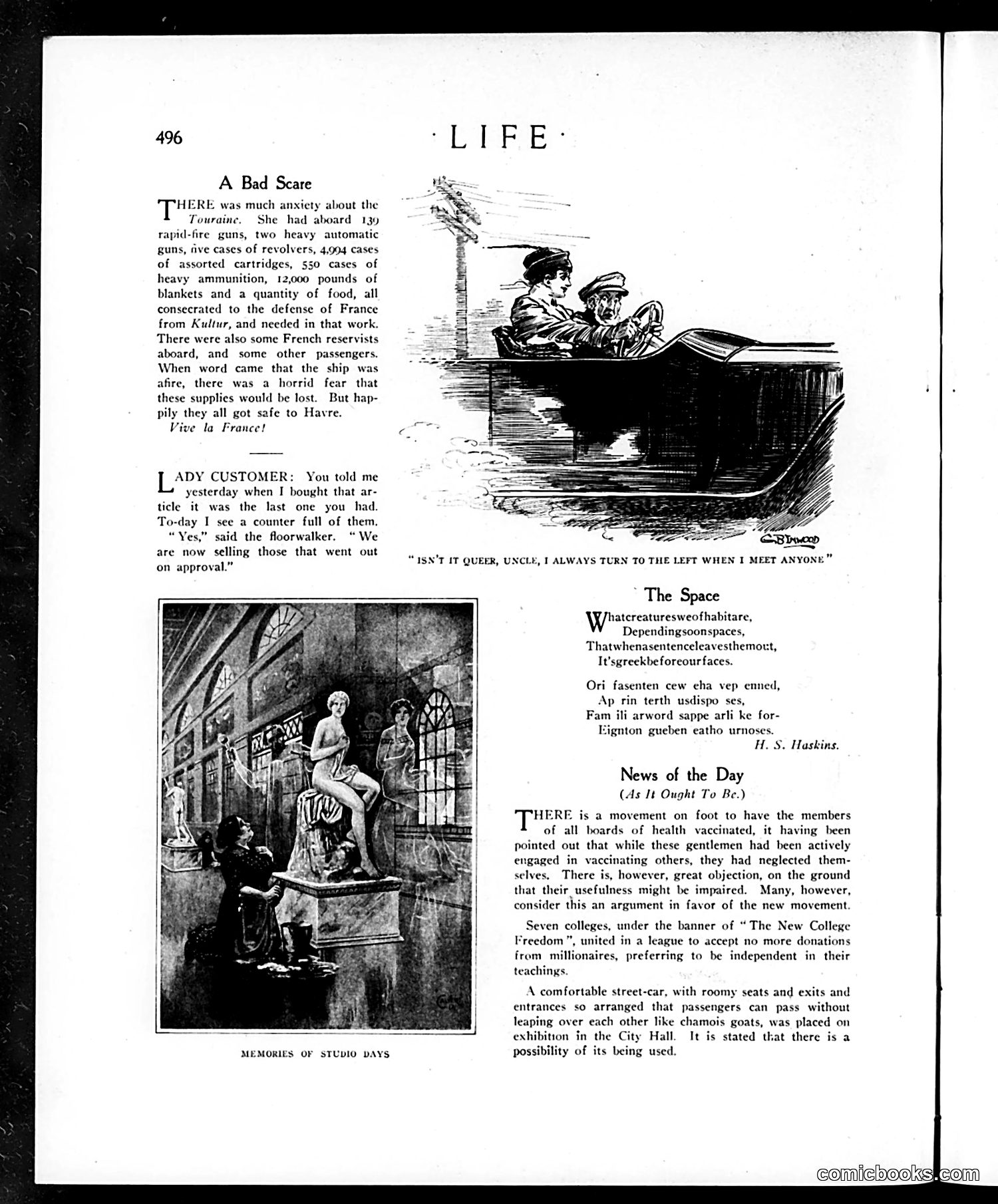
**"A Bad Scare"** (top story): The *Touraine*, a French defense supply ship carrying weapons, ammunition, and provisions, caught fire. The anxiety centered on losing supplies meant for France during World War I. The relief punch line: "Vive la France!" — they reached harbor safely. **The cartoon** (right): Shows two men in a car; one asks the driver why he always turns left when meeting anyone. The caption reads: "ISN'T IT QUEER, UNCLE, I ALWAYS TURN TO THE LEFT WHEN I MEET ANYONE?" This appears to be wordplay on driving etiquette or possibly a veiled political reference, though the specific meaning is unclear without additional context. **Other content** includes poetry and a news item about health board vaccination efforts.
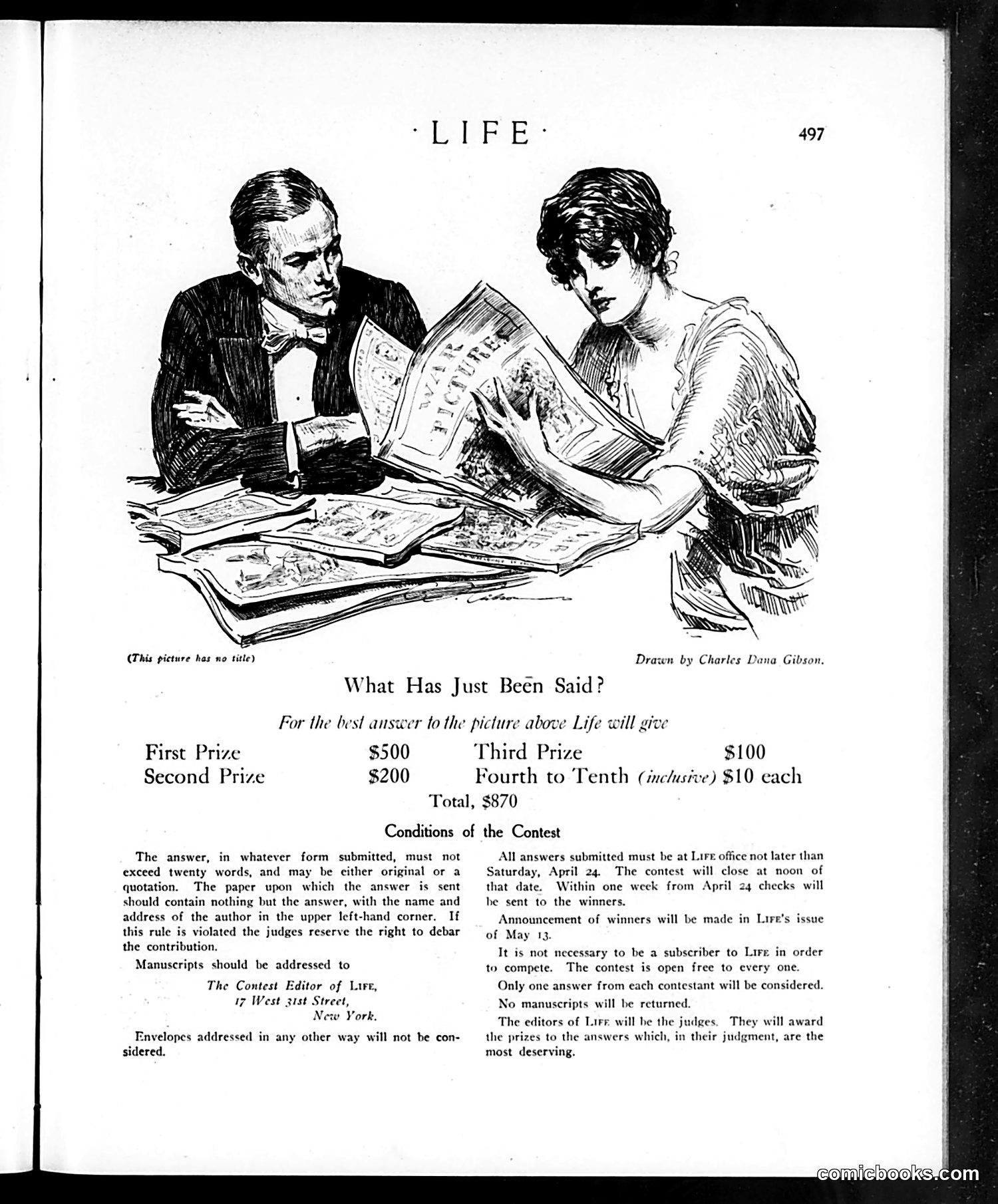
This page from *Life* magazine presents a visual contest titled "What Has Just Been Said?" The illustration, drawn by Charles Dana Gibson, shows a well-dressed man and woman examining illustrated magazines or publications together at a table. The contest invites readers to caption the scene—to identify or imagine what conversation is occurring between these figures. The prize structure ($500 first prize, $200 second, $100 third, plus smaller amounts) and submission rules suggest this was a popular reader-engagement feature. The drawing's style and the couple's fashionable appearance are characteristic of Gibson's work depicting upper-class social situations. The contest essentially asks readers to supply witty dialogue for an ambiguous social moment.
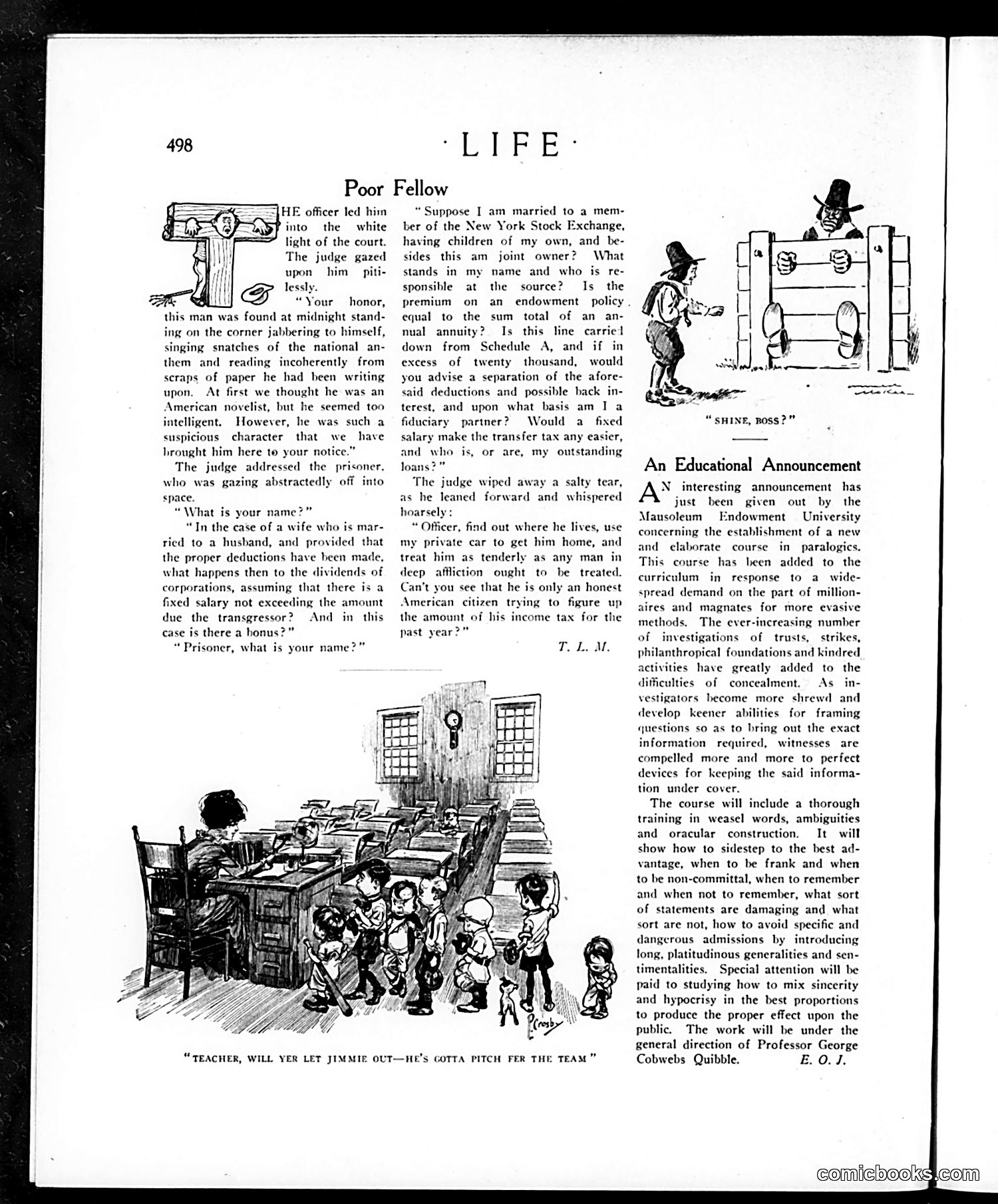
This satirical piece mocks the complexity of American tax law and financial obligations. The central story depicts a vagabond arrested for vagrancy who, upon interrogation, reveals he's technically married to a wealthy New York Stock Exchange member. This creates an absurd legal entanglement: the judge must determine whether the vagrant shares responsibility for his wife's income taxes, deductions, and financial liabilities. The humor derives from exposing how Byzantine tax regulations could produce ridiculous outcomes—a poor man potentially liable for taxes on wealth he doesn't control or access. The cartoon critiques the disconnect between legal definitions of marriage and financial responsibility, while satirizing the era's confusing tax code that created such impossible situations for ordinary citizens.
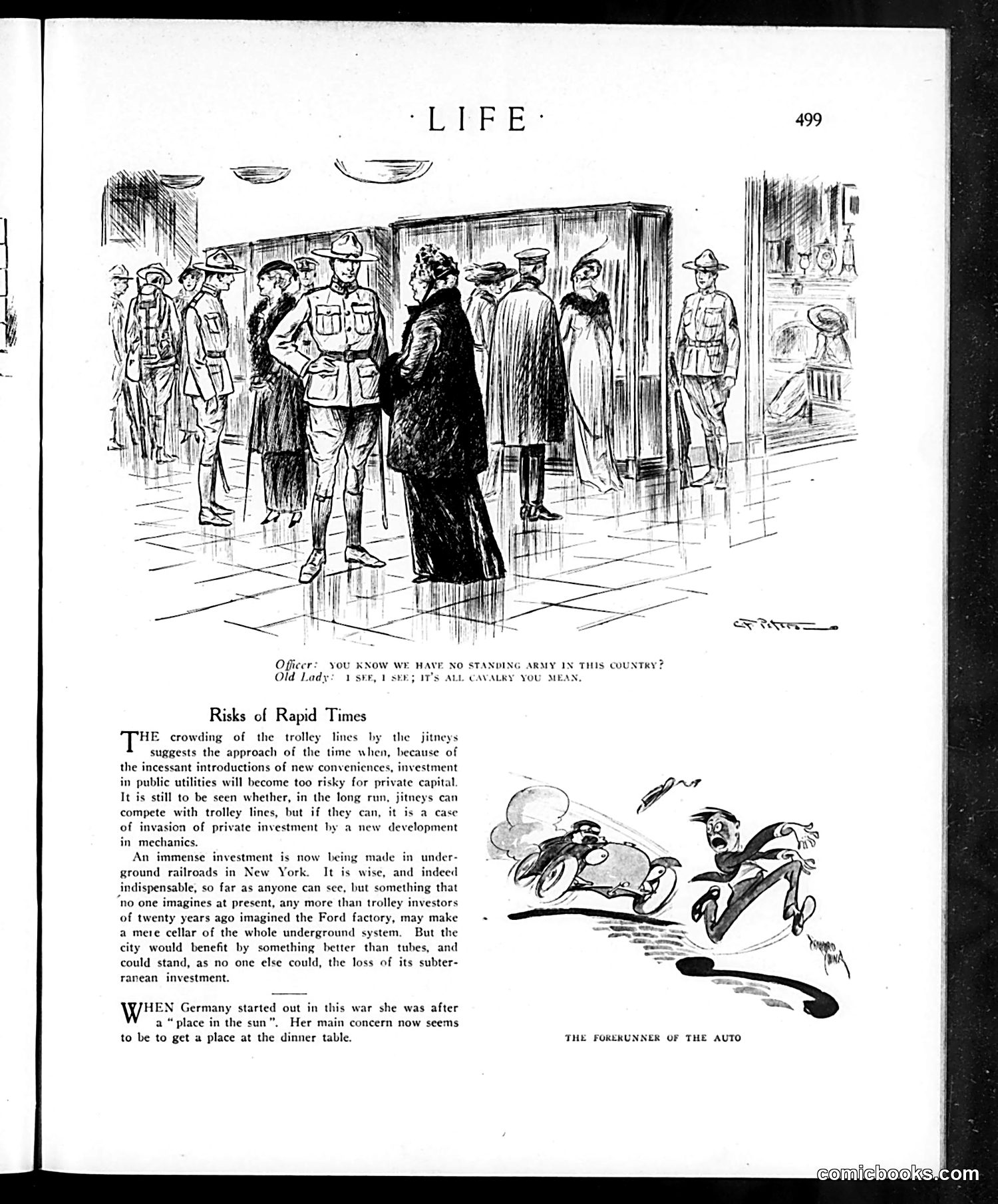
**Top Cartoon:** An officer confronts an elderly woman surrounded by soldiers in what appears to be a military inspection or gathering. The woman's confused response—claiming there's no "standing army" but "all cavalry"—is a joke about her misunderstanding or willful ignorance. She appears to be mocking the visible military presence by literally interpreting his words. **"Risks of Rapid Times" Article:** This discusses how new transportation technologies (jitneys—cheap shared automobiles) threaten established investments in trolley lines and utilities. The piece warns that rapid technological change may render massive infrastructure investments obsolete, citing the underground railroad system in New York as potentially vulnerable to future innovations. It's a prescient concern about disruptive technology. **"Forerunner of the Auto" Cartoon:** Shows motorcyclists on a road, captioned as the "forerunner" (predecessor) of automobiles—suggesting motorcycles represent an early stage of motorized personal transportation. **Germany Reference:** A brief satire on Germany's war aims, claiming their original goal of imperial expansion ("place in the sun") has been reduced to mere survival ("place at the dinner table").
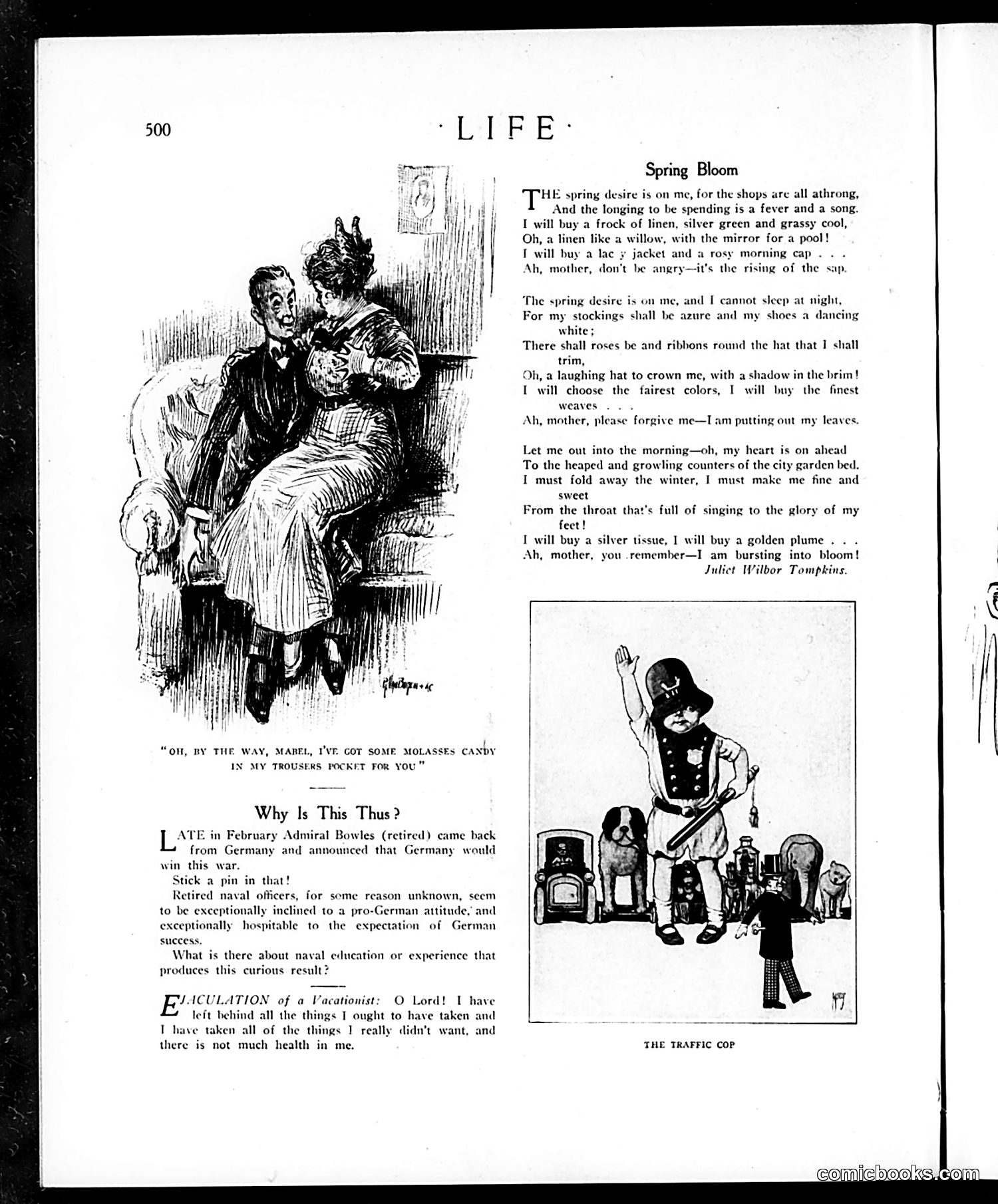
This page satirizes wartime attitudes and spring frivolity during what appears to be World War I. **"Why Is This Thus?"** criticizes retired Admiral Bowles for returning from Germany in February and publicly predicting German victory. The piece questions why retired naval officers seem disproportionately pro-German and confident in German success—suggesting their military background paradoxically makes them sympathetic to enemy interests rather than their own nation's. **"Spring Bloom"** is a lighthearted poem by Juliet Wilbor Tompkins about a young woman's irresistible urge to buy spring fashions (linens, ribbons, hats, stockings) despite her mother's disapproval. It uses the metaphor of natural spring growth to justify shopping fever—"putting out my leaves" and "bursting into bloom." The left illustration shows an intimate couple, with the caption about molasses candy as a flirtation. **"The Traffic Cop"** (right illustration) appears to show a street scene, though its specific satirical point is unclear from this excerpt alone.
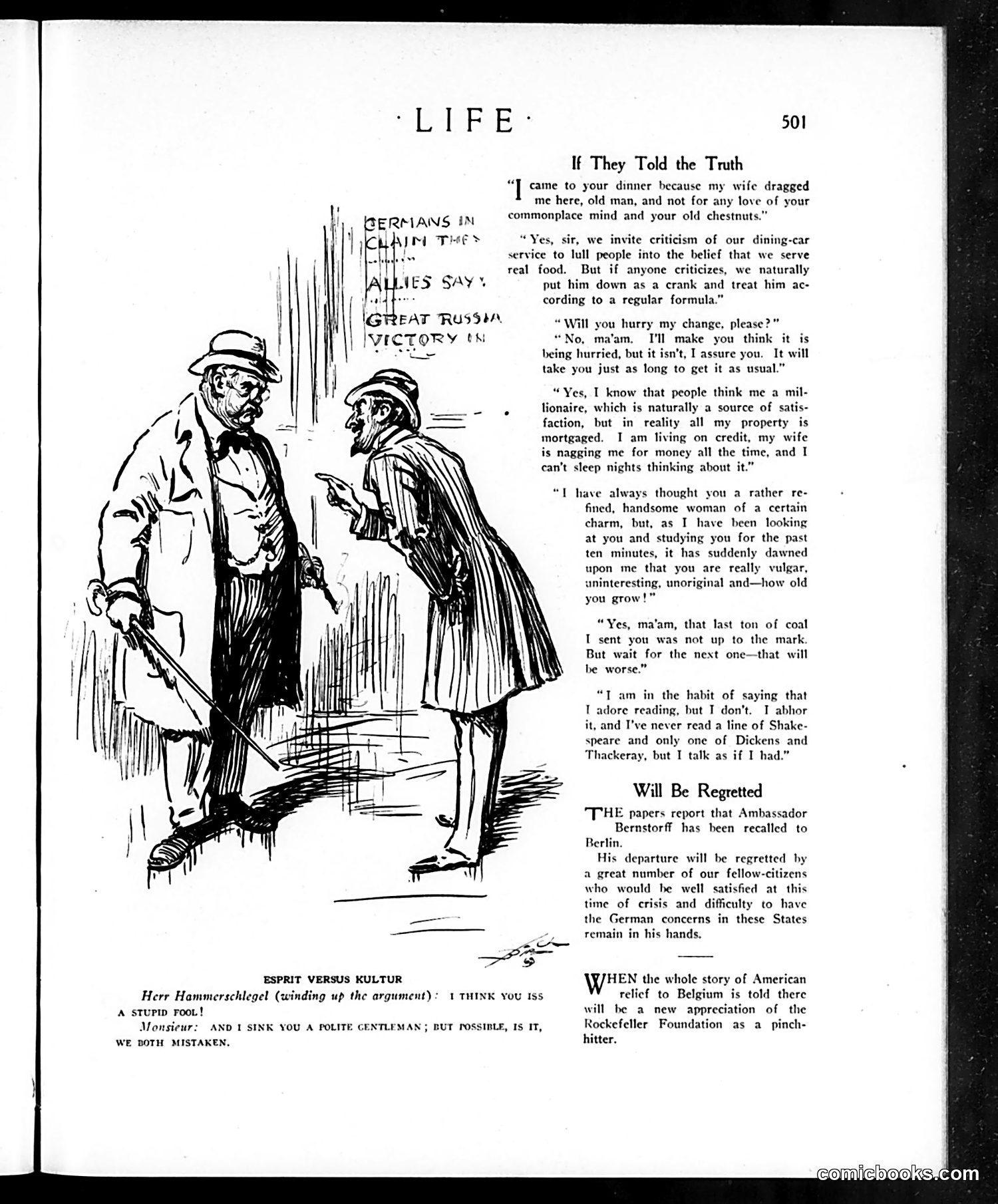
This page presents cynical commentary on American social hypocrisy during World War I era. The main cartoon "If They Told the Truth" mocks dining-car service and upper-class pretense through brutal honesty—servers admit they discourage criticism, customers confess their true financial desperation and social fakery. The bottom cartoon, "Esprit Versus Kultur," depicts a conflict between a German (Herr Hammerschlegel) and Frenchman (Monsieur) who insult each other while claiming superiority. The caption suggests both are equally foolish. The brief note about Ambassador Bernstorff's recall to Berlin references German diplomacy during WWI, when such departures signaled shifting international relations. The overall message: American society thrives on dishonesty and false appearances, while Europeans engage in equally futile posturing. The satire aims at exposing the gap between professed values and actual behavior across social classes and international relations.
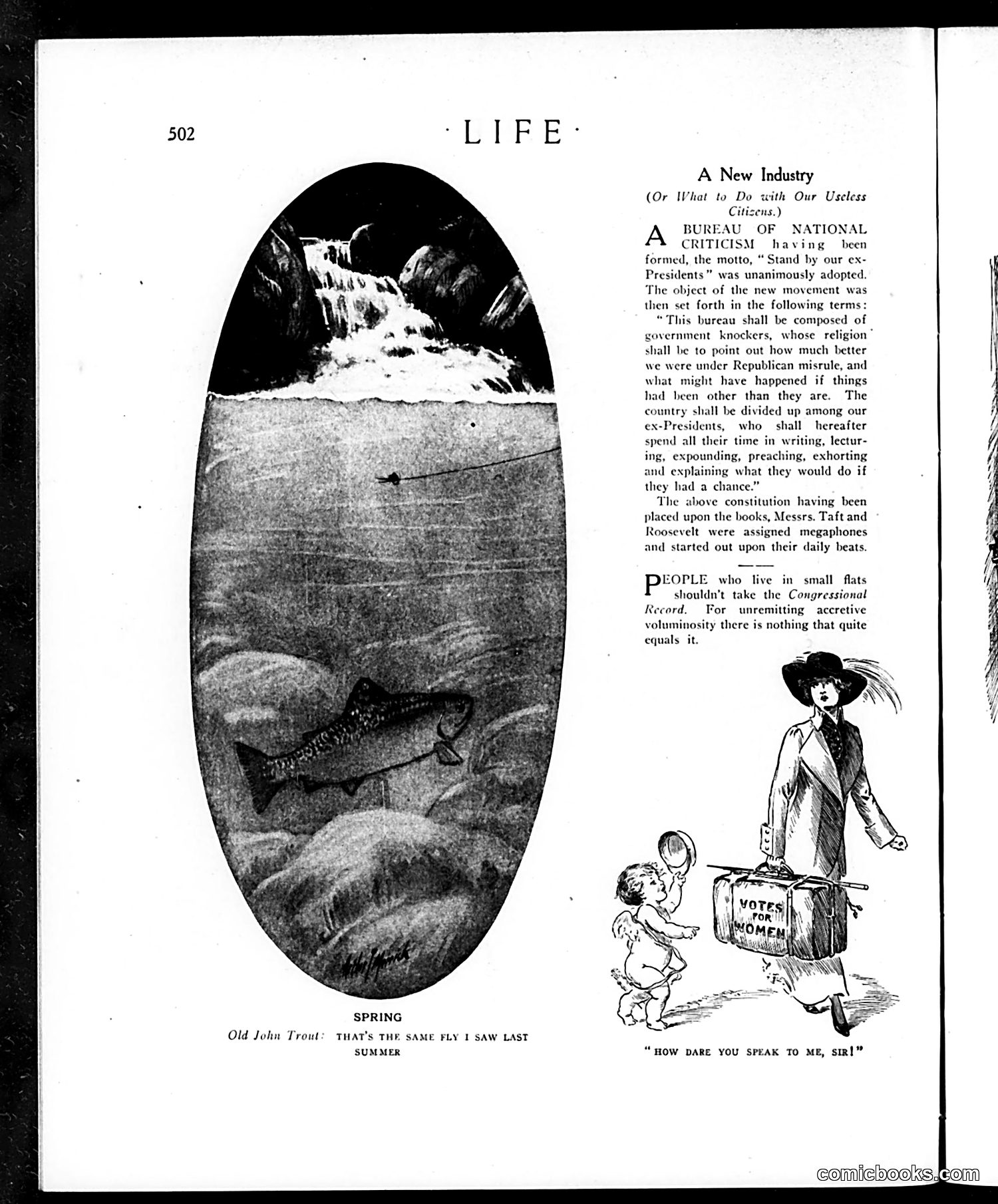
**Top Image (Spring):** A fishing scene showing "Old John Trout" encountering the same fly lure twice—once last summer, once now. The joke: the trout recognizes and mocks the repeated, obvious deception. **Main Article & Cartoon:** This satirizes the creation of a "Bureau of National Criticism" to keep ex-Presidents busy. The text proposes these former leaders should spend time writing, lecturing, and complaining about how things were better under their Republican administrations—essentially converting them into professional critics of the current (Democratic) government. **Bottom Cartoon:** Shows a suffragist woman with a "Votes for Women" placard being confronted disrespectfully by a child. Her indignant response, "How dare you speak to me, sir!" satirizes the perceived contradiction: women demanding political authority while maintaining strict social hierarchies and propriety. **The Connection:** Both the trout cartoon and suffrage cartoon mock people who fall for—or deploy—transparent, repeated tricks. The "Bureau" article suggests even ex-Presidents can be treated as transparent political theater.
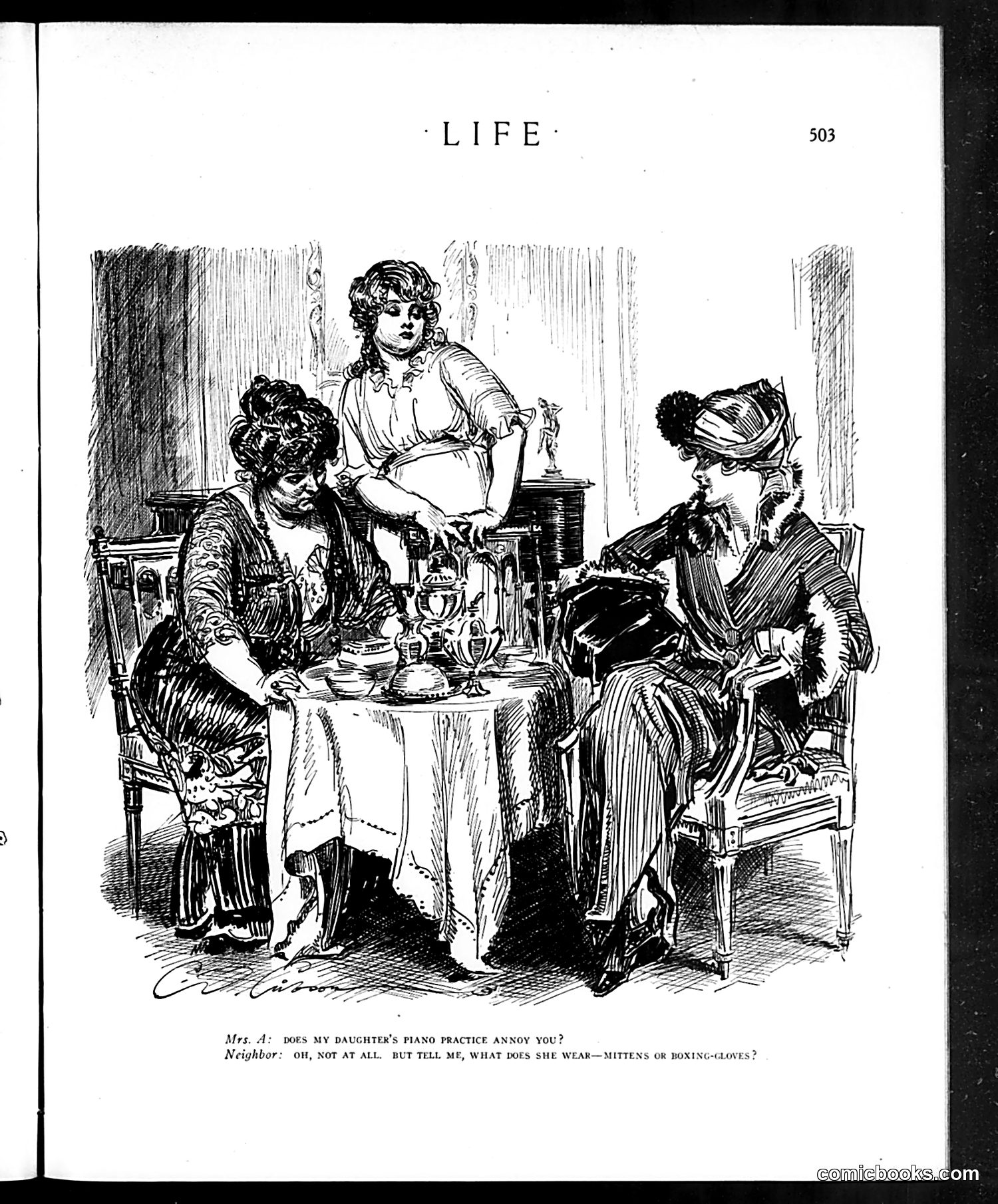
This is a single-panel satirical cartoon about a daughter's piano practice. The joke depends on a common social complaint: a neighbor is diplomatically asked if the daughter's playing is bothersome. The neighbor responds with gentle sarcasm—claiming it doesn't annoy him, but then makes a joke implying the daughter plays so aggressively or forcefully that she might as well be wearing boxing gloves or mittens rather than using her bare hands. The satire targets both the polite social pretense of the mother (asking a loaded question) and the stereotype of amateur piano students, particularly young women, who may play with excessive force rather than refined technique. The humor relies on the contrast between genteel domestic expectations and the rough physicality the neighbor sarcastically attributes to the playing.
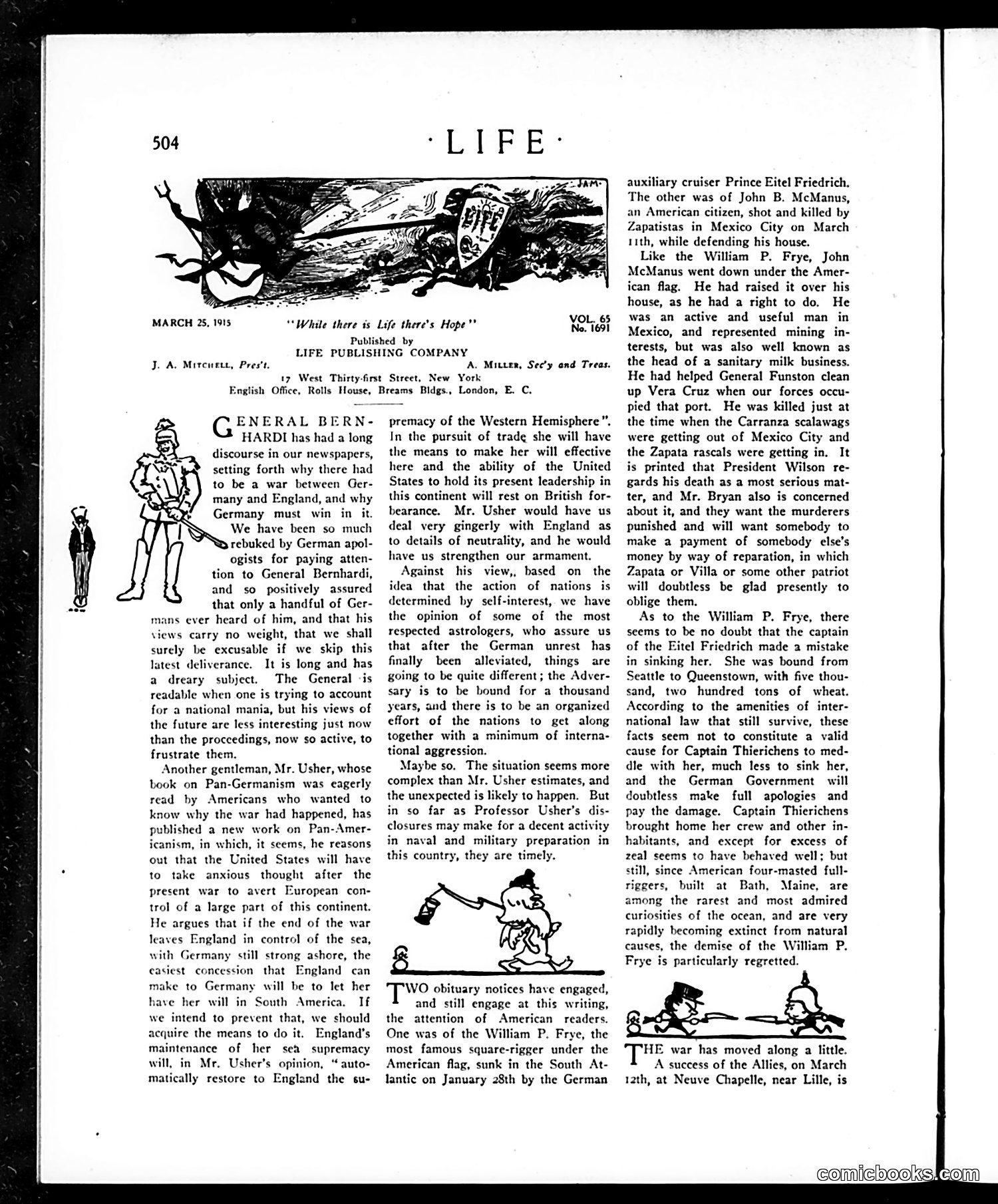
This page discusses American concerns about World War I's aftermath. The main article critiques General Bernhardi (a German military theorist) and engages with Mr. Usher's book on Pan-Germanism, which warned that if Britain controlled the seas post-war while Germany remained militarily strong, England might concede South America to Germany—threatening U.S. hemispheric dominance. The text sarcastically dismisses optimistic "astrologers" predicting post-war peace, instead supporting military preparedness. The obituaries memorialize two Americans killed under the U.S. flag: the *William P. Frye* (a famous merchant ship sunk by a German cruiser in January 1915) and John B. McManus (killed by Mexican Zapatistas). Both deaths symbolized American vulnerability—at sea and on land—during global instability, reinforcing arguments for stronger U.S. military capability before potential involvement in European conflict.
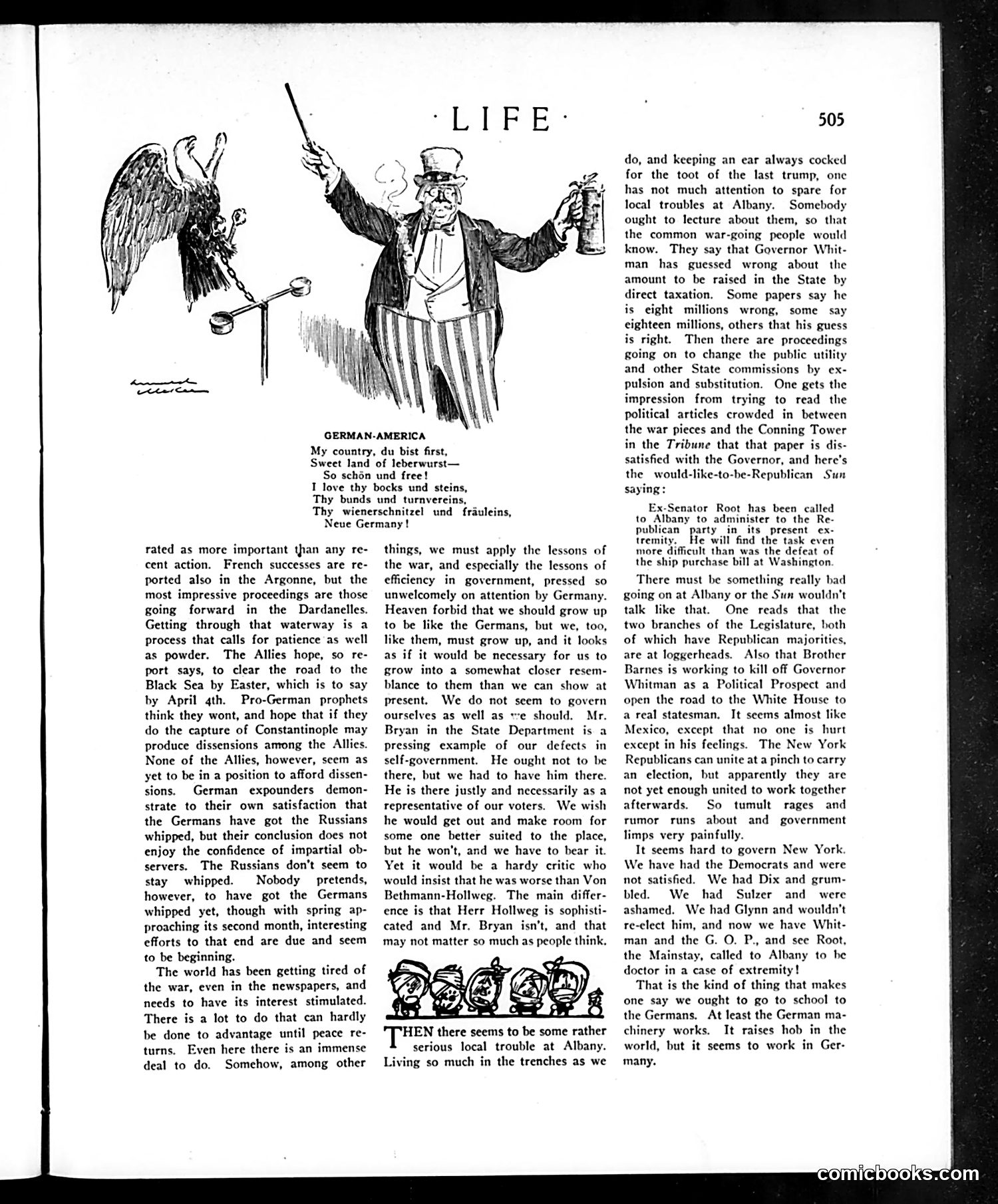
This cartoon satirizes German-American identity during World War I. The figure on the left depicts "German-America"—a personified character with exaggerated Germanic features singing a parody of "America" that replaces patriotic sentiment with German cultural references (leberwurst, beer steins, turnvereins clubs, schnitzel, frauleins). The accompanying poem mocks the tension between German-American loyalty and American patriotism, suggesting that some German-Americans prioritize German culture over American interests. Given the 1915 date and wartime context, this reflects contemporary anxiety about German-American sympathies during WWI. The cartoon appears alongside editorial commentary criticizing governmental inefficiency and comparing American leaders unfavorably to German counterparts—ironically, while simultaneously mocking German-American allegiance. This captures Life magazine's satirical treatment of wartime divided loyalties and domestic political failings.
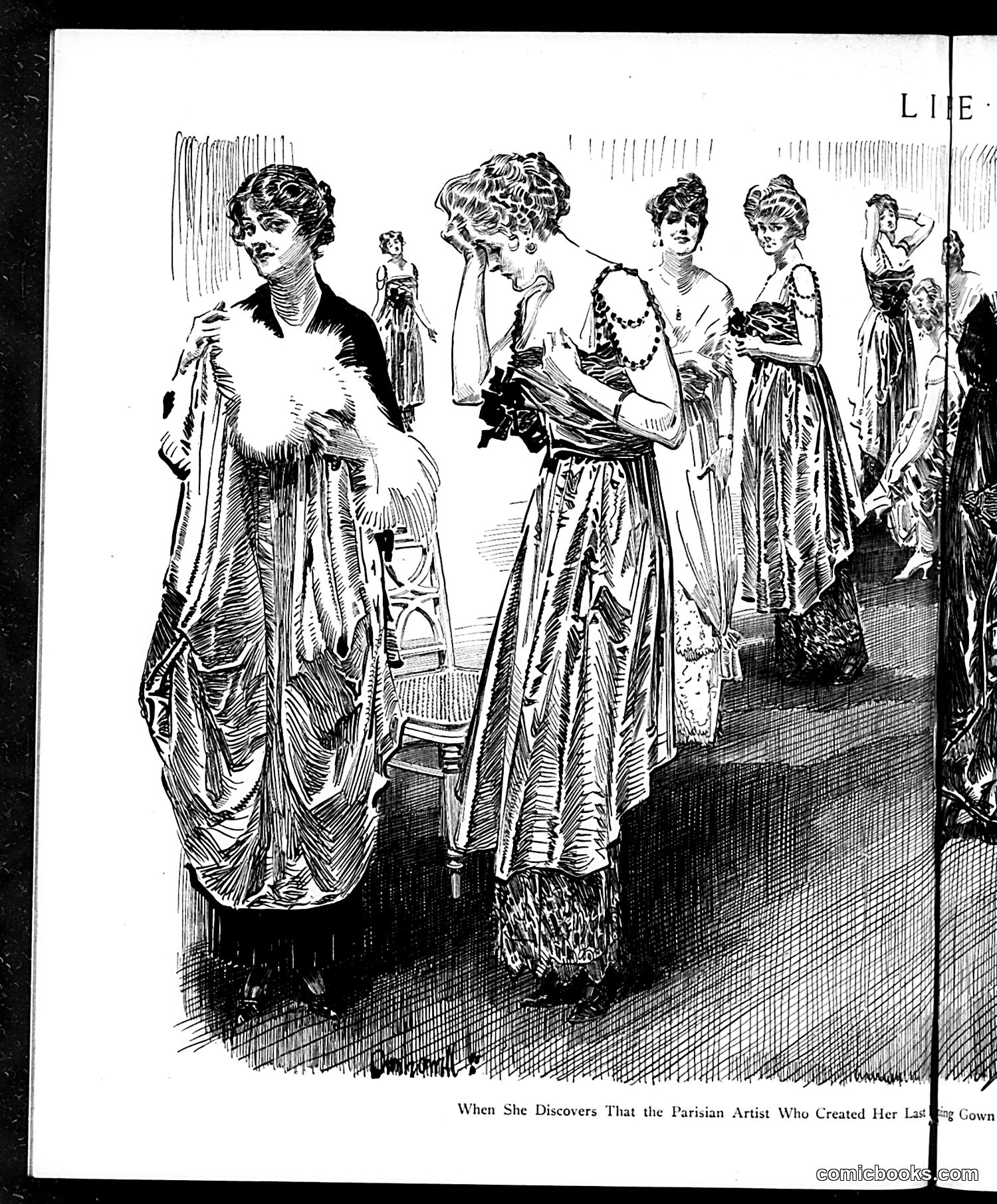
This illustration depicts a social satire about fashion and Parisian design culture. The caption reads: "When She Discovers That the Parisian Artist Who Created Her Last Evening Gown..." The cartoon shows well-dressed women in elaborate evening wear, with two figures prominently featured in the foreground wearing flowing, dramatically draped gowns. The joke appears to target the pretension and expense surrounding Parisian fashion design—likely suggesting a humorous moment of discovery about the designer's identity or credentials. The satire mocks the fashion world's reverence for Parisian couture and the gullibility of wealthy women who purchase expensive gowns based on designer prestige. The unfinished caption suggests the punchline involves an ironic revelation about the gown's creator, possibly that the celebrated "Parisian artist" is less prestigious, skilled, or legitimate than assumed. This reflects early 20th-century American attitudes toward European fashion snobbery and conspicuous consumption among the wealthy.
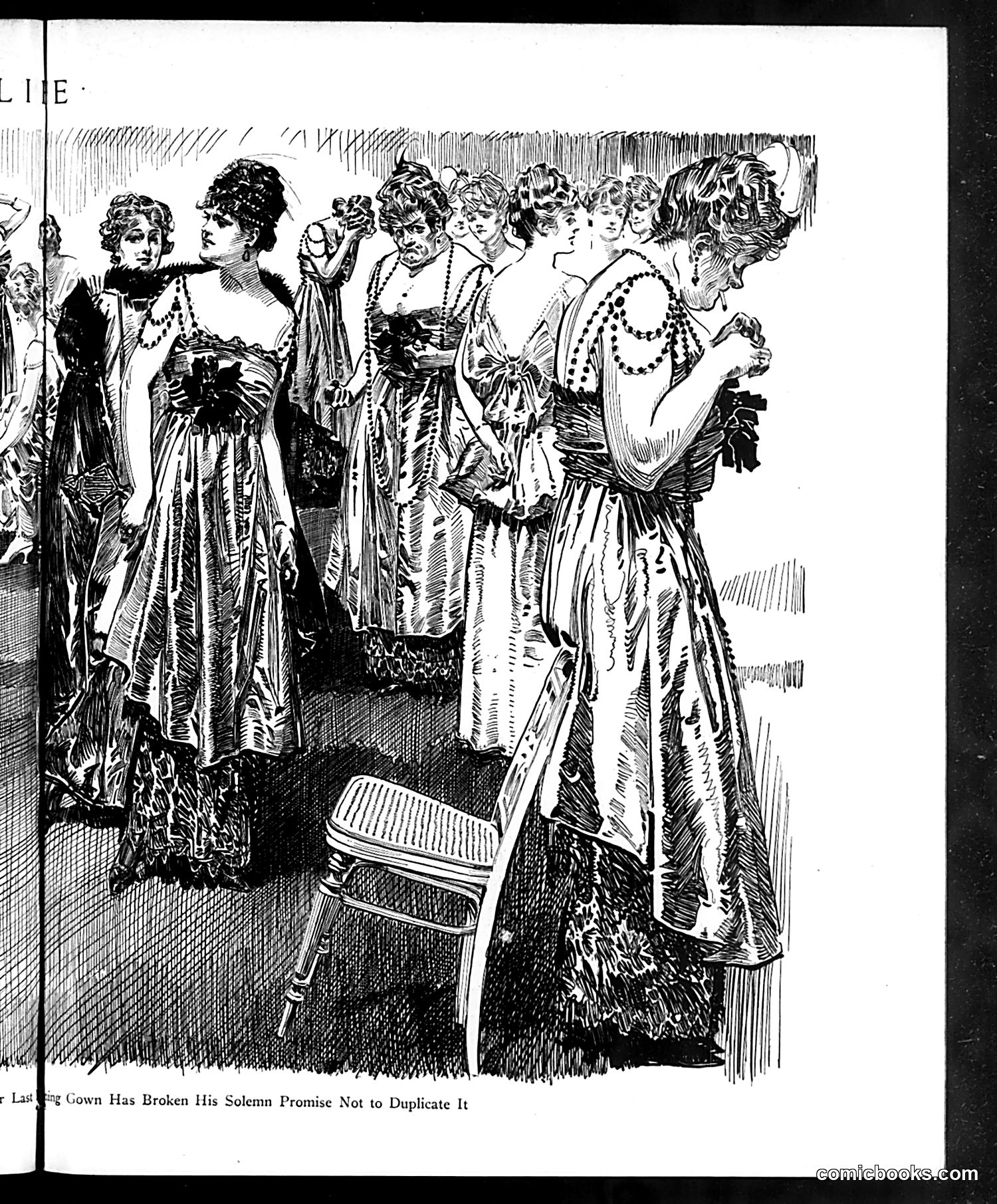
This Life magazine illustration depicts a formal social gathering of elegantly dressed women in early 20th-century fashion. The caption references "a Last Evening Gown" that has "broken his solemn promise not to duplicate it," suggesting satire about fashion designers or manufacturers. The joke appears to target the fashion industry's practice of creating "exclusive" or "one-of-a-kind" garments. The cartoon implies that a designer promised to never replicate a particular gown design, but multiple women are shown wearing apparently identical or nearly identical dresses at what seems to be an exclusive social event. This satirizes both the pretensions of high fashion and perhaps wealthy consumers' concerns about wearing the same dress as others—a significant social embarrassment in that era's upper-class circles. The humor lies in the broken exclusivity promise.
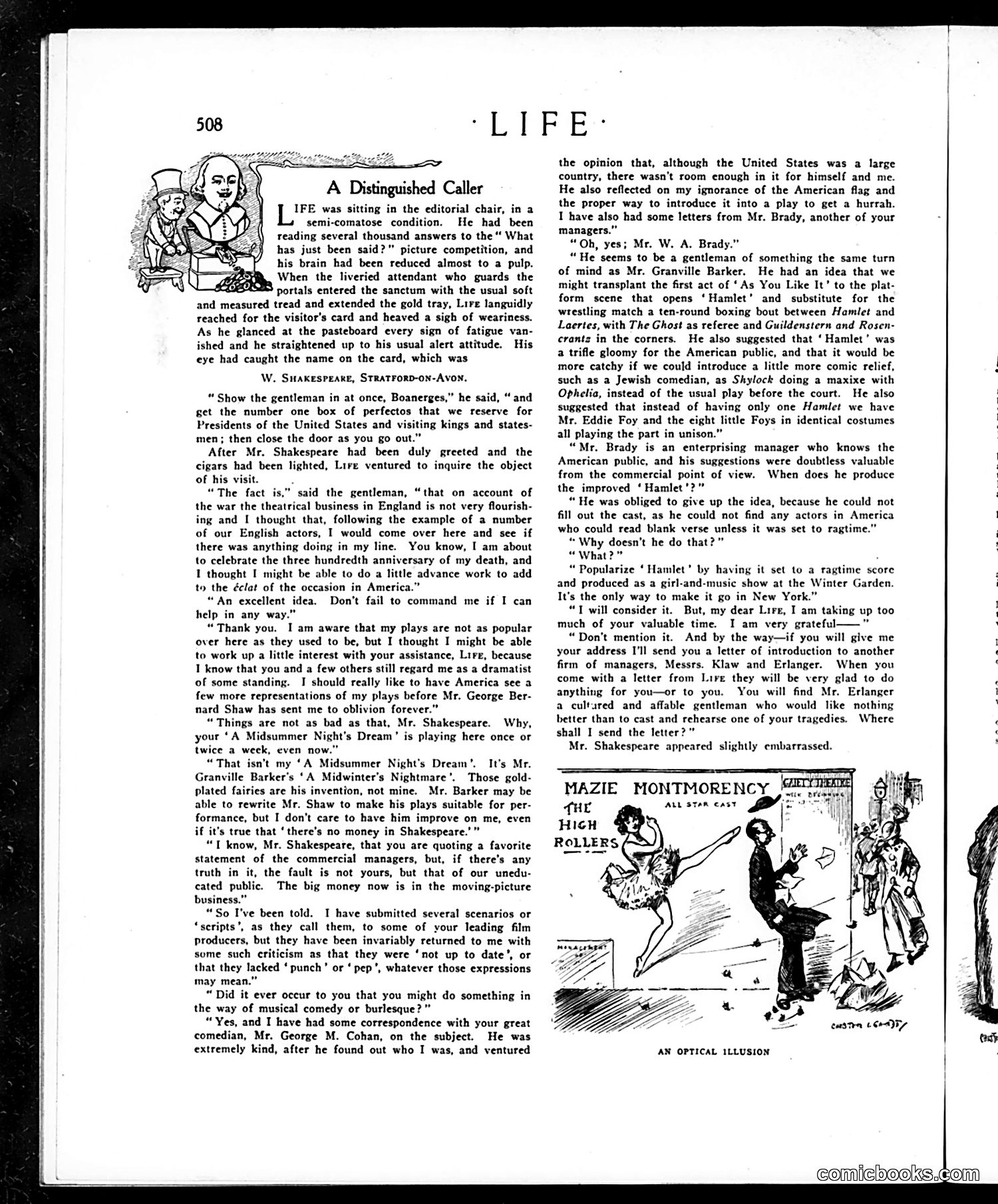
This satirical piece depicts **William Shakespeare** visiting Life magazine's editor during WWI to promote his works in America. The humor targets multiple subjects: **The Setup:** Shakespeare, preparing for the 300th anniversary of his death, seeks assistance boosting American interest in his plays, which he claims have waned. **The Satire Points:** 1. **Granville Barker's adaptations**: Shakespeare complains that Barker's "Midsummer Night's Dream" production (with "gold-plated fairies") misrepresents his work—mocking contemporary theatrical directors who heavily reimagined classics. 2. **Moving pictures over Shakespeare**: The editor notes film now makes real money, suggesting Americans prefer cinema to stage classics. 3. **George M. Cohan's dismissal**: The famous American composer/performer reportedly told Shakespeare there wasn't room for both of them in America—a joke about ego and commercial competition. 4. **"No money in Shakespeare"**: A recurring complaint that managers cite to justify ignoring classic drama for more commercial entertainment. The cartoon satirizes early 20th-century American popular taste, theatrical commercialism, and the struggle of high culture against emerging mass entertainment.
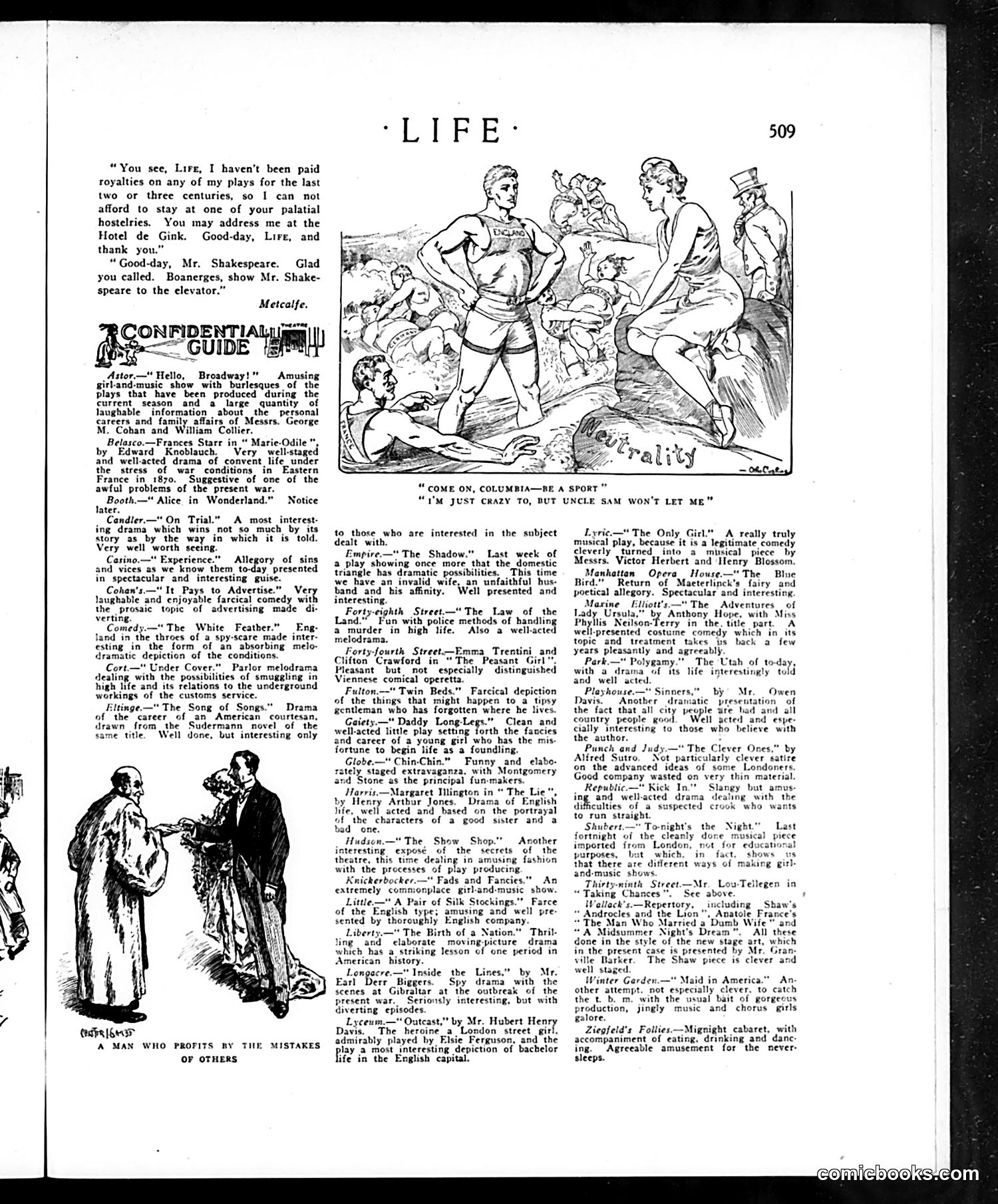
The page contains two distinct elements: **Main Cartoon:** "Come On, Columbia—Be a Sport" depicts a negotiation between two figures. One (labeled "Columbia," representing the United States) appears reluctant while the other (likely representing a European nation during WWI) pleads for participation. The caption reveals Uncle Sam (America) is preventing Columbia from joining what appears to be World War I combat. This reflects the pre-1917 American debate over neutrality versus intervention in the European conflict. **Lower Cartoon:** "A Man Who Profits by the Mistakes of Others" shows two figures in discussion, illustrating a moral lesson about opportunism—though the specific context isn't entirely clear from the visible text. The remainder is a theater review guide ("Confidential Guide") listing Broadway productions with brief critiques, typical of Life's entertainment coverage during this era. The page satirizes American isolationism while documenting contemporary theatrical offerings.
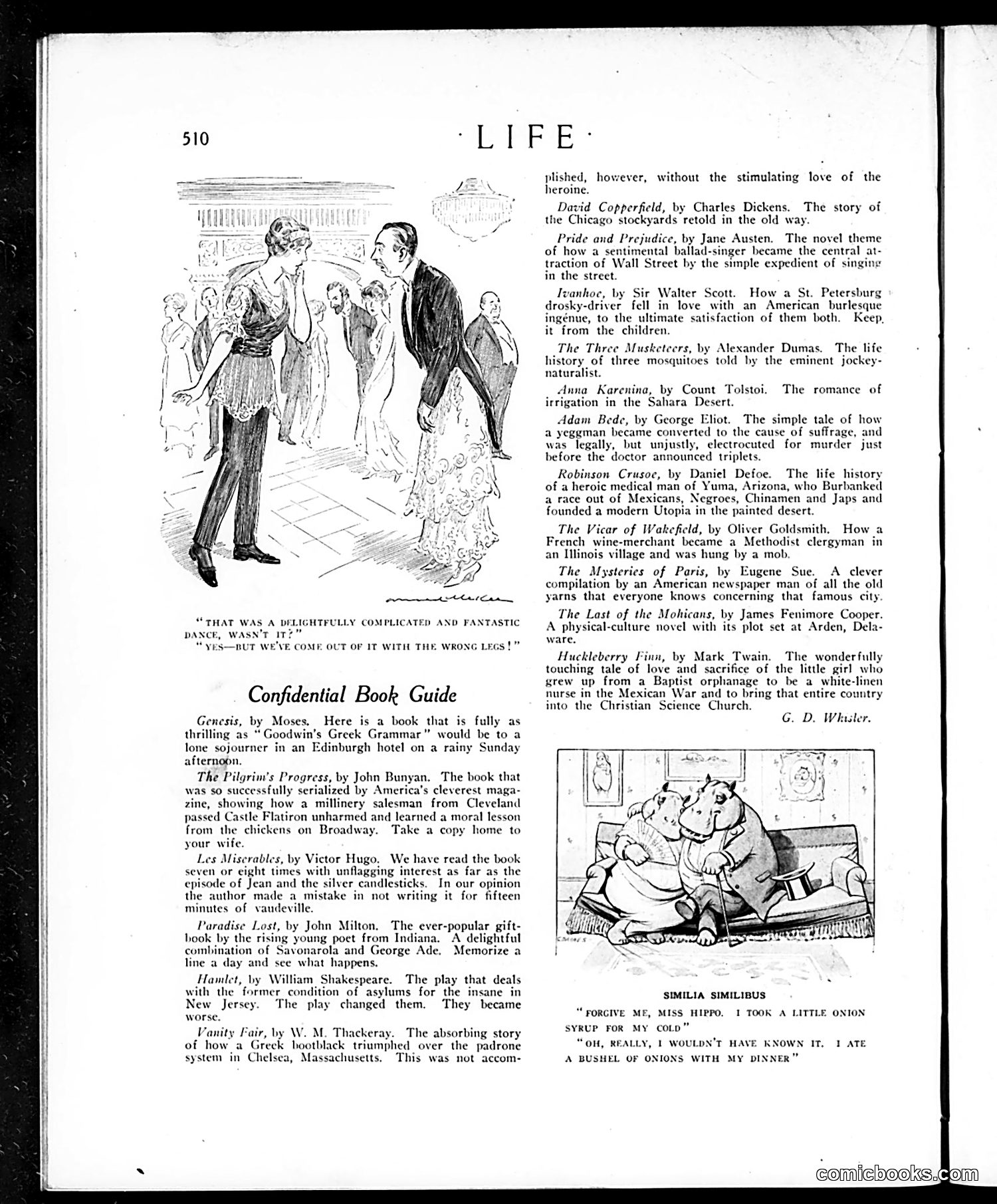
**Top Cartoon:** A couple exits a dance, with the woman remarking their dance was "delightfully complicated and fantastic," but they've "come out of it with the wrong legs!" This is a visual pun—the sketch shows them literally tangled or mismatched in their limbs, satirizing either dancing fads of the era or the general confusion of modern social life. **"Confidential Book Guide":** This is satirical literary criticism mocking famous classics by wildly misrepresenting their plots. Examples: *Genesis* compared to a Greek grammar book; *Les Misérables* claimed the author should have written only fifteen minutes for vaudeville; *Hamlet* described as about "former condition of asylums" in New Jersey. The humor targets both pretentious literary culture and readers unfamiliar with these works. **Bottom Cartoon ("Similia Similibus"):** A hippo tells Miss Hippo she needn't apologize for onion breath since the hippo ate "a bushel of onions with my dinner"—crude humor about offensive odors neutralizing each other.
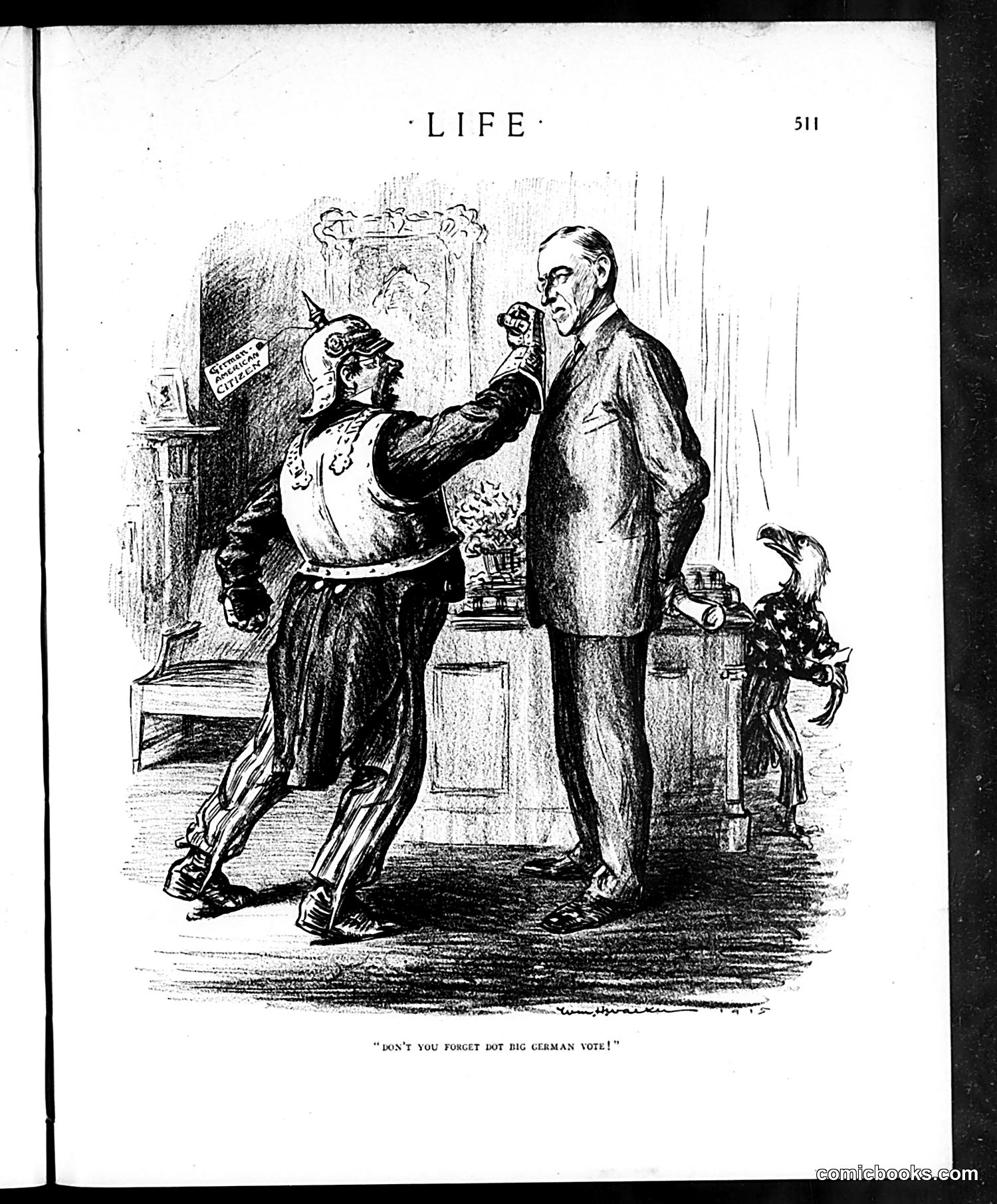
This Life magazine cartoon satirizes German-American voters and their political influence. A well-dressed man in civilian clothes (likely representing a political operative or candidate) is being reminded by a military or uniformed figure with exaggerated German features to remember "dot big German vote" — using dialect to emphasize the German-American identity. The cartoon appears to critique politicians courting the German-American voting bloc, possibly during a period of German-American political significance (likely early 20th century). The satire suggests pandering to ethnic voting groups and the outsized influence of bloc voting in American politics. The figure's military uniform and the emphasis on "the German vote" as a distinct political force suggests this addresses ethnic voting patterns and nativist anxieties about German-American political power.
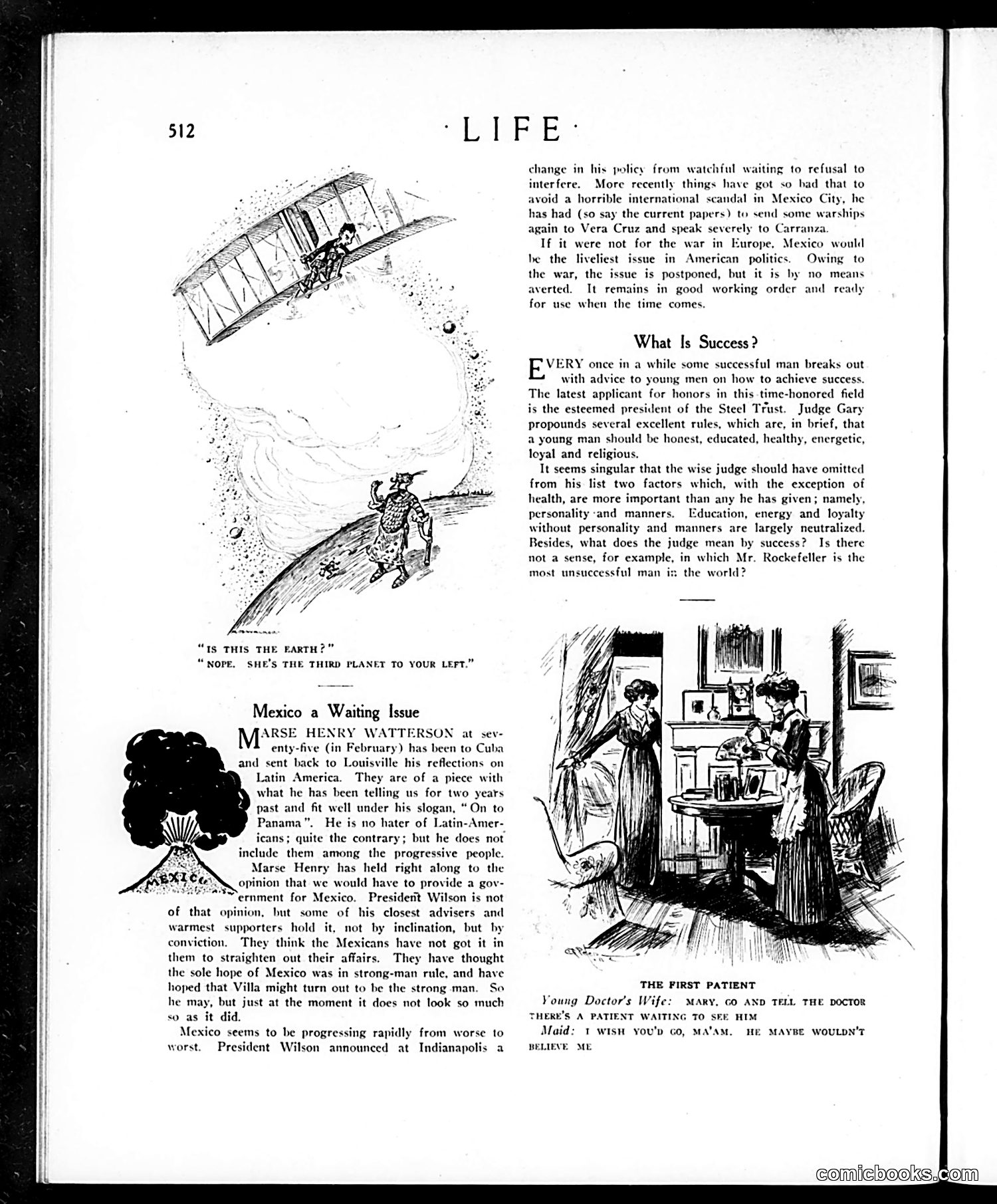
**Main Articles:** The page discusses two political issues: **Mexico** under President Wilson's foreign policy (mentions Vera Cruz, Carranza, Villa—referencing the Mexican Revolution and U.S. intervention debates) and **"What Is Success?"**—a satirical response to Judge Gary of the Steel Trust's advice to young men. The satire argues Gary omitted crucial factors like personality and manners, and ironically questions whether wealthy industrialist Rockefeller might actually be "unsuccessful" by moral standards. **Cartoons:** The top illustration shows a couple on Earth observing another planet, with the caption "Is this the Earth?" / "Nope, she's the third planet to your left"—likely satirizing confusion or planetary/cosmic themes. The bottom sketch depicts a domestic scene where a young doctor's wife tells him a patient is waiting, but the maid doubts he'll believe her—apparently joking about the doctor's absence or inattention. These are lighthearted domestic and observational humor pieces typical of *Life* magazine's satirical format.
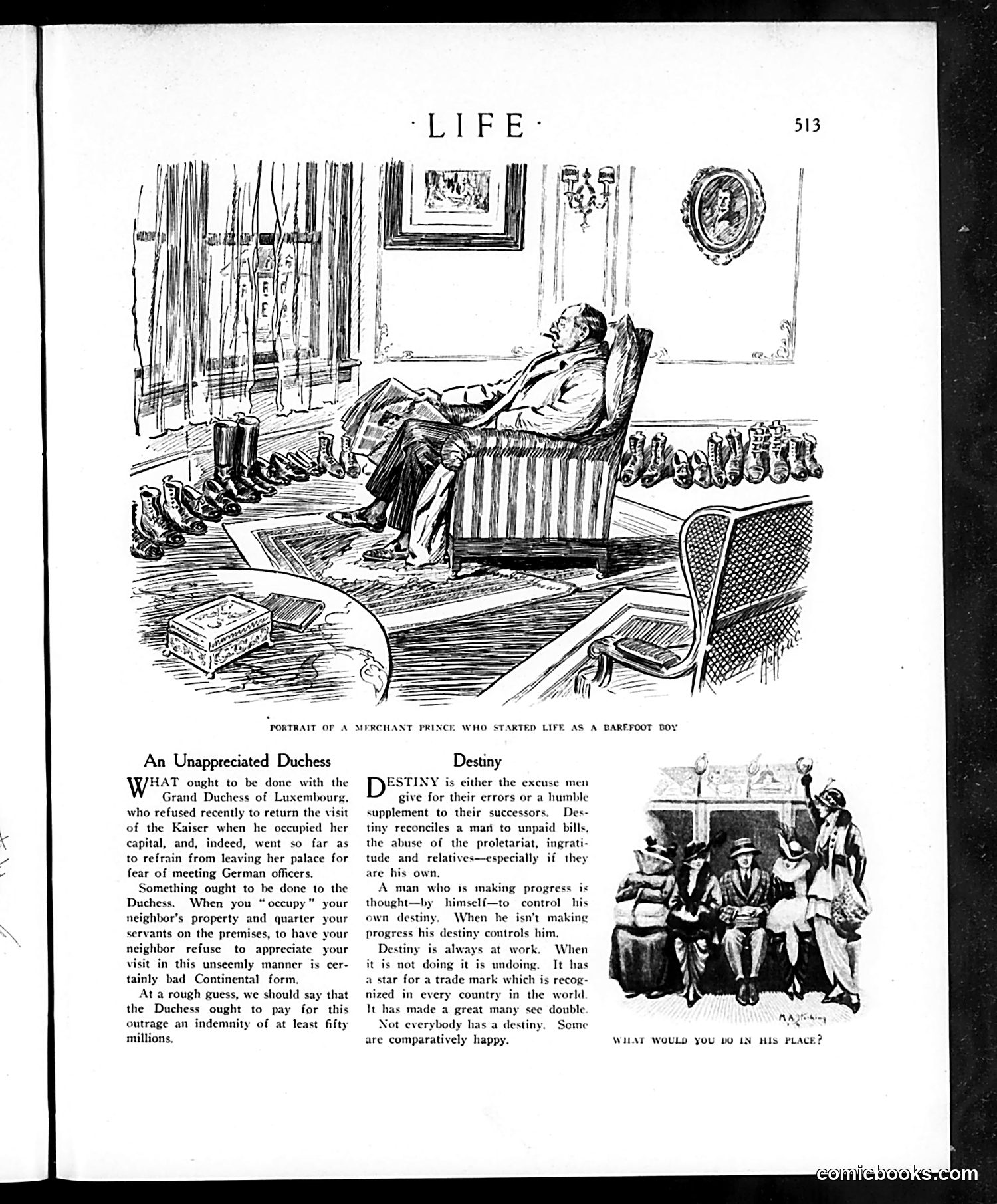
**Top Cartoon:** Satirizes the Grand Duchess of Luxembourg's refusal to visit the Kaiser during German occupation. The text mockingly suggests she owes Germany financial reparations ("fifty millions") for the "insult" of not appreciating the German occupation of her country. This is clearly ironic—Life attacks German imperial arrogance by sarcastically endorsing its absurd logic: occupying a neighbor's territory and then expecting gratitude. The cartoon critiques both German imperial presumption and, implicitly, continental power politics. **Bottom Section:** Two pieces—a philosophical essay on "Destiny" (justifying inequality through fatalism) and an illustration asking "What Would You Do In His Place?" accompanying a story titled "Portrait of a Merchant Prince Who Started Life as a Barefoot Boy" (depicting a wealthy man surrounded by shoes, suggesting his rise from poverty). The page juxtaposes political satire with aspirational Americana, typical of *Life* magazine's early 20th-century format.
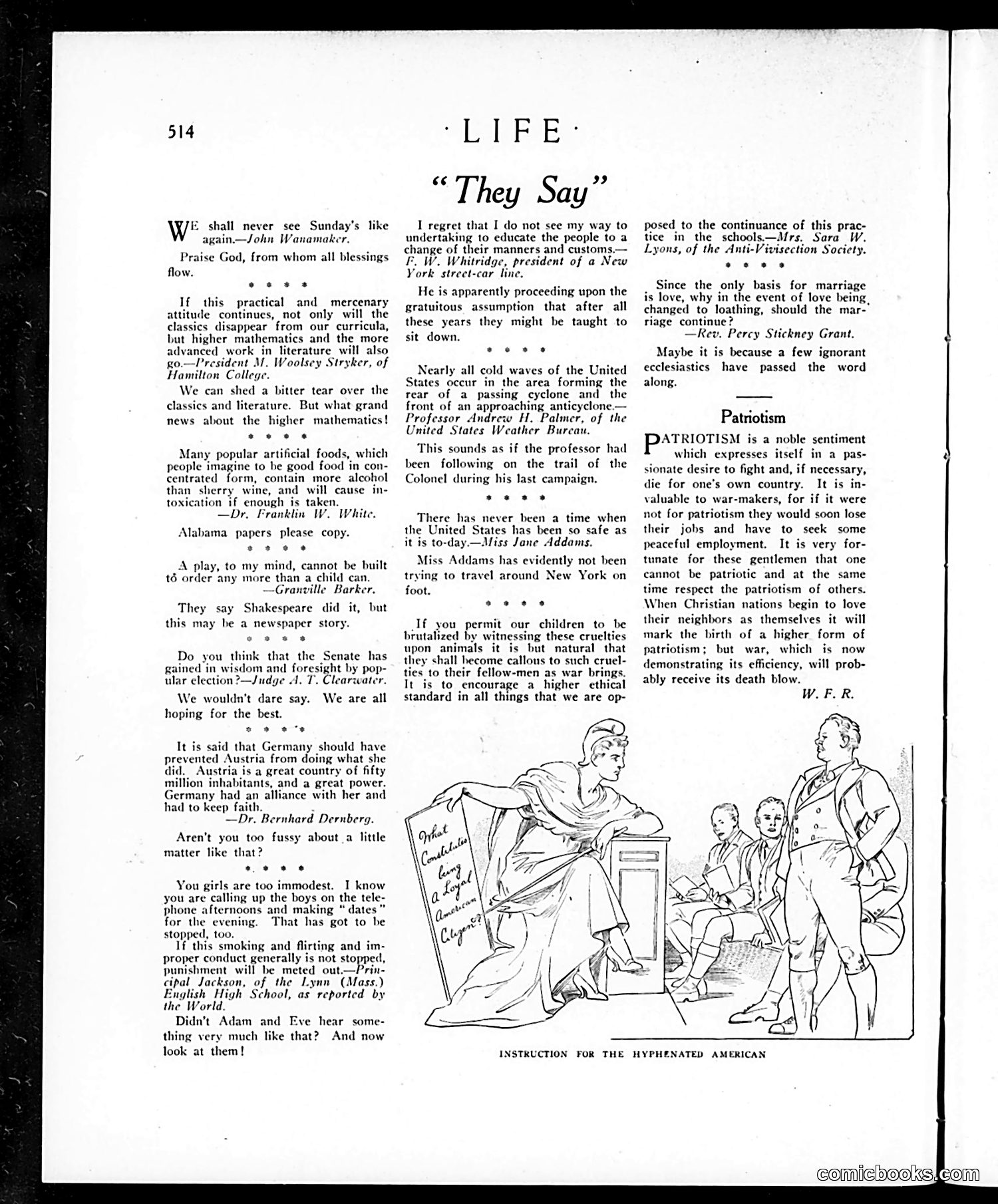
This is a satirical humor column featuring a collection of brief quotations paired with witty rejoinders. The page mocks public figures and their statements through ironic commentary. **Key targets include:** - **John Wanamaker** (retail magnate): Quoted lamenting lost "Sundays," met with sarcasm about losing mathematics education instead - **F.W. Whitridge** (streetcar company president): Claims he won't educate people to better manners; the joke implies he won't teach passengers to sit down properly - **Miss Jane Addams** (social reformer): Says America is "safe," contradicted by the witty response about dangerous New York street travel - **Principal Jackson** (Lynn High School): Forbids girls calling boys and flirting; the retort compares his prudishness to Adam and Eve's futility **The cartoon** (captioned "Instruction for the Hyphenated American") depicts Lady Liberty instructing immigrant or hyphenated-American children, satirizing debates over Americanization and immigrant assimilation during the Progressive Era. The column's broader satire targets self-important authority figures whose pronouncements reveal hypocrisy or disconnection from reality.
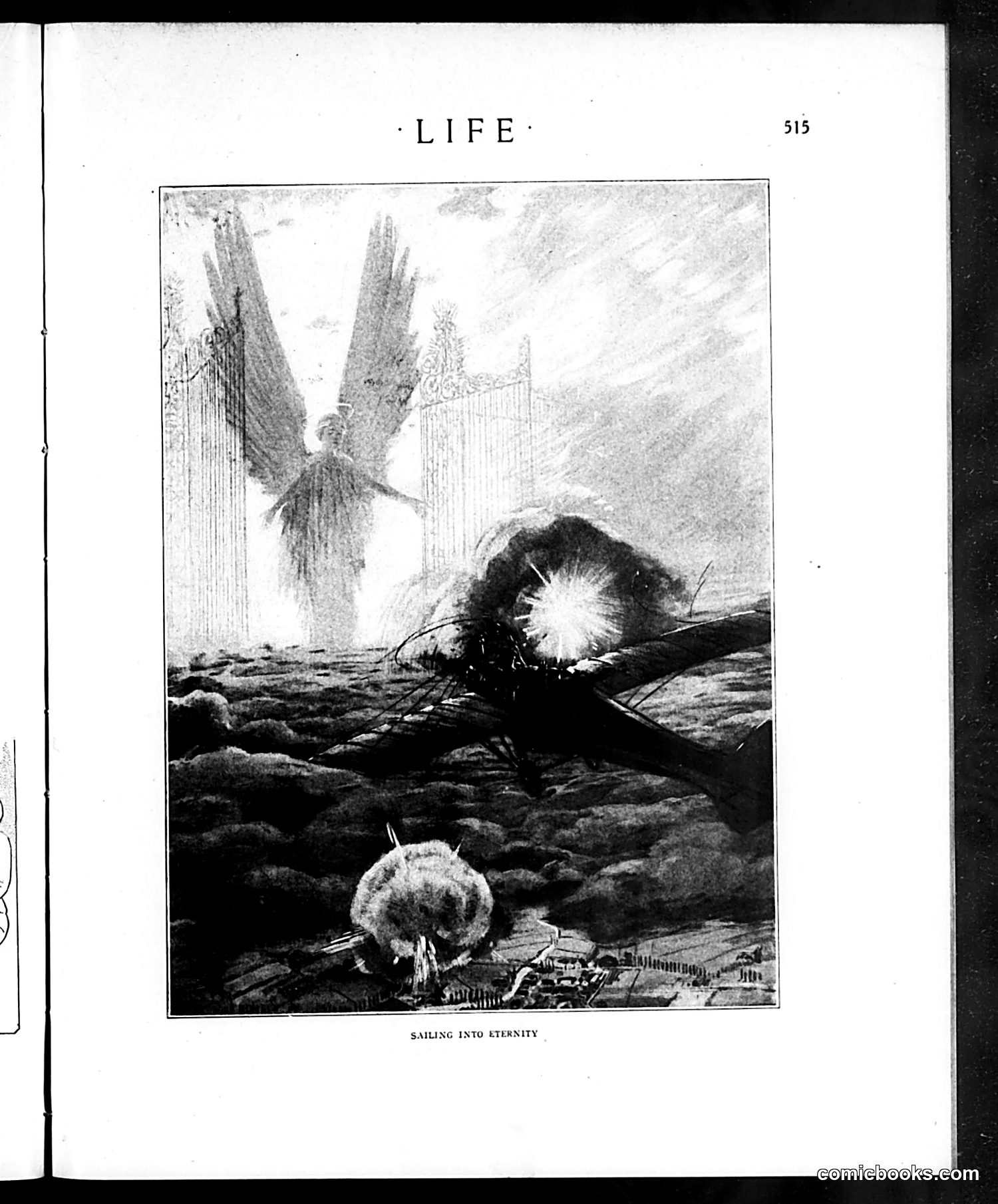
This illustration depicts winged figures (appearing to be angels or souls) ascending heavenward above a dark earthly landscape with buildings below. The title "Sailing Into Eternity" suggests a spiritual or allegorical journey toward the afterlife. Without additional context from the magazine issue, the specific satirical target remains unclear. However, given Life magazine's tradition of social and political satire, this could reference: - A contemporary death or tragedy (political figure, public scandal) - Commentary on mortality, fate, or divine judgment - Possibly a critique of war casualties or another mass-death event The romantic, somewhat ethereal artistic style contrasts with the dark ground imagery, which may underscore irony about the transition from earthly to spiritual realms. The exact historical reference would require knowing the publication date and surrounding articles.
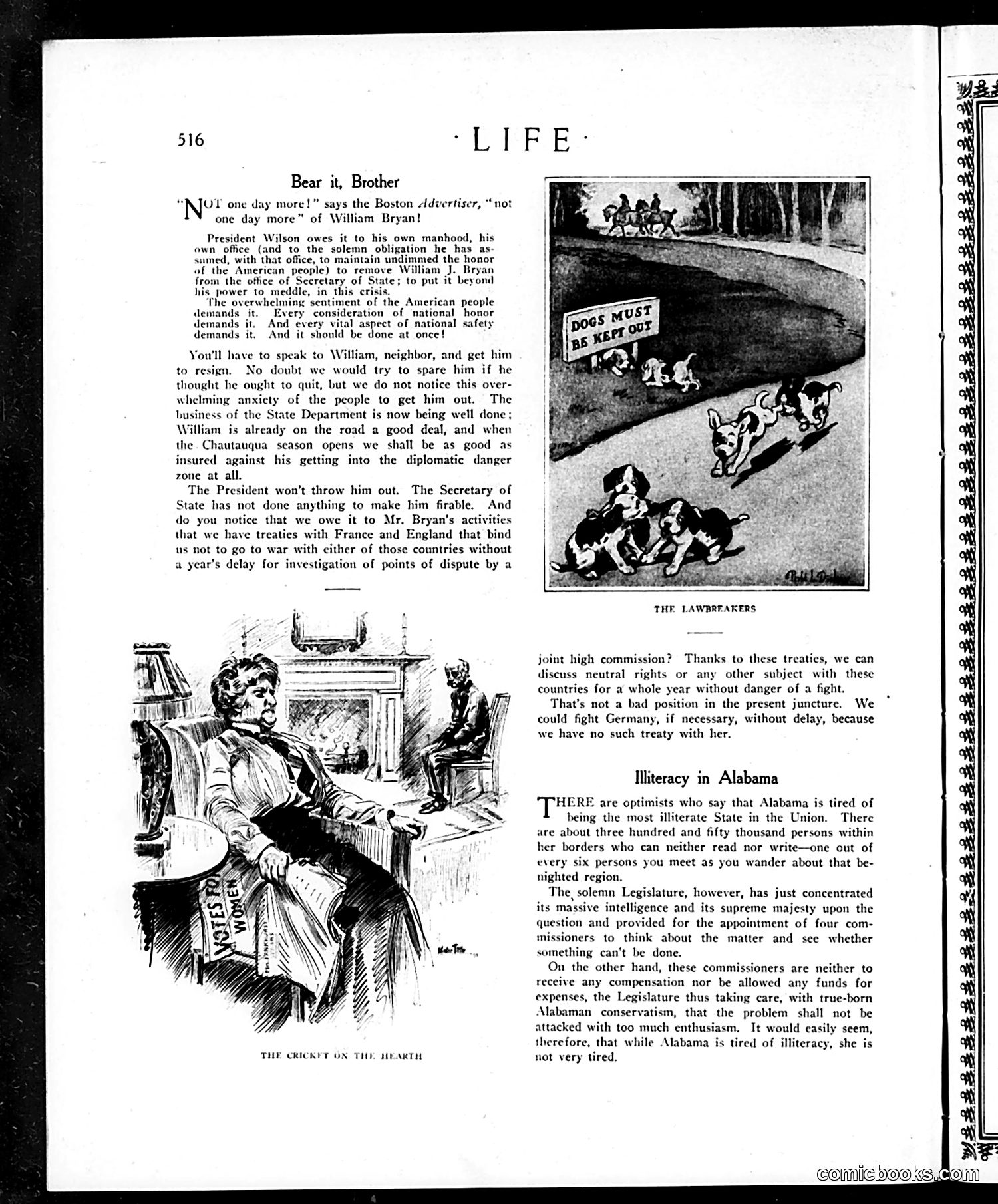
**"Bear it, Brother"** (top): Editorial cartoon satirizing calls for President Wilson to fire Secretary of State William Jennings Bryan. The Boston *Advertiser* demands Bryan's removal due to his pacifist policies during the WWI era. The cartoon depicts this as Wilson's domestic burden—he must "bear" the political pressure. Bryan actually favored negotiation treaties with France and England (mentioned in text) to delay war declarations, which the article ironically notes is strategically sound, unlike similar constraints with Germany. **"The Lawbreakers"** (right): Shows dogs labeled "DOGS MUST BE KEPT OUT" breaking through a fence—likely satirizing selective law enforcement or hypocrisy regarding regulations. **"Illiteracy in Alabama"** (lower): Mocks Alabama's Legislature for appointing four commissioners to address the state's severe illiteracy problem (one in six residents cannot read/write) while providing them no compensation or funding. The satire highlights performative action without genuine commitment to reform. The cartoon titled **"The Cricket on the Hearth"** appears partially cut off.
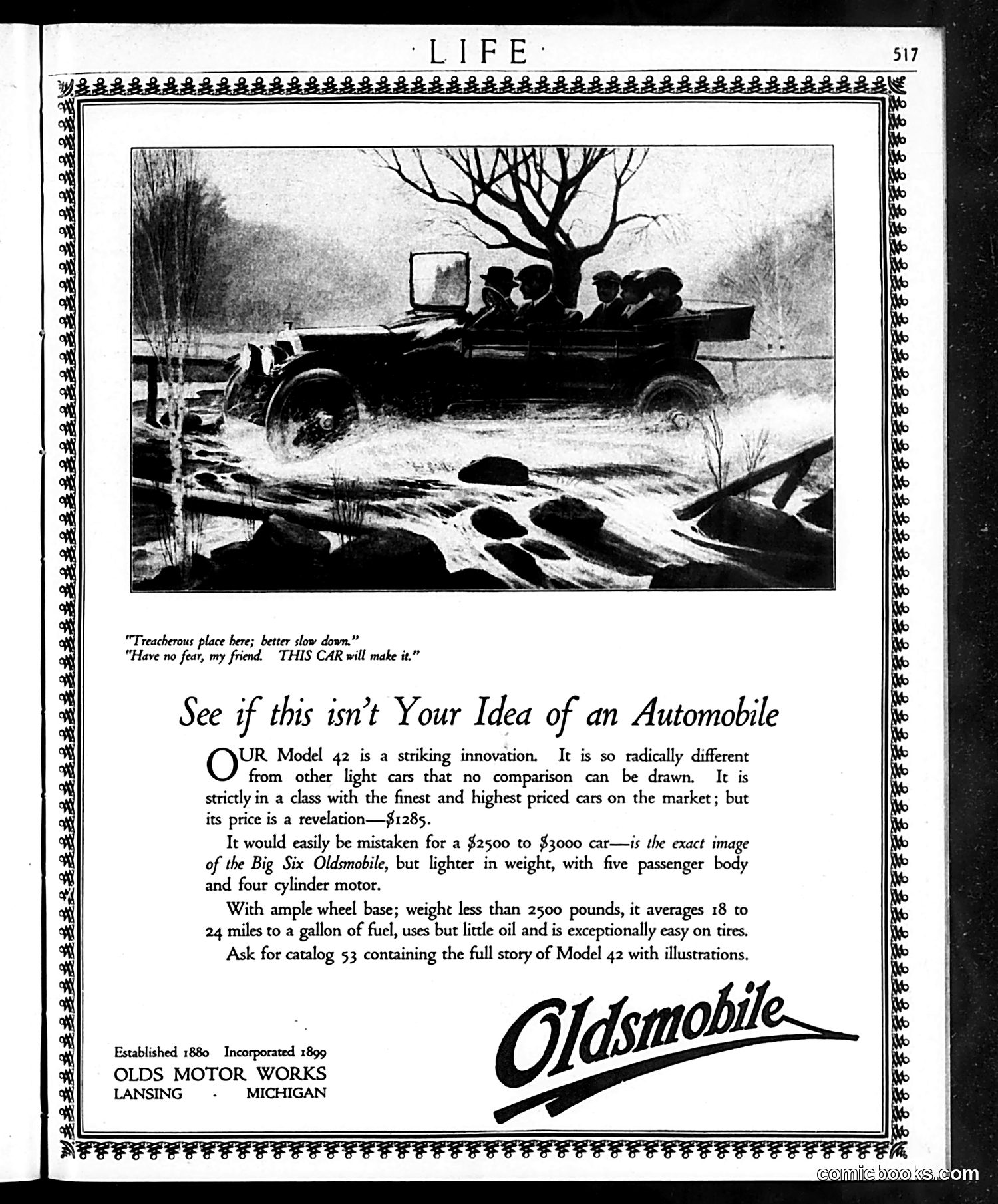
This is **not a cartoon or satire, but a straightforward automobile advertisement** for the Oldsmobile Model 42. The image shows a car successfully navigating treacherous terrain (a stream crossing), with passengers reassuring each other about the vehicle's capability. The advertisement's appeal rests on a key selling point for the era: **capability at an affordable price**. The copywriting emphasizes value—$1,285 for a car that resembles luxury models costing $2,500–$3,000. Key selling features highlight practical concerns of early automobile owners: fuel efficiency (18–24 miles per gallon), low oil consumption, and tire durability. The illustration of rugged terrain demonstrates reliability and durability. This reflects early-1900s automotive marketing, when cars were luxury goods and manufacturers competed by emphasizing both prestige and practical performance rather than styling.
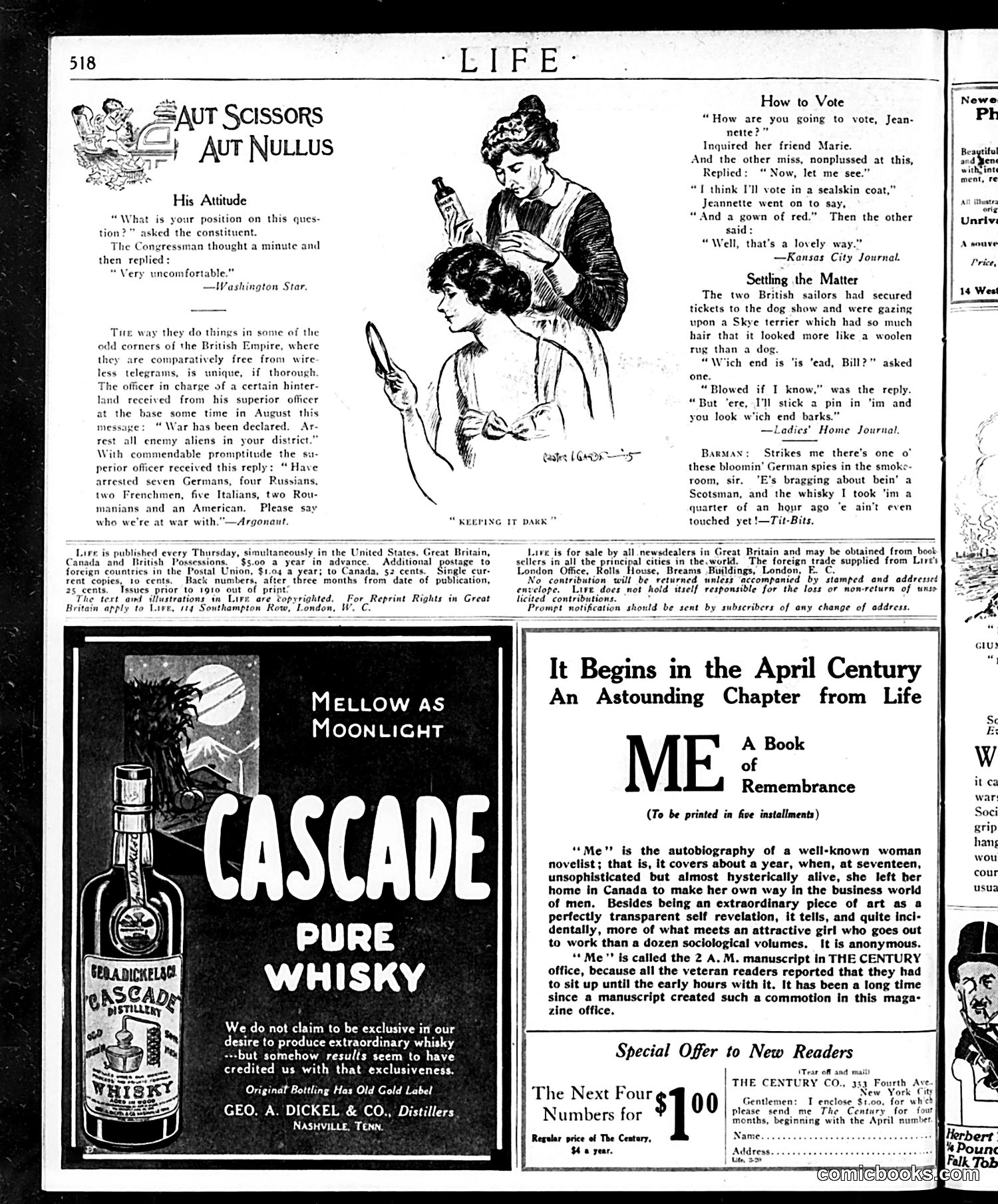
This page from *Life* magazine (circa 1910s) contains several satirical short jokes and advertisements: **"His Attitude"** mocks a politician's non-answer to a constituent's question about his position—he claims to feel "very uncomfortable," a joke about evasive politicians. **"Keeping It Dark"** cartoons a British military bureaucrat who arrests enemy aliens without knowing which country he's at war with, satirizing imperial inefficiency and confusion during wartime. **The dog-show joke** features two British sailors unable to distinguish which end of a shaggy Skye terrier is its head—humor based on working-class dialect and absurdist observation. **The barman anecdote** suggests a suspected German spy in a bar isn't drinking his whisky, implying Germans (or spies) can be identified by suspicious behavior—Cold War-era spy paranoia humor. The page is primarily **advertising and content filler**, with a Cascade Whisky ad and promotion for an autobiography serialization taking significant space.
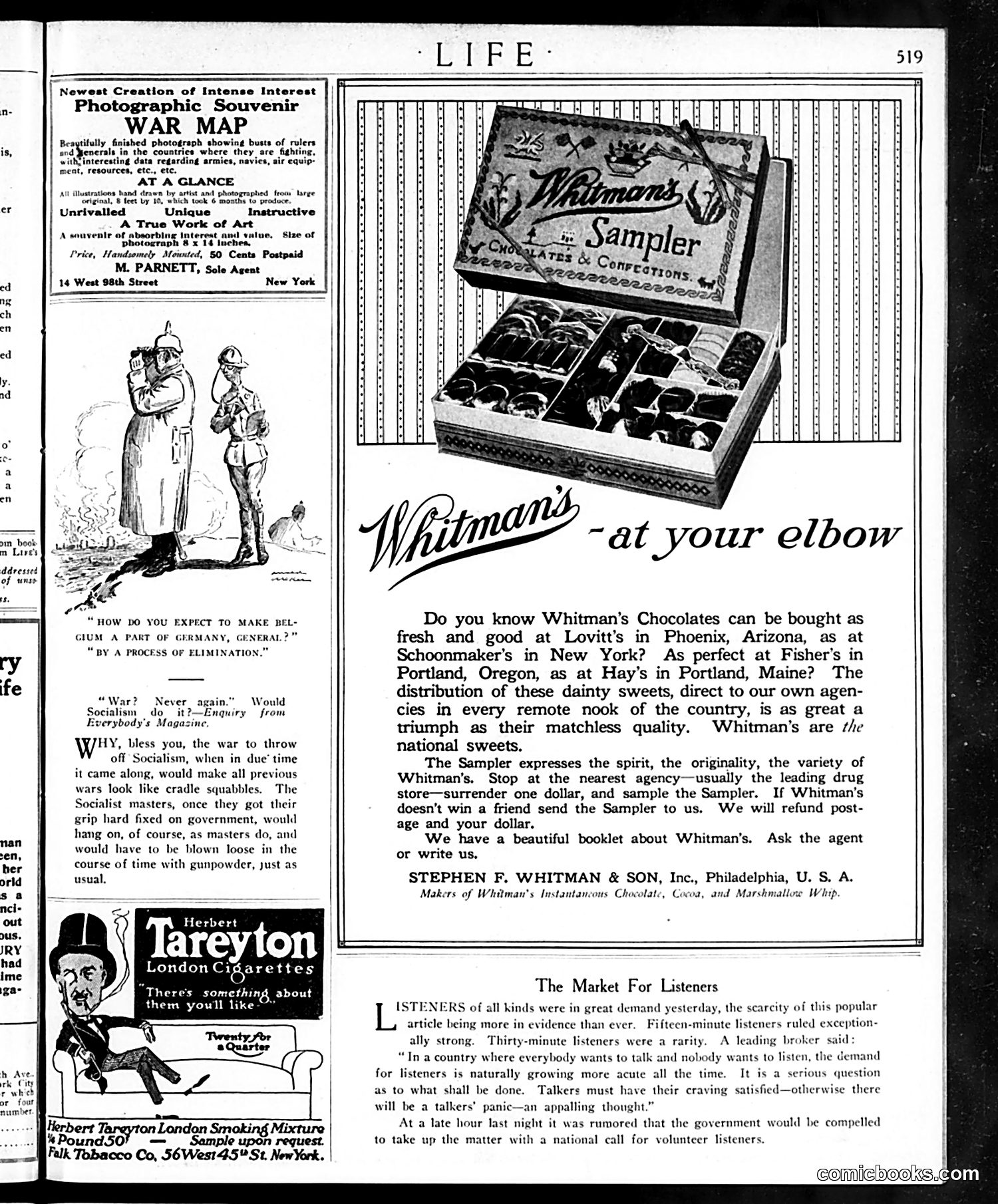
This page contains **wartime political satire from WWI era**. The main cartoon depicts a dialogue between a civilian and a German general about annexing Belgium. When asked "How do you expect to make Belgium a part of Germany, General?" the general replies "By a process of elimination"—a dark joke implying genocide or forced expulsion of the Belgian population. Below this, text satirizes **Socialist concerns** about post-war government, warning that if Socialists gained power, they'd be as authoritarian as the militarists currently fighting the war. The bottom article, "The Market For Listeners," uses **economic metaphor to mock American social problems**: it facetiously describes a shortage of people willing to listen (as opposed to talk), suggesting Americans are so self-absorbed that even a government "call for volunteer listeners" might be needed. This is gentle satire on vanity and poor conversation habits. The page is otherwise filled with **period product advertisements** (Whitman's chocolates, cigarettes).
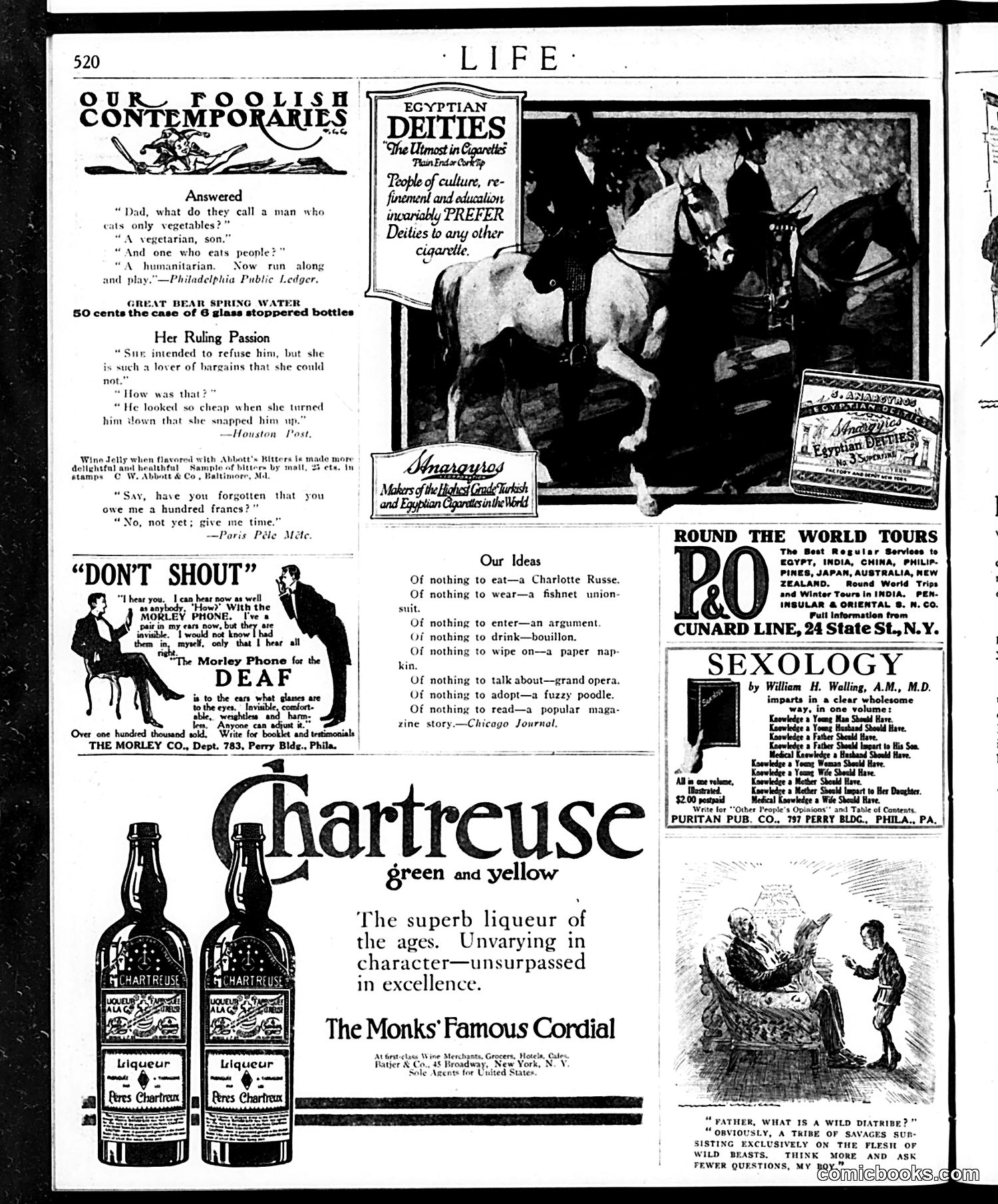
This page is primarily **advertising and humor filler**, typical of Life's satirical format. The main content includes: **"Our Foolish Contemporaries"** - A series of short jokes mocking contemporary society, including exchanges about vegetarians/humanitarians and a woman who accepts a suitor because he looked "cheap." **"Don't Shout"** - An advertisement for Morley Phones, using humor about deafness to pitch the product's superior sound quality. **"Our Ideas"** - A brief satirical list (likely from *Chicago Journal*) of mundane things people worry about—eating, clothing, drinking—presented as if they were profound philosophical concerns. The remaining content is straightforward **product advertising**: Egyptian Deities cigarettes, Great Bear Spring Water, Chartreuse liqueur, P&O cruise lines, and a sexology book. The "Egyptian Deities" cigarette ad is notable for its cultural appropriation—using exotic imagery to market cigarettes to educated consumers. No political commentary is evident; this reflects period advertising norms.
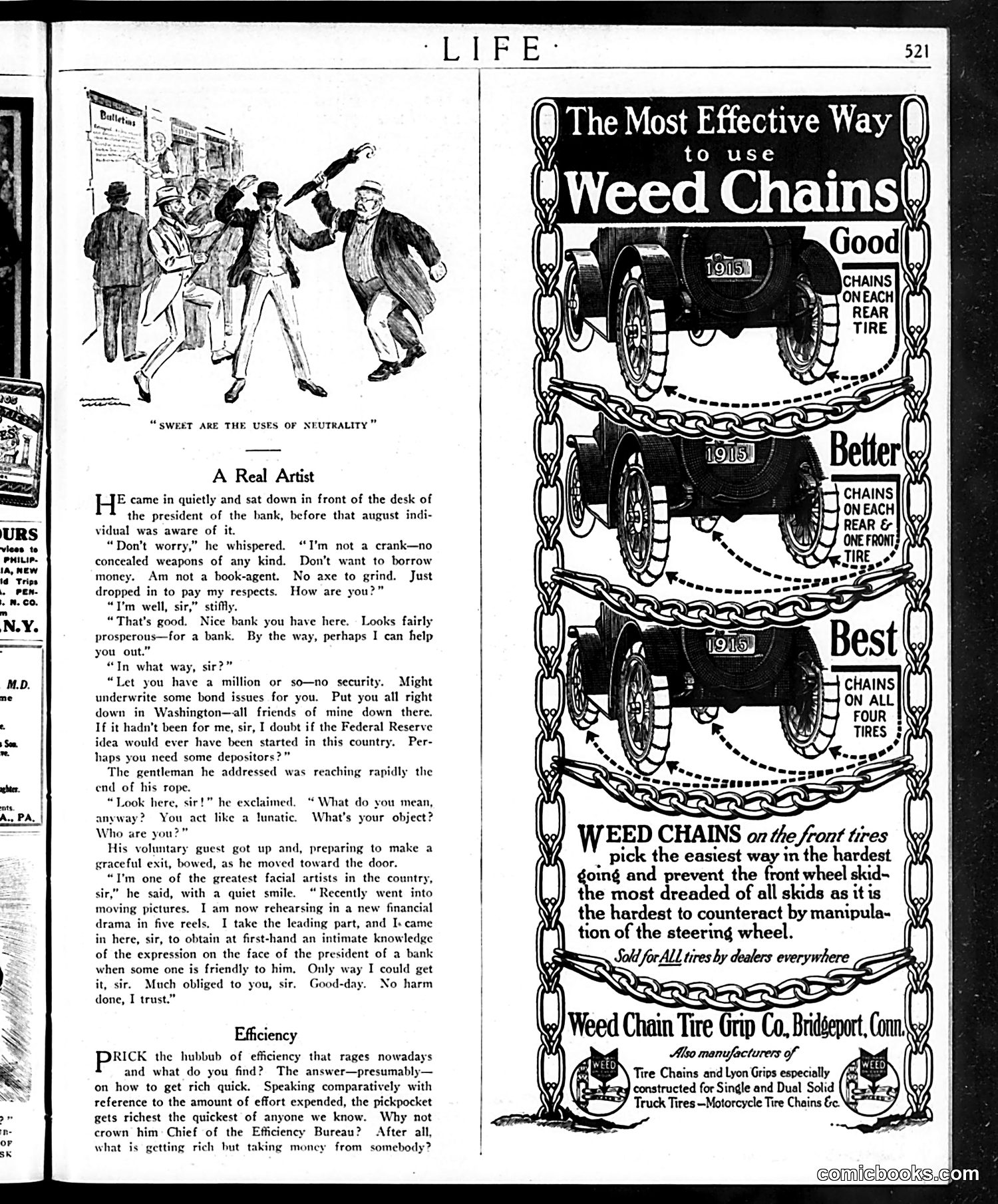
**Left side - "A Real Artist" cartoon/story:** This satirizes a con artist who infiltrates a bank president's office claiming various implausible connections (Federal Reserve creation, Washington influence, financial assistance). The banker grows increasingly frustrated. The punchline reveals the visitor is actually a "facial artist" studying the banker's expression for a movie he's rehearsing—the entire visit was theatrical manipulation. It mocks both con-artist audacity and wealthy men's gullibility. **"Efficiency" section:** This brief satire critiques the era's obsession with efficiency and wealth-building by suggesting that pickpockets are actually the most efficient wealth-getters relative to effort expended. It's cynical commentary questioning whether capitalist "success" differs morally from theft. **Right side:** Weed Chain tire advertisement showing product placement on automobile wheels—standard commercial messaging, not editorial content. The page combines satirical commentary on 1910s-20s American capitalism, bank systems, and social ambition with period advertising.
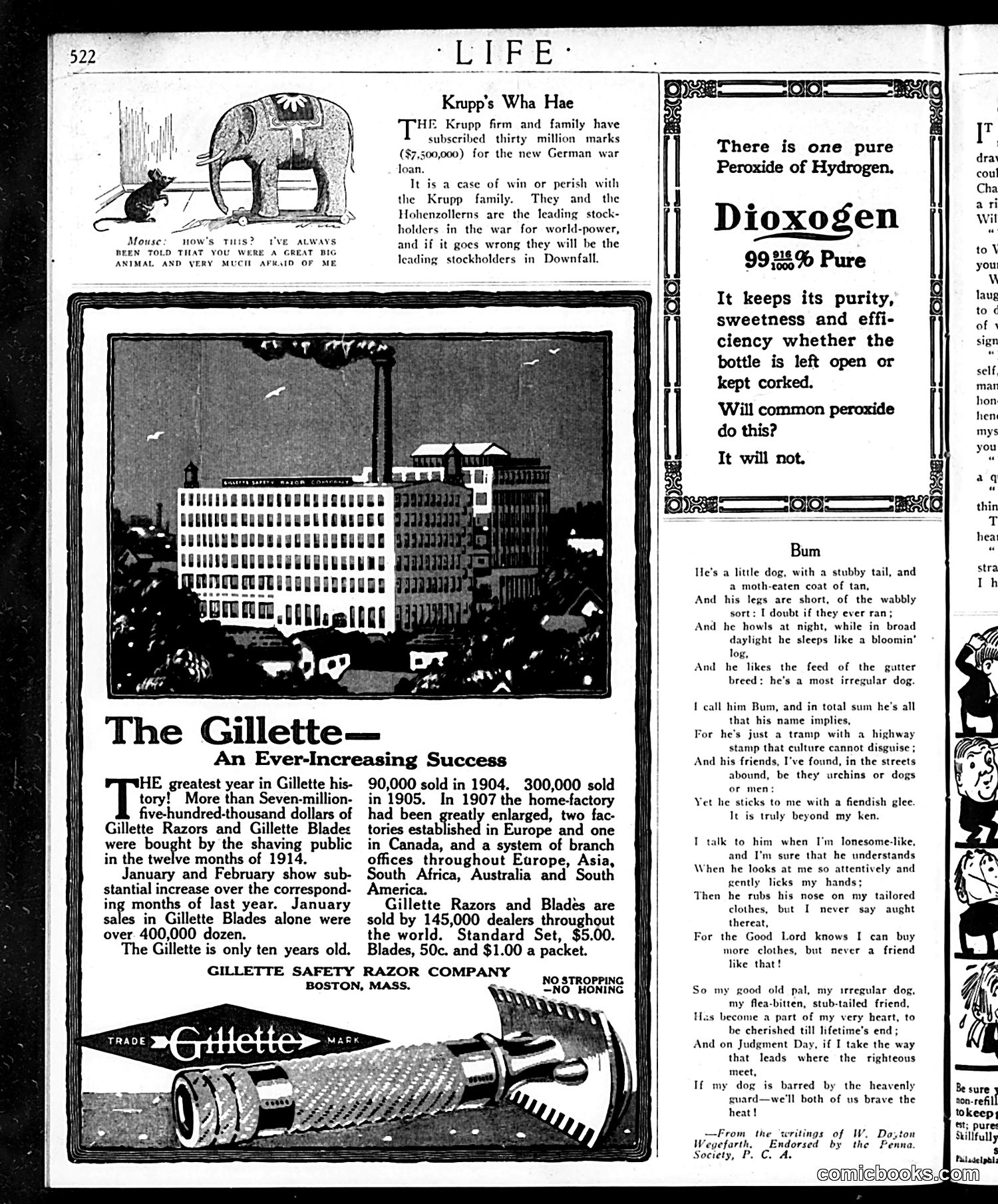
This page contains **satirical commentary and advertisements** from an American magazine during World War I. The main cartoon depicts a **mouse confronting an elephant**, with the mouse sarcastically noting the elephant's supposed size and fearfulness. This illustrates the article "Krupp's Wha Hae," which criticizes the German **Krupp industrial family** for investing 30 million marks in German war bonds. The satire suggests that despite the Krupps' apparent power and dominance in German wartime industry, they face existential risk—if Germany loses the war, their fortunes will collapse entirely. The mouse-versus-elephant reversal mocks their precarious position. The page also contains straightforward **product advertisements** (Gillette razors, Dioxogen peroxide) and a sentimental poem titled **"Bum"** about an affectionate stray dog, which serves as filler content typical of Life magazine's format. The Krupp satire reflects American skepticism toward German industrial-military power during the war.
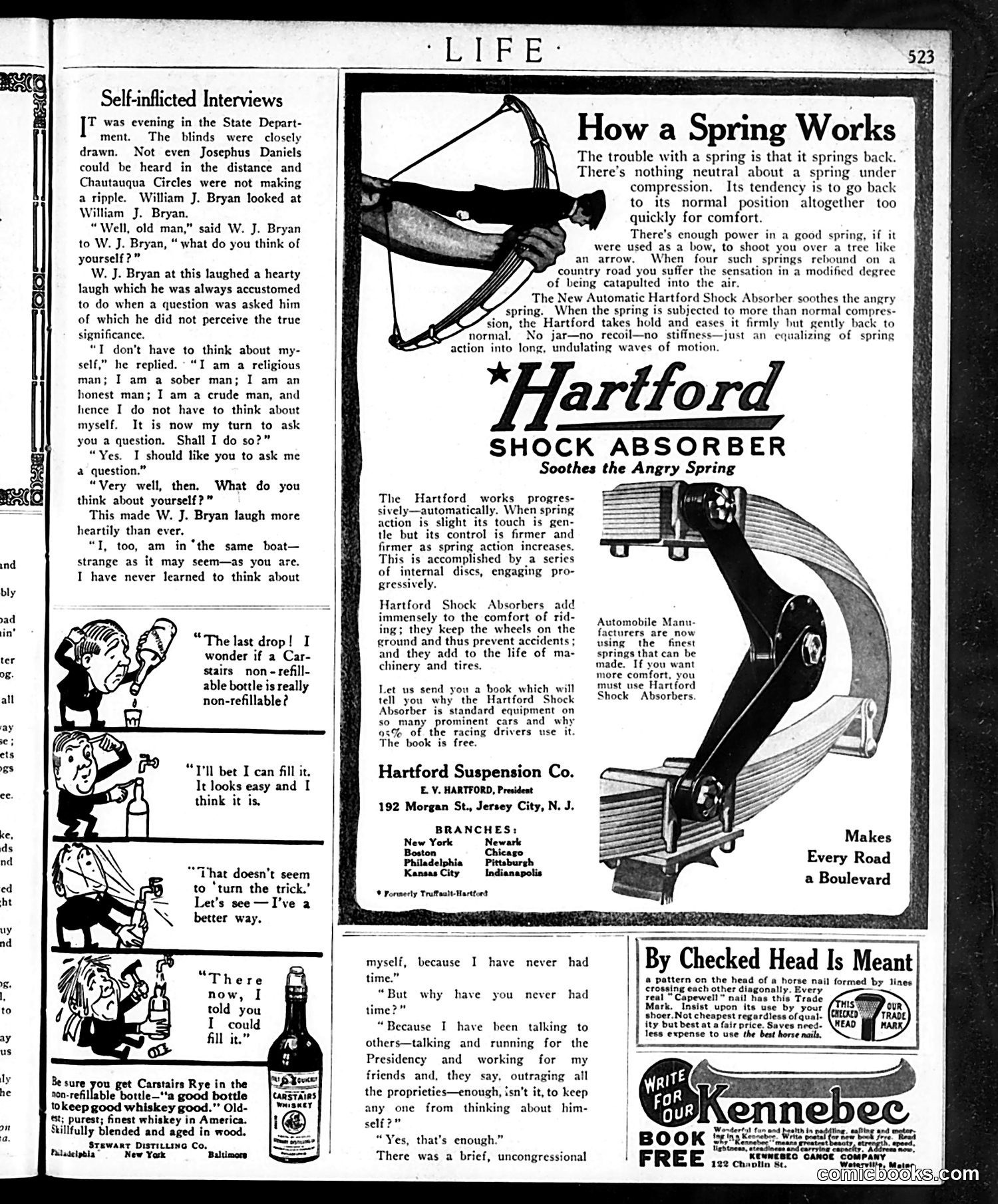
## Main Cartoon: "Self-Inflicted Interviews" This satirical piece mocks **William Jennings Bryan**, the three-time presidential candidate and then Secretary of State under Woodrow Wilson. The joke is that Bryan interviews *himself*—literally one Bryan asking the other Bryan questions. The satire targets Bryan's narcissism and tendency to avoid genuine self-reflection. When asked what he thinks of himself, he lists virtues ("religious," "sober," "honest") rather than truly examining himself. When his interviewer asks what *he* thinks of himself, Bryan responds identically—suggesting both men are equally self-absorbed and evasive. The final exchange is cutting: Bryan admits he's "never had time" to think about himself because he's been "talking and running for the Presidency...outraging all the proprieties." The implication is that Bryan's constant political activism and self-promotion prevent actual introspection—and that this self-centeredness is the point. ## Context This reflects 1920s progressive-era skepticism toward ambitious politicians, particularly Bryan, who was viewed by many intellectual circles as self-aggrandizing and out of touch. The page's remaining content is advertisements (Hartford shock absorbers, Carstairs whiskey, Kennebec products).
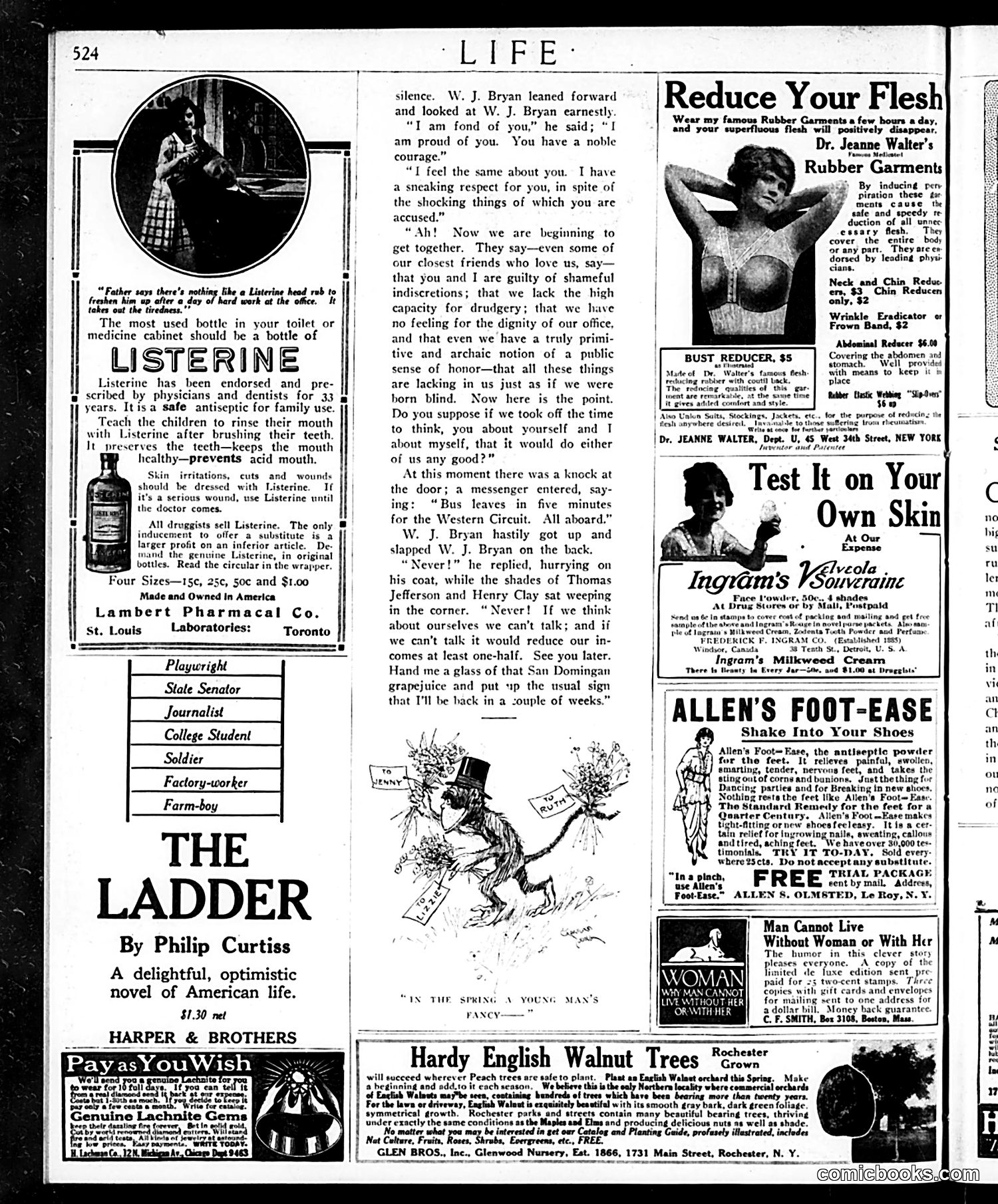
This page features a satirical dialogue between two figures both labeled "W. J. Bryan"—likely depicting William Jennings Bryan in conversation with himself. The humor mocks Bryan's political hypocrisy: he defends his integrity while simultaneously admitting that constant self-reflection would reduce his income, forcing him to abandon talking (and thus campaigning). The joke suggests Bryan's public righteousness conflicts with his mercenary motives—he can't afford the luxury of genuine introspection. The cartoon's visual joke of Bryan confronting his own reflection reinforces this self-aware irony about political duplicity. The page is otherwise dominated by period advertisements (Listerine, rubber reduction garments, foot powder) typical of 1910s-era magazines, offering little additional satirical content.
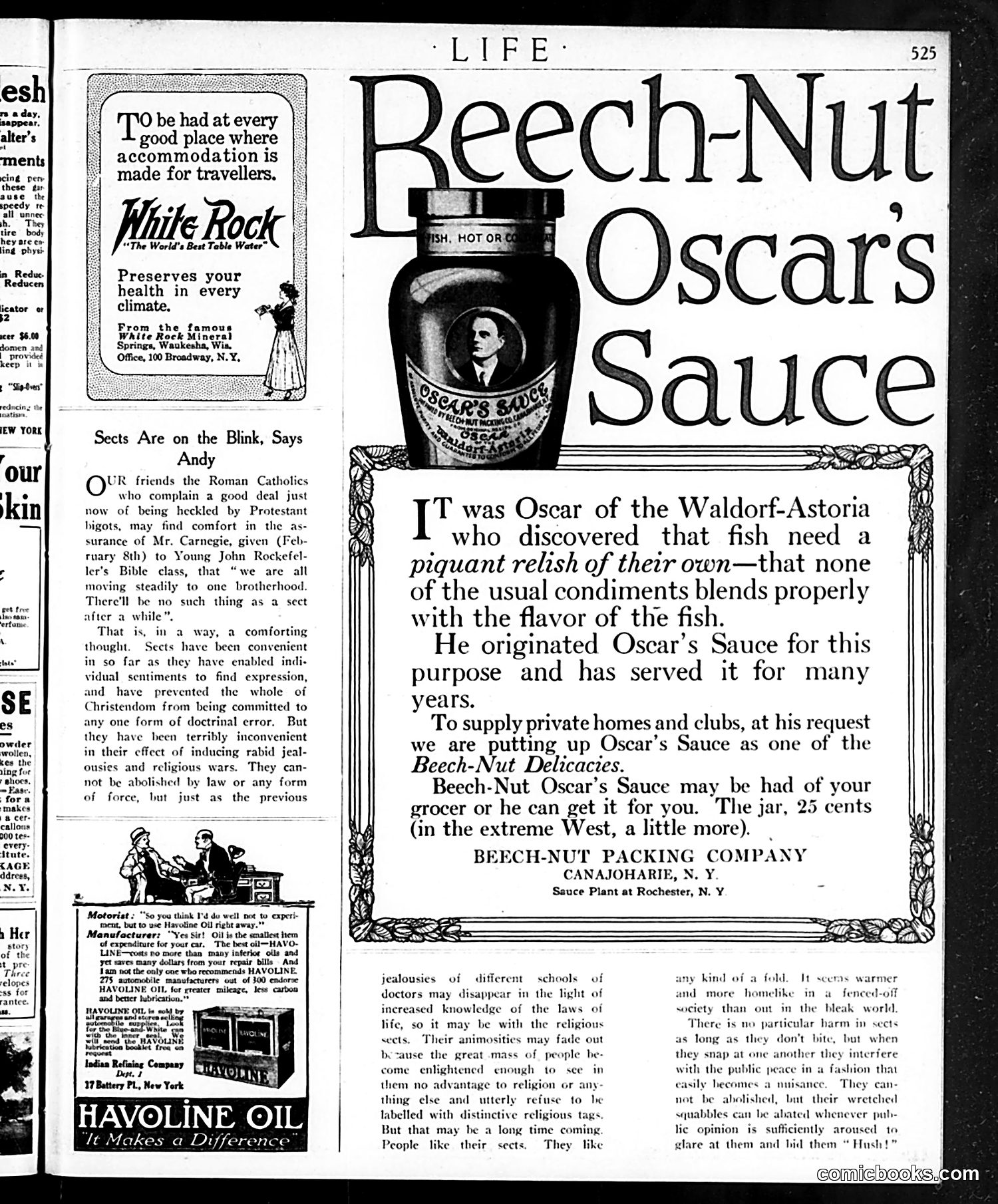
This page contains primarily **advertisements** rather than political satire. The main content includes: 1. **White Rock Mineral Springs ad** (top left): A straightforward product advertisement claiming health benefits. 2. **"Sects Are on the Blink, Says Andy"** (center): A brief commentary (not a cartoon) discussing religious sectarianism. The piece references Andrew Carnegie's 1911 statement predicting eventual religious unity, arguing that while sects have enabled individual expression, they've also caused "rabid jealousies and religious wars." The author suggests sects will naturally fade as people become "enlightened" rather than being abolished by force—a Progressive Era observation about religion's declining social divisiveness. 3. **Beech-Nut Oscar's Sauce ad** (large, right): An advertisement for a fish sauce, attributing its invention to "Oscar of the Waldorf-Astoria" hotel. 4. **Havoline Oil ad** (bottom): A motor oil advertisement featuring a dialogue between a motorist and manufacturer. The page is primarily commercial rather than satirical.
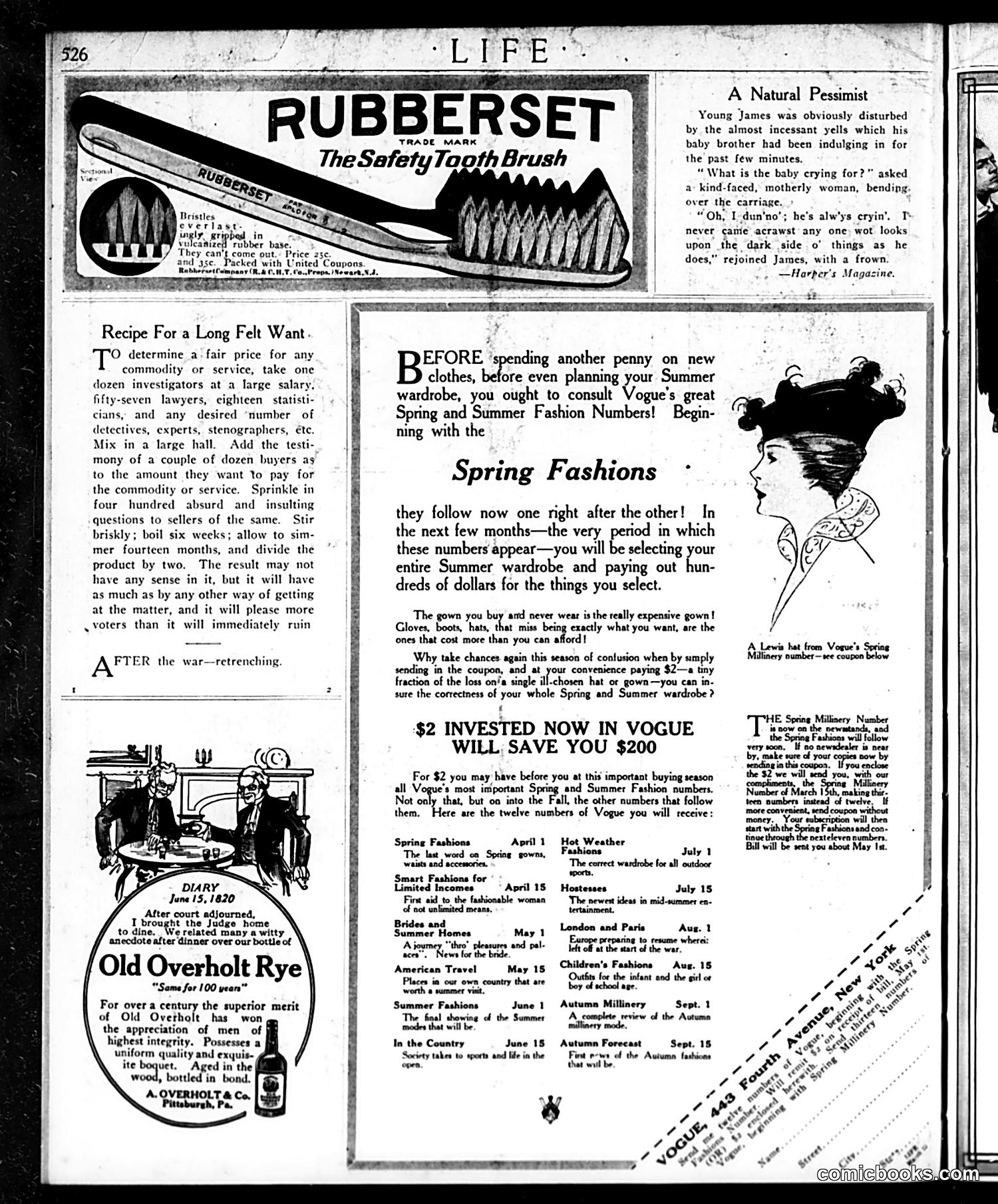
This Life magazine page (page 526) contains three distinct elements: **"A Natural Pessimist" (top right):** A brief humorous anecdote where young James, annoyed by his baby brother's constant crying, tells a sympathetic woman that the infant "always cries" and that he "never came across any one wot looks upon the dark side o' things as he does." The joke is James's ironic self-description—he's the pessimist, not realizing his own gloomy outlook mirrors what he criticizes in the baby. **"Recipe for a Long Felt Want" (left):** Post-WWI satire mocking government price-fixing efforts. It suggests determining fair prices by assembling expensive investigators, lawyers, and statisticians, then collecting contradictory buyer testimony. The absurd process promises a result "as much sense in it...as by any other way" but will "please more voters than it will immediately ruin"—cynically suggesting bureaucratic solutions are arbitrary theater meant to appease the public. **Advertisements:** The page is largely advertising (Rubberset brushes, Old Overholt Rye whiskey, and Vogue magazine subscriptions), typical of Life's mixed content format.
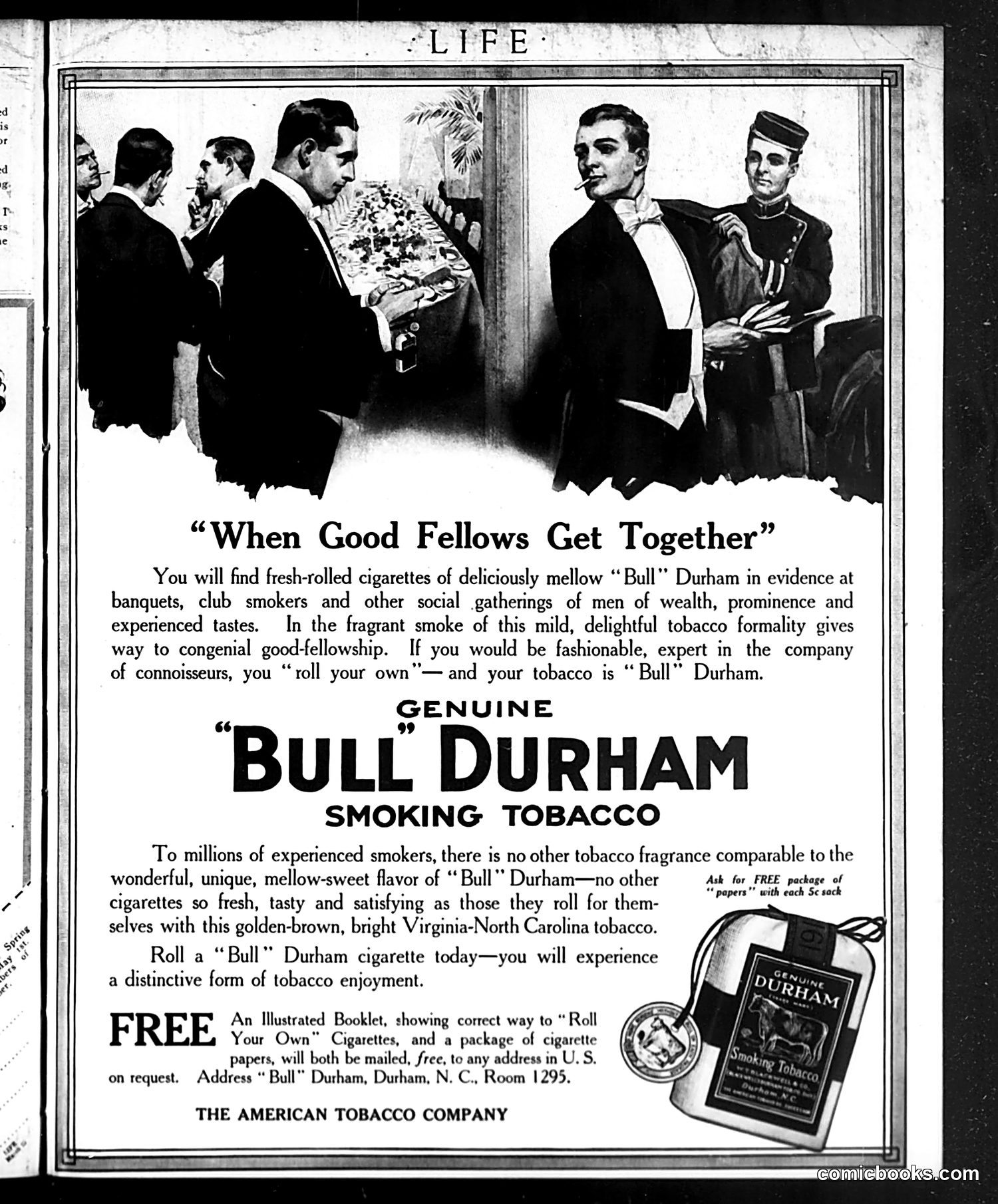
This is a **cigarette advertisement, not satire**—it's a straightforward commercial from *Life* magazine promoting Bull Durham rolling tobacco. The image depicts well-dressed gentlemen at an upscale social gathering, establishing the product's association with wealth and sophistication. The advertisement's strategy targets aspirational consumers by claiming that rolling your own cigarettes with Bull Durham is a marker of fashionable taste and social status among "men of wealth, prominence and experienced tastes." The product itself was roll-your-own tobacco—smokers would hand-roll cigarettes using papers provided with the tobacco. The ad emphasizes this DIY aspect as desirable, offering free instruction booklets and papers. By modern standards, the advertisement's claims about tobacco being "mild" and "delightful" appear absurd and misleading. The pitch that custom-rolled cigarettes represent connoisseurship would strike contemporary readers as quaint, if not darkly humorous, given what we now know about tobacco's dangers.
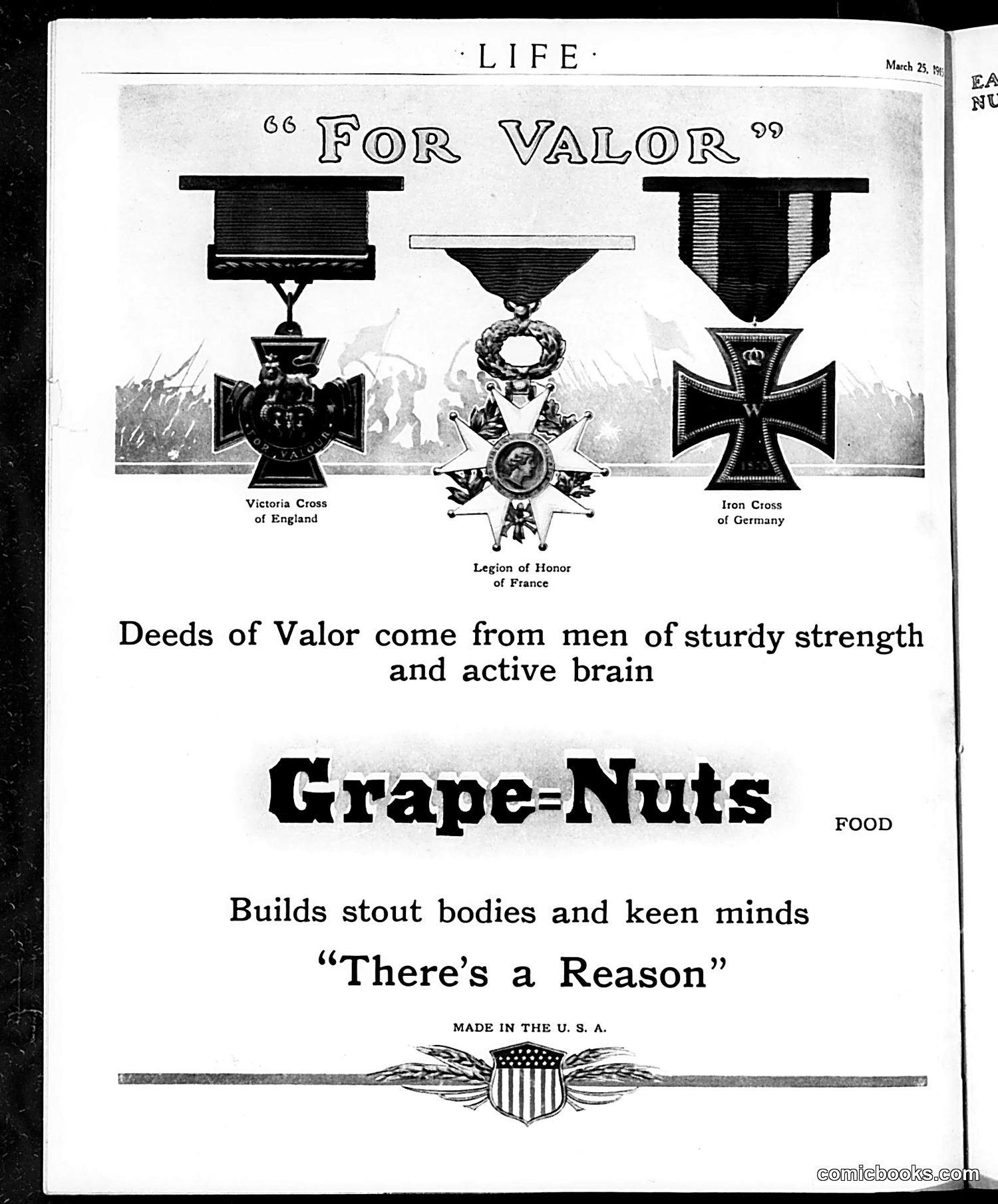
This is a World War I-era advertisement (circa 1915-1918) for Grape-Nuts cereal. It's not satire but rather patriotic marketing that capitalizes on wartime nationalism. The ad displays three Allied military decorations—Britain's Victoria Cross, France's Legion of Honor, and Germany's Iron Cross—positioned above the product. The tagline claims Grape-Nuts builds "stout bodies and keen minds" necessary for acts of valor, implying the cereal contributes to military heroism. The phrase "There's a Reason" references Grape-Nuts' famous advertising slogan. By associating the product with courage and military distinction, the ad attempts to sell breakfast cereal by linking it to patriotic duty and national pride. It's propaganda-tinged advertising that appeals to American consumers' wartime sentiments and desire to support the war effort through everyday consumption.