
Life, 1915-03-25 · page 26 of 44
Life — March 25, 1915 — page 26: what you’re looking at
What you’re looking at
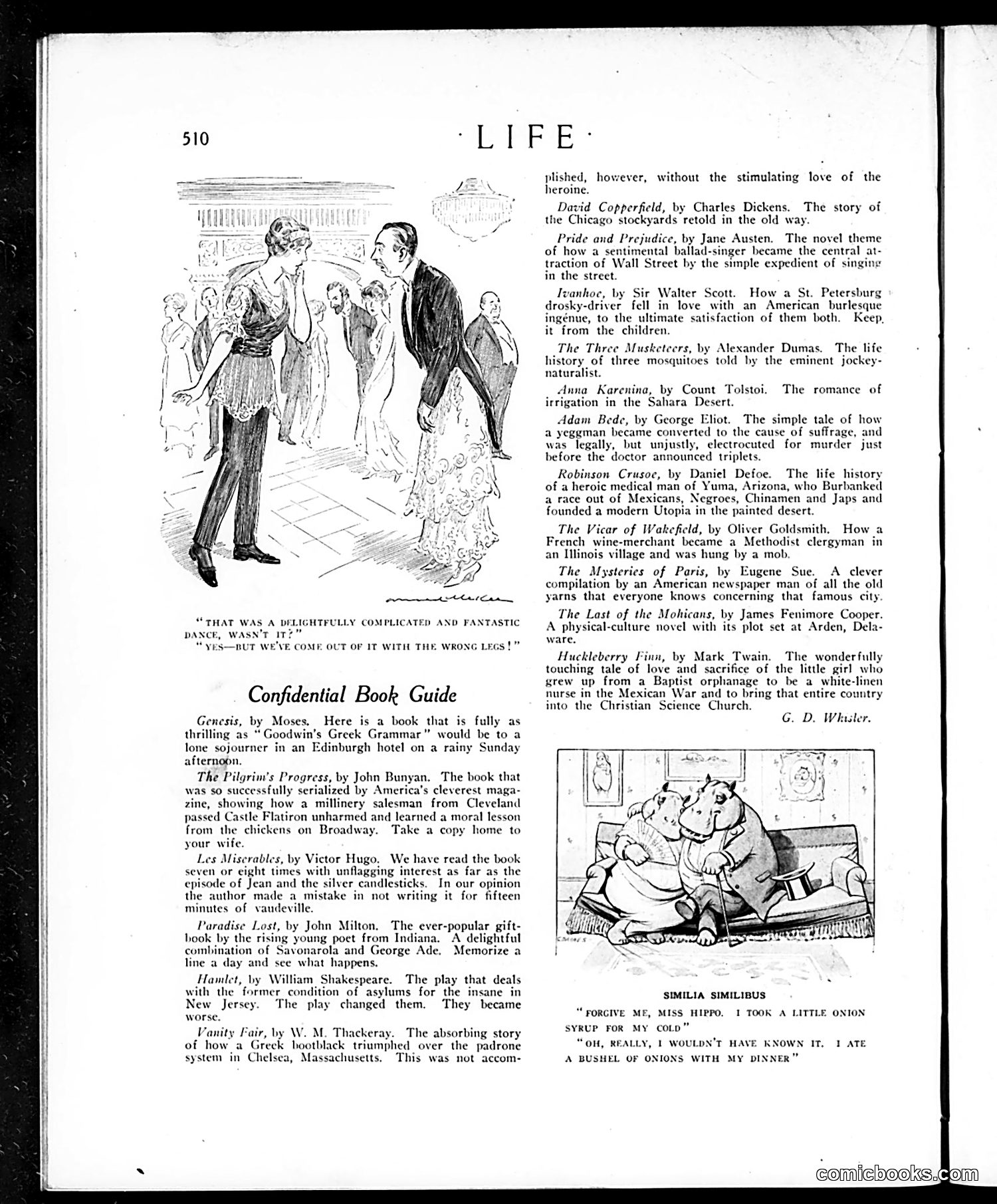
**Top Cartoon:** A couple exits a dance, with the woman remarking their dance was "delightfully complicated and fantastic," but they've "come out of it with the wrong legs!" This is a visual pun—the sketch shows them literally tangled or mismatched in their limbs, satirizing either dancing fads of the era or the general confusion of modern social life. **"Confidential Book Guide":** This is satirical literary criticism mocking famous classics by wildly misrepresenting their plots. Examples: *Genesis* compared to a Greek grammar book; *Les Misérables* claimed the author should have written only fifteen minutes for vaudeville; *Hamlet* described as about "former condition of asylums" in New Jersey. The humor targets both pretentious literary culture and readers unfamiliar with these works. **Bottom Cartoon ("Similia Similibus"):** A hippo tells Miss Hippo she needn't apologize for onion breath since the hippo ate "a bushel of onions with my dinner"—crude humor about offensive odors neutralizing each other.
📄 Transcribed text from this page (OCR, searchable)
Machine-transcribed from the original scan — historical spelling and the odd misread are preserved.
CRE “THAT WAS A DELIGHTFULLY COMPLICATED AND FANTASTIC DANCE, WASN'T IT? “ YES—RUT WE'VE COME OUT OF IT WITH THE WRONG LEGS!” Confidential Book Guide Genesis, by Moses. Here is a book that is fully as thrilling as “ Goodwin’s Greek Grammar” would be to a lone sojourner in an Edinburgh hotel on a rainy Sunday afternoon, The Pilgrim's Progress, by John Bunyan. The book that was so successfully alized by America’s cleverest maga- zine, showing how a millinery salesman from Cleveland passed Castle Flatiron unharmed and learned a moral lesson from the chickens on Broadway. Take a copy home to your wife. Les Miserables, by Victor Hugo, We have read the book seven or eight times with unflagging interest as far as the episode of Jean and the silver candlesticks. In our opinion the author made a mistake in not writing it for fifteen minutes of vaudeville. Paradise Lost, vy John Milton, The ever-popular gift hook by the rising young poet from Indiana. A delightful combination of Savonarola and George Ade. Memorize a line a day and see what happens. Hamlet, by William. Shakespeare. The play that deals with the former condition of asylums for the insane in New Jersey. The play changed them. They became worse. Vanity Fair, by WW. M. Thackeray. The absorbing story of how a Greck hootblack triumphed over the padrone system in Chelsea, Massachusetts, This was not accom- without the stimulating love of the plished, however, heroine. David Copperfield, by Charles Dickens. The story of the Chicago stockyards retold in the old way. Pride and Prejudice, by Jane Austen. The novel theme of how a sentimental bailad-singer became the central at- traction of Wall Street by the simple expedient of singing in the street. vanhoc, by Sir Walter Scott. How a St. Petersburg drosky-driver fell in love with an American burlesque ingénue, to the ultimate satisfaction of them both. Keep, it from the children. The Three Musketeers, by Alexander Dumas. The life history of three mosquitoes told by the eminent jockey- naturalist. dnna Karenina, by Count Tolstoi. The romance of irrigation in the Sahara Desert. Adam Bede, by George Eliot. The simple tale of how a yeggman became converted to the cause of suffrage, and was legally, but unjustly, electrocuted for murder just before the doctor announced triplets. Robinson Crusoe, by Daniel Defoe. The life history of a heroic medical man of Yuma, Arizona, who Burbanked a race out of Mexicans Chinamen and Japs and founded a modern Utopia in the painted desert. The Vicar of Wakefield, by Oliver Goldsmith, How a French wine-merchant became a Methodist clergyman in an Illinois village and was hung by a mob The Mysteries of Paris, by Eugene Sue. A clever compilation by an American newspaper man of all the old yarns that everyone knows concerning that famous city. The Last of the Mohicans, by James Fenimore Cooper. A physical-culture novel with its plot set at Arden, Dela- ware. Huckleberry Finn, by Mark Twain. The wonderfully touching tale of love and sacrifice of the little girl who grew up from a Baptist orphanage to be a white-linen nurse in the Mexican War and to bring that entire country into the Christian Science Church. . Whaster. SIMILIA SIMILIBUS MISS HIPPO. “FORGIVE ME, SYRUP FOR MY COLD “OH, REALLY, | WOULDN'T HAVE KNOWN IT, 1 ATE A BUSHEL OF ONIONS WITH MY DINNER” 1 TOOK A LITTLE ONION