
Life, 1915-03-25 · page 21 of 44
Life — March 25, 1915 — page 21: what you’re looking at
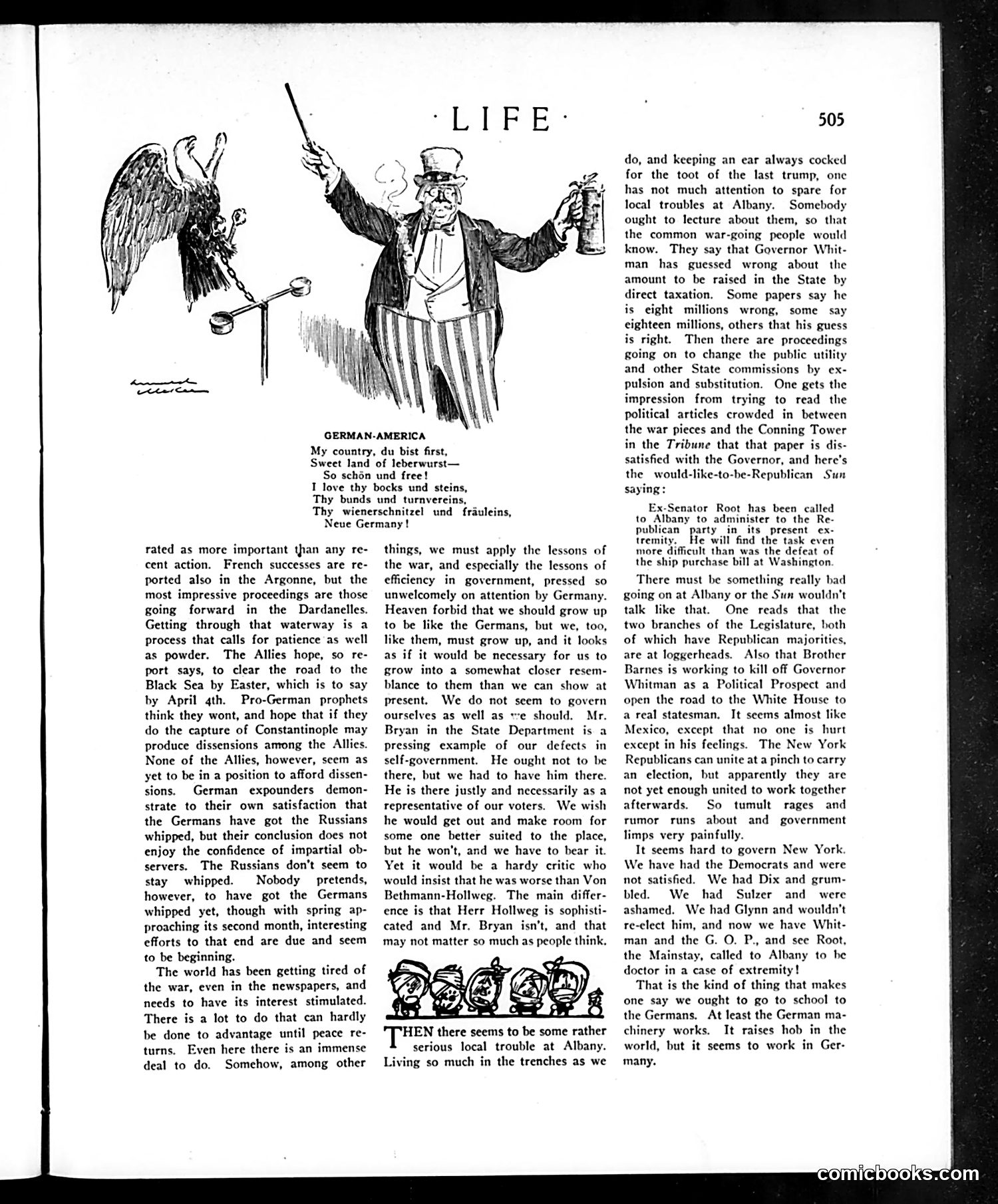
What you’re looking at
This cartoon satirizes German-American identity during World War I. The figure on the left depicts "German-America"—a personified character with exaggerated Germanic features singing a parody of "America" that replaces patriotic sentiment with German cultural references (leberwurst, beer steins, turnvereins clubs, schnitzel, frauleins). The accompanying poem mocks the tension between German-American loyalty and American patriotism, suggesting that some German-Americans prioritize German culture over American interests. Given the 1915 date and wartime context, this reflects contemporary anxiety about German-American sympathies during WWI. The cartoon appears alongside editorial commentary criticizing governmental inefficiency and comparing American leaders unfavorably to German counterparts—ironically, while simultaneously mocking German-American allegiance. This captures Life magazine's satirical treatment of wartime divided loyalties and domestic political failings.
📄 Transcribed text from this page (OCR, searchable)
Machine-transcribed from the original scan — historical spelling and the odd misread are preserved.
GERMAN-AMERICA My country, du bist first, Sweet land of leberwurst— So schén und free! I love thy bocks und steins, Thy bunds und turnvereins, Thy wienerschnitzel und frauleins, Neue Germany! rated as more important than any re- cent action. French successes are re- ported also in the Argonne, but the most impressive proceedings are those going forward in the Dardanelles. Getting through that waterway is a process that calls for patience as well as powder. The Allies hope, so re- port says, to clear the road to the Black Sea by Easter, which is to say by April 4th. Pro-German prophets think they wont, and hope that if they do the capture of Constantinople may produce dissensions among the Allies. None of the Allies, however, seem as yet to be in a position to afford dissen- sions. German expounders demon- strate to their own satisfaction that the Germans have got the Russians whipped, but their conclusion does not enjoy the confidence of impartial ob- servers. The Russians don’t seem to stay whipped. Nobody _ pretends, however, to have got the Germans whipped yet, though with spring ap- proaching its second month, interesting efforts to that end are due and seem to be beginning. The world has been getting tired of the war, even in the newspapers, and needs to have its interest stimulated. There is a lot to do that can hardly be done to advantage until peace re- turns, Even here there is an immense deal to do. Somehow, among other things, we must apply the lessons of the war, and especially the lessons of efficiency in government, pressed so unwelcomely on attention by Germany. Heaven forbid that we should grow up to be like the Germans, but we, too, like them, must grow up, and it looks as if it would be necessary for us to grow into a somewhat closer resem- blance to them than we can show at present. We do not seem to govern ourselves as well as ve should. Mr. Bryan in the State Department is a pressing example of our defects in self-government. He ought not to be there, but we had to have him there. He is there justly and necessarily as a representative of our voters. We wish he would get out and make room for some one better suited to the place, but he won't, and we have to bear it. Yet it would be a hardy critic who would insist that he was worse than Von Bethmann-Hollweg. The main differ- ence is that Herr Hollweg is sophisti- cated and Mr. Bryan isn’t, and that may not matter so much as people think. HEN there seems to be some rather serious local trouble at Albany. Living so much in the trenches as we 505 do, and keeping an ear always cocked for the toot of the last trump, one has not much attention to spare for local troubles at Albany. Somebody ought to lecture about them, so that the common war-going people would know. They say that Governor Whit- man has guessed wrong about the amount to be raised in the State by direct taxation. Some papers say he is eight millions wrong, some say eighteen millions, others that his guess is right. Then there are proceedings going on to change the public utility and other State commissions by ex- pulsion and substitution. One gets the impression from trying to read the political articles crowded in between the war pieces and the Conning Tower in the Tribune that that paper is dis- satisfied with the Governor, and here's the would-like-to-be-Republican Sun saying: Ex-Senator Root has been called to Albany to administer to the Re- publican party in_ its present ex- tremity, He will find the task even more difficult than was the defeat of the ship purchase bill at Washington. There must be something really bad going on at Albany or the Sun wouldn't talk like that. One reads that the two branches of the Legislature, both of which have Republican majorities, are at loggerheads. Also that Brother Barnes is working to kill off Governor Whitman as a Political Prospect and open the road to the White House to a real statesman. It seems almost like Mexico, except that no one is hurt except in his feelings. The New York Republicans can unite at a pinch to carry an election, but apparently they are not yet enough united to work together afterwards. So tumult rages and rumor runs about and government limps very painfully. It seems hard to govern New York. We have had the Democrats and were not satisfied. We had Dix and grum- bled. We had Sulzer and were ashamed. We had Glynn and wouldn't re-elect him, and now we have Whit- man and the G. O. P., and see Root, the Mainstay, called to Albany to be doctor in a case of extremity! That is the kind of thing that makes one say we ought to go to school to the Germans. At least the German ma- chinery works. It raises hob in the world, but it seems to work in Ger- many.