
Life, 1915-03-25 · page 29 of 44
Life — March 25, 1915 — page 29: what you’re looking at
What you’re looking at
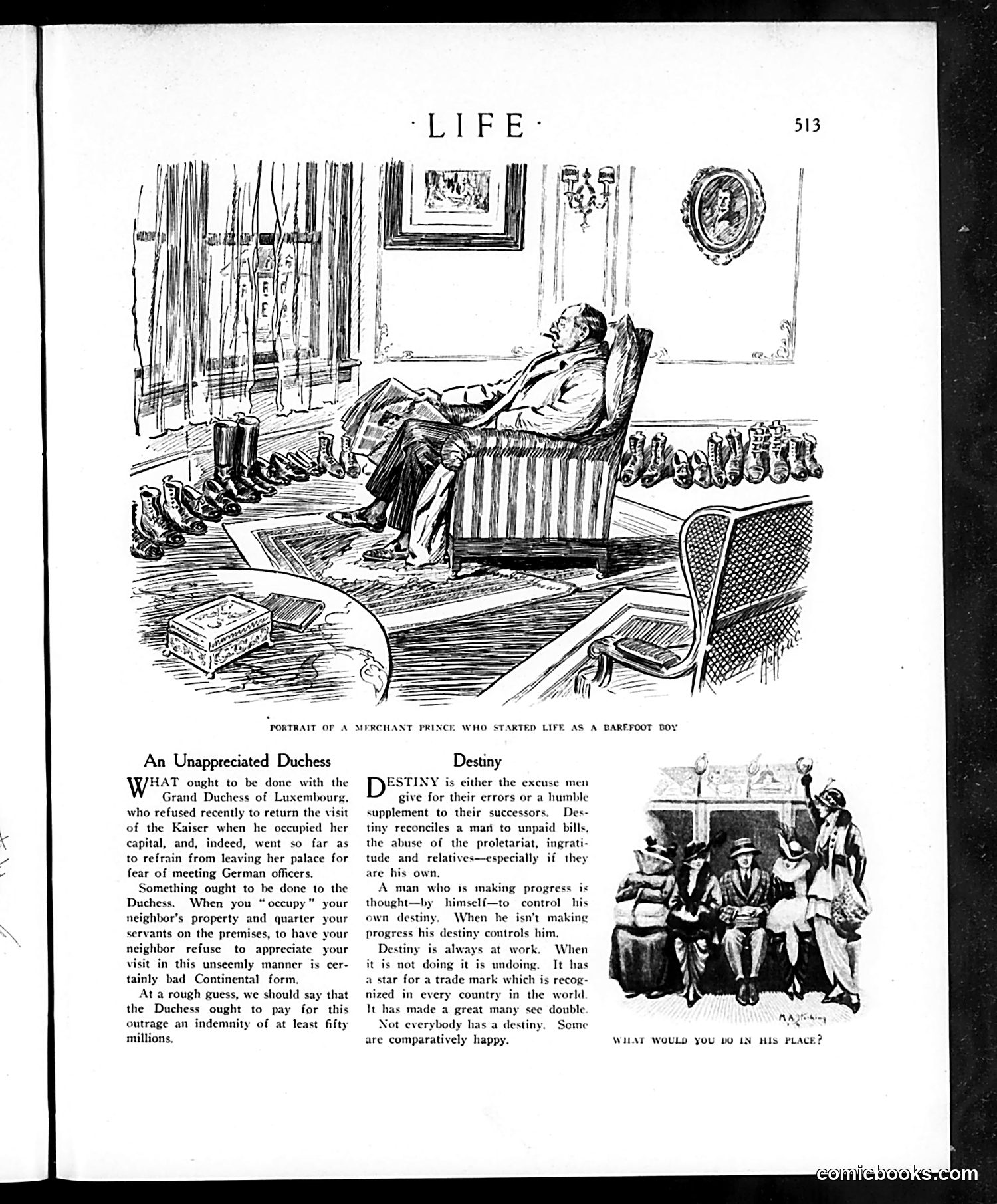
**Top Cartoon:** Satirizes the Grand Duchess of Luxembourg's refusal to visit the Kaiser during German occupation. The text mockingly suggests she owes Germany financial reparations ("fifty millions") for the "insult" of not appreciating the German occupation of her country. This is clearly ironic—Life attacks German imperial arrogance by sarcastically endorsing its absurd logic: occupying a neighbor's territory and then expecting gratitude. The cartoon critiques both German imperial presumption and, implicitly, continental power politics. **Bottom Section:** Two pieces—a philosophical essay on "Destiny" (justifying inequality through fatalism) and an illustration asking "What Would You Do In His Place?" accompanying a story titled "Portrait of a Merchant Prince Who Started Life as a Barefoot Boy" (depicting a wealthy man surrounded by shoes, suggesting his rise from poverty). The page juxtaposes political satire with aspirational Americana, typical of *Life* magazine's early 20th-century format.
📄 Transcribed text from this page (OCR, searchable)
Machine-transcribed from the original scan — historical spelling and the odd misread are preserved.
PORTRAIT OF A MPRCHANT PRINCE WHO STARTED LIFE AS A BAREFOOT BOY An Unappreciated Duchess wt ought to be done with the Grand Duchess of Luxembourg, who refused recently to return the visit of the Kaiser when he occupied her capital, and, indeed, went so far as to refrain from leaving her palace for fear of meeting German officers. Something ought to be done to the Duchess. When you “occupy” your neighbor’s property and quarter your servants on the premises, to have your neighbor refuse to appreciate your visit in this unseemly manner is cer- tainly bad Continental form. At a rough guess, we should say that the Duchess ought to pay for this outrage an indemnity of at least fifty millions. Destiny D TINY is either the excuse men give for their errors or a humble supplement to their successors. Des- tiny reconciles a man to unpaid bills, the abuse of the proletariat, ingrati- tude and relatives—especially if they are his own. A man who is making progress is thought—by himself—to control his own destiny. When he isn’t making progress his destiny controls him. Destiny is always at work. When it is not doing it is undoing. It has a star for a trade mark which is recog- nized in every country in the world It has made a great many see double. Not everybody has a destiny. Some are comparatively happy. WHAT WOULD YOU DO IN HIS PLACE?