
Life, 1915-03-25 · page 20 of 44
Life — March 25, 1915 — page 20: what you’re looking at
What you’re looking at
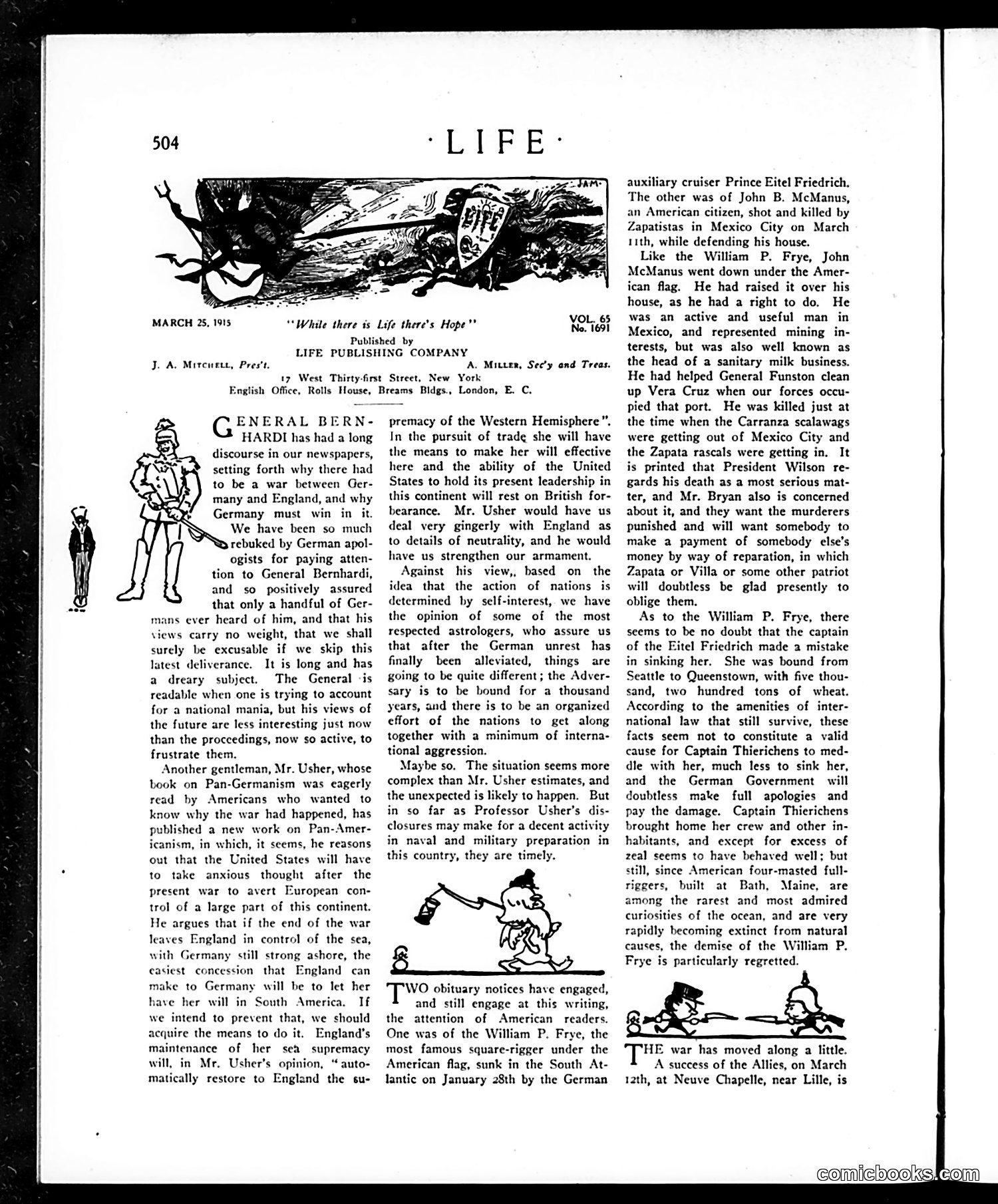
This page discusses American concerns about World War I's aftermath. The main article critiques General Bernhardi (a German military theorist) and engages with Mr. Usher's book on Pan-Germanism, which warned that if Britain controlled the seas post-war while Germany remained militarily strong, England might concede South America to Germany—threatening U.S. hemispheric dominance. The text sarcastically dismisses optimistic "astrologers" predicting post-war peace, instead supporting military preparedness. The obituaries memorialize two Americans killed under the U.S. flag: the *William P. Frye* (a famous merchant ship sunk by a German cruiser in January 1915) and John B. McManus (killed by Mexican Zapatistas). Both deaths symbolized American vulnerability—at sea and on land—during global instability, reinforcing arguments for stronger U.S. military capability before potential involvement in European conflict.
📄 Transcribed text from this page (OCR, searchable)
Machine-transcribed from the original scan — historical spelling and the odd misread are preserved.
MARCH 25, 1915 “While there is Life there's Hope" Published by LIFE PUBLISHING COMPANY J. A. Mircuett, Pres’t, A. Mutter, Sec’y and Treas. 17 West Thirty-first Street, New York English Office, Rolls House, ENERAL BERN- HARDI has had a long discourse in our newspapers, setting forth why there had to be a war between Ger- many and England, and why Germany must win in it. We have been so much rebuked by German apol- ogists for paying atten- tion to General Bernhardi, and so positively assured that only a handful of Ger- mans ever heard of him, and that his views carry no weight, that we shall surely be excusable if we skip this latest deliverance. It is long and has a dreary subject. The General -is readable when one is trying to account for a national mania, but his views of the future are less interesting just now than the proccedings, now so active, to frustrate them. Another gentleman, Mr. Usher, whose book on Pan-Germanism was eagerly read by Americans who wanted to know why the war had happened, has published a new work on Pan-Amer- icanism, in which, it seems, he reasons out that the United States will have to take anxious thought after the present war to avert European con- trol of a large part of this continent. He argues that if the end of the war leaves England in control of the sea, with Germany still strong ashore, the that England can make to Germany will be to let her have her will in South America. If we intend to prevent that, we should acquire the means to do it. England's maintenance of her sea supremacy will, in Mr. Usher's opinion, “ auto- matically restore to England the su- easiest concession Breams Bldgs, London, E. C. premacy of the Western Hemisphere”. In the pursuit of trade she will have the means to make her will effective here and the ability of the United States to hold its present leadership in this continent will rest on British for- bearance. Mr. Usher would have us deal very gingerly with England as to details of neutrality, and he would have us strengthen our armament. Against his view,, based on the idea that the action of nations is determined by self-interest, we have the opinion of some of the most respected astrologers, who assure us that after the German unrest has finally been alleviated, things are going to be quite different; the Adver- sary is to be bound for a thousand years, and there is to be an organized effort of the nations to get along together with a minimum of interna- tional aggression. Maybe so, The situation seems more complex than Mr. Usher estimates, and the unexpected is likely to happen. But in so far as Professor Usher's dis- closures may make for a decent activity in naval and military preparation in this country, they are timely. e ‘WO obituary notices have engaged, and still engage at this writing, the attention of American readers. One was of the William P. Frye, the most famous square-rigger under the American flag, sunk in the South At- lantic on January 28th by the German auxiliary cruiser Prince Eitel Friedrich. The other was of John B, McManus, an American citizen, shot and killed by Zapatistas in Mexico City on March 11th, while defending his house. Like the William P. Frye, John McManus went down under the Amer- ican flag. He had raised it over his house, as he had a right to do. He was an active and useful man in Mexico, and represented mining in- terests, but was also well known as the head of a sanitary milk business. He had helped General Funston clean up Vera Cruz when our forces occu- pied that port. He was killed just at the time when the Carranza scalawags were getting out of Mexico City and the Zapata rascals were getting in. It is printed that President Wilson re- gards his death as a most serious mat- ter, and Mr. Bryan also is concerned about it, and they want the murderers punished and will want somebody to make a payment of somebody else’s money by way of reparation, in which Zapata or Villa or some other patriot will doubtless be glad presently to oblige them, As to the William P. Frye, there seems to be no doubt that the captain of the Eitel Friedrich made a mistake in sinking her. She was bound from Seattle to Queenstown, with five thou- sand, two hundred tons of wheat. According to the amenities of inter- national law that still survive, these facts seem not to constitute a valid cause for Captain Thierichens to med- dle with her, much less to sink her, and the German Government will doubtless make full apologies and pay the damage. Captain Thierichens brought home her crew and other in- habitants, and except for excess of zeal seems to have behaved well; but still, since American four-masted full- riggers, built at Bath, Maine, are among the rarest and most admired curiosities of the ocean, and are very rapidly becoming extinct from natural causes, the demise of the William P. Frye is particularly regretted. THE war has moved along a little. A success of the Allies, on March 12th, at Neuve Chapelle, near Lille, is