
Life, 1915-03-25 · page 15 of 44
Life — March 25, 1915 — page 15: what you’re looking at
What you’re looking at
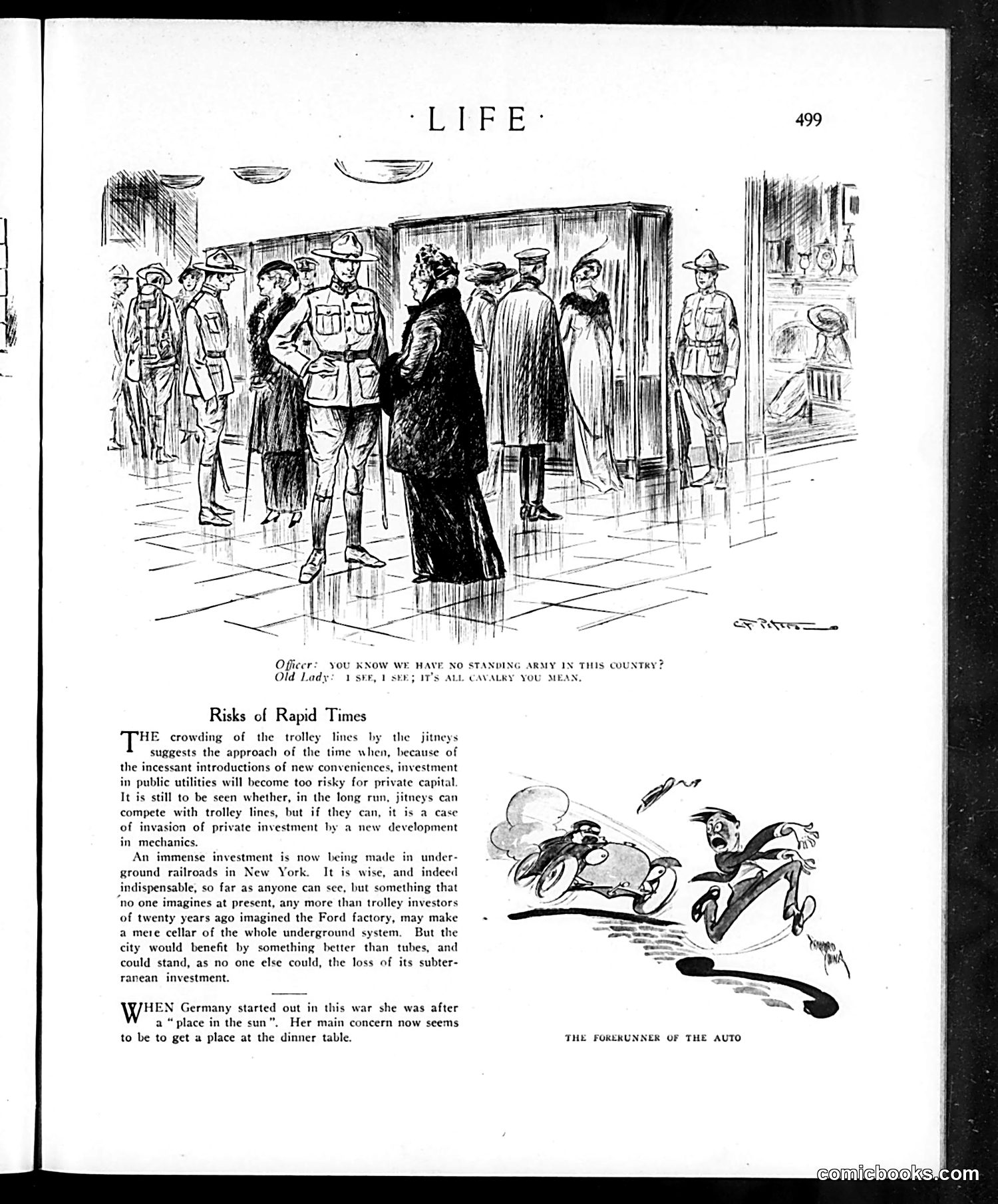
**Top Cartoon:** An officer confronts an elderly woman surrounded by soldiers in what appears to be a military inspection or gathering. The woman's confused response—claiming there's no "standing army" but "all cavalry"—is a joke about her misunderstanding or willful ignorance. She appears to be mocking the visible military presence by literally interpreting his words. **"Risks of Rapid Times" Article:** This discusses how new transportation technologies (jitneys—cheap shared automobiles) threaten established investments in trolley lines and utilities. The piece warns that rapid technological change may render massive infrastructure investments obsolete, citing the underground railroad system in New York as potentially vulnerable to future innovations. It's a prescient concern about disruptive technology. **"Forerunner of the Auto" Cartoon:** Shows motorcyclists on a road, captioned as the "forerunner" (predecessor) of automobiles—suggesting motorcycles represent an early stage of motorized personal transportation. **Germany Reference:** A brief satire on Germany's war aims, claiming their original goal of imperial expansion ("place in the sun") has been reduced to mere survival ("place at the dinner table").
📄 Transcribed text from this page (OCR, searchable)
Machine-transcribed from the original scan — historical spelling and the odd misread are preserved.
Officer: you KNOW WE HAVE NO STANDING ARMY IN THIS COUNTRY? Old Lady: 1 str, 1 SER; IT'S ALL CAVALRY YOU MEAN, Risks of Rapid Times HE crowding of the trolley lines by the jitneys suggests the approach of the time when, because of the incessant introductions of new conveniences, investment in public utilities will become too risky for private capital. It is still to be seen whether, in the long run, jitneys can compete with trolley lines, but if they can, it is a case of invasion of private investment by a new development in mechanics. An immense investment is now being made in under- ground railroads in New York. It is wise, and indeed indispensable, so far as anyone can see, but something that ‘no one imagines at present, any more than trolley investors of twenty years ago imagined the Ford factory, may make a mere cellar of the whole underground system. But the city would benefit by something better than tubes, and could stand, as no one else could, the loss of its subter- ranean investment. HEN Germany started out in this war she was after a “place in the sun". Her main concern now seems to be to get a place at the dinner table. THE FORERUNNER OF THE AUTO